
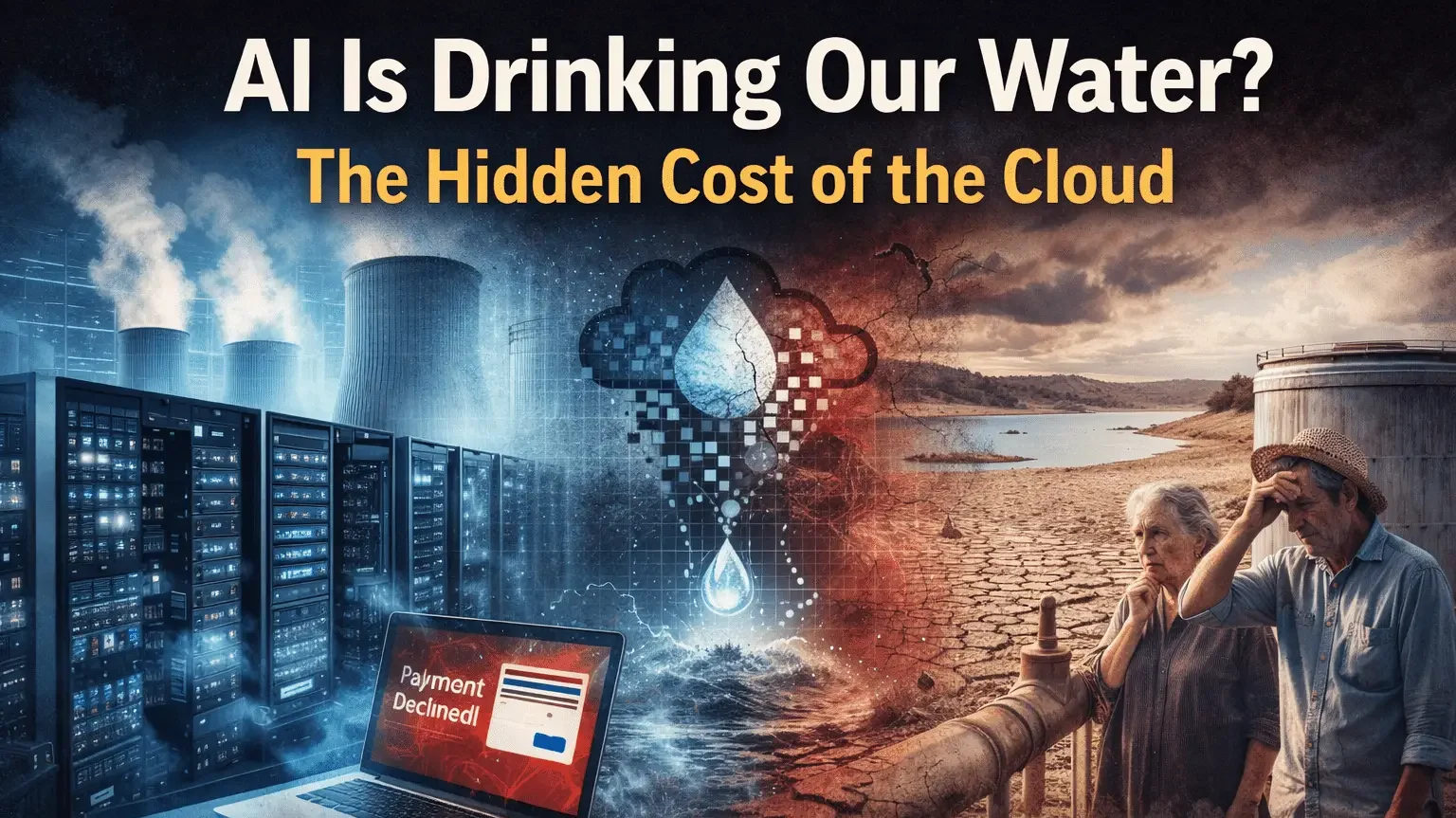
The digital age has long relied upon a brilliant, deeply deceptive metaphor: the “cloud.” The terminology inherently suggests something ethereal, weightless, and infinitely renewable—a benign, floating mist hovering high above the physical constraints of the terrestrial world. The objective reality, however, is starkly and brutally different. The cloud is not constructed of water vapor; it is forged from millions of square feet of poured concrete, thousands of miles of subterranean fiber-optic cables, arrays of silicon semiconductors, and, increasingly, staggering volumes of fresh, physical water.
As society hurtles headlong into the era of generative artificial intelligence (AI), the physical footprint of this digital revolution has become impossible to ignore. Behind the frictionless, magical interfaces of large language models (LLMs) like ChatGPT, Gemini, and Claude lies an industrial-scale consumption of natural resources. These systems require immense computational power, which generates intense, highly concentrated heat. That heat, in turn, demands massive, continuous cooling infrastructure to prevent catastrophic hardware failure. The result is a direct, uncompromising collision between the global technology sector’s ambitions for AI supremacy and a global climate crisis characterized by historic droughts, depleting aquifers, and rapidly aging public water infrastructure.
Objective analysis demands that situations be judged on right and wrong, independent of blind tribalism or anti-technology zealotry. Artificial intelligence holds undeniable promise for scientific advancement, medical breakthroughs, and economic efficiency. However, a sharp understanding of corporate human behavior—honed by years of observing corporate doubling-speak and sustainability public relations—reveals a system fundamentally out of balance. A critical ethical question must be confronted without corporate obfuscation: Should global technology giants be permitted to deplete local water tables during an era of unprecedented freshwater scarcity simply to power algorithms that generate digital text and synthetic imagery?
This comprehensive analysis pierces the veil of technological utopianism to examine the sheer physical cost of artificial intelligence. It investigates the corporate “water positive” pledges that frequently function as accounting shell games, explores the battlegrounds where local municipalities are fighting for their survival against hyperscale data centers, and interrogates the fundamental fairness of resource allocation in the twenty-first century.
The Anatomy of AI’s Thirst: Thermodynamics and the Illusion of the Ethereal
To comprehend the scale of the impending crisis, one must first understand the strict mechanical and thermodynamic reality of how artificial intelligence consumes water. AI’s thirst is not a software bug or a temporary inefficiency; it is a fundamental thermodynamic requirement of the physical hardware that powers it.
Data centers, the warehouse-sized facilities that house the servers required for cloud computing and AI, are the beating physical hearts of the internet. Inside these highly secure facilities, vast halls are filled with identical rows of computer servers arranged in specialized, highly engineered aisles. The configuration typically involves a “cold aisle,” where the server draws in chilled air, and a “hot aisle,” where the exhaust heat is forcefully vented.1 As the computing density of these servers increases—particularly with the advent of advanced Graphics Processing Units (GPUs) required for AI training and inference workloads—the heat generated becomes extreme. Without continuous, aggressive cooling, these multimillion-dollar silicon chips would literally melt down within minutes.2
Cooling these sprawling facilities relies primarily on two distinct mechanisms, which correspond directly to the two distinct ways the artificial intelligence ecosystem consumes water: Scope 1 and Scope 2.3 Understanding the distinction between the two is vital for piercing the rhetoric of corporate sustainability reports.
Scope 1: Direct On-Site Evaporation and Local Depletion
Scope 1 water usage refers to the direct, on-site consumption of water used to cool the physical servers within the data center. The most common and cost-effective technology deployed in large hyperscale data centers is evaporative cooling. In these systems, hot air from the server racks is passed through a heat exchanger, and water is actively evaporated to lower the temperature of the air before it is recirculated. This process relies on massive external cooling towers that consume staggering amounts of clean, fresh water.3
It is crucial in this context to differentiate between water withdrawal and water consumption. While some data centers utilize closed-loop systems where water is merely withdrawn, circulated, and returned to a source, “consumption” refers to the water that is permanently lost to the local watershed—usually because it is evaporated directly into the atmosphere to produce cold air.4
The raw numbers associated with this evaporation are staggering. For example, academic research indicates that training the GPT-3 language model in Microsoft’s state-of-the-art United States data centers directly evaporated an estimated 700,000 liters of clean freshwater. To place this abstract number into a tangible perspective, this is enough freshwater to manufacture 320 Tesla electric vehicles or 370 BMWs.5 This consumption is highly dependent on local climate conditions; had that exact same algorithmic training occurred in Microsoft’s Asian data centers, the water consumption would have tripled due to higher ambient temperatures and humidity.5
Once a model is trained, it enters the “inference” phase, where it actively answers user prompts. A team of researchers from the University of California, Riverside, established that a simple, routine conversation consisting of 20 to 50 questions with an AI chatbot consumes roughly 500 milliliters of water—the equivalent of pouring out a standard plastic water bottle onto the ground.6
Scope 2: The Hidden Energy-Water Nexus
Scope 2 water usage represents the indirect, off-site water consumption associated with the generation of the electricity required to power the data center. Electricity generation is an inherently water-intensive industrial process. Thermoelectric power plants—whether powered by coal, natural gas, or nuclear energy—boil water to create high-pressure steam, which turns massive turbines to generate electricity. This process also utilizes cooling towers to condense the steam back into water, resulting in massive evaporative losses at the power plant itself.9
Generative AI requires exponentially more power than traditional digital computing. A standard Google search requires approximately 0.3 watt-hours of electricity. In stark contrast, a single query processed by a Large Language Model like ChatGPT requires roughly 2.9 watt-hours—nearly ten times the energy.8 If the 9 billion daily Google searches were suddenly handled entirely by generative AI, the global electricity demand would skyrocket to 10 terawatt-hours annually. This single shift in search behavior would be equivalent to the annual electricity consumption of 1.5 million European citizens.8
This exponential leap in energy demand inherently triggers a parallel, inescapable leap in Scope 2 water consumption. Every megawatt-hour of electricity drawn from a traditional grid carries a hidden “embedded” water cost. Therefore, even if a data center claims to use “zero water” on-site for cooling, its massive electricity draw is silently evaporating millions of gallons of water at a power plant hundreds of miles away.9
The Scale of the Thirst
When combining Scope 1 and Scope 2 impacts, the global trajectory of AI water consumption becomes a matter of grave ecological concern. Scaled globally, projections by recent United States data center energy reports predict that global AI demand will account for 4.2 to 6.6 billion cubic meters of water withdrawal by the year 2027. This volume is greater than the total annual water withdrawal of four to six nations the size of Denmark.12
To provide contextual clarity on how digital activities translate into physical resource depletion, the table below illustrates the relative water footprint of various activities. This data demonstrates how hidden “embedded” water and power generation contribute to the overall environmental impact.
| Activity | Direct Usage (Scope 1) | Power Usage (Scope 2) | Embedded Water | Total “Out of Basin” Transfer |
| 30 Mins AI Use | 0.028 L (Cooling) | 0.458 L | ~7 L | 10% |
| 30 Mins Smartphone | 0.02 L (Cooling) | 0.062 L | ~2.2 L | 9% |
| Cup of Coffee | 0.25 L | 0.065 L | 190 L | 85% |
Source: GWI analysis of hyperscale operations, power generation impacts, and embedded life-cycle manufacturing footprints.14
While defenders of the technology sector are quick to point out that AI’s total water usage remains smaller than global agricultural demands, this defense entirely misses the point. Agricultural water use is spread across vast geographic areas. Data centers, conversely, represent a hyper-concentrated, massive strain on specific, localized municipal watersheds. They are industrial behemoths dropped into suburban neighborhoods and arid deserts, completely overwhelming the carrying capacity of the local environment.
The Corporate Shell Game: Deconstructing “Water Positive” Accounting
Facing mounting public scrutiny, investigative journalism, and utility resistance regarding their environmental impacts, the world’s largest hyperscalers—Microsoft, Google, Meta, and Amazon Web Services (AWS)—have launched aggressive, highly polished public relations campaigns. The cornerstone of these campaigns is a pledge to become “Water Positive.”
Microsoft pledged in 2020 that by 2030 it would become “water positive,” meaning the company intends to replenish more water than it consumes across its direct operations worldwide.15 Google made a nearly identical commitment in 2021, setting a target to replenish 120% of the freshwater volume it consumes across its offices and data centers by 2030.17 Meta and AWS have followed suit with comparable corporate pledges.11
On the surface, to the casual observer, these commitments appear to reflect robust corporate citizenship and deep ecological empathy. However, a rigorous, objective examination of the underlying accounting methodologies reveals a systemic “shell game.” This framework is seemingly designed to placate local regulators and concerned communities while allowing the unchecked, exponential expansion of hyperscale infrastructure. A sharp understanding of corporate behavioral patterns reveals how highly selective metrics are utilized to construct an illusion of sustainability.
The Geographic Mismatch of Water Replenishment
The primary, fatal deception of the “water positive” framework lies in its absolute disregard for geographic and hydrologic reality. Water, unlike carbon dioxide, is a strictly localized resource. If a multinational corporation emits a ton of carbon dioxide from a factory in Nevada and offsets it by funding the planting of a forest in Brazil, the global atmospheric ledger mathematically balances. Water does not, and cannot, behave this way.
If a data center withdraws millions of gallons of water from a severely depleted, drought-stricken aquifer in Arizona, the local community suffers an immediate, physical, and highly localized loss. To offset this extraction, a tech giant might fund a project that repairs leaking municipal pipes in Farmington, New Mexico, or restores watershed oxbow wetlands in Des Moines, Iowa.19 The corporation then claims a “volumetric water benefit” on its global sustainability report, allowing its executives to declare progress toward the “water positive” goal.4
This accounting maneuver provides zero physical relief to the residents of the original depleted basin. Pumping an aquifer dry in the American Southwest is not physically or morally mitigated by funding an agricultural app for farmers in Chile to measure soil moisture, or reviving traditional chinampas wetland agriculture in Mexico City.23 The corporate spreadsheet ledger may balance perfectly, but the local water table does not.
This practice essentially treats water as a fungible global asset—a deeply flawed, highly corporatized premise that prioritizes optical sustainability over localized human survival. As water governance experts have pointed out, if these corporations were genuinely serious about water stewardship, they would throw their immense lobbying and financial clout behind improving local water governance, securing safe drinking water rights, and funding direct infrastructure improvements within the exact basins they are exploiting.24
The Deliberate Omission of Scope 2 and Creative Carbon Accounting
A secondary, equally glaring critique of corporate water pledges is the convenient, systematic omission of Scope 2 water consumption. When hyperscalers calculate their path to becoming “water positive,” they routinely exclude the massive volumes of water evaporated by the power plants generating their electricity.11
A recent analysis revealed that AWS, despite proudly claiming to be 41% of the way toward its “water positive” goal, does not account for the water consumed in the generation of the electricity used to power its facilities.11 Even when relying strictly on their own highly curated metrics and ignoring Scope 2 entirely, AWS conserves roughly 4 gallons of water for every 10 gallons it directly consumes.11
Furthermore, overall emissions and water usage are frequently obscured through market-based accounting tricks. A company might purchase Renewable Energy Credits (RECs) to publicly claim its operations are “100% powered by renewable energy.” However, the physical reality is that the local data center is still drawing base-load power from the local, often fossil-fuel-heavy grid. An in-depth analysis by The Guardian indicated that actual emissions from data centers owned by Google, Microsoft, Meta, and Apple were likely 7.62 times greater (or 662% higher) than officially reported between 2020 and 2022 due to these creative accounting practices.8
As one observer brilliantly noted, using market-based accounting to offset local, physical consumption is “the corporate equivalent of claiming you’ve gone vegetarian because you bought someone else’s salad”.25 It is an exercise in public relations, not environmental preservation.
To illustrate the sheer scale of the water being consumed—and hidden behind global averages—one must look at the specific footprints of individual data center campuses. The following table highlights the staggering consumption of Google’s top data centers in the United States, utilizing data sourced directly from Google’s 2024 Environment Report.
| Rank | Data Center Location | State | Potable Water Used in 2023 (Gallons) |
| 1 | Council Bluffs | Iowa | 980 Million |
| 2 | Mayes County | Oklahoma | 815 Million |
| 3 | Berkeley County | South Carolina | 763 Million |
| 4 | Douglas County | Georgia | 346 Million |
| 5 | Lenoir | North Carolina | 337 Million |
| 6 | The Dalles | Oregon | 302 Million |
| 7 | Montgomery County | Tennessee | 289 Million |
| 8 | Leesburg | Virginia | 173 Million |
Source: Visual Capitalist mapping of Google’s 2024 Environment Report data. Notably, all 980 million gallons consumed in Council Bluffs, Iowa, were potable, drinking-grade water.26
These astronomical figures represent only a single corporation’s footprint. To understand the true human and political cost of this consumption, it is necessary to examine the physical battlegrounds where these facilities are being constructed.
Case Study I: Omertà in Oregon and the Weaponization of Secrecy
To truly understand the tangible, escalating friction between hyperscale AI developers and local communities, one must examine The Dalles, a picturesque city situated along the Columbia River in northern Oregon. The Dalles serves as ground zero for the modern data center boom; Google opened its first owned-and-operated data center there in 2006, drawn by cheap hydroelectric power and abundant river water.27
For years, the actual volume of water consumed by Google’s massive cooling towers in The Dalles was treated as a highly classified, guarded state secret. When local investigative journalists from The Oregonian attempted to obtain public records regarding the tech giant’s water usage in September 2021, the city government—acting in lockstep alignment with Google—denied the requests. The city legally argued that Google’s water consumption constituted a “trade secret,” deliberately shielded from the state’s public records law.28 The justification provided was that competitors could theoretically reverse-engineer the water usage data to glean proprietary insights into Google’s advanced server cooling technology.28
When the Wasco County District Attorney ultimately rejected this absurd argument, determining that municipal water usage is fundamentally a matter of public record, and ordered the city to release the documents, the city of The Dalles took an extraordinary, anti-democratic step: it filed a lawsuit against The Oregonian to prevent the disclosure of the public records.29
Consider the profound hypocrisy of this action: a municipality utilized taxpayer resources to engage in protracted litigation against a local newspaper, solely to protect a trillion-dollar corporation’s right to obscure its consumption of a vital, communal natural resource. A company whose entire global empire is built on the premise of organizing the world’s information and making it universally accessible went to court to ensure its own environmental impact remained hidden in the dark.
The litigation dragged on for over a year before a settlement was finally reached in late 2022, forcing Google and the city to capitulate. The released records were staggering and entirely validated the community’s suspicions. The data revealed that Google’s annual water use in The Dalles had skyrocketed from 104 million gallons in 2012 to 434 million gallons in 2021—an astonishing 316% increase.31 By 2021, Google’s data centers were single-handedly consuming more than 25% of all the water used in the entire city.30
This revelation coincided with a highly controversial push by city officials, who were aggressively lobbying for federal legislation known as the “Dalles Watershed Development Act.” This bill proposed transferring 150 acres of the pristine Mount Hood National Forest to the city, allowing it to triple the size of its local reservoir.31 The city heavily draws its water from Dog River, a low-flowing stream that provides an essential, legally protected cold-water refuge for threatened fish populations migrating between freshwater rivers and the Pacific Ocean.31
Environmentalists and local residents rightfully noted the alarming, undeniable correlation: as Google’s industrial thirst nearly quadrupled, the city suddenly required federal forest land to drastically expand its water supply. While city officials claimed the expansion was strictly for residential growth, objective data showed the population of The Dalles had only increased by roughly 12% over the same period, bringing the total population to just 16,200 people.31
!(https://www.archdaily.com/283518/google-releases-never-before-seen-images-of-its-data-centers/google_dls_002) Plumes of steam rising above Google’s evaporative cooling towers in The Dalles, Oregon. When atmospheric conditions allow the vapor to be visible, massive volumes of fresh water can be seen being actively transferred from the municipal supply into the atmosphere. 34
The Dalles is not an isolated anomaly. Hyperscale developers systematically utilize Non-Disclosure Agreements (NDAs) to legally blindfold municipalities across the United States. From Kentucky to Indiana, economic development boards and city council members are routinely required to sign strict NDAs before they even know the identity of the tech firm proposing a mega-campus.36
In Franklin Township, Indiana, a local city-county councilor admitted to signing an NDA regarding a massive 468-acre data center proposed by an unnamed “Fortune 100 tech company”.37 In Saline Township, Michigan, the state Attorney General publicly blasted a utility hearing regarding a massive data center as a “sham that only gives the illusion of transparency” due to the intense secrecy surrounding the contracts.38 In Kentucky, residents were offered over $8 million to sell their land to AI data center companies, contingent upon signing NDAs that prevented them from discussing the project with their neighbors.36
This practice systematically strips citizens of their democratic right to assess the environmental impact of a project before it is legally and physically entrenched. Elected officials become beholden to private developers, creating an information vacuum where the public is unable to govern its own natural resources.39 The defense often cited by developers—that NDAs prevent land speculation—is a convenient smoke screen that effectively prevents democratic opposition until it is far too late to stop the bulldozers.
Case Study II: The Desert Mirage and Arizona’s Rebellion
While the Pacific Northwest grapples with forest reservoirs and algorithmic secrecy, the American Southwest is facing an existential, acute hydrological crisis. The Colorado River is shrinking, driven by prolonged megadroughts heavily exacerbated by climate change. Groundwater aquifers are running dangerously dry. The situation has become so dire that the Arizona state government has blocked home developers from building new residential subdivisions in fast-growing areas like Buckeye and Pinal County because they cannot provide statutory proof of an assured 100-year water supply.40
Amidst this severe, highly publicized scarcity, an unlikely industry has swarmed the desert: the hyperscale data center and semiconductor manufacturing sector. Arizona is now home to nearly 200 data centers and chip factories, operated by tech giants like Microsoft, Meta, and Taiwan Semiconductor Manufacturing Company (TSMC).40 The Phoenix metropolitan area currently hosts approximately 707 megawatts of IT capacity, ranking second only to Dallas nationwide.41
The political and social response to this influx has been sharply divided, illustrating the profound tension between economic opportunism and basic ecological survival.
In the fast-growing suburb of Buckeye, local leadership actively courted the tech industry. In 2024, a developer named Tract took over a stalled 2,000-acre residential project and converted it into a sprawling $20 billion data center complex.40 The mayor of Buckeye enthusiastically defended the project, arguing that the data centers would diversify the economy, add vital tax revenue, and, surprisingly, consume less water than the originally planned 2,000 homes.40
To bypass the state’s strict groundwater rules, developers rely on complex “groundwater offset” maneuvers. This entails purchasing extra Colorado River water allocations from other municipalities and letting that water seep into local aquifers to mathematically offset their massive withdrawals for cooling towers.40 This creates a bizarre scenario where tech companies are buying up agricultural water rights to cool servers in a desert where citizens are forbidden from building new homes.
However, just two hours south in Tucson, the public reaction was fiercely different. In the summer of 2024, residents discovered a clandestine proposal known as “Project Blue”—a $3.6 billion, 290-acre data center complex heavily linked to Amazon Web Services.43 Shrouded in the customary NDAs, the project advanced quietly until the Pima County Board of Supervisors approved a land sale of unincorporated county land.44
When the project subsequently required a vote from the Tucson City Council for annexation to access municipal water and build an 18-mile reclaimed water pipeline, the community revolted. Utilizing grassroots organizing and social media, a coalition named “No Desert Data Center” mobilized hundreds of citizens.43
In a profound display of direct democracy, residents flooded municipal meetings wearing red shirts, demanding an end to the project. Their rallying cry was definitive and uncompromising: “Not one drop for data”.43 The meetings stretched for over six hours, transforming from sleepy municipal governance into a full-throated rejection of extraction capitalism. Residents accurately pointed out the objective insanity of allocating a drought-stricken desert’s most precious resource to cool computer servers.
As one organizer, Luke Felix-Rose, testified to the county board, pointing directly to the inherent power imbalance at play: “I’m sorry I don’t represent a money fund, a private equity… The only wealth I have is the trust and support of the people. You let me know if that’s enough”.46
The intense, sustained public backlash successfully forced the Tucson City Council to reject the proposal in August 2024.47 However, demonstrating the relentless nature of hyperscale capital, the developer returned months later with a redesigned proposal featuring a “closed-loop” air-cooling system, intended to drastically slash water consumption and bypass the need for Tucson Water entirely.48
Yet, as local residents and environmental advocates quickly realized, this technological pivot simply created a new, equally dangerous crisis. Closed-loop and air-cooling systems require vastly more electricity to power the massive industrial fans and refrigeration units.48 By shifting to air cooling, the data center threatened to strain an already fragile desert power grid and hike utility rates for local taxpayers.44
The Arizona conflict perfectly encapsulates the fundamental flaw of situating data centers in water-stressed environments. The tech industry operates under the arrogant assumption that massive capital can indefinitely engineer its way out of hard biological constraints. But in a desert ecosystem, every drop of water—or every megawatt of power—allocated to artificial intelligence is a resource stolen directly from the future of human habitation.
Case Study III: The Heartland Drain in West Des Moines
The physical footprint of AI is not restricted to coastal forests in Oregon or the arid deserts of the Southwest; it extends deep into the American agricultural heartland.
In a quiet suburb of Iowa, surrounded by cornfields, Microsoft quietly established the primary training ground for OpenAI’s most advanced models, including the breakthrough GPT-4.7 Iowa was selected by the tech giant for its cheap land, vast fiber-optic networks, relatively lax environmental oversight, and—crucially—its unhindered access to water from the watersheds of the Raccoon and Des Moines rivers.7
Building and training a behemoth algorithmic model like GPT-4 requires supercomputers analyzing patterns across trillions of parameters for months on end. This relentless, uninterrupted computation generates immense heat. To prevent hardware failure, Microsoft’s massive data center complexes in West Des Moines pumped colossal volumes of water into evaporative cooling towers outside its warehouse-sized buildings.7
By July 2022, local utility officials noticed an alarming, unsustainable trend. The cluster of Microsoft facilities was actively consuming approximately 6% of the entire West Des Moines monthly water supply.51 Data showed that during the peak summer months, Microsoft’s facilities consumed over 48.7 million gallons of water purely for evaporative cooling.52
This massive industrial drain occurred concurrently with regional droughts that were severely testing Iowa’s vital aquifers. Local farmers, food processors, and ethanol producers were being forced to drill deeper wells, with some operating at merely 20% of their historical capacity due to a lack of aquifer recharge.53 The juxtaposition was jarring: while Iowa farmers struggled to water crops that feed the nation, a tech giant was evaporating millions of gallons of water to teach a machine how to mimic human writing.7
Faced with a direct, mathematical threat to the long-term municipal water supply of 26,000 residential accounts, the local utility, West Des Moines Water Works, took unprecedented action. Recognizing that state and federal legislators were entirely unprepared for the sheer scale of AI’s resource consumption, the municipal utility stepped into the regulatory void to protect its citizens.51
The utility formalized a memorandum of understanding (MOU) with the city, inserting a hardline, non-negotiable clause: Microsoft would only be granted permits for future data center expansions if the corporation definitively reduced its peak water usage.51
This localized, fierce pressure successfully forced Microsoft’s hand. To secure the zoning rights for its sixth mega-campus in the area, the tech giant was compelled to commit to zero-water cooling systems in all new West Des Moines facilities starting in 2024.51
The Iowa case study demonstrates a vital truth: hyperscalers will exploit cheap, abundant resources until they are physically or legally stopped by local resistance. Microsoft’s own former director of water strategy, Priscilla Johnson, summarized the corporate mindset bluntly: “Energy was more the focus because it was more expensive… Water was too cheap to be prioritized”.55 It required the courage of a local municipal water board to force a trillion-dollar company to implement sustainable engineering practices that it possessed the capital and technology to deploy all along, but actively chose not to due to profit margins.
The Legal Void and the Redefinition of “Beneficial Use”
The escalating, nationwide conflict between hyperscale AI facilities and local communities exposes a massive, gaping void in American environmental regulation and property law. Western water rights have historically been governed by the Doctrine of Prior Appropriation, colloquially known as “first in time, first in right.” A critical, foundational pillar of this legal doctrine is that water must be put to a “beneficial use,” and the waste of water is strictly prohibited by state constitutions.56
Historically, state statutes and courts have defined “beneficial use” as activities inherently necessary for human survival, civic stability, and tangible economic production: agriculture, municipal drinking water, sanitation, and physical industrial manufacturing.57 But the advent of the hyperscale data center introduces a profound philosophical and legal dilemma that the courts have yet to resolve: Does the evaporation of billions of gallons of potable drinking water to generate algorithmic chatbots, deepfake imagery, and targeted advertising constitute a “beneficial use” equivalent to growing food or hydrating a populace?
Under the strict scrutiny of objective fairness and human empathy, the answer must be an unequivocal no. Yet, antiquated water laws have not caught up to this digital reality. Because tech giants purchase land with existing, grandfathered water rights or simply hook into municipal utility supplies as standard commercial consumers, their massive withdrawals remain legally protected. They exploit a loophole in a legal framework designed for 19th-century pioneers, applying it to 21st-century server farms.
The Legislative Awakening
However, a legislative awakening is finally beginning to occur. Lawmakers across the country are recognizing that data centers are not standard industrial consumers; they are unique, hyper-intensive resource sinks that threaten both grid reliability and water security.58 The era of unquestioned tech expansion is facing its first real regulatory friction.
In Oregon, lawmakers introduced House Bill 3546, known as the POWER Act (Protecting Oregonians With Energy Responsibility).59 This legislation creates a new classification specifically for data centers, cryptocurrency miners, and other large industrial users drawing more than 20 megawatts of power. The act demands that these entities pay their fair share to upgrade local grids, preventing the utilities from saddling everyday residential ratepayers with the infrastructure costs caused by tech expansion.60
Other states are taking direct aim at the water itself. California, Iowa, and Michigan are currently considering bills that would legally strip away the veil of NDA secrecy, mandating operators to submit public, unredacted monthly reports on their precise water and energy consumption to state agencies.61
South Carolina and Kansas are exploring aggressive mandates that would go a step further, exploring regulations that would legally prohibit data centers from using evaporative cooling entirely, forcing them to adopt closed-loop technologies regardless of the capital cost.61 Georgia, recognizing the subversion of democracy seen in places like The Dalles and Indiana, is advancing legislation to explicitly prohibit local governments from signing Non-Disclosure Agreements with data center operators regarding energy and water usage.61
These legislative efforts represent the necessary reassertion of the rule of law over corporate entitlement. Transparency cannot be an optional courtesy extended by tech billionaires; it must be a rigid legal requirement. If a corporation wishes to utilize a limited public resource to generate private profit, the public possesses an inalienable right to audit, question, and restrict that usage.
The Technological Paradox: Liquid Cooling vs. The Energy Grid
In response to the growing public backlash, utility ultimatums, and impending legislation, hyperscalers are heavily promoting a pivot in their engineering strategies. Microsoft, Google, and Meta have increasingly highlighted their transition away from traditional evaporative cooling towers toward air-cooling and advanced “direct-to-chip” closed-loop liquid cooling systems.54
A closed-loop system is highly effective at eliminating Scope 1 direct water consumption. Once the internal pipes are filled during the initial construction phase, a specialized dielectric fluid or treated water continuously circulates, drawing heat directly off the GPUs and transferring it to a heat exchanger without evaporating into the atmosphere.54 Microsoft recently published life-cycle assessment data suggesting that cold plate cooling could reduce direct water consumption by 30 to 50 percent.63
However, this technological pivot masks a severe, inescapable thermodynamic paradox: minimizing water usage inevitably maximizes energy usage.
Air-cooling and closed-loop refrigeration systems require massive industrial compressors, chillers, and fans to operate effectively, especially in the sweltering heat of environments like Phoenix, Arizona, or Midlothian, Texas. When a data center shifts from water-based evaporative cooling to air cooling, its electricity demand skyrockets. According to industry estimates, an air-cooled data center can require up to 20% more total power to maintain the same server temperatures.49
This creates a vicious, circular transfer of environmental liability. By drastically increasing their electricity demand to power air chillers, these data centers place a much heavier burden on the local power grid. Because much of the United States power grid still relies heavily on water-intensive fossil fuel or nuclear plants, the tech companies are effectively reducing their Scope 1 direct water consumption by outsourcing it to the power plant’s Scope 2 consumption.9
As one environmental analysis starkly noted, shifting to cooling systems that require more electricity is merely another facet of the corporate “shell game”.9 The water is still being evaporated; it is simply evaporating from the smokestacks of a utility provider miles away, keeping the tech giant’s immediate hands clean on its sustainability report while the regional watershed continues to bleed.
The ultimate, objective solution is not merely shifting the burden back and forth between the local water table and the local electricity grid. The solution requires powering these advanced direct-to-chip systems exclusively with zero-carbon, zero-water renewable energy sources, such as wind and solar photovoltaics. Until hyperscalers are willing to delay their massive AI deployments until the requisite renewable grids are actually operational, their claims of sustainability remain hollow marketing exercises designed to appease shareholders rather than protect the environment.
Conclusion: A Moral Architecture for the Algorithmic Age
The narrative constructed by the global technology sector insists that artificial intelligence is an unparalleled public good—a necessary catalyst for scientific breakthrough, medical discovery, and unprecedented economic efficiency. While these benefits hold immense potential, they cannot be pursued in a physical vacuum. The hardware that manifests this synthetic intelligence exists in the real world, firmly bound by the unyielding laws of thermodynamics and localized hydrology.
A rigorous, objective assessment of the current landscape reveals a system fundamentally out of balance. Global corporations, driven by the frantic race for AI supremacy, are leveraging their immense capital to extract vital natural resources from vulnerable local municipalities. Through the weaponization of non-disclosure agreements, the deployment of highly deceptive “water positive” accounting tricks, and the exploitation of antiquated water laws, the industry has systematically prioritized the acceleration of algorithms over the sustainability of human habitats.
This dynamic represents a profound failure of fairness. It is deeply unethical for a desert community in Arizona to face residential building moratoriums due to groundwater depletion while an industrial data center next door quietly evaporates millions of gallons of potable water. It is unacceptable for a community in Oregon to face the loss of a protected national forest simply to ensure a tech giant’s servers remain optimal. It is a subversion of democracy when local city councilors are forced to sign NDAs that prevent citizens from knowing who is buying their land and draining their aquifers.
The path forward requires a new moral architecture for the digital age, codified through uncompromising legislation and a strict adherence to objective right and wrong.
First, absolute transparency must be mandated by federal and state law. The use of NDAs in the negotiation of public resource allocations must be universally banned. Communities cannot manage what they are legally forbidden to measure.
Second, the definition of “beneficial use” in water rights must be updated for the 21st century to establish a strict hierarchy of needs. During times of drought or municipal stress, human consumption, sanitation, and regional agriculture must definitively supersede the cooling requirements of commercial data centers. If a hyperscale facility cannot operate without threatening the local water table, it must be legally compelled to throttle its computing power or shut down until conditions improve.
Finally, the era of abstract corporate offset accounting must end. If a corporation extracts water from a specific basin, its mitigations and replenishments must occur within that exact basin. Purchasing renewable energy credits or funding a theoretical conservation project thousands of miles away does not replenish a dry well in a local farming community.
The cloud is heavy, hot, and fiercely thirsty. As society stands on the precipice of the AI revolution, it must assert a fundamental boundary: the pursuit of synthetic intelligence must never supersede the preservation of the biological world. Humanity cannot digitize water, and algorithms cannot generate a new earth. The rule of law must prevail to protect the physical realities of human survival from the insatiable demands of the digital future.
Works cited
- Thirsty for power and water, AI-crunching data centers sprout across the West, accessed on March 11, 2026, https://andthewest.stanford.edu/2025/thirsty-for-power-and-water-ai-crunching-data-centers-sprout-across-the-west/
- Building Community-First AI Infrastructure – Microsoft On the Issues, accessed on March 11, 2026, https://blogs.microsoft.com/on-the-issues/2026/01/13/community-first-ai-infrastructure/
- How much water does AI consume? The public deserves to know – OECD.AI, accessed on March 11, 2026, https://oecd.ai/en/wonk/how-much-water-does-ai-consume
- Governing Corporate Water Replenishment Programs Twelve Practical Tips and Lessons Learned | Bluerisk, accessed on March 11, 2026, https://blueriskintel.com/wp-content/uploads/2025/01/Governing-Corporate-Water-Replenishment-Programs.pdf
- Making AI Less “Thirsty”: Uncovering and Addressing the Secret Water Footprint of AI Models, accessed on March 11, 2026, https://www.deeprogram.org/library-v2/making-ai-less-thirsty-uncovering-and-addressing-the-secret-water-footprint-of-ai-models/RHJJKCL6
- Data Centers and Water Consumption | Article | EESI, accessed on March 11, 2026, https://www.eesi.org/articles/view/data-centers-and-water-consumption
- Artificial intelligence technology behind ChatGPT was built in Iowa — with a lot of water | AP News, accessed on March 11, 2026, https://apnews.com/article/chatgpt-gpt4-iowa-ai-water-consumption-microsoft-f551fde98083d17a7e8d904f8be822c4
- Environmental Impact of Generative AI | Stats & Facts for 2026 – The Sustainable Agency, accessed on March 11, 2026, https://thesustainableagency.com/blog/environmental-impact-of-generative-ai/
- Managing the Growing Water Needs of Data Centers, Critical Minerals Mining, and Agriculture in the Great Lakes Region, accessed on March 11, 2026, https://greatlakes.org/wp-content/uploads/2025/08/AGL_WaterUse_Report_Aug2025_Final.pdf
- Artificial intelligence and the environment: Putting the numbers into perspective, accessed on March 11, 2026, https://nationalcentreforai.jiscinvolve.org/wp/2025/05/02/artificial-intelligence-and-the-environment-putting-the-numbers-into-perspective/
- AWS data centres’ “water positive” pledge isn’t greenwashing, but it …, accessed on March 11, 2026, https://interface.media/blog/2024/09/02/aws-data-centres-water-positive-pledge-isnt-greenwashing-but-it-is-misleading/
- Making AI Less “Thirsty”: Uncovering and Addressing the … – arXiv, accessed on March 11, 2026, https://arxiv.org/pdf/2304.03271
- [2304.03271] Making AI Less “Thirsty”: Uncovering and Addressing the Secret Water Footprint of AI Models – arXiv, accessed on March 11, 2026, https://arxiv.org/abs/2304.03271
- Watering the New Economy | Xylem, accessed on March 11, 2026, https://amp.xylem.com/m/aa10f8022757c5e/original/Watering-the-New-Economy-DIGITAL-final.pdf
- Sustainability | Microsoft, accessed on March 11, 2026, https://www.microsoft.com/en-us/corporate-responsibility/sustainability
- Microsoft datacenters in Iowa, accessed on March 11, 2026, https://local.microsoft.com/wp-content/uploads/2024/04/Microsoft-datacenters-in-Iowa.pdf
- 2024 Google Water Stewardship Project Portfolio, accessed on March 11, 2026, https://sustainability.google/reports/2024-google-water-stewardship-project-portfolio/
- 2025 Google Water Stewardship Project Portfolio, accessed on March 11, 2026, https://sustainability.google/reports/2025-google-water-stewardship-project-portfolio/
- Water – Meta Sustainability, accessed on March 11, 2026, https://sustainability.atmeta.com/water/
- Iowa – Microsoft Local, accessed on March 11, 2026, https://local.microsoft.com/communities/americas/greater-des-moines/
- Water replenishment: Our learnings on the journey to water positive – Microsoft, accessed on March 11, 2026, https://cdn-dynmedia-1.microsoft.com/is/content/microsoftcorp/microsoft/msc/documents/presentations/CSR/Water-replenishment-learnings-on-journey-to-water.pdf
- A closer look at P&G’s ‘water positive’ pledge | Trellis, accessed on March 11, 2026, https://trellis.net/article/closer-look-pgs-water-positive-pledge/
- Water replenishment program | Microsoft CSR, accessed on March 11, 2026, https://www.microsoft.com/en-us/corporate-responsibility/sustainability/water-replenishment
- Corporations are pledging to be ‘water positive’. What does that mean? – The Guardian, accessed on March 11, 2026, https://www.theguardian.com/environment/2021/oct/14/water-positive-pledge-corporations
- Your Cloud Is Drying My River: The Real Cost of AI – SmarterArticles, accessed on March 11, 2026, https://smarterarticles.co.uk/your-cloud-is-drying-my-river-the-real-cost-of-ai
- Ranked: Google’s Thirstiest Data Centers – Visual Capitalist, accessed on March 11, 2026, https://www.visualcapitalist.com/mapped-googles-data-centers-water-use/
- The Dalles, Oregon – Google Data Center Location, accessed on March 11, 2026, https://datacenters.google/locations/oregon/
- City of TD Votes to Settle suit with The Oregonian – Columbia Community Connection, accessed on March 11, 2026, https://columbiacommunityconnection.com/the-dalles/city-votes-to-settle-suit-with-oregonian-reveal-google-water-usage
- City sues Oregonian to shield records about Google’s local water usage, accessed on March 11, 2026, https://www.rcfp.org/litigation/city-of-the-dalles-v-rogoway/
- Oregon’s city of The Dalles agrees to reveal Google’s local water usage – Reporters Committee for Freedom of the Press, accessed on March 11, 2026, https://www.rcfp.org/dalles-google-oregonian-settlement/
- The Dalles’ mayor called OPB’s data center story inaccurate. Here are the facts, accessed on March 11, 2026, https://www.opb.org/article/2026/01/23/the-dalles-mayor-data-center-google/
- The Oregonian exposes Google and Amazon’s massive water use for data centers, accessed on March 11, 2026, https://businessjournalism.org/2023/11/oregonian-data-centers/
- Officials spark backlash amid proposal to cede ownership of town’s water source near Google data center: ‘A direct contradiction to … public interest’ – The Cool Down, accessed on March 11, 2026, https://www.thecooldown.com/green-business/the-dalles-oregon-city-water-rights-forest/
- Gallery of Google Releases Never-Before-Seen Images of Its Data Centers – 6 – ArchDaily, accessed on March 11, 2026, https://www.archdaily.com/283518/google-releases-never-before-seen-images-of-its-data-centers/google_dls_002
- Google Releases Never-Before-Seen Images of Its Data Centers – fabric | rblg, accessed on March 11, 2026, https://blog.fabric.ch/index.php?/archives/2323-Google-Releases-Never-Before-Seen-Images-of-Its-Data-Centers.html
- Americans given NDAs from AI data center company – YouTube, accessed on March 11, 2026, https://www.youtube.com/watch?v=0TwA5ttBAhU
- How confidentiality agreements around a proposed data center could impact Indianapolis’ development – WFYI, accessed on March 11, 2026, https://www.wfyi.org/news/articles/how-confidentiality-agreements-around-a-proposed-data-center-could-impact-indianapolis-development
- Transparency, or “performative listening”: Why a public hearing on a Michigan data center is so controversial, accessed on March 11, 2026, https://www.michiganpublic.org/politics-government/2025-11-20/transparency-or-performative-why-a-public-hearing-on-a-michigan-data-center-is-so-controversial
- End NDAs for Elected Officials | Minnesota Center for Environmental Advocacy, accessed on March 11, 2026, https://www.mncenter.org/end-ndas-elected-officials
- Arizona’s water is drying up. That’s not stopping the data center rush. – Grist, accessed on March 11, 2026, https://grist.org/technology/arizona-water-data-centers-semiconducters/
- Are data centers depleting the Southwest’s resources? – APM Research Lab, accessed on March 11, 2026, https://www.apmresearchlab.org/10x/data-centers-resource
- Arizona water department defends new alternative to groundwater compliance, accessed on March 11, 2026, https://courthousenews.com/arizona-water-department-defends-new-alternative-to-groundwater-compliance/
- Third Act, accessed on March 11, 2026, https://thirdact.org/feed/
- ‘The city that draws the line’: one Arizona community’s fight against a huge datacenter, accessed on March 11, 2026, https://www.theguardian.com/us-news/2025/oct/15/tucson-arizona-ai-data-center-project-blue
- Community outrage shut down Project Blue data center project in Tucson — but it’s not dead yet – KJZZ, accessed on March 11, 2026, https://www.kjzz.org/community-outrage-shut-down-project-blue-data-center-project-in-tucson-but-its-not-dead-yet
- “Join Us or Face Consequences”: How Tucson’s Organizers Turned …, accessed on March 11, 2026, https://threesonorans.substack.com/p/join-us-or-face-consequences-how
- Tucson Council Rejects Project Blue – AZBEX, accessed on March 11, 2026, https://azbex.com/planning-development/tucson-council-rejects-project-blue/
- Tucson activists educate public as Project Blue returns, accessed on March 11, 2026, https://www.tucsonspotlight.org/tucson-activists-to-educate-public-as-project-blue-returns/
- In lieu of water cooling, Google locks down renewables for Mesa data center, accessed on March 11, 2026, https://www.latitudemedia.com/news/in-lieu-of-water-cooling-google-locks-down-renewables-for-mesa-data-center/
- How a small city in Iowa became an epicenter for advancing AI – Microsoft Source, accessed on March 11, 2026, https://news.microsoft.com/source/features/ai/west-des-moines-iowa-ai-supercomputer/
- From water to policing, Midwest cities take on AI … – Iowa Public Radio, accessed on March 11, 2026, https://www.iowapublicradio.org/ipr-news/2025-07-30/from-water-to-policing-midwest-cities-take-on-ai-with-few-guardrails
- Energy, water use under close watch as data centers expand in Iowa – Business Record, accessed on March 11, 2026, https://www.businessrecord.com/energy-water-use-under-close-watch-as-data-centers-expand-in-iowa/
- Iowa Grapples with Data Centers and Demand for Water – InformationWeek, accessed on March 11, 2026, https://www.informationweek.com/sustainability/iowa-grapples-with-data-centers-and-demand-for-water
- Sustainable by design: Next-generation datacenters consume zero water for cooling | The Microsoft Cloud Blog, accessed on March 11, 2026, https://www.microsoft.com/en-us/microsoft-cloud/blog/2024/12/09/sustainable-by-design-next-generation-datacenters-consume-zero-water-for-cooling/
- Microsoft’s internal records expose massive oversight in growing data center operations: ‘Very much an afterthought’ – The Cool Down, accessed on March 11, 2026, https://www.thecooldown.com/green-business/data-centers-water-usage-report-microsoft/
- old_Water Rights Data | Western States Water Council, accessed on March 11, 2026, https://westernstateswater.org/wade/old_water-rights-data/
- An Agricultural Law Research Article Beneficial Use, Waste, and Forfeiture: The Inefficient Search for Efficiency in Western Wat, accessed on March 11, 2026, http://nationalaglawcenter.org/wp-content/uploads/assets/bibarticles/neuman_forfeiture.pdf
- States Act to Align Data Center Energy Demand with Climate Goals, accessed on March 11, 2026, http://ncel.net/articles/states-act-to-align-data-center-energy-demand-with-climate-goals/
- Oregon Adopts Climate Protection Plan | Latest News, accessed on March 11, 2026, https://oregoncub.org/news/blog/oregon-adopts-climate-protection-plan/
- ‘POWER Act’ bill would require Oregon’s large energy users like data centers pay fair share of energy use – OPB, accessed on March 11, 2026, https://www.opb.org/article/2025/03/06/power-act-data-centers-electricity-use-oregon-lawmakers-energy-google-utilities/
- State Data Center Water Usage Legislation Gains Momentum in 2025 – MultiState, accessed on March 11, 2026, https://www.multistate.us/insider/2026/3/3/state-data-center-water-usage-legislation-gains-momentum-in-2025
- Sustainable by design: Transforming datacenter water efficiency | The Microsoft Cloud Blog, accessed on March 11, 2026, https://www.microsoft.com/en-us/microsoft-cloud/blog/2024/07/25/sustainable-by-design-transforming-datacenter-water-efficiency/
- Microsoft quantifies environmental impacts of datacenter cooling from ‘cradle to grave’ in new Nature study – Source, accessed on March 11, 2026, https://news.microsoft.com/source/features/sustainability/microsoft-quantifies-environmental-impacts-of-datacenter-cooling-from-cradle-to-grave-in-new-nature-study/



Leave a Reply