
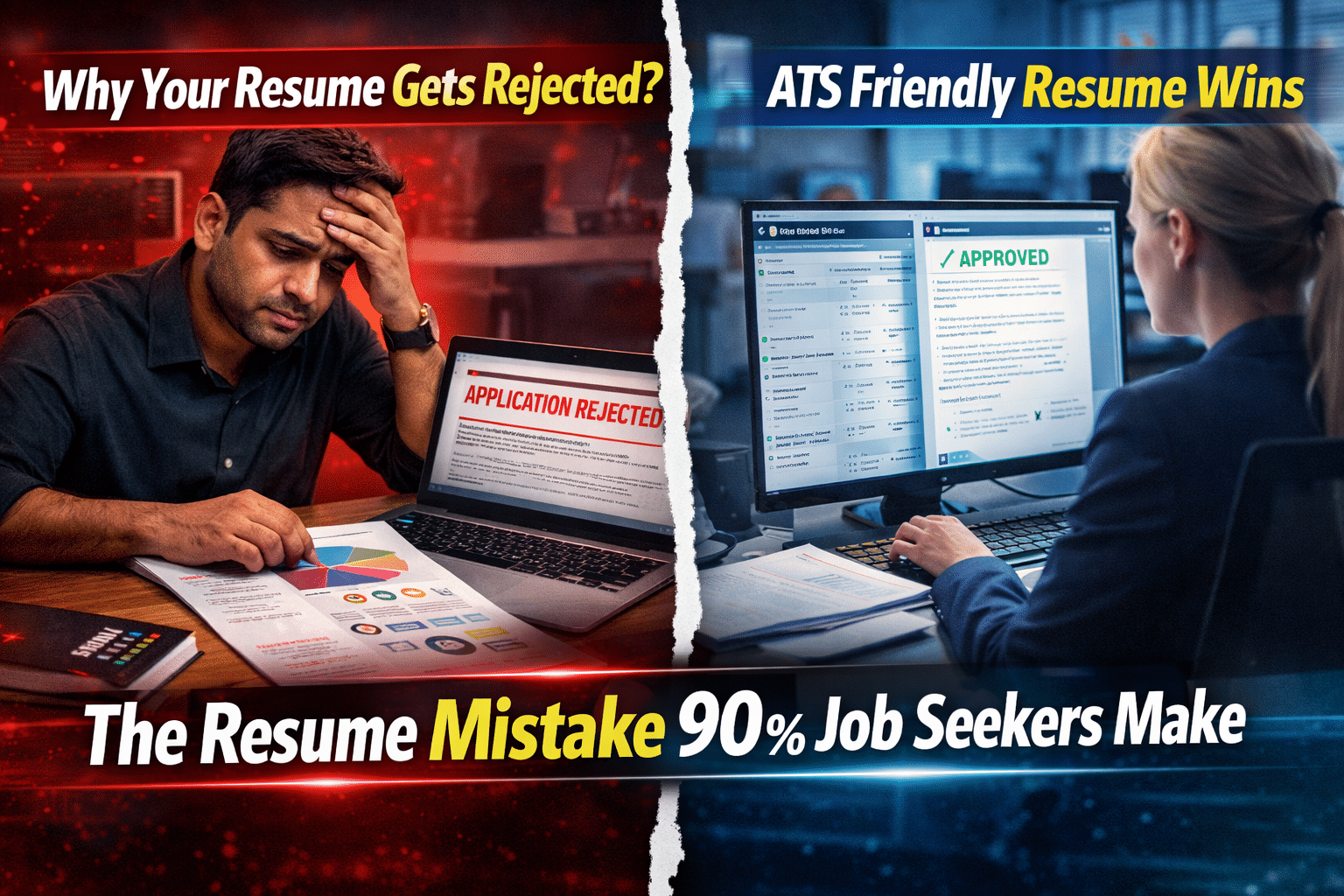
The contemporary global job search is an exercise in profound psychological endurance. For recent university graduates attempting to secure their first foothold in the corporate arena, career pivoters navigating the perilous transition between industries, and international professionals seeking entry into the highly lucrative United States market, the application process frequently resembles a black hole. Candidates spend countless hours refining their professional narratives, only to be met with automated rejection emails or, more agonizingly, absolute silence. In an attempt to break through this wall of corporate indifference, a pervasive and highly destructive trend has taken root: the deployment of heavily stylized, graphic-intensive resumes.
Fueled by the democratization of online design platforms, candidates are increasingly abandoning traditional, text-based document structures in favor of visually arresting templates featuring multi-column layouts, custom typography, embedded icons, and colorful sidebars. The underlying psychological impulse is entirely understandable. When faced with the reality that a single corporate job posting might attract hundreds or thousands of applicants, the natural human instinct is to find a mechanism to stand out, to demonstrate creativity, and to project an aura of polished professionalism.
However, within the rigid, high-volume ecosystems of corporate banking, investment banking, and Non-Banking Financial Companies (NBFCs), this aesthetic-first approach represents a catastrophic strategic error. These beautifully designed documents are fundamentally incompatible with the underlying technological infrastructure of the modern recruitment industry. Behind the scenes, the deployment of a graphic resume does not signal innovation to a corporate recruiter; rather, it triggers algorithmic failure and human cognitive overload. This comprehensive report deconstructs the precise mechanical and psychological reasons why trendy, graphic resumes fail in the Western corporate landscape, demystifying the realities of Applicant Tracking Systems (ATS) and outlining the exact, uncompromising architectural standards required to secure visibility and success in the US financial sector.
The Illusion of Aesthetic Advantage and the HR Reality
To understand the magnitude of this formatting misstep, it is necessary to examine the daily reality of human resources professionals and talent acquisition specialists operating within Fortune 500 companies and bulge bracket banks. The corporate recruiting environment is defined by relentless volume and severe time constraints. Recruiters are not evaluating candidates as art critics reviewing a portfolio; they are data miners searching for highly specific, risk-mitigating competencies.1
When candidates submit resumes that resemble elaborate menus or, as noted by frustrated HR professionals, “wedding invitations” adorned with gold swirls, conflicting fonts, and overlapping text boxes, they inadvertently generate immense friction.3 The core objective of a resume is the frictionless transfer of professional data from the applicant to the evaluator. Excessive design elements obscure this data.4 A highly stylized document demands that the recruiter expend precious cognitive energy simply figuring out where the “Work Experience” section is hidden amidst decorative lines and complex layouts.3
Furthermore, this visual complexity frequently masks underlying deficiencies or results in critical data being overlooked. In the corporate banking sector, where extreme attention to detail, regulatory compliance, and standardized reporting are paramount, submitting a resume that deviates wildly from established business norms signals a potential cultural misalignment.5 It implies that the candidate prioritizes superficial aesthetics over functional communication, a trait that is highly penalized in industries that rely on rigorous financial modeling, clear risk assessment, and unadorned data presentation.5 The empirical truth of corporate recruitment is that simple, modern, and impeccably clean layouts consistently outperform their highly designed counterparts because they align perfectly with both the psychological needs of the human reader and the parsing mechanics of the digital gatekeepers.3
Deconstructing the Applicant Tracking System (ATS) Gatekeeper
The most formidable barrier standing between a candidate and an interview is the Applicant Tracking System (ATS). Virtually every major corporate entity in the United States, the United Kingdom, and the European Union utilizes platforms such as Workday, Taleo, Greenhouse, Lever, iCIMS, BambooHR, Zoho Recruit, and PeopleForce to ingest and manage candidate flow.9 To navigate this digital perimeter, one must fundamentally understand how these systems operate, dispensing with the pervasive myths that plague job seeker communities.
The Myth of the Autonomous Rejecting Robot
The most common misconception regarding ATS technology is that it functions as an autonomous, malevolent artificial intelligence “bot” programmed to actively read resumes and independently issue rejections based on qualitative judgments.12 This anthropomorphization creates a sense of helplessness among applicants. In reality, an ATS operates fundamentally as a relational database—a passive, highly structured digital filing cabinet designed to assist human recruiters in managing workflows, sorting data, and communicating with hiring managers.12
When a candidate submits an application, the system does not actively “reject” the resume. A comprehensive survey of 630 corporate recruiters revealed that 92% of professionals do not utilize auto-reject features based on resume content.14 Instead, candidates are filtered out because their resumes become technologically “invisible”.14 Recruiters utilize the ATS like a search engine, inputting specific Boolean queries, job titles, and skill keywords to surface relevant profiles.14 If a candidate’s resume is not formatted in a way that allows the system to read, categorize, and index that specific data, the candidate will simply never appear in the search results.14 Approximately 99.7% of recruiters rely heavily on these keyword filters.14 Therefore, the bar for technical optimization is shockingly low; success does not require being the absolute best candidate in the pool, but rather being a candidate whose data is visible and correctly categorized.14
The Mechanics of Resume Parsing
The process by which an ATS extracts information from a submitted document is known as parsing. This is the exact moment where graphic, Canva-style resumes suffer catastrophic failure. The parsing sequence involves three distinct phases: text extraction, data categorization, and keyword analysis.16
During text extraction, the system attempts to strip away all visual formatting—including colors, tables, graphics, and special designs—to reveal the underlying plain text.15 For standard Microsoft Word documents (.docx), the parser seamlessly reads the underlying XML structure, which is why .docx remains the most universally reliable file format across all tested platforms.14 When dealing with PDF files, the parser attempts to read the embedded text layer. If the PDF was exported directly from a text-based word processor, modern systems generally handle the extraction well.14 However, if the PDF is an image-based file—such as those frequently exported from graphic design software or scanned physical documents—the ATS must rely on Optical Character Recognition (OCR).17
Once the text is extracted, the ATS deploys Natural Language Processing (NLP) algorithms to identify entities (such as names, company locations, and dates) and maps them to specific database fields like “Education” or “Work History”.16 If the extracted text is a jumbled, disorganized mass due to poor initial formatting, the NLP algorithms cannot assign the data to the correct fields, resulting in a fractured, unsearchable digital profile.17
The Unstructured Data Crisis: Why Graphic Templates Fail the Parse
The proliferation of visually stunning templates has led to a crisis of unstructured data within corporate HR databases. When a highly stylized resume enters the parsing sequence, the ATS does not see the elegant design; it perceives decorative noise, missing keywords, and an inability to map critical information.22 Independent testing of heavily designed templates from visual-first platforms has revealed parsing accuracy rates plummeting to between 18% and 36%, with critical sections such as “Skills” frequently failing to be recognized entirely.23
The Horizontal Merge of Multi-Column Layouts
The most fatal design element of the trendy graphic resume is the multi-column layout. Typically, these designs feature a narrow left-hand column containing contact information, education, and lists of hard skills, alongside a wider right-hand column detailing professional experience.21 ATS parsing algorithms are overwhelmingly programmed to read documents in a linear, left-to-right, top-to-bottom sequence.14
When the parser encounters a dual-column structure, it cannot recognize the vertical spatial division separating the two columns. Instead, it reads straight across the page.14 Consequently, a bullet point listing a complex financial modeling skill in the left column is seamlessly concatenated with a sentence describing a corporate merger in the right column. This horizontal merging scrambles the text into incoherent gibberish, destroying the semantic context required by the NLP algorithms to categorize the candidate’s capabilities.14
Embedded Graphics, Icons, and Text Boxes
In an effort to save space and modernize the document’s appearance, many templates replace standard text headers with visual icons—for instance, utilizing a telephone icon instead of writing “Phone,” or demonstrating language proficiency through a series of shaded circles or progress bars.20 ATS technology cannot extract semantic meaning from images.20 To the parser, a telephone icon is either completely invisible or registers as a meaningless string of characters, such as the Unicode error U+260E.14 Because the system cannot read the graphic indicating “Advanced Excel Skills,” that vital technical qualification is entirely omitted from the candidate’s searchable database profile.20
Similarly disastrous is the use of text boxes and complex tables to position information on the page. Many legacy systems, and even some contemporary platforms, are programmed to entirely bypass content enclosed within floating text boxes or complex nested tables.17 An applicant who places their executive summary or core achievements inside a stylized geometric shape risks having that entire section skipped during the data extraction phase, rendering their application fundamentally incomplete.17
Typography and the Exclusion of Headers/Footers
The desire for aesthetic uniqueness often drives candidates to utilize custom, decorative, or non-standard fonts.20 Parsers are specifically optimized to recognize and render standard, web-safe typography. When confronted with an unrecognized script or custom typeface, the system may fail to render the characters correctly, replacing the text with empty spaces or arbitrary symbols.17 To ensure data fidelity, candidates must restrict their typography to universally recognized fonts such as Arial, Calibri, Helvetica, or Times New Roman, sized appropriately between 10 and 12 points.8
Furthermore, graphic templates frequently utilize document headers and footers to house critical contact information or stylized page numbering, aiming to maximize the central whitespace.17 A significant percentage of ATS parsers are explicitly instructed to ignore header and footer data entirely, focusing solely on the main body of the document to avoid ingesting repetitive page titles.14 If an applicant’s email address and phone number are isolated in the header, the candidate may be successfully parsed into the database, but the recruiter will have absolutely no digital mechanism by which to contact them for an interview.14
| Graphic Design Element | Mechanical Parsing Failure | Corporate HR Implication |
| Two-Column Layouts | Linear parsers read horizontally across columns, merging disparate text strings. 14 | Context is destroyed; skills and experience become unsearchable gibberish, rendering the profile invisible. 14 |
| Embedded Icons & Progress Bars | OCR cannot extract text from images; icons register as blank space or garbled code (e.g., U+260E). 14 | Vital technical proficiencies and contact details are erased from the candidate’s record. 14 |
| Floating Text Boxes & Shapes | Parsing algorithms frequently bypass data enclosed outside standard paragraph margins. 17 | Entire sections of experience or executive summaries are skipped and omitted from the database. 17 |
| Headers and Footers | Parsers systematically ignore these document regions to avoid repetitive data ingestion. 14 | Contact information placed here is lost, leaving the recruiter unable to reach the candidate. 14 |
| Custom & Decorative Fonts | Non-standard typography fails to render accurately during XML or OCR extraction. 17 | Text is replaced by arbitrary symbols, completely breaking keyword matching algorithms. 17 |
The 7.4-Second Reality: Eye-Tracking and Human Cognitive Load
Assuming a highly stylized document manages to bypass the ATS—perhaps through a direct email to a hiring manager or a networking referral—it immediately confronts an equally formidable barrier: the physiological and cognitive limits of the human reader. The corporate narrative that hiring managers carefully read every word of an application is a fallacy.
Comprehensive, quantitative behavioral research utilizing advanced eye-tracking technology has mapped the precise ocular movements of recruitment professionals as they evaluate candidates. A massive study tracking 847 hiring managers across 23 industries, analyzing 4,200 resumes, provided shocking empirical data: 73% of hiring managers never read past the first third of the first page during the initial screening phase.26 The average duration of this initial screening is a mere 7.4 seconds.27 Within this heavily compressed window, the screener must make a definitive, high-stakes decision regarding the candidate’s viability.
Visual Clutter and the “F-Pattern” of Reading
During this 7.4-second interval, visual complexity becomes a distinct, overwhelming liability. Eye-tracking heat maps demonstrate that human reading patterns on business documents adhere strictly to the “F-pattern” and “E-pattern”.29 The human eye naturally scans horizontally across the top of the document, then drops vertically down the left-hand margin, branching out periodically to catch clear subheadings, bolded job titles, and brief bullet points.26
When confronted with “cluttered looks”—characterized by multiple columns, dense blocks of text, shifting alignments, and a lack of white space—the recruiter experiences an immediate cognitive spike.29 The eye-tracking data reveals that in the presence of complex designs, the recruiter’s visual focus becomes highly concentrated on relatively few areas.26 This is a physiological coping strategy to deal with the overwhelming volume of disorganized visual stimuli.29 Instead of absorbing the candidate’s actual qualifications, the screener’s cognitive bandwidth is entirely consumed by the effort of navigating the document’s chaotic architecture.
The most successful documents—those that retain recruiter attention and effectively communicate professional value—are those that eliminate visual noise entirely. They utilize clear, simple layouts, universally recognized section headers (such as “Work Experience,” “Education,” and “Skills”), and robust white space.29 A clean, single-column structure allows the screener’s eye to glide effortlessly down the page, instantly locating critical data points such as current job titles, employment dates, and core competencies without friction.3
Accessibility and the Exhausted Screener
Beyond simple preference, highly stylized documents introduce severe accessibility issues. For hiring managers or recruiters who utilize screen-reading software due to visual impairments, resumes built with complex tables, low-contrast color palettes, and heavy graphics are completely unreadable.4 By prioritizing aesthetics, the candidate has effectively locked out a portion of the evaluating audience.
Furthermore, recruiters are actively annoyed by candidates who ignore the conventions of business communication. Resumes that require the reader to hunt for basic chronological information or decipher bespoke headers like “Where I’ve Made an Impact” instead of the standard “Work Experience” are viewed as unprofessional.17 In the high-stakes environment of corporate banking, where standard operating procedures are critical, a resume that attempts to “break the mold” is often interpreted as an inability to follow instructions.2
The Evolution of AI Parsing: 2015 Legacy vs. 2026 Semantic Intelligence
To strategically optimize an application, it is crucial to understand that ATS technology is not static. The systems utilized in 2025 and 2026 are vastly superior to the legacy systems of a decade ago. Candidates who rely on outdated “hacks” found on internet forums are frequently penalized by modern AI-enhanced platforms.18
The End of Keyword Stuffing and “White Text” Manipulation
Between 2015 and 2020, rudimentary rules-based ATS platforms relied on simple, literal string matching and keyword frequency counting.18 This led to the rise of manipulative practices, most notably “keyword stuffing”—the artificial inflation of buzzwords—and the “white text hack,” wherein candidates would paste the entire job description in tiny white font at the bottom of the page to trick the parser into registering a 100% match.14
Modern ATS platforms leverage sophisticated Natural Language Processing, machine learning, and semantic understanding.13 These systems no longer merely count words; they evaluate context, recognize industry synonyms, and assess the holistic quality and authenticity of the professional narrative.18 Algorithmic screening now actively detects and penalizes manipulation.18 When an AI screener flags white text, invisible characters, or an unnatural density of repeated keywords, the application is instantly downgraded, labeled as spam, and essentially guaranteed rejection.14
The strategic imperative today is the natural integration of a “sweet spot” of 25 to 35 relevant, role-specific keywords directly into the context of quantified bullet points and professional summaries.14 This provides the requisite data for recruiter queries while seamlessly satisfying the semantic quality checks of the AI.14
Exact String Matching and Technical Consistency
Despite advancements in semantic understanding, certain mechanical rules remain absolute. When a recruiter types a query into the database, exact string matching is still highly influential. Resumes that match the exact job title from the posting in their header or summary profile receive callback rates that are 10.6 times higher than those that use approximate synonyms.14 If the requisition is for a “Senior Product Manager,” the resume must state “Senior Product Manager,” not “Product Lead”.14 Furthermore, software parsers treat specific strings literally; “Adobe Creative Cloud” and “Adobe Creative Suite” are registered as entirely different technical competencies.14 Candidates must mirror the exact terminology utilized in the job description.14
Data consistency is equally critical. Extensive testing has revealed that inconsistent date formatting causes severe algorithmic miscalculations regarding a candidate’s total years of experience.14 A candidate who mixes formats—for example, listing “Jan 2019” for one role, “2019-01” for another, and “January ’19” for a third—can cause the ATS to scramble the timeline, reducing an 8-year professional veteran to a 3-year novice in the system’s calculations.14 The most reliable, universally parsed format across all systems is the consistent “Month Year” structure (e.g., “Jan 2020 – Mar 2023”).14
| ATS Optimization Strategy | Outdated Legacy Tactic (Avoid) | Modern Semantic AI Approach (2025/2026) |
| Keyword Density | Unnatural repetition and “keyword stuffing” to inflate frequency scores. 18 | Natural integration of 25-35 contextual keywords woven into achievement bullets. 14 |
| System Manipulation | Hiding job descriptions in invisible “white text” to trick the parser. 14 | Authentic presentation; manipulation triggers automatic spam flags and rejection. 14 |
| Job Title Formatting | Using creative or approximate internal titles (e.g., “Product Guru”). 14 | Matching the exact literal string of the target job posting (results in 10.6x callbacks). 14 |
| Timeline Consistency | Mixing date formats casually (e.g., “01/20,” “Jan 2020,” “2020”). 14 | Strict, uniform adherence to the “Month Year” format to prevent experience miscalculation. 14 |
Sector-Specific Architecture: Investment Banking vs. NBFCs
While the mechanical formatting of a resume must remain uniform to pass the ATS, the lexical choices, keyword optimization, and core competencies highlighted must be ruthlessly tailored to the specific corporate sub-sector. A generic finance resume will fail. The operational models of Investment Banking (IB) and Non-Banking Financial Companies (NBFCs) require vastly different professional narratives.8
The Investment Banking Lexicon: Action and ROI
The investment banking sphere is characterized by a hyper-focus on transaction execution, exhaustive financial modeling, and measurable return on investment.7 Sleep-deprived associates and managing directors evaluating junior talent have zero tolerance for subjective self-praise or task-based descriptions.5 Resumes in this tier demand an aggressive, results-oriented structure.
Every single bullet point must open with a powerful, industry-specific action verb—such as “Executed,” “Structured,” “Developed,” “Pitched,” or “Conducted”.5 Phrases like “Responsible for” or “Tasked with” are viewed as passive and junior. More importantly, accomplishments must be rigorously quantified to demonstrate empirical value.5 Metrics such as “Structured and executed M&A transactions valued at $500M+” or “Developed and pitched investment theses that increased portfolio performance by 20%” provide the concrete evidence of deal exposure required by Wall Street firms.5
Candidates must explicitly demonstrate hard technical skills.34 A dedicated “Skills” section must house keywords such as LBO modeling, DCF valuation, M&A comparison analysis, and proficiency with specific financial software, satisfying both the ATS parsers and the human deal teams.5 Furthermore, candidates must cover as much deal exposure as possible, detailing their specific role in facilitating mergers or preparing initial public offerings (IPOs), even if their contribution was strictly analytical diligence.5
The NBFC Paradigm: Risk, Liquidity, and Compliance
Non-Banking Financial Companies operate on a distinctly different financial axis. While providing lending and credit services similar to traditional banks, NBFCs do not hold banking licenses and cannot rely on traditional customer deposits.32 Instead, they rely heavily on market-based funding sources, raising capital through commercial paper, bonds, debentures, and term loans from larger financial institutions.32
Consequently, a resume tailored for an NBFC must reflect this reality. While quantified ROI remains important, the operational focus shifts heavily toward risk mitigation and regulatory navigation.32 Candidates must highlight keywords and core competencies in credit risk management, asset-liability mismatch management, and liquidity tracking.32 Bullet points should emphasize the candidate’s ability to ensure regulatory compliance, adapt to shifting market conditions, and successfully secure capital through diverse, non-traditional funding channels.32 A candidate who merely copy-pastes their M&A-heavy investment banking resume for a senior credit risk role at an NBFC will fail to trigger the specific keyword queries required by that sector’s recruiters.5
Geopolitical Nuance: Formatting for the US vs. UK and EU Markets
A critical error frequently committed by global job seekers, expatriates, and career pivoters attempting cross-border applications is the direct porting of formatting conventions from their home countries into the United States corporate market.35 The architectural expectations for a professional profile vary drastically across geopolitical lines, heavily influenced by regional labor laws, anti-discrimination legislation, and deeply ingrained cultural attitudes toward self-promotion.
The European and UK Paradigm: The Detailed CV
In the United Kingdom, the European Union, and much of the global market, the term “CV” (Curriculum Vitae) is the default terminology for a standard job application.38 In the United States, conversely, a CV refers almost exclusively to an exhaustive, multi-page academic or scientific dossier detailing every publication, grant, and conference presentation of a candidate’s career.35
European professional CVs are structurally expansive. It is entirely normalized, and often expected, for a European CV to span two to three pages, even for early-to-mid-career professionals, as European recruiters expect a broader, highly detailed, and deeply contextualized overview of the applicant’s background.39
Crucially, the inclusion of extensive personal and demographic data is a standard practice. European CVs frequently feature a professional headshot, and commonly list the applicant’s date of birth, age, nationality, and marital status.41 The Europass CV—a standardized framework promoted by the European Union to facilitate cross-border employment transparency—explicitly codifies the inclusion of extensive language proficiency tables, structured digital competence matrices, and deep demographic data to create a uniform profile across the continent.39
In Latin American markets, while formats may slightly differ, there is a similar cultural inclination toward longer documents. Latin American CVs traditionally emphasize comprehensive task descriptions and responsibilities, reflecting a cultural communication style that values humility, duty, and detailed operational reporting over aggressive self-promotion.37
The Strict US Corporate Standard: The “Blind” Resume
When targeting the United States market, these international conventions must be violently discarded. The US corporate environment is governed by highly stringent employment laws enforced by entities such as the Equal Employment Opportunity Commission (EEOC), which explicitly prohibit hiring discrimination based on race, color, religion, sex, national origin, age, or disability. To ensure strict compliance and to mitigate the severe risk of litigation, US corporate human resources departments demand a highly sterilized, objective application document.30
The inclusion of a photograph on a US resume is strictly prohibited. It serves as an immediate, glowing red flag, frequently resulting in the automatic discarding of the document before it is even read, as HR departments desperately wish to avoid any subconscious bias accusations.1 Furthermore, all personal demographic data—including date of birth, marital status, gender, nationality, and visa status—must be entirely omitted.3 A US resume is an entirely functional, data-driven catalog of professional output, devoid of personal context.
Culturally, the humble, task-oriented prose of international CVs is severely penalized in the American market. US employers expect aggressive self-advocacy, supreme confidence, and a relentless focus on quantifiable ROI.37 International applicants must systematically rewrite their experience, transforming passive lists of responsibilities into aggressive, action-driven bullet points backed by hard financial data and specific performance metrics.36 Additionally, the length must be ruthlessly trimmed. For the vast majority of professionals, including analysts, associates, and vice presidents within the banking sector, the strict one-page mandate is absolute.6 Only senior executives with decades of specific, highly relevant industry experience may occasionally justify spilling over onto a second page.39
| Resume Component | European / UK CV Standard | United States Resume Standard |
| Document Length | 2 to 3 pages is standard and expected, providing deep context. 39 | Strictly 1 page for most professionals; maximum 2 for senior executives. 36 |
| Photographs | Highly common and frequently expected (e.g., Europass). 41 | Strictly prohibited to comply with EEOC anti-discrimination laws. 3 |
| Personal Demographics | Includes Date of Birth, Age, Nationality, and Marital Status. 41 | Entirely omitted; inclusion acts as a severe red flag for HR. 30 |
| Tone and Content | Task-oriented, comprehensive duty descriptions; humbler tone. 37 | Aggressive self-advocacy; heavily focused on quantifiable metrics and ROI. 36 |
| Terminology | Referred to universally as a “CV”. 38 | Referred to as a “Resume”; “CV” implies a massive academic dossier. 35 |
The Blueprint: Exact Standard Formatting for US Corporate Success
Having established the rigid constraints of ATS parsing algorithms, the cognitive limits of exhausted human screeners, and the geopolitical nuances of the global job market, the final dimension of optimization lies in the precise architectural construction of the document. A successful US corporate resume is an exercise in brutal minimalism and strategic data placement.
The Eradication of the Objective Statement
For decades, the standard opening to a professional resume was the “Objective Statement”—a brief sentence declaring what the candidate desired from the employer (e.g., “Seeking a challenging entry-level role in corporate banking to utilize my analytical skills for long-term career growth”).46 In the contemporary corporate landscape of 2025 and 2026, this construct is entirely obsolete and signals an outdated understanding of the job market.46
Corporate entities are fundamentally unconcerned with what the candidate seeks; they are exclusively focused on what immediate value the candidate can inject into their operation.47 The objective statement has been systematically replaced by the “Professional Summary” or “Executive Summary”.46
A highly optimized summary acts as an executive abstract, functioning as a concentrated injection of ROI and technical competency right at the focal point of the recruiter’s 7.4-second screening window—the top third of the page.26 This section must be concise, spanning no more than three sentences, and must explicitly state the candidate’s target professional title, aggregate years of relevant experience, core technical proficiencies, and a major, highly quantifiable career achievement.8 By immediately delivering a dense cluster of targeted keywords and empirical value propositions at the exact location where the human eye naturally begins its F-pattern scan, the candidate dramatically increases the probability of sustaining recruiter engagement.26
Strict Architectural Guidelines
To guarantee passage through the ATS and appeal to the human reader, the structural formatting must be uncompromising.
- Layout and Columns: The layout must be a rigorous, single-column format.8 No sidebars, no embedded text boxes, and no complex tables.8 Standardized, clear margins of 0.5 to 1 inch must be maintained on all sides to create vital white space.25
- Typography: Utilize highly readable, conservative fonts exclusively. Arial, Helvetica, Calibri, or Times New Roman, sized between 10 and 12 points for the body text, and up to 14 points for section headers, are the gold standard.8
- Section Headers: Use only universally recognized, verbatim section headers: “Work Experience,” “Education,” and “Skills”.8 Creative alternatives confuse the NLP parsers and annoy human screeners.17 The chronological structure must operate in reverse, beginning with the most recent professional experience.5
- Header and Footer Ban: Never place contact information in the document’s header or footer metadata spaces. All information, including the candidate’s name, phone number, professional email, and LinkedIn URL, must be typed directly into the main body of the document, typically centered at the very top.6
File Nomenclature and Administrative Empathy
Finally, meticulous attention must be paid to the administrative mechanics of document submission. A frequently cited, yet easily avoidable, pet peeve among human resources professionals who manually screen candidate files is poor digital hygiene regarding file nomenclature.3
Candidates routinely submit documents with generic, thoughtless file names such as resume_final_v3.docx or simply doc1.pdf.3 In a high-volume recruitment environment, these opaque file names create severe administrative friction. When a recruiter wishes to forward a candidate’s file to a hiring manager or a multi-person interview panel, they are forced to stop their workflow and manually rename the file to identify the applicant and the target role.3 While this may seem a trivial annoyance to an outsider, to an HR professional processing hundreds of files daily, it demonstrates a lack of professional empathy and administrative foresight on the part of the candidate.3
A rigorously optimized document must be saved with a clear, professional identifier—for example, Firstname_Lastname_Senior_Financial_Analyst_Resume.docx.3 This ensures seamless internal distribution within the target organization and subtly reinforces the candidate’s attention to detail. Furthermore, unless a corporate application portal explicitly mandates a PDF, utilizing a standard .docx file guarantees the absolute maximum algorithmic penetration across both legacy and modern ATS platforms.8
The architecture of the modern job search in the US corporate sector is dictated by algorithmic compliance and cognitive efficiency. The deployment of heavily stylized, graphic-intensive templates represents a fundamental misunderstanding of the recruitment ecosystem. By abandoning visual flourishes in favor of stark, empirical evidence, adhering strictly to EEOC-compliant data standards, and engineering an unobstructed, frictionless conduit for professional data, candidates can ensure their qualifications are finally rendered visible to the institutions they wish to join.
Works cited
- 10 of the Biggest Pet Peeves Recruiters Have About Candidates, accessed on March 4, 2026, https://theundercoverrecruiter.com/pet-peeves-recruiters-candidates/
- 20 Recruiter Pet Peeves, accessed on March 4, 2026, https://www.chattahoocheetech.edu/wp-content/uploads/2013/02/Top-20-Recruiter-Pet-Peeves-about-Resumes-2-Dec.doc
- For those of us still manually screening resumes , what are your …, accessed on March 4, 2026, https://www.reddit.com/r/humanresources/comments/1m8hh3v/for_those_of_us_still_manually_screening_resumes/
- Sorry if this is dumb, but AI Candidate systems CAN NOT read Canva resumes? Is that a thing? – Reddit, accessed on March 4, 2026, https://www.reddit.com/r/womenintech/comments/1ln04qt/sorry_if_this_is_dumb_but_ai_candidate_systems/
- Investment Banking Resume Examples (JPM, Goldman, Morgan Stanley) – IGotAnOffer, accessed on March 4, 2026, https://igotanoffer.com/blogs/finance/investment-banking-resume-examples
- Investment Banking Resume Guide: Tips & Templates For Every Situation, accessed on March 4, 2026, https://mergersandinquisitions.com/investment-banking/recruitment/resumes/
- Goldman Sachs Investment Banking Resume Template – ResumeLab, accessed on March 4, 2026, https://resumelab.com/resume-examples/goldman-sachs
- 2025 Resume Formatting Tips for Office and Industrial Jobs – Employ Partners, accessed on March 4, 2026, https://www.employpartners.com/2025/03/26/2025-resume-formatting-tips/
- 23 Best Applicant Tracking Systems (ATS): Full Comparison 2026 – SelectSoftware Reviews, accessed on March 4, 2026, https://www.selectsoftwarereviews.com/buyer-guide/applicant-tracking-systems
- Top 10 ATS systems: The ultimate recruiter’s guide – peopleforce.io, accessed on March 4, 2026, https://peopleforce.io/blog/top-ats-systems
- 4 Best Applicant Tracking Systems for Small Businesses | CO – U.S. Chamber of Commerce, accessed on March 4, 2026, https://www.uschamber.com/co/run/human-resources/best-small-business-applicant-tracking-systems
- Understanding How The ATS Reads And Interacts With YOUR Resume | by Kristen M Fife, accessed on March 4, 2026, https://kristenfife.medium.com/understanding-how-the-ats-reads-and-interacts-with-your-resume-401bd00b66db
- Resume myths debunked: What ATS systems actually do (and don’t do) in 2025, accessed on March 4, 2026, https://www.wahresume.com/blog/resume-myths-debunked-what-ats-systems-actually-do-and-dont-do-in-2025
- I spent 8 months testing how ATS systems actually parse resumes …, accessed on March 4, 2026, https://www.reddit.com/r/jobsearchhacks/comments/1r32a25/i_spent_8_months_testing_how_ats_systems_actually/
- Can the ATS Read Tables and Columns on Your Resume? – Jobscan, accessed on March 4, 2026, https://www.jobscan.co/blog/resume-tables-columns-ats/
- ATS Resume Mistakes: 12 Common Errors That Kill Your Chances – Upskillist, accessed on March 4, 2026, https://www.upskillist.com/blog/ats-parsing-common-resume-mistakes-to-avoid/
- How ATS Reads Resumes: Parsing Technology Explained, accessed on March 4, 2026, https://resumegyani.in/ats-guides/how-ats-reads-resumes
- 5 ATS Myths Experienced Professionals Believe – 2025 Truth | PassTheScan, accessed on March 4, 2026, https://www.passthescan.com/blog/ats-myths-experienced-professionals-believe
- The Truth About ATS Resume Myths: What Actually Works in 2025 – Woberry, accessed on March 4, 2026, https://www.woberry.com/resume-guide/ats-myths-debunked
- Avoid Canva resume templates: why they fail and alternatives – CandyCV, accessed on March 4, 2026, https://www.candycv.com/how-to/dont-make-your-resume-with-canva-why-its-templates-fail-and-what-to-use-instead-25
- Your Canva Resume is Pretty, but It’s Not ATS Compliant – WORxK Solutions, accessed on March 4, 2026, https://www.worxksolutions.com/post/your-canva-resume-is-pretty-but-it-s-not-ats-compliant
- Why Creating Resumes with Canva Is Not Suitable for Job Applications — Especially for ATS Systems | by C A Narain | Medium, accessed on March 4, 2026, https://medium.com/@c.a.narain/why-creating-resumes-with-canva-is-not-suitable-for-job-applications-especially-for-ats-f45aadff8b0e
- Why Resume Templates Look Good but Perform Poorly in ATS Systems – Scale.jobs, accessed on March 4, 2026, https://scale.jobs/blog/why-resume-templates-look-good-but-perform-poorly-in-ats-systems
- ATS Resume Builder Myths & Test Results for 2025 – ResumeFlex, accessed on March 4, 2026, https://resumeflex.com/ats-resume-builder-testing-results-and-myths-debunked-for-2025/
- You Need to Avoid These ATS Resume Formatting Mistakes – Jobscan, accessed on March 4, 2026, https://www.jobscan.co/blog/ats-formatting-mistakes/
- What Hiring Managers See First: Eye-Tracking Study of Resume Review Process – JobEase, accessed on March 4, 2026, https://www.jobease.ca/blog/what-hiring-managers-actually-do-in-the-first-6-seconds-eye-tracking-study-results
- How long recruiters spend looking at your resume in 2026 – StandOut CV, accessed on March 4, 2026, https://standout-cv.com/usa/stats-usa/how-long-recruiters-spend-looking-at-resume
- NEW STUDY CLARIFIES RECRUITER DECISION-MAKING, accessed on March 4, 2026, https://www.bu.edu/com/files/2018/10/TheLadders-EyeTracking-StudyC2.pdf
- Eye-Tracking Study – Ladders, accessed on March 4, 2026, https://www.theladders.com/static/images/basicSite/pdfs/TheLadders-EyeTracking-StudyC2.pdf
- How do I write a resume for a federal job? – USAJOBS.gov, accessed on March 4, 2026, https://help.usajobs.gov/faq/application/documents/resume/what-to-include
- Banking Resume: Examples & Templates, accessed on March 4, 2026, https://www.resume-now.com/resume/examples/banking
- Full Form of NBFC – Functions, Types, Examples, Vs Banks – WallStreetMojo, accessed on March 4, 2026, https://www.wallstreetmojo.com/full-form-of-nbfc/
- 9 Investment Banking Resume Examples for 2026, accessed on March 4, 2026, https://resumeworded.com/investment-banking-resume-examples
- Investment Banking Skills for Your Resume – Forage, accessed on March 4, 2026, https://www.theforage.com/blog/skills/investment-banking-skills
- How Do Resumes Differ From Country to Country? – Elevate Experiences | Illinois Tech, accessed on March 4, 2026, https://elevate.iit.edu/resources/how-do-resumes-differ-from-country-to-country/
- Nine tips for your resume in America as an expat in 2025, accessed on March 4, 2026, https://americajosh.com/blog/general/nine-tips-for-your-resume-in-america-as-an-expat/
- How to Create a Resume in the United States: Step-by-Step + Template – Comun.app, accessed on March 4, 2026, https://www.comun.app/en/blog/how-to-create-a-resume-in-the-united-states-step-by-step-template
- Resume vs. CV: The Ultimate 2025 Guide for US, UK & Canadian Job Seekers, accessed on March 4, 2026, https://www.resumly.ai/blog/resume-vs-cv
- European CV vs American Resume: How to Choose the Right Style for Global Employers, accessed on March 4, 2026, https://moderndiplomacy.eu/2025/11/26/european-cv-vs-american-resume-how-to-choose-the-right-style-for-global-employers/
- British CVs vs American CVs – What’s the difference? | EF English Live, accessed on March 4, 2026, https://englishlive.ef.com/en/blog/career-english/british-cvs-vs-american-cvs-whats-the-difference/
- EU CV vs North American Resume: What Really Matters For Job Applications, accessed on March 4, 2026, https://www.resumescanada.ca/eu-cv-vs-north-american-resume-what-really-matters-for-job-applications/
- Curious about the differences between US and European resumes – Reddit, accessed on March 4, 2026, https://www.reddit.com/r/Resume/comments/1j431fj/curious_about_the_differences_between_us_and/
- Europass CV vs Traditional European Resume – Key Differences and Best Practices, accessed on March 4, 2026, https://www.cvowl.com/blog/europass-cv-vs-traditional-european-resume
- The Resume Format of the USA: Making a Perfect Resume for American Jobs, accessed on March 4, 2026, https://media.jobins.com/2026/02/16/the-resume-format-of-the-usa-making-a-perfect-resume-for-american-jobs/
- Top 5 Resume Resolutions for 2025: What Executives Need to Know – CBIZ, accessed on March 4, 2026, https://www.cbiz.com/insights/article/top-5-resume-resolutions-for-2025-what-executives-need-to-know
- Ditching the Objective: A New Resume Trend – TopResume, accessed on March 4, 2026, https://topresume.com/career-advice/objective-statement-outdated
- 50+ Resume Objective Examples (2026) – Jobscan, accessed on March 4, 2026, https://www.jobscan.co/blog/resume-objective-statements-faq-how-to-examples/
- Objective or Summary for Your Resume? Everything You Need to Know in 2025, accessed on March 4, 2026, https://resumeworded.com/objective-or-summary-for-resume-key-advice
- How to Write a Resume Summary in 2025: 10+ Examples, accessed on March 4, 2026, https://www.easyresume.io/guides/resume-summary



Leave a Reply