
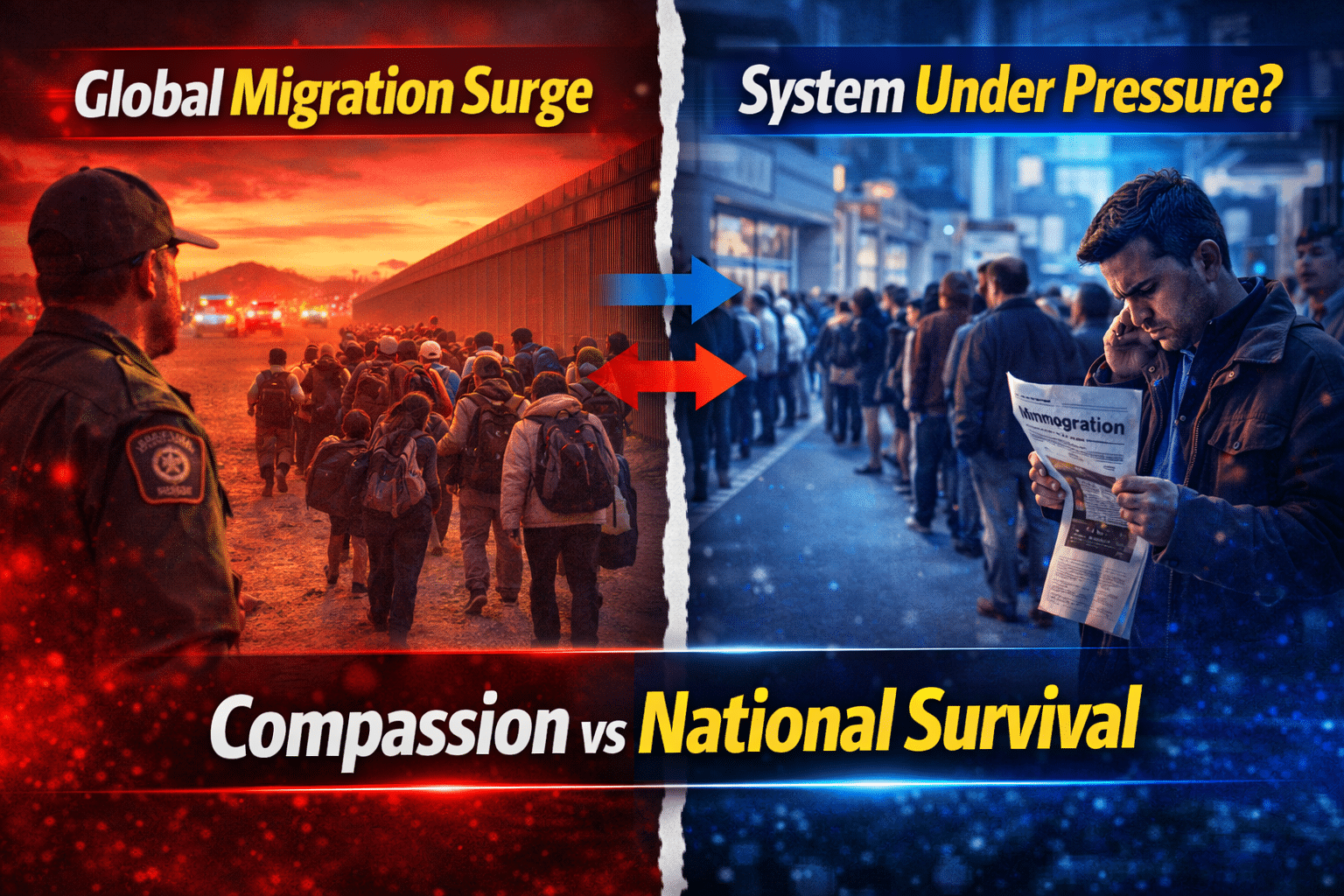
During my nearly two decades in corporate human resources, I learned a fundamental, inescapable truth about human systems: you cannot successfully integrate new people into an organization without a structured, intentional onboarding process. If you take a company of five hundred people and suddenly hire five thousand new employees over a weekend, without increasing the HR staff, without expanding the office space, and without a shared language or unified culture, that company will not thrive. It will collapse into chaos.
A nation is simply a macro-organization. It has a culture, a social contract, an economic equilibrium, and an absolute physical limit to its infrastructure. When we discuss global mass migration, we are discussing the largest unmanaged onboarding crisis in human history. Yet, the modern discourse surrounding this phenomenon has devolved into a toxic, polarized battleground of absolutes. On one side, a faction of progressive elites champions a borderless utopianism, branding any plea for enforcement or limits as inherently xenophobic and racist. On the other side, reactionary populism increasingly views every migrant as an existential threat, demanding draconian closures that betray fundamental human decency.
Between these two screaming extremes lies a complex, profoundly uncomfortable reality. Analyzing this reality requires a fierce commitment to objectivity and a dedication to fairness and the rule of law. Let me be unequivocally clear: I fiercely oppose racism, xenophobia, and the blind tribalism that seeks to demonize the “other.” I will vehemently defend the honest migrant who crosses a border legally, respects the laws of their host nation, and simply wants to work hard to feed their family. Furthermore, I believe that the protection of genuine refugees—those fleeing state-sponsored torture, execution, and war—is the ultimate moral test of a civilized society.
But I also believe that compassion, when divorced from pragmatism and boundaries, ceases to be a virtue. A welfare state that attempts to operate with open borders mathematically guarantees its own insolvency. When a nation extends unregulated altruism, it bypasses the essential mechanisms of integration, overwhelms its housing and healthcare systems, and crushes its own native working class. At a certain point, unchecked compassion becomes a catalyst for societal collapse. It becomes national suicide.
This analysis will dissect the current state of global mass migration. We will contrast the undeniable moral duty to assist real refugees with the profound economic and social strain placed upon native populations. Most importantly, we will call out the staggering hypocrisy of an affluent political and corporate elite that advocates for porous borders from the insulated safety of their gated communities, leaving the working class to bear the true, devastating costs of their virtue signaling.
The Staggering Scale of Global Human Movement
To understand the friction point between compassion and a nation’s carrying capacity, we must first comprehend the sheer volume of global human movement in the mid-2020s. We are living through an era of demographic flux that is entirely unprecedented in human history, driven by a volatile cocktail of severe economic disparity, state fragility, armed conflict, and environmental degradation.
By the middle of 2024 and into 2025, the United Nations reported that between 117 million and 122.6 million people were forcibly displaced worldwide.1 This is a staggering figure—an ocean of human suffering resulting from persecution, conflict, and human rights violations. Concurrently, the total number of international migrants reached a record 304 million, representing roughly 3.7 percent of the global population.4 To put this immense figure into perspective: if the global international migrant population were to form its own nation, it would be the fourth most populous country on Earth, trailing only India, China, and the United States.4
The United States: A System Pushed to the Brink
The United States has historically been the primary destination for international migration, but the period between 2021 and 2025 pushed the nation’s infrastructural and legal capacity to its absolute breaking point. The data paints a picture of a system in severe distress. By January 2025, the U.S. foreign-born population hit a record high of 53.3 million, constituting 15.8 percent of the total population—the largest demographic share of immigrants in American history.5
Within this historic surge, the unauthorized immigrant population swelled to an unprecedented 14 million by 2023.5 The demographic composition of this influx has been highly complex and legally convoluted. Of those 14 million unauthorized immigrants, approximately 6 million (or 40 percent) held some precarious, temporary form of protection from deportation.5 This included 2.6 million asylum applicants waiting in years-long backlogs, 700,000 humanitarian parolees, and 650,000 Temporary Protected Status (TPS) recipients.5 The sheer administrative burden of processing these individuals broke the back of the immigration court system. As a result, roughly 1 million migrants were simply released into the interior of the country with orders to appear in immigration court at dates far into the future, while another 8 million lived entirely in the shadows with no legal status or temporary protection whatsoever.5
By the summer of 2025, this trend experienced a sharp, aggressive reversal. Following a suite of 181 executive actions by the incoming Trump administration—which included rescinding deportation protections for hundreds of thousands of migrants from Cuba, Haiti, Nicaragua, and Venezuela—the total immigrant population declined to 51.9 million by June 2025.5 This marked the first actual demographic contraction of the U.S. foreign-born population since the 1960s, accompanied by a drop in border crossings to levels not seen in six decades.5
Europe: The Fortress Paradox
Across the Atlantic, Europe faces a structurally identical crisis, albeit with different geographical pressures. In 2024 alone, the European Union received nearly 913,000 first-time asylum applications.8 The burden of this influx was not distributed equally; Germany absorbed the highest shock, receiving 25 percent (230,000) of all first-time applications, followed closely by Spain at 18 percent and Italy at 17 percent.8 Simultaneously, the continent continues to host millions of Ukrainians displaced by war, with Germany and Poland accommodating 1.2 million and 992,000 beneficiaries of temporary protection, respectively.8
Following the peak crisis years of the last decade, the EU has increasingly shifted toward a deterrence-based “Fortress Europe” model. In 2024, the EU border agency Frontex reported a 38 percent drop in irregular border crossings, bringing detections down to roughly 239,000.9 However, as we will explore later, this numerical decline does not represent a resolution to the humanitarian crisis; rather, it reflects a deeply controversial strategy of “externalization,” wherein the EU pays third-world autocracies to violently intercept migrants before they can reach European shores.9
The Asian Corridor: The Volatility of the India-Bangladesh Border
It is a mistake to view mass migration solely through a Western lens. In South Asia, the incredibly porous 4,096-kilometer border between India and Bangladesh represents one of the most volatile and complex migration fault lines in the world.11 This clandestine migration network is driven by stark economic disparities—Bangladesh’s 2023 per capita GDP stood at $2,621 compared to India’s $2,411—combined with severe environmental crises.12 In Bangladesh, where roughly 27 percent of the population lives in flood-prone areas, river erosion and climate disasters displace millions internally, inevitably pushing massive waves of people across the border into India.12
Current estimates of illegal Bangladeshi immigrants living in India range widely from 12 million to 20 million, though the Indian government openly acknowledges a lack of precise data.12 This influx has fundamentally altered the demographic and cultural landscape of Indian border states. In Assam, for example, the Muslim population increased from 24.68 percent in 1951 to 34.22 percent in 2011, sparking intense social friction, fears of cultural erasure among indigenous tribes, and aggressive political countermeasures.12
| Region/Nation | Key Migration Statistic (2024-2025 Data) | Primary Drivers & Status |
| Global Total | 117M – 122.6M forcibly displaced; 304M international migrants.1 | Armed conflict, state collapse, climate change, economic disparity. |
| United States | 53.3M foreign-born peak (Jan 2025); 14M unauthorized (2023).5 | Economic opportunity, asylum seeking, humanitarian parole policies. |
| European Union | 913,000 first-time asylum apps (2024); 239,000 irregular detections.8 | Proximity to conflict zones (Syria, Afghanistan, Ukraine), welfare state attraction. |
| India | Estimated 12M – 20M undocumented Bangladeshi migrants.12 | Regional poverty, environmental displacement, historical border fluidity. |
The Moral Imperative: Defending the Honest Migrant and the True Refugee
An objective analysis of human behavior demands an unwavering acknowledgment of human suffering. A civilized, functioning society must fiercely oppose blind tribalism and racism. It is a profound moral imperative to defend the honest migrant who crosses borders legally to earn a living, and it is a foundational obligation of international human rights law to protect genuine refugees.
The human capital, resilience, and sheer grit that migrants bring to a host nation are often extraordinary. When we look at the inspiring trajectories of refugees resettled in 2024, we see the absolute best of humanity. Consider Lucky Karim, a 20-year-old Rohingya refugee who fled horrific ethnic cleansing in Myanmar at the age of 14.1 Separated from her father, she took on the responsibility of providing for her mother and siblings in a refugee camp, eventually resettling in the U.S. where she now fiercely advocates for Rohingya rights before the U.S. Congress.1
Consider Sara Wahedi, who fled Afghanistan as a child, returned to Kabul to work, and subsequently founded the Ehtesab app to provide verified emergency alerts to civilians trapped in a war zone, sending out over 250,000 life-saving alerts.1 Consider Zohal, an Afghan refugee who arrived in the Seattle area facing immense language barriers, but utilized a local non-profit culinary apprenticeship to rebuild her life, eventually becoming a leader who now mentors other immigrants in starting their own food businesses.1 Or Tshishiku Henry, who spent nearly a decade languishing in the Dzaleka refugee camp in Malawi after fleeing the Democratic Republic of the Congo. Upon resettling in Washington state, he founded the nonprofit Wide World for Refugee to help others navigate the very system that saved him.1
These individuals represent the pinnacle of the human spirit. They integrated, they respected the laws of their host nations, and they immediately began generating immense value for their new communities. This is what immigration, when managed legally and orderly, is supposed to look like.
The Cruelty of Disorganized Borders
However, the global failure to establish safe, orderly, and strictly enforced legal pathways has forced millions of desperate people into the hands of predatory smuggling networks, resulting in profound humanitarian tragedies. When borders are effectively open to anyone willing to pay a cartel or a smuggler, we do not achieve compassion; we fund transnational organized crime and facilitate mass death.
The European Union’s attempts to curb migration without fixing its underlying legal asylum structures have birthed a grim reality of subcontracted human rights abuses. In 2024, more than 2,200 people—including hundreds of children—died or went missing while attempting to cross the Mediterranean Sea, cementing its status as the deadliest migration route on the planet.9 The moral decay of the EU’s current border strategy lies in its policy of “externalization.” By funding, equipping, and training the Libyan coastguard and Tunisian authorities to intercept migrant vessels, the EU has essentially subcontracted its border enforcement to regimes with horrific human rights records.9
Reports from international watchdogs document systematic abuse, torture, and extortion of migrants who are intercepted and dragged back to Libyan detention centers.9 In one instance, a leaked video showed Egyptian and Syrian migrants being stripped and abused by staff at Libya’s Anti-Illegal Immigration Agency.14 In Tunisia, authorities, fueled by xenophobic rhetoric from senior officials, have routinely rounded up sub-Saharan African migrants and abandoned them in the desert at the borders of Algeria or Libya without food or water, leading to agonizing deaths.14 While European politicians stand at podiums and claim moral superiority over strict U.S. border policies, their own approach relies on an “out of sight, out of mind” brutality that violently violates the core tenets of the 1951 Refugee Convention.9 In 2025 alone, international human rights organizations recorded over 80,000 cases of illegal pushbacks at Europe’s external borders, where migrants were beaten, stripped, and forced back across borders without any access to asylum procedures.15
India’s Blanket Expulsions and Loss of Due Process
Similarly, the aggressive push-back policies utilized by the Indian government in 2025 illustrate the severe dangers of prioritizing rapid security optics over constitutional due process. Following a terror attack in Pahalgam, the Indian government initiated an aggressive dragnet to expel Bengali-speaking migrants.12 In a frantic bid to clear out undocumented populations, Indian authorities routinely bypassed judicial safeguards, violating the fundamental principle of non-refoulement (the practice of not forcing refugees or asylum seekers to return to a country in which they are liable to be subjected to persecution).12
Human rights organizations documented multiple, terrifying instances of lawful Indian citizens being swept up in these arbitrary dragnets. Consider the harrowing case of Khairul Islam, a 51-year-old former schoolteacher and Indian citizen from Assam. In May 2025, border officials tied his hands, gagged him, beat him, fired rubber bullets into the air, and forcibly pushed him across the border into Bangladesh.12 It took him two weeks to manage a return to his own country to prove his citizenship.12 In Mumbai, Indian citizens from West Bengal working as laborers reported being “herded like cattle” and deported to Bangladesh without ever being given a chance to present their identification.12
These tragedies underscore a vital truth: an immigration system devoid of order, legality, and strict enforcement inevitably breeds cruelty. When nations lose control of their borders, the resulting chaos victimizes the most vulnerable, empowers the most ruthless criminal syndicates, and ultimately leads governments to commit human rights atrocities in a desperate bid to regain control.
The Economic Reality: Who Actually Pays the Price?
While the moral imperative to aid refugees is clear, it cannot exist in a theoretical vacuum devoid of economic reality. Compassion requires vast resources. The narrative frequently touted by global elites, corporate media, and progressive politicians—that mass migration is an unequivocal, universal economic good—is a dangerous and manipulative oversimplification.
From a macroeconomic perspective, an influx of labor does indeed expand the aggregate Gross Domestic Product (GDP). More people means more consumption, more rent paid, and a larger overall economy. However, a larger GDP does not automatically translate to a higher quality of life for the average citizen. In fact, if GDP grows by 2 percent but the population grows by 4 percent, the average citizen is actually poorer.
When evaluating the economic impact of mass migration, we must separate the outcomes by skill level and legal status. The data reveals a stark, uncomfortable divergence: high-skilled, legal migration provides immense fiscal and innovative surpluses, while low-skilled, irregular mass migration places a crushing, unsustainable burden on the native working class.
The Innovation Engine: High-Skilled Immigration
Highly skilled immigrants are the undisputed engines of modern Western economies. The data is irrefutable. In the United States, while high-skilled immigrants comprise only about 5 percent of the total workforce, they generate over 10 percent of the national labor income.17 More critically, they account for roughly one-third of all aggregate U.S. innovation and contribute to 25 percent of all U.S. patents by total market value, including an astounding 44 percent of all tech-sector patents.17
Fiscal modeling by the Manhattan Institute demonstrates that immigrants arriving with a bachelor’s or advanced degree generate millions of dollars in lifetime fiscal surplus for the federal government.18 They arrive already educated—saving the host country hundreds of thousands of dollars in primary and secondary schooling costs—and immediately enter high tax brackets. Their high wages mean they pay vastly more into the system than they will ever extract in public benefits, effectively subsidizing the native population and reducing the national debt.18
The Fiscal Drain: Low-Skilled and Unauthorized Migration
Conversely, the economic footprint of low-skilled and unauthorized mass migration paints a vastly different picture. As the Nobel Prize-winning economist Milton Friedman famously observed, “It’s just obvious you can’t have free immigration and a welfare state”.19 A redistributive transfer state taxes the upper and middle classes to provide a safety net (schools, healthcare, housing assistance) for the lower-income brackets. When a nation imports millions of low-skilled individuals, it imports millions of natural recipients for this transfer state.
The same Manhattan Institute study reveals that immigrants lacking a college education (particularly those with only a high school diploma or less) receive significantly more in government benefits than they pay in taxes over their lifetimes, representing a massive net fiscal drain.18
Congressional testimony by Steven A. Camarota, analyzing the unprecedented U.S. border surge between 2021 and 2024, highlighted the brutal mathematics of this reality. The average illegal immigrant imposes a net lifetime fiscal deficit of approximately $68,000 on American taxpayers.20 Because unauthorized immigrants typically possess lower levels of education, they are heavily concentrated in low-wage, informal sectors like agriculture, construction, and hospitality. Consequently, their income tax contributions are minimal, while their utilization of public resources—primarily through the public education and emergency healthcare required by their U.S.-born children—is massive.20 In the U.S., households headed by illegal immigrants cost an estimated $42 billion annually in welfare usage (often accessed legally via citizen children), while the children of illegal immigrants cost public school systems an estimated $68.1 billion per year.20
Wage Compression and Native Displacement
The native working class bears the absolute brunt of this economic shift. Economic literature often relies on the tired trope that immigrants “do the jobs natives won’t do.” While this is partially true in specific, grueling agricultural sectors, it completely ignores the basic laws of supply and demand. The accurate statement is that immigrants do the jobs natives won’t do for poverty-level wages.
A massive influx of low-skilled labor inherently suppresses wages at the bottom of the socioeconomic ladder.20 When corporate employers have access to a vast, seemingly infinite pool of vulnerable, easily exploitable undocumented labor, they have absolutely zero incentive to raise wages, improve working conditions, or invest in labor-saving technological automation. This wage compression directly harms the poorest, least-educated native-born workers, as well as prior waves of legal immigrants who are now forced to compete with the new arrivals for entry-level positions.17
The societal fallout of this wage suppression is profound and devastating. In the United States, there has been a decades-long, alarming increase in the share of less-educated, prime-age (25-54) native-born men who have entirely dropped out of the labor force. In 1960, only 4 percent of this demographic was out of the labor force; by 2024, that figure had skyrocketed to 18 percent.20 Because they are not actively looking for work, they are not counted in official unemployment statistics. The continuous availability of cheap, undocumented labor has allowed policymakers and corporate elites to completely ignore this domestic crisis, turning a blind eye to the accompanying social pathologies of fentanyl addiction, suicide, and multi-generational welfare dependency that currently ravage post-industrial heartlands.20
The Working-Class Housing Crisis
Beyond stagnant wages, the most immediate pressure point for the working class is housing. The rapid injection of millions of people into localized geographic areas creates a severe, immediate demand shock in the rental and housing markets. Analysis indicates that in metropolitan areas experiencing heavy migrant settlement, a mere 5-percentage-point increase in the recent immigrant share of the population is associated with a 12 percent increase in average rent relative to native-born household income.20
The native working class, whose wages are simultaneously being suppressed by labor competition, suddenly finds itself entirely priced out of its own historic neighborhoods. This dynamic is not limited to the U.S.; similar working-class displacement and housing market distortions have been thoroughly documented in the UK and Germany following the post-2015 migration waves.20
| Economic Indicator | High-Skilled / Legal Immigrants | Low-Skilled / Unauthorized Immigrants | Impact on Native Working Class |
| Fiscal Impact | Net surplus; pay millions more in taxes than consumed in benefits.18 | Net drain; average $68,000 lifetime deficit per individual.20 | Increased local tax burdens to fund overcrowded schools and emergency services. |
| Labor Market | Drives innovation (44% of tech patents); creates complementary jobs.17 | Suppresses wages at the bottom tier; enables poor corporate labor standards.20 | Wage stagnation; massive decline in labor force participation among prime-age men.20 |
| Housing Market | Stimulates high-end real estate and suburban economic growth. | Concentrated urban demand shocks; heavily impacts low-income housing supply.20 | Severe rent inflation (12% rent spike linked to a 5% demographic shift).20 |
The Breakdown of Sociological Carrying Capacity
In biological and ecological sciences, the term “carrying capacity” refers to the maximum population size of a species that a specific environment can sustain indefinitely without degrading the ecosystem. When applied to geopolitical and sociological structures, a nation’s carrying capacity is dictated by the elasticity of its public infrastructure and the resilience of its social fabric.24
Compassion dictates that a nation should save the drowning man. But if a lifeboat designed for ten people takes on fifty, the boat capsizes, and everyone drowns. This is the essence of “national suicide” in the context of mass migration—when the ideological pursuit of borderless altruism collapses the very municipal institutions and high-trust social dynamics that make the host nation a desirable sanctuary in the first place.
The Collapse of Municipal Infrastructure
The reality of exceeding municipal carrying capacity became glaringly apparent in major U.S. cities between 2022 and 2025. Billed for years as progressive “sanctuary cities,” metropolises like New York, Chicago, and Denver were utterly destabilized when border-state governors began busing tens of thousands of asylum seekers directly to their jurisdictions.26
Despite operating budgets in the tens of billions of dollars, these cities buckled under the weight of unmanaged compassion. Tent encampments filled the streets. Community centers, airports, and police stations were commandeered for emergency housing. City budgets were slashed—cutting funding for native homeless veterans, youth programs, and sanitation—to divert billions of dollars toward providing basic necessities for migrants.27 In Chicago, the severe overcrowding and restrictive nature of poorly managed migrant shelters led to intense psychological friction; police records from 2023 and 2024 revealed that residents of migrant shelters were arrested for domestic violence at a rate of 33 percent—nearly double the citywide average of 18 percent.28
Healthcare systems suffered acute, dangerous congestion. Undocumented immigrants, largely ineligible for standard health insurance or federal programs, rely heavily on uncompensated emergency department (ER) care.29 This influx resulted in skyrocketing ER wait times, delayed treatments for critical conditions, and severe financial strain on local hospital networks.29 In migrant-heavy cities, the quality of rapid medical care available to the native, tax-paying population was visibly degraded as hospitals transitioned into triage centers for the uninsured.31
The public school system faced identical, overwhelming pressures. Schools in urban centers were suddenly forced to accommodate thousands of non-English speaking children, many of whom possessed little to no formal education from their home countries and required intensive trauma counseling.20 This diverted critical funding and teacher attention away from domestic students, particularly impacting lower-income, minority native communities whose schools were already historically underfunded.32 Furthermore, the looming threat of ICE raids under the new administration created an atmosphere of terror in these schools, with pre-kindergarten absences spiking by an estimated 35 percent in affected districts as undocumented parents kept their children home, further fracturing the educational environment for everyone.34
The Erosion of Social Cohesion
Physical infrastructure can theoretically be expanded if you throw enough printed money at it, but sociological carrying capacity—the ability of a society to maintain high-trust cohesion, shared values, and mutual civic obligations—is infinitely more fragile.
Integration requires time, shared linguistic acquisition, and a mutual willingness to assimilate to core democratic norms. When migration occurs at a slow, manageable pace, immigrants assimilate seamlessly, enriching the host culture while adopting its foundational tenets. When mass migration occurs rapidly and in overwhelming numbers, the natural assimilation engine breaks down entirely. Migrants isolate into parallel societies or enclaves. They do not need to learn the host language because everyone in their neighborhood speaks their native tongue.
Sociological studies from 2025 confirm that social cohesion is actively threatened during times of rapid demographic change. For instance, panel survey data from Chile demonstrated that rapid South-South migration waves during and after the pandemic severely degraded “convivial attitudes” among native populations, particularly in working-class neighborhoods where competition for basic resources was fiercest.36
Similarly, European studies warn of the so-called “vaccine effect”—where the introduction of highly religious, orthodox migrant populations from the Middle East and North Africa directly threatens the liberal, progressive policies of the host nation.37 When a secular European nation imports millions of individuals who hold deeply traditional, fundamentalist views regarding gender equality, LGBTQ+ rights, and the separation of church and state, the liberal democratic consensus of the host nation fractures.37 You cannot champion women’s rights and gay rights while simultaneously advocating for the unlimited immigration of populations that fundamentally oppose those rights. To do so is ideological cognitive dissonance of the highest order.
Security, Crime, and the Erosion of the Social Contract
The absolute bedrock of any functional civilization is the rule of law. A system that rewards illegal entry, tolerates fraudulent asylum claims, and provides taxpayer-funded benefits to those who bypass the system destroys public trust. Furthermore, failing to rigorously vet incoming populations essentially imports the dysfunction, tribalism, and violence of the origin countries directly into the host nation.
The Swedish Tragedy
No nation exemplifies the catastrophic consequences of ignoring carrying capacity more vividly than Sweden. Once hailed globally as the ultimate paragon of the peaceful European welfare state, Sweden took in one of the highest numbers of asylum seekers per capita during the 2015 crisis.38 For years, Swedish politicians and media elites lived in a state of deliberate denial, dismissing any working-class concerns regarding integration, parallel societies, or rising crime as mere xenophobic fearmongering.
By 2024 and 2025, the horrifying reality could no longer be obscured. The abject failure to integrate massive cohorts of migrant youth from conflict zones resulted in the rapid rise of brutal transnational criminal organizations. Most notably, the “Foxtrot Network,” led by foreign actors, began heavily recruiting alienated migrant youth—often boys as young as 13, who cannot be prosecuted under lenient Swedish laws—to carry out assassinations and bombings.39
Sweden’s security landscape mutated from one of the safest in the world to one characterized by rampant gang warfare and extortion.39 Sweden now ranks among the highest countries in Europe for explosive violence outside of active war zones. In January 2025 alone, Swedish police recorded over 30 bombings nationwide—an average of nearly one explosive incident every single day.39 In February 2025, a mass shooting in Örebro left 11 people dead, marking the deadliest shooting in Swedish history.39 The violence, previously confined to marginalized immigrant suburbs, inevitably spilled over into affluent commercial centers.39
Consequently, Sweden was forced to enact a drastic, humiliating paradigm shift. The government slashed asylum approvals, heightened deportations, rolled back migrant welfare provisions, and even deployed the military to assist police.38 Sweden proved to the world that unchecked, naive compassion ultimately necessitates authoritarian corrections.
Germany and Imported Antisemitism
Germany, which welcomed over a million Syrian and Afghan refugees under Angela Merkel’s leadership, has faced parallel, deeply disturbing struggles. While some economic integration programs like the “Job-Turbo” successfully pushed 200,000 refugees into the workforce by late 2024 42, the broader societal and cultural impact has been alarming.
Official U.S. State Department human rights reports on Germany for 2024 noted a severe deterioration in domestic security, explicitly highlighting a massive, terrifying spike in antisemitic violence and hate crimes.43 The report cited academic research from the University of Hamburg indicating that a primary driver of this antisemitism was the mass migration of populations from the Middle East who held deeply entrenched, violently hostile views toward Jewish communities.43 Following the geopolitical conflicts in late 2023, 82 percent of German Jewish congregations reported feeling that Germany was no longer a secure place to live openly.43
A nation that refuses to rigorously screen incoming populations for compatibility with its core constitutional values is guilty of gross negligence toward its own native citizens.
India’s Border Volatility and Insurgency
The security implications in India are similarly dire. The massive influx of undocumented migrants from Bangladesh has not only caused severe cultural friction with indigenous tribes in Assam and Tripura, but has routinely been linked to cross-border criminal syndicates involved in human trafficking, narcotics, and arms smuggling.12
Furthermore, intelligence reports have repeatedly flagged the radicalization of certain marginalized migrant enclaves. These reports note established links with insurgent groups like the Muslim United Liberation Tigers of Assam (MULTA) and international terror organizations, which purposefully utilize the demographic shifts and border chaos to destabilize critical Indian territories, such as the highly strategic Siliguri Corridor (“Chicken’s Neck”).44
When the state fails to secure its borders, the social contract is voided. Native populations, watching violence escalate, neighborhoods change overnight, and the rule of law evaporate, inevitably suffer a complete collapse of faith in their democratic institutions.
The Ultimate Hypocrisy: Open Borders from Gated Communities
We must now address the most toxic, infuriating element of the modern immigration debate: the staggering, unabashed hypocrisy of the affluent political and corporate classes. The fervent, moralizing advocacy for “open borders,” the “decriminalization of illegal entry,” and the maintenance of “sanctuary cities” originates almost exclusively from politicians, celebrities, and corporate executives who live entirely insulated from the consequences of the policies they demand.
This elite class resides in high-security, low-density zip codes. Their children attend exclusive private schools or well-funded suburban public schools untouched by sudden influxes of non-English speaking students. They do not sit for eight hours in emergency rooms crowded with uninsured patients. They do not compete for entry-level construction or hospitality jobs, nor are they ever priced out of the rental market by sudden demographic demand shocks.20
For the elite, mass migration is entirely, wonderfully beneficial. It provides a continuous, desperate supply of cheap labor to clean their homes, landscape their sprawling estates, nanny their children, and suppress the operational costs of the corporations they manage.17 The welfare state—funded disproportionately by the taxes of the middle and upper-middle class—effectively socializes the cost of this cheap labor (via food stamps, public housing, and emergency healthcare), while the corporate class privatizes the profits.19
The Illusion of “Sanctuary” and the “Donald Dashers”
The absolute hypocrisy of this stance was laid bare when border-state governors in the U.S. began bussing migrants to self-proclaimed progressive “sanctuary cities”.26 Politicians who had spent years virtue-signaling their infinite compassion from a safe distance of two thousand miles instantly panicked when the crisis actually arrived on their doorsteps. Within months, the mayors of these sanctuary cities were holding press conferences warning that the migrant influx would “destroy” their municipalities. They demanded immediate federal bailouts and quietly moved to aggressively evict migrants from city shelters to reclaim their budgets, proving that their “sanctuary” was nothing more than a political bumper sticker.27
We see this exact same cowardice among the cultural elite. Following the 2024 U.S. elections, a wave of wealthy celebrities and tech executives—dubbed the “Donald Dashers”—fled the United States for the United Kingdom.47 They cited a desire to escape restrictive immigration policies and the impending mass deportations of the incoming administration.47 Yet, where did these champions of the global poor relocate? They moved into exclusive, multi-million-pound enclaves like London’s Belsize Park or the idyllic, hyper-expensive Cotswolds.47 It is the absolute height of elite privilege to campaign for policies that fundamentally destabilize working-class neighborhoods, only to purchase international plane tickets and relocate to an overseas gated community the moment the political winds shift.
The EU’s “Solidarity” Buy-Out
This hypocrisy isn’t just cultural; it is institutionalized at the highest levels of global governance. In 2024, the European Union finalized its new Pact on Migration and Asylum.9 The pact included a “mandatory solidarity” mechanism, requiring all member states to help frontline countries (like Italy and Greece) absorb the massive burden of incoming asylum seekers. However, a despicable loophole was explicitly written into the law: wealthy nations could simply pay a financial “offset” fee to avoid taking in any migrants.9
Predictably, affluent countries like Belgium, Finland, and the Netherlands immediately indicated their preference to pay cash rather than house migrants.9 The EU has effectively created a two-tiered system where the ultra-wealthy nations can literally buy their way out of the sociological consequences of the very migration policies they enforce upon the rest of the continent.
Gaslighting the Working Class and the Populist Backlash
The working class is neither blind nor stupid. They recognize that they are being gaslit. When a bricklayer in Germany, a factory worker in Chicago, or a farmer in Assam voices legitimate, desperate concerns about neighborhood safety, declining school quality, or wage stagnation, they are swiftly condemned as “racists,” “bigots,” or “xenophobes” by the exact political elites whose policies caused the crisis.49
This elite condescension is the primary engine driving the global resurgence of far-right populism. As studies by the Migration Policy Institute and various international think tanks note, the sweeping electoral victories of right-wing parties across Europe and the U.S. in 2024 and 2025 were a direct, predictable reaction to the left’s total failure to manage borders.9 When mainstream, centrist parties refuse to enforce the rule of law out of a misguided fear of appearing “intolerant,” voters will inevitably turn to whoever promises to restore order—regardless of how blunt, extreme, or authoritarian the proposed solutions may be. The “vicious circle of xenophobia” is born directly from the failures of open-border idealism.53
Conclusion: Towards a Nuanced, Sustainable Future
If modern democracies are to survive without succumbing to either the chaotic entropy of open borders or the cruelty of authoritarian isolationism, we must reclaim the center. True compassion is not synonymous with national suicide; true compassion requires order, limits, and the ruthless enforcement of the rule of law.
- Absolute Enforcement of Legal Pathways: The distinction between legal and illegal immigration must be absolute and unyielding. Those who disrespect the sovereignty of a nation by entering illegally or overstaying visas must face rapid, uncompromising deportation. Allowing queue-jumpers to remain makes a mockery of the millions of honest, law-abiding immigrants who spend years navigating legal channels.
- Merit-Based Prioritization: Nations must prioritize high-skilled migration that generates a net fiscal surplus.17 Immigration policy is a tool for national prosperity, not a global charity mechanism. Welcoming doctors, engineers, and entrepreneurs benefits both the migrant and the host nation, driving the innovation required to sustain modern welfare states.17
- Rigorous Asylum Triage: The asylum system, originally designed for individuals fleeing targeted state persecution, has been utterly broken by mass economic migration. Nations must establish extraterritorial processing centers to vet claims before individuals reach the host country’s soil.9 Genuine refugees must be granted immediate sanctuary, while economic migrants utilizing fraudulent asylum claims to game the system must be swiftly repelled.
- Mandatory Integration and Assimilation: Integration cannot be optional. Nations must adopt proactive frameworks similar to Germany’s “Job-Turbo” plan, which rapidly transitions approved refugees into intensive language training and specific sectors facing labor shortages.42 Migrants must be required to learn the host nation’s language, respect its civic values, and enter the formal economy. Parallel societies and unassimilated enclaves breed resentment and crime; they must be actively dismantled through unified civic education.
The debate over mass migration is, at its core, a debate about the survival of the social contract. A nation is not merely a geographic landmass; it is an intricate web of mutual obligations, shared resources, and collective trust.
To demand that the native working classes sacrifice their wages, the safety of their neighborhoods, and the quality of their children’s public services to accommodate an unlimited influx of unvetted foreign nationals is not an act of humanitarianism. It is a profound betrayal. It is the height of moral cowardice for insulated elites to virtue-signal their compassion while outsourcing the brutal, daily realities of mass integration to the most vulnerable domestic populations.
True fairness demands nuance. It demands that we fiercely defend the honest migrant, protect the genuine refugee, and unequivocally condemn racism. But it also demands the courage to say “no.” It demands the recognition that a nation without borders is not a nation at all, and that a welfare state extended to the entire globe will rapidly bankrupt itself. If the industrialized world does not replace performative, elite-driven compassion with pragmatic, law-and-order governance, it will not save the world’s poor—it will only succeed in destroying the very stability that made it a sanctuary in the first place.
Works cited
- Five stories that inspired us in 2024 – USA for UNHCR, accessed on March 6, 2026, https://www.unrefugees.org/news/five-stories-that-inspired-us-in-2024/
- ICMPD Migration Outlook 2025, accessed on March 6, 2026, https://www.icmpd.org/file/download/63373/file/ICMPD%2520Migration%2520Outlook%25202025.pdf
- Refugee Statistics – USA for UNHCR, accessed on March 6, 2026, https://www.unrefugees.org/refugee-facts/statistics/
- Top Statistics on Global Migration and Migrants, accessed on March 6, 2026, https://www.migrationpolicy.org/article/top-statistics-global-migration-migrants
- Key findings about U.S. immigrants | Pew Research Center, accessed on March 6, 2026, https://www.pewresearch.org/short-reads/2025/08/21/key-findings-about-us-immigrants/
- Foreign-Born Number and Share of U.S. Population at All-Time Highs in January 2025, accessed on March 6, 2026, https://cis.org/Report/ForeignBorn-Number-and-Share-US-Population-AllTime-Highs-January-2025
- Record 14 Million Unauthorized Immigrants Lived in the US in 2023 | Pew Research Center, accessed on March 6, 2026, https://www.pewresearch.org/race-and-ethnicity/2025/08/21/u-s-unauthorized-immigrant-population-reached-a-record-14-million-in-2023/
- Migration and asylum in Europe – 2025 edition – Interactive …, accessed on March 6, 2026, https://ec.europa.eu/eurostat/web/interactive-publications/migration-2025
- The Myth of Europe’s Open Borders | TIME, accessed on March 6, 2026, https://time.com/7328851/europe-trump-open-borders-myth/
- A Different Kind of Spillover: Wider Implications of Current Tendencies in EU Asylum Policy in – Brill, accessed on March 6, 2026, https://brill.com/view/journals/emil/27/2-3/article-p152_2.xml?language=en
- Issues and Challenges of Borderland: A Case Study of Border Areas of India-Bangladesh, accessed on March 6, 2026, https://ejournal.svgacademy.org/index.php/iijassah/article/view/219
- (PDF) Illegal Immigration from Bangladesh to India: A …, accessed on March 6, 2026, https://www.researchgate.net/publication/394102529_Illegal_Immigration_from_Bangladesh_to_India_A_Comprehensive_Analysis_of_Historical_Roots_Socio-Economic_Drivers_Legal_Frameworks_and_Humanitarian_Implications
- Bangladeshi Migration to North-East India: Impacts on Demography, Ethnicity, Socio-Economics, Security, and Politics – IJFMR, accessed on March 6, 2026, https://www.ijfmr.com/papers/2026/1/69429.pdf
- Mixed Migration Review 2024, accessed on March 6, 2026, https://mixedmigration.org/wp-content/uploads/2024/11/Mixed-Migration-Review-2024.pdf
- 80,000 illegal pushbacks recorded at Europe’s external borders in 2025: NGOs report, accessed on March 6, 2026, https://www.aa.com.tr/en/europe/80-000-illegal-pushbacks-recorded-at-europes-external-borders-in-2025-ngos-report/3839003
- India: Hundreds of Muslims Unlawfully Expelled to Bangladesh | Human Rights Watch, accessed on March 6, 2026, https://www.hrw.org/news/2025/07/23/india-hundreds-of-muslims-unlawfully-expelled-to-bangladesh
- US immigration impact US economy | Deloitte Insights, accessed on March 6, 2026, https://www.deloitte.com/us/en/insights/topics/economy/spotlight/us-immigration-impact-us-economy.html
- The Fiscal Impact of Immigration (2025 Update) – Manhattan Institute, accessed on March 6, 2026, https://manhattan.institute/article/the-fiscal-impact-of-immigration-2025-update
- Look to Milton: Open borders and the welfare state | The Heritage Foundation, accessed on March 6, 2026, https://www.heritage.org/immigration/commentary/look-milton-open-borders-and-the-welfare-state
- The Consequences of Illegal Immigration for Housing Affordability …, accessed on March 6, 2026, https://oversight.house.gov/wp-content/uploads/2024/09/Camarota-Testimony.pdf
- Impact of Immigration on Wages, Internal Migration, and Welfare | The Review of Economic Studies | Oxford Academic, accessed on March 6, 2026, https://academic.oup.com/restud/article/88/1/406/5880456?rss=1
- Immigration, Rents, and House Prices in American Metropolitan Areas – UVM ScholarWorks, accessed on March 5, 2026, https://scholarworks.uvm.edu/bitstreams/b1e8224a-1042-4977-93b2-a11a4af2b99e/download
- Migration fears and housing affordability in France, Germany, the UK and the USA and the mediating role of interest rate – Emerald Publishing, accessed on March 5, 2026, https://www.emerald.com/ijhma/article/doi/10.1108/IJHMA-06-2024-0077/1253740/Migration-fears-and-housing-affordability-in
- Carrying capacity – Wikipedia, accessed on March 6, 2026, https://en.wikipedia.org/wiki/Carrying_capacity
- Immigration and Politics, accessed on March 6, 2026, https://ccis.ucsd.edu/_files/wp105.pdf
- Pushing Boundaries: The Role of City Governments in an Era of Urban Migration, accessed on March 6, 2026, https://mayorsmigrationcouncil.org/news/pushing-boundaries-white-paper/
- After Crisis of Unprecedented Migrant Arrivals, U.S. Cities Settle into New Normal, accessed on March 6, 2026, https://www.migrationpolicy.org/article/us-cities-innovations-integrate-arrivals
- Migrant Shelter Residents Were Disproportionately Arrested for Domestic Violence, accessed on March 6, 2026, https://southsideweekly.com/migrant-shelter-residents-were-disproportionately-arrested-for-domestic-violence/
- Emergency Department Services Use Among Immigrant and Non-immigrant Groups in the United States | Request PDF – ResearchGate, accessed on March 6, 2026, https://www.researchgate.net/publication/235750488_Emergency_Department_Services_Use_Among_Immigrant_and_Non-immigrant_Groups_in_the_United_States
- Mapped: Emergency Room Visit Times by State – Visual Capitalist, accessed on March 6, 2026, https://www.visualcapitalist.com/mapped-emergency-room-visit-times-by-state/
- Exploring differences in the utilization of the emergency department between migrant and non-migrant populations: a systematic review – PMC, accessed on March 6, 2026, https://pmc.ncbi.nlm.nih.gov/articles/PMC10996100/
- The Widespread Effects of Immigration Enforcement on Schools, in Charts – EdWeek.org, accessed on March 6, 2026, https://www.edweek.org/leadership/the-widespread-effects-of-immigration-enforcement-on-schools-in-charts/2025/11
- Mapping the Impact of Immigration on Public Schools, accessed on March 6, 2026, https://cis.org/Report/Mapping-Impact-Immigration-Public-Schools
- Student absences spiked in California, test scores fell in Florida amid surge in US immigration enforcement – The Journalist’s Resource, accessed on March 6, 2026, https://journalistsresource.org/education/students-absent-test-scores-immigration-enforcement-arrest-research/
- U.S. immigration policy: Mental health impacts of increased detentions and deportations, accessed on March 6, 2026, https://www.apa.org/monitor/2025/09/mental-health-immigration-enforcement
- Social cohesion and attitudinal changes toward migration: A longitudinal perspective amid the COVID-19 pandemic – PMC, accessed on March 6, 2026, https://pmc.ncbi.nlm.nih.gov/articles/PMC9899890/
- Social inclusion policy effects on democratic satisfaction in Europe: a catalyst of polarization threating the identities of privileged social groups – Frontiers, accessed on March 6, 2026, https://www.frontiersin.org/journals/sociology/articles/10.3389/fsoc.2025.1567394/full
- Sweden SOLVED The Immigration Crisis: Here’s HOW – YouTube, accessed on March 6, 2026, https://www.youtube.com/watch?v=nzylq1KOyOM
- Sweden Country Security Report – OSAC, accessed on March 6, 2026, https://www.osac.gov/Country/Sweden/Content/Detail/Report/32a06063-3351-4cfe-9d62-1e642fba07f5
- SWEDEN – Global Organized Crime Index, accessed on March 6, 2026, https://ocindex.net/assets/downloads/2025/english/ocindex_profile_sweden_2025.pdf
- Keeping track in Europe | Mixed Migration Centre, accessed on March 6, 2026, https://mixedmigration.org/publications/mmr/2025/keeping-track-migration-europe-2025/
- Recent developments in migrant integration policy: International Migration Outlook 2025 | OECD, accessed on March 6, 2026, https://www.oecd.org/en/publications/2025/11/international-migration-outlook-2025_355ae9fd/full-report/recent-developments-in-migrant-integration-policy_3b9ac272.html
- 2024 Country Reports on Human Rights Practices: Germany – U.S. …, accessed on March 6, 2026, https://www.state.gov/reports/2024-country-reports-on-human-rights-practices/germany
- Cross-Border Challenges: The Impact Of Illegal Bangladeshi Migration On India’s Security And Society – Analysis – Eurasia Review, accessed on March 6, 2026, https://www.eurasiareview.com/09012025-cross-border-challenges-the-impact-of-illegal-bangladeshi-migration-on-indias-security-and-society-analysis/
- The Economic Case for Opening America’s Borders – Hillsdale College, accessed on March 6, 2026, https://www.hillsdale.edu/educational-outreach/free-market-forum/2012-archive/the-economic-case-for-opening-americas-borders/
- Chicago officials begin evicting migrants from shelters under new policy – The Guardian, accessed on March 6, 2026, https://www.theguardian.com/us-news/2024/mar/19/chicago-migrant-evictions
- Why so many wealthy Americans are moving to the UK – Spear’s Magazine, accessed on March 6, 2026, https://spearswms.com/wealth/why-so-many-wealthy-americans-are-moving-to-the-uk/
- The immigration problem that really concerns me? US celebrities – The Guardian, accessed on March 6, 2026, https://www.theguardian.com/commentisfree/2025/aug/27/the-immigration-problem-that-really-concerns-me-us-celebrities
- Populism, backlash morality and immigrants | International Journal of Law in Context, accessed on March 6, 2026, https://www.cambridge.org/core/journals/international-journal-of-law-in-context/article/populism-backlash-morality-and-immigrants/090FA109E0A4186DD298071A3DB726B9
- Manufacturing the Migrant Threat: Race, Politics, and Human Rights, accessed on March 6, 2026, https://www.humanrightsresearch.org/post/manufacturing-the-migrant-threat-race-politics-and-human-rights
- Migration is Driving Support For the Radical Right, But Not in the Way People Think, accessed on March 6, 2026, https://immigrationlab.org/project/migration-driving-support-radical-right-not-way-people-think/
- Top 10 Migration Issues of 2024 | migrationpolicy.org, accessed on March 6, 2026, https://www.migrationpolicy.org/programs/migration-information-source/top-10-migration-issues-2024
- The Vicious Circle of Xenophobia: Immigration and Right-Wing Populism – IZA – Institute of Labor Economics, accessed on March 6, 2026, https://repec.iza.org/dp17754.pdf



Leave a Reply