
I spent 17 years sitting in corporate human resources departments, acting as the designated messenger between profit-driven executives and the workforce that actually kept the lights on. My job, stripped of the polite corporate phrasing, was to sell a rapidly deteriorating social contract to employees. Every autumn during open enrollment, I stood in front of exhausted workers and presented the new health insurance options. I handed out glossy brochures printed with smiling families and passed off brutal cost-shifting as “consumer empowerment.” I explained how High-Deductible Health Plans (HDHPs) and Health Savings Accounts (HSAs) would give them “more control” over their healthcare dollars.
I knew it was a lie then, and the data proves it is a catastrophe now.
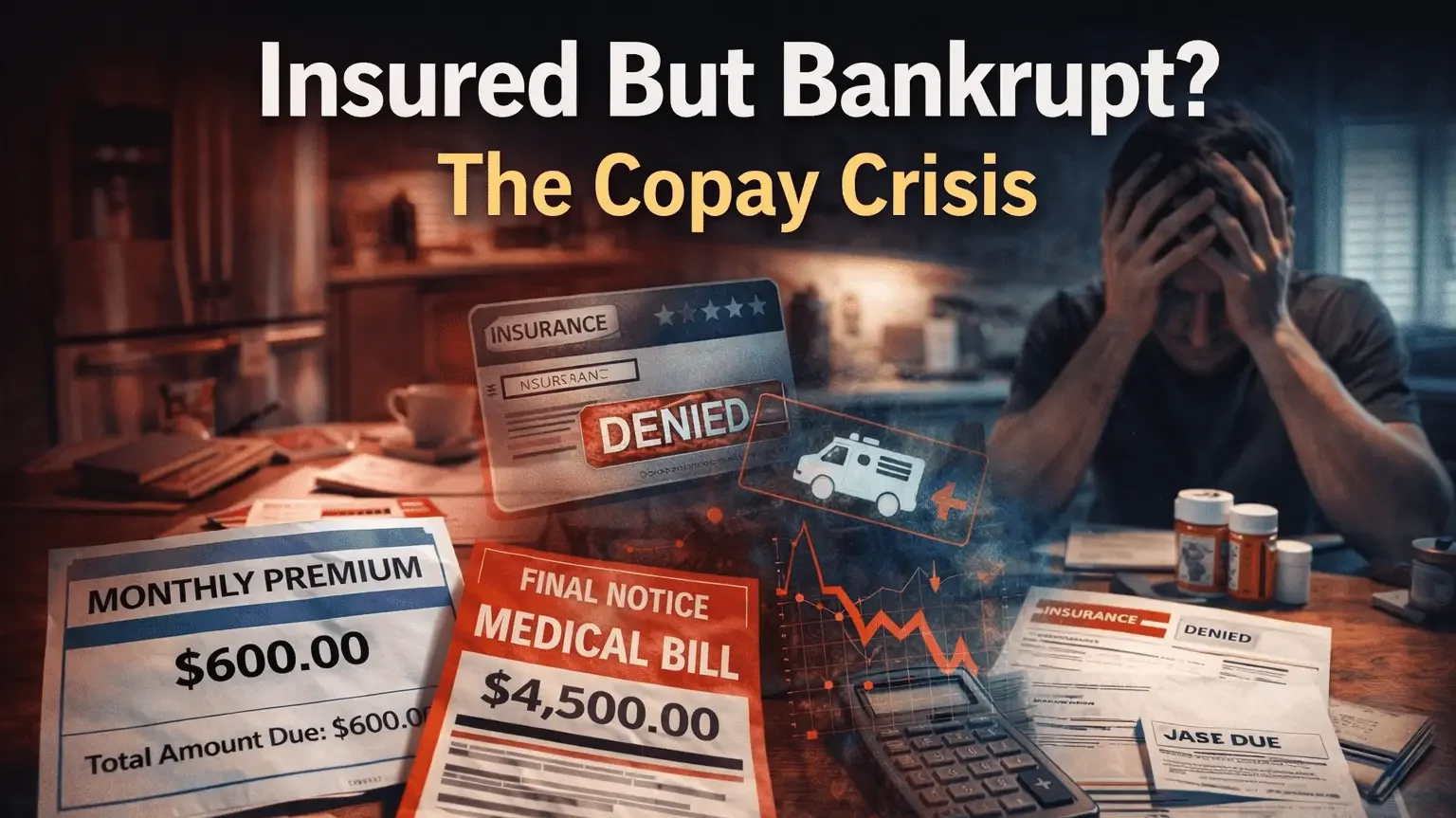
We have reached a point in the United States where having health insurance does not actually mean you are insured against financial ruin. The premise of insurance is risk pooling: we all pay a little so that if tragedy strikes, none of us are bankrupted. But the modern American healthcare financing apparatus operates entirely differently. It is a highly engineered wealth extraction system. You pay an exorbitant monthly premium—often $600 or more just for your share of a family plan—and in return, you get a plastic card that provides almost no actual shelter when the ambulance sirens start wailing.
The human reality of this system is deeply traumatic. I have had employees sitting across from my desk, sobbing because they were terrified to call an ambulance for a spouse having chest pains. They were literally doing the math on out-of-network municipal transport fees while a loved one was gasping for air. This is the psychological state of the American worker today. We are paying luxury-car prices for coverage that actively fights us when we try to use it. From algorithmic claim denials that reject life-saving surgeries in 1.2 seconds, to the glaring loopholes in the No Surprises Act, to the total destruction of the American retirement dream, the system is working exactly as it was designed to. It is designed to shift the financial burden onto the patient.
This report is a deep, fiercely objective dive into the mechanics of this crisis. It is time to pull back the curtain on the premiums, the deductibles, the AI-driven denials, and the catastrophic ripple effects that are forcing our elderly back into the labor market just to survive.
The Premium and Deductible Squeeze: Paying More for Less
To understand the sheer scale of the grift, we have to look at the baseline cost of entry. The cost of employer-sponsored health insurance has hit a terrifying new threshold. According to the 2025 KFF Employer Health Benefits Survey, the average annual premium for family coverage reached an astonishing $26,993.1 For single coverage, the average premium stands at $9,325.1 This represents a 6 percent increase over 2024, following a 7 percent increase the year prior.2
But those are just the macro numbers. The burden that falls directly on the employee’s paycheck is what causes the day-to-day panic. In 2025, covered workers contributed an average of $6,850 toward the cost of family coverage.1 If you work for a smaller company, the math is even more brutal. Workers at firms with 10 to 199 employees contribute an average of $8,889 annually for family coverage.2 Let that sink in. More than a third of covered workers in small firms (34 percent) are trapped in plans where their out-of-pocket premium contribution exceeds $10,000 a year.2
[Image placement: A simple, impactful bar chart showing the divergence between stagnant middle-class wage growth and the explosive vertical trajectory of healthcare premiums from 2004 to 2025.]
But paying that $6,850 or $10,000 does not buy you healthcare. It only buys you a deductible. Before your insurance company pays a single dime for a major procedure, you have to hit that threshold out of your own bank account. The average general annual deductible for a single worker in 2025 is $1,886.1 Again, smaller businesses take the hardest hit: the average deductible for workers at small firms is $2,631, compared to $1,670 at larger firms.4 Over the last decade, the average deductible for single coverage has surged by 43 percent.4
| Coverage Metric (2025 KFF Data) | National Average | Small Firms (10-199 workers) | Large Firms (200+ workers) |
| Total Family Premium | $26,993 | $26,993* | $26,993* |
| Worker Contribution (Family) | $6,850 | $8,889 | $6,227 |
| Single Deductible | $1,886 | $2,631 | $1,670 |
(Note: While the aggregate average family premium remains relatively consistent across firm sizes, the percentage of that cost violently shifted to the employee at smaller firms.2)
In the HR world, we justified this shift by championing High-Deductible Health Plans (HDHPs). The corporate strategy was simple: Goal: Cost Control. The Win: Lower fixed overhead and payroll tax savings via HSA contributions.5 We were handed talking points to tell employees that having “skin in the game” would make them better, more responsible consumers of healthcare.6 We pretended that an employee could shop for an MRI the same way they shop for a television.
It was a profound failure of empathy and economics. Healthcare is not an elastic consumer market. You cannot negotiate with an emergency room doctor while you are bleeding. The result of these high deductibles is not savvy shopping; it is the total avoidance of medical care.
In 2023, 27 percent of all American adults skipped some form of medical treatment simply because they couldn’t afford it.8 While 75 percent of uninsured adults skip care, having the plastic insurance card doesn’t shield you: 37 percent of adults with health insurance report delaying or entirely skipping needed medical care due to the cost of their deductibles and copays.9 Workers are cutting their pills in half, ignoring chronic pain, and hoping their symptoms magically disappear because that $2,631 deductible stands like a brick wall between them and the doctor. They are paying a massive premium for a service they cannot afford to use.
The Illusion of the EOB: Weaponized Confusion
If you do brave the doctor’s office, you enter the second phase of the gauntlet: the billing and Explanation of Benefits (EOB) cycle. To the average worker, an EOB is a terrifying, cryptic document that arrives in the mail weeks after a procedure. It explicitly states “THIS IS NOT A BILL” across the top, yet it details massive charges and leaves a deeply unsettling “Patient Responsibility” balance at the bottom.11
The EOB is the written record of the financial negotiation between the provider and the payer, and it is weaponized through sheer complexity. When an EOB doesn’t match the eventual doctor’s bill, panic sets in. Sometimes a hospital bills you before the insurance company has even processed the claim.13 Other times, the insurance company adjusts the payment based on internal codes that the patient has no hope of deciphering.
Let’s look at the actual codes used by the X12 standard in medical billing.14 These are the two-letter Group Codes and Claim Adjustment Reason Codes (CARCs) that dictate financial ruin:
| Group Code / CARC | Definition | The Patient Reality |
| PR | Patient Responsibility | The amount the insurer refuses to pay, shifting the burden entirely to you.16 |
| CO-11 | Service not covered | The insurer decided the procedure you already had wasn’t included in your policy.14 |
| CO-16 | Lacks information | The provider missed a digit on an NPI or diagnosis code, triggering an automatic denial.14 |
| CO-97 | Bundled service | The insurer claims the service was already included in another charge, often resulting in unpaid provider balances.14 |
| PI-204 | Not covered under plan | A catch-all for services the payer has unilaterally decided fall outside your benefit scope.14 |
Every single error, every missing piece of data collected at the registration desk, sends ripples downstream, resulting in costly rework, payment delays, and intense patient stress.17 When a provider submits a claim, and the insurer replies with a CO-16 denial, the provider often just bills the patient for the balance. The patient, lacking the medical coding degree required to argue with the insurer, just pays it or goes into debt. This administrative complexity is not a bug in the system; it is the system. Confusion is highly profitable.
The Algorithm Will See You Now: The Claim Denial Epidemic
This brings us to the darkest reality of modern American health insurance: the claim denial epidemic. Even when you pay your premiums, hit your deductible, and see an in-network doctor, the insurance company simply refuses to pay.
Federal transparency data analyzed by KFF for the 2023 ACA Marketplace plans revealed that insurers denied a staggering 19 percent of all in-network claims.18 Think about that: nearly one in five claims submitted by doctors approved by the insurance company were rejected. For out-of-network claims, the denial rate jumps to 37 percent.18 Across HealthCare.gov insurers, 73 million in-network claims were flatly denied in a single year.18
State-level data confirms this national crisis. In Massachusetts, the Health Policy Commission found that fully-insured commercial health plans denied 20.4 percent of all claims in 2024—a total of 45.9 million rejected claims.19
The denial rates by specific major insurers expose a business model that clearly prioritizes shareholder margins over patient health. MoneyGeek’s analysis of 2024 CMS data showed Oscar Health rejecting 25.3 percent of claims. Molina Healthcare rejected 22 percent. UnitedHealthcare, the absolute behemoth of the industry, denied 19.1 percent of claims.20
| Insurer / Entity | 2024 In-Network Denial Rate | Source |
| Oscar Health | 25.3% | MoneyGeek / CMS Data 20 |
| Molina Healthcare | 22.0% | MoneyGeek / CMS Data 20 |
| Massachusetts (All Commercial) | 20.4% | Health Policy Commission 19 |
| UnitedHealthcare | 19.1% | MoneyGeek / CMS Data 20 |
How do they deny so many claims so quickly? They have replaced human empathy and medical judgment with artificial intelligence.
Insurers have largely outsourced the medical review process—the “prior authorization” hurdle—to third-party companies that specialize in generating denials. ProPublica exposed this “denials for dollars” industry, highlighting EviCore, a company owned by Cigna that manages prior authorizations for over 100 million Americans.21 Insurers hire EviCore precisely for its ability to minimize claim payouts. In many cases, EviCore enters into “risk contracts” where it takes responsibility for paying claims; if it keeps the cost of MRI approvals or cancer treatments below a certain cap, EviCore pockets the difference.22 The financial incentive to deny your care is baked into the contract. Former insiders referred to an algorithm backed by AI as “the dial,” which they could physically turn up to generate higher denial rates when they needed to hit financial targets.21
[Image placement: A stark screenshot of an internal corporate dashboard, blurred out slightly, with an ominous digital “dial” graphic representing algorithm strictness, hovering next to a patient’s denied cancer treatment request.]
The speed of these AI denials is terrifying. ProPublica’s investigation into Cigna revealed an automated system called PXDX that allowed corporate medical directors to sign off on claim denials in batches. One doctor rejected 121,000 claims in just two months. They were denying 50 charts in 10 seconds. That is 1.2 seconds per claim.23 No one is reading your medical history. No one is looking at your doctor’s notes. A machine flags a mismatch in codes, and a doctor hits a mass-deny button.
This algorithmic violence extends to the Medicare Advantage population. UnitedHealthcare and Humana have faced class-action lawsuits for allegedly using an AI model called “nH Predict” to wrongfully deny medical claims and prematurely end post-acute care for the elderly.23 The lawsuits claim this algorithm has a 90 percent error rate, meaning that when patients actually have the stamina to fight the denial before a federal administrative law judge, the algorithm’s decision is overturned 9 out of 10 times.23
But the insurers know the golden rule of the denial game: patients are too sick, too exhausted, and too confused to fight back. Across the ACA marketplace, fewer than 0.2 percent of denied claims are ever appealed by the consumer.18 The insurers bank on your exhaustion.
The human toll of this process is catastrophic. Consider Dr. Dan Hurley, an ear, nose, and throat surgeon who spent his career fighting insurance red tape for his own patients. When he was diagnosed with chondrosarcoma, an ultra-rare bone tumor, his own insurance company mercilessly denied his care. They denied his PET scans. They denied his CT scans. They denied his chemotherapy and his radiation, claiming it was “not medically indicated”.28 If a dual-physician family cannot secure approval to treat a deadly bone tumor, what chance does a warehouse worker or a school teacher have?
Or consider Trevor Malosh, who needed a life-saving heart valve replacement. His family, insured through Molina Healthcare, spent months battling the insurance company and the hospital just to get the surgery approved, while Trevor suffered from severe weakness and dizziness, a ticking time bomb in his chest.29
The industry hides behind the excuse that most denials (roughly 77 percent) are for “administrative reasons” or paperwork errors rather than clinical judgment.20 They blame the doctors for submitting incomplete forms. But to the patient staring down a $143,000 hospital bill for a heart procedure, the distinction between a coding error and a medical necessity denial is completely irrelevant. The financial devastation is exactly the same.
The 911 Russian Roulette: The Ground Ambulance Trap
If there is one aspect of American healthcare that perfectly encapsulates the terror of being insured, it is the ground ambulance industry.
In 2022, the federal government enacted the No Surprises Act (NSA), which was heralded as a massive victory for consumers. It banned most surprise out-of-network bills for emergency room visits, in-network hospital care, and air ambulances.31 However, the law contained a massive, almost unbelievable gap: it completely excluded ground ambulances.32
Every year, 3 million privately insured Americans rely on emergency ground transportation.34 When you are having a heart attack, or when your child has been T-boned in a car crash, you dial 911. You cannot pull out your insurance directory to verify if the responding EMTs are “in-network.” You have absolutely zero market choice. Because of this, more than half of all emergency ground ambulance rides result in an out-of-network surprise bill.32
The costs are astronomical. The United States has the most expensive ambulance billing in the world. The average cost of a ground ambulance ride is between $1,093 and $1,383, with mileage fees reaching $19 per mile.36 When your insurance refuses to pay the full out-of-network rate, the ambulance company legally comes after you for the balance. The average surprise bill is $450, but it routinely stretches into the thousands.32
Let me tell you about the reality of this regulatory failure. Danielle Miele called an ambulance for her teenage son during a severe mental health crisis. The out-of-network transfer resulted in a $9,000 bill that was immediately sent to collections.39 When Danielle later suffered severe, heart-attack-mimicking seizures, she called 911 and was hit with a $4,000 bill. The trauma of the billing completely broke her trust in the system. “The last time I had one of my seizures I basically said, ‘I’m going to die here at home… I’m not getting another ambulance,'” she said. “I’d maybe rather die at home than have more medical debt”.39
Consider Katie Moraida. She gave birth to her baby in the front seat of her car just feet from the hospital entrance. Paramedics rushed out and carried her and the newborn the final few feet into the emergency department. The ride lasted less than a minute. The bill was $3,500. Her insurer covered a fraction, leaving the new family on the hook for the rest.38
Nicole Silva’s four-year-old daughter was in a severe car crash. Even though the child was covered by Medicaid, a privately acquired ambulance company billed them $2,181. When the family couldn’t pay, the debt collector added court fees, ballooning the debt to over $3,000, and successfully garnished Nicole’s wages, leaving the family unable to pay for food, electricity, and their mortgage.40
In the absence of federal protection, 22 states have scrambled to pass their own laws banning ground ambulance surprise billing for state-regulated health plans.33 California passed AB 716, which limits patient cost-sharing to in-network rates and forces insurers and ambulance companies to figure out the math themselves.39 Washington state expanded its Balance Billing Protection Act to do the same.43
But here is the devastating HR reality that most people do not understand: state laws cannot protect you if you work for a mid-to-large corporation. Roughly 65 percent of workers in the U.S. get their insurance through self-funded employer-sponsored plans.44 Under a federal law known as the Employee Retirement Income Security Act (ERISA), self-funded corporate plans are exempt from state insurance regulations.39 This means that even if you live in California or Washington, if you work for a large multi-state employer, your plan is immune to those state-level ambulance protections. You are still completely exposed.
This is why my employees were terrified to dial 911. They knew that the flashing red lights outside their window weren’t just a sign of medical rescue; they were a sign of impending financial ruin.
Ghost Networks and the HSA Scam
If you avoid the ambulance and try to responsibly book an in-network specialist, you run headfirst into another industry fabrication: the “Ghost Network.”
Insurers are required to provide directories of in-network doctors. However, these directories are frequently filled with doctors who have retired, moved, stopped accepting that specific insurance, or simply aren’t accepting new patients. A recent investigation by the New York Attorney General found that a staggering 86 percent of mental healthcare providers listed on state health plan networks were “ghosts”.45 A 2025 federal report by the HHS Office of Inspector General confirmed that Medicare Advantage and Medicaid managed care plans feature wildly inflated networks populated by inactive providers.46
For patients, ghost networks are a form of psychological torture. Seetha DeMarco spent days scrolling through her son’s Medicaid managed care directory, dialing disconnected numbers and leaving messages for doctors who refused the plan. It took her nearly ten years to locate an active, competent, in-network mental health provider for her son’s severe psychiatric condition.47 Mary Kuhn went to the ER with chest pain and was diagnosed with a massive, life-threatening hiatal hernia where her stomach had pushed into her chest cavity. When she searched her insurer’s directory for a specialist to perform the complex surgery, she found that the doctors listed didn’t actually accept her insurance. She was trapped in a ghost network while her organs twisted inside her.48
Insurers blame provider turnover, but consumer advocates know the truth: bloated, inaccurate directories allow insurers to market their plans as comprehensive while creating a massive administrative barrier to care.48 If a patient gets frustrated and pays out-of-pocket for an out-of-network doctor, the insurer saves money. If the patient gives up and doesn’t get the care at all, the insurer saves even more money.
To counter these out-of-pocket nightmares, HR departments heavily pushed Health Savings Accounts (HSAs) alongside High-Deductible Health Plans. We pitched HSAs as a brilliant, triple-tax-advantaged wealth-building tool.49 You put pre-tax money in, it grows tax-free, and you spend it tax-free on medical costs.
But from my desk, I saw the HSA for what it really was: a scam for the working class. If you are making $45,000 a year, trying to feed your kids and pay rent, you do not have disposable income to passively park in an HSA investment account. HSAs only benefit high-income earners who can afford to max out the contributions and use it as a backdoor retirement fund while paying for their current medical bills out of their standard cash flow. For the average worker, the HSA is just a mechanism to lose part of your paycheck to cover a $3,000 deductible that you never should have had in the first place.50
GoFundMe: The True American Safety Net
When the premiums eat your paycheck, the deductible drains your checking account, the algorithm denies your claim, and the ambulance sends you to collections, where do you turn? You turn to internet begging.
GoFundMe launched in 2010 to help people fund honeymoons, graduation trips, and creative dreams.51 Today, it is the de facto safety net of the American healthcare system. In 2020, there were roughly 200,000 campaigns dedicated strictly to medical causes—a 25-fold increase from 2011.51 Today, one-third of all donations made on GoFundMe go directly to paying healthcare costs.52
This has become so normalized that hospital financial aid officers and patient advocates routinely instruct desperate patients to start a GoFundMe campaign as a legitimate alternative to being sent to collections.51 We have normalized digital panhandling as a standard part of the healthcare billing cycle. Need a pediatric gene therapy that costs $2.1 million? Start a campaign.51 Your son’s appendix burst and your high-deductible plan wiped you out? Ask your neighbors for cash.54
And for those who don’t go viral, the debt consumes them. In 2024, 36.3 percent of U.S. households reported carrying some form of medical debt.55 The federal government estimates there is $194 billion of medical debt sitting in active collections.55 Over 20 percent of adults have a past-due medical bill, and 23 percent are locked into payment plans with their providers.55
This debt is absolute poison. An oft-cited study indicates that 66.5 percent of people who file for personal bankruptcy cite medical bills as the primary cause.56 Medical debt destroys your credit score, making it impossible to buy a car or rent an apartment. It limits your economic mobility. It breeds chronic stress and depression, leading people to avoid the follow-up care they desperately need, which ironically guarantees they will end up back in the hospital with a more severe, more expensive crisis down the road.57
The Ripple Effect: Stealing the Retirement Dream
The devastation of the copay crisis does not stop at the hospital doors. It is actively destroying the long-term financial security of the American workforce. You cannot simultaneously survive the medical debt gauntlet and save for retirement.
To understand this, we have to look at how corporate America systematically shifted the burden of retirement risk onto the individual over the last forty years. In the 1970s and 1980s, the gold standard for retirement was the Defined Benefit (DB) pension plan. Your employer funded the pension, managed the investments, and absorbed the market risk. When you retired, you received a guaranteed, predictable monthly check until you died.58 In 1980, 92 percent of private retirement saving contributions went into employer-funded plans.60
But corporations realized pensions were expensive and risky. Following the Employee Retirement Income Security Act (ERISA) of 1974 and the introduction of the 401(k) via the Revenue Act of 1978, companies saw a golden opportunity to wash their hands of the liability.61 They froze the pensions and moved the workforce onto the Defined Contribution (DC) model—the 401(k).59
The 401(k) was originally designed as a supplemental perk for highly compensated executives to defer taxes on bonuses.61 It was never meant to be the sole retirement vehicle for the American middle class. But employers pushed it because it shifted all the investment risk, all the market volatility, and all the funding responsibility squarely onto the shoulders of the employee.58
This massive risk transfer collided directly with the explosion of healthcare costs. Financial advisors tell workers they need to save 10 to 15 percent of their income for retirement. They say the “magic number” to retire comfortably in 2025 is $1.26 million.65
How is a worker supposed to amass $1.26 million when they are paying $10,000 a year in insurance premiums, draining their bank account to meet a $2,600 deductible, and battling a $3,500 surprise ambulance bill? They can’t.
The data from the Federal Reserve’s Survey of Consumer Finances proves that the 401(k) experiment, weighed down by the anchor of healthcare costs, has failed the average American. The median retirement savings for a household aged 55 to 64 is just $185,000.66 For those on the verge of traditional retirement, aged 65 to 74, the median balance is only $200,000.66
| Age Group | Average (Mean) Savings | Median Savings | The “Magic Number” Goal |
| 45 to 54 | $313,220 | $115,000 | N/A |
| 55 to 64 | $537,560 | $185,000 | $1,260,000 |
| 65 to 74 | $609,230 | $200,000 | $1,260,000 |
| 75 and older | $462,410 | $130,000 | N/A |
(Data sourced from the Federal Reserve Survey of Consumer Finances 65)
Notice the massive gap between the “Average” and the “Median.” That gap represents extreme wealth inequality. A handful of highly compensated executives have multi-million dollar balances that skew the average upward, making the system look healthier than it is.61 The median tells the true story of the working class. Furthermore, 54 percent of American households report having absolutely zero dedicated retirement savings.65
When you take a median balance of $200,000 and subject it to the crushing inflation we experienced between 2021 and 2024—where the cost of housing, groceries, and medical care skyrocketed—that money evaporates almost instantly.68 Inflation is the silent risk in retirement. It does not announce itself; it simply degrades your purchasing power year after year until the retirement you planned for is totally out of reach.69
Welcome to Unretirement
Because the healthcare system devoured their wages and the 401(k) system shifted the risk, an entire generation of Americans is experiencing a grim new phenomenon: “Unretirement.”
The American workforce is graying rapidly. In 2024, approximately one in five people (19 percent) aged 65 and older were still participating in the labor force.70 This is nearly double the rate of older workers compared to 35 years ago.70 Workers aged 75 and older are actually the fastest-growing age group in the labor force.72
While corporate PR might spin this as seniors “staying engaged” or looking for “social connection,” the data tells a much darker story. Nearly 30 percent of currently employed workers aged 55 and older believe they will “definitely” have to work past the traditional retirement age of 65.73 A staggering 68 percent of them explicitly state that they are continuing to work for a steady source of income and access to benefits.73 Among those who retired and were forced to re-enter the labor market—the “unretirees”—nearly half cited the desperate need for money as their primary reason for returning to work.74
They are not returning to cushy corner offices. They are taking grueling, physical jobs. Older Americans are heavily concentrated in the retail and service sectors.75 In 2024, 38.3 percent of employed older Americans were working part-time jobs.71
When you go to Walmart and see a 74-year-old man standing on a concrete floor for six hours as a greeter, or an elderly woman slowly bagging groceries at the supermarket, you are not witnessing the triumph of the American work ethic. You are witnessing the absolute failure of our healthcare and retirement systems. You are looking at someone whose life savings were likely wiped out by a single catastrophic illness, a ghost network out-of-network charge, or a $5,000 ambulance bill that their insurance company simply refused to cover.
The HR Reality: A System at the Breaking Point
As an HR professional, I watched this system break the workforce, and I am watching it break the employers as well. Companies are suffocating under the weight of these premiums.
In 2024, total health benefit costs per employee rose by about 5 percent.76 For 2025 and 2026, projections indicate an 8 to 9 percent massive surge in healthcare costs, driven by inflation, the monopolistic consolidation of hospital systems, and the explosive popularity of $1,000-a-month GLP-1 weight-loss drugs.77
To protect their profit margins, 51 percent of large employers plan to shift even more costs onto their employees in 2026 by raising deductibles and out-of-pocket maximums.79 But we have reached the saturation point. Employees have no more blood left to give.
When an employer offers a plan that bankrupts the employee upon use, the business suffers directly. Workers who skip preventative care due to high deductibles end up taking longer absences when their conditions turn critical.80 Trust in leadership plummets. Turnover increases. The entire “employer-sponsored” model has become a toxic, adversarial trap where the employer acts as a middleman, passing the extortionate costs of the healthcare industry down to a workforce that can no longer bear the weight.
We have to drop the facade. Having a health insurance card in your wallet in the United States does not mean you are protected. It means you are participating in a highly lucrative game of financial roulette, overseen by algorithms programmed to deny your claims, ambulance companies legally allowed to pillage your bank account, and a corporate structure that expects you to fund your own retirement with whatever pennies you have left.
Until we enact sweeping, aggressive federal legislation to close the ERISA loopholes, ban the algorithmic denial of care, and fundamentally divorce human health from corporate profit margins, the copay crisis will continue to rage. And the American worker will continue to pay $600 a month for the distinct privilege of being terrified to call an ambulance.


Leave a Reply