
If we were sitting across from each other having a coffee right now, I would tell you a dirty little secret about the corporate world—one that I’ve kept quiet about for a long time. Over my 17 years working in corporate Human Resources, I sat in countless budget meetings, talent acquisition strategy sessions, and hiring huddles. I have watched, year after year, as the fundamental social contract between employers and the incoming generation of workers has been quietly, systematically shredded.
We used to have a deal in our global economy. It was a fair, objective proposition: You, the young person, go to school, study hard, accrue the necessary debt, and get your degree. In exchange, we, the corporate sector, will provide you with an entry-level job. We will pay you a modest starting salary, and we will take on the burden of training you, teaching you our systems, and molding you into a productive professional.
Today, that deal is dead. And I am tired of pretending it isn’t.
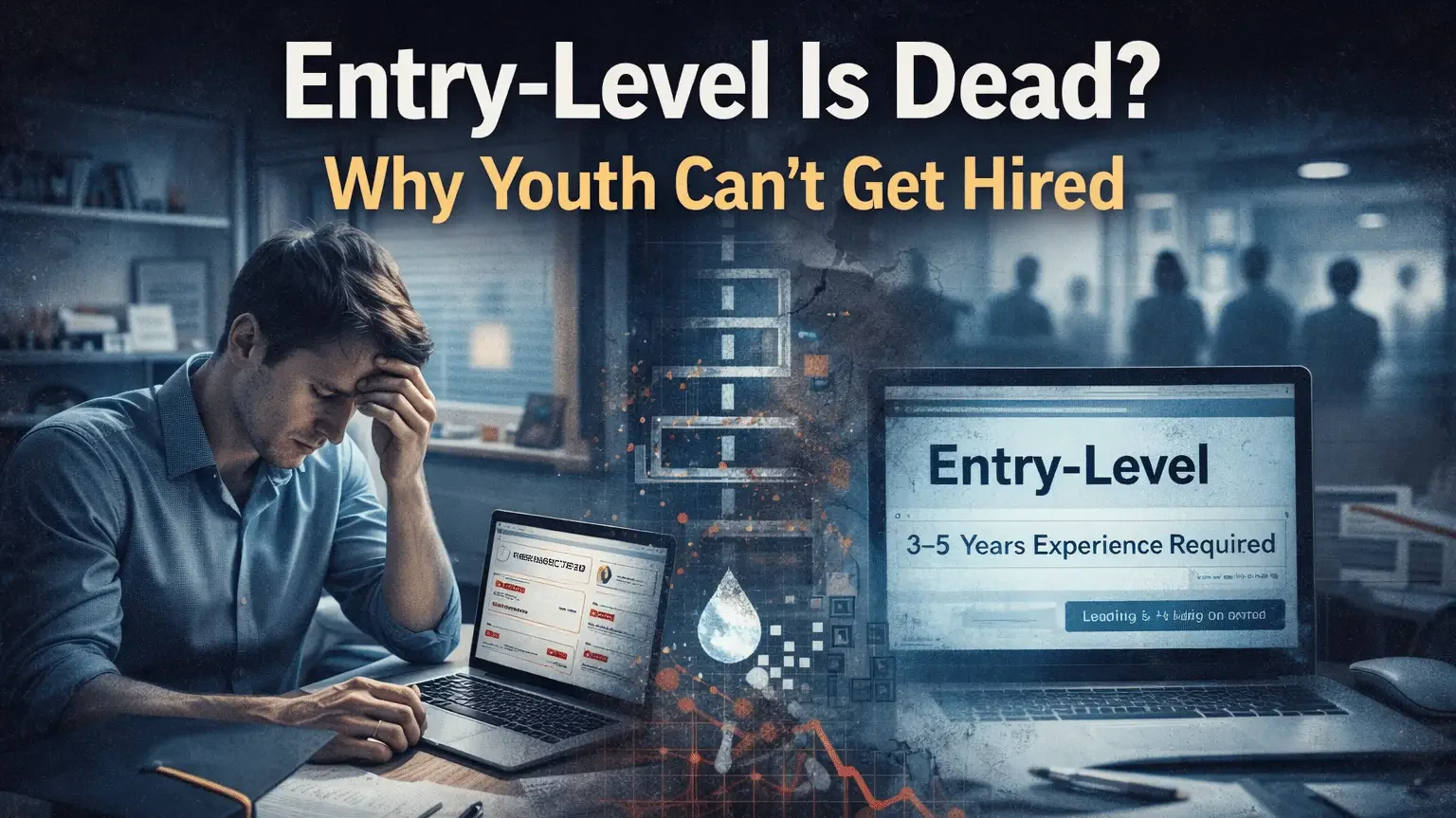
We are currently witnessing a global phenomenon that I call the “Experience Paradox.” A highly educated, deeply motivated generation of fresh graduates is slamming into an immovable, absurd structural barrier: job postings that are titled, advertised, and compensated as “entry-level,” yet explicitly demand three to five years of prior professional experience. We are demanding that a 22-year-old possess a half-decade of specialized corporate history the moment they are handed their bachelor’s degree.
As the author of The Voice of Human, my core philosophy is rooted in fairness and objective right and wrong. I have zero tolerance for entitlement, whether it comes from an employee demanding unearned privileges or a corporation demanding free labor. But what is happening to the graduating classes of 2024, 2025, and beyond is not a case of youth entitlement. It is a massive, systemic market failure driven by corporate hypocrisy, a complete refusal to invest in human capital, and the predatory illusion of the “ghost job” economy.
I want to share my deep, unfiltered thoughts with you on this. Backed by heavy, accurate research and my own nearly two decades in the HR trenches, we are going to tear apart the corporate refusal to train young talent. We will examine the broken pipeline that is permanently locking highly educated youth out of their chosen fields, creating a generation of “full-time children” in China, a massive youthquake in Africa, and a deeply scarred, anxious youth cohort in the United States and Europe.
The Statistical Reality of Experience Inflation
Let me be brutally honest: The term “entry-level” no longer means what it meant twenty, or even ten, years ago. In modern talent acquisition, “entry-level” has been functionally redefined to mean “an early-career professional who is desperate enough to accept an entry-level wage.”
The data supporting this shift is overwhelming, and it validates every ounce of frustration felt by today’s youth. An analysis of over 95,000 job postings revealed that an astonishing 61% of all full-time jobs categorized as “entry-level” require at least three years or more of prior professional experience.1 Think about that. Over six in ten jobs that are supposed to be the gateway into the workforce are legally and procedurally barring anyone who hasn’t already been working in the workforce. Furthermore, LinkedIn’s own internal data indicates that 35% of their entry-level postings mandate three or more years of experience right out of the gate.3
In my HR career, I watched this “experience inflation” happen in real-time. A hiring manager would come to me with a requisition for a junior coordinator. I would ask what the budget was. They’d give me a rock-bottom number. Then I’d ask what skills they needed. They would hand me a laundry list of software proficiencies, project management certifications, and strategic capabilities that take years to master. When I pushed back, telling them they couldn’t afford a mid-level professional on a junior budget, they would simply shrug and say, “Just post it as entry-level and require three years of experience. Someone out there is desperate enough to take it.”
Nowhere is this cruelty more evident than in the technology sector. Between the second quarters of 2022 and 2025, the share of US tech job postings demanding at least five years of experience rose from 37% to 42%.4 Concurrently, the proportion of postings seeking candidates with two to four years of experience dropped from 46% to 40%.4 You might assume that this means true entry-level roles (zero to one year of experience) expanded to fill the gap. You would be wrong. True entry-level tech postings have remained completely stagnant, accounting for a measly 18% of the tech market in early 2025.4
| Experience Level Requirement in US Tech Sector | Q2 2022 Share | Q2 2025 Share | Trend Implications |
| Senior (5+ years) | 37% | 42% | Severe tightening; hoarding of seasoned talent 4 |
| Mid-Level (2-4 years) | 46% | 40% | Squeeze on early-career professionals moving up 4 |
| True Entry-Level (0-1 year) | 17% | 18% | Stagnant; mathematically insufficient to absorb graduates 4 |
Global entry-level job posting volumes across all sectors have fallen by a staggering 29 percentage points since January 2024.5 The Aura labor index reported an 11.2% drop in entry-level postings from Q1 2021 to Q2 2024, alongside a 7% to 10% decrease in positions that genuinely require no prior experience.6 We are looking at a systemic, intentional erasure of the entry point into the global economy.
The Cruelty of the “Ghost Job” Economy
If experience inflation is the wall keeping graduates out, the “ghost job” economy is the mirage convincing them to keep running into it.
I want to talk to you about the sheer psychological warfare currently being waged on job seekers. When a fresh graduate tailors their resume, writes a passionate cover letter, and fills out a 45-minute Workday application, they operate under the assumption that there is an actual job on the other end of the screen. In a shocking number of cases, there is not.
By 2025, multiple labor market analyses confirmed that roughly one in five job postings online (between 18% and 22%) are “ghosts”—listings kept live with absolutely zero intention of hiring.7 In the corporate services sector, this figure spikes to an infuriating 31%.8 An analysis of the Bureau of Labor Statistics (BLS) Job Openings and Labor Turnover Survey (JOLTS) highlights a massive “phantom gap.” In June 2025 alone, employers reported 7.4 million job openings but made only 5.2 million hires, leaving 2.2 million roles that simply never materialized.9
Why do companies do this? Having sat in the HR director’s chair, I can tell you exactly why, and it is entirely rooted in corporate self-interest. A survey of 1,641 hiring managers in 2024 revealed the grotesque truth. Companies post fake listings to appear open to external talent (67%), to project a false image of corporate growth to investors and competitors (66%), to make current, overworked employees feel easily replaceable so they won’t ask for raises (62%), and to passively harvest resumes for a database (59%).8
These are not hiring strategies; they are deceptive marketing tactics and psychological manipulation. Astoundingly, 85% of these hiring managers admitted to actually interviewing candidates for roles they never planned to fill.8 Let that sink in. They looked a desperate 22-year-old in the eye, asked them where they saw themselves in five years, and rejected them a week later for a job that never existed, just to make it look like the HR department was busy.
For the entry-level candidate, this creates a deeply distorted, gaslit reality. In 2024, 56% of job seekers encountered a ghost job, and post-interview ghosting—where an employer simply vanishes into the ether after conducting interviews—rose to 61%.8 Historically underrepresented job seekers face this post-interview ghosting even more frequently (66%).10
This phenomenon fundamentally breaks the feedback loop of the labor market. When graduates send hundreds of applications into a void of ghost jobs, they cannot determine if their failure is due to a lack of skills, a poor resume format, or the fact that the job was an illusion. The resulting psychological toll is severe, with 79% of workers reporting heightened anxiety in the job-hunting process.10 We are bleeding the youth of their hope, their time, and their dignity to prop up fake corporate metrics.
The Market Failure: The Death of Corporate Training
To understand why a 22-year-old is expected to possess three years of experience, we must examine the systematic, deliberate dismantling of corporate training programs over the past three decades. The Experience Paradox is not merely an accident of the market; it is a calculated, albeit incredibly short-sighted, corporate strategy.
Peter Cappelli, a prominent management professor and director of the Wharton Center for Human Resources, has chronicled this beautifully. He notes that the traditional employment system—characterized by secure jobs, predictable advancement, and robust internal training—is effectively dead.3 In the past, companies operated under an “internal labor market” model. Hiring was done primarily at the entry level, with companies absorbing the cost of training fresh graduates to build a loyal, customized, highly capable workforce.12
Today, that model has been replaced by a ruthless “talent acquisition” paradigm. Companies no longer view training as a long-term capital investment; they view it as an immediate, unjustifiable expense. They want “turn-key” personnel who can be slotted directly into a workflow and generate immediate ROI.13 “Everybody wants to hire somebody with three years’ experience, and nobody wants to give them three years’ experience,” Cappelli observes.3
The Public Good Problem and the Poaching Epidemic
From an economic perspective, this shift is rooted in a fundamental concept known as the “public good problem” or an internal market failure.14 In a highly mobile, freewheeling labor market, corporate executives live in mortal terror of training someone, only to have them leave. If a company spends six months and $50,000 training an entry-level employee, that employee becomes highly valuable. A competitor—who saved money by not running a training program—can simply swoop in, offer the employee a slightly higher salary, and poach them.11
Because no individual firm wants to bear the cost and risk of training, every firm attempts to free-ride on the training provided by others. This creates a classic tragedy of the commons. When all companies refuse to train, the overall pool of competent mid-level professionals shrinks, creating artificial scarcity. This drives up the cost of experienced labor, forcing companies to pay massive premiums for senior talent while simultaneously locking out the youth who are begging for an opportunity to learn.
In my time in HR, I saw training budgets decimated. In 2024, 74% of organizations that decreased their training budgets cited “economic uncertainty” as the reason.17 Organizations allocate measly portions of their budgets to onboarding (13%) and compliance (12%), leaving almost nothing for deep, foundational skill-building.17 Instead, new hires are thrown into a “sink-or-swim” environment. They are judged by their ability to instantly perform, often trained in passing by overwhelmed, stressed-out co-workers who resent the interruption.18
The Delusion of Cost-Saving
The supreme irony—and the part that offends my sense of basic business logic—is that refusing to train rarely saves the company money in the long run. The cost of a bad hire, or the prolonged vacancy of a critical role, is astronomical. Hiring a new employee typically costs three to four times the position’s salary.18
When companies refuse to train, turnover skyrockets. In 2021, an average of 25% of employees across all industries left their jobs voluntarily, often due to a lack of development or clear career progression.18 Michael Leboeuf famously warned, “If you believe that training is expensive, it is because you do not know what ignorance costs”.19 Quality training mitigates turnover, boosts morale, and drastically increases long-term ROI.19 Organizations providing cohort-based leadership development are 1.9 times more likely to innovate effectively and 1.6 times more likely to unleash employee potential.20 Yet, in a corporate landscape obsessed with the next quarter’s earnings report, the long-term benefits of human capital development are consistently sacrificed.
The Hypocrisy of the “Skills Shortage” Myth
If you read the business press, you will inevitably hear corporate entities and industry associations screaming about an impending, catastrophic “skills shortage.” Research projections claim that between 2024 and 2032, 18.4 million experienced workers will retire, vastly outpacing the 13.8 million younger workers entering the labor market, resulting in a shortfall of 5.25 million workers with postsecondary education.21
Employers use these statistics to lobby for educational reform, demand government subsidies, and cry victim. But let’s look at this objectively: The “skills shortage” is largely a self-inflicted myth. We do not have a shortage of capable, highly educated humans. We have a shortage of fully trained, mid-career professionals willing to work for suppressed entry-level wages.
A rigorous firm-level study by MIT’s Work of the Future Taskforce evaluated the so-called “skills gap” among U.S. manufacturers. The study found absolutely no evidence of a skills gap wherein workers were somehow biologically or intellectually incapable of keeping up with advanced manufacturing capabilities.22 Instead, the researchers found that firms investing in advanced technologies simply trained their incumbent workers to use them. The companies complaining the loudest about a “skill shortage” were those demanding traditional, highly specific experience while flat-out refusing to offer on-the-job training to entry-level candidates.22
Skills-Based Hiring: A Weapon Disguised as a Tool
In response to this purported skills shortage, a massive movement toward “skills-based hiring” emerged. On paper, it sounds incredibly fair. Proponents argue that by stripping degree requirements from job postings, employers can democratize access, increase female and minority representation, and hire based on actual capability rather than expensive academic pedigrees.23 By 2025, close to two-thirds (64.8%) of employers reported using skills-based hiring practices for entry-level roles.25 LinkedIn data suggests this approach could expand global talent pools by 6.1 times.24
But here is where my HR background forces me to call out the hypocrisy. While ostensibly noble, skills-based hiring has rapidly become a new weapon used against fresh graduates. A college graduate has spent four years accumulating theoretical knowledge, cognitive flexibility, and academic discipline. For a graduate, their degree is the primary proxy for their skill.
When an employer switches to a purely “skills-based” model, they stop looking at potential. They demand proven, demonstrable workplace competencies—competencies that can only be acquired through prior employment.26 The fresh graduate is doubly penalized. Their expensive university degree is suddenly devalued by the employer as a “mere proxy,” yet they are simultaneously disqualified for lacking the specific, hard workplace skills that the employer refuses to teach them. They are caught in a Kafkaesque nightmare: they cannot get the job because they lack the exact skills, and they cannot acquire the exact skills because no one will give them a job.
| Hiring Paradigm | Corporate Justification | Actual Impact on Fresh Graduates |
| Traditional (Degree-Based) | “We hire for pedigree and train internally.” | Once provided a clear pipeline; now defunct as training budgets vanished. |
| Experience-Based (3-5 Yrs) | “We need turn-key talent to save onboarding costs.” | Creates the Experience Paradox; structurally locks youth out of the market. |
| Skills-Based Hiring | “We hire for proven competency, democratizing access.” | Devalues degrees while demanding skills only acquired through prior experience. |
The AI Factor: Automating the Apprenticeship
We cannot discuss the destruction of the entry-level job without addressing the elephant in the room: Artificial Intelligence.
Historically, true entry-level roles consisted of routine, repetitive, or foundational tasks—data entry, basic coding, drafting preliminary reports, running Excel macros, or conducting rudimentary research. These tasks were not glorious, but they served a vital purpose. They were the apprenticeship phase. They allowed young workers to learn the cadence of the business environment, understand the corporate language, and provide marginal but acceptable value to the employer while they learned.
As AI technologies (such as ChatGPT, Copilot, and Claude) have become ubiquitous since early 2023, employers have aggressively deployed these tools to absorb the foundational tasks once assigned to junior staff.4 Consequently, the “junior” role is being entirely eradicated from organizational charts. Instead, companies now seek “reviewers” and “integrators”—mid-level professionals possessing the contextual knowledge and judgment required to manage, edit, and verify AI outputs.27
By automating the bottom rung of the corporate ladder, organizations have inadvertently destroyed the mechanism by which senior talent is created. The demand for entry-level jobs requiring AI skills surged by 30% in early 2024.6 We are demanding that fresh graduates not only understand their core discipline but also possess the sophisticated technological integration and editorial skills normally acquired through years of practical corporate application.
This creates a brutal irony for Generation Z. Randstad’s massive 2025 talent survey shows that Gen Z uses AI more than any other generation, with 55% reporting they use it for problem-solving at work.5 Yet, they represent the highest share of workers worried about AI’s impact on their jobs (46%).5 They are digital natives who have mastered the tools that are being used to justify not hiring them. And to add insult to injury, there is a massive institutional failure to train them equitably: while 46% of Gen Z men have received AI training at work, only 38% of Gen Z women have.5
The Global Youth Crisis: NEETs, “Full-Time Children,” and Youthquakes
If you think this is just a minor complaint from privileged American college kids, you are entirely misreading the global macroeconomic landscape. The fallout from this broken pipeline is visible in labor statistics worldwide, and it paints a terrifying picture of a lost generation.
The International Labour Organization’s (ILO) Global Employment Trends for Youth 2024 report notes that while overall unemployment rates have ostensibly stabilized on paper, the underlying health of the youth labor market is deteriorating.29 In 2023, 64.9 million young people (aged 15 to 24) were officially unemployed worldwide, representing a rate of 13%.29
But official unemployment data grossly underestimates the crisis because it fails to capture underemployment and those who have simply given up. A far more accurate and chilling metric is the NEET rate—young people Not in Employment, Education, or Training. Globally, one in five young people (20.4%) fell into the NEET category in 2023.29 This figure represents a catastrophic waste of human potential.
The crisis is also deeply gendered and geographically unequal. Two out of every three NEETs are female, with the global youth NEET rate for young women standing at 28.1%, more than double the 13.1% rate for young men.29
China’s “Rotten-Tail Kids”
Let’s look at China to see the endgame of the Experience Paradox. In China, youth unemployment for those between 16 and 24 soared above 17% in 2024.30 With over 12 million university graduates expected to enter the market in 2025 alone, the gap between expectations and reality has reached a breaking point.31
The Chinese socio-economic landscape has birthed a devastating new terminology to describe this crisis. Graduates who are unable to find work have become known as “Rotten-tail kids” (a morbid reference to unfinished, abandoned real estate projects that litter the country).32 These are highly educated youth who, after sending out hundreds of resumes and facing salaries that are no better than what they would have received without their advanced degrees, have simply given up.30
They have become what the culture now calls “full-time children”.32 They return to their hometowns to live off their parents’ pensions, opting out of the labor force entirely. When a society tells its youth that their master’s degrees are worthless without three years of experience, and refuses to provide the avenue to gain that experience, the rational response of the youth is to withdraw. As Yun Zhou, an assistant professor of sociology at the University of Michigan, notes: “For many Chinese college graduates, better job prospects, upward social mobility, a sunnier life outlook — all things once promised by a college degree — have increasingly become elusive”.32
Africa’s Demographic Powder Keg
In regions like the Middle East and North Africa (MENA) and Sub-Saharan Africa, the challenge is existential. Africa’s youth labor force is projected to grow by an astounding 76 million people by 2050.29
Currently, in Sub-Saharan Africa, three in four young workers lack secure employment, relegated to the informal economy, temporary gigs, or sheer survivalist self-employment.29 When millions of educated, ambitious young people are concentrated in urban centers with absolutely no prospect of meaningful employment, the environment becomes a powder keg.
Macroeconomic analysts warn that youth unemployment is intrinsically linked to greater political instability.34 The lack of a stake in the economic future of their country makes youth highly susceptible to radicalization, civil unrest, and anti-government mobilization. Furthermore, this structural lockout drives massive, often perilous, cross-border migration. Young people will inevitably move to where they believe opportunity exists, draining developing nations of their brightest minds (brain drain) while simultaneously straining the political and social cohesion of destination countries in the Global North.35
| Global Region | Key Youth Labor Metric | Societal Impact |
| Global Average | 20.4% NEET Rate | 1 in 5 youth detached from the productive economy 29 |
| United States | >40% Graduate Underemployment | Widespread misalignment of education and career outcome 2 |
| China | >17% Youth Unemployment | Rise of “Rotten-tail kids” and “full-time children” 30 |
| Sub-Saharan Africa | 76M Labor Force Growth by 2050 | High risk of urban instability and massive forced migration 29 |
The Macroeconomic Doom of the “Scarring Effect”
What happens when we fail these kids? It’s not just that they have to live with their parents for a few extra years. When young workers are forced to accept low-quality, mismatched employment, or endure prolonged periods of unemployment right out of school, they suffer from what economists call the “scarring effect.”
The scarring effect is a well-documented phenomenon where entering the labor market during a period of distress or experiencing early-career underemployment results in a permanent reduction in lifetime earnings and career trajectory.36 Research demonstrates that entering the labor market during a recession, or facing structural unemployment, results in a wage penalty of 10% to 15% that persists for a decade or more.36
Let’s look at the hard data. In Canada, a mere 1% increase in the provincial youth unemployment rate during the year of graduation is associated with a 0.7% decline in earnings for five full years after graduation.38 Young women and racialized youth are disproportionately affected, facing further discrimination if they have resume gaps, thereby widening the societal equity gap.38
This scarring is not merely an individual tragedy; it is a macroeconomic anchor. When large cohorts of young workers are trapped in low-quality jobs, they fail to accumulate the relevant skills, experience, and wealth that underpin national productivity growth.36 They contribute less to the tax base while simultaneously increasing the burden on public social support systems. This dynamic lowers an economy’s long-term growth potential, suppressing aggregate demand and reinforcing a vicious cycle of economic lethargy.36 A “scarred” generation with weaker earnings prospects contributes less to innovation, buys fewer goods, and suffocates the velocity of money in the economy.
Delayed Adulthood: The Domino Effect on Housing and Milestones
The economic strangulation of the entry-level candidate has triggered a massive, generational delay in the achievement of standard life milestones. When a 24-year-old cannot secure a professional salary, they cannot save for a down payment, they cannot afford a wedding, and they cannot justify the expense of bringing children into the world.
The contrast between the Baby Boomer generation and Generation Z/Millennials is stark. Data from the Stanford Center on Longevity reveals that younger cohorts are significantly less likely to own a home by age 30, and when they do, they face a substantially higher, often crippling, debt burden.39 Life milestones such as getting married, having children, saving for retirement, and repaying student loans by age 30 are all strong predictors of home purchases, and all of these are currently being delayed by the structural lack of income.39
The National Association of REALTORS® reports a devastating statistic: Generation Z buyers (aged 18 to 25) make up a negligible 3% of the real estate market.40 Because wage stagnation and the explosive cost of living have vastly outpaced entry-level compensation, the concept of the “starter home” has completely evaporated.
Consequently, US census data reveals a staggering societal regression: nearly half of all 18- to 29-year-olds in the United States now live with their parents, the highest percentage recorded since the Great Depression era of 1929–1941.41
I stand for fairness, and I must point out the gross unfairness of this dynamic. Homeownership is the primary engine of wealth accumulation for the middle class. By locking youth out of career-track jobs, corporations are indirectly locking them out of the housing market, ensuring they miss out on a decade of vital equity growth. This transforms the younger generation into a permanent renter class, systematically transferring wealth upward to older, asset-holding generations and corporate landlords.
The Psychological Toll: Anxiety and Burnout
We cannot ignore the human element here. The emotional and psychological devastation inflicted upon this generation is profound. We are witnessing the creation of a deeply cynical, anxious, and burned-out youth cohort that feels fundamentally betrayed by the institutions that promised them success.
In the United States, 79% of job seekers report feeling heightened anxiety in the current market.10 The constant barrage of rejections from automated Applicant Tracking Systems (ATS), combined with the humiliation of interviewing for ghost jobs and the absolute impossibility of 3-5 year experience requirements, induces a state of chronic psychological distress.
A comprehensive McKinsey American Opportunity Survey highlighted that Generation Z (defined in their study as those aged 18 to 24) reports exceptionally high rates of mental health challenges, impediments to effective work, and worries about the future.42 Unlike older generations, employed Gen Z respondents are less likely to expect this period of financial insecurity to end and have high levels of doubt about their eventual ability to either buy homes or retire.42
Entering the workforce has always been daunting. But as Randstad’s research points out, Gen Z is entering a complex work environment that fosters a core paradox: they are ambitious and highly capable, yet completely disoriented and struggling to find a foothold.5 Because of the competitive market, they are forced to settle for roles that do not align with their long-term ambitions, leading to a high turnover rate. Their average tenure stands at just 1.1 years in the first five years of their career, compared with 1.8 for millennials and 2.9 for baby boomers at the same career point.5 They are moving quickly because they are desperately searching for the stability and development that no one is offering them.
Conclusion: Re-establishing the Corporate Contract
As I wrap up these thoughts, I want to be perfectly clear. The current trajectory of the global labor market is fundamentally unsustainable. The Experience Paradox—demanding years of proven capability for roles designed for beginners—is an indefensible corporate practice born of risk aversion, short-term ledger balancing, and a profound failure of industry leadership.
In my HR career, I always advocated for objective fairness. It is objectively unfair to demand that the youth shoulder the entirety of the financial burden for their academic education, and then demand they magically acquire three years of corporate training out of thin air before they are allowed to earn a living.
Corporations must abandon the delusion of the “turn-key” graduate. Universities exist to provide foundational knowledge, critical thinking, and theoretical frameworks; they do not, and should not, exist to produce fully synthesized, company-specific mid-level managers. The bridging of that gap—the transformation of a smart graduate into a productive professional—is the explicit, moral, and economic responsibility of the employer.
To repair this broken pipeline, we don’t need platitudes. We need a fundamental paradigm shift:
- A Return to Capital Investment in Humans: Employers must re-categorize training not as a sunk operational cost, but as a critical capital investment. Yes, employees might leave. But the fear of “poaching” must be combated not by refusing to train, but by creating workplace cultures, compensation structures, and retention strategies that make employees want to stay after they are trained. You cannot manage retention by keeping your workforce ignorant.
- Eradication of the Ghost Job Economy: The practice of posting fake jobs to manipulate internal morale or project false market confidence is a predatory abuse of the public. It distorts macroeconomic data and inflicts profound psychological harm on applicants. Regulatory bodies like the FTC, which recently formed a Joint Labor Task Force targeting deceptive job ads 8, must aggressively penalize corporations that harvest resumes under false pretenses. Transparency in hiring pipelines must become a standardized ethical metric.
- Redefining Skills-Based Hiring for the Youth: If companies wish to utilize skills-based hiring to democratize access, they must do it honestly. They must develop mechanisms to test for potential, cognitive agility, and aptitude rather than demanding proof of past corporate execution. True skills-based hiring should open doors for graduates by recognizing academic rigor, digital fluency, and project-based learning as valid demonstrations of capability.
- Embracing AI as an Enabler, Not a Replacer: Rather than using AI to eradicate the junior roles that traditionally trained the next generation of leaders, companies must hire youth to wield these tools. Gen Z is the most digitally native generation in human history; failing to integrate them into the AI transition is corporate suicide.
The youth of the global economy have fulfilled their end of the societal bargain. They have studied, they have adapted to a pandemic, they have accrued debt, and they are eager to build the future. It is time for the corporate sector to drop the hypocrisy, absorb the inherent costs of human development, and open the doors. If they do not, they will soon find themselves presiding over an aging, top-heavy workforce, operating within a stagnant economy stripped of the very innovation, housing demand, and societal stability upon which their long-term survival depends. We broke the pipeline. It is our absolute responsibility to fix it.
Works cited
- Entry-level jobs should be entry level | HR Dive, accessed on March 11, 2026, https://www.hrdive.com/news/entry-level-jobs-should-be-entry-level/814058/
- Entry-Level-Experience Requirements Could Be Hurting Your Hiring – SHRM, accessed on March 11, 2026, https://www.shrm.org/topics-tools/news/talent-acquisition/entry-level-experience-requirements-hurting-hiring
- Experience Required: The New Reality of Entry-Level Jobs | Indeed.com, accessed on March 11, 2026, https://www.indeed.com/career-advice/news/entry-level-jobs-prior-work-experience
- Experience Requirements Have Tightened Amid the Tech Hiring …, accessed on March 11, 2026, https://www.hiringlab.org/2025/07/30/experience-requirements-have-tightened-amid-the-tech-hiring-freeze/
- Data shows that Gen Z face a deeply competitive job market | World …, accessed on March 11, 2026, https://www.weforum.org/stories/2025/09/gen-z-are-competitive-job-market-randstad/
- Entry-Level Hiring Trends 2025: Strategy, Skills & AI Insights, accessed on March 11, 2026, https://blog.getaura.ai/entry-level-hiring-trends-2025
- From 1 in 8 to 1 in 5: Ghost Jobs Are Exploding in 2025 – Medium, accessed on March 11, 2026, https://medium.com/@patricklindsley1/from-1-in-8-to-1-in-5-ghost-jobs-are-exploding-in-2025-a7a1fbdad011
- Here is what the data actually says about Ghost jobs. : r/jobsearchhacks – Reddit, accessed on March 11, 2026, https://www.reddit.com/r/jobsearchhacks/comments/1rj2cz8/here_is_what_the_data_actually_says_about_ghost/
- Ghost Jobs: Millions of Listings That Never Lead to a Hire – My Perfect Resume, accessed on March 11, 2026, https://www.myperfectresume.com/career-center/careers/basics/ghost-job-economy
- Ghosting, ghost jobs and bots: Candidates reveal their top challenges in the Greenhouse 2024 State of Job Hunting report, accessed on March 11, 2026, https://www.greenhouse.com/blog/greenhouse-2024-state-of-job-hunting-report
- Managing Without Commitment – Wharton Magazine, accessed on March 11, 2026, https://magazine.wharton.upenn.edu/issues/winter-2001/managing-without-commitment/
- EIN NLINE – Wharton IDEAS Lab, accessed on March 11, 2026, https://ideas.wharton.upenn.edu/wp-content/uploads/2018/07/Cappelli-1999.pdf
- When, how and why did companies stop training their employees? : r/jobs – Reddit, accessed on March 11, 2026, https://www.reddit.com/r/jobs/comments/1e67ynt/when_how_and_why_did_companies_stop_training/
- Internal Market Failure: A Framework for Diagnosing Firm Inefficiency – IDEAS/RePEc, accessed on March 11, 2026, https://ideas.repec.org/a/bla/jomstd/v40y2003i2p431-457.html
- Untitled, accessed on March 11, 2026, https://ilj.law.indiana.edu/articles/76/76_1_Dau-Schmidt.pdf
- A Market-Driven Approach to Retaining Talent – Meng Weng Wong, accessed on March 11, 2026, http://mengwong.com/school/HarvardBusinessReview/market_approach_to_talent.pdf
- 2024 Training Industry Report, accessed on March 11, 2026, https://trainingmag.com/2024-training-industry-report/
- The Hidden Costs of Not Training Employees – Knowledge Anywhere, accessed on March 11, 2026, https://knowledgeanywhere.com/articles/the-hidden-costs-of-not-training-employees/
- The True Cost of Not Providing Employee Training – Shift E-Learning, accessed on March 11, 2026, https://www.shiftelearning.com/blog/the-true-cost-of-not-providing-employee-training
- What Is The True ROI Cost Of Not Training Your Employees? – Hone HQ., accessed on March 11, 2026, https://honehq.com/resources/blog/cost-of-not-training/
- Falling Behind: How Skills Shortages Threaten Future Jobs – CEW Georgetown, accessed on March 11, 2026, https://cew.georgetown.edu/cew-reports/skills-shortages/
- A Firm-level Study of Workforce Challenges at U.S. Manufacturers – MIT Work of the Future, accessed on March 11, 2026, https://workofthefuture-taskforce.mit.edu/research-post/a-firm-level-study-of-workforce-challenges-at-u-s-manufacturers/
- Skills-Based Hiring: The Long Road from Pronouncements to Practice – The Burning Glass Institute, accessed on March 11, 2026, https://www.burningglassinstitute.org/research/skills-based-hiring-2024
- Skills-Based Hiring: – LinkedIn’s Economic Graph, accessed on March 11, 2026, https://economicgraph.linkedin.com/content/dam/me/economicgraph/en-us/PDF/skills-based-hiring-march-2025.pdf
- Nearly Two-Thirds of Employers Use Skills-based Hiring Practices for New Entry-level Hires, accessed on March 11, 2026, https://www.naceweb.org/talent-acquisition/trends-and-predictions/nearly-two-thirds-of-employers-use-skills-based-hiring-practices-for-new-entry-level-hires
- Skills-Based Hiring Grows, but College Students Don’t Fully Understand It – NACE, accessed on March 11, 2026, https://www.naceweb.org/about-us/press/2026/skills-based-hiring-grows-but-college-students-dont-fully-understand-it
- AI’s Impact on Graduate Jobs: A 2025 Data Analysis – IntuitionLabs, accessed on March 11, 2026, https://intuitionlabs.ai/articles/ai-impact-graduate-jobs-2025
- Labor Market Report – LinkedIn’s Economic Graph, accessed on March 11, 2026, https://economicgraph.linkedin.com/content/dam/me/economicgraph/en-us/PDF/linkedIn-labor-market-report-building-a-future-of-work-that-works-jan-2026.pdf
- Global Employment Trends for Youth 2024 | International Labour …, accessed on March 11, 2026, https://www.ilo.org/publications/major-publications/global-employment-trends-youth-2024
- Unemployment continues to plague China’s youth in 2024 – VOA, accessed on March 11, 2026, https://www.voanews.com/a/unemployment-continues-to-plague-china-s-youth-in-2024-/7892948.html
- ‘This generation doesn’t want to be making the world’s shirts’: Why China’s jobless youth woes could persist – CNA, accessed on March 11, 2026, https://www.channelnewsasia.com/east-asia/china-young-graduates-youth-employment-two-sessions-4985016
- China’s Youth Unemployment Crisis Spurs Rise of ‘Rotten-Tail Kids’ – Vision Times, accessed on March 11, 2026, https://www.visiontimes.com/2024/08/21/chinas-youth-unemployment-crisis-spurs-rise-of-rotten-tail-kids.html
- Global Employment Trends for Youth 2024 – International Labour Organization, accessed on March 11, 2026, https://www.ilo.org/sites/default/files/2024-11/GET_2024_EN_web4.pdf
- Economic Research: Youth And Urbanization Threaten Emerging Markets’ Stability, accessed on March 11, 2026, https://www.spglobal.com/ratings/en/regulatory/article/economic-research-youth-and-urbanization-threaten-emerging-markets-stability-s101647638
- (PDF) The Impact of Youth Unemployment on Migration and Development in Nigeria, accessed on March 11, 2026, https://www.researchgate.net/publication/393886867_The_Impact_of_Youth_Unemployment_on_Migration_and_Development_in_Nigeria
- When young workers are left behind: The economic cost of youth unemployment and underemployment | International Labour Organization, accessed on March 11, 2026, https://www.ilo.org/resource/article/when-young-workers-are-left-behind-economic-cost-youth-unemployment-and
- Scarring Effects of Unemployment – IZA – Institute of Labor Economics, accessed on March 11, 2026, https://ftp.iza.org/dp6198.pdf
- Long-Term Labour Market Scarring on Youth from Economic Shocks – Future Skills Centre, accessed on March 11, 2026, https://fsc-ccf.ca/research/youth-labour-market-scarring-2/
- Generational Shifts in Age and Predictors of Homeownership – Stanford Center on Longevity, accessed on March 11, 2026, https://longevity.stanford.edu/new-map-of-life-2021/wp-content/uploads/sites/36/2018/06/Generational-Shifts-in-Age-and-Predictors-of-Homeownership-1.pdf
- Home Buyers and Sellers Generational Trends – National Association of REALTORS®, accessed on March 11, 2026, https://www.nar.realtor/research-and-statistics/research-reports/home-buyer-and-seller-generational-trends
- Home Ownership Inaccessibility for Upcoming Generations in the United States, accessed on March 11, 2026, https://ballardbrief.byu.edu/issue-briefs/home-ownership-inaccessibility-for-upcoming-generations-in-the-united-states
- How does Gen Z see its place in the working world? With trepidation – McKinsey, accessed on March 11, 2026, https://www.mckinsey.com/featured-insights/sustainable-inclusive-growth/future-of-america/how-does-gen-z-see-its-place-in-the-working-world-with-trepidation


Leave a Reply