
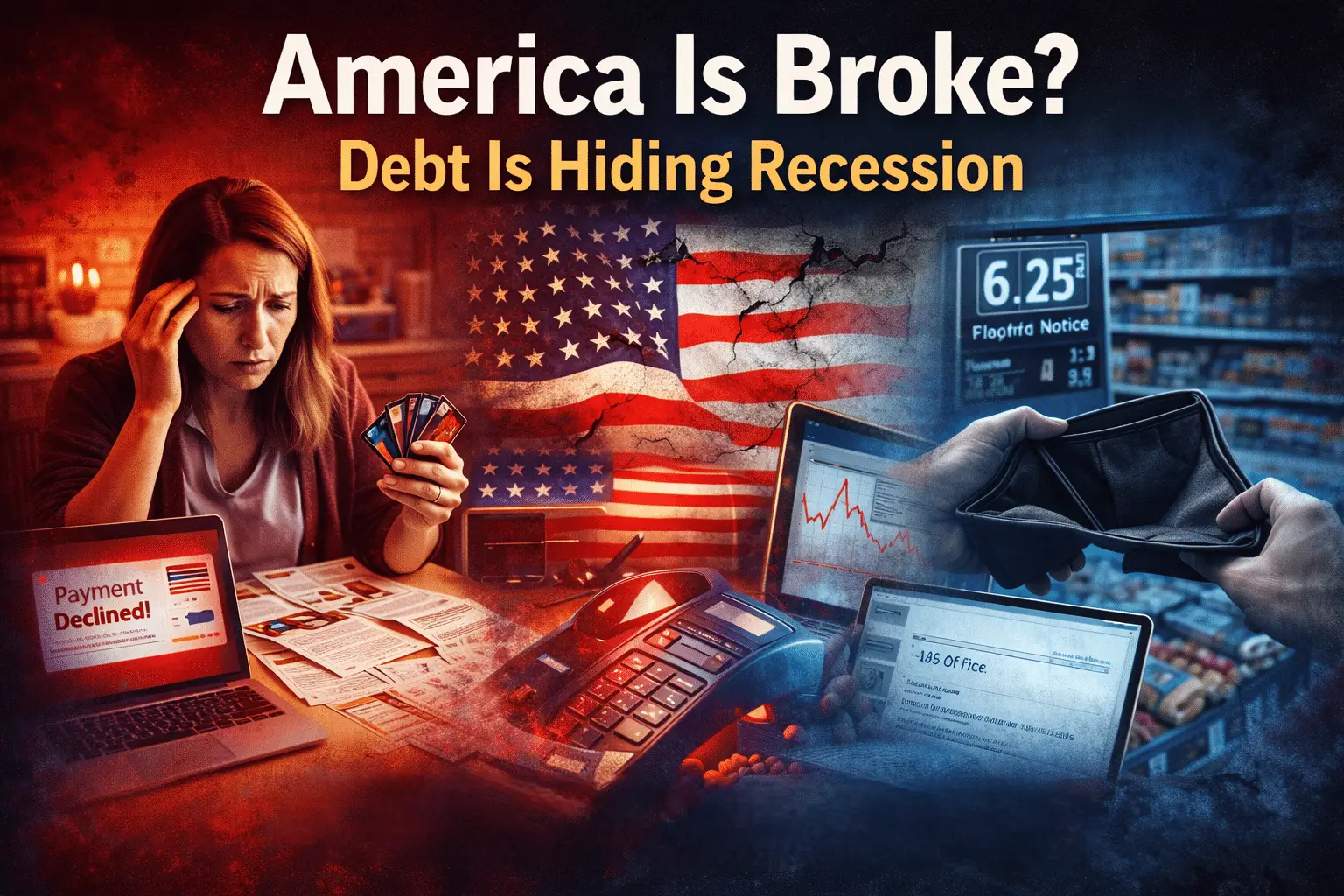
The narrative broadcast by official macroeconomic channels over the past several years has been one of relentless resilience. It is a story of a robust labor market, unyielding consumer demand, and a nation that supposedly engineered a flawless transition out of global inflation. Yet, an objective examination of the underlying reality reveals a profound, systemic rot beneath this veneer of prosperity. The United States has fully transitioned into a “Plastic Economy”—a precarious financial architecture where the illusion of a thriving middle class is sustained almost entirely by historic, high-interest consumer debt.1
This is not a story of economic expansion; it is a story of cannibalization. The narrative of a booming economy is an orchestrated gaslighting of the working class. When citizens are systemically forced to finance their fundamental caloric intake, medical care, and shelter using revolving debt instruments carrying interest rates exceeding 20 percent, the economy is not growing. It is merely leveraging its future to survive the present. The American worker in 2026 is no longer thriving. They are surviving a punishing cost-of-living crisis through a desperate, daily reliance on maxed-out credit limits.3
By piercing through the lagging, heavily revised economic indicators, a terrifying reality emerges. This comprehensive analysis will deconstruct the architecture of the Plastic Economy, exposing the catastrophic realities hidden within the 2026 jobs data, the unprecedented milestones reached in consumer debt, the daily survival mechanisms of a fractured socioeconomic class, and the profound psychological devastation this crisis is inflicting upon the human capital of the nation. It is an exploration of systemic hypocrisy, failed policies, and the quiet desperation of honest people simply trying to earn a living.
The Big Lie: Deconstructing the 2026 Labor Market Illusion
To understand the depth of the current credit crisis, the facade of the “strong” labor market must first be dismantled. For much of 2025, positive headline job reports served as the primary political and institutional defense against widespread recessionary fears. However, the employment data released in early 2026 shattered this defense, revealing a labor market that is not merely cooling but actively and aggressively contracting.5
The headline figure for February 2026 was a stunning loss of 92,000 nonfarm payroll jobs, pushing the official unemployment rate up to 4.4 percent.7 Approximately 7.6 million Americans are now officially unemployed.7 Within that population, 1.9 million individuals are classified as long-term unemployed—meaning they have been jobless for 27 weeks or more—accounting for over 25 percent of the total unemployed demographic.7
Even more damning than the outright job losses in February are the quiet, retroactive downward revisions applied to the preceding months. The final revision for December 2025 erased 65,000 jobs from the historical ledger, flipping a previously celebrated gain of 48,000 into a net loss of 17,000 jobs.7 January 2026 was similarly revised downward by 4,000 jobs.7 When the retroactive data is aggregated, United States job growth went negative in three of the six months leading up to March 2026.6 Total nonfarm employment in the year 2025 experienced the slowest non-recession year increase since 2003, adding a statistically insignificant 69,000 jobs across an entire twelve-month period.8
The Sectoral Hemorrhaging: White-Collar and Blue-Collar Devastation
The destruction of jobs is not confined to a single, volatile corner of the economy. It represents a systemic, broad-based contraction that is decimating both the white-collar knowledge economy and the blue-collar industrial base simultaneously.9
| Industry Sector | February 2026 Job Change | Sector Context and Underlying Trends |
| Health Care | -28,000 | Represents a violent reversal of a 36,000/month average gain over the prior 12 months. Driven by systemic financial strain and massive labor strikes, such as the 31,000-worker Kaiser Permanente strike.6 |
| Information & Technology | -11,000 | White-collar corporate layoffs are accelerating. The sector has bled an average of 5,000 jobs per month over the prior year as capital expenditure tightens.7 |
| Federal Government | -10,000 | Extends a continuous decline, erasing 330,000 jobs (an 11.0 percent decrease) since the sector peaked in October 2024.7 |
| Transportation & Warehousing | -11,000 | Couriers and messengers alone lost 17,000 jobs. The sector is down 157,000 jobs since its February 2025 peak, signaling massive demand destruction at the consumer retail level.7 |
| Manufacturing | -12,000 | Heavy blue-collar losses persist despite aggressive political narratives and protectionist policies promising an industrial renaissance.9 |
Data Source: United States Bureau of Labor Statistics, February 2026 Employment Situation Report.7
The data tells a clear, undeniable story of demand destruction. The loss of 157,000 jobs in the transportation and warehousing sector since early 2025 is a critical leading macroeconomic indicator.7 It signifies that the physical movement of consumer goods is grinding to a halt because the end consumer is entirely financially exhausted. Retailers are not shipping products because families are not buying them. Similarly, the contraction in the information sector points to severe corporate austerity measures; businesses are anticipating a prolonged reduction in aggregate consumer spending and are preemptively slashing their workforces.11
Furthermore, the number of individuals working part-time for economic reasons—those who desperately desire full-time employment but have had their hours arbitrarily cut by employers, or cannot locate full-time work—remains elevated at 4.4 million.7 The labor market is systematically hollowing itself out. It is replacing stable, salaried, benefits-eligible positions with precarious, hourly labor, leaving millions of workers highly exposed to sudden macroeconomic shocks. When hours are cut, hourly workers lose the very wages they need to service their debts, triggering a rapid descent into financial ruin.4
The $1.28 Trillion Elephant: The Architecture of Modern Debt
As real, inflation-adjusted wage growth struggles to keep pace with the cumulative, suffocating effects of multi-year inflation, the American consumer has turned to credit cards to fill the void.12 The inevitable result is a household debt mountain of a scale never before witnessed in modern economic history.
According to the Federal Reserve Bank of New York’s Center for Microeconomic Data, total household debt surged to an astronomical $18.8 trillion in the fourth quarter of 2025.1 While housing-related debt naturally comprises the bulk of this figure (with mortgage balances totaling $13.17 trillion), the most alarming growth velocity is found in revolving consumer credit.1 Credit card balances surged by $44 billion during the fourth quarter alone, hitting a terrifying, historic high of $1.277 trillion.1
The Hockey Stick Trajectory of Unsecured Liability
To truly grasp the danger of this figure, one must examine the historical trajectory of the data. During the peak of the pandemic-induced economic contraction, credit card balances temporarily bottomed out at $770 billion in the first quarter of 2021.2 In the five years since that momentary deleveraging, credit card balances have exploded by an astonishing 66 percent, adding $507 billion to the backs of the working class.2 The current debt load sits $350 billion higher than the pre-pandemic record established in the fourth quarter of 2019.2
This exponential, hockey-stick growth in consumer liability is not an indicator of robust consumer confidence, nor does it reflect a wealthy populace engaging in discretionary luxury spending. It is a distress flare. It indicates a population leveraging its future income to survive its present reality.2
The Mathematics of Ruin: Predatory Interest Rates
The raw volume of the $1.277 trillion debt is only half of the macroeconomic crisis; the punitive cost of servicing that debt is where the true destruction of household wealth occurs. As the Federal Reserve maintained aggressively elevated benchmark interest rates to combat sticky, persistent inflation, credit card issuers passed these operational costs directly onto the consumer, pushing Annual Percentage Rates (APRs) into predatory territory.
| Credit Card Classification | Average APR (Low End) | Average APR (High End) |
| Airline Rewards Cards | 19.43% | 28.59% |
| Hotel Rewards Cards | 19.39% | 28.32% |
| Grocery Rewards Cards | 19.71% | 27.78% |
| Gas Rewards Cards | 20.32% | 27.49% |
| Student Credit Cards | 17.49% | 27.09% |
| Secured Credit Cards | 26.05% | 26.10% |
Data Source: LendingTree 2026 Credit Card Debt Statistics Review of 220 U.S. Credit Cards.2
When a struggling household carries a revolving balance at 28 percent APR, the mathematical reality of compound interest ensures rapid, inescapable wealth destruction. The interest equation dictates that a family rolling over a $5,000 balance at 24 percent APR while only making the minimum allowable payments will spend years attempting to clear the debt.13 In doing so, they generate massive, risk-free profits for the issuing financial institution while simultaneously starving their own household of the disposable income necessary for savings, investment, or basic quality of life. The fact that secured credit cards—financial instruments designed specifically for the most vulnerable, subprime consumers attempting to rebuild broken credit—carry static, punitive rates exceeding 26 percent is a glaring indictment of the financial system’s reliance on extracting wealth from the poor.2
The Delinquency Warning Sirens
The breaking point of this highly leveraged system is objectively measurable through delinquency transition rates. By the end of the fourth quarter of 2025, 4.8 percent of all outstanding household debt was in some stage of delinquency.1 More specifically, the transition into serious delinquency—defined as being 90 days or more past due—for credit card debt remained dangerously elevated at 7.13 percent.14
| Unsecured Debt Category | 90+ Days Delinquency Rate (Q4 2024) | 90+ Days Delinquency Rate (Q4 2025) |
| Credit Card Debt | 7.18% | 7.13% |
| Auto Loan Debt | 2.96% | 2.95% |
| Student Loan Debt | 0.70% | 16.19% |
| Home Equity Line of Credit | 0.56% | 1.24% |
Data Source: Federal Reserve Bank of New York, Household Debt and Credit Report.14
While credit card delinquencies have stubbornly hovered above 7 percent for over a year, this plateau is highly deceptive. It is maintained only because desperate consumers are aggressively prioritizing their minimum credit card payments to preserve their absolute final lifeline of liquidity.14 The terrifying explosion in student loan delinquencies—which violently skyrocketed from a baseline of 0.70 percent to 16.19 percent in a single year—provides the true context.14 Borrowers are making the calculated, desperate decision to default on non-revolving, unsecured government and private student debt specifically so they can direct their limited cash flow toward keeping their credit cards active for essential purchases.14 This is a battlefield survival tactic, not an indicator of financial stability.
The Grocery Gap: Financing Caloric Intake at 28 Percent APR
The pervasive political and media narrative that American consumers are willfully engaging in frivolous “doom spending” to purchase luxury goods is a gross, insulting mischaracterization of the working class.15 The empirical data reveals a much darker, systemic reality: the middle class is willingly walking into the trap of high-interest debt simply to afford basic sustenance and shelter.
By the dawn of 2026, the so-called “grocery gap” morphed from a temporary inflationary inconvenience into a structural, unyielding financial crisis.3 Since the year 2020, food prices have seen a cumulative, staggering increase of 24 percent, vastly outpacing the nominal wage growth experienced by the bottom three income quartiles of the American workforce.3 In January 2026, the Consumer Price Index (CPI) specifically for food-at-home (basic grocery store purchases) was 2.1 percent higher than the previous year, compounding upon years of prior aggressive price hikes.16
The human result of this macroeconomic data is devastating. According to a comprehensive analysis by the Urban Institute, 1 in 4 United States adults now pay for their standard groceries with a credit card and deliberately carry that balance forward month to month.3 Over a quarter of the adult population is essentially taking out high-interest micro-loans just to put dinner on the table. For an average American family of four, the projected 2026 market basket means spending nearly $1,000 more on essential food items than they did in the previous calendar year.3 Protein sources, such as beef, hit record highs exceeding $6.20 per pound in late 2025, driven by the smallest domestic cattle herd in decades.3
Using revolving credit for perishable necessities creates a terminal, inescapable economic “snowball effect.” Because the purchased asset (food) is consumed immediately, it provides zero long-term residual value to the household, yet the financial liability remains and compounds daily.13 A $200 trip to the grocery store, when financed at a 28 percent APR, effectively costs the struggling consumer $250 to $300 over the lifecycle of that debt.3 The household is continuously forced to allocate future, unearned wages simply to pay for last month’s milk and eggs. This mathematical certainty systematically destroys their monthly cash flow, locking them into a state of perpetual indentured servitude to the issuing bank.
Class Warfare by a Thousand Swipes: The Educational and Socioeconomic Divide
The affordability crisis does not strike the population equally. A deep, widening schism exists between the college-educated, salaried class and the working-class, hourly wage earners.4 To view the economy as a single, homogenous entity is to entirely miss the targeted destruction occurring at the lower end of the income spectrum.
Extensive survey data indicates that 70 percent of non-college-educated individuals currently carry significant debt burdens (ranging from student loans and medical debt to massive credit card balances), compared to 59 percent of college-educated Americans.4 Furthermore, 50 percent of working-class respondents reported earning a total household income of less than $50,000 annually in 2024, representing roughly three times the rate of college-educated Americans operating at that income level.4 Crucially, 53 percent of the working class report being paid on an hourly basis, leaving them highly exposed to arbitrary corporate decisions to cut shift hours to save on payroll costs.4
When traditional credit cards reach their absolute maximum limits, the working class is forced into the unregulated, highly predatory shadow banking sector. High-cost financing mechanisms such as Buy Now, Pay Later (BNPL) algorithms and predatory payday loans are increasingly utilized not to purchase discretionary electronics or vacations, but for basic, non-negotiable survival.
Working-class voters are significantly more likely to rely on BNPL structures to spread out the cost of essential groceries, monthly rent, and child care (36 percent usage rate) compared to their college-educated peers (24 percent).4 Even more alarmingly, the non-college-educated demographic is roughly twice as likely to resort to the devastating trap of payday loans (19 percent versus 10 percent).4 Payday loans, which can carry effective Annual Percentage Rates equating to 400 percent, are the ultimate, undeniable indicator of a deeply distressed populace that has been entirely cut off from the traditional banking system and left to the mercy of financial predators.19
The Evaporation of the Safety Net: Savings Rates and Emergency Vulnerability
The extreme vulnerability of the American household is further compounded by a total, systemic lack of liquidity. The personal savings rate—defined by the Bureau of Economic Analysis as the percentage of disposable income people have left to save after paying taxes and spending on necessities—plummeted to a dangerously low 3.6 percent by December 2025.20
Heading into 2026, 62 percent of United States consumers earning under $50,000 possess absolutely no emergency savings fund.22 They are operating completely without a net. Among current credit card debtors, an alarming 61 percent have been carrying their revolving debt for over a full year, representing a significant increase from 53 percent in late 2024.23 Approximately 1 in 5 debtors harbor the deep psychological dread that they will never actually pay off their balances before they die.23
When a household possesses zero liquidity, the slightest deviation from the expected norm triggers a catastrophic domino effect. A flat tire, a minor transmission repair, or an unexpected $1,000 emergency room co-pay immediately forces the family into crisis management.23 Without a cash buffer, the expense is forcefully placed on a high-interest credit card. If that card is already maxed out from grocery purchases, funds must be diverted from other critical obligations. The rent payment is delayed to pay for the car repair; the utility bill is ignored to cover the rent. This cascading failure risks eviction, utility shutoffs, and a total collapse of the family’s stability.25
An Organizational Psychology Perspective: The Annihilation of Workforce Well-being
The fallout of the Plastic Economy is not merely a collection of abstract macroeconomic data points compiled by the Federal Reserve; it is a profound, visceral human crisis that spills directly onto the factory floor and into the corporate office. An analysis of organizational behavior and human resources dynamics reveals that the psychological attrition caused by unmanageable debt is causing catastrophic, measurable damage to workforce productivity, retention, and overall human well-being.
The modern American worker is existing in a state of chronic, unyielding financial trauma. A staggering 77 percent of American workers explicitly identify their current level of personal debt as a major life problem, with credit card debt ranking universally as the highest concern.26 When 83 percent of employees cite rising living expenses and the terror of medical bills as their primary life stressors, the psychological baseline of the entire workforce shifts away from ambition, innovation, and career growth, descending entirely into pure survival anxiety.27
This chronic stress manifests in severe physiological and behavioral symptoms that destroy human capital. Rigorous research conducted by Rice University, funded by the Department of Defense, highlighted the dangerous phenomenon of “stress-before-bed behaviors.” Workers are lying awake in the dark, paralyzed by the mental mathematics of pending utility bills, compounding interest rates, and the looming threat of job insecurity.28 This intense economic stress directly predicts elevated insomnia symptoms, creating a vicious, inescapable cycle of daytime fatigue, severely reduced cognitive function, and diminished emotional resilience.28
The illusion that personal financial stress remains safely compartmentalized at home is definitively shattered by modern organizational data. Employees carry their financial terror into the workplace, and the resultant cost to employers is monumental.
Global worker disengagement—driven heavily by financial anxiety, wage stagnation, and burnout—cost the world economy an estimated $438 billion in lost productivity in the year 2024 alone.29 The cognitive load of managing insurmountable debt quite literally destroys executive function in the human brain. Research indicates that the distraction of severe money worries reduces an employee’s concentration, problem-solving abilities, and decision-making capabilities to a degree mathematically comparable to an immediate 13-point drop in IQ.30 Up to 38 percent of financially worried employees report that their stress explicitly reduces their job satisfaction, and 33 percent note a tangible decline in their daily productivity.30
Financially stressed employees are estimated to spend at least three hours of compensated company time per week actively attempting to manage their personal financial disasters—fielding harassing phone calls from debt collectors, frantically attempting to balance overdrawn checking accounts, or researching secondary gig-economy income streams just to make minimum payments.19
Behavioral Indicators of Systemic Distress on the Corporate Ledger
For human capital managers and organizational leaders, the behavioral red flags indicating a total collapse of the Plastic Economy are ubiquitous. To recognize the depth of the 2026 recession, one only needs to observe how employees are leveraging their corporate benefits in acts of sheer desperation.19
First, there is the tragedy of retirement sabotage. Over 27 percent of employees have now taken a formal loan, an early withdrawal, or a hardship withdrawal directly from their 401(k) retirement accounts.19 They are actively cannibalizing their future security, willingly accepting severe tax penalties and destroying decades of compound interest, simply to pay down high-interest credit card balances or cover unexpected medical emergencies today.19
Second, the demand for payday advances has skyrocketed. Workers are pleading with human resources departments for access to employer-sponsored short-term cash advances or earned wage access programs. They are demanding access to Tuesday’s unearned wages on a Wednesday because their bank accounts hit zero days before the traditional Friday payroll cycle.19
Third, the misalignment of corporate benefits reveals a deep cynicism. Traditional corporate wellness programs that offer superficial mindfulness applications or generic stress-reduction seminars are viewed with intense disdain by a workforce drowning in 28 percent APR debt. Workers are explicitly demanding structural financial interventions—such as emergency savings programs directly linked to payroll, robust financial literacy coaching, and fundamental compensation adjustments that match inflation.33
The decade leading up to 2026 systematically broke employee financial well-being. Compared to the baseline established in 2016, today’s workers are 12 percentage points less likely to feel in control of their personal finances, and 5 percentage points less likely to possess even a modest three-month emergency buffer.27 This hidden fragility means the American workforce is operating entirely without a safety net, utterly dependent on the next payroll cycle and the available limit on their Visa or Mastercard.
The Cost of Health Avoidance: Trading Physical Well-being for Financial Survival
When a population is forced to choose between servicing high-cost debt to keep the lights on or paying for essential maintenance of the human body, the body is sacrificed. Financial desperation forces workers to make perilous, potentially lethal health trade-offs.
Roughly 34 percent of working-age Americans have actively avoided visiting a doctor or skipped necessary medical services purely due to cost concerns.19 Furthermore, nearly 30 percent of registered voters reported delaying or skipping critical medical care in the past year.18
This deliberate health avoidance results in a workforce that is sicker, significantly more prone to chronic, debilitating conditions, and ultimately vastly more expensive to insure. The avoidance of preventative care ensures that minor medical issues fester into catastrophic emergencies. When that inevitable emergency strikes, the patient is forced into the emergency room—the most expensive venue for healthcare—and the resulting thousands of dollars in medical debt are immediately loaded onto a high-interest credit card, accelerating the cycle of ruin.4 Employers are directly feeling the impact of this physical decay, noting that employees now miss an average of six days of work annually specifically due to health-related issues that are exacerbated by chronic financial neglect.27
The Nuance of Macro Policy: Immigration, Tariffs, and Political Hypocrisy
An objective, highly nuanced social commentary must acknowledge that the crisis of the Plastic Economy is significantly exacerbated by performative political policies and profound hypocrisy at the macroeconomic level. A society must stand for fairness and the absolute rule of law. It is entirely logical to support native populations and reject entitled or illegal behaviors that circumvent established systems. However, to blame the current cost-of-living crisis entirely on marginalized groups while ignoring the structural failures of government policy is to engage in blind, intellectual dishonesty.
Honest migrants who navigate legal channels to earn a living are not the architects of 28 percent credit card APRs; they are active participants in the economy. The data clearly shows that shifting immigration policies have fundamentally altered labor supply and demand.35 While abruptly tightening the labor market theoretically provides leverage for native populations to demand higher wages, it also drastically reduces aggregate consumer spending. Immigrants are not merely a labor source; they are a vital consumer base that pays rent, purchases groceries, and buys vehicles.35 The sudden removal of this demographic cohort fundamentally reduces the sustainable pace of job creation, contributing to the fact that healthy job growth has collapsed to a mere average of 17,000 monthly jobs since early 2025.35
Simultaneously, the weaponization of global trade through broad-based, aggressive tariffs creates immediate, devastating inflationary shocks that punish the working class. Tariffs operate functionally as regressive consumption taxes. They disproportionately harm poor households by drastically raising the baseline cost of imported goods, essential components, and raw materials.8
Political narratives repeatedly promise that tariffs will spark a glorious manufacturing renaissance, protecting blue-collar jobs. The data exposes this as a fallacy. It is not a coincidence that despite intense protectionist rhetoric, the United States manufacturing sector still lost 12,000 jobs in February 2026, contributing to a massive loss of 119,000 manufacturing jobs throughout 2025.8 When domestic supply chains face arbitrary tax hikes on imported components, they do not universally hire more expensive domestic labor; they contract operations, accelerate automation, or simply lay off existing workers to preserve corporate margins.
The Deficit Mirror: How Federal Recklessness Fuels Household Ruin
The crisis of the Plastic Economy at the household level is perfectly, tragically mirrored by the breathtaking fiscal irresponsibility at the federal level. The American consumer is drowning in debt precisely because they are trapped in a macroeconomic environment defined by massive government deficits, persistent inflationary pressures, and structural inefficiencies.
The Congressional Budget Office (CBO) projections for fiscal year 2026 indicate a federal deficit reaching an unfathomable $1.9 trillion, representing 5.8 percent of the nation’s Gross Domestic Product (GDP).36 This is a staggering figure for an economy that is not actively engaged in a declared global war or a recognized, official depression. To provide historical context, deficits over the past 50 years averaged only 3.8 percent of GDP.36 By the year 2036, the CBO projects the annual deficit will hit $3.1 trillion, pushing debt held by the public to 120 percent of GDP, easily surpassing the previous historical record set in the direct aftermath of World War II.36
This sheer magnitude of government spending acts as an artificial, debt-fueled guardrail against a deep, immediate depression.37 It injects just enough liquidity into the system to mute the downside of the economic cycle. However, it achieves this at the terrible cost of chronic inflation and severe currency debasement.37 Big government spending is notoriously less efficient, putting a structural, heavy ceiling on medium-to-long-term economic growth.37
The American middle class ultimately pays the hidden tax of this reckless deficit spending through the sustained, irreversible devaluation of their purchasing power. As the dollar weakens against the cost of hard assets and essential goods, the consumer is directly forced back to the credit card terminal simply to afford their weekly groceries.38
Heading into 2026, economists note the United States is increasingly tracking toward a toxic “stagflation lite” scenario: a miserable economic reality where GDP growth stalls below the typical 2 percent trendline, the labor market actively sheds jobs (as evidenced by the February loss of 92,000 jobs), yet inflation remains uncomfortably sticky and high.37
The Danger of Performative Politics: The 10 Percent Rate Cap Delusion
In response to the extreme financial pain felt by the working class, populist political proposals often emerge that sound empathetic but fail entirely to address root macroeconomic causes. A prime example of this performative politics is the 2026 executive proposal to arbitrarily cap all credit card interest rates at a maximum of 10 percent.39
While a 10 percent rate cap sounds like a merciful intervention for the indebted consumer, basic financial mechanics dictate that the implementation of such a policy would be catastrophic for the exact demographic it claims to protect.
With current average rates hovering around 21 to 28 percent, a forced, artificial reduction to 10 percent would instantly render the vast majority of credit card portfolios deeply unprofitable for major banks, given the inherent, high default risks associated with unsecured consumer lending.39 The immediate, predictable corporate response would be a drastic, violent tightening of underwriting standards. Banks would summarily close millions of active accounts and slash credit limits for anyone who does not reside within the highest echelon of wealth and creditworthiness.39
For the college-educated elite with pristine credit, this would represent a minor inconvenience. For the working class—the 1 in 4 adults who actively rely on their credit cards to purchase groceries—it would be an economic death sentence.3 Severing this final line of credit access would force millions of desperate citizens entirely into the unregulated shadow banking sector. Stripped of their Visa or Mastercard, families would have no choice but to rely on 400-percent APR payday loans or illegal loan sharks to survive the week, triggering a massive cascade of personal bankruptcies, vehicle repossessions, and mass evictions.19
Furthermore, stripping the middle class of their synthetic purchasing power would trigger an immediate, devastating demand shock across the retail, travel, and hospitality sectors. Without access to credit, consumption plummets. This would accelerate the already hemorrhaging job market, transforming a hidden, credit-masked recession into a blatant, undeniable, and exceptionally painful depression.39
Conclusion: The Inevitable Reckoning
The United States in 2026 operates as an empire built on a foundation of revolving, unsecured debt. The institutional attempts to project an aura of economic supremacy have been systematically dismantled by the reality of the February jobs report, which exposes a broad-based, undeniable contraction across both white-collar tech hubs and blue-collar manufacturing floors.6 The quiet revisions to the data have stripped away the mirage of late-2025 growth, revealing an economy that has been bleeding opportunity for months.8
But the true, lasting tragedy lies not within the macro data tables; it is found in the micro reality of the American household. A nation where $1.28 trillion in credit card debt is treated as a standard operating procedure is a nation that is profoundly unwell.1 When honest, hardworking citizens are systemically forced to finance perishable groceries at 28 percent interest simply to survive, the basic social contract is broken.3 They are trapped in a highly engineered, punitive cycle where the sheer cost of survival strips away their human dignity, decays their physical health, and mortgages their future.4
From an organizational and human capital standpoint, the American worker is breaking. The immense psychological burden of carrying this debt manifests as lost corporate productivity, severe physical illness, and a deep-seated, quiet despair that permeates society.27 Employers and policymakers can no longer afford to view financial wellness as an ancillary perk; it is the core determinant of societal and workforce viability.41
The Plastic Economy cannot sustain itself in perpetuity. Debt mathematically requires either repayment or default. With personal savings effectively evaporated to 3.6 percent 20, severe delinquency rates climbing rapidly 14, and the labor market accelerating its contraction 6, the threshold of maximum leverage is rapidly approaching.
Arbitrary, performative political fixes—such as artificial interest rate caps that destroy credit access, protectionist tariffs that tax the poor, or endless deficit spending that debases the currency—will not solve the underlying disease of stagnant real wages and runaway asset inflation. They will only serve to restrict the last lifeline of the vulnerable or further erode the purchasing power of the dollar.
The recession of 2026 is no longer a looming threat on the distant horizon; it is already here. It has simply been heavily disguised by the desperate swipe of a high-interest credit card. The moment those credit limits are finally exhausted, the plastic facade will shatter, and the true, devastating cost of this economic era will finally be exacted upon the nation.
Works cited
- Household Debt and Credit Report – FEDERAL RESERVE BANK of NEW YORK, accessed on March 10, 2026, https://www.newyorkfed.org/microeconomics/hhdc
- 2026 Credit Card Debt Statistics | LendingTree, accessed on March 10, 2026, https://www.lendingtree.com/credit-cards/study/credit-card-debt-statistics/
- People Are Using Credit Cards Just to Afford Basic Groceries – SavingAdvice.com Blog, accessed on March 10, 2026, https://www.savingadvice.com/articles/2026/01/04/10712489_people-are-using-credit-cards-just-to-afford-basic-groceries.html
- The Affordability Crisis Is Here, and It’s Hitting the Working Class the Hardest – Ms. Magazine, accessed on March 10, 2026, https://msmagazine.com/2026/01/07/rising-prices-working-class-usa-medical-credit-card-debt-loans-healthcare-costs/
- Beyer on February Jobs Report: “A Flashing Red Warning Light for the Trump Administration”, accessed on March 10, 2026, https://beyer.house.gov/news/documentsingle.aspx?DocumentID=9003
- US Job Growth Fell Dramatically in February, accessed on March 10, 2026, https://www.shrm.org/topics-tools/news/talent-acquisition/bls-hr-jobs-unemployment-mar-2026
- The Employment Situation – February 2026 – Bureau of Labor Statistics, accessed on March 10, 2026, https://www.bls.gov/news.release/pdf/empsit.pdf
- Flat Job Gains, accessed on March 10, 2026, https://epicforamerica.org/the-economy/flat-job-gains/
- The U.S. labor market lost 92,000 jobs in February in warning sign for economy, accessed on March 10, 2026, https://www.washingtonpost.com/business/2026/03/06/february-jobs-unemployment/
- Jobs report: BLS shows job losses, unemployment rate rise in February – Quartz, accessed on March 10, 2026, https://qz.com/february-2026-bls-jobs-report-white-collar-layoffs-unemployment-ai
- 2026 Market Outlook | J.P. Morgan Global Research, accessed on March 10, 2026, https://www.jpmorgan.com/insights/global-research/outlook/market-outlook
- Are wages keeping up with inflation? – USAFacts, accessed on March 10, 2026, https://usafacts.org/answers/are-wages-keeping-up-with-inflation/country/united-states/
- America’s Top 2026 Money Goal Is Eliminating Credit Card Debt — Here’s How to Speed It Up – The Motley Fool, accessed on March 10, 2026, https://www.fool.com/money/credit-cards/articles/americas-top-2026-money-goal-is-eliminating-credit-card-debt-heres-how-to-speed-it-up-2/
- Household Debt Balances Grow Modestly; Early Delinquencies Level Out for Non-Housing Debts – FEDERAL RESERVE BANK of NEW YORK, accessed on March 10, 2026, https://www.newyorkfed.org/newsevents/news/research/2026/20260210
- 2026 U.S. Credit Card Sector Outlook: Another Year of Disconnect Between Consumers’ Sour Mood and Spending Habits? | Morningstar DBRS, accessed on March 10, 2026, https://dbrs.morningstar.com/research/471267/2026-us-credit-card-sector-outlook-another-year-of-disconnect-between-consumers-sour-mood-and-spending-habits
- Food Price Outlook – Summary Findings | Economic Research Service – ers.usda.gov, accessed on March 10, 2026, https://www.ers.usda.gov/data-products/food-price-outlook/summary-findings
- Americans go into debt — this time for groceries – Marketplace, accessed on March 10, 2026, https://www.marketplace.org/story/2024/05/17/americans-go-into-debt-this-time-for-groceries
- Survey: The Affordability Crisis Is Here, and It’s Hitting the Working Class the Hardest, accessed on March 10, 2026, https://tcf.org/content/report/survey-the-affordability-crisis-is-here-and-its-hitting-the-working-class-the-hardest/
- Look Out for these 5 Signs of Employee Financial Stress – Purchasing Power, accessed on March 10, 2026, https://corp.purchasingpower.com/resource-hub/look-out-for-these-5-signs-of-employee-financial-stress
- United States Personal Savings Rate – Trading Economics, accessed on March 10, 2026, https://tradingeconomics.com/united-states/personal-savings
- Personal Saving Rate | U.S. Bureau of Economic Analysis (BEA), accessed on March 10, 2026, https://www.bea.gov/data/income-saving/personal-saving-rate
- Groceries, Debt and Doubt: The Financial Mood of U.S. Consumers Heading Into 2026 – Credit One Bank, accessed on March 10, 2026, https://www.creditonebank.com/articles/groceries-debt-and-doubt-the-financial-mood-of-us-consumers-head
- Bankrate’s 2026 Credit Card Debt Report, accessed on March 10, 2026, https://www.bankrate.com/credit-cards/news/credit-card-debt-report/
- More Americans burdened by long-term credit card debt, study says – Marketplace, accessed on March 10, 2026, https://www.marketplace.org/story/2026/01/13/more-americans-burdened-by-longterm-credit-card-debt-study-says
- The Shrinking Middle Class in 2026: 7 Money Moves To Stay There | Nasdaq, accessed on March 10, 2026, https://www.nasdaq.com/articles/shrinking-middle-class-2026-7-money-moves-stay-there
- Survey: Majority of Workers Worry About Credit Card Debt – Greenwald Research, accessed on March 10, 2026, https://greenwaldresearch.com/survey-majority-of-workers-worry-about-credit-card-debt/
- The decade that broke employee financial wellbeing, according to MetLife – HR Executive, accessed on March 10, 2026, https://hrexecutive.com/the-decade-that-broke-employee-financial-wellbeing-according-to-metlife/
- Losing sleep over money: Rice study reveals how financial stress follows workers to bed, accessed on March 10, 2026, https://news.rice.edu/news/2025/losing-sleep-over-money-rice-study-reveals-how-financial-stress-follows-workers-bed
- State of the Global Workplace Report – Gallup, accessed on March 10, 2026, https://www.gallup.com/workplace/349484/state-of-the-global-workplace.aspx
- How does employee financial wellbeing affect productivity and retention? – Zellis, accessed on March 10, 2026, https://www.zellis.com/resources/blog/why-employee-financial-wellbeing-important-productivity-retention/
- Rising Financial Stress Is Reshaping Workforce Well-Being | MH Blog – Modern Health, accessed on March 10, 2026, https://www.modernhealth.com/post/rising-financial-stress-is-reshaping-workforce-well-being
- Financial Stress and Workplace Performance – VTechWorks, accessed on March 10, 2026, https://vtechworks.lib.vt.edu/bitstreams/77078a73-9899-4712-826a-dd7febe8c4f8/download
- How Employers Can Reduce Stress in the Workplace – ADP, accessed on March 10, 2026, https://www.adp.com/resources/articles-and-insights/articles/f/financial-stress.aspx
- State of the Workplace 2025 Financial Benefits Study – Morgan Stanley, accessed on March 10, 2026, https://www.morganstanley.com/atwork/articles/state-of-workplace-financial-benefits-study
- Economic issues to watch in 2026 | Brookings, accessed on March 10, 2026, https://www.brookings.edu/articles/economic-issues-to-watch-in-2026/
- The Budget and Economic Outlook: 2026 to 2036 | Congressional Budget Office – CBO.gov, accessed on March 10, 2026, https://www.cbo.gov/publication/62105
- Five themes for the US economy in 2026 – RBC Economics, accessed on March 10, 2026, https://www.rbc.com/en/economics/us-analysis/us-featured-analysis/five-themes-for-the-us-economy-in-2026/
- What Would a Fiscal Crisis Look Like? | Committee for a Responsible Federal Budget, accessed on March 10, 2026, https://www.crfb.org/papers/what-would-fiscal-crisis-look
- Credit Card Rates Capped at 10%? The US Economy Could Take a Hit – Gotrade, accessed on March 10, 2026, https://www.heygotrade.com/en/news/credit-card-rates-capped-at-10-the-us-economy-could-take-a-hit
- Trump’s Credit-Card Cap Would Crush the Economy – City Journal, accessed on March 10, 2026, https://www.city-journal.org/article/trump-credit-card-interest-rate-cap-economy
- The Cost Of Financial Stress: Why HR Should Care, accessed on March 10, 2026, https://www.hr.com/en/magazines/all_articles/the-cost-of-financial-stress-why-hr-should-care_m56bryk6.html


Leave a Reply