
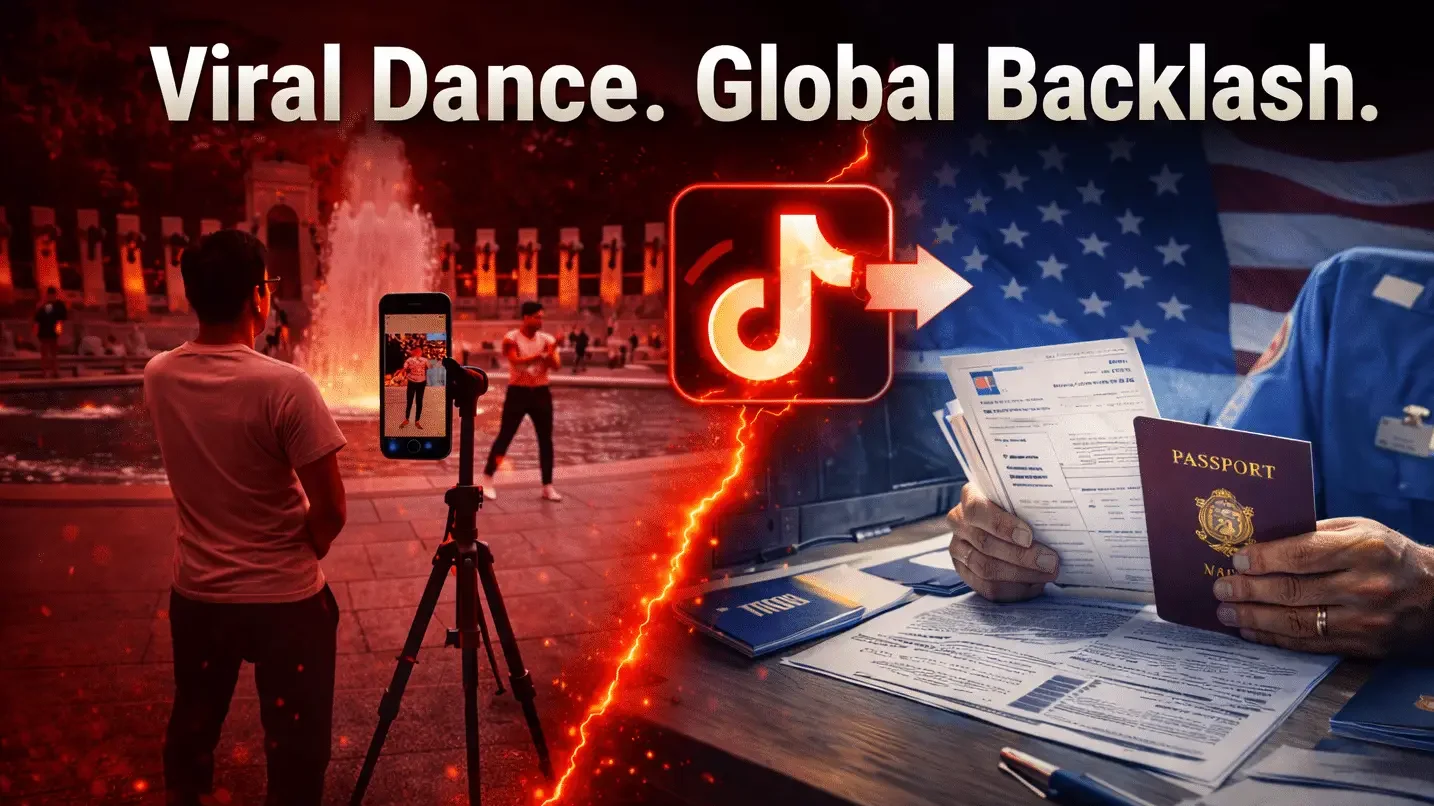
A fifteen-second video uploaded to a social media platform is rarely just a digital artifact; it is frequently a cultural Rorschach test that exposes the fault lines of a society. When an Indian-origin man residing in the United States on a non-immigrant visa filmed a choreographed TikTok dance routine at the National World War II Memorial in Washington, D.C., the resulting firestorm transcended the boundaries of a mere internet controversy.1 The incident, featuring the viral “Don’t Rush Challenge,” ignited a fierce, international debate that culminated in the deletion of the individual’s social media footprints, aggressive calls for his termination from his employer, Palo Alto Networks, and an administrative review of his visa status by U.S. immigration authorities.1
Yet, to view this event solely through the lens of one misguided dance routine is to miss the profound sociological tectonic plates shifting beneath the surface. The massive, visceral backlash against this video was not an isolated burst of outrage over a minor faux pas. Instead, it represents the bursting of a sociological dam. It serves as a flashpoint exposing deeply uncomfortable, accumulated tensions surrounding global migration, the sacredness of host spaces, the erosion of high-trust civic norms, and the profound paradox of modern diasporic assimilation.
This comprehensive analysis delves into the anatomy of the incident, dismantling the defensive fallacies of “whataboutism” that inevitably followed.4 It explores the psychological tipping point of host populations, whose silent frustrations over the civic etiquette of some immigrant cohorts are increasingly spilling into the public domain.6 Drawing upon sophisticated sociological frameworks, including former diplomat Pavan Varma’s critiques of the Indian middle class and Edward Banfield’s concept of “amoral familism” 8, the evidence reveals a painful paradox: millions of individuals migrate in search of orderly, high-trust societies, only to inadvertently import the very civic indiscipline they sought to escape.10
The demand for assimilation and civic sense must not be misconstrued as a manifestation of blind tribalism or racism. Rather, it is a universal requirement for maintaining the fragile social contracts that sustain functioning democracies. Accountability, especially for a guest in a host nation, remains absolute and non-negotiable.
1. The Violation of Consecrated Ground: Anatomy of an Incident
To understand the severity of the backlash, the analysis must first recognize the architectural, historical, and emotional significance of the space that was violated. The National World War II Memorial, situated on the National Mall cleanly between the Washington Monument and the Lincoln Memorial, is not a generic public park or an aesthetic backdrop for content creation; it is consecrated ground.12
Dedicated in the spring of 2004 and designed by Friedrich St. Florian, the site honors the 16 million Americans who served in the armed forces during the conflict, and serves as a solemn site of perpetual remembrance for the more than 400,000 who died.1 The memorial illustrates the clear relationship between the home front and the battlefront, bearing inscriptions such as “Here in the presence of Washington and Lincoln,” demanding a profound level of reverence from its visitors.12
The Institutional Rules of Engagement
The National Park Service (NPS) enforces strict regulations to preserve an atmosphere of contemplation at these sites. Under the Superintendent’s Compendium and the Code of Federal Regulations (36 CFR 7.96), behaviors such as bathing, wading in the Rainbow Pool, sporting activities, and filming that impedes public access are expressly prohibited or require special, highly restrictive permits.13 The memorial is designed to evoke the scale of a national sacrifice. The establishment of “Restricted Zones” at memorials on the National Mall specifically mandates that these areas are not playgrounds, stages, or platforms for self-aggrandizement.14
The Catalyst and the Fallout
In March 2026, a widely circulated clip surfaced showing a man, identified across social media platforms as Madhu Raju, performing a coordinated dance routine with a female companion directly in front of the memorial’s features.1 Raju, believed to be residing in the United States on an H-1B or similar non-immigrant visa, was quickly identified by online sleuths as a Cloud Network Security Engineer employed at the prominent cybersecurity firm Palo Alto Networks since June 2025.1 Furthermore, digital footprints linked him to the operation of a Dallas-based dance studio named MAD Dance.1
The public reaction was immediate, visceral, and highly punitive. Outraged citizens, military veterans, and social commentators shared the video across platforms, explicitly condemning the transformation of a site of wartime sacrifice into a “TikTok set”.2 Users expressed their revulsion at the lack of spatial and historical awareness, noting that “behavior like this reflects poorly on the hardworking Indians in America who honour that legacy”.2
The scrutiny triggered a rapid, total digital retreat. Raju’s personal Instagram and LinkedIn profiles were summarily deleted, and the MAD Dallas dance studio’s website and online presence were dismantled to avoid the surging wave of public anger.2
Table 1: The Anatomy of the WWII Memorial Incident
| Dimension | Detail and Impact |
| The Act | A choreographed TikTok dance (“Don’t Rush Challenge”) filmed at the National WWII Memorial in Washington, D.C..1 |
| The Actor | Madhu Raju, an Indian-origin individual residing in the U.S. on a non-immigrant visa, employed as a Cloud Network Security Engineer.1 |
| Public Backlash | Viral outrage demanding employer termination (Palo Alto Networks) and deportation. Widespread condemnation of treating a war memorial as a social media prop.2 |
| Institutional Response | U.S. immigration authorities initiated an administrative review to determine if the conduct violated visa terms or constituted disorderly conduct.1 |
| Digital Eradication | Deletion of the actor’s personal LinkedIn and Instagram accounts, as well as the website for his affiliated MAD Dallas dance studio.2 |
Furthermore, the incident drew the immediate attention of U.S. immigration authorities. Under U.S. immigration law, visa holders can face revocation of their status if they engage in conduct considered inconsistent with the terms of their stay, or if they are convicted of offenses such as disorderly conduct.1 Legal experts noted that while dancing itself is not a criminal act, unauthorized performances at federal monuments that disrupt the solemnity of the space can potentially trigger administrative reviews of a non-immigrant’s right to remain in the country.1 The velocity of the destruction of the individual’s digital and professional life underscores a critical sociological reality: the host population views the desecration of its sacred spaces not merely as a faux pas, but as an intolerable breach of the foundational social contract expected of a guest.
2. The Sacredness of Host Spaces & The Fallacy of ‘Whataboutism’
In the immediate aftermath of the viral outrage, a defensive posture emerged from certain segments of the internet, particularly within the South Asian diaspora and its progressive defenders. This defense relied heavily on historical justifications, claims of harmlessness, and, most prominently, the rhetorical tactic of “whataboutism”.4
Some commentators pointed out that India itself sent over 2.5 million soldiers to fight for the Allies during World War II, with 87,000 suffering casualties.5 They argued that Indians share a historical connection to the memorial, and should not be subjected to “self-flagellating” over a compatriot’s “harmless self-expression”.5 Others explicitly weaponized the behavior of the native population to shield the immigrant actor. Social media users guaranteed that “white people, black people, descendants of the Pilgrims” have all danced at the memorial, framing the outrage as a racist, “cherry-picking” attack against South Asians.5 A Germany-based Indian entrepreneur branded the backlash as “straight up racism,” arguing that a traditional Irish dance would not have provoked the same ire.4
The Objective Reality of Native Transgressions
The objective analysis requires brutal honesty: the defenders are entirely correct that native-born Americans frequently disrespect their own monuments. The historical and contemporary record is replete with instances of domestic vandalism and disrespect. During the chaotic protests following the death of George Floyd, the WWII Memorial and the Lincoln Memorial were spray-painted and vandalized by domestic activists asking, “Do black vets count?”.16
Furthermore, during summer heatwaves, the National Park Service routinely struggles with tourists—many of them white Americans—wading, swimming, and dipping their feet into the memorial’s Rainbow Pool.18 This widespread domestic behavior prompts severe complaints from veterans who view the activity as deeply insulting to the generation who lived through the war.18 NPS citations for disorderly conduct, swimming in reflecting pools, and creating disturbances are issued regularly to American citizens.13
Dismantling the Fallacy
However, invoking the bad behavior of the native population to excuse the transgressions of an immigrant is a profound logical fallacy that fundamentally misreads the sociology of the guest-host dynamic.
When a guest enters a host’s home, they are bound by an implicit, immutable contract of respect. If a guest soils the host’s carpet or mocks their family heirlooms, it is no defense to point out that the host’s own children are unruly. The host possesses an inherent, territorial right to discipline, tolerate, or battle with their own; the guest does not possess the right to exploit that internal domestic dysfunction as a license for their own misconduct.
“Whataboutism” in migrant assimilation debates frames disconnected events as equivalent, ultimately attempting to cancel out legitimate criticism and avoid accountability.21 It serves as a psychological shield. The expectation that immigrants respect the soil that feeds them, honors the monuments of their host nation, and adheres to the civic laws of their adopted home is an objective baseline of human decency.2 A war memorial is a site of profound national grief.1 Treating it as a backdrop for a self-aggrandizing social media trend reflects a catastrophic failure to read the room of the host culture.
Accountability for such actions must be absolute. Attempting to deflect that accountability by citing the host nation’s internal flaws only deepens the perception of immigrant entitlement. A socially mature diaspora must reject whataboutism entirely, policing its own ranks and demanding a standard of behavior that honors the privilege of global mobility.
3. The Tipping Point of Accumulated Frustration
If the dance video was merely an isolated lapse in judgment by a single individual, the reaction would likely have been confined to fleeting internet mockery. The sheer magnitude of the backlash, the calls for immediate deportation, the targeting of H-1B visa policies, and the systemic pressure applied to the individual’s corporate livelihood indicate something far more volatile.3 The outrage is not just about a single dance video; it is the rupture of a sociological dam.2
The incident served as a proxy for the accumulated, often silent dissatisfaction of Western host populations regarding the broader public behavior of some immigrant cohorts. As migration patterns have shifted over the last few decades, bringing large volumes of people from developing nations into highly developed, high-trust Western societies, friction points surrounding civic etiquette have become glaringly apparent.10
The Friction of Civic Etiquette
In countries spanning the Anglosphere—including Australia, Canada, the United States, and the United Kingdom—local populations have increasingly reported intense friction regarding basic public conduct. The unwritten rules that govern these high-trust societies—such as strict adherence to queuing, maintaining spatial awareness, keeping public volume low, and yielding personal space—are frequently violated by individuals arriving from vastly different cultural paradigms.7
For example, public forums detailing integration advice for new arrivals in Australia explicitly highlight the urgent need to respect queues and avoid cutting in line, to wait for passengers to disembark before boarding trains, to walk strictly on the left side of footpaths, and to refrain from using speakerphones on public transit.7 These behaviors, while seemingly minor or pedantic to an outsider, form the invisible connective tissue of daily civic harmony in the West.
When a large influx of individuals arrives from cultures conditioned by a “smaller personal space bubble” and a “less of an ‘orderly queue’ culture,” the resulting friction is immediate and visceral.26 In societies where one must “assert yourself to get anything” due to resource scarcity and overpopulation, pushing to the front of a line is a highly rational survival mechanism; in a Western civic context, it is viewed as an aggressive violation of fundamental fairness.26
The Psychology of Host Resentment
This friction cannot be dismissed merely as cultural misunderstanding; it generates deep, psychological resentment. Sociologists explain that the merging of immigration control and moral panic often results in “loud panicking” and “quiet manoeuvring” by the state and the public.27 The host population begins to perceive that their civic spaces are being continually degraded by newcomers who actively refuse to assimilate to local norms of cleanliness, order, and mutual respect.28
The backlash against the Indian dancer at the WWII Memorial was fueled by the underlying sentiment that a segment of the immigrant population feels entitled to extract the economic wealth of the host nation while openly flouting its civic and historical boundaries. When an immigrant writes on an online forum, “As an Indian, I saw people from my culture showing the same lack of civic sense in Canada,” it validates the host population’s sense that the friction is real, observable, and deeply problematic.11 The bursting of the dam is not an attack on an ethnicity, but a desperate demand for the restoration of orderly civic conduct.
4. The Economics of High-Trust vs. Low-Trust Societies
To truly understand why the violation of civic etiquette generates such intense outrage, the analysis must examine the macro-economic and sociological data surrounding “social trust.” The clash of public behaviors is fundamentally a collision between high-trust and low-trust societal paradigms.
Research continuously demonstrates a strong causal relationship between generalized social trust and economic prosperity.29 According to the World Values Survey, in high-trust societies like Norway and Sweden, over 60% of respondents believe that most people can be trusted.29 This high level of generalized trust lowers transaction costs, encourages investment in public goods, and sustains the rule of law.29 High-trust societies are characterized by citizens who self-regulate for the common good, believing that their fellow citizens will do the same.10
Conversely, many developing nations from which modern migrants originate are categorized as low-trust, survival-oriented societies.10 In countries like Brazil, Colombia, and various South Asian nations, less than 10% of the population believes that most people can be trusted.29 In these environments, national identity is often fragmented, and ethical norms are fragile.10 Rule-following is based entirely on the fear of authoritative punishment rather than internalized ethics, and the driving instinct is reactive survival rather than proactive civic responsibility.10
Table 2: Divergence in Civic Paradigms: High-Trust vs. Survival-Oriented Societies
10
| Societal Metric | High-Trust Society (Host Nation Paradigm) | Low-Trust/Survival Society (Origin Nation Paradigm) |
| Rule Following | Internalized ethics; self-regulation for the common good. | Based on fear of authority; rules are bent for personal/family gain. |
| Public Space | Viewed as a shared asset requiring collective respect and maintenance. | Viewed as ownerless territory; a place to extract from or dump into. |
| Social Trust | High confidence in strangers, institutions, and the rule of law. | Low trust; loyalty is strictly confined to the family or immediate tribe. |
| Economic Impact | High efficiency, robust public infrastructure, economic growth. | High transaction costs, systemic corruption, institutional fragility. |
When individuals migrate from a low-trust paradigm to a high-trust paradigm, the fundamental expectation is that they will rapidly assimilate into the civic behaviors of the host nation. The host nation’s infrastructure—its clean parks, undefended monuments, and orderly transit systems—exists because of its high-trust behavioral architecture. When immigrants fail to adapt—when they ignore queues, litter, play loud music in public, or treat sacred public monuments as personal TikTok studios—it signals to the host population that the immigrant is eager to extract the economic benefits of the high-trust society without contributing to the behavioral infrastructure that makes it possible.10 The outrage is, therefore, a rational defense mechanism designed to protect the very civic fabric that makes the host country desirable in the first place.
5. The Private Palace and the Public Sewer: Unpacking ‘Amoral Familism’
To effectively address why some highly educated, successful immigrants display a startling lack of civic sense in public spaces, the analysis must examine the profound sociological conditioning of their origin nations. The behavior witnessed at the WWII Memorial is not merely an individual anomaly; it is the physical manifestation of deeply ingrained cultural paradigms.
Former Indian diplomat and acclaimed author Pavan K. Varma, in his seminal works The Great Indian Middle Class and Being Indian, provides a devastatingly accurate and unsparing dissection of this phenomenon.8 Varma highlights a profound cognitive dissonance within the Indian middle class: a fastidious, almost obsessive dedication to the cleanliness and sanctity of the private home, contrasted with a complete, apathetic disregard for the public commons.8
The Concept of Amoral Familism
This dichotomy is rooted in what sociologists, drawing upon Edward Banfield’s theories, term “amoral familism”.9 In societies marked by historically fragile institutions, vast wealth inequality, a legacy of colonialism, and systemic corruption, the family unit becomes the sole locus of loyalty, resource allocation, and moral obligation.10 The public sphere is viewed not as a shared inheritance to be protected, but as a hostile, ownerless territory to be exploited, navigated, or ignored.10
Varma notes that the “new middle class” in India is often characterized by a hyper-focus on consumerism, money-making, and upward mobility.35 Extending the viewpoints of sociologists, consumption of goods has become an end in itself, and this class has left behind its dependence on austerity and state protection.35 However, this rapid economic ascension is rarely accompanied by a corresponding evolution in civic responsibility.30 Citizens become driven entirely by personal and familial goals, viewing national priorities and the maintenance of public spaces as an afterthought.30
The result is a society where individuals will meticulously sweep the dirt from their pristine living rooms directly into the communal street, feeling zero moral culpability for degrading the shared environment.36 There is a complete disconnect between private morality and public duty.
When individuals conditioned by this “amoral familism” migrate to the West, they pack this psychological architecture in their suitcases. They arrive in cities characterized by clean parks, orderly transit systems, and pristine monuments. However, because they lack the internalized “civic sense” that built and maintains these spaces, they often treat the host country’s commons as simply a cleaner, wealthier version of the ownerless streets back home. They extract the aesthetic and economic value of the space—such as utilizing the WWII Memorial for a viral dance video to boost a personal brand or dance studio—without recognizing the invisible social contract of solemnity, historical weight, and mutual respect required to sustain it.2
6. The Canadian Crucible: When Civic Friction Ignites Nativist Backlash
The catastrophic consequences of this accumulated frustration and failure to assimilate are most starkly visible in Canada. Currently, Canada serves as a volatile crucible for the collision between mass migration, civic friction, and xenophobic backlash. The dynamics playing out in Canadian suburbs and online spaces provide a chilling, real-time preview of how failures in civic assimilation can poison the well for an entire diaspora.
In recent years, Canada has experienced a massive demographic shift, with a significant influx of South Asian immigrants, particularly concentrated in enclaves like Brampton, Ontario.6 While the vast majority of these immigrants are hardworking, law-abiding contributors to the economy, the sheer scale and rapid concentration of the influx have magnified visibility regarding civic indiscipline. Commentators, journalists, and local residents have increasingly voiced intense concerns over aggressive driving, a lack of civic sense, ethno-nepotism, and the importation of foreign political conflicts—such as Khalistani separatism and transnational repression—onto Canadian soil.37
The Weaponization of Frustration
This valid, observable civic friction, however, has been aggressively and dangerously weaponized by bad actors, resulting in a terrifying moral panic. Between 2019 and 2023, police-reported hate crimes against South Asians in Canada skyrocketed by a staggering 227%.39 Research indicates that posts containing anti-South Asian slurs on platforms like X increased by more than 1,350% from 2023 to 2024.39
Domestic extremist groups, such as the Canadian network Diagolon, have systematically targeted these communities with hate speech, harassment, and explicit calls for violence, generating over 1.2 million engagements on hateful content in the lead-up to federal elections.39 This phenomenon often merges anti-immigrant sentiment with the fabrication of “crimmigration” narratives.27
A prime example of this occurred in the summer of 2024, when a viral TikTok video falsely claimed that Indian immigrants were digging holes and defecating on the public beaches of Wasaga Beach, Ontario.28 The rumor, echoing xenophobic tropes from the United States (such as the false claims of Haitian immigrants eating pets in Springfield, Ohio), spread like wildfire.28 It generated hundreds of thousands of views, sparking localized panic and a flood of racist vitriol.28
The Wasaga Beach incident perfectly illustrates the profound danger of the tipping point. When host populations feel that their civic spaces are being continually degraded by newcomers who refuse to assimilate to local norms of cleanliness and order, they become highly susceptible to radicalization, confirmation bias, and the consumption of fake news. The failure of a highly visible minority to observe basic civic etiquette creates a fertile breeding ground for systemic racism.
This is the ultimate, heartbreaking tragedy of the tipping point: the entitled, chaotic behavior of a few unassimilated individuals jeopardizes the physical and psychological safety of millions of honest, integrated immigrants who are simply trying to earn a living and raise their families in peace.39 A fierce objectivity requires condemning the racist backlash without hesitation, while simultaneously demanding that immigrant communities rigorously police their own ranks and strictly adhere to the civic norms of the host nation.
7. Importing the Chaos We Fled: The Asian American Assimilation Paradox
This brings the analysis to the most painful, uncomfortable paradox of modern global migration. Millions of individuals leave their home countries, enduring massive logistical, financial, and emotional hurdles, specifically to seek a better life. They are drawn to the West by the promise of cleaner cities, orderly societies, functional infrastructure, and the impartial, predictable rule of law.40
Yet, upon arriving and securing the economic benefits of the host nation, a visible segment of the diaspora actively refuses to assimilate. Instead, they recreate the exact same civic indiscipline, chaos, and disregard for public rules that made their countries of origin unlivable in the first place.11
Economic Integration Without Civic Integration
This paradox is particularly stark within the highly skilled immigrant cohorts. Sociologists point to the “Asian American assimilation paradox,” wherein hyper-selected immigrant groups—such as Indians and Chinese migrating under the H-1B visa program—achieve massive professional, educational, and financial success in both the first and second generations.40 The actor in the WWII Memorial incident, a Cloud Network Security Engineer at a premier Silicon Valley tech company, is the absolute epitome of this demographic.2
However, economic and professional integration does not automatically translate to civic integration.11 A highly skilled engineer may seamlessly navigate complex corporate environments, utilize advanced structured interviewing practices, and master cloud architecture, while simultaneously demonstrating a total illiteracy regarding the historical sensitivities and behavioral expectations of the host culture.2
When migrants bypass the civic integration process, treating their new country merely as an economic zone or a sprawling hotel rather than a community, the host society suffers.11 True diversity and multiculturalism can only thrive upon a bedrock of shared foundational values—namely, the rule of law, mutual respect, and the sanctity of public spaces. When those foundations are repeatedly stress-tested by entitled behavior, the host population’s goodwill inevitably evaporates, replacing tolerance with profound resentment.37 Importing the chaos one fled is not an exercise in cultural preservation; it is an act of civic sabotage.
8. Institutional Responses and the Legal Boundaries of Guests
The swift institutional response to the WWII Memorial dance—including the pressure applied to corporate employers and the scrutiny of immigration authorities—underscores the legal precariousness of the unassimilated migrant. It serves as a stark reminder that immigration is fundamentally a conditional privilege, not an absolute human right.
The U.S. immigration framework, like that of most sovereign nations, contains robust mechanisms to revoke the status of non-immigrants who violate the terms of their stay or engage in conduct detrimental to public order.1 While performing a TikTok dance is not inherently illegal, the violation of federal park regulations—such as demonstrating without a permit, filming that impedes access, or engaging in disorderly conduct—can trigger severe administrative consequences.1
Furthermore, the corporate sector is increasingly entangled in these cultural flashpoints. Palo Alto Networks, a company that explicitly promotes a rigorous Code of Conduct, unconscious bias training, and high-quality hiring standards, found its brand dragged into a viral controversy regarding the off-duty behavior of its employee.44 The public demands for Raju’s termination highlight a shifting cultural tolerance.2 Host populations are increasingly willing to leverage institutional, corporate, and legal mechanisms to enforce civic boundaries.37
While some progressive commentators argue that deportation or loss of livelihood is a disproportionate response to a dance video 1, from a strictly legal and sociological standpoint, it reinforces the non-negotiable nature of the guest-host contract. When a guest on a temporary work visa blatantly disrespects a site dedicated to the nation’s war dead for the sake of social media clout, the host nation is entirely justified in questioning whether that individual possesses the necessary character, respect, and civic alignment to remain within its borders. The rule of law must be upheld, and consequences for desecrating national heritage must be severe enough to act as a deterrent.
9. Conclusion: A Universal Demand for Human Decency
The incident at the World War II Memorial in Washington, D.C., was never just about a fifteen-second TikTok dance. It was a societal stress test. The outrage it generated is the manifestation of a host culture pushed to the brink by the steady erosion of its high-trust civic norms and the flagrant entitlement of guests who view sacred spaces as mere backdrops for self-promotion.
To analyze this event objectively requires threading a highly nuanced needle. One must fiercely oppose the xenophobic and racist forces that use such incidents to demonize entire populations, spread vile rumors of beach defecation, and incite violence against honest, hardworking migrants.28 The vast majority of immigrants cross oceans to build better lives, contributing immensely to the economic, technological, and cultural fabric of their adopted homes.40 They are the ones who suffer the most when the nativist backlash is unleashed.
However, protecting the rights and safety of honest migrants demands holding the unassimilated strictly accountable. Society must dispense with the intellectual cowardice of whataboutism. The fact that a host nation struggles with its own internal discord, or that its native citizens sometimes behave poorly, provides zero justification for an immigrant to disrespect the soil that feeds them.16
The demand for civic responsibility—for waiting patiently in lines, keeping public spaces pristine, respecting personal boundaries, keeping public volume low, and honoring national memorials—is not an attack on any specific nationality. It is a universal demand for basic human decency. It is a fundamental recognition that the orderly, clean, and safe societies that millions flee their homelands to join are not natural phenomena; they are the fragile products of high social trust, invisible civic contracts, and profound historical sacrifices.10
If one wishes to share in the staggering prosperity and stability of a host nation, one must first demonstrate the capacity to respect its grief, honor its history, and abide unconditionally by its civic codes. Assimilation does not require the erasure of one’s rich cultural heritage, but it absolutely demands the total abandonment of the civic chaos left behind. Accountability is the unalterable price of admission to the high-trust world, and the enforcement of that accountability—without prejudice, but without apology—is the only way to ensure the survival of civil society.
Works cited
- Indian-origin man may face deportation over viral dance video at WW2 Memorial in US, accessed on March 9, 2026, https://www.indiatoday.in/world/story/indian-origin-man-madhu-raju-face-deportation-viral-video-tik-tok-dance-world-war-two-memorial-washington-dc-us-2878879-2026-03-08
- Indian-origin man dancing in front of World War II Memorial in US deletes LinkedIn, Instagram amid fierce criticism | Hindustan Times, accessed on March 9, 2026, https://www.hindustantimes.com/trending/us/indianorigin-man-dancing-in-front-of-world-war-ii-memorial-in-us-deletes-linkedin-instagram-amid-fierce-criticism-101772870353615.html
- Who Is Madhu Raju? TikToker deletes social media after MAGA backlash over WWII Memorial video – The American Bazaar, accessed on March 9, 2026, https://americanbazaaronline.com/2026/03/07/who-is-madhu-raju-tiktoker-deletes-social-media-after-maga-backlash-over-wwii-memorial-video-476478/
- Indian origin founder slams backlash against viral Indian dance in US – New India Abroad, accessed on March 9, 2026, https://www.newindiaabroad.com/news/indian-origin-founder-slams-backlash-against-viral-indian-dance-in-us
- Indian couple’s dance reel at World War II memorial in Washington …, accessed on March 9, 2026, https://m.economictimes.com/news/new-updates/some-places-deserve-respect-indian-couples-dance-reel-at-world-war-ii-memorial-in-washington-dc-triggers-huge-backlash/articleshow/129224991.cms
- Brampton, Browntown, or Bramladesh? A Critique of the Hate Speech Used Against Racialized Spaces in Canada – ResearchGate, accessed on March 9, 2026, https://www.researchgate.net/publication/389908951_Brampton_Browntown_or_Bramladesh_A_Critique_of_the_Hate_Speech_Used_Against_Racialized_Spaces_in_Canada
- What “etiquette tips” would you give to new immigrants to make for better social cohesion? : r/australian – Reddit, accessed on March 9, 2026, https://www.reddit.com/r/australian/comments/192w0jh/what_etiquette_tips_would_you_give_to_new/
- Rule by Aesthetics: World-Class City Making in Delhi – UC Berkeley, accessed on March 9, 2026, https://escholarship.org/content/qt0pt7w0c5/qt0pt7w0c5.pdf
- Current Anthropology – The University of Chicago Press: Journals, accessed on March 9, 2026, https://www.journals.uchicago.edu/pb-assets/docs/journals/CAv59nS18-1593018044853.pdf
- (PDF) PEOPLE BEFORE INSTITUTIONS: REFRAMING …, accessed on March 9, 2026, https://www.researchgate.net/publication/395590837_PEOPLE_BEFORE_INSTITUTIONS_REFRAMING_DEVELOPMENT_THROUGH_BEHAVIOURAL_EVOLUTION
- CMV: immigration is good for culture in America : r/changemyview – Reddit, accessed on March 9, 2026, https://www.reddit.com/r/changemyview/comments/1mb8gfr/cmv_immigration_is_good_for_culture_in_america/
- The World War II Memorial in Washington DC: An Interpretive Guide (U.S. National Park Service), accessed on March 9, 2026, https://www.nps.gov/articles/ww2memorialguide.htm
- Superintendent’s Compendium – National Mall and Memorial Parks (U.S. National Park Service) – NPS.gov, accessed on March 9, 2026, https://www.nps.gov/nama/learn/management/superintendent-s-compendium.htm
- Special Regulations, Areas of the National Park System, National Capital Region, Special Events and Demonstrations – Federal Register, accessed on March 9, 2026, https://www.federalregister.gov/documents/2018/08/15/2018-17386/special-regulations-areas-of-the-national-park-system-national-capital-region-special-events-and
- TRAFFIC REGULATIONS UNITED STATES CAPITOL GROUNDS, accessed on March 9, 2026, https://www.uscp.gov/sites/evo-subsites/www.uscp.gov/files/documents/Capitol%20Police%20Board%20US%20Capitol%20Grounds%20Traffic%20Regulations%20-%20For%20Public%20Release.pdf
- Protesters deface World War II Memorial and other National Mall monuments – FOX 5 DC, accessed on March 9, 2026, https://www.fox5dc.com/news/protesters-deface-world-war-ii-memorial-and-other-national-mall-monuments
- World War II Memorial among several on National Mall vandalized during protests, accessed on March 9, 2026, https://taskandpurpose.com/news/world-war-ii-memorial-vandalized-protests/
- Veterans say wading in WWII memorial’s Rainbow Pool ‘disrespectful’ | Fox News, accessed on March 9, 2026, https://www.foxnews.com/politics/veterans-say-wading-in-wwii-memorials-rainbow-pool-disrespectful
- Veterans say wading in WWII memorial’s Rainbow Pool ‘disrespectful’ | FOX 13 Tampa Bay, accessed on March 9, 2026, https://www.fox13news.com/news/veterans-say-wading-in-wwii-memorials-rainbow-pool-disrespectful
- NN 11-29-12 diana_Layout 1 – The Nome Nugget, accessed on March 9, 2026, https://www.nomenugget.net/archives/2012/112912NN.pdf
- The Multidirectional Diaspora: Writing Chinese Migration History in a Time of Global Racial Reckoning | The Historical Journal, accessed on March 9, 2026, https://www.cambridge.org/core/journals/historical-journal/article/multidirectional-diaspora-writing-chinese-migration-history-in-a-time-of-global-racial-reckoning/3E922FE502CBDAB066D8FED4526D2A70
- WM COMPILATION revamp – Migrants’ Rights Network, accessed on March 9, 2026, https://migrantsrights.org.uk/wp-content/uploads/2025/10/WM-COMPILATION-revamp.pdf
- Indian couple dancing at WWII Memorial in Washington DC goes viral, draws flak: ‘Send those H1-Bs back’ – The Times of India, accessed on March 9, 2026, https://timesofindia.indiatimes.com/world/us/indian-couple-dancing-at-wwii-memorial-in-washington-dc-goes-viral-draws-flak-send-those-h1-bs-back/articleshow/129154445.cms
- which came first – CHAPTER I – Sacramento State, accessed on March 9, 2026, https://scholars.csus.edu/view/pdfCoverPage?instCode=01CALS_USL&filePid=13244994160001671&download=true
- Australian Etiquettes You NEED to Know & Follow! Tips for International Students & Tourists – YouTube, accessed on March 9, 2026, https://www.youtube.com/watch?v=WBBI8Sw2K1s
- Why are Chinese tourists weird about standing in lines/waiting? – Reddit, accessed on March 9, 2026, https://www.reddit.com/r/Hawaii/comments/16zrarn/why_are_chinese_tourists_weird_about_standing_in/
- The Sonics of Crimmigration in Australia*: Wall of Noise and Quiet Manoeuvring, accessed on March 9, 2026, https://www.researchgate.net/publication/273040107_The_Sonics_of_Crimmigration_in_Australia_Wall_of_Noise_and_Quiet_Manoeuvring
- The rise of anti-South Asian content online – Transcript | CBC Radio, accessed on March 9, 2026, https://www.cbc.ca/radio/frontburner/the-rise-of-anti-south-asian-content-online-transcript-1.7333452
- Trust – Our World in Data, accessed on March 9, 2026, https://ourworldindata.org/trust
- Peer reviewed Journal Impact Factor:7.265 ISSN-2230-9578, accessed on March 9, 2026, https://jrdrvb.org/wp-content/uploads/2024/06/February-2022-Volume-13-Issue-4.pdf
- Story of a – Harmony Magazine, accessed on March 9, 2026, https://harmonyindia.org/wp-content/uploads/2019/05/Harmony-Issue-110-July-13-low-res.pdf
- New Citizen’s Activism in India – Heinrich-Böll-Stiftung, accessed on March 9, 2026, https://www.boell.de/sites/default/files/study-new-citizens-activism-in-india.pdf
- Neoliberal Utopia and Urban Realities in Delhi – ACME: An International Journal for Critical Geographies, accessed on March 9, 2026, https://acme-journal.org/index.php/acme/article/download/893/749/2736
- Culture and Institutions – NBER, accessed on March 9, 2026, https://www.nber.org/system/files/working_papers/w19750/w19750.pdf
- (a) Discuss the historical antecedents of the emergence of Sociology as a discipline. (10 Marks) – Sleepy Classes, accessed on March 9, 2026, https://sleepyclasses.com/wp-content/uploads/2024/08/Sociology-PYQs-2019-1.pdf
- Civic sense and cleanliness: Pedagogy and aesthetics in middle-class Mumbai activism, accessed on March 9, 2026, https://www.researchgate.net/publication/263553016_Civic_sense_and_cleanliness_Pedagogy_and_aesthetics_in_middle-class_Mumbai_activism
- Why the Right turned on Indians – UnHerd, accessed on March 9, 2026, https://unherd.com/2025/09/why-the-right-turned-on-indians/?edition=us
- As Carney walks the fence, in Brampton & across the country Sikh Canadians & others don’t buy claim that India has stopped its campaign of violence here | The Pointer, accessed on March 9, 2026, https://thepointer.com/article/2026-02-27/as-carney-walks-the-fence-in-brampton-across-the-country-sikh-canadians-others-don-t-buy-claim-that-india-has-stopped-its-campaign-of-violence-here
- The rise of anti-South Asian hate in Canada – Institute for Strategic Dialogue, accessed on March 9, 2026, https://www.isdglobal.org/digital-dispatch/the-rise-of-anti-south-asian-hate-in-canada/
- Asian American Diversity and Growth | Annual Reviews, accessed on March 9, 2026, https://www.annualreviews.org/content/journals/10.1146/annurev-soc-031021-012617?crawler=true
- Social Realities of Indian Americans: Results From the 2020 Indian American Attitudes Survey | Carnegie Endowment for International Peace, accessed on March 9, 2026, https://carnegieendowment.org/russia-eurasia/research/2021/06/social-realities-of-indian-americans-results-from-the-2020-indian-american-attitudes-survey
- The Partition of Inda and Religion Warfare in Train For Pakistan by Khushwant Singh | PDF, accessed on March 9, 2026, https://www.scribd.com/document/937264247/The-Partition-of-Inda-and-Religion-Warfare-in-Train-for-Pakistan-by-Khushwant-Singh
- Organizational Life and Political Incorporation of Two Asian Immigrant Groups: A Case Study – PMC, accessed on March 9, 2026, https://pmc.ncbi.nlm.nih.gov/articles/PMC3650845/
- Palo Alto Networks Inc. – DEF 14A – SEC.gov, accessed on March 9, 2026, https://www.sec.gov/Archives/edgar/data/1327567/000130817924000770/panw4345341-def14a.htm
- Class versus Migration Status: Analyzing Race-to-the-Bottom Discourse among Swedish Elite at the Expense of Racialized Migrants. Comments on Digitally Mobile Swedes. – ResearchGate, accessed on March 9, 2026, https://www.researchgate.net/publication/395031243_Class_versus_Migration_Status_Analyzing_Race-to-the-Bottom_Discourse_among_Swedish_Elite_at_the_Expense_of_Racialized_Migrants_Comments_on_Digitally_Mobile_Swedes
- Current Affairs for Competitive Exams 2024-25 | PDF – Scribd, accessed on March 9, 2026, https://www.scribd.com/document/948052646/RBE-Current-Affairs-Magazine-Updated-Nov-2025-RBE
- Global Candidate Privacy Notice – Palo Alto Networks, accessed on March 9, 2026, https://www.paloaltonetworks.com/legal-notices/privacy/privacy-notice



Leave a Reply