
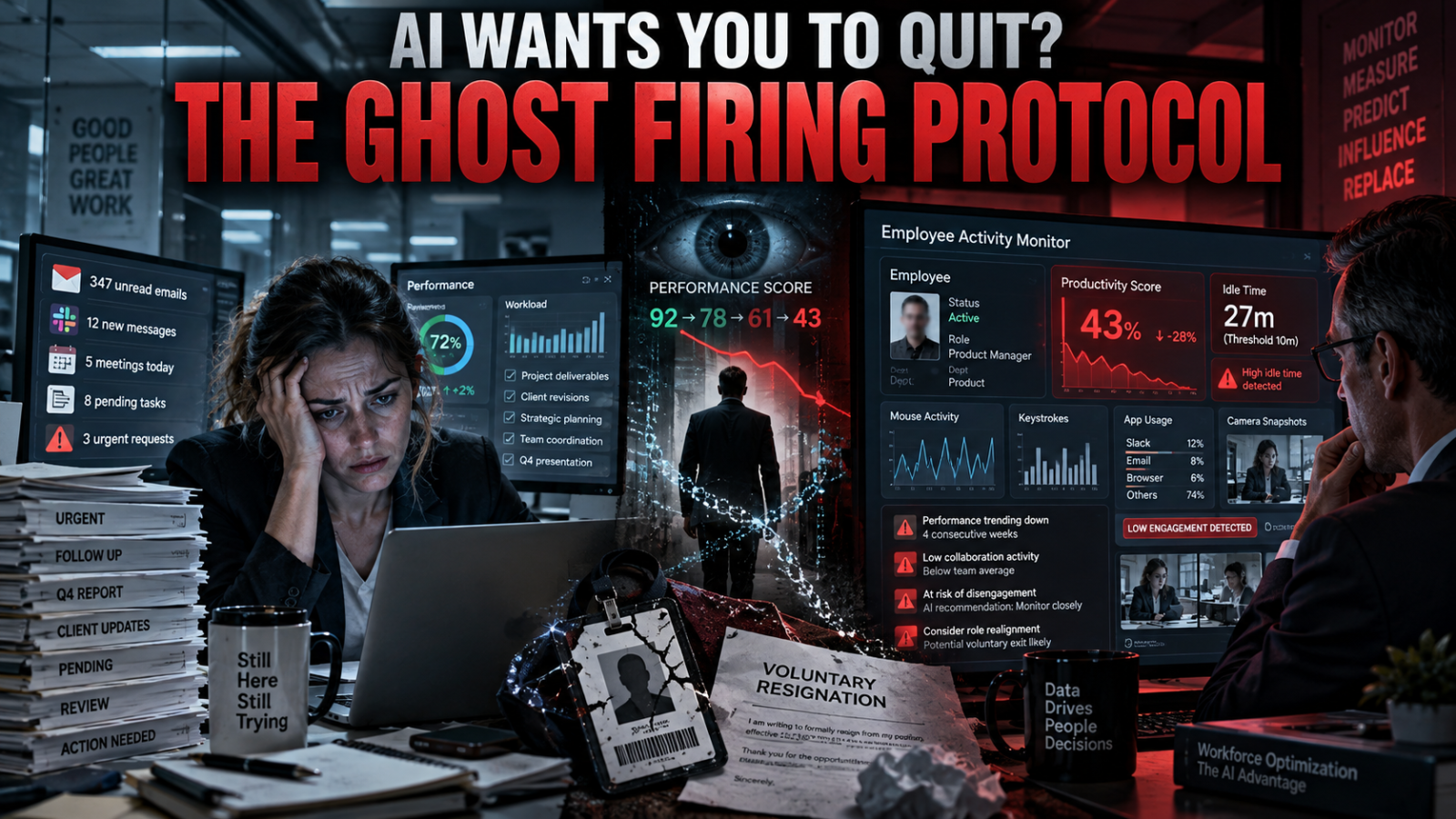
It starts with something small. You open your laptop on Monday morning and notice another dashboard tracking your activity. By Tuesday, your workload has doubled. Wednesday brings an automated warning because your screen was inactive for several minutes. Meetings with your manager become less frequent, but performance alerts somehow become more frequent. Important projects quietly move to someone else. You begin wondering whether you’re suddenly bad at a job you’ve successfully done for years. Nobody tells you to leave. Nobody has to. By Friday night, you’re already thinking about resigning.
The modern corporate office operates as a digital panopticon. Algorithms track the mouse. Software logs every keystroke. Webcams analyze facial expressions for signs of distraction. Corporations market these tools as productivity enhancements. The actual motive is much darker.
Mass layoffs look terrible. Public relations disasters destroy stock prices. Severance packages cost billions. Corporations desperately want expensive, experienced employees off the payroll. Firing them directly requires cause, documentation, and payouts. The solution is the “Ghost Firing” protocol.
Corporate human resources veterans recognize this playbook immediately. Seventeen years of executive HR experience reveals the hidden mechanics of this protocol firsthand. Companies deploy algorithmic management to intentionally burn employees out. They create impossible workloads. They mandate invasive surveillance. They cultivate hyper-toxic environments. The goal is simple. Force the employee to quit. The resignation absolves the company of legal and financial responsibility. The corporation wins. The worker breaks.
The Impossible Workload
Artificial intelligence promised a shorter workweek. The reality delivered the exact opposite. Workers now face a brutal productivity paradox. Algorithms automate basic tasks, but executives immediately replace that freed time with higher quotas. Employees do not work less. They simply manage more chaotic, fragmented systems.
Behavioral data exposes the lie. After adopting AI, deep focus work fell by 9% across organizations. Time spent on email surged 104%, and messaging skyrocketed 145%. Workers now spend 6.4 hours every week just “botsitting”—monitoring AI tools and fixing their errors. The cognitive load crushes the human mind.
Ghost firing weaponizes this chaos. Managers use algorithmic task assignment to bury targeted employees. The system demands infinite scale. It assigns unachievable goals. When the employee inevitably falls behind, the algorithm flags the failure. The software builds a digital paper trail of manufactured incompetence. The company avoids direct confrontation. The machine simply declares the worker inadequate.
This creates a relentless pressure cooker. Algorithmic management operates as digital Taylorism, systematically eroding worker autonomy and reconfiguring the boundaries of human endurance. The system isolates the target. Managers stop scheduling regular check-ins. They exclude the employee from relevant email chains. They reassign meaningful work and replace it with menial, unchallenging tasks. The silence deafens. The target isolates. The employee quits.
The Surveillance Squeeze
Digital Taylorism dominates the modern workplace. Employers reduce human beings to quantifiable data points. In 2026, 78% of companies monitor their employees. For organizations with remote workers, that number reaches a staggering 96%. The global employee monitoring market now exceeds $2.72 billion, confirming that surveillance is now mainstream enterprise infrastructure.
This is not passive observation. This is active psychological warfare. “Bossware” tracks active screen time. It logs the exact websites visited. It records the duration of bathroom breaks. Automated systems issue warnings for exceeding brief windows of idle time, and prolonged inactivity automatically triggers termination workflows.
The surveillance squeeze strips workers of all professional dignity. The data reveals a massive perception gap between those who watch and those who work.
| Algorithmic Surveillance Metric (2026) | Percentage | Practical Impact on the Workforce | Source |
| Employers Believing Monitoring Works | 68% | Drives increased investment in “bossware” technology | |
| Employees Seeing Zero Positive Impact | 72% | Destroys psychological safety and organizational trust | |
| Monitored Workers Reporting High Stress | 56% | Accelerates emotional exhaustion and chronic panic | |
| Employees Faking Online Activity | 49% | Forces defensive behavior like using mouse jigglers | |
| Workers Willing to Quit Over Surveillance | 54% | Triggers the exact voluntary turnover employers seek |
Companies know this surveillance breeds hostility. Trust is dead. Surveillance replaces management. Data replaces empathy. The tension forces the worker to snap. They resign to escape the microscope, surrendering their right to unemployment benefits in the process.
The Legal and Financial Shell Game
Ghost firing serves one master: corporate finance. Voluntary turnover saves the company the cost of severance packages, extended benefits payouts, and increased unemployment insurance premiums. By pushing expensive, tenured staff out the door, organizations quietly slash their operational budgets without triggering the stock-price volatility associated with mass layoff announcements.
The legal framework struggles to catch up. Employees who quit under extreme pressure occasionally file constructive discharge claims. Constructive discharge laws treat a forced resignation as a formal firing. However, courts demand rigorous proof. Employees must demonstrate a clear timeline of escalating mistreatment where a reasonable person would feel compelled to leave. Algorithms obscure this evidence. The company points to the data. The HR department claims the employee simply failed to meet objective, machine-generated performance metrics.
Class action lawsuits offer a glimmer of resistance. Workers increasingly target the AI vendors enabling this surveillance. Recent lawsuits invoke the Fair Credit Reporting Act (FCRA) to challenge automated hiring and firing algorithms. Plaintiffs argue these systems act as unregistered consumer reporting agencies, scraping data and scoring workers without proper disclosure.
State legislatures attempt to intervene. California advanced Senate Bill 947, the “No Robo Bosses Act,” which prohibits employers from relying solely on automated decision systems for discipline or termination. The European Union AI Act classifies workplace AI monitoring as a high-risk category, demanding mandatory human oversight and transparency. Yet, corporations adapt quickly. They keep a human manager in the loop just enough to satisfy regulators. The algorithm still dictates the daily torment. The human merely signs the paperwork.
The Psychological Toll
The human cost of algorithmic quiet firing is catastrophic. Mental health collapses under the weight of continuous digital tracking. In 2026, 76% of employees report experiencing workplace burnout. The statistics reveal a global workforce stretched far beyond its natural breaking point.
| Global Burnout Indicators (2026) | Prevalence | Underlying Algorithmic Driver | Source |
| General Workforce Burnout | 76% | Chronic overwork and always-on digital communication | |
| Indian Workforce Burnout | 59% | High-stress sprint cycles and unyielding productivity quotas | |
| Tech Sector Burnout | 71% | Escalating AI review queues and extreme context switching | |
| Gen Z Worker Burnout | 71% | Digital presenteeism and lack of mentorship support |
Ghost firing drives these numbers intentionally. The tactic relies on isolation and psychological exhaustion. Instead of providing constructive feedback, managers withdraw completely. Professional stagnation sets in. The employee watches colleagues advance while their own access to strategic projects mysteriously vanishes. The algorithm issues the reprimands. The human manager hides behind the dashboard.
The persistent pressure creates a phenomenon known as “silent burnout”. The employee internalizes the systemic abuse as personal failure. Confidence erodes. Self-doubt replaces certainty. High-performing professionals begin to question their own basic competence. Eventually, the psychological damage outweighs the paycheck. Employees quit voluntarily to preserve their basic sanity. The corporation wins. No severance. No legal liability. No bad press.
The ghost firing protocol weaponizes data against humanity. Massive corporations refuse to pay for the human capital they consume. They manipulate algorithms to execute their dirty work. They dodge severance payouts. They protect their stock valuations. They leave broken workers to pay the psychological and financial price.
This algorithmic cruelty fundamentally severs the social contract of employment. Work no longer offers mutual benefit. It operates as a sophisticated extraction machine. As the digital panopticon tightens its grip, a critical question remains. Will human labor successfully regulate the algorithms that seek to break us, or will workers accept their fate as disposable inputs in an automated corporate machine?



Leave a Reply