The foundational premise of the modern, multicultural democratic state relies upon a delicate, historically unprecedented social contract: that individuals may bring their heritage, their faith, and the vibrant memories of their homelands to a new nation, but they must leave their ancestral wars at the border. For decades, this unspoken agreement allowed diverse populations to build shared communities, fostering neighborhoods where different cultures could coexist and thrive. Over the past three years, however, this vital social contract has systematically unraveled. The geopolitical inferno of the Middle East—ignited by the tragic events of October 2023 and dramatically escalated by the massive US-Israeli military campaign against Iran in early 2026—has violently breached the boundaries of geography. It is no longer a localized conflict fought in the deserts of the Levant or the skies over Tehran; it is being fought in the bustling supermarkets of Paris, the historic university quadrangles of New York, and the internal corporate networks of London.
This comprehensive analysis explores the profound domestic impact of this overseas war on the social fabric of Western host nations. It is, at its core, a tragedy of imported hatred. While human beings naturally and rightfully grieve for the suffering of their ancestral homelands, the transmutation of that grief into zero-sum tribalism within a host country only multiplies the original tragedy.1 Turning on one’s local neighbors, harassing neighborhood businesses, and paralyzing civic infrastructure does not bring peace to the Middle East; it simply brings the destruction of war to the West.
To understand this phenomenon requires a fiercely objective lens—one that strips away partisan blinders and refuses to cater to ideological echo chambers. It demands absolute empathy for honest individuals who are watching their ancestral lands burn, coupled with an uncompromising, ironclad defense of the rule of law. Native populations have a fundamental right to social cohesion, civic peace, and public safety within their own borders.3 Simultaneously, minority and migrant communities have an absolute, non-negotiable right to live free from the terrifying resurgence of racism, antisemitism, and Islamophobia.3 Judging this crisis requires looking beyond the blind tribalism of the current moment to examine the objective realities of human behavior, the deep sociological mechanisms of conflict diffusion, and the dangerous psychological frameworks that are actively driving Western communities apart.
The Psychological Architecture of Diaspora Conflict
To comprehend why a geopolitical conflict occurring thousands of miles away causes a university student in California to physically intimidate a classmate, or a long-time resident of Berlin to vandalize a local storefront, one must first examine the psychological framework known in social science as “identity fusion.” In standard social psychology, group identification is understood through a hydraulic relationship: as social identity becomes salient, personal identity recedes.7 Identity fusion, however, represents a far more extreme psychological state. It occurs when an individual’s personal identity becomes deeply, inextricably, and functionally intertwined with their social, religious, or ethnic identity.7
For highly fused individuals living in diaspora communities, the boundary between the personal self and the distant group vanishes entirely. Any attack on the group—even one occurring across the globe—is perceived not as a distant political event, but as a direct, physical attack on the individual’s personal agency and physical safety.7 This psychological transference explains the visceral, often extreme reactions witnessed on Western streets over the past three years. The trauma is not theoretical; to the fused individual, it is immediate and existential. When this fusion is weaponized by the trauma of war, it fosters a willingness to engage in extreme behaviors, bypassing traditional civic restraints and replacing them with a primal, familial mandate to defend the ingroup at all costs.7
Historically, conflict studies have shown that diaspora groups can inadvertently serve as peace-wreckers rather than peace-builders. The diffusion of conflict is not a mechanical inevitability; it is the result of human choices.1 Research analyzing protracted civil conflicts—such as those involving the Irish, Tamils, Armenians, and Kurds—demonstrates that diaspora populations often adopt more hardline, uncompromising stances than those actually living in the conflict zones.9 From the safety of a townhouse in Fairfax, Virginia, or a flat in London, the physical cost of the conflict is negligible, making it psychologically easier to demand absolute victory and reject diplomatic compromise.10 The financial and political support from these safe havens often sustains the hostilities, empowering hardliners and silencing moderate voices seeking reconciliation.9
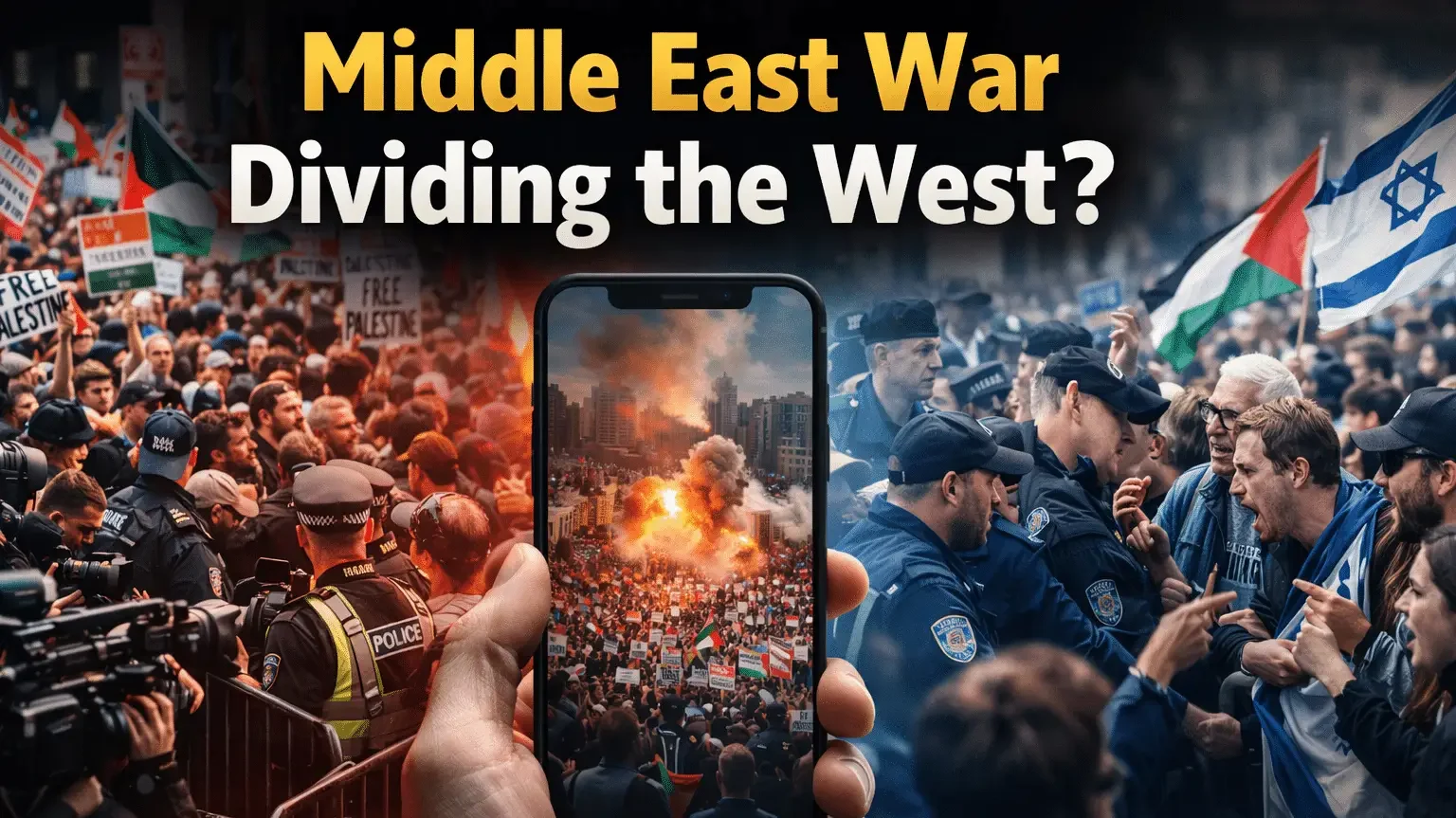
A visual representation of identity fusion manifesting in physical confrontations on the streets of Western capitals, where distant geopolitical grievances supersede local civic order.
Yet, the psychology of trauma in displaced populations is not entirely negative, which makes the current descent into tribalism all the more tragic. Deep sociological studies on refugees—such as those fleeing Syria and Iraq for host countries like Turkey—reveal a complex duality between post-traumatic stress and post-traumatic growth.11 Individuals with high exposure to conflict often demonstrate increased generalized social trust toward their local neighbors and local law enforcement, driven by positive experiences of cooperation in the midst of displacement.11 However, this same trauma drastically reduces trust in political institutions.11 When Western states fail to provide a neutral, safe, and objective environment—or when they appear complicit in the overseas suffering—that delicate social trust shatters, leaving diaspora communities vulnerable to radicalization and isolation.2
The Echo Chamber Effect: Algorithmic Radicalization
This psychological vulnerability is exponentially amplified by the architecture of modern digital communication. The digital age has birthed sophisticated algorithmic echo chambers that hijack human emotion and systematically dismantle social tolerance. Sociological research demonstrates that users on platforms like Facebook, X (formerly Twitter), and TikTok instinctively select information that adheres strictly to their pre-existing belief systems, forming highly polarized, insulated groups characterized by extreme homophily.12
Within these digital silos, the consumption of conflict-related content ceases to be informative and becomes exclusively radicalizing. Studies analyzing the evolution of online communities during crises show that as a user’s involvement inside an echo chamber increases, their emotional state degrades rapidly toward negativity and hostility.12 More active users experience a faster shift toward radicalized negativity than passive users.12 Misinformation, graphic imagery of war, and highly curated propagandistic framing flood these networks, stripping away all geopolitical nuance and humanizing context.12
The sociological impact on the real world is devastating. Research tracking the social networks of students reveals that heavy reliance on shared, insulated social media networks constrains network diversity and significantly lowers social tolerance for opposing viewpoints.14 Conversely, when individuals are forced to interact outside their digital bubbles, their social tolerance increases.14 Tragically, the Middle East conflict has driven populations deeper into their respective echo chambers. The result is a population of citizens and migrants alike who are algorithmically conditioned to view their local neighbors not as fellow citizens of a shared host country, but as proxies for foreign enemies. When the psychological mechanism of identity fusion meets the radicalizing engine of the digital echo chamber, the natural human capacity for empathy is replaced by the rigid, unforgiving hostility of conflict transference.2
A Statistical Anatomy of Hate: The Domestic Toll
The psychological shift from civic integration to tribal hostility is not merely theoretical; it is written in the staggering, bloody statistics of hate crimes recorded across Western democracies between 2023 and 2026. The data reveals a terrifying normalization of bigotry, where the geopolitical conflict has provided a convenient, socially acceptable mask for latent racism, antisemitism, and Islamophobia to explode into the public sphere.
In the United Kingdom, the Community Security Trust (CST) reported a catastrophic 589% increase in antisemitic incidents in the immediate aftermath of the October 7, 2023 attacks, a spike that occurred instantly, even before substantive military responses were launched in Gaza.6 This indicated a pre-existing prejudice that merely required a geopolitical trigger. By the first half of 2025, the CST had recorded 1,521 antisemitic incidents—the second-highest total ever reported for a six-month period, fueled heavily by the ongoing Middle East conflict.16 Simultaneously, the UK Home Office reported a 19% rise in religious hate crimes against Muslims by early 2025.5 This surge was exacerbated by far-right agitators and political opportunists who exploited international tensions and false rumors to incite domestic riots, targeting mosques and migrant centers with a ferocity that observers noted echoed the darkest racism of the 1970s and 1980s.5
The United States mirrors this dark, fractured trajectory. In late 2024, the FBI’s Hate Crime Statistics report revealed a record peak for the year 2023, documenting nearly 12,000 reported incidents—the highest volume since the agency began tracking such data in 1991.17 Hate crimes rooted in race and ethnicity remained the most common, but religion-based crimes skyrocketed. The FBI recorded 1,832 anti-Jewish incidents and a sharp rise in anti-Muslim assaults.17 The Anti-Defamation League (ADL) documented a nearly 400% year-over-year increase in antisemitic incidents, while the Council on American-Islamic Relations (CAIR) reported that American Muslims faced the largest wave of Islamophobic bias documented since 2015, with 774 anti-Muslim incidents occurring in just a two-and-a-half-week span following the outbreak of the war.20
In mainland Europe, the statistics are equally grim. The French Interior Ministry recorded 646 antisemitic acts in the first six months of 2025 alone. While this was a slight decrease from the peak of 2024, it still represented an astonishing 112.5% jump compared to the same period in 2023, before the Gaza war began.22 In Germany, the rights group CLAIM documented 644 anti-Muslim attacks in 2024, a nearly 70% increase, noting that Muslims were increasingly being placed under general suspicion and framed by media and politicians as inherent security threats.23
Comparative Anatomy of Conflict-Driven Hate Crimes (2023–2025)
| Host Nation | Reporting Agency / Timeframe | Reported Incident Volume | Contextual Drivers and Societal Impact |
| United States | FBI National Hate Crime Data (2023) | 11,862 total incidents (Record high) | 1,832 anti-Jewish and 236 anti-Muslim incidents. Represents the highest volume of hate crimes since tracking began in 1991.17 |
| United States | ADL & CAIR Reports (Post-Oct 2023) | ADL: ~400% increase. CAIR: 12x normal rate. | Direct, localized retaliation. Individuals targeted in their communities based on their perceived alignment with the Middle East war.20 |
| United Kingdom | Community Security Trust (H1 2025) | 1,521 antisemitic incidents | The second-highest half-year total ever recorded; sustained by the prolonged nature of the overseas conflict.16 |
| United Kingdom | Home Office Statistics (March 2025) | 19% rise in anti-Muslim hate crimes | Echoes of 1970s racism; violently exacerbated by far-right agitators exploiting geopolitical anxieties to spark domestic riots.5 |
| France | French Interior Ministry (H1 2025) | 646 formal antisemitic acts | Represents a 112.5% jump compared to pre-war 2023 levels, leading to severe social isolation in Jewish neighborhoods.22 |
| Germany | CLAIM Rights Group Monitor (2024) | 644 anti-Muslim attacks | A 70% increase. Muslims broadly framed as security threats, leading to street-level harassment, including attacks on children.23 |
This quantitative data paints a damning, irrefutable portrait of ideological hypocrisy across all sides of the political spectrum. It exposes the native chauvinist who uses the guise of national security and patriotism to terrorize innocent Muslim immigrants who are simply trying to earn a living and raise their families in peace. Equally, it exposes the radical ideological activist who uses the guise of “anti-colonial resistance” to justify the harassment, intimidation, and assault of Jewish citizens who have absolutely no control over the military decisions of a foreign government. In both cases, the objective right to safety, fairness, and the rule of law are sacrificed on the altar of blind, unthinking tribal grievance.
Fractured Pavements: Neighborhood Case Studies in Collapse
The macro-level statistics of hate and polarization manifest most tragically in the micro-level tearing of neighborhood social fabrics. Communities that spent decades painstakingly building fragile but functional multicultural ecosystems are now collapsing under the unbearable weight of imported geopolitical polarization.
Sarcelles, France: The Fading of “Little Jerusalem”
Located just north of Paris, the suburb of Sarcelles has historically stood as a living, breathing mosaic of France’s layered social fabric. On traditional market days, the neighborhood is a riot of color and sound, where halal and kosher butchers operate side by side, and the air is thick with the scent of grilled meats and fresh fruit.22 At the absolute center of this diverse suburb lies the dense Jewish quarter known affectionately as “Little Jerusalem.” This community was established in the 1950s and 1960s by Sephardic Jews and pieds-noirs (French settlers) who were driven from North Africa following the Algerian war of independence.22
For decades, Sarcelles was held up as a symbol of uneasy but enduring multicultural balance—a testament to the possibility of civic integration. Today, however, that fragile equilibrium has completely shattered. Two years of unyielding, devastating warfare in Gaza have hardened French public opinion, and a dangerous, unchecked conflation of the State of Israel with global Judaism has driven a surge of hostility directly into the streets of Sarcelles.22 Jewish residents report a suffocating, paralyzing sense of isolation and fear. Across northern France, homes and small businesses have been vandalized with swastikas and horrific messages calling for genocide.22
The sociological and political fallout of this pervasive fear is profound. Driven by a desperate need for physical safety, a significant portion of this historically moderate minority community is drifting toward the far-right National Rally (RN).22 Residents express a tragic, heartbreaking willingness to compromise on their own fundamental civil liberties—such as accepting potential right-wing bans on ritual slaughter—if it guarantees state protection from imported violence and aggressive neighborhood protests.22 It is a stark, terrifying example of how the failure of the political center to enforce the rule of law and protect a vulnerable minority population forces ordinary citizens into the arms of political extremes simply to survive.
Neukölln, Berlin: The Alienation of the “Arab Street”
A parallel, deeply empathetic tragedy is unfolding on Sonnenallee, famously known as Berlin’s “Arab Street” in the district of Neukölln.24 This neighborhood, beloved by vast diaspora communities for its cultural familiarity and entrepreneurial spirit, has become a volatile flashpoint for tension between the German state and its Muslim residents. Following the escalation of the Middle East conflict, German authorities enacted exceptionally strict measures against pro-Palestinian demonstrations, explicitly citing the historical necessity to prevent antisemitic incitement on German soil.24
However, the blunt, indiscriminate execution of these policies—characterized by heavy-handed police crackdowns, the pre-emptive banning of peaceful protests, and the intense policing of basic political expression—has bred deep, lasting resentment.23 The Muslim community in Neukölln reports feeling completely alienated, placed under a blanket of general suspicion, and portrayed unilaterally by the media and politicians as inherent security threats rather than equal citizens grieving for their families overseas.23 Rights groups documented an alarming 70% increase in anti-Muslim attacks in the German capital, with incidents spilling directly into the streets and affecting the safety of children.23
In January 2024, the tension boiled over as thousands of local workers, students, and neighborhood residents marched through Neukölln from Richardplatz to Hermannplatz, striking in protest of the war in Gaza and demanding an end to German complicity in the violence.25 The visual imagery of the march—self-made posters condemning civilian deaths, met by lines of heavily armored riot police—encapsulates the deep, perhaps irreparable fracture in the host nation. The systemic failure to distinguish between dangerous, violent radicalism and legitimate, peaceful democratic expression has alienated a massive segment of the honest migrant population, pushing them further into marginalized enclaves and destroying the mutual trust necessary for a functioning society.
The heavy police presence on Berlin’s “Arab Street” illustrates the tense, often unnuanced standoff between state security mandates and the legitimate grief of diaspora communities.
The Academic Battleground: When Universities Become Proxies for War
Nowhere has the collision of imported conflict, ideological purity, and domestic policy been more highly visible—and more poorly managed—than on the campuses of Western universities. Historically viewed as inviolable sanctuaries for intellectual pursuit, rigorous debate, and free expression, institutions across the United States and Europe have been transformed into highly volatile, sometimes dangerous proxies for the Middle East war.
By the spring of 2024, student protests had erupted in 45 of the 50 US states, resulting in sprawling encampments, aggressive building occupations, and coordinated walkouts on nearly 140 different campuses.26 At Columbia University in New York, which became the media epicenter of the movement, the situation deteriorated to such a degree that the university administration authorized the New York City Police Department to enter the campus in riot gear and conduct mass arrests to forcefully dismantle the encampments.26 At the University of Pennsylvania, intense, polarized protests and the administration’s catastrophic mishandling of campus antisemitism ultimately led to disastrous congressional hearings and the forced resignation of the university president.28
The core of the student demands centered largely on the concept of “divestment”—a concerted pressure campaign aimed at forcing university endowments to sell off assets tied to Israeli companies, weapons manufacturers, or the military.27 However, the methodology of these protests frequently crossed the crucial, objective line separating protected political speech from targeted harassment and the creation of hostile educational environments. The deployment of dramatic, intimidating visual displays, the establishment of physical “mock checkpoints” blocking access to libraries, and the relentless chanting of slogans perceived by many as calling for the violent destruction of a sovereign state dramatically increased feelings of deep insecurity and fear among Jewish and Israeli students.28 Surveys highlighted a dramatic rise in the exclusion of Jewish students from campus life wherever Boycott, Divestment, and Sanctions (BDS) activities were prominent.28
Conversely, university administrations frequently responded with draconian, inconsistent measures, abruptly suspending students, introducing highly restrictive, retroactive policies on where and how protests could occur, and calling in militarized police forces rather than engaging in effective mediation.27 This heavy-handed approach sparked a massive backlash from faculty and human rights organizations regarding the suppression of free speech and the chilling of academic freedom to criticize foreign governments.29
The objective reality of the campus crisis is one of profound, systemic institutional failure. Universities failed in their most basic duty: to establish and enforce objective, viewpoint-neutral behavioral boundaries. A functional campus must absolutely allow the fierce, uncompromising debate of ideas, but it cannot, under any circumstances, allow the physical intimidation of its students, the blockading of educational facilities, or the importation of tribal hostilities that prevent the primary function of the institution: education.
The HR Crucible: Managing Geopolitical Tensions in the Workplace
The contagion of international conflict has not respected the boundaries of the public square; it has violently breached the walls of the corporate sector. Viewed through the lens of a seasoned observer with a 17-year background in corporate human resources, it becomes undeniably clear that managing geopolitical tensions in the modern workplace is one of the most perilous, complex challenges company leadership faces today. The workplace is a fragile, highly interdependent ecosystem explicitly designed for collaboration, productivity, and mutual respect; it is not a public square intended for geopolitical grandstanding or ideological warfare.
Between 2024 and 2026, human resources departments globally were forced to navigate a daily minefield of political tension, desperately attempting to balance employee wellbeing, strict legal compliance, and the preservation of cohesive company culture.30 A comprehensive 2025 Brightmine survey on “Politics in the Workplace” revealed that the volume of political conversations had spiked dramatically, exacting a massive emotional toll on employees and fracturing cross-cultural teams.30 Employees reported severe anxiety, noting that political discussions directly undermined collaboration and created a toxic atmosphere.30
The legal boundaries of this issue are highly complex and vary significantly by jurisdiction. In the United Kingdom, the employment tribunal case involving Lloyds Bank serves as a critical, definitive precedent. In 2024, two employees sued the bank for direct and indirect religious and political discrimination after being severely disciplined—including being formally reported to the Financial Conduct Authority (FCA) for gross misconduct—for posting pro-Palestine messages on the bank’s internal chat system.32 The London employment tribunal decisively dismissed the lawsuits, ruling that Lloyds was entirely justified in removing the posts due to the “polarizing effect of the subject matter and the workplace context”.33 While the judges noted the bank’s disciplinary actions (which could prevent the individuals from finding future work in finance) were somewhat “heavy-handed,” the ruling firmly reinforced the principle that employers have the absolute right to curate internal communication to prevent ideological disruption.32
In the United States, the complexities of Title VII of the Civil Rights Act blur the already thin lines between necessary religious accommodation and disruptive political speech. Following the onset of the war, federal agencies like the Equal Employment Opportunity Commission (EEOC) emphasized that Title VII strictly prohibits religious discrimination, explicitly encompassing both antisemitism and anti-Arab/Islamophobic discrimination.34 However, the fundamental protections for an employee’s religious identity do not grant that employee carte blanche to engage in disruptive, hostile political speech during working hours.
Objective HR frameworks developed during this turbulent period highlight the absolute necessity for rigid behavioral boundaries. Leading guidelines dictate that any workplace comment portraying a demographic group in a negative light, or singling out a specific nationality with malicious intent or double standards, warrants immediate, unyielding disciplinary action.36 There is no constitutional right to unbridled free speech within a private corporate environment.36 Employees are compensated to execute their professional duties, not to import the intractable, bloody hatreds of the Middle East into the corporate breakroom or the company Slack channel. Companies that successfully navigated this volatile period did so by promoting uncompromising civility, training managers heavily in conflict resolution, and enforcing policies with absolute, objective consistency, entirely regardless of which “side” of the geopolitical conflict an employee supported.30
Weaponizing the Wallet: The Surge in Geopolitical Boycotts
As physical protests swept city streets and university campuses, a parallel, highly destructive economic war was launched by consumers seeking to leverage their collective purchasing power. The Boycott, Divestment, and Sanctions (BDS) movement, working alongside massive, organic grassroots campaigns, specifically targeted multinational corporations that were perceived to be complicit in, or supportive of, the war efforts.37
This rising tide of economic tribalism resulted in widespread, sustained boycotts against major global brands, reshaping market dynamics. In the Middle East, Western companies faced massive, unprecedented backlash. Global brands like McDonald’s, Starbucks, Burger King, and the French supermarket chain Carrefour saw their regional sales plummet disastrously.39 In Amman, Jordan, the once-bustling, highly profitable aisles of Carrefour supermarkets stood completely empty as part of an unwavering, highly organized boycott campaign.41 In Cairo, massive banners hung in the busy streets explicitly linking the purchase of Western consumer products to the funding of military actions, reading: “Every pound you spend on their products returns as a bullet in your brother’s back”.41
These severe boycotts subsequently bled heavily into Western domestic markets. A 2025 consumer survey conducted by the Kearney Consumer Institute indicated that a staggering 51% of consumers had intentionally stopped shopping at brands that did not align with their personal political or ethical values.42 In the United States, holiday shoppers organized sophisticated “Target fasts” to protest the company’s shifting stances on diversity and geopolitical issues.43 Activists also engaged in highly disruptive “buy-ins”—purchasing and immediately returning large quantities of items en masse specifically to clog sales lines, ruin inventory metrics, and disrupt corporate operations at the local level.43
The Economic and Social Impact of Politicized Consumerism
| Targeted Corporation | Alleged Infraction / Consumer Motivation | Economic & Social Impact on Operations |
| McDonald’s / Starbucks | Perceived support or financial ties to Israeli military actions; providing meals to soldiers. | Plunging regional sales across the Middle East; localized protests and vandalism at Western franchises.39 |
| Target Corporation | Abandoning DEI initiatives under political pressure; perceived broader corporate complicity. | 9.5% drop in foot traffic; $12.4 billion plunge in market value; sustained grassroots “fasts” and physical protests.43 |
| Airbnb | Listing rental properties located in disputed settlements in the West Bank. | Heavily targeted by BDS; faced intense legal battles, regulatory scrutiny, and severe public relations crises.37 |
| Carrefour | Economic ties, franchising agreements, and operations within the active conflict zone. | Mass, sustained boycotts in Jordan and Egypt, resulting in empty stores and shattered regional revenue models.41 |
While these boycotts undeniably represent a non-violent exercise of consumer sovereignty, an objective analysis reveals the tragic collateral damage of imported conflict. Multinational boycotts frequently devastate local, franchise-owned businesses that are operated by native citizens or working-class migrants who have absolutely zero influence over international geopolitics.40 Boycotting a local coffee shop franchise in London or a fast-food restaurant in New York does not change the military realities in the Levant; it simply jeopardizes the livelihoods of local workers. It is a stark reminder that in the deeply interconnected global economy, the weaponization of the wallet often inflicts the deepest, most permanent wounds on the local community fabric.
Operation Epic Fury: The 2026 Escalation and Global Backlash
If the bubbling tensions of 2023 through 2025 laid the dry kindling of social division, the unprecedented military events of early 2026 poured jet fuel on the fire. On the morning of February 28, 2026, the United States and Israel launched “Operation Epic Fury,” a massive, coordinated, and highly destructive military campaign directly against the Islamic Republic of Iran.45 Triggered by the total collapse of diplomatic negotiations, the failure of the 2025 peace efforts, and years of simmering proxy warfare, the operation was staggering in its scale. It involved nearly 900 strikes in the first 12 hours alone, utilizing B-2 stealth bombers to systematically target Iranian missile defense systems, space command infrastructure, and deep leadership compounds.47
The opening salvo achieved its ultimate, highly controversial decapitation objective: the assassination of Iran’s Supreme Leader, Ayatollah Ali Khamenei, along with several other senior government and military officials.45 The Iranian response was immediate, sweeping, and desperate, launching hundreds of retaliatory ballistic missiles and armed drones at US and allied bases across a massive geographic footprint, including Bahrain, Kuwait, Oman, Qatar, the UAE, and even striking the British military base in Cyprus.45 Within days, the conflict threatened to plunge the entire Middle East, and by extension the global economy, into a catastrophic, multi-front regional war.52

Thousands gathered outside the White House in Washington D.C. in March 2026 to fiercely protest the unilateral launch of Operation Epic Fury.
The domestic backlash across Western nations was instantaneous, explosive, and deeply polarizing. The unilateral nature of the strikes, launched by the Trump administration without Congressional approval, triggered massive civic unrest.54 Within hours of the news of Khamenei’s death circulating, emergency protests were organized by vast coalitions of anti-war groups, Palestinian youth movements, and socialist advocacy organizations.54
In Washington D.C., outside the gates of the White House, in New York’s Times Square, and across more than 50 major US cities, hundreds of thousands of citizens took to the streets.54 The visual imagery of the protests was fierce and uncompromising: signs reading “US hands off Iran!” and placards denouncing the administration’s pivot from domestic issues to international warfare flooded the avenues.54 Protesters explicitly connected the billions of dollars spent on the military machine to the crippling domestic affordability crisis, highlighting the inherent hypocrisy of funding foreign regime change while local healthcare and infrastructure crumble.54
The political and social fallout in Europe was equally severe, creating massive rifts between historic allies. The response from European capitals was sharply divided, reflecting the deep, existential anxieties of populations terrified of a new, overwhelming refugee crisis, skyrocketing energy costs, and the looming specter of retaliatory cyber-attacks and terrorism.46 Spain openly and aggressively rejected the unilateral military action, officially denying the US the use of its military bases, which prompted immediate, furious threats of trade retaliation from Washington.51 In the UK, public and political friction escalated rapidly over the controversial use of British military installations to support the strikes, leading to public spats between the US administration and the UK Prime Minister.51
Public Opinion Plummets: Polling on the 2026 War
The disconnect between hawkish state action and the actual will of the public reached historic, undeniable levels in March 2026. Quantitative data from leading international polling organizations demonstrated that the vast majority of Western citizens vehemently opposed the importation and escalation of this war, prioritizing domestic social cohesion over foreign regime change.
| Polling Organization / Date | Geographic Region | Key Findings on the US-Iran Conflict and Social Impact |
| Quinnipiac University (March 2026) | United States | 74% oppose sending ground troops; over 50% oppose all military action; the vast majority expects a prolonged, damaging conflict.56 |
| Marist Poll (March 2026) | United States | 56% oppose or strongly oppose US military action in Iran; massive partisan split with 86% of Democrats and 61% of Independents opposing the war.57 |
| YouGov UK (March 2026) | United Kingdom | 59% oppose US strikes on Iran (jumping 10 points in just one week); 74% expect severe negative impacts on their personal household finances.58 |
| YouTrend / ARD (March 2026) | Italy / Germany | Large segments of the European public strongly oppose the strikes; polling indicates exceptionally low public trust toward US and Israeli military objectives.59 |
This data underscores a fundamental, unassailable truth: the everyday citizens of Western nations—whether native-born workers or recently arrived migrants—do not want this war. They recognize with stark clarity that the collateral damage of Operation Epic Fury will not be neatly confined to the Persian Gulf; it will be paid for directly at the local gas pump, in the steady erosion of domestic civil liberties, and in the further, violent fracturing of their own neighborhoods.
Failed Mediations and the Illusion of Imported Peace
Adding to the frustration and domestic anger is the repeated, systemic failure of the international community to mediate the conflict effectively. For years, Western governments, including the US, Canada, and European member states, have poured billions of dollars into the Middle East Peace Process (MEPP) and various reconciliation initiatives.60 Yet, these efforts continually reach disastrous impasses.
Analytical assessments of these diplomatic failures reveal structural-cognitive weaknesses in how Western powers approach the region.60 They consistently fail to address the deeply entrenched, localized emotions of anger and revenge that fuel the conflict.61 Grassroots reconciliation initiatives often expose the reality that high-level political factions—such as Fatah and Hamas, or the warring generals in Sudan—are more interested in maintaining their own power bases and criminalizing their opponents than in achieving genuine peace.61 Over a dozen internationally sponsored reconciliation agreements have collapsed because they ignored the necessity of local trust-building and genuine accountability.61
When Western nations attempt to import these flawed, top-down mediation strategies into their own domestic spheres to quell diaspora tensions, they fail for the exact same reasons.60 You cannot mandate social cohesion from a government podium when the underlying psychological trauma and tribal hatred have not been addressed. The failure of overseas diplomacy directly translates to the failure of domestic community relations, leaving local neighborhoods to deal with the explosive fallout of geopolitical incompetence.65
Conclusion: Reclaiming the Shared Soil
The profound tragedy of the Middle East conflict is that its bloodlines run agonizingly deep, tangling the emotions, identities, and histories of millions of people who now reside in the West. Empathy for the immense, unspeakable suffering of civilians in Gaza, Israel, Lebanon, and Iran is not a political statement; it is a baseline requirement for human decency. However, empathy cannot be permitted to override the objective, functional mechanisms of civilization.
When an individual migrates to a new nation, or when a native citizen participates in the daily life of a diverse democracy, they enter into a binding, sacred covenant. That covenant guarantees them protection from racism, bigotry, and state persecution. The alarming, statistically proven rise of Islamophobia and antisemitism documented in this analysis is an absolute, catastrophic failure of the host nations to uphold their end of that bargain.5 There is no moral universe in which it is acceptable for a native citizen to view a local mosque, a synagogue, or an ethnic grocery store as a forward operating base of a foreign military. Bigotry that cowardly masquerades as patriotism or political activism must be prosecuted with the full, unyielding, objective force of the law.
Conversely, the exact same rigid standard must apply to those who seek refuge, education, or economic opportunity in the West. The right to asylum, the right to a university education, or the right to citizenship does not include the right to import ancestral blood feuds. Paralyzing educational institutions, harassing local workers, vandalizing neighborhood businesses, and transforming Western streets into violent proxy battlegrounds for foreign regimes violates the core tenets of civic integration. When activists and highly fused diaspora members attempt to justify violence, intimidation, or civil disruption under the romanticized banner of “resistance,” they actively strip the host country of its peace and security.3
An objective, functioning society cannot survive on the poison of double standards. It cannot tolerate the far-right agitator who burns a migrant center or assaults a refugee, nor can it tolerate the radical activist who physically barricades a university campus or terrorizes a fellow student based on their nationality.
The only viable path forward requires a ruthless, unapologetic return to objectivity. Western governments, university administrations, and corporate leaders must abandon the cowardly paralysis of political correctness and enforce strict, universally applicable behavioral boundaries. Let citizens protest peacefully; let them wield their economic power through organized boycotts; let them mourn their dead with dignity. But the absolute moment that political expression crosses the line into tribal harassment, institutional disruption, or hate crime, the hammer of the law must fall with absolute, blind equity.
The soils of the West are currently deeply divided, sown with the bitter, toxic seeds of a distant, intractable war. If these nations are to avoid tearing themselves apart entirely, they must remember that the rule of law is not a polite suggestion—it is the only wall standing between civilization and the abyss. Human suffering is tragically universal, but civic duty is inherently local. It is time to enforce the boundaries, protect the innocent of all backgrounds, and demand, without apology, that the bloody wars of the old world remain firmly outside the borders of the new.
Works cited
- Diffusion of Conflict | The Princeton Encyclopedia of Self-Determination, accessed on March 11, 2026, https://pesd.princeton.edu/node/261
- Diaspora mobilisation in a conflict setting – Maastricht University, accessed on March 11, 2026, https://cris.maastrichtuniversity.nl/ws/portalfiles/portal/47647461/c6681.pdf
- Migration Is Remaking Europe: Is There A Workable Path Forward For The Continent?, accessed on March 11, 2026, https://www.hoover.org/research/migration-remaking-europe-there-workable-path-forward-continent
- The Complexities of Immigration: Why Western Countries Struggle with Immigration Politics and Policies | Jennifer L. Hochschild, accessed on March 11, 2026, https://jlhochschild.scholars.harvard.edu/publications/complexities-immigration-why-western-countries-struggle-immigration-politi
- UK media biased against Muslims, says group that analysed 40000 articles – Al Jazeera, accessed on March 11, 2026, https://www.aljazeera.com/news/2026/3/9/uk-media-bias-muslims
- Huge rise in antisemitic abuse in UK since Hamas attack, says charity – The Guardian, accessed on March 11, 2026, https://www.theguardian.com/news/2024/feb/15/huge-rise-in-antisemitic-abuse-in-uk-since-hamas-attack-says-charity
- Exploring the Pathways Between Transformative Group Experiences and Identity Fusion, accessed on March 11, 2026, https://www.frontiersin.org/journals/psychology/articles/10.3389/fpsyg.2020.01172/full
- Identity Fusion | Psychology | Research Starters – EBSCO, accessed on March 11, 2026, https://www.ebsco.com/research-starters/psychology/identity-fusion
- Diasporas and conflict | Journal of Economic Geography – Oxford Academic, accessed on March 11, 2026, https://academic.oup.com/joeg/article/18/4/761/4953821
- Diaspora Influences on Conflict | Beyond Intractability, accessed on March 11, 2026, https://www.beyondintractability.org/audiodisplay/lyons-t-4-diaspora1
- Trauma and Trust: How War Exposure Shapes Social and Institutional Trust Among Refugees – PMC, accessed on March 11, 2026, https://pmc.ncbi.nlm.nih.gov/articles/PMC9426640/
- Echo Chambers: Emotional Contagion and Group Polarization on Facebook – PMC, accessed on March 11, 2026, https://pmc.ncbi.nlm.nih.gov/articles/PMC5131349/
- The echo chamber effect on social media – PubMed, accessed on March 11, 2026, https://pubmed.ncbi.nlm.nih.gov/33622786/
- How social media shapes tolerance and echo chambers | MSUToday, accessed on March 11, 2026, https://msutoday.msu.edu/news/2025/12/how-social-media-shapes-tolerance-echo-chambers
- Disrupting echo chambers? How social media is related to social tolerance through network diversity: – Kelley Cotter, accessed on March 11, 2026, https://kelleycotter.com/wp-content/uploads/2025/04/Disrupting-echo-chambers-How-social-media-is-related-to-social-tolerance-through-network-diversity-linked-lives-over-a-major-life-course-event.pdf
- Antisemitic Incidents January – June 2025, accessed on March 11, 2026, https://archive.jpr.org.uk/object-4762
- 2023 FBI Hate Crimes Statistics – Department of Justice, accessed on March 11, 2026, https://www.justice.gov/crs/news/2023-hate-crime-statistics
- Are hate crimes on the rise? – USAFacts, accessed on March 11, 2026, https://usafacts.org/articles/which-groups-have-experienced-an-increase-in-hate-crimes/
- Detroit Evening Report: Hate crimes in US reached all-time high in 2023, FBI data shows, accessed on March 11, 2026, https://wdet.org/2024/09/24/hate-crimes-in-us-reached-all-time-high-in-2023-fbi-data-shows/
- Islamophobia and antisemitism on rise in US amid Israel-Hamas war – The Guardian, accessed on March 11, 2026, https://www.theguardian.com/us-news/2023/nov/10/us-islamophobia-antisemitism-hate-speech-israel-hamas-war-gaza
- ADL and CAIR Report Dramatic Surge in Antisemitic and Islamophobic Incidents, accessed on March 11, 2026, https://www.scientologyreligion.org/blog/adl-and-cair-report-dramatic-surge-in-antisemitic-and-islamophobic-incidents.html
- How the war in Gaza is dividing France’s Jewish community and …, accessed on March 11, 2026, https://www.theparliamentmagazine.eu/news/article/frances-jewish-community-feel-the-strain-as-gaza-war-deepens-divides
- Anti-Muslim attacks surge 70% in Berlin, report shows – TRT World, accessed on March 11, 2026, https://www.trtworld.com/article/637a9acb2054
- Fear, grief, anguish on Berlin’s ‘Arab Street’ as Israel levels Gaza – Al Jazeera, accessed on March 11, 2026, https://www.aljazeera.com/features/2024/3/12/fear-grief-anger-on-berlins-arab-street-as-israel-levels-gaza
- Berlin-Neukölln: Powerful strike and demonstration against the genocide in Gaza, accessed on March 11, 2026, https://www.wsws.org/en/articles/2024/01/17/afjo-j17.html
- Gaza war protests at universities – Wikipedia, accessed on March 11, 2026, https://en.wikipedia.org/wiki/Gaza_war_protests_at_universities
- ‘Divest from Israel’: Decoding the Gaza protest call shaking US campuses – Al Jazeera, accessed on March 11, 2026, https://www.aljazeera.com/news/2024/4/30/divest-from-israel-breaking-down-the-us-student-protesters-demands
- Full article: Weaponisation of academia: the Palestinian BDS movement and anti-Israel campus protests – Taylor & Francis, accessed on March 11, 2026, https://www.tandfonline.com/doi/full/10.1080/13537121.2025.2516167
- Free to Think 2025 – Scholars at Risk, accessed on March 11, 2026, https://www.scholarsatrisk.org/resources/free-to-think-2025/
- Workplace politics: key HR insights for 2025 – Brightmine, accessed on March 11, 2026, https://www.brightmine.com/us/resources/talent-management/employee-engagement/workplace-politics-key-hr-insights-for-2025/
- Global employment trends and what’s ahead: 2025 in review and 2026 preview | DLA Piper, accessed on March 11, 2026, https://www.dlapiper.com/insights/publications/2025/12/global-employment-trends-and-whats-ahead-2025
- Disciplinary action following posts about Israel/Palestine conflict was …, accessed on March 11, 2026, https://www.herrington-carmichael.com/disciplinary-action-following-posts-about-israel-palestine-conflict-was-heavy-handed-and-not-proportionate-but-not-discrimination/
- Lloyds Wins Discrimination Suits Over Pro-Palestine Posts Despite ‘Heavy Handed’ Disciplinary Action – Claims Journal, accessed on March 11, 2026, https://www.claimsjournal.com/news/national/2026/02/10/335618.htm
- Amid latest Mideast conflict, why HR must be attuned to religious discrimination, accessed on March 11, 2026, https://hrexecutive.com/amid-latest-mideast-conflict-why-hr-must-be-attuned-to-religious-discrimination/
- Cover Story: Matters of Faith – SHRM, accessed on March 11, 2026, https://www.shrm.org/topics-tools/news/hr-magazine/cover-story-matters-faith
- A Guide for HR Leaders for Handling Workplace Issues Surrounding the Israel-Gaza War, accessed on March 11, 2026, https://drorindavis.medium.com/a-guide-for-hr-leaders-for-handling-workplace-issues-surrounding-the-israel-gaza-war-ffcb52176f7b
- Boycotts List | Ethical Consumer, accessed on March 11, 2026, https://www.ethicalconsumer.org/ethicalcampaigns/boycotts
- BDS Movement | BDS MOVEMENT, accessed on March 11, 2026, https://bdsmovement.net/
- 2025 BDS Boycott List for Palestine – USCPR, accessed on March 11, 2026, https://uscpr.org/activist-resource/boycott-divestment-and-sanctions/
- Consumers Protest the Gaza War by Boycotting US Goods – Stimson Center, accessed on March 11, 2026, https://www.stimson.org/2024/consumers-protest-the-gaza-war-by-boycotting-us-goods/
- The BDS Movement Is Making Strides Across the Middle East | Truthout, accessed on March 11, 2026, https://truthout.org/articles/the-bds-movement-is-making-strides-across-the-middle-east/
- Politically-charged boycotts against major businesses increase in recent years – El Estoque, accessed on March 11, 2026, https://elestoque.org/2026/03/02/news/politically-charged-boycotts-against-big-business-increase-in-recent-years/
- Holiday shoppers are flexing political power through big boycott campaigns, accessed on March 11, 2026, https://wagingnonviolence.org/2025/12/holiday-boycott-campaigns/
- Boycott Smarter, Not Harder: Lessons from 2025’s Wins and Fails, accessed on March 11, 2026, https://www.indivisible-baltimorecounty.org/boycott-smarter-not-harder-lessons-from-2025s-wins-and-fails/
- A Sprawling Middle East War Explodes | International Crisis Group, accessed on March 11, 2026, https://www.crisisgroup.org/cmt/middle-east-north-africa/iran-israelpalestine-united-states/sprawling-middle-east-war-explodes
- From Tehran to Europe: Terrorism Risks After the Killing of Iran’s Ayatollah, accessed on March 11, 2026, https://icct.nl/publication/tehran-europe-terrorism-risks-after-killing-irans-ayatollah
- 2026 Iran conflict | Explained, United States, Israel, Map, & War | Britannica, accessed on March 11, 2026, https://www.britannica.com/event/2026-Iran-Conflict
- Operation Epic Fury: Unmatched Power, Unrelenting Force of America’s Warriors, accessed on March 11, 2026, https://www.whitehouse.gov/articles/2026/03/operation-epic-fury-unmatched-power-unrelenting-force-of-americas-warriors/
- U.S. targeting Iran’s space capabilities early into Operation Epic Fury | DefenseScoop, accessed on March 11, 2026, https://defensescoop.com/2026/03/05/operation-epic-fury-targeting-iran-space-capabilities/
- 2026 Iran war – Wikipedia, accessed on March 11, 2026, https://en.wikipedia.org/wiki/2026_Iran_war
- Europe’s View on Operation Epic Fury – CNAS, accessed on March 11, 2026, https://www.cnas.org/publications/podcast/europes-view-on-operation-epic-fury
- A Worst-Case Scenario for the War with Iran – War on the Rocks, accessed on March 11, 2026, https://warontherocks.com/2026/03/a-worst-case-scenario-for-the-war-with-iran/
- US-Israel strikes on Iran: February/March 2026 – The House of Commons Library, accessed on March 11, 2026, https://commonslibrary.parliament.uk/research-briefings/cbp-10521/
- Protesters rally across US after strikes on Iran that killed Khamenei …, accessed on March 11, 2026, https://www.theguardian.com/us-news/2026/feb/28/khamenei-killing-protests-us
- Protesters in over 50 U.S. cities demand end to war on Iran – People’s Daily Online, accessed on March 11, 2026, https://en.people.cn/n3/2026/0309/c90000-20433592.html
- U.S. Military Action Against Iran: Over Half Of Voters Oppose It, 74% Oppose Sending Ground Troops Into Iran, Quinnipiac University National Poll Finds; Vast Majority Expects The Conflict To Last Months Or More, accessed on March 11, 2026, https://poll.qu.edu/poll-release?releaseid=3952
- War with Iran, March 2026 – Marist Poll, accessed on March 11, 2026, https://maristpoll.marist.edu/polls/war-with-iran-march-2026/
- UK public opinion on the US-Iran conflict – YouGov, accessed on March 11, 2026, https://yougov.com/en-gb/articles/54243-uk-public-opinion-on-the-us-iran-conflict
- Polls show majority of Europeans oppose US, Israeli strikes on Iran – Anadolu Ajansı, accessed on March 11, 2026, https://www.aa.com.tr/en/middle-east/polls-show-majority-of-europeans-oppose-us-israeli-strikes-on-iran/3853988
- Full article: The international community’s role and impact on the Middle East Peace Process, accessed on March 11, 2026, https://www.tandfonline.com/doi/full/10.1080/11926422.2020.1855596
- Palestinian Grassroots Reconciliation Initiatives Expose Failures of Fatah and Hamas Leaders | Brookings, accessed on March 11, 2026, https://www.brookings.edu/articles/palestinian-grassroots-reconciliation-initiatives-expose-failures-of-fatah-and-hamas-leaders/
- The Persistent Illusion of Palestinian Reconciliation – Arab Center Washington DC, accessed on March 11, 2026, https://arabcenterdc.org/resource/the-persistent-illusion-of-palestinian-reconciliation/
- Sudan’s War: The Failure of Mediation and the Struggle for Civilian Rule, accessed on March 11, 2026, https://arabcenterdc.org/resource/sudans-war-the-failure-of-mediation-and-the-struggle-for-civilian-rule/
- U.S. Middle East Policy Has Failed | Cato Institute, accessed on March 11, 2026, https://www.cato.org/commentary/us-middle-east-policy-has-failed
- When Has Western Intervention in the Middle East Ever Gone Well? | Steven Methven, accessed on March 11, 2026, https://novaramedia.com/2026/03/02/when-has-western-intervention-in-the-middle-east-ever-gone-well/
Leave a Reply