
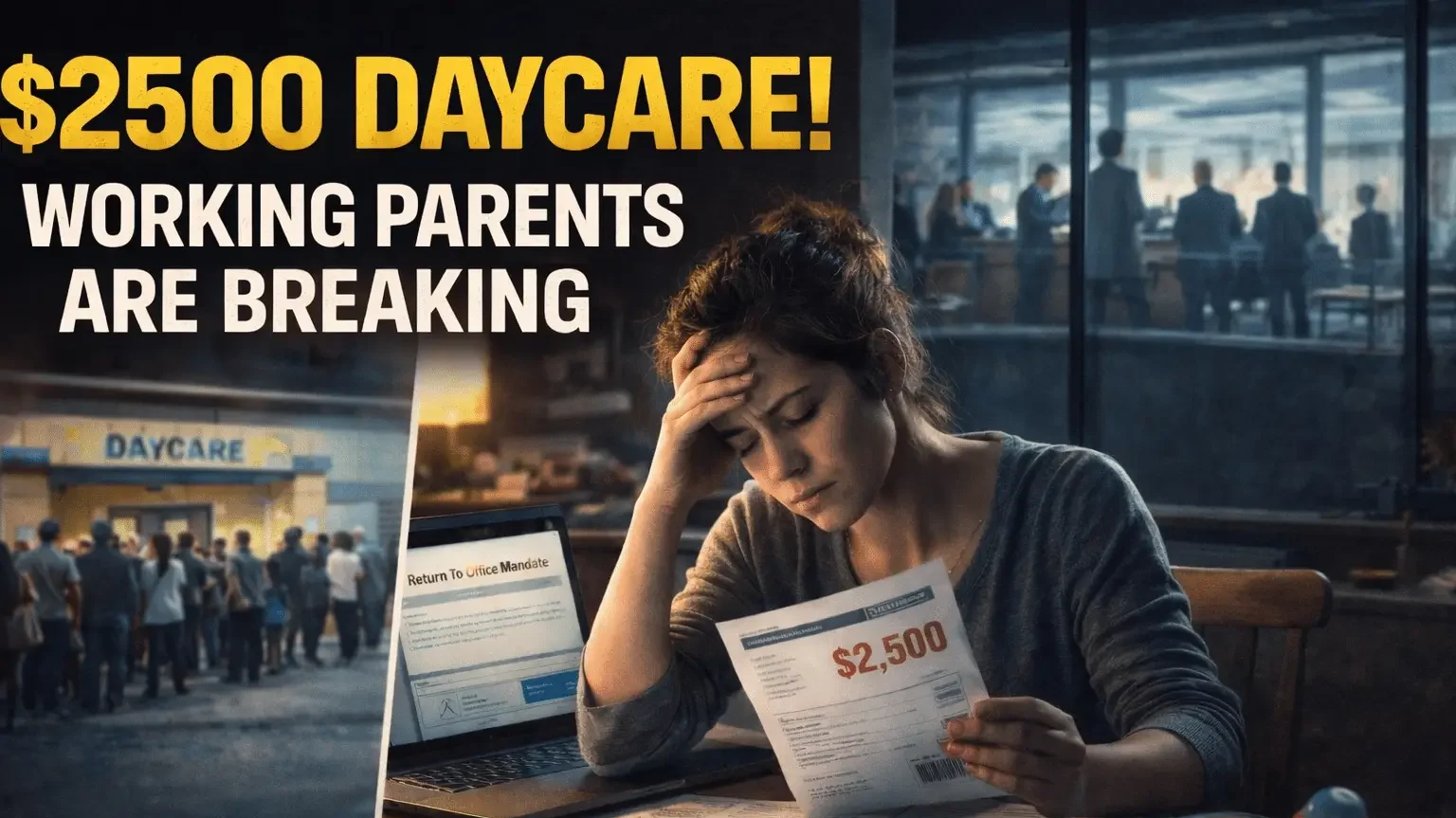
For seventeen years, I sat across from employees in sterile corporate Human Resources offices. I have seen every iteration of human ambition, burnout, and desperation. I have negotiated executive compensation packages that could buy a small island, and I have conducted exit interviews with brilliant, driven professionals who were walking away from their careers with tears in their eyes. But in all those years, nothing has struck me as more profoundly unjust, more economically self-destructive, and more fundamentally hypocritical than the American childcare system.
We operate under a social contract in this country: you work hard, you contribute to the economy, you obey the law, and in return, you get to build a life. You get to have a family. But today, if you decide to have a child in the United States, the economy does not support you. It punishes you. It exacts a financial penalty so severe that it is actively driving prime-age workers out of the labor force, suffocating the middle class, and setting the stage for a demographic and macroeconomic collapse.
I am writing this to you as a friend, but also as someone who insists on looking at the world through the cold, hard lens of objective reality. I do not care about your political tribalism. I stand for fairness, the rule of law, and objective right and wrong. And objectively, a society that forces a family to pay $2,500 a month just to keep their infant safe while they go to work to pay taxes is a society that is fundamentally broken.
This is not a theoretical debate about entitlement programs. This is an exhaustive investigation into a total market failure. Let’s strip away the political talking points and the corporate jargon. Let’s look at the brutal reality of what it actually costs to be a working parent in America today, why the system collapsed, the staggering hypocrisy of the people in charge, and the demographic death spiral we are proudly marching toward.
The View from the HR Desk: The Collision of Reality and RTO
Before we dive into the national data, I want to frame this from the perspective of the American workplace. Over the last few years, we have witnessed Corporate America launch an aggressive, unrelenting campaign for Return-to-Office (RTO) mandates. From Wall Street to Silicon Valley, the edict has come down from the C-suite: get back to your desks.
As an HR professional, I can tell you exactly what happens when you enforce a rigid RTO policy in a country with a decimated childcare infrastructure: you lose your best people, and disproportionately, you lose women. According to recent data, 52% of working parents flat-out struggle to coordinate childcare when faced with strict RTO mandates.1 But the real kicker is the gender divide. Roughly two-thirds of women report that they would actively consider quitting their jobs if their employer rolled out a full-time return-to-office mandate—a figure nearly 10 percentage points higher than their male counterparts.2
Why? Because the pervasive, unspoken imbalance in caregiving expectations still falls squarely on the shoulders of working mothers. When the pandemic hit, the childcare sector lost 34% of all its jobs by March 2020.3 While federal funds temporarily stabilized the bleeding, those funds have now dried up. Since late 2023, we have seen a phenomenon I refer to as “The Great Exit.” Women with young children—specifically those with a college degree or higher—are leaving the labor force in droves.3 Meanwhile, over the same period, men with young children have actually increased their participation in the labor force.3
This is not a coincidence. This is the math of a broken system making the decisions for us. When an employer demands five days in the office, and the local daycare charges $3,000 a month for an infant slot with a twelve-month waitlist, the family sits down at the kitchen table and does the math. Almost inevitably, the lower earner—usually the mother—is forced to tender her resignation. I have processed those resignations. The company loses a top performer, spends 33% of her base pay (averaging $15,000) just to recruit and train a replacement, and the broader economy loses her labor, her tax revenue, and her purchasing power.4
And yet, executive leadership remains willfully blind. They view childcare as a “personal problem,” ignoring the fact that you cannot have a functioning workforce without it.
The $2,500 Reality Check: Data by the Numbers
Let us look at the numbers, because the numbers are terrifying. The sticker shock of modern childcare has morphed from a manageable line item in a family budget into a predatory financial leviathan.
In high-cost-of-living (HCOL) areas like San Francisco, Boston, and New York City, infant care routinely exceeds $2,500 per month.5 Let that sink in. $2,500 a month is $30,000 a year. That is post-tax money. To afford that, a parent needs to earn roughly $40,000 to $45,000 pre-tax just to break even on the cost of putting their child in a safe room so they can go to work. If you have two children, double it.
National averages try to smooth this out, but even the averages are grim. According to the 13th annual Cost of Care Report for 2025/2026, the national average weekly cost for a nanny is $870 (up 5% from 2024), while daycare centers average $332 per week.6 But these averages obscure the localized devastation.
I want you to look at this table. This is the reality of annual and monthly childcare costs for an infant in various states across the country for 2025/2026.
| State | Annual Infant Care Cost | Monthly Equivalent | Average 4-Year-Old Cost (Annual) |
| Minnesota | $22,569 | $1,880 | $17,882 |
| California | $21,945 | $1,828 | $13,020 |
| Colorado | $21,840 | $1,820 | $15,992 |
| Hawaii | $21,167 | $1,763 | $15,224 |
| New York | $19,344 | $1,612 | $16,440 |
| Delaware | $16,220 | $1,351 | $12,168 |
| Illinois | $16,107 | $1,342 | $10,947 |
| Pennsylvania | $13,354 | $1,112 | $11,798 |
| Florida | $10,548 | $879 | $8,964 |
| Texas | $9,324 | $777 | $7,920 |
Data compiled from state-level reporting and childcare calculators for 2025/2026.7 Note: Actual costs in metropolitan hubs within these states are significantly higher.
The U.S. Department of Health and Human Services (HHS) has a very clear benchmark: childcare is only considered “affordable” if it costs no more than 7% of a household’s income.6 Do you know what the reality is? The average American parent currently spends 20% of their annual household income on childcare—nearly triple the federal affordability threshold.6
For lower-income households, the situation crosses the line from difficult into dystopian. Mothers in the lowest-income brackets face scenarios where childcare would consume nearly 80% of their income.10 When childcare costs 80% of your paycheck, working is no longer an economic decision; it is an exercise in futility. Modest earners are less likely to have access to pre-tax withholding mechanisms, meaning they must pay these exorbitant costs upfront with already-taxed dollars.11 The system literally punishes you for being poor while trying to work your way out of poverty.
The Absurdity of the Expense: Rent and College
To truly grasp how broken this is, we have to compare childcare to the other major pillars of American financial anxiety: housing and higher education.
We accept, as a society, that housing is expensive. But childcare has quietly overtaken it. An analysis by LendingTree of 85 major U.S. cities found that the average monthly cost of full-time center-based childcare for an infant and a four-year-old outpaces the average cost of rent.12 The average monthly cost for two children is $2,182, which is 39.4% higher than the average rent for a two-bedroom apartment ($1,566).13
In some cities, the ratio is simply mind-boggling. In Springfield, Massachusetts, daycare for two children is 136% higher than rent. In Syracuse, New York, it is 131% higher. In Buffalo, it’s 125% higher.13 You are paying more to rent a crib in a shared room for eight hours a day than you are to rent the actual home your family sleeps in at night.
Then there is higher education. We have massive federal programs, political debates, and societal angst over the cost of college. Yet, childcare for one infant is now more expensive than in-state public college tuition in 38 states and Washington D.C..14
Take Ohio, for example. The average tuition at a four-year public college in Ohio is roughly $11,110. But the cost to put a baby in daycare is nearly 54% higher than that.15 We have structured our society to offer 18-year-olds subsidized federal loans, grants, and decades-long repayment plans to afford an $11,000 tuition bill. But we look at a 28-year-old mother—who is likely still paying off her own student loans—and demand she cash-flow $16,000 a year out of her monthly post-tax paycheck, with virtually zero structural support. It is institutionalized insanity.
The Real Human Cost: Stories from the Brink
I promised to keep this human, so let’s look at the people behind these statistics. Real parents are drowning.
Consider Kath, a 42-year-old social scientist in Washington D.C. She and her husband rely entirely on daycare because they have no family nearby. They spend $2,580 a month for their youngest, plus $500 for after-school care for their seven-year-old.16 That is over $3,000 a month. As Kath notes, “Our house is very old, and it’s already very hard to keep up with the costs of repair because all of our spare change goes to childcare”.16 When a professional social scientist cannot afford home repairs because daycare consumes the entirety of her disposable income, the middle class is dead.
Or listen to Anne, a 34-year-old elementary school teacher in Tacoma, Washington. In a typical month, her household income is $8,480. Her bills total $11,900. Why? Because daycare alone costs $3,472 a month for her two children.16 “Every month we are negative, and the extra money comes from my savings,” she says. “My thought is, I just have to make it through the daycare years. I cry all the time”.16
We have public school teachers—the very people educating our older children—crying all the time and draining their life savings just to afford care for their own babies.
On forums like Reddit, the panic is palpable. One expectant mother in Boston described reaching out to over 20 providers as soon as she got a positive pregnancy test, only to face year-long waitlists. She finally secured a spot at a center 15 minutes away. The cost? $3,500 a month. “That amounts to $42,000 a year,” she wrote. “I am dying. That’s so much money. Yes, we can make it work, but my god we won’t be saving much for a few years”.17 Another parent touring an in-home facility in Boston was quoted $2,400 a month.18
This is the reality. The U.S. economy does not care about your family values. It demands your labor, and it taxes your desire to procreate.
The Macroeconomic Bleed: $172 Billion Down the Drain
When individual families are pushed to the brink, the macroeconomic dam eventually breaks. The childcare crisis is no longer a localized issue; it is a national economic emergency.
In a landmark 2026 report, the organization ReadyNation revealed that the childcare crisis now costs the U.S. economy a staggering $172 billion every single year.19 To understand the trajectory of this failure, you have to look at the historical data. Previous ReadyNation research found the economic toll was $57 billion in 2018. By 2022, it had climbed to $122 billion. Today, it sits at $172 billion.22 This is not a slow leak; it is an arterial hemorrhage.
Where does that $172 billion go? It is a cascading failure across three distinct vectors:
- Working Families Lose $134 Billion: In a national poll of working parents with young children, over 60% reported that childcare struggles forced them to leave work early, arrive late, miss full days, or operate under severe distraction.22 Half missed part of a work shift. These logistical nightmares have brutal, predictable outcomes: workers have their hours reduced, turn down promotions, or get fired. As a result, American families lose $134 billion annually in forgone earnings and job search expenses.23
- Employers Lose $38 Billion: This is where my HR background makes my blood boil. Corporate America is actively losing money by ignoring this. When employees cannot find reliable care, absenteeism spikes, operations are disrupted, and turnover accelerates.21 Employers are bleeding $38 billion annually due to childcare-driven productivity bottlenecks.23
- Taxpayers Lose $37 Billion: When parents drop out of the workforce or reduce their hours, they pay less in income taxes and consume fewer goods, generating less sales tax. The result is a $37 billion annual deficit in federal and state tax revenues.23
We are literally burning $172 billion a year in economic potential because our politicians and corporate leaders refuse to build a functional bridge between the home and the workplace. As the ReadyNation briefing bluntly stated: “Parents Cannot Work Without Child Care – and the Economy Is Paying the Price”.21
The ROI of Care vs. C-Suite Blindness
Given the $38 billion hit to employers, you would think that Corporate America would be leading the charge to solve this. Instead, we see a baffling mixture of awareness at the HR level and profound, stubborn blindness in the C-suite.
A 2025 CHRO Perspectives Survey by KinderCare and The Harris Poll paints a crystal-clear picture of what HR leaders know to be true. Among Fortune 500 HR leaders, 86% believe that offering childcare benefits is instrumental in attracting top talent, and 85% report that these benefits play a critical role in reducing employee turnover.24 Furthermore, 83% recognize childcare benefits as vital for enhancing employee mental health.26
We know it works. For employees, the lack of childcare support is a dealbreaker; 29% of job switchers cited it as their primary motivation for leaving their previous employer, and one in five who already moved did so specifically because their last company offered zero family care benefits.27
So why isn’t every major corporation offering robust childcare subsidies, back-up care, or on-site facilities? Because the executives signing the checks refuse to look at the math. An astounding 78% of HR leaders admit they struggle to demonstrate the long-term Return on Investment (ROI) of childcare benefits to their C-suite executives.26
Let me do the math for them. A comprehensive report by Moms First and Boston Consulting Group (BCG) analyzed five major companies—Etsy, Fast Retailing, Steamboat Ski Resort, Synchrony, and UPS—that offered childcare benefits. Every single one of them saw a positive return on investment, ranging from 90% to a massive 425%.27 These gains were realized across both salaried and hourly workers.28
The BCG analysis revealed a shocking truth: an employer only needs to retain between 1% and 12% of the employees eligible for childcare benefits to hit the “retention breakeven point”—meaning the money saved on turnover entirely covers the cost of the childcare program.27 When it costs 33% of a worker’s base pay to replace them, spending a fraction of that to subsidize their daycare is not a perk. It is a highly aggressive, financially sound retention strategy.
To ignore a 425% ROI because you view childcare as a “women’s issue” or a “personal choice” is corporate malpractice.
The Market Failure: Why it Costs So Much but Pays So Little
We need to address the central paradox of this crisis. If parents are paying $2,500 a month, daycare center owners must be driving Lamborghinis, right? Wrong. The childcare sector is the textbook definition of a market failure.29 It is an industry where the consumer cannot afford the true cost of the service, and the provider cannot afford to charge any less without going bankrupt.
Unlike tech or manufacturing, early childhood education cannot be scaled through automation. You cannot replace a human being rocking a crying infant with a software algorithm. Safety and quality are dictated by strict, legally mandated caregiver-to-child ratios. The National Association for the Education of Young Children (NAEYC) recommends no more than 3 to 4 infants per caregiver.5
Because of these ratios, childcare is intensely labor-heavy. Let’s look at the operating budget of a standard childcare center. Between 45% and 55% (and sometimes up to 70.5%) of total revenue goes directly to teacher salaries, benefits, and support staff.31 Facility costs, including rent or commercial mortgages, consume another 15% to 20%.31 Then you have food and supplies (7%), comprehensive liability, property, and vehicle insurance which costs between $3,000 and $8,000 annually, plus utilities, maintenance, and licensing fees.31
Providers operate on razor-thin margins. If a center charges an average of $1,200 per child, they might need 43 enrolled children just to break even—any dip in enrollment means they are losing money before they even buy crayons or snacks.32
Because parents have an absolute affordability ceiling, providers are forced to balance their budgets by suppressing the only variable cost they can control: labor.29 This results in the systematic exploitation of the early childhood education (ECE) workforce.
These educators, who are disproportionately women and women of color, are tasked with facilitating the cognitive development of our next generation. Yet, their compensation is abhorrent. In California, a state with an astronomical cost of living, the typical starting wage for a childcare assistant teacher in 2025 was approximately $18 per hour.34 Lead teachers topped out around $21 to $26.60 per hour.34 To put that in perspective, California’s fast-food minimum wage is $20 per hour.34 One in five centers uses the absolute minimum wage to set starting pay.34
Nationally, the inflation-adjusted median wage for childcare workers was $15.90 per hour in late 2024.3 This is a poverty wage. It is not enough to cover the basic cost of living in almost any U.S. county.3 More than half of all early childhood educators are forced to rely on public assistance just to feed their own families.29
When you pay the people raising your children less than the people flipping your burgers, you guarantee a catastrophic turnover rate. This turnover destabilizes children who need secure attachments, and it creates endless administrative friction for center directors.3 The market failure is complete: parents are bankrupted by the tuition, providers are bankrupted by the overhead, and the workers are trapped in systemic poverty.
The Childcare Cliff: A Manufactured Crisis
How did it get this bad so quickly? Because our government built a bridge out of toothpicks and then set it on fire.
When the COVID-19 pandemic hit, the government realized that if the childcare sector collapsed, the entire economy would grind to a halt. So, they pumped historic levels of federal funding into the system via the CARES Act and the American Rescue Plan Act (ARPA) in 2020 and 2021.3 This funding was a lifeline. It helped 220,000 childcare programs remain operational and allowed 10 million children to access care.36 Providers used this money to keep their doors open, offer modest retention bonuses to their starving staff, and prevent tuition from skyrocketing at the same pace as broader economic inflation.29
But Congress designed this funding to expire. The critical ARPA stabilization funds ran out on September 30, 2023, and the remaining supplemental funds evaporated on September 30, 2024.35 We call this the “Childcare Cliff.”
The impact of this cliff has been devastating. In Ohio alone, 33% of the 6,265 providers who received ARPA grants stated they would have closed without them. The state has already lost 10% of its licensed programs (nearly 1,000 facilities) since 2019, and recent data shows a 30% drop in providers from 2018 to 2024.37 In Pennsylvania, 41% of programs said they would have folded without the federal help.37
When the federal dollars vanished, providers had only two choices: drastically raise tuition on parents who were already maxed out, or close their doors permanently.36 The government requested $16 billion in emergency funding to prevent the cliff, but partisan gridlock ensured it never materialized.36 We manufactured a crisis, watched it unfold, and let working parents take the fall.
Immigration, Hypocrisy, and the Rule of Law
Now, I want to talk about something that makes people on all sides of the political aisle uncomfortable. I told you my philosophy: I stand for the rule of law. I oppose illegal, entitled behavior, and I do not believe a nation can exist without secure borders. But I am fiercely objective, and I will vehemently defend honest migrants who are the literal backbone of our domestic economy.
If you want to know why childcare supply is shrinking and costs are exploding, you have to look at the intersection of early childhood education and immigration policy.
The American economy heavily depends on immigrant workers in the childcare sector. Foreign-born workers make up approximately 20% of the entire U.S. childcare workforce, totaling more than 282,000 professionals.38 In center-based daycares, one-fourth of all workers are immigrants.3 In major states like Florida, Texas, New York, and California, the numbers are even higher. In California alone, nearly 40% of the early childhood educators are foreign-born—almost half a million people.38
These are the women wiping noses, changing diapers, teaching ABCs, and holding crying toddlers so that American citizens can go to work. They are filling the massive labor gaps created by the poverty wages I detailed above.39
But in 2025 and 2026, we are seeing the catastrophic fallout of aggressive, indiscriminate immigration policies. Heightened Immigration and Customs Enforcement (ICE) activity at and around childcare facilities, coupled with sweeping mass deportation agendas, are devastating this workforce.38
Let me be brutally honest here: when you send ICE to raid a neighborhood or a daycare center, you do not just remove undocumented individuals. You terrify the entire community, including mixed-status families and legal residents. You force honest, hardworking people into the shadows. And when those 282,000 workers vanish from the labor pool, the ECE system collapses.
The ripple effects are immediate. According to a recent report, disruptions to the childcare system stemming from these immigration policies are projected to affect 12.8 million households with children under the age of 14 in 2025 alone.40 That means 41.9% of those households will have at least one adult whose job is compromised because they lost access to their immigrant caregiver.40
This is the ultimate hypocrisy of blind tribalism. You cannot scream “America First” while simultaneously deporting the very people who allow American parents to participate in the American economy. Shrinking an already decimated labor pool through indiscriminate immigration crackdowns guarantees that daycares will close, waiting lists will grow, and the $2,500 bill will become $3,500.38 You are hurting the honest migrant, yes, but you are also actively destroying the financial stability of the native-born population you claim to protect.
Political Theater vs. Family Values
This brings us to the political arena, which is currently a masterclass in deception and hypocrisy.
Voters are not stupid. They know they are drowning. In recent polling, 80% of all voters stated that the ability of working parents to find and afford childcare is in a “state of crisis” or a “major problem.” This cuts across all party lines: 65% of Republicans, 81% of Independents, and 94% of Democrats agree.41 Among Republican primary voters, 75% view childcare as a serious problem, and 89% of all voters want candidates who have a clear plan to make childcare affordable.41
Yet, what do we get from our leaders? We get “family values” rhetoric masking draconian budget cuts.
In the Fiscal Year 2026 federal budget proposals, conservative lawmakers—who campaign endlessly on the sanctity of the family—proposed devastating cuts to childcare spending.43 The House blueprint proposed flat-funding the Child Care and Development Fund (CCDF). Because of inflation, flat-funding is a massive functional cut to a program that already fails to reach 85% of eligible low-income families.43
Even worse, the budget proposals push to entirely eliminate the Child Care Access Means Parents In School (CCAMPIS) program and the Preschool Development Grant (PDG) program.43 Advocacy groups, like Family Values @ Work, have correctly pointed out that these cuts, alongside gutting Medicaid and reducing SNAP benefits, will destabilize local economies, deepen the childcare crisis, and leave millions without basic security.45
The hypocrisy is breathtaking. You cannot claim to be the party of the family while systemically dismantling the exact economic support structures families need to survive. You cannot feign outrage over declining birth rates while voting to strip funding from the facilities that care for the babies you want people to have.46
And let us not let the Democrats off the hook. While they champion sweeping, multi-billion dollar proposals that look great on campaign websites, they consistently fail to execute. They allowed the ARPA funds to expire, engaging in partisan bickering and tying childcare funding to massive, unpassable omnibus bills instead of securing standalone, bipartisan solutions to save the industry from the cliff.47
Both sides use working parents as political pawns. The Right cuts the funding; the Left fails to secure it. And the parents are left holding a $2,500 monthly bill.
The International Disgrace: How the Rest of the World Does It
Sometimes, to see how toxic your own environment is, you have to look outside it. The American approach to childcare is a stark, humiliating anomaly among developed nations.
In most peer countries, early childhood education is viewed as essential public infrastructure. It is treated like roads, bridges, or public schools—a necessary investment to keep the economy moving. In the United States, it is treated as a private luxury.
Let’s look at the data from the Organisation for Economic Co-operation and Development (OECD). In 2022, U.S. couples who both earn an average wage and have two young children spent a staggering 20% of their disposable household income on childcare.48 For single parents on an average wage, the burden is a crushing 37% of their net income.48
These figures place the United States at the very top of the developed world for childcare unaffordability. The only country that comes close is Switzerland (32% for couples), which, like the U.S., relies heavily on a private, unregulated, and unsubsidized market.48
Other nations are looking at the math and adapting. Canada began investing in a nationwide system for affordable childcare in 2021, and they have successfully cut parent fees by an average of 50%.50 The United Kingdom is rolling out a program to offer 30 hours of free childcare per week for any child under five by September 2025. Why? Because the UK government calculated that this investment will encourage an extra 60,000 parents to re-enter the workforce, boosting their GDP.50 Portugal has enacted a scheme allowing children up to age one to enroll in daycares for free, regardless of family income, with plans to extend it to age three.50
The U.S. Treasury Secretary has openly called the American system a “broken market”.48 We are the wealthiest nation on earth, yet we offshore the entirety of this economic burden onto the shoulders of new parents during the exact years they are most financially vulnerable. It is a national disgrace.
The Demographic Death Spiral: Social Security’s Ticking Clock
If you do not care about the moral argument, or the HR turnover costs, or the international comparisons, then care about this: we are currently engineering our own demographic doom.
When a society makes it financially ruinous to raise children, its citizens behave in a perfectly rational economic manner: they stop having them.
The U.S. fertility rate reached a record low in 2024, with the average American woman giving birth to less than two children—well below the population replacement rate.51 According to a 2025 American Family Survey, 70% of respondents now say raising children is simply too expensive.52 But here is the terrifying data point: for the first time in the survey’s 11-year history, finances are now the number one reason Americans limit the size of their family. A full 43% cite “insufficient money” as the primary factor in not having more children.52 Among rural parents, 20% explicitly state they are putting off having kids specifically because childcare is so expensive.52
This is not a cultural shift away from family life. This is a generation looking at their bank accounts, looking at a $2,500 monthly daycare bill, and deciding they literally cannot afford to reproduce.
The downstream macroeconomic consequences of this are catastrophic, particularly for our social safety nets. Social Security operates on an intergenerational transfer model. The taxes of current workers pay for the benefits of current retirees. It is a system that relies entirely on a stable or growing ratio of workers to beneficiaries.
According to the Social Security Board of Trustees, the program’s costs are projected to outpace revenues to the point of trust fund depletion by 2034.53 At that point, only 83% of scheduled benefits would be payable, dropping further as the century progresses.53 The Penn Wharton Budget Model projects a 75-year actuarial shortfall equal to 4.2% of all future covered payroll.53
And what is driving this shortfall? It is not just that Boomers are living longer. As the Chief Actuary of the Social Security Administration noted, the increase in costs relative to revenue “results from population aging, not because we are living longer, but because birth rates dropped from three to two children per woman”.54
Read that again. The impending collapse of our retirement system is directly tied to the fact that we are not producing enough taxpayers. We are caught in a death spiral. Politicians argue that we cannot afford to subsidize childcare. The objective mathematical reality is that we cannot afford not to. If we do not invest in the infrastructure required to raise the next generation of workers, there will be no one left to fund the economy, pay the taxes, or support the elderly in the decades to come.
A Blueprint for Sanity: The New Mexico Model
Is it hopeless? No. Because while the federal government flounders and Corporate America acts blind, some states are proving that we can fix this.
Look to the American Southwest. In late 2025, New Mexico did something historic: it became the first state in the nation to offer universal childcare (UCC) available to all children.55
Recognizing that means-testing and arbitrary income caps actively punish the middle class, New Mexico wiped the slate clean. Starting November 1, 2025, they removed all income limits for their childcare assistance program.57 The UCC program has no income limits, no copays, and no fees.56 They paired this with a $12.7 million low-interest loan fund to construct and renovate childcare facilities to build the supply side.56
The results have been immediate and profoundly validating. Since the rollout, over 9,390 new families applied and were found eligible. Crucially, 85% of these new families are of low or moderate income—including frontline workers, first responders, and two-parent households relying on care to stay employed.55
New Mexico is not treating this as a welfare entitlement; they are treating it as an aggressive economic development strategy. They leaned on research showing that universal early childhood programs raise parents’ earnings by 22%, increase hours worked by 13 per week, and reduce the likelihood of career gaps by 34%.55 By securing the logistics of their working class, New Mexico is supercharging their talent pool and their economic output.55 They proved that when you stop punishing parents, the entire economy rises.
Conclusion: A Demand for a New Contract
I have spent my career studying human behavior within the confines of the economy. What we are witnessing right now is not a minor policy failure. It is a profound, systemic betrayal of the American working class.
We have constructed an economy that demands absolute devotion and maximum productivity from its citizens, yet actively penalizes them with a $30,000 annual bill if they dare to bring a child into the world. We are bleeding $172 billion a year in lost productivity while our politicians offer empty “family values” platitudes and slash the budgets that keep daycares open. We are deporting the vital workers who watch our children, and we are driving our most talented, educated women out of the workforce to satisfy the fragile egos of executives demanding Return-to-Office compliance.
And at the end of the road, a demographic cliff waits to bankrupt our retirement systems because we made it too expensive for an entire generation to reproduce.
We do not need more political tribalism. We do not need more corporate buzzwords about “work-life balance.” We need to recognize childcare for what it is: essential, critical economic infrastructure. Until we treat it as such, until we fund it as such, we are a society that is actively choosing to cannibalize its own future. And that is a choice we can no longer afford to make.
Works cited
- An HR Guide to Return-to-Office Strategies (2026 Edition) – Meditopia for Work, accessed on March 10, 2026, https://meditopia.com/en/forwork/articles/return-to-office-strategies-hr-guide
- RTO pressures meet childcare gap: Why employers risk losing parents – HR Executive, accessed on March 10, 2026, https://hrexecutive.com/rto-pressures-meet-childcare-gap-why-employers-risk-losing-parents/
- The great exit: – KPMG, accessed on March 10, 2026, https://kpmg.com/us/en/articles/2025/october-2025-the-great-exit.html
- The Business Impact of the Child Care Cliff for Employers–and Their Working Parents, accessed on March 10, 2026, https://www.care.com/benefits/how-the-child-care-cliff-impacts-employers/
- How Much Does Daycare Cost? Complete 2026 Price Guide – Wonderschool, accessed on March 10, 2026, https://www.wonderschool.com/blog/family-resources/how-much-does-daycare-cost-complete-2026-price-guide
- How Much Does Child Care Cost? 2026 Cost of Care Report, accessed on March 10, 2026, https://www.care.com/c/how-much-does-child-care-cost/
- 2026 Child Care Cost Calculator | Average Daycare Cost by State, accessed on March 10, 2026, https://childcarecalculators.com/
- Child Care Cost by State 2026 – World Population Review, accessed on March 10, 2026, https://worldpopulationreview.com/state-rankings/child-care-costs-by-state
- The many costs of childcare – Bank of America Institute, accessed on March 10, 2026, https://institute.bankofamerica.com/content/dam/economic-insights/childcare-costs.pdf
- The economic cost of California’s broken child care market – Upjohn Institute, accessed on March 10, 2026, https://www.upjohn.org/research-highlights/economic-cost-californias-broken-child-care-market
- Child Care Cost Burden | County Health Rankings & Roadmaps, accessed on March 10, 2026, https://www.countyhealthrankings.org/health-data/community-conditions/social-and-economic-factors/safety-and-social-support/child-care-cost-burden
- Child care expenses top the cost of rent in dozens of U.S. cities, analysis finds. See where., accessed on March 10, 2026, https://www.cbsnews.com/news/child-care-costs-rent-lendingtree/
- Study: Child Care Frequently Costs More Than Rent – NAM, accessed on March 10, 2026, https://nam.org/study-child-care-frequently-costs-more-than-rent-32134/
- Updated resource calculates the cost of child care in every state: Child care is more expensive than public college tuition in 38 states and Washington D.C. | Economic Policy Institute, accessed on March 10, 2026, https://www.epi.org/press/updated-resource-calculates-the-cost-of-child-care-in-every-state-child-care-is-more-expensive-than-public-college-tuition-in-38-states-and-washington-d-c/
- Child care costs more than public college for most Ohio families – Signal Cleveland, accessed on March 10, 2026, https://signalcleveland.org/child-care-costs-more-than-public-college-for-many-ohio-families/
- Here’s how much I pay for childcare – and what I’d do instead if it were free – The Guardian, accessed on March 10, 2026, https://www.theguardian.com/us-news/2025/mar/24/how-much-i-pay-for-childcare
- Heart attack over daycare costs : r/BabyBumps – Reddit, accessed on March 10, 2026, https://www.reddit.com/r/BabyBumps/comments/1j8vh14/heart_attack_over_daycare_costs/
- I know I shouldn’t be shocked. : r/NewParents – Reddit, accessed on March 10, 2026, https://www.reddit.com/r/NewParents/comments/1lai972/i_know_i_shouldnt_be_shocked/
- New ReadyNation Report Finds the Economic Impact of Child Care …, accessed on March 10, 2026, https://www.ffyf.org/2026/02/11/readynation-report/
- ReadyNation: The Child Care Crisis Costs the U.S. Economy $172 Billion Each Year (2026 Report), accessed on March 10, 2026, https://www.instituteforchildsuccess.org/resources/resource/cost-child-care-crisis-report/
- The Child Care Crisis Is Now a $172 Billion Economic Emergency – And Employers Hold the Key to Solving It – TOOTRiS, accessed on March 10, 2026, https://tootris.com/edu/blog/news/the-child-care-crisis-is-now-a-172-billion-economic-emergency-and-employers-hold-the-key-to-solving-it/
- The Child Care Crisis Costs the U.S. Economy $172 Billion Each Year, accessed on March 10, 2026, https://www.instituteforchildsuccess.org/wp-content/uploads/2026/02/Cost-of-Child-Care-Crisis_ReadyNation_2026_Report.pdf
- The Child Care Crisis Costs the U.S. Economy $172 Billion Each Year, accessed on March 10, 2026, https://www.instituteforchildsuccess.org/cost-child-care-crisis/
- CHRO Survey 2025 | KinderCare Learning Companies, accessed on March 10, 2026, https://www.kc-learning.com/newsroom/articles/chro-survey-2025
- Supporting Working Parents Through Employee Discount Programs – PerkSpot, accessed on March 10, 2026, https://www.perkspot.com/blog/supporting-working-parents-through-employee-discount-programs/
- 85% of HR leaders say childcare benefits help lower employee turnover, report finds, accessed on March 10, 2026, https://hrsea.economictimes.indiatimes.com/news/industry/85-of-hr-leaders-say-childcare-benefits-help-lower-employee-turnover-report-finds/117298701
- Investing in people: The business case for family care benefits, accessed on March 10, 2026, https://www.care.com/about/the-business-case-for-family-care-employee-benefits/
- CEOs doubt the ROI of childcare benefits — how can HR change their minds? – WorkLife, accessed on March 10, 2026, https://www.worklife.news/leadership/ceos-doubt-the-roi-of-childcare-benefits-how-can-hr-change-their-minds/
- Still Unaffordable: Child Care’s Rising Prices, Stretched Supply, and …, accessed on March 10, 2026, https://tcf.org/content/commentary/still-unaffordable-child-cares-rising-prices-stretched-supply-and-staffing-shortages/
- Understanding the Basics of Child Care in the United States – Center for American Progress, accessed on March 10, 2026, https://www.americanprogress.org/article/understanding-the-basics-of-child-care-in-the-united-states/
- Childcare Center Budget: How to Successfully Create and Balance Your Budget, accessed on March 10, 2026, https://mybrightwheel.com/blog/child-care-center-budget
- Daycare Center Running Costs: $588K Monthly, 2 Month Breakeven – Financial Models Lab, accessed on March 10, 2026, https://financialmodelslab.com/blogs/operating-costs/daycare
- Child Care Centers, accessed on March 10, 2026, https://earlychildhoodny.org/resourceguide/resources/OperatingBudgets-Child%20Care%20Inc%20publication.pdf
- Child Care Centers Compete With California’s $20 Fast Food Wage, accessed on March 10, 2026, https://cscce.berkeley.edu/publications/data-snapshot/california-wages-2020-to-2025/
- Key Findings – Early Childhood Workforce Index 2024 – CSCCE, accessed on March 10, 2026, https://cscce.berkeley.edu/workforce-index-2024/executive-summary/key-findings/
- State-by-State Map on Local Impact of Child Care Funding Cliff, accessed on March 10, 2026, https://nwlc.org/resource/cc-map/
- Child Care Funding Cliff at One Year: Rising Prices, Shrinking Options, and Families Squeezed – The Century Foundation, accessed on March 10, 2026, https://tcf.org/content/report/child-care-funding-cliff-at-one-year/
- Padilla, Schiff, 40+ Lawmakers Sound Alarm on How Trump’s Immigration Agenda is Hurting Workers and Families’ Child Care Access, Raising Costs, accessed on March 10, 2026, https://www.padilla.senate.gov/newsroom/press-releases/padilla-schiff-40-lawmakers-sound-alarm-on-how-trumps-immigration-agenda-is-hurting-workers-and-families-child-care-access-raising-costs/
- Explainer: Immigrants’ Critical Role in the U.S. Childcare Workforce and in Increasing Labor Force Participation Rates, accessed on March 10, 2026, https://forumtogether.org/article/explainer-immigrants-critical-role-in-the-u-s-childcare-workforce-and-in-increasing-labor-force-participation-rates/
- New Report: Trump’s Mass Deportation Agenda Will Deepen the Childcare Crisis, accessed on March 10, 2026, https://www.americanimmigrationcouncil.org/press-release/report-childcare-crisis-trump-mass-deportation/
- First Five Things to Know About: 2026 National Child Care Poll, accessed on March 10, 2026, https://www.ffyf.org/resources/2026/02/first-five-things-2026-national-poll/
- Beyond the Base: Why Child Care Matters to Republican Voters Too, accessed on March 10, 2026, https://bipartisanpolicy.org/article/beyond-the-base-why-child-care-matters-to-republican-voters-too/
- Trump and Republicans in Congress Are Making the Child Care Crisis Even Worse, accessed on March 10, 2026, https://tcf.org/content/commentary/trump-and-republicans-in-congress-are-making-the-child-care-crisis-even-worse/
- NAFCC Statement on the FY2026 Budget: A Silent Threat to Family Child Care, accessed on March 10, 2026, https://nafcc.org/nafcc-statement-on-the-fy2026-budget-a-silent-threat-to-family-child-care/
- Family Values @ Work Urges Congress: Reject Budget Cuts That Harm Working Families and Invest in Care Policies, accessed on March 10, 2026, https://familyvaluesatwork.org/family-values-work-urges-congress-reject-budget-cuts-that-harm-working-families-and-invest-in-care-policies/
- Debate over SEIU bill characterized by hypocrisy, deception – Freedom Foundation, accessed on March 10, 2026, https://www.freedomfoundation.com/labor/debate-seiu-bill-characterized-hypocrisy-deception/
- The Democrats’ CHIP Hypocrisy – Commentary Magazine, accessed on March 10, 2026, https://www.commentary.org/noah-rothman/the-democrats-chip-hypocrisy/
- Chart: U.S. Childcare Cost Higher Than In Other Developed Countries | Statista, accessed on March 10, 2026, https://www.statista.com/chart/33438/share-of-disposable-household-income-spent-on-childcare/
- Net childcare costs – OECD, accessed on March 10, 2026, https://www.oecd.org/en/data/indicators/net-childcare-costs.html
- Highest childcare costs and how countries are cutting them – The World Economic Forum, accessed on March 10, 2026, https://www.weforum.org/stories/2023/07/highest-childcare-costs-by-country/
- Is the U.S. birth rate declining? | Johns Hopkins | Bloomberg School of Public Health, accessed on March 10, 2026, https://publichealth.jhu.edu/2026/is-the-us-birth-rate-declining
- NEW: “High Cost of Child Care Shapes Families’ Choices and Futures”, accessed on March 10, 2026, https://www.ffyf.org/resources/2025/11/new-high-cost-of-child-care-shapes-families-choices-and-futures/
- The Long-Term Outlook for Social Security: Baseline and Alternative Assumptions, accessed on March 10, 2026, https://budgetmodel.wharton.upenn.edu/p/2025-09-26-the-long-term-outlook-for-social-security/
- Research: The Future Financial Status of the Social Security Program, accessed on March 10, 2026, https://www.ssa.gov/policy/docs/ssb/v70n3/v70n3p111.html
- and Budget Priorities – Universal Child Care at a Glance for New Mexico Legislators, accessed on March 10, 2026, https://www.nmececd.org/wp-content/uploads/2026/01/Universal-Child-Care-at-a-Glance-for-New-Mexico-Legislators_FINAL_Jan_20_2026.pdf
- BILL ANALYSIS AND FISCAL IMPACT REPORT – New Mexico Legislature, accessed on March 10, 2026, https://www.nmlegis.gov/Sessions/26%20Regular/AgencyAnalysis/HB0106_333.pdf
- How New Mexico Will Pay for Universal Childcare – Fiscal Policy Institute, accessed on March 10, 2026, https://fiscalpolicy.org/how-new-mexico-will-pay-for-universal-childcare



Leave a Reply