
The Grand Illusion of the 2026 Labor Market
The global labor market in 2026 presents a jarring, almost irreconcilable contradiction that has left economists, policymakers, and highly qualified job seekers profoundly disoriented. On the surface, macroeconomic indicators and digital job board metrics project a landscape of robust, unyielding opportunity. Millions of positions are advertised daily across platforms like LinkedIn, Indeed, and ZipRecruiter, complete with competitive salary bands, comprehensive benefits packages, and urgent calls for immediate applications. Yet, the lived reality for professionals—particularly within the technology, corporate banking, and non-banking financial company (NBFC) sectors—is defined by algorithmic silence, infinite interview loops, and an impenetrable barrier to entry. This stark disconnect is not merely a symptom of a cooling economy, nor is it simply a transient skills gap. It is the direct result of a calculated, structural illusion known as the “ghost job” epidemic.
To fully comprehend the scale of this phenomenon, it is necessary to examine the widening chasm between advertised job openings and actual hiring data. An analysis of the United States Bureau of Labor Statistics (BLS) Job Openings and Labor Turnover Survey (JOLTS) reveals a persistent, multi-million job deficit.1 In June 2025 alone, U.S. employers reported an impressive 7.4 million job openings, yet only 5.2 million hires were actualized.1 This left more than 2.2 million advertised roles that never materialized into genuine employment, disappearing into the digital ether.1
Historically, this gap did not exist at such a staggering scale. From 2010 to 2014, job openings ranged from 2 to 4 million, with the gap between openings and hires rarely exceeding 500,000.2 Between 2015 and 2019, openings climbed to 6 to 7 million, with hires closely tracking that upward trajectory.2 However, following the pandemic-era hiring euphoria, the “phantom gap” expanded massively. Beginning in 2021, job postings surged above 11 million while hiring activity flatlined, and the disparity has held steady ever since.1 By 2026, roughly 28% to 38% of all job postings each month fail to result in a hire.1
The broader economic context makes these numbers even more alarming. By the end of October 2025, the American workforce had endured one of its most turbulent periods since the pandemic, with more than one million workers losing their jobs to corporate layoffs across nearly every major industry.4 The technology sector bore a disproportionate share of this restructuring. Tracking firms recorded approximately 141,159 job cuts in the tech sector by late 2025, a significant increase from the 120,470 cuts during the same period the previous year.5 Major technology firms executed aggressive workforce reductions to streamline operations and reallocate capital toward artificial intelligence. Intel Corporation announced the elimination of more than 21,000 positions—roughly 20% of its workforce—to achieve massive operating expense reductions, while Microsoft cut approximately 15,000 roles, targeting middle management and administrative functions.4 Furthermore, government-related workforce reductions, driven heavily by the Department of Government Efficiency (DOGE) initiative, accounted for over 307,000 job losses, severely impacting downstream private and nonprofit entities.4
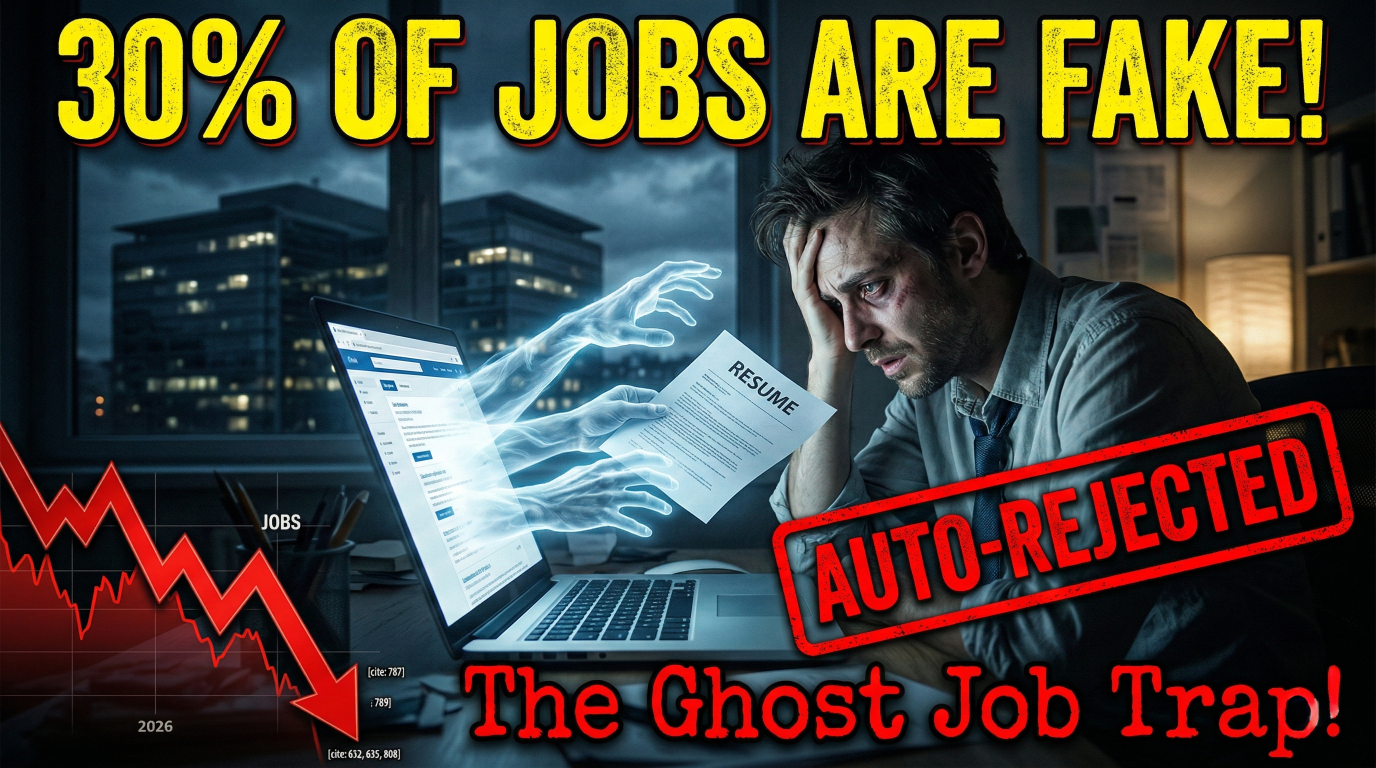
Despite this aggressive contraction, corporate career pages remain flooded with ostensibly active job listings. By 2026, industry analytics estimate that roughly 30% of all job postings in the technology sector are “ghost jobs”—roles publicly advertised with absolutely no near-term intention of hiring.6 The situation is even more pronounced in other sectors, with the ghost job rate reaching 60% in government, 50% in education and health, 48% in information technology, and 44% in financial activities.1 This data exposes a deeply problematic corporate reality: the modern recruitment architecture is increasingly engineered not to match talent with opportunity, but to serve internal corporate optics, manipulate existing workforces, and harvest market data. The proliferation of ghost jobs distorts the talent market, wastes millions of hours of candidate productivity, and fundamentally fractures the psychological contract between employers and the labor force.1
The Anatomy of a Phantom Requisition
A “ghost job”—often referred to interchangeably as a phantom listing or fake job—is defined as an employment advertisement for a position that does not actually exist, lacks an approved departmental budget, or for which the company has no immediate intention of hiring an external candidate.6 While these listings are visually and textually indistinguishable from legitimate roles, they act as digital black holes, absorbing candidate resumes without any actionable recruitment workflow attached to them.6
The sheer prevalence of this practice is staggering and openly acknowledged by human resources professionals. A comprehensive 2024 survey of 1,641 hiring managers commissioned by ResumeBuilder revealed that 40% of companies had posted a fake job listing within the past year, and three in ten companies maintained active ghost listings at the exact moment of the inquiry.7 Among the organizations actively engaging in this deception, the volume of fake postings is substantial: 13% of these companies admitted to posting 75 or more fake listings, while another 11% posted up to 50.7 These phantom roles are not isolated to entry-level positions; they span the entire corporate hierarchy, targeting mid-level (68%), entry-level (63%), senior-level (53%), and executive-tier (45%) roles.7
Ghost job listings typically fall into several distinct archetypes, each serving a specific, albeit hidden, corporate function:
| Ghost Job Archetype | Operational Definition | Primary Corporate Utility |
| The Pipeline Builder | Roles posted explicitly to collect resumes for future needs, with no immediate intent or budget to interview candidates. | Ensures a readily available pool of talent is on standby, reducing the “time-to-fill” metric if a sudden vacancy occurs or a budget is unexpectedly approved.6 |
| The Compliance Facade | Positions that have already been filled internally, but are posted externally to satisfy diversity mandates, union rules, or visa immigration requirements. | Provides a paper trail proving that the company conducted an “external search,” even though the internal candidate was pre-selected.8 |
| The Budget-Pending Lure | Situations where a hiring manager has submitted a requisition, but the finance department has not yet approved the headcount. | Allows the department to gauge market interest and salary expectations before making a formal financial commitment.6 |
| The PR and Optics Listing | Postings designed primarily for media, competitor, or investor optics to demonstrate “aggressive hiring” and operational vitality. | Inflates the company’s perceived growth trajectory, which can be critical during venture capital fundraising rounds or public earnings calls.6 |
| The Unicorn Trap | Speculative roles left open indefinitely for hard-to-fill tech positions, hoping a generational talent applies. | Operates on a “cream skimming” strategy. The company will not hire a standard qualified candidate, but will unlock emergency budget for an exceptional industry veteran.6 |
These roles are distributed widely across the digital ecosystem. The ResumeBuilder survey noted that fake listings appeared on company websites (72%), LinkedIn (70%), ZipRecruiter (58%), Indeed (49%), and Glassdoor (48%).7 The duration of these listings further betrays their illegitimacy. While a genuine, urgent role typically fills within 2 to 4 weeks, ghost jobs are kept active for extended periods, with 31% remaining open for a month, 19% for three months, and 9% for a year or more.7
The Dark Psychology of Corporate Gaslighting
To understand why a company would dedicate resources to posting jobs it has no intention of filling, one must pull back the curtain on the internal psychology and strategic motivations of modern corporate management. The drivers behind ghost jobs reveal a deeply cynical approach to human capital management, characterized by a willingness to weaponize the macroeconomic environment against both current employees and external job seekers.
The motivations driving human resources departments, senior managers, and executives to authorize ghost jobs can be categorized into four primary quadrants: external optics, internal workforce manipulation, data harvesting, and business intelligence.
1. The Illusion of Infinite Growth (External Optics) In the modern corporate landscape, particularly within publicly traded companies and venture-backed tech startups, the optics of ambition often dictate market valuation. A company that ceases to post jobs signals to Wall Street, competitors, and investors that its growth phase has concluded or that it is experiencing financial distress.11 According to the ResumeBuilder survey, 66% of hiring managers who post ghost jobs do so specifically to create the illusion that the company is growing.7 By maintaining a robust digital footprint of job listings, organizations feed third-party algorithms and equity analysts the data points required to sustain a narrative of continuous expansion and financial health, effectively manipulating market perception.7
2. The Weaponization of Replaceability (Internal Manipulation) Perhaps the most troubling motivation behind the ghost job epidemic is the deliberate psychological manipulation of the existing workforce. An astonishing 62% of hiring managers admitted that they post fake listings to foster a sense of replaceability among current staff.7 In an era characterized by flatlining wages, reduced benefits, and heightened demands for productivity, executives utilize the visible presence of external job postings to induce anxiety. The implicit message to the employee is clear: “You are easily replaceable, so you must work harder, accept fewer resources, and refrain from demanding compensation increases.” As business consultants have noted, this relies on a deliberate campaign of misinformation to keep employees feeling insecure, suppressing their leverage in a tightening economy.14
Conversely, 63% of managers stated they post ghost jobs to trick overworked, burnt-out employees into believing that “help is on the way”.7 By projecting the illusion that the company is actively trying to hire additional staff to alleviate heavy workloads, management can temporarily boost morale and prevent immediate resignations, all while avoiding the actual financial cost of expanding the payroll.7
3. The Harvesting of Human Capital (Talent Pipelining) Nearly 60% of surveyed companies maintain ghost jobs simply to collect resumes and keep them on file for potential future needs.7 In high-turnover industries or highly specialized technical fields, organizations operate under the assumption that it is more efficient to possess a pre-vetted database of desperate candidates than to initiate a search from scratch when a role actually materializes. This transforms the public job board from a marketplace of opportunity into a non-consensual data-harvesting operation, where candidates unknowingly surrender their professional histories, contact information, and salary expectations to corporate databases.7
4. The Business Intelligence Reconnaissance In highly competitive sectors, ghost jobs are occasionally deployed as instruments of corporate espionage and market research. Companies may post a highly lucrative, senior-level position to attract talent from rival firms. The ensuing “interviews” are not genuine evaluations of the candidate, but rather intelligence-gathering sessions designed to extract proprietary workflows, strategic insights, and structural knowledge about the competitor’s operations.11 Furthermore, companies use fake listings to benchmark current salary expectations across the market, allowing them to adjust their own compensation bands without ever making a formal hire.11
The ethical degradation inherent in these practices is profound. Despite the inherent deception, seven in ten hiring managers believe the practice is morally acceptable (43% calling it “definitely acceptable” and 27% “probably acceptable”).7 This moral flexibility is justified by the perceived operational benefits: 77% of managers reported that ghost jobs positively impacted productivity, 68% claimed a positive impact on revenue, and 65% noted a positive impact on employee morale.7
However, the lengths to which companies will go to maintain the facade are chilling. Of the companies that contact applicants for these fake roles, 85% carry the deception all the way through to conducting formal interviews.7 Candidates are subjected to rigorous multi-stage technical assessments, cultural fit interviews, and executive panels for positions that possess zero allocated headcount.7 This practice crosses the line from passive data collection into the active, uncompensated exploitation of a professional’s time, emotional energy, and intellectual property.
This ethical bankruptcy is beginning to trigger internal revolts within human resources departments. In a highly publicized 2025 incident, a senior hiring manager was terminated after refusing executive orders to continue posting ghost jobs.17 The manager, who had already posted over 300 fake listings across major job boards for a major retailer, cited the deep moral injury inflicted on the existing workforce and external candidates.17 The manager stated, “I’m not going to continue to post ghost job listings so our employees can act like they are scared to lose their jobs. That ruins their mental, it destroys their mental health deeply”.17 This rare moment of internal whistleblower transparency underscores the deliberate cruelty embedded within the ghost job strategy.
The Silicon Valley Paradox: Layoffs and “Urgent” Hires
In the technology sector, the ghost job epidemic intersects with a highly specific, structural macroeconomic realignment. Following the unprecedented hiring boom of the pandemic era, Silicon Valley entered a protracted “Year of Efficiency.” This period has been characterized by brutal workforce reductions, the flattening of middle-management hierarchies, and the aggressive integration of generative artificial intelligence into internal operational workflows.4 Indeed’s 2025 Tech Talent Report revealed that genuine tech job postings had plummeted by an estimated 36% compared to pre-2020 baselines, establishing a deeply contracted, highly selective hiring environment.19
Yet, anyone navigating job boards in 2026 will see a technology sector that appears to be hiring aggressively. This contradiction is driven by a strategy of “cream skimming” and the hyper-specific demands of digital transformation. The tech industry is currently shrinking and growing simultaneously.19 While entry-level and generalist mid-tier roles are being rapidly automated out of existence—leaving recent computer science graduates in a barren landscape—the demand for highly specialized talent remains acutely unmet.19
Postings containing AI-related terms surged by more than 130% through late 2025, significantly bucking the broader downward trend in hiring.22 Nearly 45% of data and analytics postings now contain AI-related requirements.22 Because the skills gap is so severe—with the World Economic Forum projecting that 39% of workers’ core skills will become obsolete by 2030—tech companies leave speculative, aspirational job postings open indefinitely.21
These roles function as “unicorn traps.” They are ghost jobs that exist solely to capture the resume of a rare, generational talent should they happen to enter the market.6 For example, a major tech firm may post a listing for a senior machine learning architect. The company has no immediate, desperate need to fill the role, nor do they intend to hire an “average” candidate who meets 80% of the qualifications. However, if a top-tier engineer recently laid off from a rival FAANG company applies, the hiring manager will instantly bypass normal protocols, unlock emergency budget, and make a hire.10
This creates a “low hire, low fire” market dynamic.20 Employers hang onto existing workers tightly, resulting in low general turnover, while forcing external applicants to compete for a shrinking pool of genuine requisitions masked by thousands of speculative, aspirational postings.20 For the standard tech professional, the market feels impenetrable because the vast majority of visible roles are essentially lottery tickets reserved for unicorns.
The Financial Sector Facade: A View from Corporate Banking and NBFCs
While Silicon Valley dominates the discourse on algorithmic hiring and digital transformation, veterans of the corporate Banking and Non-Banking Financial Company (NBFC) sectors understand that these industries exhibit an even higher concentration of phantom roles. Data from the summer of 2025 indicated that while the tech sector hovered around a 30% ghost job rate, the “Financial Activities” sector reached a staggering 44%.1
The elevated rate of ghost jobs in finance and banking is driven by a unique convergence of intense regulatory scrutiny, rigid institutional bureaucracy, and the specific mechanics of internal mobility. In major banking institutions, securing headcount approval is a notoriously protracted process involving multiple layers of financial risk assessment, compensation committee reviews, and departmental budget allocations. Hiring managers in corporate banking frequently instruct their internal talent acquisition teams to post roles before the budget is formally secured.6 This allows the department to engage in preemptive market testing, gauging salary expectations and the caliber of available external talent before making a formal financial request to the executive board.6 If the budget request is ultimately denied or delayed by the finance committee—a frequent occurrence in a high-interest-rate environment—the job posting is often abandoned rather than formally closed, leaving it to auto-renew on external job boards indefinitely.13
Furthermore, the finance sector heavily utilizes external postings to leverage internal promotions through compliance theater. It is a strict institutional mandate within corporate banking to demonstrate that external market talent was thoroughly evaluated before promoting an internal analyst or associate to a Vice President or Director level.8 This is designed to ensure compensation equity, prevent nepotism, and satisfy rigorous diversity, equity, and inclusion (DEI) audits. Consequently, when a high-performing internal candidate is identified for a promotion, HR is required to post the “new” role externally for a statutory period.8 External applicants unknowingly submit their resumes for a position that has already been verbally awarded to an internal employee, creating a massive volume of purely performative, legally mandated ghost jobs.8
Complicating the landscape for finance professionals in 2026 is the dramatic rise in sophisticated employment scams, which are frequently conflated with corporate ghost jobs. Between 2020 and 2024, job scams tripled, with consumers losing a staggering $501 million to recruitment fraud in 2024 alone.24 In the financial sector, malicious actors clone the career pages of legitimate NBFCs, accounting firms, and investment banks, posting fake remote roles for financial analysts, compliance officers, and accountants.26
These scammers conduct highly convincing virtual interviews and establish phony onboarding portals.26 Under the guise of setting up corporate equipment and direct deposit protocols, they harvest highly sensitive personal data, including Social Security numbers and bank account details.26 Sometimes the fraud extends to requiring the “new hire” to purchase proprietary software or home office equipment from a “preferred vendor,” with the promise of future reimbursement that never arrives.26 Job seekers in the banking sector must therefore navigate a treacherous dual threat: legitimate corporate HR departments hoarding resumes for optics and compliance, alongside international fraud rings harvesting financial data.
The Transatlantic Contagion: UK Struggles and the European Regulatory Antidote
The ghost job epidemic is not confined to the borders of North America; it has deeply penetrated the United Kingdom and European labor markets, albeit with distinct regional variations driven by unique economic pressures and impending legislative interventions.
In the United Kingdom, the labor market experienced a severe contraction moving into 2026. Data from the job search engine Adzuna revealed that in January 2026, the number of advertised job vacancies tumbled to 695,000—the lowest level in five years, marking the first time vacancies dropped below the 700,000 threshold since January 2021.27 Graduate job postings plummeted below 10,000.27 This contraction was heavily influenced by significant tax changes introduced in late 2024, including substantial rises in employers’ national insurance contributions and a 4.1% increase in the minimum wage.27 These financial pressures forced businesses to freeze genuine hiring, trim advertised benefits, and pivot aggressively toward automation and AI adoption, where the UK currently leads its peer countries.27
Despite this genuine, measurable contraction in employer demand, the visible volume of jobs—bolstered by ghost listings—remains artificially high, leading to immense candidate frustration. Research published by Employment Hero in early 2026 indicated that nearly one in four UK workers (24%) had applied for a job they believed did not actually exist, a figure that rises to 37% among younger demographics (18-34 years old).29 Further analysis by Robert Walters and StandOutCV revealed that ghost listings accounted for an average of 34.4% of postings across 20 common UK roles throughout 2025, including highly sought-after positions like software engineers and accountants.30
The impact on British professionals has been paralyzing. According to the Robert Walters survey, 44% of professionals stated that vacancies advertised without genuine intent to hire completely stalled their job search, while 35% noted that such listings destroyed their trust in the corporate recruitment process.30 The structural inefficiency is staggering: with job seekers spending up to two hours tailoring each application, those submitting 10 to 15 applications weekly are losing anywhere between 1.5 to 10 hours of uncompensated labor every week to phantom roles.30 This environment has bred deep cynicism, with 61% of UK workers stating that the convoluted, unresponsive hiring process has put them off looking for a new role altogether.32
However, the European Union is poised to radically alter the recruitment architecture and potentially eradicate the ghost job. By June 2026, the EU Pay Transparency Directive will take full effect across all member states.33 This landmark legislation mandates that it will be entirely illegal for any employer to post a job without explicitly displaying a realistic salary range.33 Furthermore, employers will be legally prohibited from asking candidates about their previous pay, and companies will be subjected to strict audits for unnatural pay gaps among employees performing similar work.34
This directive represents a functional death knell for the casual corporate ghost job in Europe. Because employers will be legally barred from posting fake or arbitrarily wide salary bands (e.g., “$50,000 – $150,000”), the legal and financial liability of maintaining hundreds of fake listings for market intelligence or investor optics will far outweigh the strategic benefits.34 If a company posts a ghost job with an inflated salary to project aggressive growth, they will be legally bound to justify that high salary parity against their internal, existing workforce during a regulatory audit.34 Consequently, the European market is expected to see a massive purge of phantom listings by mid-2026, establishing a regulatory standard of transparency that American and British job seekers can currently only envy.
The Algorithmic Gatekeepers and the AI Arms Race
The facilitation of the ghost job epidemic is heavily reliant on the opaque, automated nature of modern Applicant Tracking Systems (ATS). Software suites that were originally designed in the early 2000s to organize human resources workflows have morphed into impenetrable algorithmic gatekeepers that actively sustain the illusion of a booming job market.
A 2026 Hiring Insights Report by Resume Genius revealed that 71% of organizations utilize ATS software, with adoption reaching 85% among Gen Z hiring managers.35 Over a third of hiring managers (37%) explicitly rely on these systems to automatically screen out candidates based on rigid preset criteria before a human ever views the resume.35 In the context of ghost jobs, the ATS is the primary enabler. Enterprise-grade platforms like Workday and Taleo are frequently configured with automated lifecycle triggers.8 These platforms are programmed to automatically renew and republish expired job listings across aggregated job boards (like Indeed, LinkedIn, and ZipRecruiter) every 30 to 90 days.8 Consequently, a role that was paused due to a budget freeze in early 2025 may continue to be automatically refreshed and marked as “Newly Posted” well into 2026, creating a self-perpetuating cycle of phantom vacancies.8
This dynamic has generated severe “ATS anxiety” among the applicant pool. A Monster report found that 77% of candidates operate under the constant fear that their resumes will be algorithmically filtered out, leading 49% to submit resumes longer than one page in desperate attempts to stuff keywords and bypass the digital filters.36 Because the sheer volume of ghost jobs necessitates mass applying, 68% of candidates now spend less than 30 minutes tailoring a resume; efficiency has entirely replaced storytelling, as candidates recognize they are likely applying to a machine, not a human.36
However, the late 2025 and 2026 market is witnessing a technological counter-offensive. Recognizing that the recruitment market has reached a “Digital Stalemate”—where candidates use AI to mass-apply and companies use AI to mass-filter—former talent acquisition executives from tech giants like Google, Meta, and Amazon have begun launching transparent intelligence platforms.37
Tools such as Futurizm, Wobo, and EDLIGO AIRA are successfully reverse-engineering corporate ATS logic.8 These platforms provide candidates with an “AI-Résumé Analyzer” that acts as an ATS simulator, offering a real-time fit score (0–100%) and transparent reasoning regarding how a corporate algorithm will interpret their profile.8 Furthermore, these tools generate an “Interview Probability Score,” allowing a candidate to objectively assess if a job posting is a genuine opportunity or a digital black hole.37 By utilizing these AI defenses, job seekers can finally identify why they are being ghosted, correct the “Modesty Gap” in their language, and bypass the trap of applying to roles with a 0% probability of human review.37 Savvy candidates are also abandoning aggregated boards entirely, utilizing specialized AI agents to scan native career sites directly, bypassing the automated reposting loops that plague platforms like LinkedIn and Indeed.38
The Human Cost: Psychological Devastation and the Discouraged Worker
The most profound damage inflicted by the ghost job economy cannot be measured in macroeconomic percentages or automated rejection rates; it is measured in the psychological devastation of the global workforce. The 2026 job search process has evolved from a transitional career hurdle into a prolonged, trauma-inducing gauntlet that fundamentally degrades the mental health of highly qualified professionals.
A comprehensive 2026 report on the state of job search mental health presents a harrowing picture of candidate well-being. According to the data, a staggering 72% of job seekers report that searching for employment is actively negatively impacting their mental health.39 Nearly 80% experience chronic anxiety, and 66% feel entirely burned out by the process before they even secure a role.39 This is not the standard stress associated with career transitions; this is a full-blown mental health crisis driven by systems that reject applicants silently, employers who ghost them indefinitely, and a market that has broken the fundamental promise that diligent effort leads to opportunity.39
The primary stressor, cited by 55% of respondents, is the agonizing experience of “waiting to hear back”—the absolute, deafening silence that follows hours of tailored application labor.39 The median search time for a new role has stretched to an agonizing 68.5 days.39 This prolonged exposure to uncertainty, coupled with the algorithmic rejection inherent in modern ATS platforms, significantly elevates the risk of clinical depression compared to shorter searches.39
The systemic deception of ghost jobs creates a unique psychological whiplash. Candidates invest immense emotional energy preparing for interviews for roles that were never real. When they are ghosted after the third or fourth round of a fake recruitment process, the resulting blow to their professional confidence is profound.7
This environment has created a massive cohort of what economists term “discouraged workers.” By 2026, data indicates that 514,000 highly qualified professionals have stopped looking for work entirely, convinced that the market is devoid of genuine opportunities.39 Another 6.4 million individuals desire employment but refuse to actively engage in the psychologically toxic search process, stepping away from the labor market to preserve their mental health.39 The ghost job epidemic is not just wasting time; it is actively driving top talent out of the workforce.
Macroeconomic Distortion and the Legislative Reckoning
Beyond the immediate psychological devastation of job seekers, the ghost job economy poses a severe systemic risk to macroeconomic stability. Central banks, including the U.S. Federal Reserve and the Bank of England, rely heavily on labor market data to formulate monetary policy, set interest rates, and evaluate national economic health. Metrics such as the ratio of job openings to unemployed workers are critical indicators of wage pressure and inflation potential.41
When a structural flaw results in 30% to 40% of job board listings being non-actionable “ghosts,” the underlying economic data is fundamentally corrupted.1 A labor market that appears exceptionally tight on paper—suggesting high demand for workers and impending wage inflation—may actually be experiencing a severe contraction.42 If traders, economists, and policymakers misinterpret this inflated job count, it can lead to mispriced growth expectations in equity and fixed-income markets.42 More dangerously, if central banks rely on this distorted data, they may maintain artificially high interest rates to cool a labor market that is already freezing. The ghost job epidemic creates a dangerous blind spot in the economic intelligence apparatus of Western governments, potentially accelerating recessionary conditions by projecting phantom resilience.1
Recognizing this threat, lawmakers and regulatory bodies are beginning to mount a legislative counter-offensive. While the practice has historically existed in a legal gray area, a wave of new legislation aims to classify fake job postings as deceptive business practices.
In California, lawmakers introduced Assembly Bill 1251, a bill specifically designed to ban “ghost” job postings.44 The proposed legislation requires private employers to explicitly disclose in all job advertisements whether the position is an existing, budgeted vacancy.44 Employers failing to provide this transparency would be in direct violation of California’s unfair competition laws under the Business and Professions Code.44 The California Privacy Protection Agency (CPPA) is slated to oversee enforcement, wielding the authority to impose administrative fines and issue cease-and-desist orders against non-compliant corporations.44
Similarly, in New Jersey, the Moriarty Bill (S-3509) cleared the Senate Labor Committee in March 2025.45 Sponsored by Senator Paul Moriarty, the legislation mandates that employers must disclose if a posting is for an existing vacancy, provide an estimated timeframe for when the position will be filled, and strictly requires the removal of the job posting once the role is occupied.45 Violators of the New Jersey law face civil penalties ranging from $1,000 to $5,000 per infraction, collected through a civil action by a summary proceeding.45
At the federal level, legal scholars are constructing frameworks to combat ghost jobs using existing consumer protection laws. A comprehensive analysis published in the Columbia Law Review argued that ghost jobs represent a new evolution in the non-consensual harvesting and misuse of sensitive personal data.15 Because these fake listings deceive candidates into surrendering highly sensitive personal information—and fundamentally distort national economic data—the publication asserts that ghost jobs violate the consumer protection mandates of the Federal Trade Commission (FTC) Act.15 The framework proposes that the FTC should utilize its enforcement authority over unfair and deceptive consumer practices to exorcise ghost jobs from the online hiring landscape entirely, categorizing resume harvesting via fake listings as a breach of the modern digital social contract.15
The Insider’s Playbook: How to Spot a Ghost Job in the Wild
Until sweeping legislative changes take effect and enforcement mechanisms are formalized, professionals navigating the 2026 labor market must adopt a highly defensive, analytical approach to job hunting. Treating every job board listing as a potentially hostile data-harvesting mechanism or a phantom corporate lure is the new baseline for career survival. By understanding the internal mechanics of HR departments, candidates can identify the specific red flags that differentiate a genuine requisition from a ghost posting.
The following diagnostic matrix outlines the most prevalent indicators of a ghost job, the underlying HR reality driving the listing, and the actionable steps candidates must take to protect their time.
| Red Flag Indicator | The Underlying HR Reality | Actionable Defense Strategy for Candidates |
| The “Urgent” Forever Post | If a job is marked “Urgently Hiring” but the posting date is 30+ days old, it is an automated ATS refresh loop. Genuine, urgent roles in corporate environments typically fill within 2 to 4 weeks.8 | Check Google cache or LinkedIn timestamps to verify the original inception date of the posting. Discard the application immediately if the core listing is older than 30 days with no substantive updates.8 |
| Hyper-Generic Platitudes | Listings lacking specific daily responsibilities, demanding absurdly broad criteria (e.g., “3-15 years experience”), or relying heavily on cultural buzzwords (“fast-paced environment,” “wear many hats”) are typically pipeline-building tools, not active roles.8 | Run the job description through AI evaluation tools to assess specificity. If it lacks clear, measurable project goals or technical requirements, it is likely a data harvesting operation.47 |
| Absurd Compensation Bands | Salary ranges spanning massive gaps (e.g., $50,000 to $150,000) indicate the hiring department has not secured a specific budget from finance and is merely testing market expectations.7 | Avoid applications that do not provide a realistic, narrow compensation band. A genuine role has a defined, board-approved budget attached to the requisition.7 |
| Instant Auto-Rejection | An ATS rejection email received in under 60 seconds is a hard knockout filter. This often indicates the role is a compliance posting for a pre-selected internal candidate, and external applications are being automatically purged.8 | Do not internalize the rejection. Recognize it as a mechanical compliance barrier, not a reflection of your professional capability or resume quality.8 |
| The “Always Hiring” Echo | Multiple identical openings for the exact same role, live for consecutive months on the company’s career page, indicate an evergreen requisition hoarding resumes for high-turnover pipelines.8 | Direct networking is required. Bypass the ATS entirely and contact departmental leadership or internal recruiters directly via LinkedIn to ascertain if immediate headcount actually exists.8 |
| The Unresponsive Loop | The posting is three months old, but lists the start date as “Immediate.” This indicates the HR team has forgotten to close the requisition, and the ATS is mindlessly reposting it.47 | Cross-reference the role on the company’s direct native career page. If it only exists on a third-party aggregator like Indeed, it is a dead link.46 |
Furthermore, job seekers must adapt to the reality that public job boards are increasingly saturated with promoted spam and algorithmic noise. The days of mass applying are over; submitting hundreds of applications into the void merely feeds the phantom economy and accelerates burnout.
Success in the 2026 market requires a sniper’s approach. Candidates must utilize AI transparency tools to score their resume probability against genuine listings, rigorously screen out aged postings, and leverage direct, human-to-human networking to bypass the algorithmic gatekeepers entirely. In a market where 43% of postings may already have an internal candidate chosen 8, the most effective application is often the one that never touches an ATS at all, but is handed directly to a decision-maker.
The Future of Hiring
The ghost job epidemic of 2026 is not an accidental byproduct of a clumsy technological transition into the AI era; it is a calculated feature of the modern corporate recruitment ecosystem. By maintaining millions of phantom job listings, companies across Silicon Valley, Wall Street, and the global markets have successfully engineered a system that projects an external illusion of limitless growth, while internally weaponizing labor market anxiety against their own employees.
This systemic deception carries profound consequences that ripple far beyond the HR department. It distorts the macroeconomic data relied upon by central banks, obscures the reality of aggressive corporate downsizing, and inflicts a devastating psychological toll on a global workforce that is burning out in pursuit of digital mirages.
While technological counter-measures powered by artificial intelligence and incoming legislative efforts like the EU Pay Transparency Directive offer glimmers of structural reform, the immediate burden continues to fall squarely upon the job seeker. Navigating this fractured landscape requires a firm rejection of traditional application methods and the adoption of a highly critical, defense-oriented career strategy. The genuine opportunities still exist, hidden beneath the noise, but securing them requires seeing clearly through the digital ghosts currently haunting the modern economy.
Works cited
- Ghost Jobs: Millions of Listings That Never Lead to a Hire – My Perfect Resume, accessed on March 2, 2026, https://www.myperfectresume.com/career-center/careers/basics/ghost-job-economy
- Millions Of “Ghost Jobs” Haunt The U.S. Labor Market – Allwork.Space, accessed on March 2, 2026, https://allwork.space/2025/11/millions-of-ghost-jobs-haunt-the-u-s-labor-market/
- Ghost Jobs: Up to 1 in 3 Job Listings Don’t Result in Hires – CPA Practice Advisor, accessed on March 2, 2026, https://www.cpapracticeadvisor.com/2025/11/12/ghost-jobs-up-to-1-in-3-job-listings-dont-result-in-hires/173044/
- The Layoff Era: Understanding Job Cuts from 2025 to 2026 | by Averageguymedianow, accessed on March 2, 2026, https://medium.com/@averageguymedianow/the-layoff-era-understanding-job-cuts-from-2025-to-2026-e36ab1b62746
- Hundreds of thousands of tech workers are in trouble, new report shows – SFGATE, accessed on March 2, 2026, https://www.sfgate.com/tech/article/october-2025-tech-industry-layoffs-blood-bath-21143585.php
- The Ghost Job Epidemic: Why 30% of 2026 Job Postings Are Fake – Fonzi AI, accessed on March 2, 2026, https://fonzi.ai/blog/ghost-jobs-meaning
- That job you applied for might not exist. Here’s what’s behind a …, accessed on March 2, 2026, https://www.cbsnews.com/news/fake-job-listing-ghost-jobs-cbs-news-explains/
- The 2026 ATS Conspiracy: Why Your Dream Job Posting Doesn’t Exist (Ghost Jobs Exposed) – EDLIGO, accessed on March 2, 2026, https://www.edligo.net/job-search-tips/the-2026-ats-conspiracy-why-your-dream-job-posting-doesnt-exist-ghost-jobs-exposed/
- Ghost Jobs: What They Are and How to Spot Them | Built In, accessed on March 2, 2026, https://builtin.com/articles/ghost-jobs
- The Ghost Job Economy: 1 in 3 U.S. Job Listings Lead Nowhere : r/Economics – Reddit, accessed on March 2, 2026, https://www.reddit.com/r/Economics/comments/1pkrj1y/the_ghost_job_economy_1_in_3_us_job_listings_lead/
- Companies Are Outlining Plans for 2026. Hiring Isn’t One of Them. : r/Economics – Reddit, accessed on March 2, 2026, https://www.reddit.com/r/Economics/comments/1q15ywp/companies_are_outlining_plans_for_2026_hiring/
- Why are there so many fake job postings out there? : r/recruitinghell – Reddit, accessed on March 2, 2026, https://www.reddit.com/r/recruitinghell/comments/18cuw88/why_are_there_so_many_fake_job_postings_out_there/
- The Dark Side of Hiring: Why Ghost Jobs Harm Everyone Involved – Opus Virtual Offices, accessed on March 2, 2026, https://www.opusvirtualoffices.com/blog/ghost-jobs/
- Bosses Are Posting Fake Jobs To Trick Overworked, Burned Out Workers Into Thinking Things Will Get Better – YourTango, accessed on March 2, 2026, https://www.yourtango.com/career/bosses-posting-fake-jobs-trick-workers-things-will-get-better
- GHOST JOBS – Columbia Law Review, accessed on March 2, 2026, https://columbialawreview.org/content/ghost-jobs/
- Why Do Companies Post Fake Job Ads?, accessed on March 2, 2026, https://valuesvalue.com/blog/why-do-companies-post-fake-job-ads/
- Hiring manager fired for refusing to post ‘ghost jobs’ is now sharing how to recognize them, accessed on March 2, 2026, https://www.upworthy.com/hiring-manager-fired-for-refusing-to-post-ghost-jobs-is-now-sharing-how-to-recognize-them/
- A VP of HR told me companies are “secretly sacking thousands” due to AI. As a 2026 grad, I’m spiralling cus how are we supposed to survive this? : r/careerguidance – Reddit, accessed on March 2, 2026, https://www.reddit.com/r/careerguidance/comments/1r2s8et/a_vp_of_hr_told_me_companies_are_secretly_sacking/
- Tech Is Shrinking… and Growing? The 2026 Job Market Plot Twist. – Interview Query, accessed on March 2, 2026, https://www.interviewquery.com/p/tech-job-market-2026-shrinking-and-growing
- WTF is Wrong with the Tech Job Market in 2026 ? – YouTube, accessed on March 2, 2026, https://www.youtube.com/watch?v=LNJPnQFRZmQ
- Beyond the Paradox: Adapting to the New Hiring Architecture of 2026 – Sharp Decisions, accessed on March 2, 2026, https://www.sharpdecisions.com/insights/beyond-the-paradox-adapting-to-the-new-hiring-architecture-of-2026
- January 2026 US Labor Market Update: Jobs Mentioning AI Are Growing Amid Broader Hiring Weakness, accessed on March 2, 2026, https://www.hiringlab.org/2026/01/22/january-labor-market-update-jobs-mentioning-ai-are-growing-amid-broader-hiring-weakness/
- Question to corporate recruiters from an agency recruiter about rumored “ghost jobs” – Reddit, accessed on March 2, 2026, https://www.reddit.com/r/recruiting/comments/1i2uzee/question_to_corporate_recruiters_from_an_agency/
- Fake Job Postings and Ghost Jobs: How to Spot and Avoid Them – VidCruiter, accessed on March 2, 2026, https://vidcruiter.com/resources/fake-and-ghost-jobs/
- How to Spot a Fake Job Posting | Acara Solutions, accessed on March 2, 2026, https://acarasolutions.com/blog/job-seekers/how-to-spot-a-fake-job-posting/
- Taking the “ploy” out of employment scams | Federal Trade Commission, accessed on March 2, 2026, https://www.ftc.gov/business-guidance/blog/2023/01/taking-ploy-out-employment-scams
- UK job vacancies ‘fall to lowest level since pandemic’ – The Guardian, accessed on March 2, 2026, https://www.theguardian.com/business/2026/feb/23/uk-job-vacancies-fall-to-lowest-level-since-pandemic
- Indeed’s 2026 UK Jobs & Hiring Trends Report: Caution Persists, but Bright Spots Emerge, accessed on March 2, 2026, https://www.hiringlab.org/uk/blog/2025/12/09/indeed-2026-uk-jobs-hiring-trends-report/
- 1 in 4 UK jobseekers applied for ghost jobs – Staffing Industry Analysts, accessed on March 2, 2026, https://www.staffingindustry.com/news/global-daily-news/1-in-4-uk-jobseekers-applied-for-ghost-jobs
- ‘Ghost’ job listings stalling UK job searches, survey finds – Workplace Journal, accessed on March 2, 2026, https://workplacejournal.co.uk/2026/02/ghost-job-listings-stalling-uk-job-searches-survey-finds/
- 44% of UK Professionals Say ‘Ghost’ Jobs Are Wasting Their Time – FM News, accessed on March 2, 2026, https://news.fmbusinessdaily.com/2026/02/44-of-uk-professionals-say-ghost-jobs-are-wasting-their-time/
- Ghost jobs & fake job listings discourage UK job seekers – Employment Hero, accessed on March 2, 2026, https://employmenthero.com/uk/news/ghost-jobs-fake-job-listings-uk-job-seekers/
- accessed on March 2, 2026, https://www.reddit.com/r/linkedin/comments/1ovceq6/big_change_coming_to_the_eu_job_market_by_2026/#:~:text=The%20EU%20has%20passed%20a,without%20showing%20a%20salary%20range.
- Big change coming to the EU job market by 2026 : r/linkedin – Reddit, accessed on March 2, 2026, https://www.reddit.com/r/linkedin/comments/1ovceq6/big_change_coming_to_the_eu_job_market_by_2026/
- A third of managers rely on applicant tracking systems to screen out applications, report finds – Workplace Journal, accessed on March 2, 2026, https://workplacejournal.co.uk/2026/02/a-third-of-managers-rely-on-applicant-tracking-systems-to-screen-out-applications-report-finds/
- Job seekers optimize resumes amid ATS ‘anxiety’ – HR Dive, accessed on March 2, 2026, https://www.hrdive.com/news/job-seekers-longer-resumes-growing-ats-concerns-monster/810834/
- Hiring has reached a “Digital Stalemate”—Now, an ex-Google recruiter is giving candidates the answers – Markets – Valley City Times-Record, accessed on March 2, 2026, http://business.times-online.com/times-online/article/prlog-2026-2-25-hiring-has-reached-a-digital-stalematenow-an-ex-google-recruiter-is-giving-candidates-the-answers
- My job search is hitting a wall. LinkedIn and Indeed feel like ghost towns. What are the best sites to actually get an interview in 2026? – Reddit, accessed on March 2, 2026, https://www.reddit.com/r/work/comments/1qve81m/my_job_search_is_hitting_a_wall_linkedin_and/
- The State of Job Search Mental Health in 2026: Why 72% of Job Seekers Are Breaking Down Before They Ever Get Hired (A Comprehensive Research Report) – The Interview Guys, accessed on March 2, 2026, https://blog.theinterviewguys.com/state-of-job-search-mental-health-in-2026/
- Ghost Jobs & Misleading Job Ads Are Still Rising — What Job Seekers and Employers Need to Know – DAVRON, accessed on March 2, 2026, https://www.davron.net/ghost-jobs-misleading-job-ads-are-still-rising-what-job-seekers-and-employers-need-to-know/
- 1 in 3 US job listings go nowhere, creating a ‘ghost job economy,’ report finds | HR Dive, accessed on March 2, 2026, https://www.hrdive.com/news/us-job-listings-go-nowhere-creating-a-ghost-job-economy/805448/
- “Ghost Jobs” on the Rise — What It Means for Labor Markets and Hiring Data, accessed on March 2, 2026, https://unusualwhales.com/news/ghost-jobs-on-the-rise-what-it-means-for-labor-markets-and-hiring-data
- From 1 in 8 to 1 in 5: Ghost Jobs Are Exploding in 2025 – Medium, accessed on March 2, 2026, https://medium.com/@patricklindsley1/from-1-in-8-to-1-in-5-ghost-jobs-are-exploding-in-2025-a7a1fbdad011
- California Lawmakers Want to Ban “Ghost” Job … – Fisher Phillips, accessed on March 2, 2026, https://www.fisherphillips.com/print/v2/content/40221/california-lawmakers-want-to-ban-ghost-job-postings.pdf
- Moriarty Bill to Prohibit Employers from Posting ‘Ghost Job …, accessed on March 2, 2026, https://www.njsendems.org/m/newsflash/home/detail/670
- How to spot a ghost job posting before you waste time applying : r/recruitinghell – Reddit, accessed on March 2, 2026, https://www.reddit.com/r/recruitinghell/comments/1r61zl4/how_to_spot_a_ghost_job_posting_before_you_waste/
- Beyond the Buzzwords: How to Spot Red Flags in Modern Job Postings – Expand Reach Inc., accessed on March 2, 2026, https://www.expandreach.ca/2026/01/16/how-to-spot-red-flags-in-modern-job-postings/
- The Invisible Job Market: Spotting Ghost Job Postings Before They Haunt You, accessed on March 2, 2026, https://inovapayroll.com/recruiting-onboarding/ghost-job-postings/
- Job hunting in 2026 is brutal — so I use ChatGPT to spot red flags in listings | Tom’s Guide, accessed on March 2, 2026, https://www.tomsguide.com/ai/job-hunting-in-2026-is-brutal-so-i-use-chatgpt-to-spot-red-flags-in-listings
- Who’s afraid of ghost jobs – LeadDev, accessed on March 2, 2026, https://leaddev.com/hiring/whos-afraid-of-ghost-jobs



Leave a Reply