
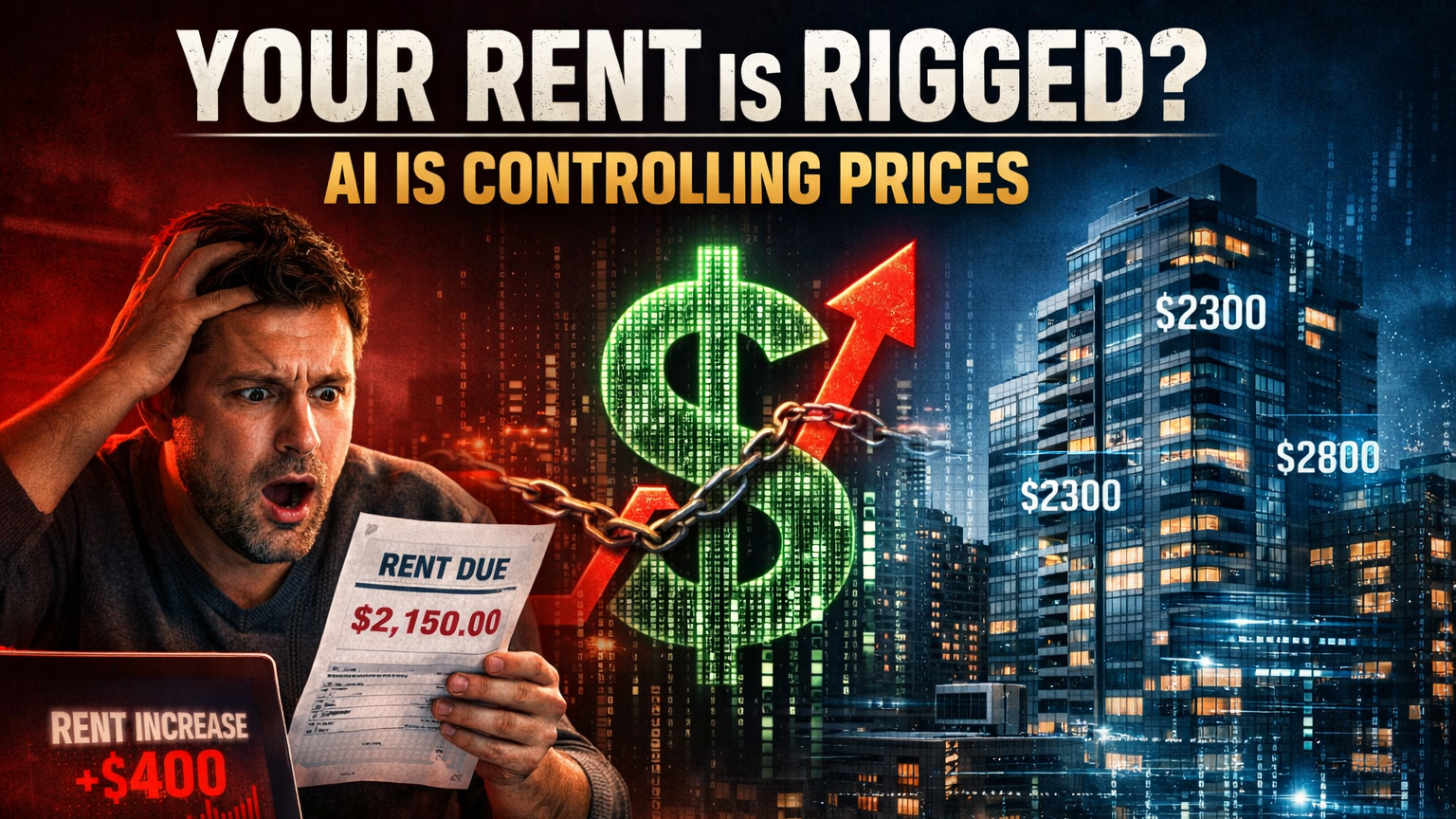
You open your email and see the notification: your rent has increased—again. The increase was significant, amounting to hundreds of dollars over night. You check nearby listings, hoping for relief. But every apartment shows the same pattern. Same pricing. Same jump. Same refusal to negotiate. It doesn’t feel like a market anymore. It feels… controlled. What you don’t see is the invisible system behind it—an algorithm quietly deciding how much more you should pay, every single month.
I have spent 17 years inside the corporate machine, primarily as an HR executive in the banking and financial sectors. I have sat in the boardrooms. I know exactly how the sausage is made. Right now, the American middle class is being crushed by a cost-of-living crisis that feels entirely unnatural. And it is. Between 2019 and 2024, the national average rent paid in the United States skyrocketed 31%, hitting $1,302. For millions of working professionals, it wasn’t just a gradual bump; rent went up $400 or more practically overnight. This wasn’t standard inflation. It was a calculated extraction.
In 2023 alone, algorithmic pricing software cost American renters roughly $3.8 billion. A handful of massive corporate landlords used shared data to artificially coordinate nationwide rent increases. They bypassed the free market entirely. As someone who spent a career ensuring corporations didn’t violate federal labor laws, what strikes me is how blatantly this scheme mirrors illegal corporate wage-fixing. Here is exactly how Wall Street weaponized an algorithm against your paycheck, and what you can do about it.
The Automation of Corporate Greed
The free market in real estate is dead. It was murdered by an algorithm. Corporate landlords no longer compete for your tenancy. Instead, they collude through a shared software intermediary to guarantee prices never drop.
Platforms like RealPage’s YieldStar absorb non-public, highly sensitive lease data from competing property managers across the country. The software then spits out precise daily pricing recommendations. The result? A White House Council of Economic Advisers report from December 2024 revealed that renters in algorithm-utilizing buildings paid an average penalty of $70 per month. In Denver, the algorithmic premium hit an agonizing $136 per month. By September 2025, major metros were completely suffocated. In Miami, for example, renters are handing over 37.1% of their median household income just for shelter.
| U.S. Metropolitan Area | Median Asking Rent (Sept 2025) | Rent Share of Median Income |
| Miami-Fort Lauderdale, FL | $2,298 | 37.1% |
| Los Angeles-Long Beach, CA | $2,821 | 37.0% |
| New York-Newark, NY-NJ | $2,903 | 36.7% |
| Boston-Cambridge, MA-NH | $2,944 | 32.3% |
| San Diego-Carlsbad, CA | $2,703 | 31.5% |
In my 17 years of HR, I’ve seen the Department of Justice crack down hard on this exact behavior. If a group of competing banks secretly pooled their real-time compensation data to suppress employee salaries, executives would face federal criminal prosecution under the Sherman Antitrust Act. We call it wage-fixing. It’s highly illegal. Yet, corporate landlords simply inverted the playbook. Instead of gathering in a smoke-filled room to suppress wages, they used a sleek software dashboard to inflate housing costs. The underlying crime is identical: destroying independent decision-making to rig the game.
You need to spot the algorithm before you apply. If a leasing agent tells you the price changes daily based on “market optimization” and refuses to negotiate even a single dollar, walk away. You aren’t negotiating with a human. You’re negotiating with a cartel’s algorithm.
Manufactured Scarcity and the Occupancy Illusion
Corporate landlords are intentionally keeping apartments empty to force you to pay more. They manufacture scarcity to justify extortion.
Traditional economics dictates that if supply increases, prices fall. RealPage actively dismantled this rule. The software’s developers admitted that human leasing agents possess “too much empathy”. To fix that, the algorithm frequently advises property managers to accept a lower occupancy rate—say, 94% instead of 98%—in order to push aggregate rents higher across the building. They found it is more profitable to hold units vacant than to offer a working family a discount. Despite a historic apartment construction boom, the typical U.S. asking rent in January 2026 sat at $1,895, up 35% since the pandemic began. Stabilized Class A properties hovered around 95% occupancy. They successfully squeezed more cash out of fewer people.
Let me translate this into boardroom lingo. When an HR department sets a compensation strategy, we decide to either “lead the market,” “match the market,” or “lag the market”. A functional economy requires a mix of all three. But when ProPublica found that 70% of apartments in one Seattle neighborhood were controlled by RealPage software, the entire concept of a market vanished. If every single employer in your city suddenly conspired to “lead the market” in slashing 401(k) matches, you’d have zero alternatives. That is precisely what happened to your housing options. The algorithm forces every participating landlord to act as a single, ruthless monopoly.
Change where you hunt for housing. Large, shiny corporate complexes with aggressive branding are almost universally running this software. Seek out older buildings, independent mom-and-pop landlords, or private condos for rent. They typically lack the capital to subscribe to these data cartels and still rely on manual, human pricing where negotiation is actually possible.
The Private Equity Playbook and the Illusion of a Fix
Wall Street engineered this crisis for rapid profit, and the government’s highly publicized legal fix is far too little, far too late.
The explosion of algorithmic pricing isn’t an accident. It’s a private equity strategy. In 2021, the massive private equity firm Thoma Bravo acquired RealPage in a $10.2 billion cash deal. Private equity relies on “roll-up” strategies—buying a core asset and ruthlessly extracting yield by dominating a sector. Under immense public pressure, the DOJ finally sued RealPage in August 2024. By late 2025, they reached a proposed settlement. RealPage didn’t admit liability, but agreed to stop using active, non-public lease data to train its models, force data to age 12 months, and accept a court-appointed monitor.
| 2025 DOJ Settlement Constraint | Impact on Algorithmic Pricing |
| 12-Month Data Aging | Stops real-time price coordination among competing landlords. |
| State-Level Geography | Prevents hyper-local neighborhood price monopolies. |
| Removal of Price Floors | Restores the ability of landlords to lower prices for vacancies. |
| Court-Appointed Monitor | Audits the internal runtime logic for antitrust compliance. |
I’ve watched this exact regulatory theater play out before. In early 2023, the DOJ Antitrust Division rescinded its “safe harbor” guidelines for HR information sharing because corporations were using third-party salary surveys to secretly suppress wages. The DOJ realized that laundering price-fixing through a third-party analytics vendor is still price-fixing. The RealPage settlement mirrors recent HR consent decrees, right down to the outside monitors. But here is the brutal truth: the economic damage is already baked in. The algorithms established a permanently inflated baseline for rent. Forcing them to use 12-month-old data just means they’ll base next year’s extortion on last year’s extortion.
Don’t wait for the government to lower your rent. If you rented from a major corporate landlord like Greystar between 2018 and 2025, you might be eligible for a piece of the $141.8 million multidistrict class-action settlement. Track the lawsuit updates carefully. Beyond that, scrutinize property ownership records before signing a lease. If the building is owned by private equity, expect aggressive, unyielding rent hikes.
The Bottom Line
The American worker is trapped in a vise. Wages are sluggish, inflation eats away at purchasing power, and the roof over your head has been transformed into an optimized financial instrument. The RealPage scandal proves that the free market doesn’t break by accident. It gets dismantled by design. Corporate landlords recognized they could extract $3.8 billion from the middle class simply by removing human empathy from the equation and hiding behind a software agreement. Yes, the DOJ is finally stepping in, and yes, some rules are changing. But the economic scars will linger for a generation.
If software can be legally weaponized to coordinate the cost of human shelter for nearly a decade, what other foundational aspects of your life are currently being optimized for extraction?


Leave a Reply