The Question of Being Human
I remember sitting in a boardroom that was too bright and too air-conditioned in late 2019 and watching a group of senior executives talk about “geopolitical headwinds.” We were watching a slideshow about risks in the supply chain and quarterly forecasts, but the language was very boring. People never talked about the real people who would be hurt if those “headwinds” turned into a hurricane. It was all about protecting the profits, lowering the risk for shareholders, and making sure the business machine kept running smoothly.
I went to a lot of meetings like that one when I worked in corporate HR for 17 years. I kept the company’s stories safe. I defended policies that, in hindsight, hurt real people. And I saw how systems that saw good people as just lines on a spreadsheet could hurt them. After a while, I left the corporate world because I realized that I am a person first and an HR guy with scars and stories from 17 years of work.
There is a hurricane going on right now. In late March 2026, the US and Israel are in a huge war with Iran. The war is getting bigger very fast. The Israelis call it “Operation Roaring Lion,” and the Pentagon calls it “Operation Epic Fury.” Three weeks have passed since the operation started, and the news is full of military strategy, the deployment of aircraft carriers, and threats from the president. But there is a deep, quiet panic going on in America right now. It’s happening in break rooms, grocery store aisles, and gas stations.
Every day, Americans wake up to news of bombings in Tehran, retaliatory strikes across the Gulf, and the closing of trade routes around the world. Then they drive to work, wondering how they will pay for gas that costs $4 a gallon just to get to an office where they sit on video calls all day. They are in cubicles trying to focus on their Q2 marketing tasks, but they are really worried that a world war is about to ruin their kids’ futures.
Why is this topic important to regular people? Because the geopolitical is very personal. A decision made in a war room in Washington or Tel Aviv determines whether a single mother in Ohio must choose between obtaining gasoline for her commute or purchasing sufficient food for the week. It decides if a young professional spends their weekend looking at bad news about a possible draft instead of making plans for their future. The think tanks aren’t just talking about how to deal with other countries. It’s a crisis of human stability, and the systems we rely on aren’t keeping us safe.
What the Research Actually Says
To understand the human cost, we must look at the cold, factual data of what has transpired over the past few weeks. On February 28, 2026, the United States and Israel launched a massive, coordinated military campaign against Iran. This was not a limited, surgical strike. It was meant to be a decapitation operation that would bring down the regime, destroy nuclear and missile infrastructure, and wipe out the Iranian Navy.1 The opening salvo attacked a leadership meeting in Tehran, killing Supreme Leader Ali Khamenei, Iran’s defense minister, and several other top officials.1
Since then, the conflict has rapidly spiraled. Iran retaliated by launching hundreds of ballistic missiles and drones at Israel, as well as at U.S. military bases and energy infrastructure in neighboring Gulf states, including Qatar, Saudi Arabia, and the United Arab Emirates.1 We are now seeing strikes hitting civilian infrastructure, airports, and hotels in places like Dubai and Abu Dhabi.4
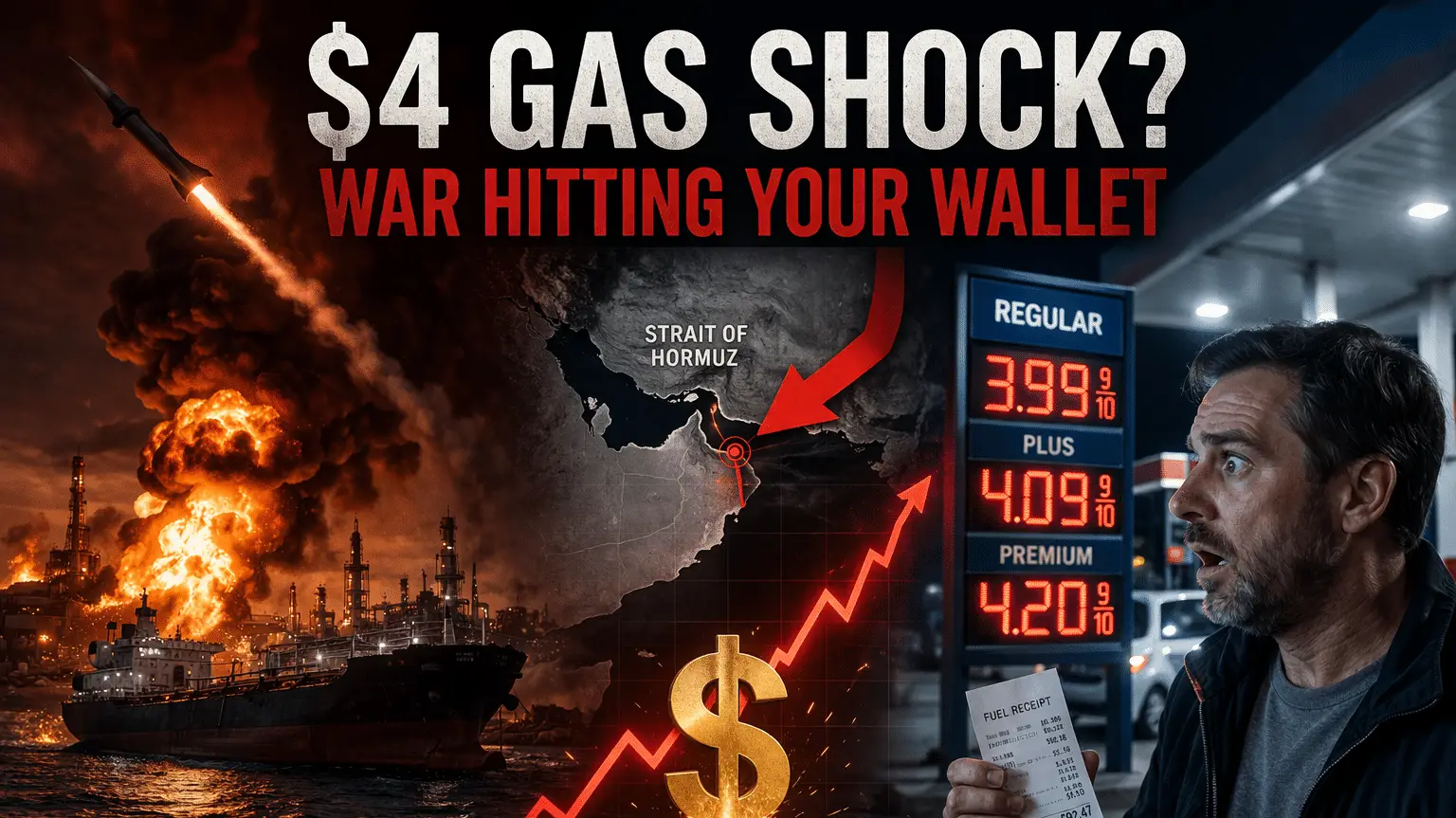
The immediate economic fallout has been historic. Iran has effectively closed the Strait of Hormuz, a critical maritime chokepoint through which approximately 20% of the world’s daily oil consumption passes.5 The global energy market has been thrown into absolute chaos. Let us look at what the financial markets are doing, and more importantly, what this means for the everyday consumer.
| Global Economic Indicator | Pre-War Context (Early Feb 2026) | Post-War Reality (Mid-March 2026) | Human Impact |
| Brent Crude Oil | ~$73 per barrel | Over $112 per barrel (up 50%) | Highest prices in years, driving up global inflation and making everyday goods more expensive.7 |
| Dubai Crude Oil | Standard market rates | $153.25 per barrel | An all-time record high, bypassing the 2008 peak, severely tightening Asian supply lines.9 |
| U.S. National Average Gas Price | $2.98 – $3.15 per gallon | $3.92 per gallon | A jump of nearly a dollar, heavily straining household budgets for commuters.10 |
| Jet Fuel Prices | Stable | Doubled in many regions | Airlines are passing costs to consumers; logistics and shipping costs are soaring.11 |
| Natural Gas (Dutch TTF) | Standard winter rates | Spiked over 90% | Massive utility cost increases globally, threatening to freeze out low-income families.6 |
These numbers translate directly to pain at the pump. In the U.S., the national average for regular gasoline jumped nearly 27 cents in a single week in early March, and by March 21, it reached $3.92.10 This is the largest supply disruption in the history of the global oil market.5
But it gets worse. The strategic guardrails that usually protect everyday citizens from these shocks have been systematically dismantled. In July 2025, under the guise of the “Department of Government Efficiency” (DOGE), the Trump administration purged the State Department of its top oil and gas experts.11 The very individuals whose job it was to model a Strait of Hormuz closure, liaise with foreign energy bureaus, and coordinate emergency petroleum releases with the International Energy Agency (IEA) were laid off to cut costs.11 Now, facing the exact crisis those experts warned about, the administration is flying blind. They lack the institutional knowledge to manage the fallout, and executives in the private sector are complaining they have no diplomatic point of contact, forcing them to hire “MAGA lobbyists” just to get answers.11
Meanwhile, public sentiment is clear: Americans do not want this war. The data shows a massive disconnect between the actions of the government and the will of the people.
| Public Opinion Metric | Polling Data (March 2026) | Context & Insight |
| Opposition to U.S. Military Action | 53% – 56% Oppose | A clear majority of Americans are against the strikes, crossing multiple demographics.13 |
| Opposition to Ground Troops | 74% Oppose | Overwhelming bipartisan rejection of deploying soldiers to Iranian soil, reflecting deep war fatigue.14 |
| Fear of World War III | 63% believe it is likely | A sharp increase from 55% in 2025, indicating deep public anxiety and psychological distress.16 |
| Approval of President’s Handling of Iran | 36% – 38% Approve | Nearly 60% of voters disapprove of the administration’s foreign policy and economic handling.13 |
Despite this public outcry, the rhetoric is only escalating. On March 21, President Trump issued a 48-hour ultimatum on the social media platform Truth Social, threatening to “hit and obliterate” Iran’s power plants—starting with the largest—if the Strait of Hormuz is not immediately reopened.17 This threat of expanding the target list to civilian infrastructure guarantees further retaliation, higher energy prices, and deeper economic instability.19
To cope with the immediate energy shock, the IEA has issued an unprecedented 10-point emergency plan. Their top recommendation? Mandate working from home to save fuel.21 They are also urging governments to lower highway speed limits, restrict private car usage through alternating license plate days, and drastically cut business travel.23
My Take After 17+ Years in the Trenches
Let’s call this exactly what it is. We are watching a catastrophic failure of leadership at both the political and corporate levels, and the bill is being handed to the working class.
In my 17+ years navigating the corporate labyrinth, I have seen this dynamic play out on a micro level countless times. A CEO makes a reckless decision to acquire a failing competitor because it strokes their ego. The board cheers them on. The integration becomes an absolute disaster. The stock tanks. And who pays the price? The executives parachute out with their golden severance packages, while the mid-level managers and frontline workers are laid off to “balance the books.”
What we are witnessing in the Middle East is the macroeconomic version of that exact phenomenon. Politicians and ideologues launch a massive military campaign with vague endgame objectives, banking on the hubris of regime change.2 When the region explodes and the global energy supply is choked off, it isn’t the politicians who suffer. It is the ordinary human being who has to figure out how to stretch a stagnant paycheck to cover $4.00 gasoline, double-digit food inflation, and skyrocketing utility bills.6
Let’s look at the State Department’s “DOGE” cuts.11 I have executed corporate downsizings. I know the playbook intimately. Leadership decides they need to cut 15% of headcount to please shareholders or fulfill a political promise. In the frenzy, they cut the quiet, highly specialized veterans—the people who actually know how the plumbing works—because their salaries look heavy on a ledger. Months later, a pipe bursts, and the executives stand around looking shocked that the building is flooding.
The U.S. government fired its top geopolitical energy analysts six months before starting a war in the most volatile energy region on earth.11 They fired the people who modeled the Strait of Hormuz closure. They fired the primary liaison to the IEA.11 Now, the administration is reportedly “shocked” by the retaliatory strikes on Arab energy infrastructure and the ensuing economic fallout.11 It is textbook institutional self-sabotage. It is the exact same hubris that drives a tech company to fire its senior engineers to boost quarterly profits, only to suffer a catastrophic server outage a month later.
But perhaps the most glaring irony for me, as an HR veteran, is the IEA’s urgent plea for the world to transition immediately to remote work to save global oil supplies.21
Think about this for a second. For the last two years, corporate executives have waged a relentless, punitive war against their own employees over Return-to-Office (RTO) mandates. They dragged people back into cubicles, citing intangible, fabricated concepts like “watercooler synergy,” “spontaneous collaboration,” and “company culture.” Employees begged to stay remote, pointing out the environmental benefits, the financial savings, the lack of a commute, and the sheer common sense of it.26 They were ignored, disciplined, and sometimes fired.
Now, the global energy market is imploding. Oil is trapped. Prices are skyrocketing. And the world’s leading energy watchdog is effectively saying: Send everyone home. We cannot afford the fuel you are burning just to sit at a desk..22
It takes a global war and an existential energy crisis to force the corporate elite to admit that the daily commute is an incredibly fragile, wasteful luxury. I have spoken to leaders who still refuse to back down. Even with gas prices climbing 30 cents a week, some CEOs remain obsessed with tracking badge swipes. It is a stunning display of ego over reality. We are asking everyday humans to absorb the financial shock of a geopolitical war just so they can sit in an office and join a Zoom call they could have taken from their living room.
And then there is the psychological reality. Companies love to talk about “resilience.” I despise how that word has been hijacked. Corporate resilience nowadays just means asking employees to endure increasingly absurd amounts of stress without complaining. Right now, workers are watching their President threaten to obliterate power plants on social media, potentially triggering a wider regional war that could draw in global superpowers.17 They are reading that 63% of the country believes World War III is around the corner.16 They are watching prices surge at the supermarket.
How does an employee sit in a performance review and care about key performance indicators (KPIs) when the world feels like it is unraveling? They don’t. They are distracted, exhausted, and running on empty. A recent survey noted that geopolitical events affect people even when they are physically distant from the conflict; constant news exposure creates a sustained sense of instability that ruins concentration, sleep, and emotional bandwidth.28 And yet, the corporate machine grinds on, offering little more than a generic email reminding everyone to “utilize the Employee Assistance Program (EAP) if you feel stressed.” An app with breathing exercises does not fix the terror of a global conflict.
The Real Cost to Real People
To truly understand this crisis, you have to look past the oil barrels, the missile trajectories, and the political posturing. You have to look at the human impact.
The Financial Suffocation at Home
For the average American, the economy was already a tightrope. This war just cut the safety net. When the Strait of Hormuz is blocked, it doesn’t just trap oil; it traps 20% of the world’s fertilizer supply.29 We are entering the spring planting season. Without fertilizer, crop yields plummet. When crop yields plummet, food prices soar. So, the single mother I mentioned earlier isn’t just paying more to drive to her shift at the hospital. She is about to pay significantly more for bread, milk, and produce.
Let’s not forget the compounding trauma of the April 2025 “Liberation Day” tariffs, which already reduced long-run GDP by about 6% and cost the middle-income household $22,000 in lifetime losses.30 Add to that the current war-induced economic pain, which a Trump adviser recently brushed aside as “the last of our concerns,” claiming the economy is strong enough to handle it.11
This hits different when you’ve sat across the table from a crying employee who just found out their rent is going up and their raise was denied. Imagine telling that person that their commute now costs an extra $60 a month, and their groceries will cost an extra $100, all because of a war they explicitly told pollsters they didn’t want. The disconnect between the decisions of the powerful and the suffering of the powerless is staggering.
The Psychological Burden
We are living in a state of chronic, low-grade dread. The American public is deeply engaged, but they are also deeply exhausted. The threat of escalation hangs in the air like humidity. Will there be a draft? Will Iran’s proxies launch cyberattacks on our infrastructure? Will the economy crash?
Psychiatrists are already noting that the constant news exposure and uncertainty about escalation are creating a sustained sense of instability.28 In the workplace, this manifests as extreme fatigue, lack of focus, and emotional burnout. Expats and workers with family ties to the Middle East are experiencing acute trauma, waiting by their phones for signs of life from loved ones in Tehran, Beirut, or the Gulf.31 We are expecting humans to compartmentalize profound existential dread and still deliver a “synergistic Q2 growth strategy.” It is an inhuman expectation.
Furthermore, consider the sheer terror of ordinary civilians inside Iran. The regime is collapsing, the Basij militia is out in force, and ordinary Iranians are so desperate for liberation that they are actively transmitting targeting information to Israeli intelligence via social media, hoping to dismantle the security state that oppresses them.32 Imagine the courage and the terror required to send a WhatsApp message with the coordinates of a militia checkpoint, knowing that if you are caught, you will be executed, but if you succeed, a missile will level the building down the street. That is the human reality of this war.
The Humanitarian Nightmare Abroad
While Americans feel the pinch at the pump and the anxiety of escalation, we must acknowledge the absolute devastation happening to human beings in the conflict zones.
The strikes in Iran, Lebanon, and across the Gulf are tearing lives apart. The UN World Food Programme (WFP) recently issued a harrowing warning: if this conflict and the associated oil shock persist, up to 45 million more people will be pushed into acute hunger this year.33 That is 45 million human beings staring down starvation because global supply chains have been weaponized. The projections are grim: a 21% increase in food-insecure people in West and Central Africa, a 17% increase in East Africa, and a 24% increase in Asia.33
In places like Lebanon and Gaza, where communities were already decimated by ongoing conflict, the spike in fuel prices has severely hindered humanitarian aid. Food is disappearing from markets, and prices for basic goods like flour have surged by 270% in some areas in a matter of days.34 Health facilities are being destroyed, and those that remain open cannot secure the fuel needed to run backup generators or the supply chains required to stock basic, life-saving medicines like insulin.35 The UN Human Rights Chief recently deplored the strikes on water desalination plants and fuel facilities, warning of catastrophic health consequences from oil fires and acid rain contamination.37
There is a ripple effect to human suffering. The strikes on natural gas and oil facilities in Iran and the Gulf aren’t just strategic military victories; they are environmental and humanitarian catastrophes. Wars are fought by militaries and debated by politicians, but they are invariably paid for by civilians—with their homes, their health, and their lives.
What We Should Actually Do About It
If we truly care about people—if we are going to look beyond the corporate jargon and the political posturing—we need to take immediate, practical steps that protect humans, not just profit margins and political egos.
1. End the Return-to-Office Mandates Immediately This is not a debate anymore. The International Energy Agency has literally told the world that remote work is a critical emergency measure to preserve global stability and ease the oil shock.21 Corporate leaders must drop their egos. If a job can be done from home, it must be done from home. Forcing an employee to burn $4-a-gallon gas to sit in a cubicle during the greatest energy shock in modern history is not just bad management; it is a profound moral failure. Companies must pivot to genuine distributed work, not as a perk, but as a strategic and ethical necessity.27
2. Implement Meaningful Financial Relief for Essential Workers
For the millions of workers who cannot work remotely—nurses, warehouse staff, retail workers, teachers, delivery drivers—companies must step up. Implement immediate, temporary fuel stipends. Do not wait for a quarterly review. Do not tie it to performance metrics. If your people are bearing the cost of a geopolitical crisis just to show up and make your company money, you owe them the dignity of offsetting that cost. The pain at the pump is real, and wages have not kept pace with war-driven inflation.
3. Shift from “Wellness” to Real Mental Health Support Throw away the corporate meditation apps. Real mental health support right now means radical flexibility. It means training managers to recognize when their team is buckling under the weight of global anxiety and giving them the autonomy to say, “Take tomorrow off, no questions asked.” It means adjusting Q2 productivity goals to reflect the reality that your workforce is navigating a global crisis. It means hiring actual, trained trauma counselors for expats and employees with family in the conflict zones.31 Empathy is not a soft skill; right now, it is the only operational strategy that will prevent a mass psychological collapse.
4. Demand Diplomatic De-escalation and Rebuild Expertise As citizens, we must hold our leaders accountable. The data is clear: 74% of Americans oppose sending ground troops to Iran, and the majority oppose the military action altogether.14 We must vocally reject the reckless, late-night social media ultimatums that threaten to obliterate infrastructure and widen the war.17 Diplomacy is not weakness; it is the ultimate protection of human life. We need to demand that our government rebuilds the diplomatic and strategic expertise it so foolishly dismantled during the DOGE cuts.11 We need adults in the room who understand that military coercion and “regime change” thousands of miles away usually result in generations of suffering, not rapid victories.38
Closing Reflection
I’ve spent most of my adult life inside the belly of the corporate beast, trying to buffer real people against systems designed to extract their labor while ignoring their humanity. What is happening right now in the Middle East, and the economic shockwaves hitting our shores, is the ultimate manifestation of that exact system operating on a global scale.
The people who start wars rarely fight in them. The politicians who draft the ultimatums rarely have to choose between groceries and gasoline. The executives who demand mandatory office attendance rarely have to worry about the cost of their commute. The system hums along, insulated by wealth and power, while ordinary humans are left to absorb the impact, balance the budgets, and bury the dead.
But we don’t have to just accept it. We can choose to lead with humanity in our own spheres of influence. We can advocate for our teams, protect our neighbors, and refuse to let the sterile language of “geopolitical headwinds” numb us to the reality of human suffering. We can look at the numbers and choose to see the faces behind them.
I’d love to hear how this is playing out in your world. Are you feeling the squeeze at the pump? Is your company forcing a commute despite the crisis? How are you holding up?
— Som Bentur, The Voice of Human



Leave a Reply