
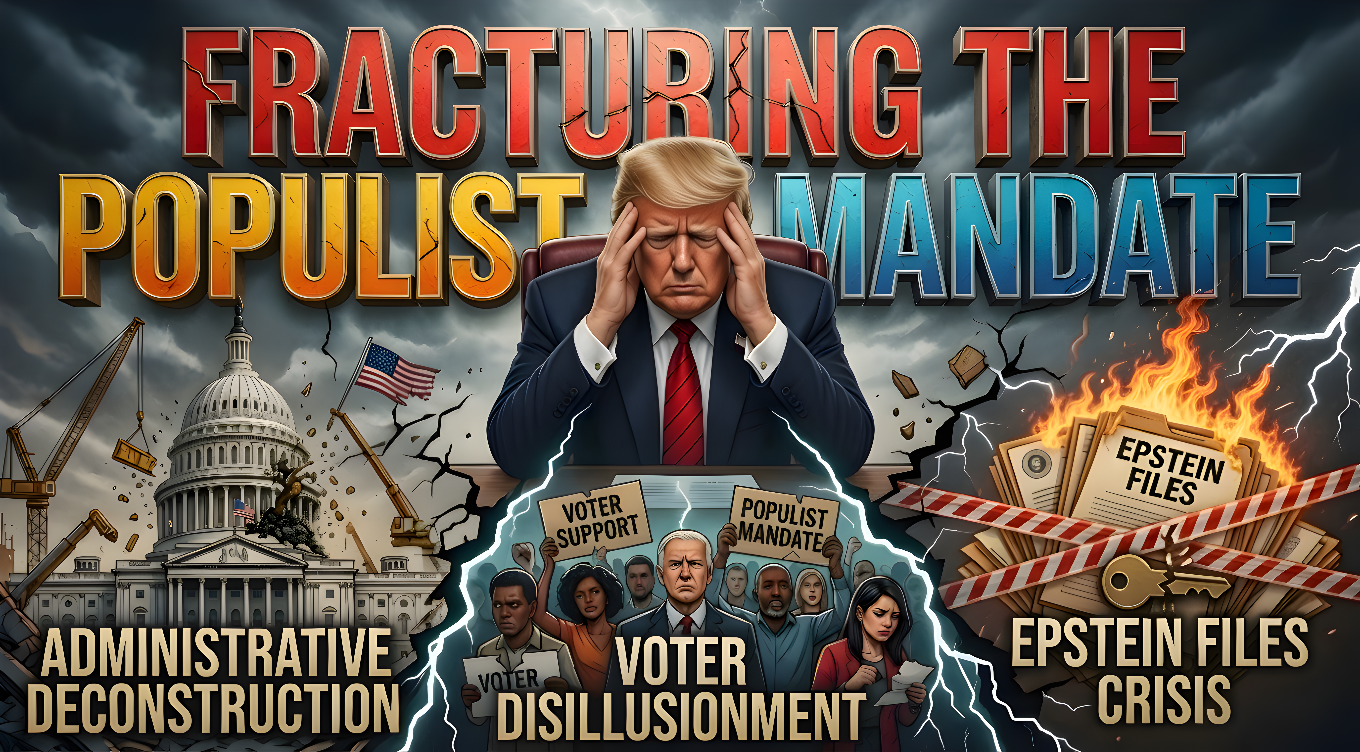
The Fracturing of the Populist Mandate: Administrative Deconstruction, Voter Disillusionment, and the Epstein Files Crisis in the Second Trump Term
Introduction: A Presidency Entangled in Its Own Contradictions
More than a year into the second term of President Donald J. Trump, the political, economic, and institutional landscape of the United States has been fundamentally destabilized. After winning the 2024 election, which the administration saw as a clear mandate to dismantle the federal administrative state, the implementation of its radical policy agenda has caused a lot of chaos at home.1 Instead of bringing about the promised “golden age of America,” the administration’s aggressive restructuring has turned into a long-lasting, multi-front crisis that is causing a lot of pain for the very right-wing Republican lawmakers and conservative voters who helped the President get back into office.1
The second term has been characterized by an unparalleled convergence of self-inflicted administrative sabotage, significant macroeconomic disruptions, and the audacious deterioration of institutional standards. The Heritage Foundation’s “Project 2025” plan for systematically dismantling federal agencies caused a lot of economic problems that hurt the working class, rural areas, and veterans, who are the main groups that make up the populist conservative coalition.5 At the same time, the government’s aggressive unilateral tariff policies caused a historic global stock market crash, and a long 43-day government shutdown made it very difficult for important social safety nets, especially the Supplemental Nutrition Assistance Program (SNAP), to work in states that were mostly Republican-controlled.6 These terrible failures in domestic policy have been made worse by an open rise in executive self-enrichment and the clear weaponization of the Department of Justice. This has destroyed the administration’s anti-corruption and “drain the swamp” narrative.6
But the most serious, life-threatening, and possibly fatal threat to the administration’s survival comes from the forced release of the Jeffrey Epstein files. Driven by the Epstein Files Transparency Act of 2025—a legislative mechanism that effectively cornered the executive branch—the ensuing disclosures have ignited a violent revolt among the administration’s most ardent supporters.11 The suspicious withholding of critical FBI interview notes detailing alleged sexual assault of a minor by the President has transformed the Epstein saga from a peripheral conspiracy theory into a lethal political weapon.11
Analytical models of the current crisis suggest that the legislative push to release the Epstein files was not merely a pursuit of historical transparency, but a highly orchestrated, bipartisan strategic trap designed explicitly to remove the President from power.16 Political opponents have used the populist base’s demand for truth against the White House by forcing the administration to either reveal its own criminal wrongdoing or cover it up in a hypocritical way.4 This detailed report looks at how the failures of domestic policy, economic instability, the decline of institutions, and the shocking revelations from the Epstein files have all come together to drive away the core constituency. It also talks about the legal and constitutional ways that are currently coming together to permanently end the presidency, such as the 25th Amendment and impeachment.
The Structure of Chaos: Bureaucratic Purges and Economic Disruption
The foundational promise of the 2024 populist campaign was the swift and decisive dismantling of the administrative state. The intellectual and operational architecture for this dismantling was provided by Project 2025, a 900-page “Mandate for Leadership” designed to reorganize the entire federal government, consolidate executive power, and eliminate agencies deemed hostile to conservative ideology.5 Upon assuming office, the administration executed this vision with a rapidity that profoundly destabilized the functional capacity of the United States government, resulting in severe economic and social repercussions.
The Department of Government Efficiency and Mass Furloughs
The operational vanguard of the administration’s bureaucratic purge was the Department of Government Efficiency (DOGE), established by executive order on January 20, 2025.6 Tasked ostensibly with modernizing information technology, maximizing productivity, and cutting excess regulations and spending, DOGE was granted pervasive, unprecedented administrative access to federal infrastructure, financial records, and classified materials, effectively bypassing traditional congressional oversight mechanisms.6
The subsequent implementation of overlapping workforce reduction strategies devastated the civil service. On January 28, 2025, an executive order established “Schedule F” employment classifications, stripping legal protections against political firings from thousands of federal employees.6 This was immediately followed by a “Deferred Resignation Program” that pushed roughly 75,000 workers out of the government by mid-February, and a draconian directive on February 13, 2025, to dismiss probationary employees without cause or evidence of poor performance.6 Agencies were subsequently ordered to submit Reduction in Force (RIF) plans to slash their workforces by targeting positions not strictly required by statute.6
By mid-2025, approximately 300,000 civil servants were targeted for termination, buyouts, or forced resignations, representing roughly 12% of the 2.4 million civilian federal workforce.6 The purges were catastrophic for critical agencies. The Department of Defense lost 55,000 personnel; the Department of Agriculture (USDA) lost 21,000; the Department of Interior lost 9,700; and the Centers for Disease Control and Prevention (CDC) lost 1,622 employees, representing 13% of its total size.6 The Consumer Financial Protection Bureau (CFPB) was effectively neutralized, losing 1,500 employees (86% of its workforce).6
The implementation of these cuts was inherently chaotic and ultimately self-defeating for the administration’s stated fiscal goals. Rather than generating massive savings, independent analyses and other government entities estimated that DOGE’s operations cost taxpayers approximately $135 billion.6 Furthermore, the Internal Revenue Service (IRS) projected revenue losses exceeding $500 billion due to “DOGE-driven” cuts to its enforcement divisions, exacerbating the federal deficit.6 The human cost of the chaotic dismantling of federal oversight was staggering; reductions in foreign aid programs driven by DOGE were estimated by Professor Brooke Nichols to have resulted in over 793,900 global deaths by February 2026, primarily children.6
For the administration’s core right-wing voters, the impact was immediate, localized, and devastating. Rural communities heavily reliant on USDA agricultural services, veterans dependent on the Department of Defense logistics and VA hospital support networks, and middle-class federal contractors found their livelihoods abruptly terminated. The ideological victory of shrinking the state rapidly translated into tangible economic anxiety and job insecurity for the working-class electorate, fracturing their loyalty to the administration.7
| Federal Agency | Confirmed Personnel Losses | Percentage of Total Workforce | Sector Impact |
| Department of Defense (DOD) | 55,000 | N/A | Military readiness, logistics, defense contracting.6 |
| Department of Agriculture (USDA) | 21,000 | N/A | Rural aid, agricultural subsidies, disease tracking (H5N1).6 |
| Consumer Financial Protection Bureau | 1,500 | 86% | Consumer advocacy, financial regulation.6 |
| Centers for Disease Control (CDC) | 1,622 | 13% | Public health infrastructure, pandemic response.6 |
| Department of Education (ED) | 1,378 | 33% | Public school funding administration, student loans.6 |
The SNAP Crisis and the 43-Day Government ShutdownThe 43-Day Government Shutdown and the SNAP Crisis
The longest federal government shutdown in US history, which lasted 43 days from October 1 to November 12, 2025, made the administrative mess caused by DOGE even worse. The shutdown happened because there was an unbreakable deadlock over funding and the administration wouldn’t extend the expanded Affordable Care Act subsidies. About 900,000 federal employees were put on leave, and another two million essential workers had to work without pay.8
A pivotal moment in the disintegration of the right-wing base transpired when funding for the Supplemental Nutrition Assistance Program (SNAP) was depleted. On November 1, 2025, the one-month anniversary of the shutdown, SNAP benefits were completely stopped. This meant that millions of low-income families lost access to important food assistance right away. The shutdown caused severe, localized humanitarian crises in deeply red districts because working-class, rural demographics—a key part of the populist Republican coalition—are disproportionately dependent on SNAP benefits for survival.7
The political fallout happened quickly. Governors in every state had to give their people very clear warnings. Republican governors, like Glenn Youngkin of Virginia, had to declare states of emergency to fight hunger and give out emergency aid. This put state-level Republican leaders directly against the White House’s refusal to budge on spending. This event broke the trust between the administration and its most economically vulnerable supporters at its core. These voters did not see the shutdown as a principled, ideological stand against federal overreach. Instead, they saw it as a cold, uncaring disregard for their basic survival, which goes against the populist promise to put the forgotten working-class American first.7
The “Liberation Day” Tariffs and the Loss of Capital
The third thing that caused problems at home for the administration was the aggressive use of trade policy as a weapon, which led to the global stock market crash in 2025. The President called April 2, 2025, “Liberation Day.” On that day, the administration declared the U.S. trade deficit a national emergency and used the International Emergency Economic Powers Act to impose huge, unfair tariffs without getting permission or oversight from Congress.6
The size of the protectionist measures was never seen before. The government set a 10% baseline tariff on almost all goods coming into the United States. Targeted tariffs were much higher: tariffs on Chinese goods started at 54% and went up to an unbelievable 245%. The European Union had to pay 20% tariffs, and Southeast Asian countries were hit hard, with Vietnam paying 46%, Thailand paying 36%, and Cambodia paying 49%. Even loyal allies like Japan (24%) and Taiwan (32%) were not safe.6
The macroeconomic response was quick, violent, and terrible for global capital markets. Between April 2 and April 4, more than $6.6 trillion in wealth was lost around the world. This was the biggest loss in financial history over two days. The Dow Jones Industrial Average fell almost 10% in two days, losing 2,231 points (5.5%) on April 4 alone after China announced a retaliatory tariff. The Nasdaq Composite fell into bear market territory, marking its worst drop since the pandemic. The VIX “fear gauge” rose to 45.31.6
There was a major crisis in the bond market at the same time as the equity collapse, which was marked by violent “bond vigilantism.” The 10-year Treasury yield rose to 4.5% by April 9, and the 30-year yield had its biggest three-day jump since 1982, rising to 4.92%. This was because people were worried about inflation.6
On April 9, the administration finally announced a 90-day pause and a drop to the 10% baseline on most tariffs (except for China) to stabilize the markets that were falling fast. However, the damage to the voters’ economic security was very bad. The crash wiped out a lot of 401(k) retirement accounts and caused a lot of people to worry about a recession in their area. This self-inflicted economic wound turned off suburban, moderate Republicans and older, fixed-income conservative voters who have always put stability in the market and predictability in the budget ahead of radical protectionist ideas. The stock market crash, the SNAP shutdown, and the mass layoffs of federal workers all worked together to destroy the administration’s main argument for re-election: that the economy was stable and growing.
| Economic Event | Date / Timeline | Metric of Impact | Demographic Alienated |
| “Liberation Day” Announcement | April 2, 2025 | Baseline 10% tariffs; up to 245% on China.6 | Pro-business establishment Republicans. |
| Global Market Collapse | April 2 – April 4, 2025 | $6.6 Trillion global wealth erased; Dow drops 9.48%.6 | 401(k) holders, suburban moderates. |
| Bond Market Meltdown | April 4 – April 9, 2025 | 30-year yield hits highest 3-day jump since 1982.6 | Institutional investors, fixed-income retirees. |
| Tariff Pause / Modification | April 9, 2025 | 90-day pause enacted to halt market freefall.6 | Base voters promised absolute protectionism. |
Kleptocracy and the Erosion of Institutional Integrity
Compounding the intense economic anxieties of the right-wing base is the administration’s blatant, unapologetic normalization of financial conflicts of interest. The populist mandate of 2024 was heavily predicated on an anti-corruption, “drain the swamp” narrative that promised to remove elite influence from Washington. However, the first year of the second term saw the President increase his personal net worth by approximately $3 billion, a scale of self-enrichment that the Brennan Center for Justice notes dwarfs historical American scandals such as Teapot Dome, Watergate, and Crédit Mobilier.10 Because the president is exempt from the ethics rules that bind most other federal officials, these entanglements are largely legal on their face, yet they fundamentally erase the distinction between public office and private enterprise.10
Cryptocurrency Ventures and Sovereign Conflicts
Approximately two-thirds of the President’s net worth increase ($2 billion) was derived directly from the explosion of his family’s cryptocurrency ventures, primarily World Liberty Financial, which netted the family roughly $1 billion since its creation shortly before the second inauguration.10
This venture immediately blurred the lines of U.S. foreign policy and national security. Shortly before the inauguration, Sheikh Tahnoon bin Zayed Al Nahyan, a prominent member of the Emirati royal family, purchased a 49% stake in World Liberty Financial for $500 million, netting the administration’s family roughly $187 million.10 Following this massive investment, Steve Witkoff—the President’s special envoy to the Middle East, whose affiliated entities received $31 million from the stake purchase—helped broker a highly controversial diplomatic deal.10 This deal granted the United Arab Emirates access to advanced, closely guarded U.S. computer chip technology, explicitly ignoring long-standing national security concerns regarding the UAE’s deepening technological ties with China.10
Furthermore, the administration engaged in stark regulatory favoritism that benefited its private financial partners. The President pardoned Binance founder Changpeng Zhao—who had pleaded guilty in 2023 to violating money laundering rules that allowed terrorists and sanctioned entities in Iran and Russia to move billions of dollars—shortly after Binance assisted in launching and bolstering the USD1 stablecoin for World Liberty Financial.10 Similarly, the Securities and Exchange Commission (SEC) abruptly paused its active fraud investigation into Chinese crypto billionaire Justin Sun in February 2026, mere months after Sun purchased $90 million worth of the administration’s family cryptocurrencies.10
The profits extended into international real estate. The administration saw hundreds of millions in profits from a resurgence of branded international real estate deals in Saudi Arabia and Qatar. At the same time, these governments got very good diplomatic treatment, like access to advanced U.S. microchips and weapons systems, and Saudi Crown Prince Mohammed bin Salman’s guilt for the 2018 murder of Jamal Khashoggi was “diplomatically erased.”10 Officials in Vietnam broke local rules to speed up the sale of existing Trump properties while also negotiating trade tariffs with the U.S. the government.10
The EEOC’s Use Against Women as a Weapon
The ideological restructuring of the federal government also aimed at enforcing civil rights, which caused problems with moderate conservatives and women. The Equal Employment Opportunity Commission (EEOC) was systematically turned into a weapon to look into and fix discrimination in the workplace.19 With Andrea Lucas as the new chair of the EEOC and a confirmed Republican majority, the agency’s resources were moved away from protecting workers and toward looking into employers that the President had personal grudges against.19 This included the President’s aggressive questioning of twenty well-known law firms about how they hire people, focusing on firms he thought were hostile.19 The administration actively rolled back women’s rights and protections at work by making it harder for the EEOC to enforce anti-discrimination laws. This turned off suburban women voters who are important to the Republican coalition.19
The Thursday Night Massacre and the DOJ’s Loss of Power
The erosion of institutional norms aggressively spread to the judicial branch, causing huge internal revolts and showing a clear willingness to break the law for political gain.ration executed what legal commentators dubbed the “Thursday Night Massacre” or the purging of the “Valentine’s Day Seven”.6
Emil Bove, the acting deputy attorney general, told career prosecutors to drop federal criminal corruption charges against New York City Mayor Eric Adams.6 Bove said that firing Adams would keep him from interfering with Adams’ campaign for mayor and let him focus on crime and illegal immigration.6 But the reality inside was very transactional. Acting in the U.S. Danielle Sassoon, the attorney for the Southern District of New York (SDNY), quit in protest and wrote a scathing letter to Attorney General Pam Bondi. She is a registered Republican and a member of the Federalist Society. Sassoon said that the firing was a direct deal: the federal charges would be dropped if Mayor Adams agreed to help the administration carry out its priorities for enforcement and mass deportation.6
Bove put more pressure on Sassoon and Assistant U.S. Attorney Hagan Scotten (an Iraq War veteran and former clerk for Chief Justice John Roberts) when they refused the order and quit, saying the reason was “transparently pretextual.”6 He went to the Public Integrity Section in Washington, D.C., and gave nearly 20 lawyers a harsh one-hour ultimatum to pick someone to sign the dismissal motion or risk losing their jobs.6 Kevin Driscoll, who was in charge of the Criminal Division, and John Keller, who was in charge of the Public Integrity Section, both quit right away instead of following orders.6 Trial attorney Ryan Crosswell also resigned, stating he was pressured to sign a motion that Bove himself admitted was not based on “facts or the law”.6
The corruption charges against Adams were eventually dismissed with prejudice by U.S. District Judge Dale Ho, who noted on the record that the government’s refusal to prosecute necessitated the dismissal.6 However, Judge Ho severely criticized the action, stating that granting “special dispensation” to an official to facilitate federal policy goals fundamentally violated the basic promise of “equal justice under law”.6
This internal purge was mirrored in other divisions. Gail Slater, the head of the DOJ’s antitrust division, was forced out of the administration in February 2026 after a turbulent tenure where she clashed with Attorney General Pam Bondi and Vice President JD Vance over her attempts to block corporate mergers, demonstrating that the administration prioritized corporate lobbying interests over genuine antitrust enforcement.21
For the right-wing base, which had been ideologically primed to view the Department of Justice as a corrupt, politicized institution in desperate need of reform, the blatant, transactional weaponization of the DOJ to protect a Democratic mayor for political leverage shattered the illusion of ideological purity. It signaled to voters that the administration’s much-touted battle against the “Deep State” was not a principled crusade for justice, but merely a hostile takeover designed to consolidate personal power and protect political allies.4
| Resigning DOJ Official | Position Held Prior to Resignation | Reason for Resignation (Feb 2025) |
| Danielle Sassoon | Acting U.S. Attorney, SDNY | Refused to execute quid pro quo dismissal of Eric Adams; alleged political interference.6 |
| Hagan Scotten | Assistant U.S. Attorney, SDNY | Disputed justifications for dismissal as “transparently pretextual”.6 |
| Kevin Driscoll | Acting Head, Criminal Division | Resigned rather than sign the dismissal motion under Bove’s ultimatum.6 |
| John Keller | Acting Chief, Public Integrity | Refused to comply with Bove’s directive to drop corruption charges.6 |
| Ryan Crosswell | Trial Attorney, Public Integrity | Stated Bove pressured attorneys to sign a motion lacking factual or legal basis.6 |
| Gail Slater | Head of Antitrust Division | Forced out after clashing with Pam Bondi and JD Vance over corporate mergers.21 |
Foreign Policy Adventurism: The 2026 Cuban Crisis and the Alienation of the Non-Interventionist Right
The alienation of the conservative base extends beyond domestic economics and institutional corruption. The administration’s foreign policy has drastically deviated from the isolationist, “America First” rhetoric that defined the 2024 campaign, creating immense friction with the populist, anti-interventionist wing of the Republican Party, notably the House Freedom Caucus.22
In late 2025, the administration launched Operation Southern Spear, an expansive military and surveillance campaign in the Caribbean. Officially categorized as a hybridization of the war on drugs and the war on terror, the operation was publicly framed by Secretary of Defense Pete Hegseth as an effort to detect and disrupt transnational criminal networks, specifically designating the Cartel of the Suns as a Foreign Terrorist Organization and classifying fentanyl as a weapon of mass destruction.6
However, the operation rapidly morphed from maritime interdiction into a full-scale regime-change initiative targeting Venezuela. Without congressional authorization—violating the limits of constitutional war powers and the 1973 War Powers Resolution—the U.S. military conducted airstrikes on Venezuelan infrastructure, including a drone strike on a marine facility on December 24, 2025.6
The escalation culminated on January 3, 2026, when U.S. special forces executed Operation Absolute Resolve. The U.S. bombed targets in Caracas, resulting in the deaths of at least 23 military personnel and 32 Cubans, and successfully captured Venezuelan President Nicolás Maduro and his wife, Cilia Flores.6 The captives were extracted to the U.S. warship Iwo Jima, transported to New York, and indicted by Attorney General Pam Bondi in the Southern District of New York on narco-terrorism and cocaine importation charges.25
The second-order geopolitical effects were immediate, destabilizing, and deeply controversial. The U.S. implemented a strict oil blockade on Venezuela, cutting off critical energy supplies to Cuba, triggering the “2026 Cuban crisis”.6 The blockade, combined with emergency tariffs imposed on nations attempting to supply oil to Havana, pushed Cuba to the brink of a major humanitarian disaster characterized by severe fuel shortages, soaring grocery prices, and prolonged blackouts.27 While the Treasury Department’s Office of Foreign Assets Control (OFAC) later eased licensing policy in February 2026 to allow resale of oil to the Cuban private sector, the damage was already done.26
While the removal of a socialist dictator theoretically plays well with specific domestic constituencies (e.g., South Florida conservative voters), the broader Republican electorate and fiscal conservatives viewed the unauthorized military adventurism as a dangerous, unconstitutional overreach.24 It resurrected deep-seated fears of endless foreign entanglements and nation-building—the exact neoconservative policies the populist base had vehemently rejected. The unilateral nature of the strikes severely tested the limits of a Republican-led Congress, forcing lawmakers to choose between rubber-stamping an imperial presidency or asserting their constitutional prerogative.2
The Epstein Files Transparency Act: A Weaponized Political Trap
While economic and administrative failures have critically weakened the administration’s political standing, the most immediate and existential threat emanates from the controversy surrounding the Jeffrey Epstein files. The dynamics of this crisis suggest it is not merely a scandal of association, but a highly orchestrated political trap engineered to exploit the administration’s deepest vulnerabilities and force its removal from power.16 This crisis is uniquely perilous because it strikes at the ideological core of the right-wing populist movement.
For years, the administration and its allied media ecosystem heavily stoked conspiratorial narratives (often overlapping with QAnon ideologies) regarding a “Deep State” cabal of coastal elites engaged in global child trafficking.4 During the 2024 campaign, the President explicitly promised to release the Epstein files to expose this corruption, casting himself as the sole savior capable of demolishing the deep state and bringing the powerful to justice.4
However, once in power, the administration aggressively attempted to suppress the release of these documents. This strategy backfired spectacularly due to the actions of the administration’s own party, manipulated by a unified Democratic opposition. In September 2025, Republican Representative Thomas Massie filed a discharge petition in support of the Epstein Files Transparency Act.13 By November 12, the petition achieved the requisite 218 signatures. Crucially, the petition was driven by 214 Democrats and a small faction of rogue populist Republicans (Lauren Boebert, Marjorie Taylor Greene, Nancy Mace, and Massie), effectively forcing a floor vote against the will of the Republican establishment.13 The House of Representatives passed the legislation with an overwhelming 427-1 vote (with Republican Clay Higgins casting the lone nay vote), and the Senate followed with unanimous consent.13
Politically cornered, facing a veto override that would definitively paint him as a protector of elite sex traffickers, and desperate to maintain his anti-establishment credibility, the President reversed his position. Claiming “we have nothing to hide,” he reluctantly signed the Act into law on November 19, 2025.12
The law mandated the unredacted release of all files and a list of politically exposed persons within 30 days.13 On January 30, 2026, the Department of Justice published 3.5 million pages of documents, including 2,000 videos and 180,000 images, drawn from Florida and New York cases, multiple FBI investigations, and the Office of Inspector General.30 The DOJ explicitly noted that this would be the final release, claiming it had met its legal obligations.31
The Missing 50 Pages and the 13-Year-Old Victim
The crisis escalated from a political headache to severe legal jeopardy when independent journalistic investigations by NPR, subsequently backed by a CNN review and congressional Democrats, revealed that the Department of Justice had illegally withheld highly damaging evidence from the mandated release.11
Investigations confirmed that over 50 pages of FBI witness interviews and accompanying handwritten notes were surgically removed from the public database.14 These withheld documents detail extensive interviews with a woman who alleged that she was sexually assaulted by the President decades earlier, when she was a minor (approximately 13 or 14 years old).14 The victim alleged that the President forced her to perform oral sex and subsequently physically hit her.15 The same woman also accused Jeffrey Epstein of repeated assault starting when she was 13.14
Crucially, while the FBI interviews detailing her abuse by Epstein were included in the 3.5 million-page release, the specific interviews detailing her abuse by the President were excised.14 The existence of these allegations is not speculative; they were confirmed to be cataloged in a 2025 internal DOJ PowerPoint presentation detailing FBI Epstein-related investigations.11 Furthermore, an internal FBI email explicitly noted that “salacious information” regarding the President was in the file, referring to an “identified victim” who claimed abuse.15 The FBI also interviewed a woman known as “Jane,” who testified under oath at the trial of Ghislaine Maxwell that she was introduced to the President.15
Administration officials initially defended the omission by claiming to media outlets that the documents were “duplicative files” or “non-credible accusations,” and thus exempt from the Transparency Act’s requirements as written by Congress.11 However, Representative Robert Garcia, the ranking Democrat on the House Oversight Committee, reviewed unredacted evidence logs and publicly confirmed that the DOJ appeared to have “illegally withheld FBI interviews with this survivor who accused President Trump of heinous crimes”.12 Representative Jamie Raskin condemned the omission as a “full-blown coverup”.34
The DOJ “Smokescreen” and the MAGA Revolt
Recognizing the existential threat posed by these withheld documents, the administration initiated a highly controversial legal maneuver to block further disclosures, effectively triggering the trap laid by the Transparency Act. Just prior to a crucial House vote on enforcing further transparency, the President ordered a new DOJ probe into the links between his political opponents (specifically Democrats) and Jeffrey Epstein.16
Legal scholars, former federal prosecutors, and key proponents of the transparency push—including Republican Rep. Thomas Massie—immediately identified this new investigation as a tactical “smokescreen”.16 Under federal law, documents related to an “ongoing investigation” are generally shielded from public release.16 By launching a new, broad investigation into the Epstein network, the DOJ manufactured a legal pretext to assert executive privilege over the remaining files, thereby keeping the damaging testimony regarding the President hidden from Congress and the public.16
As former U.S. Attorney Barbara McQuade noted, this allows the DOJ to assert executive privilege.16 Bruce Green, a former federal prosecutor, highlighted that this strategy shifts the political responsibility: it provides an “excuse” for loyalist Republican members of Congress to oppose the files’ release on the grounds that it would interfere with federal law enforcement, killing the disclosure effort without forcing the President to issue a highly damaging personal veto.16
The Revolt of the Populist Base
The administration fundamentally miscalculated the psychology of its base. By attempting to downplay the Epstein story—with the President publicly asking at a cabinet meeting, “Are people still talking about this guy, this creep?” and calling the demands for transparency a “hoax”—the administration triggered a massive backlash from its most loyal foot soldiers.28 The President’s attempts to deflect blame by asserting that the Epstein files were “written by Obama, Crooked Hillary, Comey, Brennan, and the Losers and Criminals of the Biden Administration” were entirely rejected by his supporters.28
High-profile right-wing commentators and allies initiated a public, furious revolt against the White House. General Michael Flynn publicly pleaded with the President to recognize that the affair “is not going away”.4 Laura Loomer called for the immediate resignation of Attorney General Pam Bondi.4 Jack Posobiec vowed to go “full Jan. 6 committee on the Jeffrey Epstein files”.4 Steve Bannon explicitly warned that mishandling the Epstein disclosures would cost the administration 10% of the MAGA movement.4
The populist base, trained for years to distrust institutional secrecy and primed by QAnon-adjacent rhetoric to view elite pedophilia as the ultimate evil, naturally interpreted the administration’s hesitance and the DOJ’s missing 50 pages as proof of complicity.4 The “faulty assumption” made by the White House was that it could control a conspiracy theory that was rooted in the factual abuse of young girls.4 The base demanded a bloodletting, and the administration’s failure to provide full transparency shattered the illusion of the President as the anti-establishment crusader, transforming him into the very “Deep State” elite he promised to destroy.29
| Epstein File Crisis Component | Details and Actions | Political Ramification |
| Transparency Act Passage | Passed 427-1 via GOP discharge petition.13 | Forced Trump to sign transparency into law, trapping the administration. |
| The Missing 50 Pages | FBI notes detailing assault on 13-year-old by the President excised.14 | Direct evidence of a DOJ cover-up; confirms worst suspicions of the base.12 |
| The DOJ “Smokescreen” | New probe launched into Democrats.16 | Manufactures executive privilege to block file release.16 |
| The MAGA Backlash | Bannon, Flynn, Loomer revolt against White House suppression.4 | Fractures the core populist coalition ahead of the 2026 midterms.4 |
The Midterm Mutiny and Institutional Precedents for Removal
The cumulative effect of these cascading administrative shocks, economic failures, and the Epstein cover-up has severely eroded the administration’s political capital as the nation approaches the critical 2026 midterm elections. The assumption that unified Republican control would yield unbridled legislative success has proven entirely false, replaced by a deep institutional fatigue.2
Polling data from early 2026 indicates a catastrophic decline in public confidence. The President’s disapproval rating has stabilized at a daunting 60%, the highest since the aftermath of the January 6, 2021, Capitol attack.39 Across six key qualities needed to serve as president, more Americans express little or no confidence, with a marked decline occurring specifically among Republican respondents.40 Crucially, the demographic groups that shifted toward the populist right in 2024—Hispanics, Independents, and young adults—are expressing deep disappointment over the administration’s failure to address core economic issues.3
This dissatisfaction translates directly into an enthusiasm gap that terrifies the Republican establishment. A staggering 79% of registered Democrats report being “certain to vote” in the upcoming midterms, compared to only 65% of Republicans—a massive 14-point advantage that stands as the largest since at least 2006.41
Within Congress, this polling reality has emboldened dissent. Vulnerable Republicans, particularly those in highly competitive districts (such as Pennsylvania’s 1st, 7th, 8th, and 10th congressional districts) and at-risk Senators (such as Susan Collins of Maine and Bill Cassidy of Louisiana), are actively distancing themselves from the administration’s erratic policy directives and the toxic fallout of the Epstein files.42 Conversely, the administration is actively backing primary challenges against dissenters, further fracturing the party apparatus and causing friction with the House Freedom Caucus, leading to the early exit of several key conservative lawmakers.22
The Subpoena Trap: Bill Clinton’s Testimony and the “New Precedent”
The Democratic opposition executed a highly strategic parliamentary maneuver in late February 2026 that directly threatens the presidency. By compelling former President Bill Clinton and former Secretary of State Hillary Clinton to testify regarding their documented ties to Epstein before the House Oversight Committee, Democrats laid the final piece of the trap.34
Bill Clinton complied, sitting for a closed-door deposition where he maintained, “I saw nothing, and I did nothing wrong,” deferring to the committee when asked if Trump should be called to testify.34 Hillary Clinton likewise testified, characterizing Republican questions about UFOs and “Pizzagate” as a fishing expedition.34
While Republicans had pushed for the Clintons’ testimony to highlight Democratic complicity, Democrats used the event to establish a devastating legal and political framework. Ranking member Robert Garcia explicitly stated that by successfully compelling a former president to testify, a “new precedent in this country” had been established.34 Because the President appears in the Epstein files extensively, Democrats are formally preparing to summon him to answer questions regarding the missing 50 pages of DOJ files, the alleged White House cover-up, and the specific allegations of minor assault.34
If the President refuses a congressional subpoena—which is highly likely given his assertion that the investigation is a fabricated hoax—it will trigger a monumental constitutional crisis over executive privilege, further paralyzing the administration just months ahead of the midterms.
Constitutional Crises: The 25th Amendment and Impeachment
The talk about getting rid of the President is no longer just partisan exaggeration; it is becoming a practical decision among lawmakers who are scared of losing the election in 2026. There are currently two different constitutional ways to go about this: the 25th Amendment and Impeachment.
The administration’s erratic foreign policy brought up the 25th Amendment again. When the President renewed intense efforts to annex Greenland, threatening European allies with tariffs and stating there was “no going back,” lawmakers expressed deep concern over his stability.49 Following reports that the President linked his failure to win a Nobel Peace Prize to the Greenland acquisition, Democratic Senator Ed Markey and Representative Yassamin Ansari called for the immediate invocation of the 25th Amendment.49 Republican Representative Don Bacon of Nebraska noted he would “lean” toward impeachment if the U.S. were to invade the allied territory.49 The unauthorized military strikes in Venezuela further fueled arguments that the Commander-in-Chief’s decision-making was fundamentally impaired.23
However, the Epstein scandal provides the most actionable momentum for formal impeachment. Representative Al Green of Texas delivered an explosive address on the House floor, launching a “countdown to impeachment” focused on the normalization of political violence and the nefarious conduct surrounding the DOJ cover-ups of the Epstein files.50
Unlike the impeachments of the first term, a potential 2026 impeachment drive regarding the Epstein files possesses a unique, lethal characteristic: it holds bipartisan leverage. The administration can no longer rely on the unwavering protection of the right-wing base to pressure Republican lawmakers into acquitting him. Because the MAGA base itself is demanding transparency and threatening primary challenges against anyone complicit in an Epstein cover-up, vulnerable Republicans may view supporting an impeachment inquiry—or forcing a resignation—as their only mechanism for political survival.4
Conclusion
The second term of the Trump administration has been characterized by a catastrophic miscalculation of political capital. The assumption that a populist electoral victory granted immunity from the structural realities of governance has proven fatal to the coalition’s stability.
By executing the chaotic mass purges of Project 2025, initiating the 43-day government shutdown that halted SNAP benefits, and igniting a global trade war that erased $6.6 trillion in wealth, the administration systematically dismantled the federal services and economic stability that its working-class and rural base desperately requires. By normalizing unprecedented sovereign wealth profiteering through cryptocurrency ventures, and by explicitly weaponizing the Department of Justice to protect political allies and punish enemies, it shattered the anti-corruption, anti-establishment narrative that defined the MAGA movement.
However, it is the Epstein Files Transparency Act that serves as the ultimate catalyst for the administration’s potential collapse. The legislation functioned as a flawlessly executed bipartisan trap, forcing the administration into a zero-sum game with its most fervent supporters. By illegally suppressing the 50 pages of FBI interviews detailing allegations of minor assault by the President, and by deploying the DOJ to manufacture a “smokescreen” investigation to claim executive privilege, the White House authored a cover-up that permanently alienated its base and armed its opposition.
The resulting political paralysis—driven by an impending congressional subpoena crisis, a 14-point Democratic enthusiasm advantage heading into the 2026 midterms, and mounting, pragmatic calls for the invocation of the 25th Amendment or Articles of Impeachment—suggests that the administration has run out of maneuvers. Entangled in a web of economic dislocation, institutional decay, and weaponized transparency, the presidency faces an unprecedented threat of removal, engineered by the very populist forces it once harnessed to achieve power.



Leave a Reply