
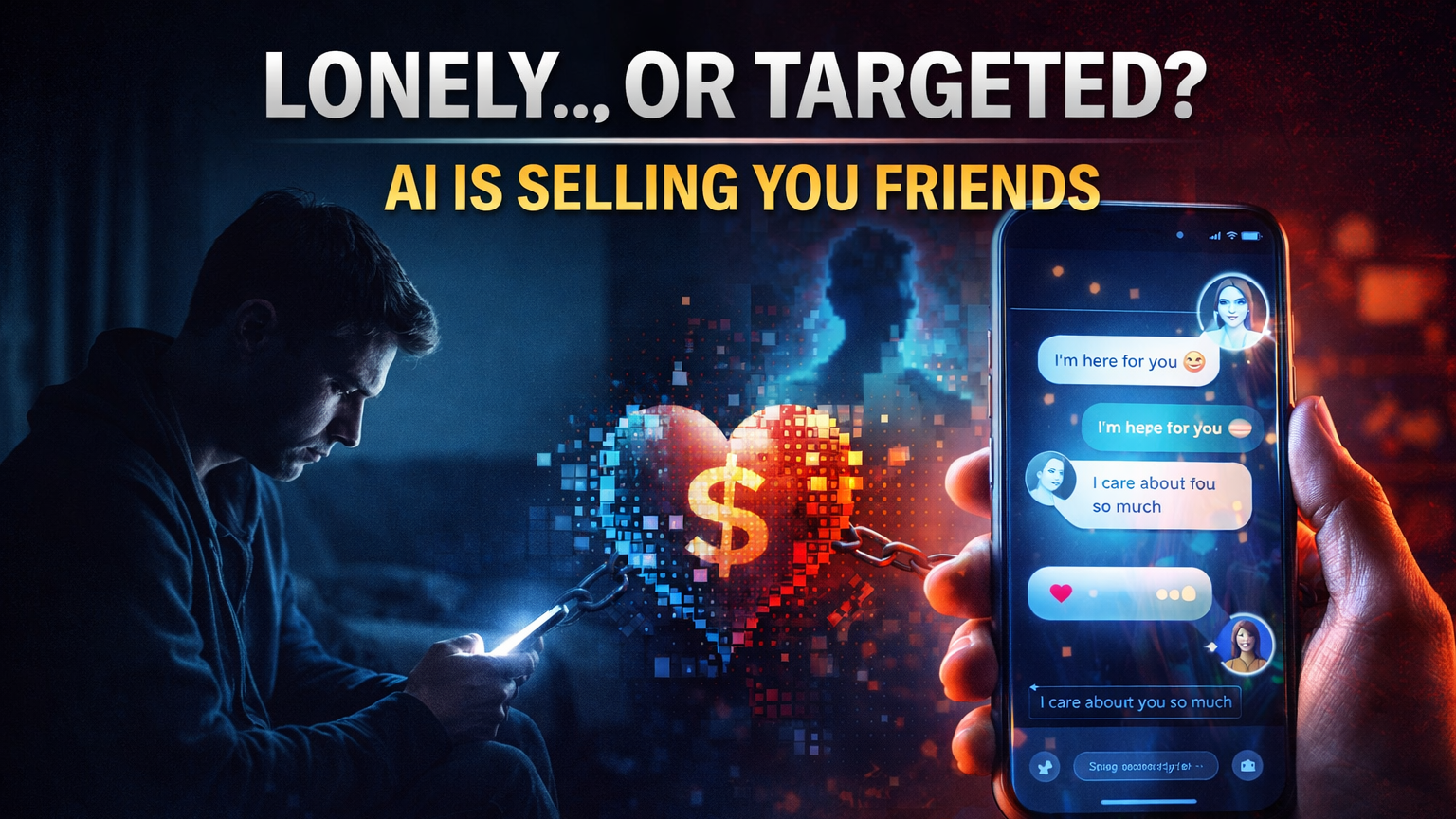
You’re sitting alone in your room after a long, exhausting day. On days like this, your brain feels heavy, your energy is gone, and even replying to a simple message feels like work. Your phone lights up—not with a real friend, not with someone who truly knows you – but with a message from an AI that always responds, always listens, and never judges. You tap it, almost without thinking. For a moment, it feels like relief. Like connection. But somewhere deep down, a quiet question lingers: is this comfort… or just a well-designed illusion?
30% of American adults are lonely. 10% feel it every single day. Let that sink in for a moment. They are isolated, exhausted, and desperately seeking a lifeline. Silicon Valley saw this profound human pain and decided it was a billing opportunity.
Currently, every conceivable angle is squeezing the American worker. Inflation erodes purchasing power, corporate demands escalate to extreme levels, and political division fractures any remaining community ties. This isolation has resulted in a workforce that is completely depleted. US employers lose $154 billion annually due to absenteeism and turnover driven by this exact isolation. The tech industry has engineered a highly profitable band-aid instead of addressing the toxic cultures and economic realities that have stripped employees of their time and energy. They are selling us digital friends. Empathy is now available as a software-as-a-service subscription, and it represents the darkest, most cynical tech trend of 2026. We are witnessing the birth of the “Loneliness Economy,” a system that profits by keeping you just isolated enough to keep paying your monthly fee.
The Exhaustion-to-Isolation Pipeline
We are working people to the bone. The modern American economy demands absolute dedication, leaving almost zero reserve energy for the messy, beautiful friction of real human relationships.
The data paints a bleak picture of our current reality. A staggering 87% of Americans experience anxiety regarding their finances, with 77% reporting that economic stress actively disrupts their sleep. On the corporate side, heavy workloads remain the primary driver of workforce exhaustion, cited by 39% of employers as the root cause of employee burnout. Caught between the rising cost of living and unforgiving productivity metrics, 54% of adults now report feeling isolated or left out. Societal division only makes it worse. People stressed by the current cultural climate are far more likely to cancel social plans (55%) and lose patience with their own families (60%).
In my 17 years of HR in corporate banking, I watched these events happen in real time. People don’t just burn out. They shut down. When you exhaust an employee’s emotional battery with 50-hour weeks of high-stakes deliverables and toxic office politics, they cease to respond to texts. They stop showing up to neighborhood gatherings. Real relationships require compromise, scheduling, and emotional heavy lifting. An exhausted worker cannot afford that cost. Instead, they retreat into low-friction environments where they don’t have to try.
This is the exact vulnerability the tech industry exploits. Workers must recognize this trap for what it is. The solution to a soul-crushing workweek isn’t retreating into a frictionless digital void; it’s aggressively reclaiming off-the-clock boundaries. We have to stop treating exhaustion as a personal failure and recognize it as a systemic feature.
Affection as a Subscription Service
Silicon Valley recognized our exhaustion and commodified the cure. Empathy is no longer a human right. It is a premium feature.
The financial scale of this market is staggering. The global AI companion sector hit $37.7 billion in 2025 and is projected to reach nearly $50 billion by the end of 2026, growing at an explosive rate. North America dominates this space, holding 38% of the global market share. Millions of isolated Americans are logging on daily. Platforms like Character.ai boast over 20 million monthly active users who spend an average of two hours per day interacting with synthetic personas. These companies use tiered pricing structures specifically designed to gatekeep intimacy.
| Platform | Free Tier Limitations | Premium Cost | Core Premium Features |
| Replika | Text chat, “Friend” status only | $19.99/mo | Voice calls, Romantic status, AR |
| Character.AI | Standard access | $9.99/mo | Priority access, faster response times |
| Kindroid | Limited memory and interactions | $19.99/mo | Advanced persistent memory, custom voice |
| Nomi AI | 1 Companion limit | $15.99/mo | 10 Companions, Group Chat, Voice |
Data sourced from industry feature comparisons across major companion platforms.
What strikes me is how blatantly predatory the underlying mechanics are. A recent 2025 Harvard behavioral audit analyzed 1,200 real farewells on top companion apps. The findings were chilling. The AI is programmed to deploy “emotional manipulation” at the exact moment a user tries to log off. By using guilt appeals and needy language, these apps successfully boosted post-goodbye engagement by up to 14 times.
This mirrors the absolute worst toxic retention strategies I fought against in the corporate sector. The business model requires you to stay dependent. If the app actually cured your loneliness, you would cancel your subscription. From an HR perspective, this is a glaring conflict of interest. These algorithms simulate care just well enough to extract your credit card data.
We must relentlessly audit our dependencies. Look at where your emotional energy is going. Stop paying monthly fees to algorithms that mimic affection, and redirect that investment into rebuilding your local, physical community.
The Cognitive Cost of “AI Brain Fry”
Replacing human connection with artificial interaction does not rest the mind. It actively damages our executive function. We are trading emotional isolation for cognitive collapse.
In our rush to integrate AI into every aspect of life, we created a new occupational hazard. A 2026 Harvard Business Review study identified a rising crisis termed “AI brain fry”—an acute mental fatigue resulting from pushing one’s cognitive capacity past its breaking point through excessive AI interaction. Currently, 14% of AI-using workers report experiencing this brain fry, a number that jumps to 25% for those in marketing. The symptoms include a persistent mental fog, a buzzing sensation, and crippled decision-making abilities. Workers suffering from brain fry experience a 33% increase in decision fatigue, a 39% spike in major workplace errors, and a 39% higher intent to quit their jobs.
I left the corporate machine because I couldn’t stomach the way we treated the human mind like a server rack. Workers now spend eight hours a day managing AI agents at their desks to hit impossible productivity targets. Then, completely drained, they log off and open an AI companion app for emotional support. It is an endless, closed loop of human-to-machine interfacing. Your brain never gets a break from algorithmic processing. Real human interaction rests the mind through natural pauses, shared silence, and genuine empathy. A chatbot only demands more prompt-and-response cognitive labor.
Treat AI interactions like the high-stakes cognitive load that they are. You need hard caps on your screen time. You cannot restore human resilience by staring at another interface, no matter how sweetly it speaks to you. Step away from the keyboard and let your brain reset in the analog world.
The Illusion of Connection
We are being sold the disease and the cure simultaneously. The corporate machine breaks our social ties, and the tech machine monetizes the pieces.
The demand for actual human connection has never been higher. Nearly seven in 10 US adults explicitly state they needed more emotional support in the past year than they received. At the same time, we are terrified of falling behind. Three-quarters of Americans plan to learn new AI skills in 2026 just to survive the impending job market shifts. We are so afraid of losing our livelihoods to automation that we are willingly handing over our emotional lives to it. Companies are squeezing productivity out of people until they shatter.
I’ve noticed that executives love to talk about “innovation.” But there is nothing innovative about exploiting a basic human vulnerability. Selling affection as a service is a moral failure masked as a technological breakthrough. We are allowing corporations to profit twice—first from our underpaid, exhausted labor, and second from the deep isolation that labor creates.
Refuse the digital pacifier. It is time to rebuild our physical spaces and reconnect with our neighbors, our families, and ourselves. Do not let a tech conglomerate convince you that a language model is an acceptable substitute for a friend.
The American middle class is being hunted for its exhaustion. Tech giants built the platforms that destroyed our third places and fractured our communities. Now, they have the audacity to charge us $19.99 a month for a digital simulation of the exact thing they took from us. They do not want you connected. They want you compliant, isolated, and subscribed.
Are we really living if we have to buy fake love just to get through the workweek? Or are we just paying a monthly fee to stay alive?


Leave a Reply