
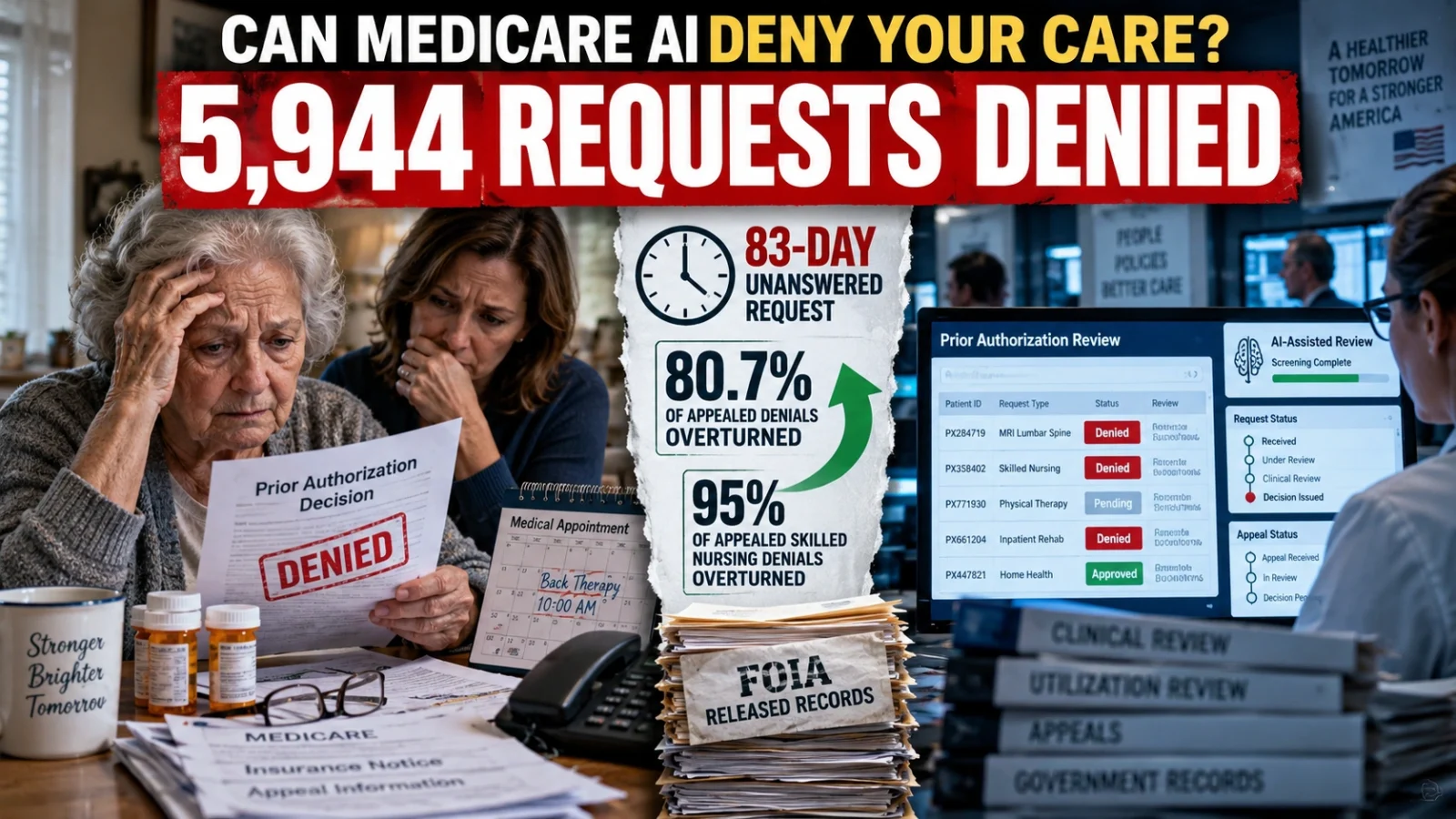
On September 27, 2026, the industry trade publication BenefitsPro published a piece titled “How AI is already changing health plan administration,” describing a future in which employees ask a chatbot “What is a deductible?” as many times as they like “without causing pain.” That is one face of AI in health insurance. The other face arrived two weeks earlier, in roughly 1,000 pages of internal government records that the Electronic Frontier Foundation pried loose from the Centers for Medicare & Medicaid Services through a Freedom of Information Act lawsuit.
Those records, released September 8 and reported by STAT News on September 15, describe Medicare’s first large-scale experiment with AI-screened prior authorization — the WISeR model, running in six states since January. Two vendors denied 5,944 requests in the program’s first three months; one request sat unanswered for 83 days; and doctors wrote to CMS about patients “crying in pain” while waiting. The documents also confirm that vendors are paid, in part, based on the care they deny.
Why this matters now: the same pattern — automated screening, low appeal rates, and very high reversal rates when someone does appeal — shows up across Medicare Advantage, Medicaid managed care, and ACA marketplace plans in new federal data. The people affected are not abstractions. They are seniors waiting for a back procedure, stroke patients being pushed out of rehab early, and families who never learned that a denial could be fought.
The industry’s version of the story
In the trade press and at benefits conferences, AI is pitched as a cure for paperwork. The BenefitsPro piece frames it as relief for benefits teams drowning in PDFs and repetitive questions during open enrollment. Consultants describe AI helping with fraud detection, plan selection, and explaining benefits to confused members.
None of that is false, and some of it helps workers. But it is a narrow slice of what the technology is doing. The same tools that answer “What is a deductible?” are, in other configurations, deciding whether a nursing home stay gets paid for — and that is where the record of harm is accumulating.
Inside Medicare’s AI experiment
The Wasteful and Inappropriate Service Reduction (WISeR) model launched January 1, 2026 in Arizona, New Jersey, Ohio, Oklahoma, Texas and Washington, and is scheduled to run through 2031. For the first time at scale, traditional Medicare — the program many retirees chose precisely because it lacked private-plan hurdles — now requires prior authorization for 13 service categories, including epidural steroid injections, skin substitutes and spinal procedures. Private technology vendors screen the requests using AI and machine learning; CMS says a qualified clinician must review any denial.
The EFF records paint a troubled rollout. About a month before launch, the Ohio vendor, Innovaccer, warned CMS that its software lacked full functionality and had not been end-to-end tested, and said it would simply auto-approve requests until it could finish building — “the only path available” given CMS’s refusal to delay, the vendor wrote. Another vendor, Virtix, denied more requests than it approved in the first three months and was required by CMS to submit a corrective action plan, according to EFF and Rep. Suzan DelBene’s office. CMS publicly promises 72-hour turnaround; the records show widespread misses.
The payment structure is the part patients should understand. According to the released WISeR Data Reporting Guide, vendors are paid for requests they deny (not for denials later reversed on appeal), and poor “quality scores” reduce their pay by only 5 to 10 percent. EFF calls that a financial incentive to deny care; CMS has described the quality scores as its safeguard. Both statements are true at once — the dispute is over whether a 5-to-10-percent penalty is a brake or a rounding error.
The appeal gap: denials that don’t survive a second look
The strongest evidence that automated denials are frequently wrong comes from what happens when someone pushes back. KFF’s analysis of federal data found Medicare Advantage insurers made nearly 53 million prior authorization determinations in 2024 and denied 4.1 million of them (7.7 percent). Only 11.5 percent of denials were appealed — but 80.7 percent of those appeals were fully or partially overturned.
The HHS Office of Inspector General found something starker in a June 2026 report: in June 2024, the 19 largest Medicare Advantage organizations denied 12 percent of skilled nursing facility admission requests, and when those denials were appealed, 95 percent were overturned. OIG wrote that the overturn rate “indicates that some enrollees were initially denied medically necessary care and raises concerns about denials that were not appealed.”
| Measure | Figure | Source |
|---|---|---|
| Medicare Advantage prior auth denials, 2024 | 4.1 million (7.7%) | KFF, Jan. 2026 |
| Share of MA denials appealed, 2024 | 11.5% | KFF |
| Appealed MA denials overturned, 2024 | 80.7% | KFF |
| Appealed SNF denials overturned, June 2024 (19 insurers) | 95% | HHS OIG, June 2026 |
| Standard MA denials overturned on appeal, 2025 insurer reports | 67% | KFF, Aug. 2026 |
| WISeR denials by two vendors, first 3 months of 2026 | 5,944 | EFF/CMS records |
| Longest unanswered WISeR request in released records | 83 days | EFF/CMS records |
Insurers reading the same numbers argue that high overturn rates reflect new information submitted on appeal, not bad initial decisions. That is plausible in some cases. But for the roughly nine in ten denied patients who never appeal — because they are sick, elderly, confused by the letter, or simply unaware they can — the outcome is the same regardless of the explanation: care not received, or paid for out of pocket.
The lawsuit that could write the rules
The test case for AI-driven denials is Estate of Lokken v. UnitedHealth Group, a proposed nationwide class action filed in November 2023 in federal court in Minnesota by families of two deceased Medicare Advantage members. The suit alleges UnitedHealth used an algorithm called nH Predict, built by its naviHealth subsidiary, to override physicians and cut off rehabilitation and nursing-home coverage prematurely. The complaint cites a roughly 90 percent reversal rate when such denials reached appeal — a figure that remains the plaintiffs’ allegation, not a court finding.
UnitedHealth has said the suit “has no merit” and that medical necessity determinations “are made by qualified physicians following CMS guidance — not AI.” A federal judge in February 2025 dismissed five of seven counts on Medicare preemption grounds but let breach-of-contract and good-faith claims proceed. On March 9, 2026, a magistrate judge ordered UnitedHealth to produce documents dating to 2017, including all internal analyses of nH Predict, records of its AI review board, and compensation records for the care coordinators and medical directors who handled denials. Trial readiness is set for February 2028.
An October 2024 Senate Permanent Subcommittee on Investigations report had already concluded that UnitedHealthcare, Humana and CVS “intentionally use prior authorization to boost profits by denying post-acute care.” The insurers disputed that characterization.
“The dial”: the contractors behind the curtain
Much algorithmic review happens not inside insurers but at middlemen. A ProPublica/Capitol Forum investigation found that EviCore, which makes coverage decisions for more than 100 million people on behalf of major insurers, uses an AI-backed algorithm that insiders called “the dial” — adjustable to raise the odds that company doctors would screen, and potentially deny, a request. Former employees told reporters the dial was turned when EviCore wasn’t generating enough savings to justify its fees; a Connecticut audit found EviCore played a role in “inappropriate denials” for 30 cancer patients because its guidelines were out of date. EviCore has said its reviews follow evidence-based guidelines.
Earlier ProPublica reporting described Cigna’s PxDx system, which allowed medical directors to reject payment for claims in batches without opening patient files. Cigna said the process was limited to low-cost claims and that ProPublica mischaracterized payment denials as denials of care; House Energy and Commerce Committee leaders nonetheless demanded answers, noting that about 80 percent of appealed Cigna Medicare Advantage denials were overturned. These accounts are investigative findings and company responses, not adjudicated facts.
States push back; Washington pushes the other way
State legislatures have moved faster than Congress. California’s SB 1120, the Physicians Make Decisions Act, took effect January 1, 2025, barring plans from denying or modifying care on medical-necessity grounds unless a licensed clinician makes the call. Maryland’s HB 820 (effective October 2025) requires AI tools used in utilization review to base decisions on the individual patient’s record, and a 2026 Maryland law requires insurers to report AI-assisted adverse decisions quarterly. Texas, Arizona, Washington, Alabama, Indiana, Iowa and others enacted similar human-review requirements in 2025 and 2026, with effective dates stretching into 2027.
The White House is moving in the opposite direction. Executive Order 14365, signed December 11, 2025, directs the Justice Department to create an “AI Litigation Task Force” to challenge “onerous” state AI laws and asks Commerce to list state statutes that impede innovation. Whether that order can actually override state insurance laws is contested — Harvard health policy scholar Carmel Shachar told Governing that preemption authority generally rests with Congress, which twice declined to pass a state-law moratorium. For now, the state laws stand, but their durability is an open question.
Patients fight AI with AI
The one development that has clearly shifted power toward patients is cheap appeal-writing software. Counterforce Health, a North Carolina nonprofit funded by NIH and university grants, lets patients upload a denial letter and generates a cited appeal in under a minute, free; it has since added an AI assistant that places follow-up calls to insurers. Claimable, co-founded by a former VA chief data scientist, charges about $40 per appeal and says roughly 1,000 denials have been overturned by patients using its platform. Fight Health Insurance offers a similar free tool.
These tools don’t fix the underlying problem — they exploit the gap between a low appeal rate and a high reversal rate. But for a family facing a rehab cutoff this week, that gap is the whole fight. If your denial letter arrives, the practical advice from patient advocates is consistent: appeal, ask in writing whether an algorithm was used, cite your state’s human-review law if one exists, and request an expedited review when health is at risk.
What happens next
CMS is still producing WISeR records under the EFF lawsuit, and a June 2025 planning document in the first release lists services the agency has considered adding in later years — including air ambulance transport, cancer treatment and MRI scans, services where “prior authorization would have to be done on a more urgent or emergent basis.” CMS has not announced any such expansion. Lawmakers from WISeR states introduced repeal legislation in late 2025, and AFSCME’s 2026 convention passed a resolution calling for the pilot’s termination.
The UnitedHealth discovery process will, for the first time, put an insurer’s internal analyses of a care-denial algorithm into a court record, with trial readiness in early 2028. State laws take effect through 2027 even as the federal AI Litigation Task Force decides which ones to challenge. And the mandatory prior authorization “report cards” now required under CMS-0057-F mean next year’s denial and overturn numbers will be public — the clearest scoreboard yet for whether the machines are getting it right.
Editorial note: Allegations in the UnitedHealth, EviCore and Cigna matters are drawn from court filings, congressional reports and investigative journalism; the companies dispute them, and no court has found wrongdoing. Denial figures from WISeR reflect records released by EFF, which corrected an earlier higher figure to 5,944.
Sources
- BenefitsPro — https://www.benefitspro.com/2026/09/27/how-ai-is-already-changing-health-plan-administration
- Electronic Frontier Foundation, WISeR records — https://www.eff.org/deeplinks/2026/09/new-records-reveal-problems-medicares-ai-prior-authorization-experiment
- STAT News — https://www.statnews.com/2026/09/15/medicare-wiser-ai-prior-authorization-pilot-rushed-launch-delayed-care/
- Newsweek — https://www.newsweek.com/medicare-ai-program-results-in-lengthy-treatment-delays-new-data-shows-12441120
- Quartz — https://qz.com/medicare-wiser-ai-prior-authorization-denials-delays-091626
- Dinsmore & Shohl, WISeR overview — https://www.dinsmore.com/publications/is-ai-wiser-cms-models-ai-based-prior-authorization-process-in-six-states/
- AFSCME Resolution No. 16 — https://afscme.org/about/governance/conventions/resolutions-amendments/2026/resolutions/16-no-ai-in-medicare
- KFF, Medicare Advantage prior authorization 2024 — https://www.kff.org/medicare/medicare-advantage-insurers-made-nearly-53-million-prior-authorization-determinations-in-2024/
- KFF, prior authorization metrics across markets — https://www.kff.org/patient-consumer-protections/prior-authorization-metrics-provide-new-insights-into-insurer-practices-but-gaps-remain/
- HHS Office of Inspector General, OEI-09-24-00331 — https://oig.hhs.gov/reports/all/2026/medicare-advantage-organizations-overturned-nearly-all-appealed-prior-authorization-denials-for-skilled-nursing-facility-admission-raising-concerns-about-initial-denials/
- Becker’s Payer Issues, UnitedHealth discovery order — https://www.beckerspayer.com/legal/judge-orders-unitedhealth-to-hand-over-broad-discovery-in-ai-coverage-denial-case/
- ArentFox Schiff, discovery analysis — https://www.afslaw.com/perspectives/alerts/federal-court-orders-broad-discovery-against-uhc-ai-coverage-denial-lawsuit
- Healthcare Finance News, motion to dismiss ruling — https://www.healthcarefinancenews.com/news/class-action-lawsuit-against-unitedhealths-ai-claim-denials-advances
- Center for Medicare Advocacy (Senate PSI report) — https://medicareadvocacy.org/ongoing-medicare-advantage-overpayments-and-barriers-to-care/
- ProPublica, EviCore — https://www.propublica.org/article/evicore-health-insurance-denials-cigna-unitedhealthcare-aetna-prior-authorizations
- ProPublica, Cigna PxDx congressional inquiry — https://www.propublica.org/article/cigna-health-insurance-denials-pxdx-congress-investigation
- House Energy and Commerce Committee letter to Cigna — https://energycommerce.house.gov/posts/e-and-c-republicans-press-cigna-for-clarification-after-investigative-report-accuses-insurance-company-of-denying-claims-without-reading-them
- AMA, state legislative update on AI in health care — https://www.ama-assn.org/system/files/issue-brief-state-legislative-update-ai-health-care.pdf
- Davis Wright Tremaine Health Law Blog — https://healthlawblog.dwlaw.com/2026/08/the-state-of-ai-regulation-in-healthcare-still-complicated/
- Executive Order 14365 — https://www.whitehouse.gov/presidential-actions/2025/12/eliminating-state-law-obstruction-of-national-artificial-intelligence-policy/
- Governing — https://www.governing.com/artificial-intelligence/red-and-blue-states-want-to-regulate-ai-in-insurance-the-white-house-disagrees
- Stateline — https://stateline.org/2025/11/20/patients-deploy-bots-to-battle-health-insurers-that-deny-care/
- NBC News, patients using AI to appeal — https://www.nbcnews.com/news/us-news/ai-helping-patients-fight-insurance-company-denials-wild-rcna219008
- Managed Healthcare Executive — https://www.managedhealthcareexecutive.com/view/power-to-the-patients-ai-for-fighting-insurance-denials


Leave a Reply