Oct 1, 2026
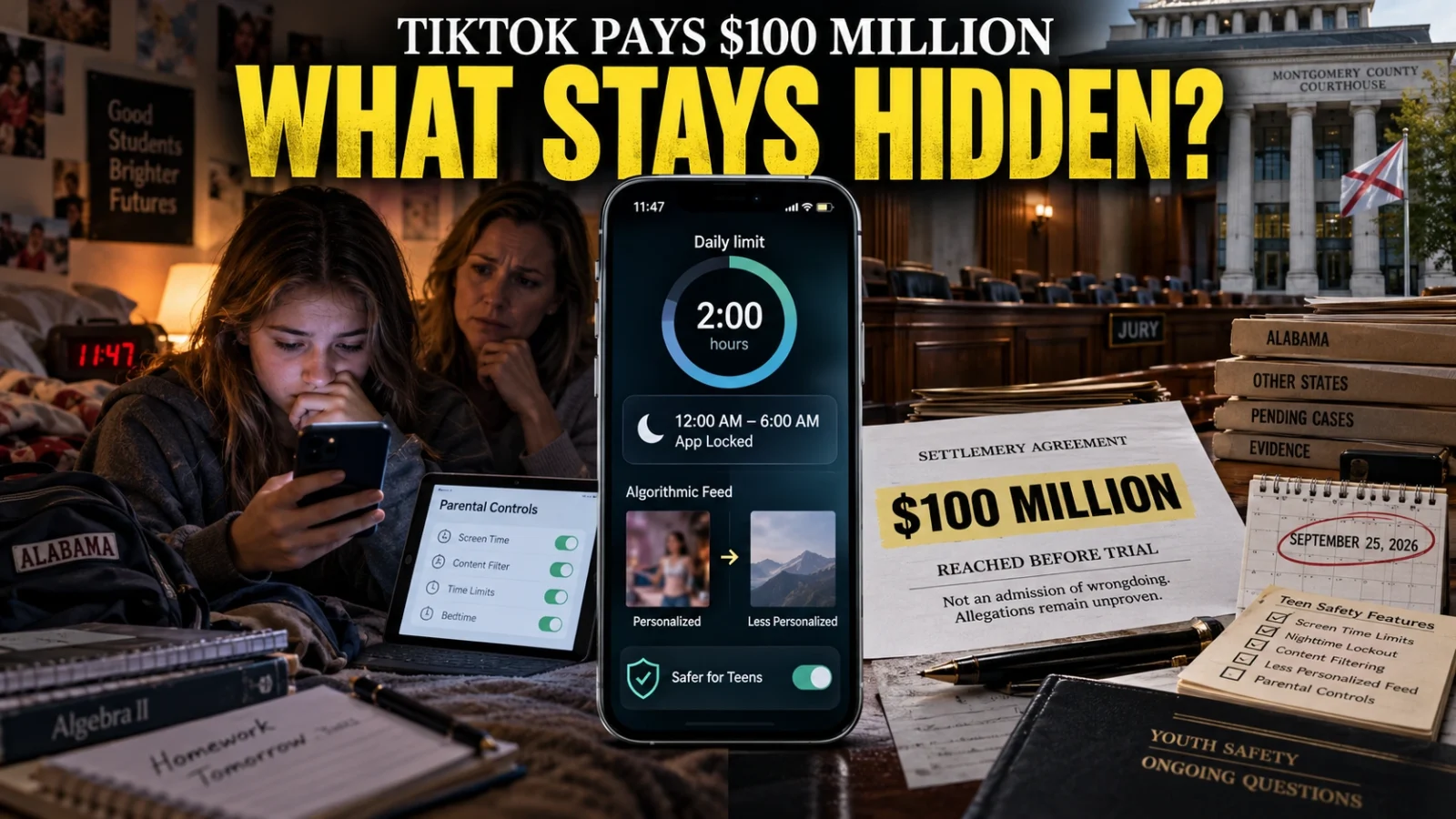
TikTok has agreed to pay Alabama at least $100 million to settle the state’s lawsuit accusing the app of being designed to addict children and of misleading families about its safety. Attorney General Steve Marshall announced the deal on Friday, September 25, 2026, three days before the case was set to become the first state lawsuit against TikTok to go before a jury.
The settlement also forces TikTok to change how the app works for young users in Alabama, including a two-hour daily limit, an overnight lockout and a default feed that is not personalized for teens. The payout could rise to $300 million if certain conditions are met, according to the attorney general’s office.
The deal matters far beyond one state. At least 27 other states and Washington, D.C., have filed similar suits, and TikTok faces thousands more from families and school districts, Reuters reported. For parents, the settlement offers new guardrails. It also means the public will not hear, in open court, the evidence Alabama had gathered about how TikTok’s system treats young users.
What TikTok agreed to change
Under the settlement filed in Montgomery County Circuit Court, Alabama receives at least $100 million within 45 days. According to the attorney general’s office, TikTok must also put in place these protections for young users in the state:
A two-hour daily time limit, with parental controls to set a lower cap.
“Productive pauses” that interrupt teen users after 15 minutes of continuous use, and again at 60 and 90 minutes.
No access for children from midnight to 6 a.m., plus limits on messages and push notifications overnight and during school hours.
Stronger age checks to identify young users.
Limits on adults finding teen accounts, and alerts to parents about suspicious adult contact.
A ban on cosmetic beauty filters for teens.
A default feed for teens that is not personalized.
Reuters reported that the deal also requires TikTok to adopt further restrictions if rivals such as Snap, Google and Meta make similar changes. The terms apply only to users in Alabama, though Reuters noted that major platform changes could be hard to run state by state.
What Alabama alleged, and how TikTok responded
Alabama sued TikTok and ByteDance in April 2025 under the state’s Deceptive Trade Practices Act. The complaint said more than one-third of TikTok’s daily U.S. users are 14 or younger, and that the app’s algorithm keeps minors scrolling while exposing them to content promoting depression, eating disorders, self-harm and drug use, local station WAFF reported at the time.
According to Reuters, the state claimed TikTok’s endless video stream makes it the most addictive social platform, and that its design pushes young users toward intense content, contributing to a teen mental health crisis and causing self-harm emergency room visits in the state to “skyrocket.” Alabama also alleged that TikTok’s “Kids Mode” and “Restricted Mode” were easy to bypass, partly because people can watch videos without creating an account or proving their age.
These are allegations that were never tested before a jury. TikTok has said it designed its platform with teen safety as a key priority and has argued that Section 230 of the federal Communications Decency Act protects platforms from liability over user-generated content. After the settlement, a spokesperson for TikTok’s U.S. operations said the deal “builds on our commitment and core objective to continually enhance our robust safety tools to protect teens.”
Why settle on the eve of trial
The Alabama trial, expected to last two to three weeks, was set to offer “a rare look inside TikTok,” Reuters reported. The company has sought to keep details of its operations from public view and has now settled every case selected for trial against it, including claims by five young people and a Kentucky school district. TikTok also settled before trial in the landmark Los Angeles addiction case earlier this year, CBS News reported.
Settling lets a company avoid two risks at once: a jury verdict that could invite larger penalties elsewhere, and testimony and documents aired in open court. In Los Angeles, the case TikTok exited went on against Meta and YouTube, and a jury awarded the plaintiff $6 million in March 2026. In New Mexico, a jury returned a $375 million verdict against Meta.
Measured against the company’s size, the guaranteed payment is small. Bloomberg reported that ByteDance targeted about $186 billion in 2025 revenue; $100 million would be roughly 0.05% of that. In our analysis, the real cost to TikTok lies less in the check than in the product changes, if they spread beyond Alabama.
The algorithm question
In our view, the most significant term is the default non-personalized feed for teens. TikTok’s personalized “For You” feed is the app’s signature feature, and Alabama’s complaint argued they trap young users in “filter bubbles” of increasingly intense material, according to Reuters. A default that switches this off for teens goes to the heart of the state’s case.
The word “default” matters, though. Public summaries do not say whether teens or parents can switch personalization back on, or how often families will do so. The real effect of time limits and pauses will likewise depend on how they are enforced and checked.
The new rules also depend on knowing who is a teen. Alabama alleged that TikTok’s age checks were easy to evade, and the settlement calls for “robust age assurance.” Stronger age checks usually mean collecting more personal data, a tradeoff the published summaries do not address.
Part of a much bigger reckoning
Alabama’s deal arrives one month after the largest youth-safety settlement yet. Meta agreed in August to pay states up to $17.1 billion over 10 years and to add similar teen protections on Instagram and Facebook. Meta did not admit wrongdoing, Reuters reported, and conditioned $5 billion of that payout on TikTok, Snap and YouTube adopting comparable terms.
| Case | Date | Amount | Notes |
|---|---|---|---|
| Alabama v. TikTok (settlement) | Sept. 25, 2026 | At least $100 million; up to $300 million | Alabama-only safety changes |
| States v. Meta (settlement) | Aug. 26, 2026 | Up to $17.1 billion over 10 years | Alabama’s share: about $117 million |
| U.S. Justice Department v. TikTok (settlement) | Aug. 2026 | $400 million | Children’s privacy claims |
| New Mexico v. Meta (jury verdict) | 2026 | $375 million | Plus a separate $567 million abatement award |
| K.G.M. v. Meta et al. (jury verdict) | March 2026 | $6 million | Against Meta and YouTube; TikTok settled before trial |
According to Reuters, the Alabama payout could grow to $300 million if 40 other attorneys general sign similar agreements with TikTok within a set period. Some outlets described the trigger differently, and the attorney general’s office has said only that the larger sum depends on “certain conditions.” That structure gives TikTok a template for settling with other states, and gives other states a price tag to measure against.
What families get, and what they don’t
The $100 million goes to the State of Alabama, not to individual families. The attorney general’s announcement did not say how the money will be spent. Some states have said where their Meta settlement money will go; Colorado, for example, said its share would go to youth mental health and safety initiatives, according to The Hill.
Families who believe their children were harmed keep their own legal options. The thousands of individual lawsuits against TikTok, Meta, Snap and YouTube continue, and the state settlements do not compensate individual children.
For Alabama parents, the most concrete change is in the app itself: time caps, overnight lockouts and stronger parental controls. Parents in other states will not automatically get these protections unless TikTok extends them voluntarily or their own states win similar terms.
What happens next
TikTok must pay Alabama the first $100 million within 45 days of the September 25 announcement, which falls in early November. Public summaries do not give deadlines for each safety feature, so Alabama families should watch for when the time limits, overnight lockout and non-personalized feed actually appear in the app.
The bigger question is whether other states follow. At least 27 states and Washington, D.C., have their own suits against TikTok, and Alabama’s larger payout is tied to TikTok reaching similar deals with 40 attorneys general. Under the Meta settlement, rivals’ adoption of comparable teen protections also triggers more money and tighter limits.
Thousands of individual, school district and municipal cases against TikTok and other platforms remain pending, and Section 230 defenses are still being argued. Each settlement before trial means another case where the facts are resolved by negotiation rather than by a jury.
Sources
Alabama Attorney General, “Attorney General Marshall Announces Historic Multi-Million-Dollar Settlement with TikTok” (September 25, 2026): https://content.govdelivery.com/accounts/ALAG/bulletins/42c948f
Settlement filing, State of Alabama v. TikTok Inc. et al., Montgomery County Circuit Court, No. 03-CV-2025-900628 (filed September 25, 2026): https://www.alabamaag.gov/wp-content/uploads/2026/09/2c218616-c8e5-48a0-8b2f-5e771948385d.pdf
Reuters via Cyprus Mail, “TikTok reaches first state settlement over teen safety claims” (September 26, 2026): https://cyprus-mail.com/2026/09/26/tiktok-reaches-first-state-settlement-over-teen-safety-claims
CBS News, “TikTok settles Alabama lawsuit over youth safety concerns for at least $100 million” (September 25, 2026): https://www.cbsnews.com/news/tiktok-alabama-youth-safety-lawsuit-settlement/
Alabama Attorney General, announcement of lawsuit against TikTok (April 2025): https://www.alabamaag.gov/attorney-general-steve-marshall-sues-social-media-giant-tiktok-for-deceptive-claims-about-youth-safety/
WAFF, “Alabama Attorney General Steve Marshall files lawsuit against TikTok, ByteDance” (April 29, 2025): https://www.waff.com/2025/04/29/alabama-attorney-general-steve-marshall-files-lawsuit-against-tiktok-bytedance
NPR, “Meta, states agree to $17 billion settlement in child safety trial” (August 26, 2026): https://www.npr.org/2026/08/26/nx-s1-5944781/meta-settlement-child-safety-lawsuit
Hunton Andrews Kurth, “Court Approves Meta Settlement With 29 States Over Alleged Harms to Children and Teens” (August 31, 2026): https://www.hunton.com/privacy-and-cybersecurity-law-blog/court-approves-meta-settlement-with-29-states-over-alleged-harms-to-children-and-teens
The Hill, “Meta settles social media addiction trial with states for up to $17B” (August 26, 2026): https://thehill.com/policy/technology/6051476-meta-settlement-youth-addiction-lawsuit/
Wikipedia, “K.G.M. v. Meta et al.”: https://en.wikipedia.org/wiki/K.G.M._v._Meta_et_al.
Storyboard18, citing Bloomberg, “ByteDance set for $50 billion profit in 2025” (December 22, 2025): https://www.storyboard18.com/digital/bytedance-set-for-50-billion-profit-in-2025-as-tiktok-fuels-e-commerce-surge-86292.htm

Leave a Reply