
Oct 8, 2026 · @Som Bentur
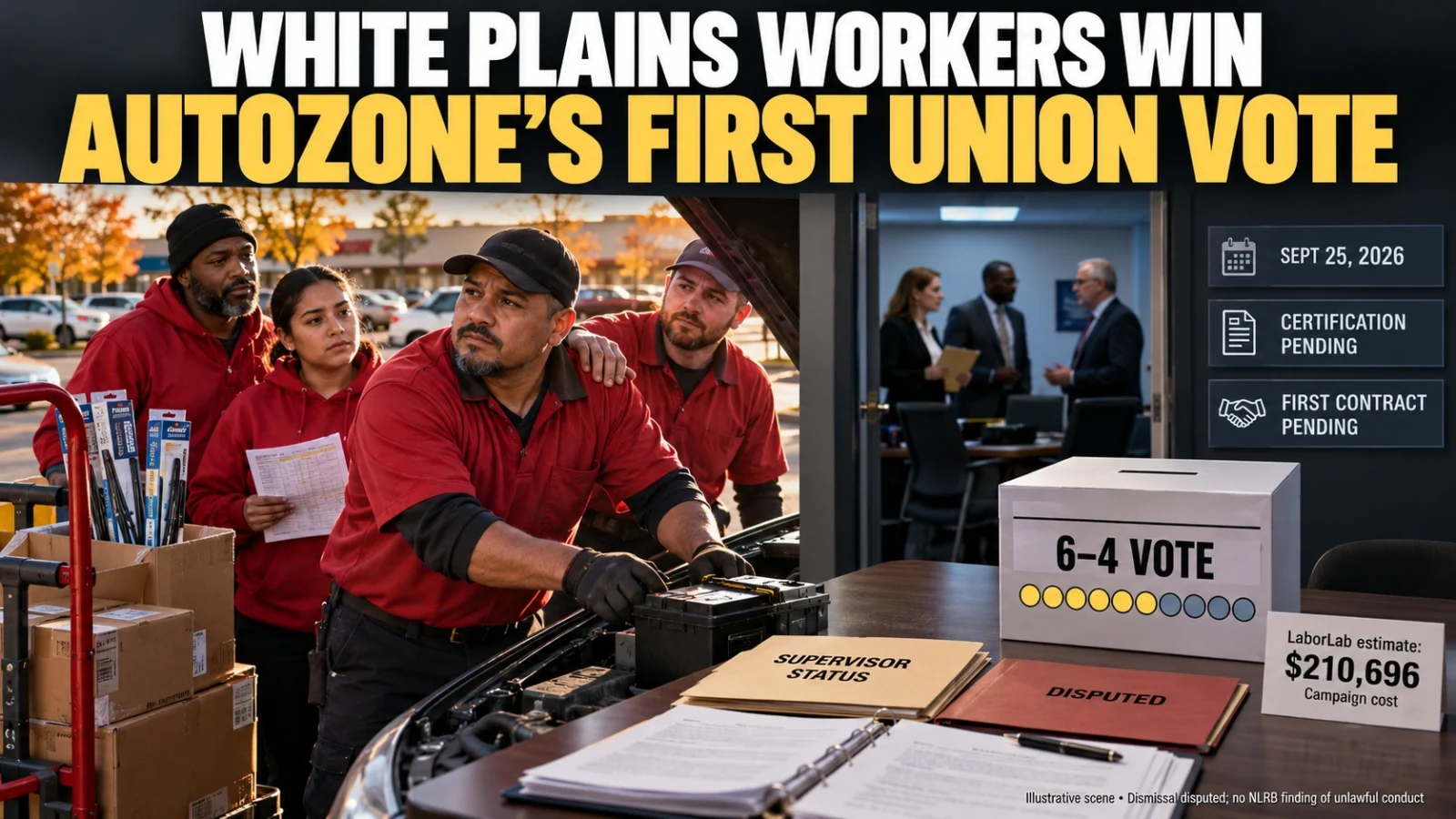
On Friday, September 25, 2026, employees at an AutoZone store in White Plains, New York, voted 6 to 4 to join United Auto Workers Local 259, forming the first union at any of the company’s more than 6,800 U.S. stores, according to , a New York labor newspaper. The AFL-CIO called it a first for a nationwide chain in a , and the UAW’s Region 9A director said the workers had beaten “all the possible anti union consultants” the company could hire.
The scale is tiny and the stakes are not. AutoZone is the largest auto parts retailer in the country, with more than 111,000 employees and a fiscal 2026 profit of $1.3 billion, and until last month it had no union anywhere. A watchdog group estimates the company spent more than $200,000 to keep one store with about a dozen eligible voters from organizing. One day after the vote, the worker who started the drive was fired, in a conversation he recorded in which a regional manager cited his “union activity” as the reason.
Who is affected: the ten people who voted, the organizer who could not, and the AutoZone employees in thousands of other stores who now have proof that an election can be won. The workers say they want pay and job security that reflect what they bring to the company. AutoZone did not respond to The Chief’s request for comment on the vote or the firing. Nothing in the public record so far has been adjudicated by the National Labor Relations Board.
How the vote happened
The drive began in April, when Nathan DuCongé, a parts equipment manager earning $18.50 an hour, met a UAW member at a training run by the Emergency Workplace Organizing Committee, a volunteer project tied to the Democratic Socialists of America and the United Electrical workers’ union, . Workers went public in July with a demand letter asking for fair wages, regular raises, reliable scheduling and affordable health insurance. Management, DuCongé told The Chief, caught wind of the effort the same month.
The path to a ballot was not straight. AutoZone argued that DuCongé was a supervisor and therefore ineligible to vote, a dispute that could have delayed the election for months and cost the union tens of thousands of dollars to litigate, Local 259 vice president Michael DiGiuseppe told Labor Notes. The union withdrew its petition in late July and refiled in August without DuCongé in the unit. Workers said management had also transferred two new employees into the store who they expected to vote no, an allegation the company has not addressed publicly.
Eleven workers were eligible. On September 25, the vote was 6 to 4, one vote away from the 5-5 tie that would have sunk the effort, as happened at a Manhattan Trader Joe’s in 2023. The result will be certified by the National Labor Relations Board unless objections are filed; as of this writing, no certification or objection has been reported.
Why they organized
The grievances are specific and small in the way retail grievances usually are. Juan Accostupa has worked at the store for ten years and earns $17 an hour; his pay, he told Labor Notes, has risen only as fast as New York’s minimum wage. David Valencia, hired in May, said he got interested in the union after being scheduled on the Fourth of July with no holiday pay or bonus. “We’re not getting close to what we’re worth,” he told the AFL-CIO.
The work is more than running a register. Workers unload trucks and install wiper blades, headlights and batteries in the parking lot in all weather; DuCongé said he walked through a blizzard this year to open the store. They say the company profits from those installation services and pushes them to upsell washer fluid and battery grease. Labor Notes reported that AutoZone’s CEO, Phil Daniele III, earned $9.64 million last year, 331 times the median AutoZone worker’s $29,017.
Valencia’s summary of the anti-union spending was blunt: a company does not spend money without expecting to make more, “and where is that money going to come from? It’s going to come from us.” That is a worker’s inference, not a finding, but it is the frame through which the ten voters appear to have read the $200,000 campaign.
What AutoZone did, and what it has said
The company’s campaign, as described by workers and the watchdog LaborLab, was out of proportion to the store. Workers identified at least 11 corporate executives plus regional and district managers who appeared at the store before the vote; The Chief put the total at 17 managers flown in from Memphis, Indiana, California, Florida and elsewhere. They held repeated mandatory meetings, DuCongé said, and a regional manager told him on an August 28 recording that his social media was being monitored and that “if you don’t stop, we will accept your invitation to fire you.” Letters to workers warned that “you could actually end up with less” because “your wages could go up or down” in bargaining, The Guardian reported.
LaborLab’s estimated the cost at $210,696 in outside attorney fees and executive salaries, based on workers’ reports. That is an estimate from an advocacy group, not a disclosed figure. The Economic Policy Institute estimates U.S. employers spend about $1.7 billion a year on union-avoidance consultants and lawyers.
One day after the vote, AutoZone fired DuCongé. In a recording he gave The Chief, regional manager Tammy Hamilton said the company was terminating him for “engaging in and or facilitating union activity” despite instructions not to as a manager. AutoZone’s position is that DuCongé was a supervisor, who is not protected by federal labor law. He says he had no authority to hire, fire or discipline. Days later, DuCongé said, the company fired a store supervisor for failing to stop the union. AutoZone did not respond to The Chief’s request for comment, and no unfair-labor-practice finding has been issued. Federal law bars retaliation against non-supervisory employees for organizing; whether DuCongé was one is the question any NLRB charge would turn on.
There is a precedent. In 1992, the Teamsters sought to organize an AutoZone distribution center in Greenville, South Carolina, and lost. The NLRB later ordered a rerun election, and a findings that the company had threatened job losses and withheld a scheduled pay increase because of the union drive. No AutoZone store or warehouse filed for an election in the 34 years that followed.
A first in a sector where firsts rarely stick
Retail is among the least unionized private industries in the country, and the broader organizing wave that followed the pandemic has cooled. Union membership in wholesale and retail trade was 5.2 percent in 2025, according to the . Bloomberg Law counted 1,372 NLRB elections in 2025, down from 1,938 the year before, with union wins falling nearly 27 percent.
| Measure | Figure | Source |
|---|---|---|
| AutoZone U.S. stores | 6,800+ | The Chief |
| AutoZone U.S. employees | 111,000+ | The Chief |
| AutoZone fiscal 2026 profit | $1.3 billion | AutoZone release via The Chief |
| CEO pay vs. median worker (last year) | $9.64 million vs. $29,017 (331 to 1) | Labor Notes |
| Workers eligible to vote in White Plains | 11 | Labor Notes, The Guardian |
| Vote | 6 to 4 | The Chief |
| Estimated anti-union spending | $210,696 | LaborLab |
| Union membership, wholesale and retail trade, 2025 | 5.2% | BLS |
| NLRB union elections, 2025 vs. 2024 | 1,372 vs. 1,938 | Bloomberg Law |
The harder number is first contracts. Since 2021, workers at Starbucks, Chipotle, Home Depot, REI and Trader Joe’s stores have won elections; Labor Notes reports that even the winners have mostly not secured a first contract, and Chipotle workers abandoned their effort this year. An election win obliges a company to bargain in good faith; it does not oblige it to agree to anything. Public approval of unions nonetheless sits near a record high at roughly 70 percent in Gallup’s polling.
Why the UAW, and what comes after a win
Local 259 is not an assembly-line local. It represents mechanics and service technicians at car dealerships and repair shops around New York City, and DiGiuseppe has organized service centers, including a Mercedes-Benz shop where the union alleged anti-union firings, according to The Chief. An auto parts store where workers install batteries and wiper blades in the lot is, in that sense, adjacent work. The UAW’s Region 9A, which covers the Northeast, has expanded well beyond auto plants in recent years into graduate workers, museum staff and legal aid lawyers.
The connection to DuCongé came through politics as much as labor. Labor Notes reported that he was a field lead in the Bronx for Zohran Mamdani’s mayoral campaign, met EWOC organizers while canvassing, and was put in touch with a UAW organizer from there. EWOC trainings have seeded several New York retail and restaurant campaigns since 2020.
The road ahead is procedural and slow. If no objections are filed, the NLRB certifies the result and AutoZone must bargain with Local 259 for a contract covering one store. Any charge over DuCongé’s firing would go to the NLRB’s regional office, where the supervisor question would be litigated; remedies, if any, typically take months or years. The union has said it will support workers at other AutoZone stores who want to organize, and DuCongé has publicly invited them to reach out.
What happens next
Three things to watch. First, whether AutoZone files objections to the election or accepts certification; the company has not said. Second, whether the union files unfair-labor-practice charges over DuCongé’s dismissal and the second firing he described, and how the NLRB resolves whether he was a supervisor. Third, whether a second AutoZone store files for an election; DiGiuseppe’s hope of a wave depends on it.
For the ten workers who voted, the near term is a bargaining table with a company that has never sat at one for a store. The record of comparable retail wins suggests a first contract, if it comes, will take longer than the campaign did.
Editorial note: Accounts of management conduct, the $210,696 spending estimate and the reasons for DuCongé’s firing come from workers, union officials, LaborLab and recordings provided to reporters. AutoZone did not respond to requests for comment from The Chief and has not publicly disputed or confirmed the accounts. The company’s stated position that DuCongé was a supervisor is reported as such. No NLRB finding of unlawful conduct has been made in the White Plains matter. The 1990s findings against AutoZone concern a different facility and were adjudicated.
Sources
The Chief via Portside, “Worker Firing the Latest Chapter in AutoZone’s Relentless Union-Busting Campaign,” September 30, 2026 — https://portside.org/2026-09-30/worker-firing-latest-chapter-autozones-relentless-union-busting-campaign
The Chief, original article — https://www.thechiefleader.com/stories/worker-firing-the-latest-chapter-in-autozones-relentless-union-busting-campaign,57714
AFL-CIO, “Service & Solidarity Spotlight: AutoZone Workers Vote to Join UAW, First for Nationwide Chain,” September 29, 2026 — https://aflcio.org/2026/9/29/service-solidarity-spotlight-autozone-workers-vote-join-uaw-first-nationwide-chain
WNY Labor Today, “‘In A First For A Nationwide Chain,’ AutoZone Workers In White Plains ‘Go Union'” — https://www.wnylabortoday.com/news/2026/09/29/new-york-state-labor-news/labor-news-update-in-a-first-for-a-nationwide-chain-autozone-workers-in-white-plains-go-union-vote-to-join-the-united-auto-workers
Labor Notes via Portside, “AutoZone Workers Are Trying To Form the Company’s First-Ever Union,” September 21, 2026 — https://portside.org/2026-09-21/autozone-workers-are-trying-form-companys-first-ever-union
The Guardian via PressReader, “Workers in New York seek to create first AutoZone union as company resists,” September 19, 2026 — https://www.pressreader.com/usa/the-guardian-usa/20260919/281608132339389
UAW Region 9A, “AutoZone Workers Are Trying to Form the Company’s First-Ever Union with Local 259” — https://region9a.uaw.org/news/AutoZone
UAW Region 9A Weekly Newsletter, October 2, 2026 — https://region9a.uaw.org/news/newsletter100226
OnLabor, News & Commentary, September 22, 2026 — https://onlabor.org/september-22-2026/
LaborLab, union-busting cost calculator — https://calculator.laborlab.us/
AutoZone Inc. v. NLRB, 83 F.3d 422 (6th Cir. 1996) — https://law.justia.com/cases/federal/appellate-courts/F3/83/422/586049/
Bureau of Labor Statistics, “Union membership rate 10.0 percent in 2025” — https://www.bls.gov/opub/ted/2026/union-membership-rate-10-0-percent-in-2025.htm
Bloomberg Law, “Unionizing Set to Fall Due to Economic, Political Headwinds” — https://news.bloomberglaw.com/daily-tax-report/unionizing-set-to-fall-due-to-economic-political-headwinds
Economic Policy Institute, employer spending on union avoidance — https://www.epi.org/publication/u-s-employers-spend-more-than-1-5-billion-annually-on-union-avoidance/
AutoZone, fiscal 2026 fourth-quarter results — https://about.autozone.com/news-releases/news-release-details/autozone-4th-quarter-total-company-same-store-sales-increase-15


Leave a Reply