
The Staffing Agency Shield: How Two-Tier Subcontracting Strips Worker Protections and Shelters Corporate Giants from Legal Liability
Summary
Across the American industrial and service landscape, major corporations are systematically partitioning their direct employment relationships through complex networks of staffing agencies, logistics intermediaries, and franchise systems. By separating the enterprise that extracts commercial profit from the secondary entity that directly issues paychecks, lead firms construct an enduring legal firewall against liability. This investigation examines how this two-tier subcontracting model insulates parent companies from collective bargaining obligations, workplace safety enforcement, and wage theft claims.
The human consequences fall heavily on millions of contingent, temporary, and contracted workers across warehousing, logistics, manufacturing, and food processing. These workers, who are disproportionately Black, Hispanic, and immigrant laborers, experience substantial wage penalties, reduced access to healthcare, and elevated rates of occupational injury. Meanwhile, direct-hire employees see their collective bargaining leverage diluted as lead employers cultivate on-demand contingent labor pools to discipline internal wage demands.
The central finding of this Study is that federal labor and employment statutes designed in the mid-twentieth century have been outflanked by modern corporate fissuring. While lead firms exercise extensive control over daily work through algorithmic quotas, proprietary technology, and master service agreements, current legal interpretations allow them to disclaim statutory responsibility. The result is an institutional loophole where parent corporations capture high margins while shifting the financial and physical risks of production onto intermediary labor brokers and vulnerable families.
Background and definitions
During the middle decades of the twentieth century, the dominant American employment framework centered on vertical corporate integration. Under this historic arrangement, major companies directly hired, trained, and managed internal labor forces spanning janitorial personnel, assembly workers, and executive staff. Direct employment tied wages and fringe benefits to overall enterprise productivity, creating accessible pathways for blue-collar wage growth and establishing clear lines of administrative accountability under federal law.
Beginning in the 1980s and accelerating over the subsequent four decades, corporate management philosophy pivoted toward core competency theory. Management strategists urged corporations to shed non-core functions, arguing that direct operational headcount burdened corporate balances with long-term liabilities, pension commitments, and unionization risk. Capital markets incentivized corporate executives to retain proprietary design, marketing, and software development in-house while spinning off execution-level labor to networks of outside vendors and staffing contractors.
In his foundational work The Fissured Workplace, former federal Wage and Hour Administrator David Weil documented how this transformation shattered the traditional employment relationship. Weil showed that lead firms systematically split operational work away from parent entities while utilizing rigid contractual specifications and performance audits to maintain complete control over end products. The resulting dynamic created an institutional boundary between the enterprise capturing retail and brand profits and the intermediary entities tasked with daily labor management.
Understanding this structural transformation requires defining several key legal and operational concepts. Two-tier subcontracting refers to an employment model in which a primary corporation relies on a secondary firm or vendor to supply workers for internal operations, creating unequal tiers of direct-hire and contracted staff on the same work floor. Contingent labor describes work arrangements lacking an implicit or explicit contract for long-term employment, frequently characterized by irregular schedules, task-based pay, and third-party placement. Third-party logistics and vendor networks represent intermediary businesses that sign service contracts to manage warehousing, cross-dock distribution, and last-mile transportation on behalf of primary brand clients.
Federal oversight of this ecosystem rests on three primary statutory frameworks. The National Labor Relations Act (NLRA) of 1935 regulates union organizing and collective bargaining rights. The Fair Labor Standards Act (FLSA) of 1938 establishes federal minimum wage, overtime premiums, and child labor protections. The Occupational Safety and Health Act (OSH Act) of 1970 establishes statutory duties to maintain work environments free from recognized physical hazards.
The joint employment doctrine governs whether two distinct corporate entities simultaneously possess sufficient authority over a group of employees to share statutory liability and collective bargaining mandates under these federal laws. Over the past decade, administrative agencies and federal courts have engaged in intense conflict over how far these statutes reach into subcontracted workplaces. As regulatory standards swing between presidential administrations, the fundamental legal question remains unresolved: whether joint employer accountability requires the continuous, direct exercise of supervision, or whether reserved and indirect commercial control is sufficient to hold lead companies liable.
How it works
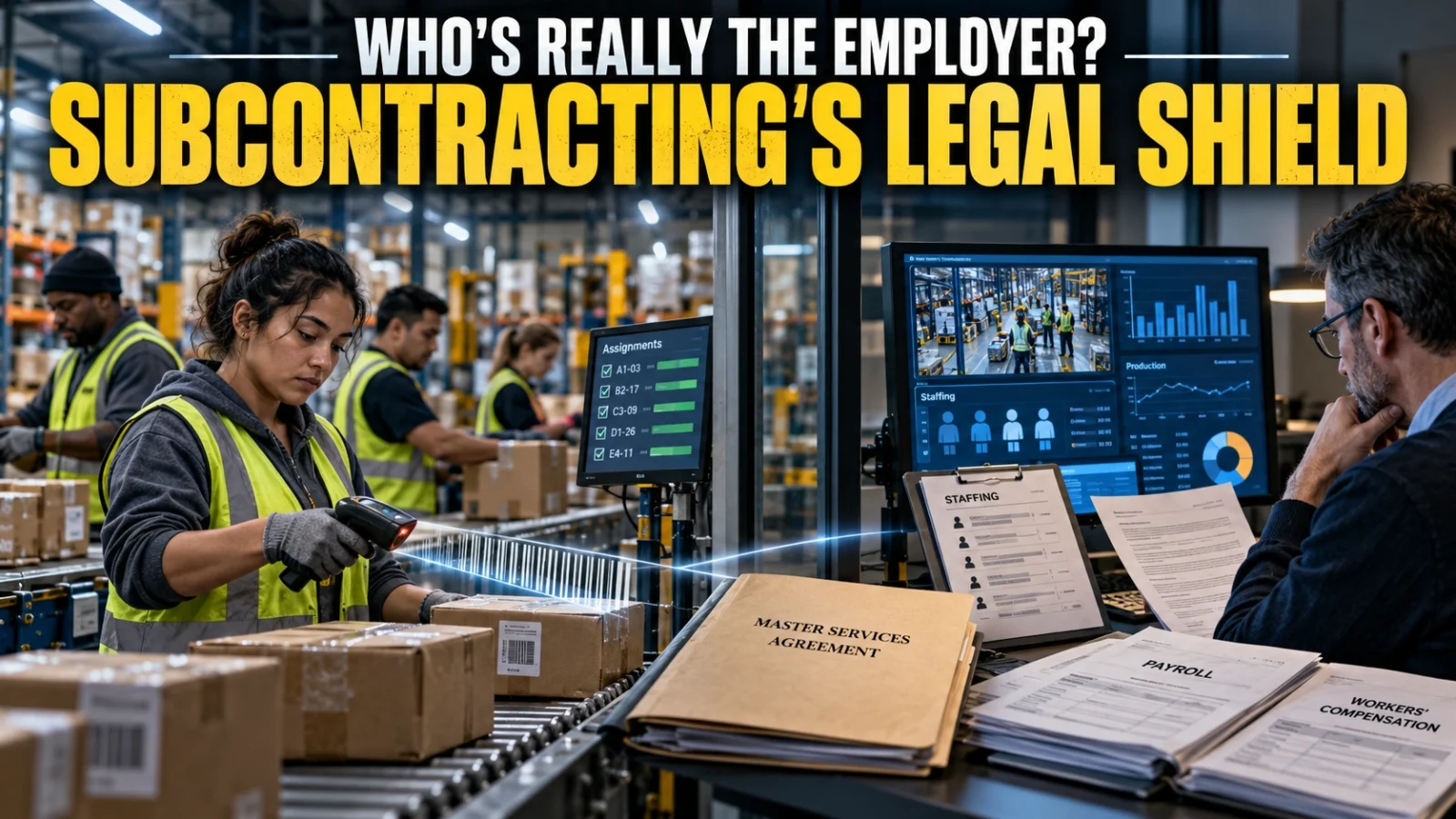
The mechanics of two-tier subcontracting rely on a series of structural legal instruments, economic cost transfers, and technological surveillance mechanisms. These elements operate collectively to insulate lead corporations while transferring operational volatility onto labor brokers. The commercial process begins with a formal Master Services Agreement negotiated between the lead enterprise and an outside staffing vendor, third-party logistics firm, or service contractor.
This commercial agreement contractually designates the secondary vendor as the sole statutory employer of record, saddling it with complete legal responsibility for payroll taxes, workers’ compensation insurance, and statutory compliance. The contract routinely includes mandatory indemnification provisions requiring the labor intermediary to defend and hold harmless the lead corporation against any administrative fines, wage lawsuits, or injury liabilities. Through this legal mechanism, the parent firm formally delegates employer duties while retaining commercial ownership over the premises and operational workflows.
Once the legal partition is established, downward financial pressures dictate operational realities on the work floor. Lead firms leverage intense market competition among regional labor suppliers to negotiate aggressive procurement markups, which typically range between 25 and 55 percent over base pay in warehousing and light manufacturing. Because this markup must absorb mandatory state payroll taxes, workers’ compensation premiums, administrative overhead, and contractor profit, the secondary agency operates on razor-thin operating margins. Consequently, the intermediary has virtually no financial capacity to offer health benefits, provide wage increases, or fund comprehensive occupational safety training.
To maintain uniform production quality across operations it does not nominally manage, the lead enterprise deploys advanced digital oversight systems. Handheld scanners, automated warehouse management software, telematics sensors, and computer vision systems monitor worker performance in real time. Algorithms automatically assign tasks, establish expected pick rates, track minutes of inactivity, and alert corporate managers to operational lags. When a subcontracted laborer fails to meet corporate production baselines, the lead firm instructs the intermediary agency to remove the individual from the facility.
This structural partition creates a major barrier when workers attempt to exercise collective bargaining rights under the NLRA. Under prevailing direct-control legal precedents, unionized subcontracted laborers can only demand collective negotiations with their direct employer of record—the staffing broker. However, the staffing agency possesses no legal or operational authority over line speeds, facility temperatures, technological quotas, or master billing rates set by the lead corporation. The enterprise exercising genuine economic power remains shielded from any obligation to sit at the bargaining table.
Finally, the structure provides a durable defense against regulatory enforcement actions by the Department of Labor or OSHA. When investigators detect systemic wage theft, illegal overtime deductions, or severe safety hazards, the direct employer of record absorbs the initial penalties. If regulatory liabilities or civil damages threaten commercial viability, undercapitalized staffing agencies frequently enter bankruptcy or dissolve entirely. The lead corporation then terminates the vendor contract, disclaims operational knowledge, and hires a replacement staffing agency to supply fresh labor under identical terms.
Who is involved
The two-tier subcontracted economy involves multiple stakeholders, each occupying structural positions characterized by diverging economic incentives and varying degrees of legal leverage. At the apex of the structure sit lead corporations and brand holding companies. These enterprises gain substantial operational flexibility by converting fixed payroll liabilities into variable operating costs, which allows them to scale staffing levels up or down without paying severance or absorbing higher unemployment tax rates. In exchange, lead firms assume modest risks of supply chain disruption and public relations damage when severe labor exploitation within their supply pipelines is exposed.
Staffing agencies, delivery service partners, and franchise operators function as commercial shock absorbers within this ecosystem. These intermediary businesses gain access to high-volume corporate contracts, enabling entrepreneurs to build substantial revenue streams with minimal initial capital expenditure. However, intermediaries face intense contract volatility, as lead clients retain the unilateral right to terminate vendor agreements on short notice. Furthermore, subcontractors absorb direct statutory exposure for wage claims, occupational injuries, and regulatory audits, operating under compressed margins that punish spending on worker safety and training.
Frontline subcontracted workers bear the heaviest economic and physical burdens created by fissured workplace models. While agency staffing provides low-barrier entry to employment for workers facing structural hurdles, it frequently locks individuals into precarious, secondary-tier jobs. These workers perform the most physically taxing and hazardous duties inside industrial facilities, but they receive lower wages and are largely excluded from employer-sponsored healthcare. When working conditions become dangerous, subcontracted employees face severe disincentives to organize or report violations, knowing that host managers can request their dismissal without cause.
Direct-hire core workers within these hybrid facilities occupy an increasingly defensive position. Although these workers retain higher base pay, predictable schedules, and employer-sponsored medical insurance, their workplace security is steadily eroded. Lead enterprises leverage the presence of a parallel, non-union contingent workforce as an implicit alternative during contract negotiations, dampening baseline wage growth across entire industrial sectors. Over time, core employees face speedup pressures as lead firms calibrate production benchmarks to the output of expendable temporary shifts.
Federal and state regulatory agencies operate under profound structural disadvantages when policing subcontracted networks. Enforcers at the Department of Labor, the NLRB, and OSHA must expend extensive resources untangling corporate contracts, digital command hierarchies, and financial relationships just to establish basic employer liability. While regulators can secure monetary penalties and consent decrees against intermediary staffing brokers, these isolated enforcement actions rarely change the enterprise-level commercial incentives that produce systemic violations.
Data and the paper trail
Federal labor datasets, administrative enforcement logs, academic surveys, and court records reveal a detailed paper trail of how two-tier subcontracting depresses worker earnings and amplifies workplace hazards. The U.S. Bureau of Labor Statistics Contingent and Alternative Employment Arrangements Supplement, based on Current Population Survey data collected in July 2023, documents the scale of non-standard work arrangements in the United States. The survey identified 6.9 million workers whose primary job was contingent, representing 4.3 percent of total employment—an increase from 3.8 percent in May 2017. Across distinct alternative arrangements, the BLS documented 945,000 temporary help agency workers and 862,000 workers provided by contract firms.
The demographic distribution of this workforce exhibits sharp stratification. Temporary agency workers are disproportionately Black or Hispanic compared to direct-hire labor, and younger workers aged 16 to 24 are four times more likely to hold contingent roles (12.9 percent) than workers aged 25 to 54 (3.1 percent). Among Hispanic workers, the contingent employment rate stands at 6.0 percent, compared to 4.1 percent for White workers. Furthermore, temporary help agency personnel are heavily concentrated in manual production, transportation, and material moving occupations, representing one out of every four temporary workers.
The compensation penalties associated with subcontracted status are acute and persistent. BLS data demonstrate that among full-time workers, median weekly earnings for contingent personnel stood at $838, representing only 74 percent of the median weekly earnings of noncontingent counterparts ($1,137). This reflects an unadjusted 26 percent wage gap. The disparity deepens when analyzing employer-sponsored safety nets: only 19.9 percent of contingent workers had employer-provided health insurance coverage, compared with 51.2 percent of permanent workers. While industry surveys often assert that contingent workers prefer flexible arrangements, federal data reveal that 44.8 percent of contingent workers explicitly sought permanent employment, while only 40.8 percent favored their non-standard status.
Workplace injury surveillance presents an equally stark contrast between core and contingent personnel. Research conducted by the National Institute for Occupational Safety and Health and the Washington State Department of Labor & Industries revealed that temporary agency workers experience injury rates between 36 percent and 72 percent higher than permanent workers across identical broad occupational classifications. In higher-hazard manufacturing and construction roles, the temporary worker claim rate rose to more than double the direct-hire baseline. These disparities stem directly from training deficits: NIOSH studies found that over 40 percent of temporary workers never received basic workplace safety training from either their direct staffing vendor or their host company, compared to 25 percent of permanent workers. Subsequent multi-state workers’ compensation analyses, controlling for age, gender, and specific Standard Occupational Classification codes, identified that temporary workers possessed more than four-fold higher odds of sustaining traumatic workplace injuries.
On the administrative and legal front, the National Labor Relations Board has engaged in a protracted struggle over the definition of joint employment. In October 2023, the NLRB issued a Final Rule (88 Fed. Reg. 73946) establishing that common-law agency principles require treating an entity as a joint employer if it possesses reserved or indirect authority over any essential condition of employment—including wages, schedules, discipline, or workplace safety. However, the U.S. Chamber of Commerce and business coalitions challenged the rule in federal court. On March 8, 2024, the U.S. District Court for the Eastern District of Texas struck down and vacated the rule nationwide in Chamber of Commerce v. NLRB (723 F. Supp. 3d 498), finding that the board’s broad standard exceeded common-law bounds. In July 2024, the NLRB voluntarily dismissed its appeal before the Fifth Circuit Court of Appeals, leaving the restrictive 2020 direct-control standard (29 C.F.R. § 103.40) in place.
Parallel enforcement challenges exist under OSHA’s Multi-Employer Citation Policy (Directive CPL 02-00-124). OSHA categorizes worksite firms as Creating, Exposing, Correcting, or Controlling employers. While a controlling host employer has general supervisory duties over site safety, the directive explicitly specifies that a controlling employer’s obligation to exercise reasonable care is substantially lower than what is required to protect its own direct payroll employees, making it difficult to hold corporate hosts liable for hazardous subcontractor shortcuts.
The comparative metrics below contrast the economic, legal, and safety conditions governing direct-hire employees against subcontracted temporary personnel across United States worksites.
| Operational & Legal Dimension | Direct-Hire / Core Employees | Subcontracted & Staffing Agency Labor | Primary Authority / Empirical Source |
|---|---|---|---|
| Median Full-Time Weekly Pay | $1,137 median weekly earnings | $838 median weekly earnings (26% wage penalty) | U.S. Bureau of Labor Statistics (July 2023 Survey) |
| Employer Health Insurance Rate | 51.2% covered by employer | 19.9% covered by employer | U.S. Bureau of Labor Statistics (July 2023 Survey) |
| Occupational Injury Risk Ratio | Baseline rate (1.0x) across standard sectors | 1.36x to 1.72x overall; >2.0x in manufacturing/construction | NIOSH & Washington State SHARP Studies |
| Safety Training Provision Gap | 75% receive documented safety onboarding | <60% receive safety onboarding (over 40% receive none) | NIOSH Science Bulletin & CDC Guidelines |
| NLRA Joint-Employer Test | Direct common-law employment relationship | Strict direct control required (2020 Rule reinstated 2024) | Chamber of Commerce v. NLRB, 723 F. Supp. 3d 498 |
| OSHA Worksite Duty Standard | High affirmative duty to inspect and eliminate hazards | Controlling employer duty requires less frequent inspection | OSHA Compliance Directive CPL 02-00-124 |
| Collective Bargaining Directness | Direct negotiation with enterprise capital holders | Bargaining isolated to intermediary labor broker | David Weil, The Fissured Workplace (Harvard) |
Every side of the argument
The expansion of subcontracting structures has generated intense legal, economic, and ethical conflict. The debate separates fundamentally along the division between corporate efficiency models and labor standards enforcement. Each side marshals sophisticated economic data and legal doctrines to justify its view of how modern production should be regulated.
Industry trade associations, business coalitions, and corporate legal counsels present a defense centered on market efficiency and consumer welfare. Organizations such as the U.S. Chamber of Commerce and the American Action Forum argue that specialized subcontracting allows firms to adapt rapidly to demand fluctuations and global supply chain shocks. They contend that imposing joint-employer liability for ordinary contractual standards would destroy the franchise business model and force lead companies to abandon specialized vendors. According to this view, forcing parent corporations into collective bargaining with third-party employees would create legal confusion, raise consumer prices, and reduce overall economic output.
Business advocates also stress that clear liability rules protect legitimate commercial contracting. Under common-law agency principles, an entity is only an employer if it exercises actual, direct supervision over hiring, firing, wages, and daily work direction. The American Franchise Act and business lobbying groups argue that brand quality guidelines and safety standards should never be used as evidence of an employment relationship. From this perspective, holding lead firms liable for the independent misconduct of licensed franchisees or staffing agencies unfairly penalizes parent companies and undermines local entrepreneurship.
Conversely, labor unions, employment attorneys, and progressive economists assert that modern subcontracting constitutes calculated regulatory evasion. Researchers at the Economic Policy Institute and scholars following David Weil argue that lead corporations routinely extract all the economic value of tight operational supervision while utilizing paper contracts to disclaim statutory duties. They maintain that because staffing agencies operate on fixed fees dictated by parent firms, collective bargaining with an agency alone is fundamentally futile. Without the corporate entity that controls the enterprise budget at the bargaining table, workers cannot negotiate living wages or safer production speeds.
Public health researchers and worker centers further contend that two-tier structures create moral hazard. By outsourcing hazardous tasks to temporary brokers, lead corporations shield their workers’ compensation experience ratings and insulate their balance sheets from direct OSHA liability. This dynamic removes corporate incentives to invest in capital safety improvements or reduce repetitive strain hazards. Labor advocates point out that the resulting injuries and uncompensated medical expenses are externalized onto public health safety nets, creating a hidden public subsidy for low-road corporate employment practices.
What it means for readers
For individuals and families navigating the modern economy, the staffing agency shield shapes everyday financial stability, personal dignity, and physical safety. The proliferation of fissured employment arrangements directly undermines the predictability that households require to build long-term economic security. Understanding these structural mechanisms provides clarity on why contemporary job growth often fails to generate middle-class prosperity.
The lived experience of a subcontracted worker is defined by perpetual contingency. Without an explicit employment contract, workers are subjected to fluctuating weekly schedules, sudden shift cancellations, and involuntary downtime dictated by automated text messages. This erratic income flow complicates basic financial management, making it difficult to pay rent on time, budget for groceries, or secure affordable childcare. Furthermore, because temporary assignments can be terminated instantly without cause or severance, workers exist in a constant state of precarity that impedes access to auto loans, mortgages, or stable housing leases.
On the shop floor, the human cost of the two-tier structure manifests as physical exhaustion and elevated occupational risk. Workers dispatched by staffing agencies frequently receive minimal onboarding before being assigned to high-speed conveyor lines, heavy machinery, or toxic sanitation duties. If an agency worker suffers an injury or observes a severe safety violation, the threat of retaliation is immediate and acute. Requesting safety equipment or reporting an injury often results in the host company quietly requesting the worker’s removal, leaving the laborer without wages or recourse.
For tech-focused observers, the subcontracted workplace illustrates the dark side of algorithmic management and automated workplace surveillance. Digital platforms, handheld scanners, and telematics systems track every movement, keystroke, and pause with microsecond precision. Software systems automatically issue discipline or recommend discharge based on mathematical production models designed by corporate engineers. Yet, when workers seek redress for unattainable speed quotas or algorithmic wage deductions, parent companies maintain in court that they do not employ the workforce.
For the broader middle class, the institutionalization of the staffing agency shield exerts persistent downward pressure on compensation standards. As major employers replace stable direct-hire jobs with subcontracted positions across logistics, manufacturing, healthcare, and technology, wages across entire regional labor markets stagnate. The division of the workplace into permanent insiders and disposable outsiders shatters labor solidarity and leaves all working families more vulnerable to sudden economic dislocation.
Case studies
Documented enforcement actions and labor disputes illustrate how lead corporations utilize intermediate corporate structures to insulate themselves from liability, alongside the regulatory hurdles enforcers face when challenging these barriers.
Meatpacking Sanitation: Packers Sanitation Services Inc. and Fayette Janitorial
Between 2022 and 2024, the U.S. Department of Labor’s Wage and Hour Division uncovered widespread oppressive child labor operations within the domestic meat processing industry. The investigations centered on third-party cleaning contractors, notably Packers Sanitation Services Inc. (PSSI) and Fayette Janitorial LLC. In February 2023, PSSI paid $1.5 million in civil money penalties after federal investigators documented 102 minors, aged 13 to 17, working overnight shifts across 13 meatpacking facilities operated by agricultural giants, including Tyson Foods, JBS USA, and Cargill.
The children were tasked with sanitizing hazardous, powered meat-cutting equipment, including bone splitters, deheading machines, and industrial band saws, using corrosive chemical agents. Several minors suffered severe chemical burns and deep lacerations while working overnight shifts. Despite the ongoing presence of children inside these facilities night after night, the lead meatpacking companies initially avoided direct FLSA child labor penalties because the workers were legally employed, paid, and supervised by PSSI. The primary meatpackers maintained that facility sanitation was entirely outsourced, using contractual degrees of separation as an operational shield. The Department of Labor subsequently deployed the “hot goods” provisions of Section 12(a) of the FLSA to temporarily halt interstate shipments of meat processed in facilities utilizing child labor, forcing lead meatpackers to terminate contracts with the offending contractors.
Logistics and Last-Mile Delivery: The Amazon Delivery Service Partner Network
The structure of Amazon’s last-mile logistics operations provides an example of modern algorithmic fissuring. Rather than directly employing the hundreds of thousands of delivery drivers who transport packages from local stations to consumers, Amazon routes operations through its Delivery Service Partner (DSP) network—comprising thousands of small businesses that nominally operate as independent LLCs. Amazon establishes the delivery routes, sets driver package quotas, monitors real-time driving behavior through Netradyne AI cameras, mandates uniforms, and maintains unilateral control over the software platform.
The legal friction generated by this model emerged in Palmdale, California. In April 2023, 84 delivery drivers employed by Battle-Tested Strategies (BTS), an Amazon DSP operating out of the DAX8 facility, unionized with Teamsters Local 396 and negotiated a collective bargaining agreement with BTS management. Amazon promptly refused to recognize the union or bargain, asserting that BTS was an independent contractor, and terminated BTS’s commercial vendor contract, effectively firing the entire unit. Following an extensive investigation, NLRB Region 31 issued formal unfair labor practice complaints in August and September 2024, determining that Amazon was a joint employer with BTS and had unlawfully terminated the contract to crush unionization. Amazon continues to litigate the determination, arguing that its contractual performance standards do not constitute direct common-law supervision.
Heavy Manufacturing: Automotive Supply Chains in Alabama
Between 2022 and 2024, federal and investigative reports revealed how layered subcontracting pipelines conceal systemic labor violations within modern automotive manufacturing chains. A multi-agency federal investigation documented that migrant children as young as 12 and 13 were working in high-hazard parts stamping plants in rural Alabama. The violations centered on facilities including SMART Alabama LLC—a tier-one parts supplier majority-owned by Hyundai Motor America—and SL Alabama LLC, a direct tier-one supplier to both Hyundai and Kia.
Minors worked up to 50 to 60 hours per week operating sheet-metal presses and welding machinery on high-volume production lines. When regulatory enforcers intervened, the manufacturing plants maintained they were unaware of the workers’ ages, explaining that the personnel had been recruited, vetted, and dispatched by third-party staffing agencies, including Best Practice Service LLC and JK USA. The staffing firms operated as intermediaries that accepted falsified identification and absorbed the direct statutory violation risk. While the Department of Labor secured consent judgments, required managerial terminations, and recovered civil fines against both suppliers and staffing firms, the parent automotive companies initially avoided direct statutory liability for child labor. The proceedings underscored how lead manufacturers use two-tier subcontracting to run round-the-clock assembly operations without bearing direct legal accountability for the recruitment and screening practices used to fill their factory floors.
Open questions and what to watch next
The legal and political conflict surrounding the staffing agency shield is accelerating across multiple institutional arenas. As federal rulemaking encounters persistent resistance from the judiciary, state governments are testing innovative legislative models to protect subcontracted labor forces. The resolution of several open questions will determine whether corporations can continue utilizing subcontracting to evade labor standards.
State-level legislative innovation represents the most immediate battleground. The New Jersey Temporary Workers’ Bill of Rights (P.L. 2023, c. 10), which took full effect in August 2023, mandates that covered staffing agency workers receive the same average rate of pay and equivalent cash benefits as direct-hire employees performing substantially similar duties. After staffing industry associations challenged the statute, the U.S. Court of Appeals for the Third Circuit upheld the law in July 2024, establishing a significant legal precedent for state wage equity statutes. Similarly, Illinois amended its Day and Temporary Labor Services Act (HB 2862) to mandate equal pay for equal work after 90 days of worksite assignment. If more industrial states pass comparable equal pay legislation, the economic incentive for corporations to deploy two-tier staffing models will diminish considerably.
A second critical issue is whether federal courts will recognize algorithmic management as direct operational control under common-law agency doctrine. As machine learning systems, automated dispatch algorithms, and telematics software assume the traditional functions of human supervisors, the boundary between contractual specifications and operational direction has blurred. If judges determine that programming the software that dictates line speeds, routes, and terminations constitutes direct employer control, lead technology and logistics corporations will no longer be able to maintain joint-employer immunity.
The legislative future of joint employment at the federal level remains deeply uncertain. The proposed Protecting the Right to Organize (PRO) Act would codify an expansive joint-employer standard under the NLRA, establishing that possessing indirect or reserved control over working conditions creates a mandatory bargaining obligation. In contrast, employer trade groups continue to advocate for the American Franchise Act, which would permanently codify a narrow, direct-control standard into federal statute, shielding franchisors and lead brands from secondary liability. With Congress divided, administrative standards will likely continue to swing with presidential administrations, producing ongoing regulatory uncertainty.
Finally, the expanding use of aggressive supply-chain enforcement mechanisms warrants close monitoring. The Department of Labor’s strategic use of Section 12(a) “hot goods” provisions under the FLSA demonstrates that regulators can halt the commercial movement of goods produced under unlawful conditions without litigating complex joint-employer relationships. By targeting the finished product rather than the formal employment structure, federal agencies can disrupt corporate supply chains and force lead brands to enforce labor compliance across their subcontractor tiers.
Glossary
- Joint Employer: A legal designation where two or more separate business entities share operational control over an employee’s working conditions and divide statutory liability under federal labor standards.
- Fissured Workplace: A corporate operational structure in which lead enterprises shed direct employment of operational functions while maintaining tight control over output, pricing, and quality benchmarks.
- Master Services Agreement: A comprehensive commercial contract that governs ongoing legal relationships, operational deliverables, and liability indemnification clauses between a lead corporation and a third-party vendor.
- Contingent Labor: Work arrangements lacking an implicit or explicit contract for ongoing employment, encompassing temporary agency workers, on-call staff, and day laborers.
- Direct and Immediate Control: A restrictive legal standard requiring an entity to actively and continuously exercise authority over hiring, firing, payroll, and daily workplace supervision to be recognized as an employer.
- Reserved Control: Contractual authority possessed by an enterprise to intervene in wages, hours, or working conditions, regardless of whether the enterprise actively exercises that authority.
- Controlling Employer: Under OSHA compliance policy, an employer that possesses general supervisory authority over a worksite but owes a lesser standard of reasonable care toward subcontractor personnel than toward its own payroll employees.
- Staffing Agency Markup: The percentage fee billed by a labor broker above a worker’s base hourly wage to cover employer payroll taxes, workers’ compensation insurance, recruiting expenses, and agency profit.
- Hot Goods Provision: A federal statutory mechanism under Section 12(a) of the FLSA that prohibits the interstate shipment of commercial goods produced in violation of minimum wage, overtime, or child labor laws.
Sources
- U.S. Bureau of Labor Statistics (BLS): Contingent and Alternative Employment Arrangements News Release and Data Tables, https://www.bls.gov/news.release/conemp.nr0.htm
- National Labor Relations Board (NLRB): The Standard for Determining Joint-Employer Status Final Rule, https://www.nlrb.gov/about-nlrb/what-we-do/the-standard-for-determining-joint-employer-status-final-rule
- Occupational Safety and Health Administration (OSHA): Multi-Employer Citation Policy Compliance Directive CPL 02-00-124, https://www.osha.gov/enforcement/directives/cpl-02-00-124
- U.S. Department of Labor (DOL) Wage and Hour Division: Child Labor Enforcement Outcomes and Report to Congress, https://www.dol.gov/sites/dolgov/files/WHD/child-labor/child-labor-report-congress_2023-2024.pdf
- Harvard University Press: David Weil, The Fissured Workplace: Why Work Became So Bad for So Many and What Can Be Done to Improve It, https://www.hup.harvard.edu/books/9780674975446



Leave a Reply