
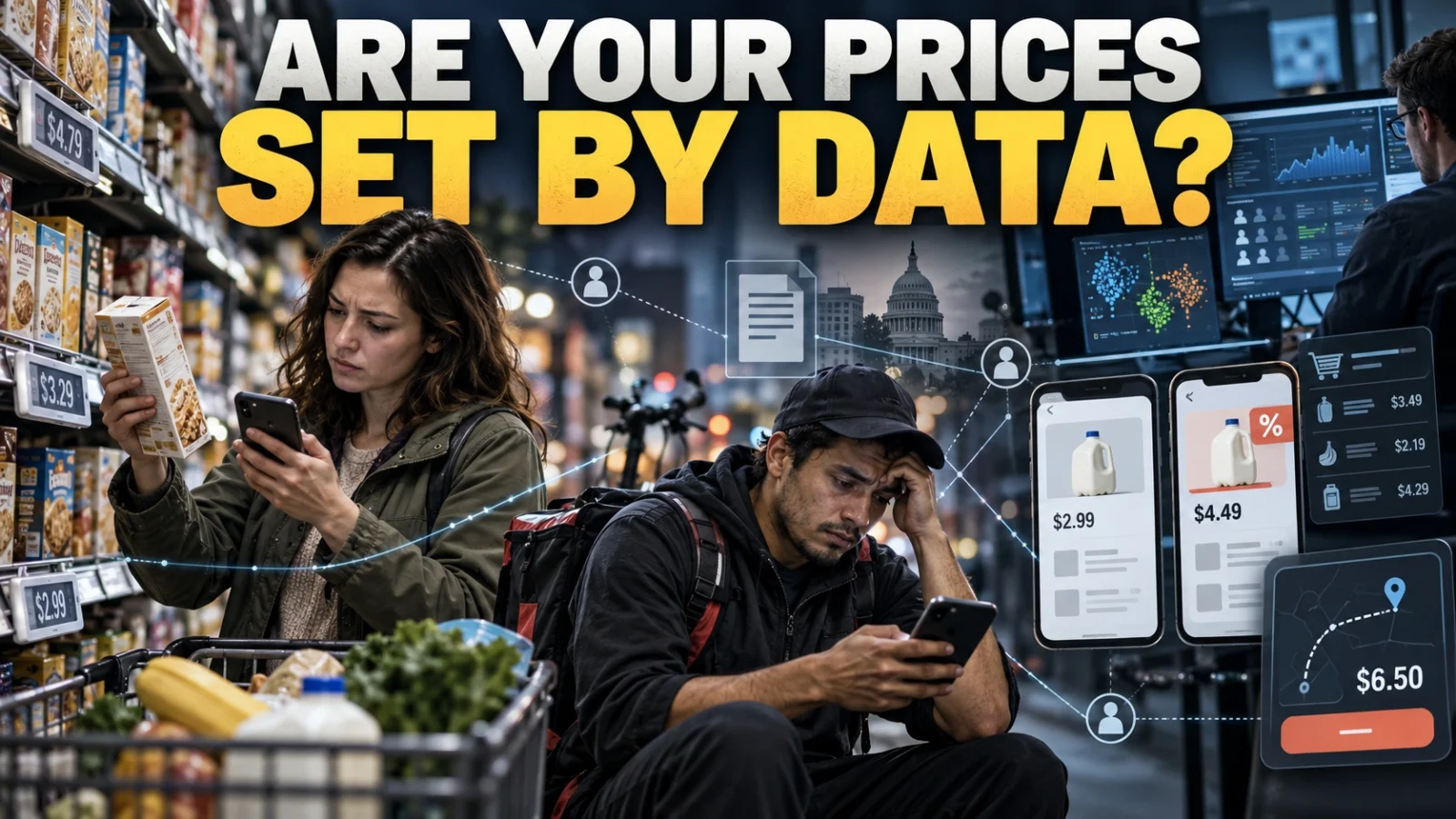
How Algorithmic Platforms Monetize Consumer Desperation and Worker Exhaustion Through Surveillance Pricing
Summary
Across the United States, retail supermarkets, e-commerce marketplaces, and on-demand delivery platforms are quietly replacing uniform price tags with individualized, algorithmically generated prices. Known to federal and state regulators as surveillance pricing, this practice combines real-time behavioral telemetry with personal financial and demographic histories to calculate the exact maximum price an individual shopper will tolerate at a given moment. Rather than responding solely to aggregate supply and demand, modern pricing engines evaluate markers of personal urgency, cognitive fatigue, and brand captivity to extract consumer surplus from ordinary American households.
This structural shift has reached a critical legal and economic inflection point in 2026 as ubiquitous digital tracking merges with physical retail hardware and generative artificial intelligence. Following a landmark Federal Trade Commission inquiry launched in July 2024 and initial staff findings published in January 2025, congressional committees and state legislatures have uncovered widespread deployment of price-targeting software across grocery chains, pharmacies, travel platforms, and delivery apps. Between November 2025 and October 2026, New York, Maryland, Connecticut, and New Jersey enacted the nation’s first binding statutes to disclose or prohibit personal data-driven pricing, transforming the everyday retail price tag into a fiercely contested regulatory frontier.
The central finding of this Study is that algorithmic price discrimination operates as a two-sided extraction machine that squeezes both ends of a working family’s balance sheet. On the consumer side, third-party pricing intermediaries report to federal investigators that behavioral price targeting expands corporate profit margins by 1% to 4% and boosts overall client revenue by 2% to 5% without needing to increase unit sales volume. On the labor side, the exact same optimization architecture is deployed by gig delivery, rideshare, and healthcare staffing platforms to calculate each worker’s minimum reservation wage, exploiting financial precarity to push after-expense hourly earnings as low as 15% to 93% of local statutory minimum wages.
Background and Definitions
For more than a century, American retail commerce operated under the foundational norm of uniform posted pricing, in which every customer walking down a supermarket aisle or browsing a catalog saw the identical price for a loaf of bread or a bottle of medicine. In classical economic theory, uniform pricing leaves “consumer surplus” in the pockets of buyers whose internal willingness to pay exceeds the posted shelf price. Although merchants historically captured portions of this surplus through broad third-degree price discrimination—such as senior citizen rates, student discounts, or paper coupons—high physical transaction costs prevented retailers from calculating a unique price for every individual buyer.
The proliferation of cloud computing, mobile smartphones, and commercial data brokerages eliminated the operational friction of altering prices in real time. In the first wave of digital optimization, airlines, hotels, and ride-hailing networks popularized dynamic pricing, an algorithmic model that adjusts rates based on aggregate market signals such as seasonal demand, local traffic, weather, or inventory scarcity. Under true dynamic pricing, two customers standing on the same street corner at the exact same minute are quoted the same surge fare because the algorithm is pricing market-wide supply and demand rather than the identity of the buyer.
Surveillance pricing represents a sharp structural departure from aggregate dynamic pricing toward what economists call first-degree or personalized price discrimination. As defined by the Federal Trade Commission and state consumer fraud statutes enacted in 2026, surveillance pricing utilizes individualized consumer data—including browsing history, real-time geolocation, smartphone hardware telemetry, credit history, and inferred emotional state—to set a custom price tailored to a specific person. Instead of pricing a commodity based on its cost of production or local scarcity, a surveillance pricing engine calculates how much a specific individual can be pressured to pay before abandoning the checkout screen.
In parallel with consumer-facing surveillance pricing, legal scholars and labor economists have documented its direct workplace counterpart: algorithmic wage discrimination. Coined by University of California, Irvine law professor Veena Dubal in a 2023 Columbia Law Review study, algorithmic wage discrimination describes the extraction of granular worker telemetry by digital platforms to calculate individualized, variable pay rates for identical labor. By tracking shift acceptance speeds, cancellation patterns, and geographic movements, platform algorithms estimate each worker’s “reservation wage”—the lowest compensation a person under acute financial stress will accept—and tailor job offers down to that personal floor.
Together, surveillance pricing and algorithmic wage discrimination rely on consumer segmentation and search-ranking intermediaries that operate behind the scenes of digital commerce. Rather than displaying a transparent price hike on a shelf tag, modern systems often achieve price discrimination by dynamically reordering search results to hide cheaper options or selectively withholding promotional discounts from habitual buyers. Whether executed through a mobile delivery interface or an automated hospital staffing platform, the underlying computational objective is identical: using behavioral surveillance to eliminate asymmetric information in favor of the corporation.
How the Surveillance Pricing Machine Works
The operational mechanics of stress-based surveillance pricing depend on a continuous, three-stage pipeline consisting of behavioral data ingestion, algorithmic profiling, and dynamic price or wage execution. When a shopper opens a retail mobile app or navigates an e-commerce site, embedded tracking technologies—specifically browser cookies, web tracking pixels, and native mobile Software Development Kits (SDKs)—immediately begin harvesting hardware and behavioral telemetry. According to redacted staff research summaries released by the Federal Trade Commission in January 2025, these tracking libraries link app installations, cross-device browsing histories, and login credentials even when a consumer has not voluntarily provided an email address or phone number.
At the ingestion layer, surveillance tools monitor unconscious micro-interactions to infer a user’s emotional state, purchase urgency, and cognitive exhaustion. Web pixels record the exact time of day a consumer opens an email blast, how deeply they scroll down a webpage, whether their mouse cursor highlights a specific product name, and what language default is configured on their browser. For example, FTC investigators documented that financial and retail platforms use a U.S. IP address paired with a Spanish-language browser default to steer consumers toward specific credit card offers and money-transfer rates. In other documented instances, a survival gear retailer automatically triggered SMS text marketing the instant a user watched at least 65% of a product video, while an online sports betting platform tracked cursor movements toward the browser’s close-tab button to fire real-time pop-ups of popular live games before the bettor could exit.
In the second stage, these behavioral signals are fed into third-party consumer segmentation and profiling engines alongside proprietary retailer loyalty records, credit bureau data, and web-scraped competitor prices. The algorithm categorizes the individual into a dynamic behavioral persona based on inferred family size, income bracket, coupon affinity, and maximum willingness to pay. Crucially, this optimization logic penalizes brand loyalty and medical or household necessity. The FTC’s January 2025 report revealed that retail pharmacies utilize segmentation software to identify habitual buyers of over-the-counter medications and systematically exclude them from promotional discounts, calculating that captive patients will buy the medicine at full price while directing discounts solely to infrequent shoppers who might otherwise leave.
At the third stage—price presentation and execution—platforms deploy three distinct mechanisms to extract higher revenue without alerting the shopper. First, search and product ranking algorithms dynamically reorder e-commerce displays so that consumers profiled as having a high willingness to pay are shown higher-margin or higher-priced items at the top of their screen. Second, targeted promotion engines selectively display or hide digital discount codes, creating wide net price disparities between two neighbors viewing the exact same item. Third, in brick-and-mortar supermarkets, retailers are installing wireless Electronic Shelf Labels (ESLs) that sync with central pricing servers to eliminate the two days of manual labor previously required to re-tag 120,000 store items.
The money flows within this ecosystem create powerful institutional incentives for rapid adoption across both retail and business-to-business (B2B) wholesale markets. Third-party software intermediaries license their pricing engines to supermarkets, department stores, car rental firms, and medical supply wholesalers on the documented promise of lifting overall revenue by 2% to 5% and expanding profit margins by 1% to 4%. Furthermore, recently enacted state laws contain structural loopholes that preserve much of this revenue stream. Because statutes in Maryland, Connecticut, and New Jersey explicitly exempt opt-in “loyalty programs” and personalized promotional discounts, retailers can legally raise baseline shelf prices for all shoppers and use app-based loyalty discounts to replicate individualized surveillance pricing under the guise of a reward program.
Who Is Involved: Stakeholders, Gains, and Losses
The surveillance pricing and algorithmic wage economy is structured around five distinct stakeholder groups whose financial gains and socioeconomic losses are directly linked. Rather than relying on a single vendor, major retail and delivery corporations frequently contract with multiple third-party intermediaries simultaneously, layering separate profiling, search-ranking, and price-setting tools across the same customer base.
The first major stakeholder group consists of Third-Party Pricing Intermediaries, Financial Networks, and Management Consultancies. Identified in the FTC’s July 2024 compulsory orders as Mastercard, JPMorgan Chase, Revionics, Bloomreach, Task Software, PROS, Accenture, and McKinsey & Co., these firms build and license the algorithmic infrastructure of personalized pricing. They gain lucrative B2B software-as-a-service (SaaS) contracts and consulting fees while leveraging massive proprietary payment and transaction datasets. Their primary exposure lies in escalating regulatory investigations, compulsory disclosures of client lists, and statutory liability under emerging state laws that prohibit knowingly licensing surveillance pricing software.
The second stakeholder group comprises Retailers, Supermarkets, Delivery Platforms, and Landlords that deploy these tools to widen operating margins. Spanning national grocers like Walmart and Kroger, third-party food delivery apps, airlines, hotels, lease-to-own e-commerce merchants, and multifamily housing operators, these firms gain a 1% to 4% expansion in net profit margins by eliminating consumer surplus. In grocery retail, where perishable food waste often exceeds total net profit, digital pricing hardware also helps operators recover margin from fresh produce and store-brand goods. However, retailers risk severe consumer boycotts if perceived to be surge-pricing food essentials, alongside up to $50,000 per-violation civil penalties and class-action treble damages in states like New Jersey.
The third group encompasses App-Based Gig Workers and Platform-Mediated Professionals, including rideshare drivers, grocery delivery couriers, Amazon Delivery Service Partner (DSP) drivers, and per-diem healthcare nurses. Predominantly composed of immigrant and racial minority workers in urban transportation markets controlled by an Uber-Lyft duopoly, these workers lose wage transparency, income stability, and the legal protection of equal pay for equal work. By continuously tracking their response times and financial desperation, platforms compress driver earnings down to their personal reservation wage while shifting vehicle maintenance, insurance, and fuel costs onto the worker.
The fourth group includes In-Store Retail Employees and Labor Unions, notably represented by the United Food and Commercial Workers (UFCW) International. As supermarkets invest hundreds of thousands of dollars per store to install Electronic Shelf Labels that pay for themselves in 12 to 24 months mainly through labor savings, retail clerks lose hours previously dedicated to manual price tagging. Simultaneously, remaining cashiers and floor workers absorb front-line verbal abuse from frustrated shoppers when digital shelf prices fluctuate between the aisle and the checkout register.
The fifth stakeholder group is Ordinary American Consumers and Vulnerable Families, who bear the direct monetary extraction of behavioral pricing. Low-income shoppers, credit-constrained households utilizing Buy Now, Pay Later (BNPL) or lease-to-own e-commerce sites, older adults, and time-poor parents ordering delivery after exhausting workdays lack the capacity to evade continuous behavioral tracking. They lose household purchasing power, financial predictability, and informational privacy whenever an algorithm detects their urgency and withholds a discount or inflates a fee.
Data and the Paper Trail
The documentary record exposing surveillance pricing and algorithmic wage suppression rests on federal regulatory orders, congressional investigations, academic labor audits, and state statutes enacted between 2024 and October 2026. The federal paper trail formally opened on July 23, 2024, when the Federal Trade Commission voted 5–0 in Matter No. P246202 to issue compulsory special report orders under Section 6(b) of the FTC Act (15 U.S.C. § 46(b)) to eight pricing intermediaries: Mastercard, Revionics, Bloomreach, JPMorgan Chase, Task Software, PROS, Accenture, and McKinsey & Co.. Those orders demanded internal technical specifications, training datasets, client lists ranked by spend, and empirical assessments of how consumer segmentation affects retail prices.
In January 2025, the FTC invoked Section 6(f) of the FTC Act (15 U.S.C. § 46(f)) to publish redacted staff research summaries from Matter No. P246202. The staff report documented that intermediary tools support client revenue growth of 2% to 5% and profit margin increases of 1% to 4%, while detailing behavioral triggers such as the 65% video-completion threshold used by a survival gear site to launch targeted text messages. Commissioners Andrew N. Ferguson and Melissa Holyoak issued a formal dissenting statement against the January 2025 publication, criticizing the release of interim “initial observations” as unprecedented and politically rushed compared to traditional Section 6(b) reports like the ongoing 2022 Pharmacy Benefit Managers inquiry (Matter No. P221200).
Despite internal Commission debate over the January 2025 summaries, federal enforcement and congressional oversight accelerated throughout late 2025 and 2026. In December 2025, the FTC issued a compulsory Civil Investigative Demand (CID) to a delivery service company targeting its use of an artificial intelligence tool to inform consumer pricing. In Congress, the House Oversight Committee opened a formal investigation in March 2026, Energy and Commerce Committee Democrats launched a parallel inquiry in May 2026, and a Senate Judiciary subcommittee held hearings on AI surveillance pricing on August 4, 2026. On October 7, 2026, FTC Chairman Andrew Ferguson announced plans to launch a new Section 6(b) study on personalized pricing alongside a proposed enforcement policy statement.
At the state level, legislatures enacted a wave of statutory bans and disclosure regimes between May 2025 and July 2026, while 16 state attorneys general petitioned the FTC in May 2026 for a federal rule. In parallel with retail grocery laws, New Jersey Governor Mikie Sherrill signed the Forbidding the Algorithmic Inflation of Rent (FAIR) Act (P.L. 2026, c. 43) on July 20, 2026 (effective July 1, 2027), citing national empirical estimates that rent-pricing algorithms added $70 per month to apartment rents in buildings using them and cost U.S. renters $3.8 billion in 2023. On the labor side, a May 12, 2025 Human Rights Watch report (The Gig Trap), a Columbia University survey of 955 app delivery workers, and 2025 economic audits by Jacobs et al. established that mandated employer payroll costs add 13.6% to 19.8% to statutory minimum wages, and that TNC-influenced pay formulas leave drivers earning a ratio of just 0.15 to 0.93 of local employee-equivalent minimum wages.
The table below provides a comprehensive comparison of the key dates, legal scopes, statutory exemptions, and financial penalties across major federal and state surveillance pricing actions through October 2026.
| Jurisdiction & Measure | Key Date(s) | Covered Entities & Statutory Scope | Statutory Exemptions & Safe Harbors | Penalties & Enforcement Mechanism |
|---|---|---|---|---|
Federal: FTC Section 6(b) Inquiry (Matter P246202) | Ordered July 23, 2024; Staff Report Jan 2025; New study Oct 7, 2026 | 8 pricing intermediaries (Mastercard, Revionics, Bloomreach, JPMorgan Chase, Task Software, PROS, Accenture, McKinsey) | Fact-finding study under 15 U.S.C. § 46(b); not a direct law enforcement adjudication | Compulsory special reports; followed by Dec 2025 FTC Civil Investigative Demand to a delivery platform |
Federal: Stop AI Price Gouging Bills (H.R. 4640 & H.R. 4966) | Pending in 119th Congress (2025–2026); Senate companion S. 3387 | Retail grocery stores and platforms utilizing AI for surveillance pricing or algorithmic wage fixing | Uniform cost-based adjustments and non-personalized promotional discounts | $15,000 per violation or treble damages (whichever is greater) plus attorneys’ fees; enforced by FTC, State AGs, and private lawsuits |
New York: Algorithmic Pricing Disclosure Act | Signed May 2025; Effective Nov 10, 2025 | Merchants setting prices via personalized algorithmic pricing using consumer data | Aggregate dynamic pricing; survived 1st Amendment challenge in S.D.N.Y. (2nd Cir. appeal pending) | Up to $1,000 per violation; exclusive enforcement by NY Attorney General (no private right of action) |
New York: One Fair Price Act (S.8623B / A.9349B) | Passed Legislature June 2026; awaiting Governor’s signature | Broad prohibition on personalized algorithmic price manipulation across consumer retail | Bona fide loyalty discounts and uniform market-wide price adjustments | Up to $5,000 (1st offense) and $20,000 (subsequent) or disgorgement of profits; private right of action removed |
Maryland: Protection from Predatory Pricing Act (H.B. 895) | Enacted 2026; Effective Oct 1, 2026 | Retail grocery stores ≥\ge≥ 15,000 sq. ft. and third-party food delivery platforms | Loyalty programs, subscription pricing, and differences based on supply, location, or operating costs | State Attorney General enforcement subject to a mandatory 45-day cure period for offending businesses |
Connecticut: Public Act 26-130 (H.B. 5563) | Signed June 4, 2026; Effective Oct 1, 2026 | Broadly bars retailers and third-party delivery services from surveillance pricing; adds disclosure rule | Discounts and price variations unrelated to personal consumer data | State consumer protection penalties; mandates label: “THIS PRICE WAS INCREASED BY A PRICE SETTING DEVICE USING YOUR PERSONAL DATA” |
New Jersey: Fair Price Protection Act (A4085) | Signed July 23, 2026; Effective Aug 1, 2027 | Retail food stores and third-party grocery delivery apps; 1-year moratorium on new Electronic Shelf Labels | Loyalty programs, bona fide group discounts (teachers, veterans, seniors), and operational cost differences | Up to $50,000 per violation or actual damages, plus restitution, treble damages, and private right of action |
New Jersey: FAIR Act on Algorithmic Rent (P.L. 2026, c. 43) | Signed July 20, 2026; Effective July 1, 2027 | Landlords and property managers pooling non-public rental data (occupancy, lease dates) to set rents | Software relying solely on publicly available market data without competitor coordination | Treated as a violation of New Jersey antitrust law; overseen and enforced by the NJ Attorney General |
Vermont: Electronic Shelf Label Regulation | Enacted and in force by 2026 | Retail establishments deploying Electronic Shelf Labels (ESLs) in physical stores | Permits ESL hardware installation and downward intraday markdowns | Strictly bans intraday price increases on ESLs outside of documented pricing errors |
Every Side of the Argument
Evaluating surveillance pricing requires separating verified empirical facts from theoretical economic claims and attributing each argument to its institutional proponents. Across regulatory filings, academic journals, and legislative hearings, the debate centers on whether individualized pricing represents a welfare-enhancing market efficiency or a predatory extraction of household wealth.
The Case Against Surveillance Pricing and Algorithmic Wage Setting
Consumer advocates, labor unions, Democratic lawmakers, and antitrust scholars argue that surveillance pricing destroys the foundational social contract of the marketplace: that a posted price reflects product cost and open competition rather than a buyer’s private vulnerabilities. Upon signing New Jersey’s Fair Price Protection Act on July 23, 2026, Governor Mikie Sherrill and Attorney General Jennifer Davenport argued that families already strained by inflation should not be secretly profiled at the checkout counter, while State Senator Joe Cryan and Assemblyman Onyema condemned the practice as an abusive misuse of artificial intelligence. Civil rights leaders, including Damon King of the New Jersey Institute for Social Justice, Dena Mottola Jaborska of New Jersey Citizen Action, and Robin Peacock of MEND, contend that behavioral pricing disproportionately harms low-income families, older adults, and communities of color who lack the digital tools or transportation options to escape local price surges.
In peer-reviewed antitrust literature, economists Ginger Zhe Jin, Liad Wagman, and Mengyi demonstrate in the July 2025 CPI Antitrust Chronicle that surveillance pricing fundamentally alters the risk of monopolistic predatory pricing. Under traditional U.S. Supreme Court precedent in Brooke Group Ltd. v. Brown & Williamson Tobacco Corp., 509 U.S. 209 (1993), predatory pricing claims rarely succeed because an incumbent must cut prices below cost across the entire market and later recoup massive losses. However, Jin, Wagman, and Mengyi show that personalized pricing enables an incumbent to target below-cost prices exclusively to the narrow slice of marginal shoppers considering a new competitor, while simultaneously charging high prices to captive inframarginal customers—making predation cheap to execute and deterring new competitors from entering the market.
In the labor arena, Professor Veena Dubal and Ademola Oyefeso, International Vice President of the UFCW, argue that algorithmic management strips workers of economic security and collective bargaining power. Dubal contends in the Columbia Law Review and the Yale Law Journal that importing consumer price discrimination into wage setting violates the core moral and legal principle of equal pay for equal work codified in the Equal Pay Act (29 U.S.C. § 206(d)) and Title VII of the Civil Rights Act of 1964. By turning hourly compensation into an opaque, variable lottery based on inferred worker desperation, platforms subject low-income and minority workforces to the psychological volatility of gambling as a mandatory condition of employment.
The Case for Personalized Pricing and Digital Shelf Technology
On the other side of the debate, free-market economists, retail industry executives, and Republican FTC Commissioners argue that blanket condemnation of personalized pricing ignores consumer benefits and mischaracterizes store technology. In their July 2024 concurring statements in Matter No. P246202, Commissioners Andrew N. Ferguson and Melissa Holyoak argued that the label “surveillance pricing” is a loaded political term that begs the question by assuming individualized pricing is inherently harmful before facts are gathered. Economic researchers note in the CPI Antitrust Chronicle that in many theoretical and empirical settings, personalized pricing expands market access: by offering targeted discounts, bundles, or coupons to highly price-sensitive shoppers, firms can serve lower-income consumers who would be priced out of the market under a single uniform price.
Grocery executives and retail real estate analysts further contend that political alarm over Electronic Shelf Labels (ESLs) confuses downward waste reduction with upward surge pricing. Industry data establishes as a verifiable fact that supermarket profit margins are razor-thin and that perishable food shrinkage in perimeter departments—such as fresh produce, meat, and dairy, which account for nearly half of supermarket revenue—regularly exceeds the store’s entire net profit. Because a can of beans is not a fixed, perishable capacity unit like an airline seat, and because families shop for groceries every week and compare staple prices closely, retail economists point out that surging grocery prices during peak hours would trigger immediate customer defection.
This industry defense is supported by independent empirical evidence. As reported by the Associated Press in June 2025, a five-year academic study examining price changes across a grocery chain using digital shelf labels found zero evidence of demand-based price surges. Instead, the study confirmed that grocers used digital tags to execute rapid downward markdowns on expiring perishables like bananas and to eliminate the two days of repetitive manual labor required to swap paper tags across 120,000 items. Furthermore, a survey by PYMNTS Intelligence and ACI Worldwide found that 32% of grocers believe shoppers would actually switch stores if denied the convenience and accuracy of digital shelf tags.
What It Means for Readers: Daily Life, Money, Work, and Rights
For ordinary Americans, the rise of behavioral pricing means that routine digital interactions now carry hidden financial consequences for the household budget. Every time a shopper scrolls through a delivery app late at night, leaves their browser language set to Spanish, uses an older smartphone with a draining battery, or repeatedly orders the same brand of infant formula or allergy medicine, third-party SDKs and tracking pixels log those actions to estimate price inelasticity. Instead of rewarding loyal customers, algorithmic segmentation engines frequently penalize habitual buyers by hiding promotional coupons that are freely displayed to occasional browsers.
In the workplace, algorithmic wage discrimination is rapidly expanding beyond app-based ride-hailing and food delivery into mainstream salaried and hourly professions, including hospital nursing and engineering. When a nurse picks up shifts through a gig healthcare app or a courier accepts delivery batches, machine-learning models track how quickly they tap notifications and which pay rates they reject. As economist Pedro Pires documented in a December 2024 study on gig work, constant algorithmic changes in pay formulas exploit cognitive biases and cause workers to severely overestimate their net earnings after vehicle depreciation, fuel, and insurance expenses.
The human consequence of this earnings compression is acute household instability. In its May 2025 investigation, Human Rights Watch documented full-time platform drivers forced into impossible trade-offs between paying rent to prevent eviction and making auto loan payments to prevent repossession of the vehicle required to work. Compounding this precarity, platforms govern workforces through automated deactivation algorithms that lack basic due process; Human Rights Watch found that nearly half of deactivated workers who managed to appeal were eventually cleared of any wrongdoing, demonstrating that automated errors routinely sever family incomes without warning.
For consumers and workers seeking to assert their legal rights in late 2026, protection depends heavily on state residency and statutory design. Residents of New York (since November 2025) and Connecticut (effective October 1, 2026) have a statutory right to see explicit disclosures when an algorithm uses their personal data to set or raise a price, while Maryland shoppers gained a ban on personalized grocery pricing on October 1, 2026. New Jersey residents will gain the nation’s strongest legal weapon on August 1, 2027, when the Fair Price Protection Act empowers ordinary citizens to bring private lawsuits for treble damages and $50,000 civil penalties. However, as Veena Dubal demonstrates, individual data-privacy rights—such as European Union GDPR Article 22 or California’s consumer privacy laws—have proven insufficient on their own, because workers and shoppers cannot realistically opt out of data collection when their livelihood or dinner depends on using the platform.
Case Studies in Behavioral Monetization
Three verifiable case studies across urban transportation, supermarket retail, and platform labor illustrate how behavioral surveillance operates in practice and where documented evidence diverges from public rumor.
Case Study 1: Uber, Smartphone Battery Telemetry, and the Psychology of Surge Pricing
In May 2016, Keith Chen—then head of economic research at Uber and a behavioral economist at UCLA—joined host Shankar Vedantam on NPR’s Hidden Brain podcast in an episode titled “This Is Your Brain On Uber”. During the broadcast, Chen revealed that the Uber mobile app monitors the battery level of a user’s smartphone, explaining that the technical permission allows the app to enter low-power mode. Strikingly, Chen disclosed that internal Uber economic research found a dying phone battery to be one of the single strongest predictors that a customer will accept high surge pricing, with low-battery riders willing to pay up to 9.9 times the standard fare out of fear of being stranded offline. Chen also revealed that riders angrily reject rounded surge multiples like 2.0x as arbitrary gouging, whereas quoting a precise decimal like 2.1x convinces the human brain that a fair, sophisticated algorithm is calculating the price.
Strict editorial caution is required when interpreting the legal and factual aftermath of Chen’s interview. On the same NPR broadcast and in subsequent corporate statements through 2024, Chen and Uber officials explicitly stated that the company “absolutely [doesn’t] use” battery life to set individual fares and that surge pricing is optimized solely for the network as a whole. Furthermore, fact-checkers at Snopes confirmed that a widely circulated social media screenshot showing an Uber alert reading “Your phone’s battery is low, so we increased prices” was a fabrication created by a satirical X account. While independent researchers have never proven that Uber alters individual prices based on battery percentage, Chen’s admission remains the foundational case study showing how everyday hardware telemetry directly measures human desperation.
Case Study 2: Kroger, Electronic Shelf Labels, and the Grocery Surveillance Investigation
Between 2024 and 2026, U.S. grocery chains embarked on a massive capital transition from paper price tags to wireless Electronic Shelf Labels (ESLs), led by Walmart’s rollout to 2,300 stores by 2026, Whole Foods’ testing in nearly 50 locations, and Kroger’s expansion following a 20-store pilot (including locations such as Monroe, Ohio). In August 2024, U.S. Senators Elizabeth Warren and Bob Casey sent a formal investigative letter to Kroger CEO Rodney McMullen questioning whether the nation’s second-largest supermarket chain planned to combine ESLs with in-store facial-recognition cameras to surge grocery prices during high-demand periods or customize prices based on a shopper’s age and gender.
Kroger issued an unequivocal denial to the Wall Street Journal and Congress, stating that it uses digital shelf labels strictly to reduce paper waste, save employee tagging time, and lower prices via markdowns, not for dynamic surge pricing. Independent retail analysts confirm that in-store facial-recognition pricing at Kroger remains an unproven allegation rather than a documented practice. However, the FTC’s January 2025 Section 6(b) report verified as an established fact that large regional grocers and food retailers are actively using third-party surveillance pricing intermediaries to segment customers and tailor promotions online and through mobile apps. That verified link between digital grocery profiles and physical store hardware directly drove the New Jersey Legislature and Governor Mikie Sherrill to impose a one-year statutory moratorium on new ESL installations in July 2026.
Case Study 3: Rideshare Duopolies, Gig Nursing Apps, and the Reservation Wage Collapse
The empirical reality of algorithmic wage discrimination is documented in multi-city transportation audits and healthcare staffing studies conducted between 2021 and 2026. In major U.S. metropolitan areas where Uber and Lyft exercise duopsonistic control over a heavily immigrant driver workforce, platforms replaced transparent rate cards with opaque upfront pricing algorithms that calculate personalized trip offers based on real-time driver location, acceptance speed, and historical behavior. According to 2025 labor economic audits, when accounting for employer-mandated payroll taxes and benefits (which add 13.6% to 19.8% to statutory minimum wages) alongside vehicle expenses, driver pay in jurisdictions with TNC-influenced pay standards falls to a ratio of just 0.15 to 0.93 of the local minimum wage, compared to 1.13 to 1.35 under independent regulatory standards. In studied markets, as platforms flooded streets with returning drivers between Q4 2021 and Q4 2022, passenger utilization (P3) dropped from 49% to 42.7% and average hourly pay plunged from $46.11 to $26.00.
As documented by Veena Dubal and a December 2024 Roosevelt Institute brief on “Uber for Nursing,” this exact wage-suppression model has now penetrated professional healthcare. Hospital staffing platforms and per-diem nursing apps monitor how rapidly individual nurses tap shift notifications, whether they cancel shifts, and what hourly rates they accept under varying conditions. Without an engineer ever writing an explicit rule to penalize financially stressed nurses, machine-learning optimization algorithms detect the behavioral correlates of lower reservation wages and systematically offer lower hourly pay for identical hospital shifts to nurses who exhibit financial urgency.
Open Questions and What to Watch Next
As the first generation of state surveillance pricing bans takes effect in October 2026 and August 2027, four critical legal and economic questions will determine whether behavioral price gouging is curbed or merely re-engineered. The first open question is whether mandatory pricing disclosures survive federal constitutional scrutiny under the First Amendment. Although New York’s Algorithmic Pricing Disclosure Act survived an initial First Amendment challenge in the U.S. District Court for the Southern District of New York after taking effect in November 2025, corporate plaintiffs have appealed the ruling to the U.S. Court of Appeals for the Second Circuit. The Second Circuit’s forthcoming decision will directly impact Connecticut’s October 1, 2026 mandatory warning label (“THIS PRICE WAS INCREASED BY A PRICE SETTING DEVICE USING YOUR PERSONAL DATA”) and dozens of pending state disclosure bills.
The second major question is whether state attorneys general and private class-action litigators can close the “loyalty program” and “aggregate dynamic pricing” loopholes. Enacted statutes in Maryland, Connecticut, and New Jersey preserve exemptions for opt-in loyalty programs, subscription pricing, and supply-and-demand adjustments. Corporate defense law firms are already advising retail and delivery clients to document internal compliance training around aggregate dynamic pricing while migrating personalized price discrimination inside app-based loyalty programs. If supermarkets raise baseline shelf prices by 15% for walk-in cash customers and use personalized “loyalty discounts” to charge different net prices to app users, courts will have to decide whether an illusory discount constitutes an unlawful price increase.
The third development to watch is the federal enforcement posture of the Federal Trade Commission under Chairman Andrew Ferguson and the outcome of the New Jersey Innovation Authority’s ESL audit. Following the December 2025 Civil Investigative Demand to a major delivery service company and the May 2026 petition by 16 state attorneys general requesting a federal trade regulation rule, Chairman Ferguson’s October 7, 2026 announcement of a new Section 6(b) personalized pricing study and policy statement signals that targeted federal enforcement will continue even without a new act of Congress. Meanwhile, the New Jersey Innovation Authority’s year-long empirical study of Electronic Shelf Labels—conducted during the state’s moratorium ahead of the August 1, 2027 effective date of the Fair Price Protection Act—will provide the first government-mandated audit of how digital shelf tags impact both retail workers and grocery prices.
Finally, researchers and policymakers must watch the rapid convergence of autonomous vehicles and algorithmic pricing in urban transportation. By late 2025, Waymo’s autonomous robotaxis had already captured a 22% market share of transportation network company trips originating and ending within San Francisco city limits. As autonomous fleets scale under highly concentrated network effects, eliminating human drivers removes the labor side of the platform equation while leaving the consumer surveillance pricing engine intact—raising the stakes for pending cross-sector legislation like New Jersey’s S4314 and federal bills H.R. 4640 and H.R. 4966.
Glossary
- Algorithmic Wage Discrimination: The use of worker surveillance data and machine-learning algorithms by digital platforms or employers to calculate individualized, variable pay rates for workers performing identical tasks.
- Consumer Surplus: The monetary gain obtained by consumers when they are able to purchase a product for a uniform market price that is lower than the highest price they would personally be willing to pay.
- Dynamic Pricing: The adjustment of prices in real time based on aggregate market-wide signals—such as local supply, seasonal demand, traffic, or weather—without using personal data about the individual buyer.
- Electronic Shelf Labels (ESLs): Wireless digital display screens mounted on retail store shelving that enable merchants to update posted product prices remotely and instantaneously from a central computer server.
- Inframarginal Customers: Habitual, brand-loyal, or captive consumers who exhibit low price sensitivity and continue purchasing an item even when its price rises above the competitive baseline.
- Maximum Willingness to Pay: The absolute highest price an individual consumer can be induced to pay for a specific good or service at a particular moment before abandoning the transaction.
- Private Right of Action: A statutory mechanism—enacted in New Jersey’s Fair Price Protection Act—authorizing ordinary citizens and class-action plaintiffs to file civil lawsuits directly against corporations for statutory violations.
- Reservation Wage: The lowest hourly wage or piece rate at which a worker under a given set of financial and personal conditions is willing to accept a job or shift.
- Section 6(b) Authority: An investigative power under the Federal Trade Commission Act (15 U.S.C. § 46(b)) enabling the FTC to compel corporations to file special reports and internal documents for industry-wide market studies.
- Surveillance Pricing: The practice of using individualized consumer data—such as browsing history, geolocation, device telemetry, credit history, and inferred emotional state—to set customized prices for the same goods or services.
Sources
- Federal Trade Commission (FTC) — Section 6(b) Orders on Surveillance Pricing (July 23, 2024): Official press release and Commission order details for Matter No. P246202 investigating eight pricing intermediaries. https://www.ftc.gov/news-events/news/press-releases/2024/07/ftc-issues-orders-eight-companies-seeking-information-surveillance-pricing
- Federal Trade Commission (FTC) — P246202 Surveillance Pricing 6(b) Study Research Summaries (January 2025): Official staff report detailing targeting mechanisms, behavioral triggers, client industries, and profit margin impacts. https://www.ftc.gov/system/files/ftc_gov/pdf/p246202_surveillancepricing6bstudy_researchsummaries_redacted.pdf
- State of New Jersey, Office of the Governor — Enactment of the Fair Price Protection Act (July 23, 2026): Official executive release detailing Bill A4085, statutory prohibitions on grocery surveillance pricing, civil penalties, and the one-year moratorium on Electronic Shelf Labels. https://www.nj.gov/governor/news/2026/20260723a.shtml
- Columbia Law Review — Veena Dubal, “On Algorithmic Wage Discrimination” (2023): Peer-reviewed legal and empirical study (Vol. 123, No. 7, pp. 1929–1992) analyzing worker telemetry, reservation wages, and personalized pay in platform work and healthcare. https://columbialawreview.org/content/on-algorithmic-wage-discrimination/
- The Guardian — “New Jersey bans ‘surveillance pricing’ that charges shoppers different prices based on personal data” (July 26, 2026): Major news report verifying the national legislative landscape across New Jersey, Maryland, Connecticut, and New York alongside labor union and executive reactions. https://www.theguardian.com/us-news/2026/jul/26/new-jersey-surveillance-pricing-ban



Leave a Reply