
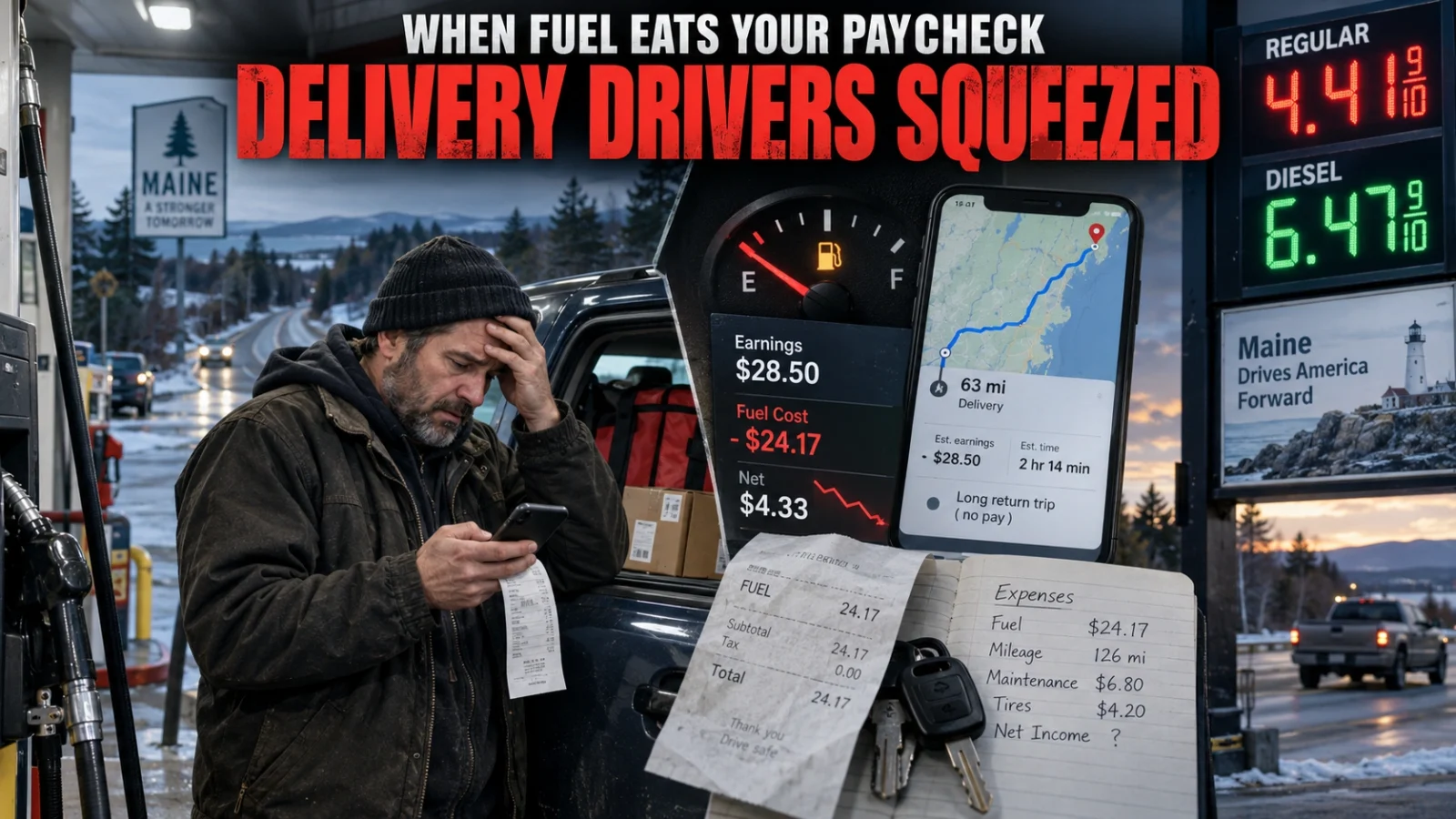
For millions of Americans, a trip to the gas station is an expense. For a delivery driver, ride-share worker or courier, it is the price of showing up for work.
That distinction is becoming painfully clear in Maine. On September 30, 2026, AAA put the statewide average price of regular gasoline at $4.41 a gallon, about 42% higher than a year earlier. Diesel averaged nearly $6.47, after reaching a record Maine average of $6.52 on September 22.
The consequences are showing up in the paychecks of people who deliver food, move passengers, transport packages and run small service businesses from their own vehicles. Maine is a particularly vivid example, but the underlying problem is national: when workers supply both their labor and their cars, a fuel shock can function like an immediate wage cut.
In Maine, every fill-up is eating into the paycheck
Local reporting published September 28 documented workers across Maine changing the way they operate because of rising fuel costs.
A Portland-area ride-share driver, Gary Jones, told Central Maine that he had spent roughly $190 on gasoline during September while earning nearly $1,000 from Uber and Lyft work. He had begun avoiding trips that could leave him driving long distances back without a paying passenger, according to the report.
In Auburn, DoorDash driver Katrina Buchholz told the newspaper that fuel could consume roughly half of what she considered her profits. Dustin Veinott, a pizza delivery driver in Farmingdale who said he can cover about 200 miles on a delivery day, estimated that roughly half of his tips were now being absorbed by the increase in gasoline costs. Those figures are workers’ own estimates, not audited earnings data, but they illustrate how quickly fuel volatility can change the economics of driving for pay.
Small businesses are feeling the pressure too. The same report found that a Portland pet-service business raised one service price from $45 to $50 after its owners faced higher fuel bills, while some restaurants had reconsidered or increased what they return to delivery employees through mileage payments or delivery fees.
The central fact behind those individual stories is independently confirmed by AAA: Maine gasoline averaged $4.4128 on September 30, up from $4.1257 a month earlier and $3.1016 a year earlier. Diesel had risen even faster.
| Fuel benchmark | Sept. 30, 2026 | One month earlier | One year earlier | Change from year earlier |
|---|---|---|---|---|
| Maine regular gasoline | $4.41 | $4.13 | $3.10 | about +42% |
| Maine diesel | $6.47 | $5.67 | $3.88 | about +67% |
| U.S. regular gasoline | $4.43 | $4.08 | $3.15 | about +41% |
AAA’s Maine diesel series also shows a state record of $6.5159 per gallon on September 22, 2026. Nationally, AAA put diesel above $6.41 on September 30.
For a delivery worker, gasoline is not consumption — it is a production cost
Traditional employees generally arrive at work and begin earning money. A driver using a personal vehicle may begin spending money before the first order is completed.
Fuel is only the most visible part of that cost. Tires wear down. Oil must be changed. Brakes, insurance, depreciation and repairs accumulate with every additional mile.
DoorDash itself acknowledges that structure in its 2026 guidance for prospective drivers, telling workers to evaluate earnings after expenses rather than looking only at gross payouts. The company notes that every mile creates fuel, depreciation and wear costs and that Dashers in most U.S. markets work as independent contractors, although legal classification varies by jurisdiction.
The federal government has effectively recognized the same cost pressure. The IRS originally set the 2026 optional business mileage rate at 72.5 cents a mile, then raised it to 76 cents per mile beginning July 1, explicitly saying the revision resulted from recent increases in fuel prices.
That 76-cent figure is not a guaranteed reimbursement and does not mean gasoline alone costs 76 cents for every mile driven. It is an optional tax benchmark intended to approximate the broader cost of operating a vehicle for business.
But it demonstrates a critical economic point: measuring a delivery driver’s income without accounting for the vehicle can substantially overstate what the worker actually earns.
The gig economy moves fuel risk from the company to the worker
This vulnerability is built into much of the app-based labor model.
A customer orders dinner. Software matches the order with a driver. The restaurant prepares the meal. But in many markets, the driver supplies the vehicle, pays for the gasoline and absorbs the depreciation needed to physically complete the transaction.
When gasoline suddenly jumps by 40% year over year, the platform does not necessarily need to purchase a fleet’s worth of more expensive fuel. The worker may face the cost directly.
That distinction helps explain why gross hourly earnings can be misleading in app-based work.
A 2024 UC Berkeley Labor Center study examined more than 52,000 passenger and delivery trips performed by 1,088 drivers in Boston, Chicago, Los Angeles, San Francisco and Seattle. Using January 2022 data and accounting for expenses and workers’ entire shifts, the researchers found that typical passenger and delivery drivers in all five metropolitan areas earned less than their applicable minimum wage.
Among delivery drivers outside California in that study, median net earnings were $9.87 an hour including tips after expenses; an employee-equivalent calculation that also accounted for payroll taxes and employee benefits reduced the figure to $8.36. The study is not a measurement of Maine drivers in 2026, and platform pay systems have changed since the data were collected. It nevertheless illustrates why operating expenses are essential when evaluating gig-worker earnings.
The Federal Reserve has found similar signs of financial vulnerability among gig workers more broadly. In its survey covering 2024, 4% of U.S. adults reported performing platform tasks through an app or website. Among those workers, 41% said they would have trouble making ends meet without gig income, while 61% said they wished the pay were more consistent.
Those statistics do not prove that every delivery driver is poor. They show that platform work often functions as a financial buffer for people who have little room for an unexpected increase in the cost of earning that income.
Maine is a warning for a much larger American workforce
App-based couriers represent only one part of America’s delivery economy.
The Bureau of Labor Statistics estimates that about 1.5 million delivery truck drivers and driver/sales workers were employed in the United States in 2025. Median annual pay was $44,860 for light truck drivers and $38,770 for driver/sales workers. BLS expects overall employment in those occupations to grow 7% between 2025 and 2035 as e-commerce and demand for local delivery continue expanding.
Those BLS figures primarily describe established occupations rather than the entire universe of informal or app-based delivery work. The Federal Reserve’s broader surveys show that millions more Americans periodically turn to short-term tasks, ride-sharing and delivery work to supplement household income.
That makes fuel inflation unusually regressive for transportation-dependent workers.
A highly paid professional who drives to an office may dislike paying $4.40 a gallon. A courier whose revenue depends directly on driving 100 or 200 miles can see the same price increase remove a meaningful portion of the day’s earnings.
The burden can be even heavier in rural states such as Maine, where distances between communities are long and alternatives to personal vehicles are limited. A delivery that looks profitable when a worker accepts it can become far less attractive once unpaid return mileage is included.
For ride-share drivers, that produces a new calculation: not simply whether a passenger’s trip pays enough, but whether another passenger is likely to be waiting at the destination.
For food-delivery drivers, the calculation includes restaurant wait times, distance to the customer, the likelihood of a tip and the miles required to reach the next order.
The result is an economy in which workers must continuously decide whether an algorithmically offered job is actually worth performing after they pay the cost of moving themselves through the physical world.
Why gasoline surged again
The current increase is not simply a Maine phenomenon.
The U.S. Energy Information Administration reported that regular gasoline averaged $4.465 nationwide for the week ending September 28, compared with $3.118 a year earlier. New England regular gasoline averaged $4.369.
The forces pushing prices higher begin far from Maine.
In its September Short-Term Energy Outlook, the EIA said global oil inventories had fallen by an estimated 400 million barrels during 2026 and that constraints on Middle Eastern oil exports were keeping prices elevated. The agency reported that Brent crude averaged $91 a barrel in August, $7 higher than in July.
The EIA specifically cited disruptions to Middle Eastern exports associated with conflict around the Strait of Hormuz, restrictions on Iranian exports, sanctions and attacks affecting alternative oil-export routes. It expected some export constraints to persist through the end of 2026.
Diesel has been particularly vulnerable. EIA forecast U.S. distillate inventories below 100 million barrels in September and said tight global distillate supplies were contributing to elevated diesel prices.
More recent reporting from Reuters has described states responding with measures ranging from temporary fuel-tax suspensions to regulatory changes as gasoline and diesel costs climbed. The effectiveness of those measures remains contested because tax relief does not by itself create additional crude oil, refinery capacity or fuel inventories.
Discounts help, but they do not answer who should absorb the cost
Platforms have tools available to soften fuel shocks.
DoorDash currently advertises fuel-related rewards and discounts, including cash back through its Crimson card, Shell fuel discounts and tools that help drivers locate cheaper gasoline. Its own driver guidance describes fuel as a significant operating expense.
Uber demonstrated another approach during the 2022 fuel shock. It temporarily added a consumer-paid fuel surcharge of 35 to 55 cents per ride and 35 to 45 cents per Uber Eats delivery, depending on location, and said the money would go directly to drivers. That program is historical precedent, not evidence of a comparable nationwide surcharge in effect today.
Public policy has gone further in some cities.
New York City currently requires covered restaurant and grocery delivery apps to pay at least $22.13 an hour before tips for qualifying delivery time, with additional rules governing minimum compensation.
Seattle takes a different approach. Its 2026 app-worker minimum standard includes 80 cents per mile plus 47 cents per minute, subject to a minimum per-offer floor of $5.34. A city analysis published in April reported that, after vehicle expenses and employer-equivalent payroll costs, hourly take-home pay for covered drivers was $16.29 during the first half of 2025 and had increased after implementation of the standard.
Those policies cannot simply be transplanted to Maine without considering differences in density, trip length, demand and state labor law. They do show, however, that fuel and vehicle costs do not have to be treated as invisible expenses borne entirely by the person behind the wheel.
Maine’s statewide minimum wage is $15.10 in 2026, but minimum-wage protections apply to employees under the relevant labor laws; independent-contractor status creates different legal obligations. Worker classification depends on the facts, the platform and the applicable law, so individual cases should not be generalized without legal analysis.
When the driver’s costs rise, the entire delivery economy feels it
The immediate victim of higher gas prices may be the driver, but the economic pressure rarely stops there.
Drivers can reject longer orders. Small businesses can increase delivery charges. Restaurants can raise reimbursement. Service companies can raise customer prices. Platforms can offer incentives or alter compensation. Customers can tip more — or order less.
Every option moves the cost somewhere else.
That is what makes fuel inflation different from many consumer-price increases. Transportation is embedded in the physical delivery of nearly everything Americans buy, from groceries and restaurant meals to medicine and packages.
For lower-paid drivers, however, the timing of the burden is especially punishing. The expense arrives immediately at the pump, while tax deductions come later and vehicle depreciation may not become visible until a major repair or replacement is required.
A worker can therefore appear to be making money today while consuming the economic value of the car needed to earn tomorrow’s income.
The technology economy has made ordering nearly frictionless. One tap can summon dinner, groceries or a ride.
But the final mile is still physical.
Someone must drive it.
And when gasoline surges, that person may be the least financially equipped participant in the transaction to absorb the shock.
What happens next
The near-term direction of fuel prices remains uncertain.
EIA’s September forecast expected Brent crude to remain near $90 a barrel during the second half of 2026 before declining toward an average of $74 in 2027 as production recovers and inventories rebuild. But that forecast was completed September 3, before some of the subsequent late-September fuel-market movements, and the agency’s next Short-Term Energy Outlook is scheduled for October 6.
For Maine drivers, even stabilization near today’s level would mean living with gasoline more than 40% above last year’s price and diesel roughly two-thirds higher.
The larger policy question is no longer just how to bring fuel prices down.
It is who bears the risk when they go up.
If delivery platforms, restaurants and consumers want instant transportation and on-demand service, the current Maine experience exposes the hidden subsidy behind part of that convenience: workers who provide not only their time, but also their vehicle, fuel, maintenance and financial risk.
For Americans driving to keep food on somebody else’s table — and often to keep food on their own — a dollar added to the pump price is not merely inflation.
It is money coming directly out of the workday.
Sources
- AAA Fuel Prices, Maine averages and historical records: https://gasprices.aaa.com/?state=ME
- U.S. Energy Information Administration, Gasoline and Diesel Fuel Update: https://www.eia.gov/petroleum/gasdiesel/
- U.S. Energy Information Administration, September 2026 Short-Term Energy Outlook: https://www.eia.gov/outlooks/steo/report/index.php
- Central Maine, “Rising gas prices eating into profits of Mainers who drive their cars for a living,” Sept. 28, 2026: https://www.centralmaine.com/2026/09/28/rising-gas-prices-hit-hard-for-mainers-who-drive-for-a-living/
- Internal Revenue Service, revised 2026 standard mileage rates: https://www.irs.gov/irb/2026-29_irb
- Federal Reserve Board, Economic Well-Being of U.S. Households in 2024 — Employment and Gig Work: https://www.federalreserve.gov/publications/2025-economic-well-being-of-us-households-in-2024-employment-and-gig-work.htm
- UC Berkeley Labor Center, Gig Passenger and Delivery Driver Pay in Five Metro Areas: https://laborcenter.berkeley.edu/gig-passenger-and-delivery-driver-pay-in-five-metro-areas/
- U.S. Bureau of Labor Statistics, Delivery Truck Drivers and Driver/Sales Workers: https://www.bls.gov/ooh/transportation-and-material-moving/delivery-truck-drivers-and-driver-sales-workers.htm
- DoorDash, 2026 guidance on driving-gig expenses: https://dasher.doordash.com/en-us/blog/how-to-make-money-with-your-car
- Uber, 2022 temporary fuel surcharge announcement: https://www.uber.com/us/en/newsroom/new-fuel-surcharge/
- New York City Department of Consumer and Worker Protection, Delivery Worker Rights: https://www.nyc.gov/site/dca/workers/workersrights/Delivery-Workers.page
- Seattle Office of Labor Standards, App-Based Worker Minimum Payment Ordinance: https://legacywww.seattle.gov/laborstandards/ordinances/app-based-worker-ordinances/app-based-worker-minimum-payment-ordinance
- Maine Department of Labor, 2026 minimum wage information: https://www.maine.gov/labor/labor_laws/minimumwagefaq/



Leave a Reply