
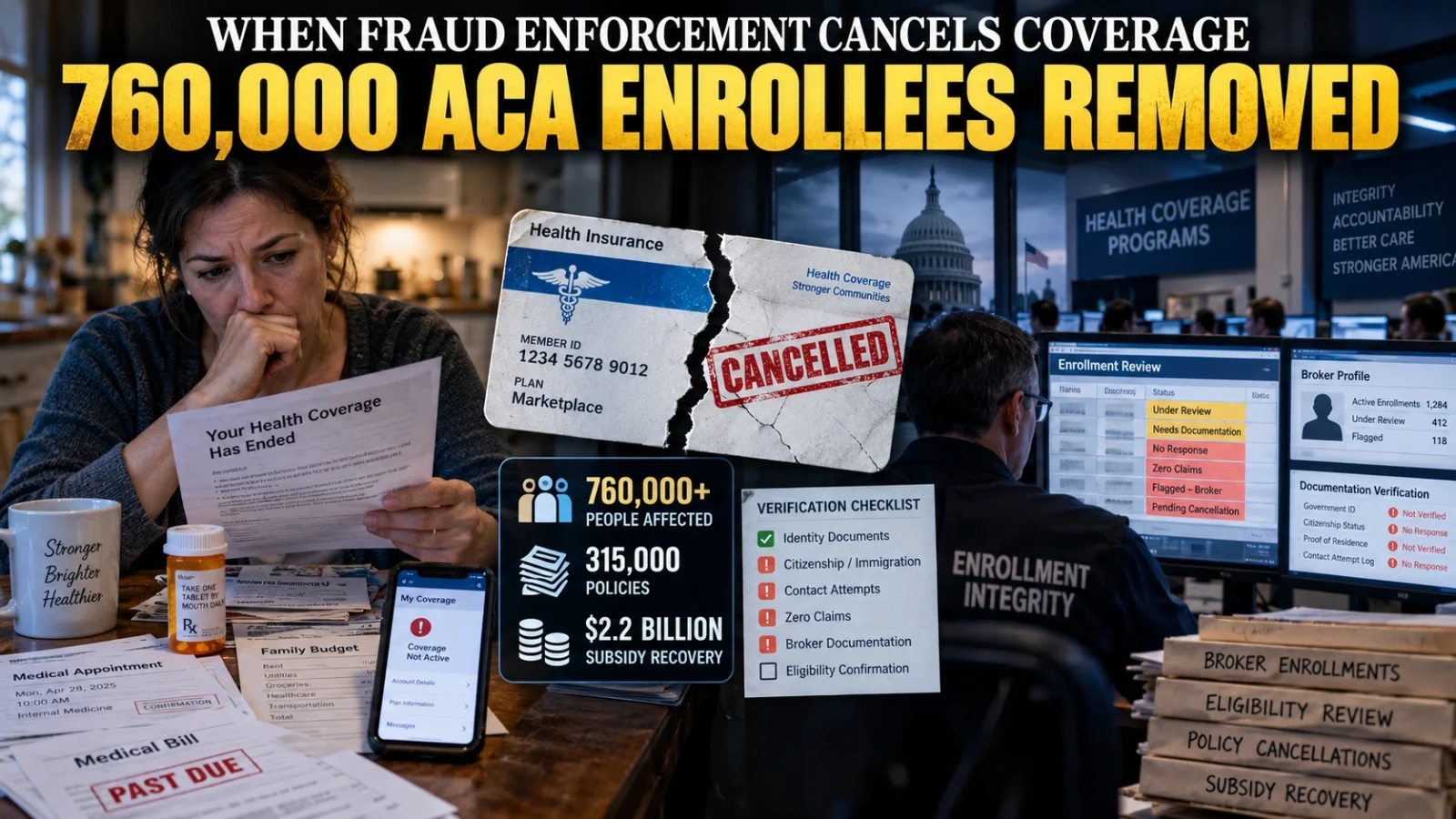
The federal government canceled Affordable Care Act Marketplace coverage tied to more than 760,000 people on August 31, 2026, in one of the largest anti-fraud actions undertaken against the health insurance exchanges. The Trump administration says the roughly 315,000 canceled policies were unauthorized and expects to recover about $2.2 billion in federal premium subsidies associated with them.
The scale is extraordinary. But so is the distinction at the heart of the story: the government has not shown that 760,000 individual consumers personally committed fraud, and public data do not establish that every person whose Marketplace enrollment was canceled is now uninsured. Some may have had other coverage; some, according to the administration, may never have known they had an ACA plan at all.
For Americans who did knowingly rely on one of the canceled plans, however, the consequences could be immediate: a doctor’s visit, prescription refill or hospital bill can suddenly become an uninsured expense. The controversy is therefore no longer simply about whether fraud exists — federal investigators have documented serious weaknesses in the Marketplace — but about whether mass administrative enforcement can distinguish accurately between fraudulent records, unauthorized broker activity and legitimate people caught in a flawed system.
What exactly happened to the 760,000 enrollments?
CMS announced the action publicly on September 22, but the cancellations themselves occurred on August 31, 2026. The agency says approximately 315,000 policies covering more than 760,000 individuals were canceled after reviews conducted with insurers under its process for investigating unauthorized enrollments.
The Federal Register provides more detail about the group CMS selected. According to the government, the affected policies had been enrolled with agent or broker assistance, lacked verified citizenship or immigration documentation, had no identifiable insurance claims, and involved consumers whom insurers were unable to contact. CMS describes the resulting cancellations as confirmed unauthorized enrollments.
| Date | Federal action | Scale |
|---|---|---|
| Aug. 31, 2026 | Marketplace policies canceled as unauthorized | ~315,000 policies / 760,000+ people |
| Sept. 22, 2026 | CMS publicly announces crackdown | ~$2.2 billion in expected subsidy recovery |
| Sept. 22, 2026 | Administration announces further eligibility verification | ~419,000 to 450,000 additional people |
| Through Feb. 1, 2027 | New federal Marketplace broker registrations paused for certain applicants | Six-month temporary moratorium |
Vice President JD Vance characterized the affected population as including both people who did not meet eligibility requirements and so-called “phantom” enrollees — real people whom brokers may have enrolled without their knowledge, as well as records the administration believes may not correspond to legitimate beneficiaries. CMS Administrator Mehmet Oz said the government considered the lack of claims and inability to reach enrollees significant indicators.
That is not the same as establishing that every individual was an intentional fraudster. In many of the cases CMS says it is targeting, the alleged misconduct involves agents and brokers, not necessarily the people whose identities were used to obtain coverage.
The fraud problem is real — and the government has evidence
Concerns about unauthorized ACA enrollment are not invented.
In July, the nonpartisan Government Accountability Office concluded that CMS’s safeguards were not strong enough to prevent unauthorized actions by some agents and brokers. GAO found weaknesses in how the federal Marketplace verifies consumer consent, limits access to consumer accounts and informs people when brokers alter their coverage.
Consumer complaints involving confirmed unauthorized enrollments and plan switches increased more than fourfold from 2023 through 2025, according to GAO. The agency found that some state-run Marketplaces use stronger controls, including one-time passcodes, and recommended that CMS implement similar protections; HHS agreed with the recommendations.
A separate GAO investigation demonstrated the vulnerability more dramatically.
Investigators created fictitious applicants and attempted to obtain subsidized ACA coverage. All four fake applicants used in a 2024 test obtained subsidized plans, and 18 of 20 fictitious applicants created for 2025 were still actively covered as of September 2025. GAO stressed that its undercover sample was illustrative and cannot be generalized to the entire Marketplace population.
GAO also identified at least 160,000 applications in plan year 2024 that appeared to have undergone likely unauthorized changes by agents or brokers. Such manipulation can harm consumers directly by changing their doctors, prescription coverage, deductibles or tax-credit liabilities without their permission.
In other words, there is strong evidence that the ACA Marketplace has faced genuine fraud and broker misconduct.
What remains disputed is how accurately the government’s new enforcement operation identifies it.
Why “760,000 Americans left uninsured” goes beyond the evidence
The number is dramatic enough without overstating it.
CMS unquestionably canceled Marketplace policies covering more than 760,000 individuals. But as of October 1, the government has not published data showing how many of those people subsequently had no health insurance at all.
Some may have Medicaid, employer coverage or another insurance policy. Some may have been unknowingly enrolled in the ACA Marketplace and therefore lost coverage they never realized existed. Others may have believed their Marketplace insurance was valid and depended on it for future care even if they had not yet filed a claim.
Nor does an absence of prior medical claims prove by itself that a person does not exist or does not need insurance. Healthy people routinely go months without using medical services — one reason insurance exists in the first place.
The administration’s June analysis acknowledged that zero claims are an indicator used to detect potentially improper enrollment rather than direct proof in every individual case. HHS estimated that millions of Marketplace enrollments in recent years may have been improper, fraudulent or “phantom,” but those figures rely partly on statistical estimates rather than individual fraud adjudications.
KFF’s Cynthia Cox told the Associated Press that fraudulent enrollments should be canceled but questioned whether the process used had accurately identified every affected enrollee. Former CMS official Ellen Montz similarly told AP that the September announcement did not provide enough detail to independently determine how the canceled population was selected.
That distinction matters legally and editorially: the 760,000 should not be described as 760,000 people proven to have committed healthcare fraud. They are people associated with policies CMS says its process determined were unauthorized.
When an administrative error becomes a medical crisis
For a consumer who was knowingly insured, even a mistaken cancellation can carry consequences far beyond paperwork.
Marketplace insurance can determine whether a prescription costs a copay or hundreds of dollars, whether a cancer specialist is affordable, whether a child can see a doctor or whether an emergency-room bill becomes household debt.
GAO has already documented what can happen when unauthorized broker activity disrupts legitimate coverage. Consumers can lose access to doctors and medications, face higher deductibles or copayments and encounter unexpected tax liabilities when inaccurate premium subsidies are attached to their identities.
The same principle works in reverse: an aggressive system designed to correct fraudulent enrollment needs safeguards against terminating valid coverage.
CMS has an existing process requiring insurers investigating suspected unauthorized enrollment to attempt to contact consumers and, under its enrollment procedures, provide time for them to respond before a suspected unauthorized policy is canceled. The Federal Register says the 760,000-person action followed CMS’s unauthorized-enrollment processes.
Consumers who believe Marketplace activity involving their accounts was unauthorized or handled incorrectly can contact the federal Marketplace Call Center. CMS has previously directed consumers affected by unauthorized broker activity to that channel for resolution.
But administrative remedies require something vulnerable households do not always have: awareness that a problem exists, reliable mail or internet access, time to make calls, documentation and the ability to navigate a complicated insurance system.
For someone facing chemotherapy, insulin costs or an upcoming surgery, the difference between correcting an enrollment problem in five days and correcting it in five weeks can be measured in health, not bureaucracy.
The crackdown comes as ACA coverage is already shrinking
The cancellation also lands during a difficult year for the individual insurance market.
Federal data show that 19.2 million people had effectuated ACA Marketplace coverage in early 2026, down from about 21.8 million the previous year — the first nationwide decline in several years. KFF calculated the decrease at roughly 12%, or close to three million people.
That broader decline cannot simply be labeled fraud removal.
The enhanced federal premium tax credits that had reduced Marketplace costs from 2021 through 2025 expired at the end of last year. KFF found that average premium payments among people purchasing 2026 coverage increased about 58%, from $113 to $178 a month, as consumers either paid more, moved into cheaper plans with higher deductibles or dropped coverage.
Average Marketplace deductibles jumped 37% to approximately $3,786 per person, according to KFF’s analysis. In a follow-up survey, 9% of people who had Marketplace coverage in 2025 reported being uninsured in 2026, and cost was cited by eight in 10 respondents who had changed their coverage or become uninsured.
HHS offers a different interpretation of part of the enrollment decline. Its June report argues that program-integrity actions removed large numbers of improper or phantom enrollments and estimates that 2.6 million suspicious enrollments could still remain. The methodology uses enrollment patterns, zero-claim rates and estimated transitions from other forms of insurance; the estimate should therefore be distinguished from a count of individually proven fraud cases.
Both realities can exist at once: the Marketplace has experienced documented fraudulent and unauthorized enrollments, while legitimate consumers have simultaneously left because coverage became more expensive.
For families, the difference matters. Fraud reduction is a program-integrity success when nonexistent or unauthorized coverage is removed. It becomes a coverage problem when an eligible person who wants insurance loses it through an erroneous match, unreachable phone number or unresolved documentation issue.
Brokers are now at the center of the enforcement campaign
The administration is increasingly directing its scrutiny toward the insurance intermediaries who enroll millions of Marketplace customers.
Since January, CMS says it has issued termination notices to more than 200 noncompliant agents and brokers. During the summer it issued 569 notices of intent to terminate Exchange agreements involving brokers whose 2026 application activity contained what CMS called statistically implausible rates of missing identifying information such as Social Security numbers.
Federal regulators also imposed a temporary moratorium preventing agents and brokers without 2026 federal Marketplace agreements from newly registering for plan year 2027 until February 1, unless the moratorium is changed. Existing registered brokers are not categorically removed: CMS said there were more than 84,000 agents and brokers with active federal Marketplace enrollments during 2026.
The administration argues the pause gives CMS time to introduce stronger identity verification, authentication and consumer-authorization safeguards before open enrollment intensifies. Industry representatives have countered that a broad freeze risks restricting legitimate enrollment assistance along with fraudulent activity.
That disagreement exposes a recurring problem in fraud enforcement: a control can reduce one form of abuse while simultaneously making a public benefit harder for eligible people to access.
Open enrollment for 2027 begins November 1.
AI is entering the health-coverage enforcement system
There is also a technology dimension to the crackdown.
The Washington Post reported that CMS Administrator Oz said artificial-intelligence-supported data analysis helped the administration identify suspicious Marketplace enrollment patterns. The government has increasingly emphasized data matching and anomaly detection as tools for shifting healthcare fraud enforcement from recovering money after payment toward stopping suspicious payments earlier.
AI and automated analytics can be useful in a program with tens of millions of records. Patterns involving one broker submitting extraordinary numbers of applications, duplicate identities or inconsistent eligibility information can be difficult to identify manually.
But healthcare coverage is also a domain where false positives can have unusually serious consequences.
The government’s September CMS fact sheet and Federal Register notice describe the criteria and administrative rationale behind the enforcement campaign, but they do not publish a false-positive rate for the 760,000 cancellations or enough technical information for outsiders to independently measure the accuracy of any AI-supported screening component.
That does not establish that the system is inaccurate. It means its error rate cannot currently be evaluated from the public evidence released with the announcement.
For automated government decision-making, that distinction should matter. A fraud-detection model can be highly useful as an investigative filter without being reliable enough to serve as the sole basis for terminating a family’s health coverage.
The human question hidden inside a $2.2 billion savings estimate
The Trump administration emphasizes that canceling the 315,000 policies should return roughly $2.2 billion in advance premium tax credits that otherwise would have flowed to insurers. If those policies truly were unauthorized, stopping the payments protects taxpayers and prevents brokers or insurers from receiving federal money attached to nonexistent or unwanted coverage.
The administration is also reviewing roughly another 419,000 to 450,000 people for eligibility issues involving legal status, income or other enrollment requirements. That means the September action may not be the final major cancellation.
The unresolved issue is not whether the federal government should fight fraud. GAO’s findings make clear that it should.
The harder issue is what level of evidence should be required before government systems cancel health insurance — especially when the person whose policy is being terminated may have been the victim of the broker misconduct the government is trying to stop.
An unauthorized enrollment can harm a consumer.
So can an unauthorized disenrollment.
A functioning anti-fraud system has to prevent both.
What happens next
CMS says it will continue working with insurers to identify potentially unauthorized Marketplace enrollments, cancel those it confirms were unauthorized and recover associated premium subsidies. At the same time, the federal government is developing tighter identity and consumer-authorization controls before the 2027 enrollment period.
GAO’s July recommendations provide one possible path: stronger direct verification that the consumer actually authorized a broker’s action, restrictions on who can access an enrollee’s Marketplace account and immediate notifications when an agent changes coverage. Those measures target the transaction itself rather than trying to infer fraud later from whether someone used medical care.
Consumers whose Marketplace coverage has disappeared unexpectedly should check their HealthCare.gov account and contact the Marketplace Call Center or their insurer to verify their enrollment status. Open enrollment for 2027 begins November 1, while Special Enrollment Period eligibility outside that window depends on individual circumstances.
The coming months will reveal whether the government’s crackdown produces evidence that the 760,000 cancellations were overwhelmingly the elimination of phantom coverage — or whether substantial numbers of legitimate consumers emerge saying their health insurance was wrongly terminated.
Until that evidence is available, two facts should not be confused.
America’s ACA Marketplace has a documented fraud problem.
And more than 760,000 people just had Marketplace coverage attached to their names canceled in the effort to solve it.
Sources
- Centers for Medicare & Medicaid Services, “Federal Marketplace (FFE and SBE-FP) Anti-Fraud Actions,” Sept. 22, 2026.
https://www.cms.gov/newsroom/fact-sheets/federal-marketplace-ffe-sbe-fp-anti-fraud-actions - Centers for Medicare & Medicaid Services, “CMS Cracks Down on Fraud, Waste, and Abuse in the Federal Health Insurance Marketplace,” Sept. 22, 2026.
https://www.cms.gov/newsroom/press-releases/cms-cracks-down-fraud-waste-abuse-federal-health-insurance-marketplacer - Federal Register, “Patient Protection and Affordable Care Act; Temporary Moratoria on Certain Agent and Broker Registration To Participate in the Exchanges,” Sept. 23, 2026.
https://www.govinfo.gov/content/pkg/FR-2026-09-23/html/2026-19493.htm - U.S. Government Accountability Office, “Health Insurance Marketplaces: CMS Needs Stronger Controls to Prevent Unauthorized Actions by Agents and Brokers,” July 13, 2026.
https://www.gao.gov/products/gao-26-108297 - U.S. Government Accountability Office, “Patient Protection and Affordable Care Act: Preliminary Results from Ongoing Review Suggest Fraud Risks in the Advance Premium Tax Credit Persist,” Dec. 3, 2025.
https://www.gao.gov/products/gao-26-108742 - HHS Office of the Assistant Secretary for Planning and Evaluation, “ACA Exchange Enrollment in 2026,” June 26, 2026.
https://aspe.hhs.gov/reports/aca-exchange-enrollment-2026 - KFF, “How Has ACA Marketplace Enrollment Changed Across States in 2026?” July 28, 2026.
https://www.kff.org/affordable-care-act/how-has-aca-marketplace-enrollment-changed-across-states-in-2026/ - KFF, “What We Know So Far About 2026 ACA Marketplace Enrollment, Premiums, and Deductibles,” May 19, 2026.
https://www.kff.org/affordable-care-act/what-we-know-so-far-about-2026-aca-marketplace-enrollment-premiums-and-deductibles/ - Reuters, “US halts Obamacare enrollment for over 760,000 enrollees, claiming fraud,” Sept. 22, 2026.
https://www.reuters.com/legal/government/us-says-it-canceled-315000-obamacare-policies-last-month-2026-09-22/ - Associated Press, “Trump administration to remove 760,000 Affordable Care Act enrollees over fraud claims,” Sept. 22, 2026.
https://apnews.com/article/vance-healthcare-oz-aca-fraud-task-force-eb57a4819c8a876a72c1301a112e21dc - HealthCare.gov, Marketplace contact information.
https://www.healthcare.gov/contact-us/ - HealthCare.gov, coverage outside Open Enrollment and Special Enrollment Period information.
https://www.healthcare.gov/coverage-outside-open-enrollment/your-options/




Leave a Reply