
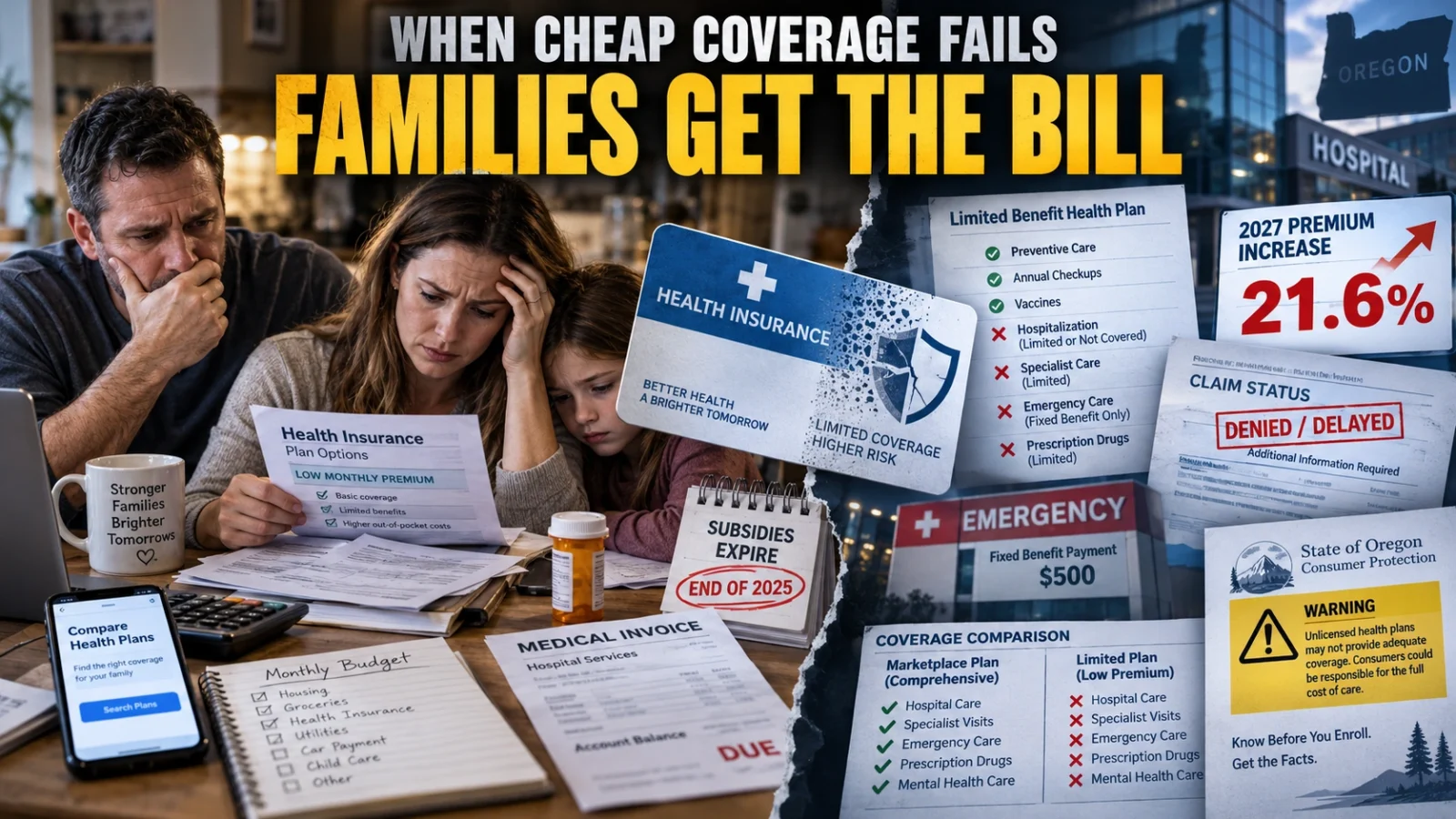
A health plan can look affordable right up until someone gets sick.
That is the warning Oregon regulators are sending ahead of the 2027 health insurance enrollment season. On September 22, 2026, the Oregon Division of Financial Regulation told consumers to be wary of unusually cheap “self-funded” limited-partner health plans and other unlicensed arrangements that may appear to offer comprehensive insurance while covering little beyond basic preventive care.
The warning comes at a particularly dangerous moment for families shopping on price. Oregon has approved an average 21.6% increase in individual-market insurance rates for 2027, enhanced federal Affordable Care Act subsidies expired at the end of 2025, and ACA enrollment has fallen nationally. In that environment, a plan promising low premiums, low deductibles and broad coverage can look like financial rescue.
It may instead leave a family holding tens of thousands of dollars in medical bills.
Oregon’s warning: cheap coverage can be dangerously incomplete
The Oregon Division of Financial Regulation says some companies sell arrangements that describe customers as “limited partners” or “employees,” potentially positioning the plans outside state insurance rules that would otherwise apply.
Many of these limited-partner plans cover primarily preventive services such as checkups and routine screenings, according to the regulator. They are not ACA-compliant comprehensive individual health plans, even though consumers may encounter marketing that makes the products appear much broader.
Oregon Insurance Commissioner TK Keen warned consumers to be skeptical of products that combine unusually low premiums and deductibles with promises of full or unlimited benefits.
The state identified several warning signs: salespeople claiming a product is exempt from insurance regulation, offers available outside normal enrollment periods without a qualifying event, references to “stop-loss” insurance, unusually cheap prices, demands for substantial upfront payments, and repeated delays or denials when medical claims are submitted.
State regulators also warned consumers about websites designed to resemble official health insurance portals. Beginning November 1, Oregon residents purchasing 2027 Marketplace coverage will use Explore Health, Oregon’s new official state-based Marketplace.
The basic advice from regulators is simple: a low monthly price tells consumers almost nothing about what will happen when a $40,000 hospital bill arrives.
What “coverage” means can change dramatically outside the ACA
An Affordable Care Act Marketplace plan comes with a federally defined floor of consumer protections.
Marketplace policies must cover 10 categories of essential health benefits, including hospitalization, emergency services, prescription drugs, maternity care, laboratory services and mental health and substance-use treatment. They must cover pre-existing conditions and cannot impose annual or lifetime dollar limits on essential health benefits.
A non-ACA product may operate very differently.
A fixed-indemnity plan, for example, might promise a predetermined payment when a medical event occurs rather than paying the actual hospital bill. A health-sharing arrangement may have members contribute toward one another’s expenses without providing the contractual guarantees associated with regulated insurance. Other limited-benefit arrangements can exclude categories of treatment or cap how much they pay.
The Government Accountability Office examined alternative health-coverage arrangements in 2023 and found that they generally were not required to comply with major ACA protections. Benefits varied substantially, and regulators interviewed by GAO said such products tended to carry few of the consumer protections required of comprehensive individual insurance.
That does not make every non-ACA product fraudulent. Some limited products explicitly disclose what they are and may serve specific purposes.
The danger arises when consumers believe they are buying comprehensive health insurance but have actually purchased something far narrower.
One emergency-room visit can expose the illusion
A federal enforcement case filed this year shows how extreme that difference can become.
In April, the Federal Trade Commission sued Innovative Partners, American Collective and related defendants, alleging that they deceptively marketed limited-benefit products and medical discount memberships as comprehensive PPO health insurance. The FTC says some sales representatives impersonated government agencies or recognizable insurers and told consumers they were purchasing policies offering broad coverage.
The allegations have not been finally adjudicated; the FTC case remains pending. A federal court nevertheless temporarily halted the operation and appointed a receiver while the litigation proceeds.
The court-appointed receiver subsequently described what some customers had actually purchased. According to plan documents reviewed by the receiver, one Innovative Partners product offered just $125 toward one illness-related emergency-room visit per year and $150 toward one illness-related ambulance trip, with no other hospital-related benefit.
A $125 payment can technically be a health benefit.
Against the cost of emergency care, it can also be financially insignificant.
The FTC alleges consumers paid hundreds of dollars per month and thousands per year for products that some believed were comprehensive insurance. According to the complaint, some discovered the limitations only after seeking medical care, leaving people to postpone treatment or face substantial medical debt.
Oregon responded by obtaining a Special Enrollment Period for residents who had been enrolled through Innovative Partners or American Collective, allowing affected consumers to move into comprehensive Marketplace coverage.
Oregon has already had to shut down another health arrangement
The September warning was not Oregon’s first intervention this year.
On April 27, the state announced a cease-and-desist order against ClearShare Health and affiliated companies after regulators concluded that their health-cost-sharing program functioned as insurance without the certificate required to conduct insurance business in Oregon.
ClearShare described its products as memberships in which participants contributed monthly amounts toward a pool used for medical expenses. Oregon regulators said the program excluded or restricted participation for some people with pre-existing conditions and people older than 65 and had come to the state’s attention after multiple consumer complaints.
The state barred new sales and renewals and later announced that existing ClearShare coverage would end September 1. HealthCare.gov opened a temporary Special Enrollment Period so affected consumers could obtain regulated Marketplace coverage.
The ClearShare action and the federal Innovative Partners lawsuit involve different entities and legal theories. They should not be treated as proof that every alternative health plan operates unlawfully.
Together, however, they show why Oregon regulators are worried: consumers can spend months paying what feels like an insurance premium before discovering that the legal and financial protections behind the product are very different from what they expected.
Families are becoming easier targets because real insurance is getting harder to afford
The market for stripped-down coverage does not exist in isolation.
It grows in the gap between what families need and what they can afford.
Oregon regulators approved an average 21.6% individual-market rate increase for 2027, even after the state committed additional reinsurance funding intended to restrain premiums. Regulators cited rising medical costs, pharmaceutical and medical-equipment pressures, market instability and the disappearance of enhanced federal ACA premium subsidies among the forces affecting rates.
Those enhanced federal tax credits expired at the end of 2025. Nearly 120,000 Oregonians had benefited from the expanded assistance, according to Oregon regulators.
Enrollment is already declining.
Nationally, ACA Marketplace effectuated enrollment fell from 21.8 million people in 2025 to approximately 19.2 million in February 2026, a 12% decrease. KFF found that every state except New Mexico experienced a decline and that 9% of people surveyed who had Marketplace coverage in 2025 reported becoming uninsured for 2026.
The Trump administration has attributed part of the decline to efforts targeting improper and fraudulent enrollment. HHS estimates that previous Marketplace totals included millions of improper, unauthorized or “phantom” enrollments. Those estimates rely partly on modeling and should not be equated with individually adjudicated fraud cases.
At the same time, the expiration of enhanced subsidies substantially increased what many legitimate customers had to pay.
That affordability squeeze is pushing some consumers nationally toward short-term insurance, health-sharing arrangements or no coverage at all.
Reuters reported in September that nearly a dozen consumers it interviewed had moved toward less comprehensive alternatives after ACA costs rose. One self-employed Utah photographer at elevated breast-cancer risk said she had begun weighing the roughly $1,200 cost of a mammogram against keeping her business afloat after dropping her ACA coverage.
That is the market in which cheap health-plan advertising becomes most powerful.
A family worried about next month’s premium is naturally attracted to a product promising hundreds of dollars in savings today.
The problem may not reveal itself until the family needs tomorrow’s hospital.
The cheapest policy may carry the largest hidden deductible of all
Traditional health insurance forces consumers to confront visible costs: a $700 premium, a $4,000 deductible or a $9,000 out-of-pocket maximum.
Limited products can shift the risk into a less visible place — services that are simply not covered.
If an ACA plan covers a hospitalization subject to deductibles and coinsurance, the patient still receives the plan’s negotiated rates and eventually reaches an annual out-of-pocket ceiling for covered in-network essential benefits.
When a limited product excludes that hospitalization, caps reimbursement at a small fixed amount or treats the expense as ineligible, there may be no comparable protection.
That distinction is why regulators tell consumers to examine the entire policy rather than compare monthly premiums.
A $300 plan that leaves a $75,000 hospital bill uncovered is not necessarily cheaper than a $600 comprehensive plan. It simply postpones the cost until sickness makes it unavoidable.
For families with little savings, that timing can be devastating. Medical debt can compete with rent, groceries, child care and car payments — and fear of the bill can cause people to delay treatment before debt even appears.
Short-term insurance adds another layer to America’s regulatory patchwork
Limited-partner arrangements are not the same thing as federally recognized short-term, limited-duration insurance. But both illustrate how much consumer protection can depend on the legal category attached to a health product.
In 2024, federal regulators limited newly issued short-term policies to an initial term of no more than three months and four months including extensions, arguing that longer arrangements could be mistaken for comprehensive insurance. Short-term insurance is generally exempt from many ACA individual-market requirements.
The policy direction changed in 2025.
The Departments of Labor, Health and Human Services and Treasury announced in August 2025 that they would reconsider the federal definition and, pending future rulemaking, would not prioritize enforcement of violations involving the 2024 duration and notice requirements.
That federal enforcement stance does not erase stricter state rules.
Oregon law independently limits short-term health insurance to three months, including renewals, and prevents the same insurer from immediately chaining another policy onto the first. Oregon also requires warnings explaining that short-term policies are not subject to all federal health-insurance protections.
The result nationally is a patchwork: consumers in different states may encounter very different alternatives, durations and safeguards.
For someone shopping online, those distinctions can be almost invisible.
A search box can put legitimate coverage beside something entirely different
Health insurance shopping increasingly begins with a web search rather than an insurance office.
That creates another vulnerability.
Oregon regulators specifically warn consumers to check website addresses because sites resembling official Marketplace portals may sell products that are not ACA compliant. They also advise shoppers to obtain an insurance salesperson’s full name and National Producer Number and verify the person’s license before providing money or personal information.
The FTC’s Innovative Partners allegations show how much more sophisticated the problem can become. According to the agency, callers allegedly impersonated government agencies and recognizable insurance companies, presented limited products as PPO insurance and created urgency around immediate payment.
Technology can make an offer appear professional long before a consumer understands the entity behind it.
A polished website, provider-network logo, digital insurance card or automated enrollment process is not proof that a product provides comprehensive insurance.
The relevant questions remain old-fashioned ones: Who regulates it? What exactly does the contract pay? Are hospital stays covered? Are prescriptions covered? What happens with a pre-existing condition? Is there an annual payment cap? And who pays once the plan reaches that cap?
How consumers can distinguish insurance from an expensive promise
For Oregon residents, the state’s September warning offers several practical safeguards.
Consumers should verify that the agent is licensed, confirm the insurer or plan with the Division of Financial Regulation and carefully read exclusions before paying. A salesperson who says licensing is unnecessary because a plan is technically not “insurance” is not providing reassurance — the statement is a reason to determine exactly what protections the consumer is giving up.
For 2027, Oregon’s official Marketplace is Explore Health. Open enrollment runs from November 1, 2026, through January 15, 2027. Marketplace plans must comply with ACA coverage requirements, and eligible households can determine whether federal financial assistance is available through the official system.
Oregon Medicaid, known as the Oregon Health Plan, remains another possible source of comprehensive coverage for eligible households and accepts applications year-round.
Consumers considering any alternative plan should ask for the complete benefit documents before paying and search specifically for hospitalization, emergency care, prescriptions, specialist treatment, maternity care, mental health services, exclusions, payment caps and pre-existing-condition rules.
The most important question is not, “How much is the premium?”
It is, “What happens if tomorrow I need $100,000 worth of medical care?”
What happens next
Oregon’s 2027 individual-market open enrollment begins November 1 against one of the most difficult affordability environments the state has faced in years.
The state is simultaneously launching its own Marketplace, absorbing double-digit premium increases and trying to keep consumers from fleeing toward products that may not provide the protection they believe they are purchasing.
Federal regulators are also still litigating the Innovative Partners case. The FTC’s allegations remain allegations until resolved by the court, while the court-appointed receiver says a large backlog of claims from the companies will likely remain unprocessed and unpaid because of their financial condition when the receivership began.
Meanwhile, federal agencies are reconsidering rules governing short-term coverage, creating the possibility of broader availability of less comprehensive insurance in parts of the country. Oregon’s separate state restrictions remain in place.
None of this means every inexpensive health product is a scam.
It means price alone has become a dangerously poor measure of health coverage.
For a family trying to save $200 a month, a stripped-down plan may look like the only affordable choice. But health insurance is purchased for the moment ordinary life stops being ordinary — a cancer diagnosis, a car crash, a complicated pregnancy, a child’s hospitalization.
If the protection disappears at exactly that moment, the cheap policy was never truly cheap.
The premium was simply the first bill.
Sources
- Oregon Division of Financial Regulation, “DFR warns of ‘self-funded’ limited-partner health plans,” Sept. 22, 2026.
https://dfr.oregon.gov/news/news2026/Pages/20260922-self-funded-limited-partner-health-plans.aspx - Oregon Public Broadcasting / The Lund Report, “State warns Oregonians about buying low-cost health plans that cover little,” Sept. 25, 2026.
https://www.opb.org/article/2026/09/25/oregon-warning-low-cost-health-plan/ - Oregon Division of Financial Regulation, “Division of Financial Regulation finalizes 2027 health insurance rates,” Aug. 18, 2026.
https://dfr.oregon.gov/news/news2026/Pages/20260818-DFR-finalizes-2027-insurance-rates.aspx - Oregon Division of Financial Regulation, ClearShare cease-and-desist announcement, April 27, 2026.
https://dfr.oregon.gov/news/news2026/pages/clearshare.aspx - Oregon Health Insurance Marketplace, emergency updates for ClearShare, Innovative Partners and American Collective customers.
https://healthcare.oregon.gov/marketplace/Pages/updates.aspx - Federal Trade Commission, “FTC Sues to Stop Deceptive Health Care Scheme,” April 22, 2026.
https://www.ftc.gov/news-events/news/press-releases/2026/04/ftc-sues-stop-deceptive-health-care-scheme - Federal Trade Commission, FTC v. Innovative Partners et al., case page.
https://www.ftc.gov/legal-library/browse/cases-proceedings/2423043-innovative-partners-ftc-v - Court-appointed Innovative Partners receiver, consumer and claims information.
https://www.innovativereceiver.com/ - U.S. Government Accountability Office, Private Health Coverage: Information on Farm Bureau Health Plans, Health Care Sharing Ministries, and Fixed Indemnity Plans.
https://www.gao.gov/products/gao-23-106034 - HealthCare.gov, essential health benefits required of Marketplace plans.
https://www.healthcare.gov/coverage/what-marketplace-plans-cover/ - HealthCare.gov, protections for pre-existing conditions.
https://www.healthcare.gov/coverage/pre-existing-conditions/ - U.S. Departments of Labor, Health and Human Services and Treasury, statement on short-term, limited-duration insurance, Aug. 7, 2025.
https://www.dol.gov/agencies/ebsa/laws-and-regulations/laws/affordable-care-act/for-employers-and-advisers/short-term-limited-duration-insurance/stldi-statement-08-07-2025 - Oregon Division of Financial Regulation, guidance for short-term health insurance.
https://dfr.oregon.gov/business/reg/health/pages/short-term-guidance.aspx - Oregon Health Authority, Explore Health Marketplace launch information.
https://www.oregon.gov/oha/ERD/Pages/Oregon-to-launch-Explore-Health-this-November-08.21.2026.aspx - KFF, “How Has ACA Marketplace Enrollment Changed Across States in 2026?”
https://www.kff.org/affordable-care-act/how-has-aca-marketplace-enrollment-changed-across-states-in-2026/ - Reuters, “Americans navigate ‘wild West’ of health insurance options after dropping Obamacare plans,” Sept. 25, 2026.
https://www.reuters.com/legal/litigation/americans-navigate-wild-west-health-insurance-options-after-dropping-obamacare-2026-09-25/




Leave a Reply