The Vote That Broke the Boardroom
The September commission vote was an act of political and financial desperation born out of a looming deadline. For months, the SEHBC had been paralyzed by consecutive 2-2 deadlocks between labor union representatives and administration appointees, rendering the body unable to find a structural alternative that would significantly reduce the projected premium spikes. State treasury officials issued a dire ultimatum, warning that failing to authorize the new actuarially sound rates would result in the complete shutdown of the School Employees’ Health Benefits Program (SEHBP) by January 1, 2027. A shutdown would have unceremoniously stripped hundreds of thousands of public servants of their medical coverage in the middle of winter.
Faced with this existential threat, the administration’s representatives on the commission argued that basic arithmetic had to override political optics. Commission Chair Danielle Schimmel, representing state Treasurer Aaron Binder, articulated the grim reality of the boardroom prior to the final tally. Schimmel noted bluntly that “the rates are what they are and we need rates to operate a plan to be able to have open enrollment and to be able to have members”. The structural deficit, exacerbated by skyrocketing claims, left the commission with no viable financial alternatives but to pass the cost along.
Union representatives vehemently opposed the hike, viewing the forced vote as a subversion of the collective bargaining process and a betrayal of the state’s workforce. Daniel Holub, a labor union representative on the commission, declared before casting his dissenting vote that the committee was “being bullied, essentially, into passing premium increases”. Michael Salerno, another commission member and an associate director for the New Jersey Education Association (NJEA), summarized the impossible choice facing the panel. He noted that “voting yes or no is both a death of the SEHBP,” because approving the hike would make the plan unaffordable, while rejecting it would legally terminate the program.
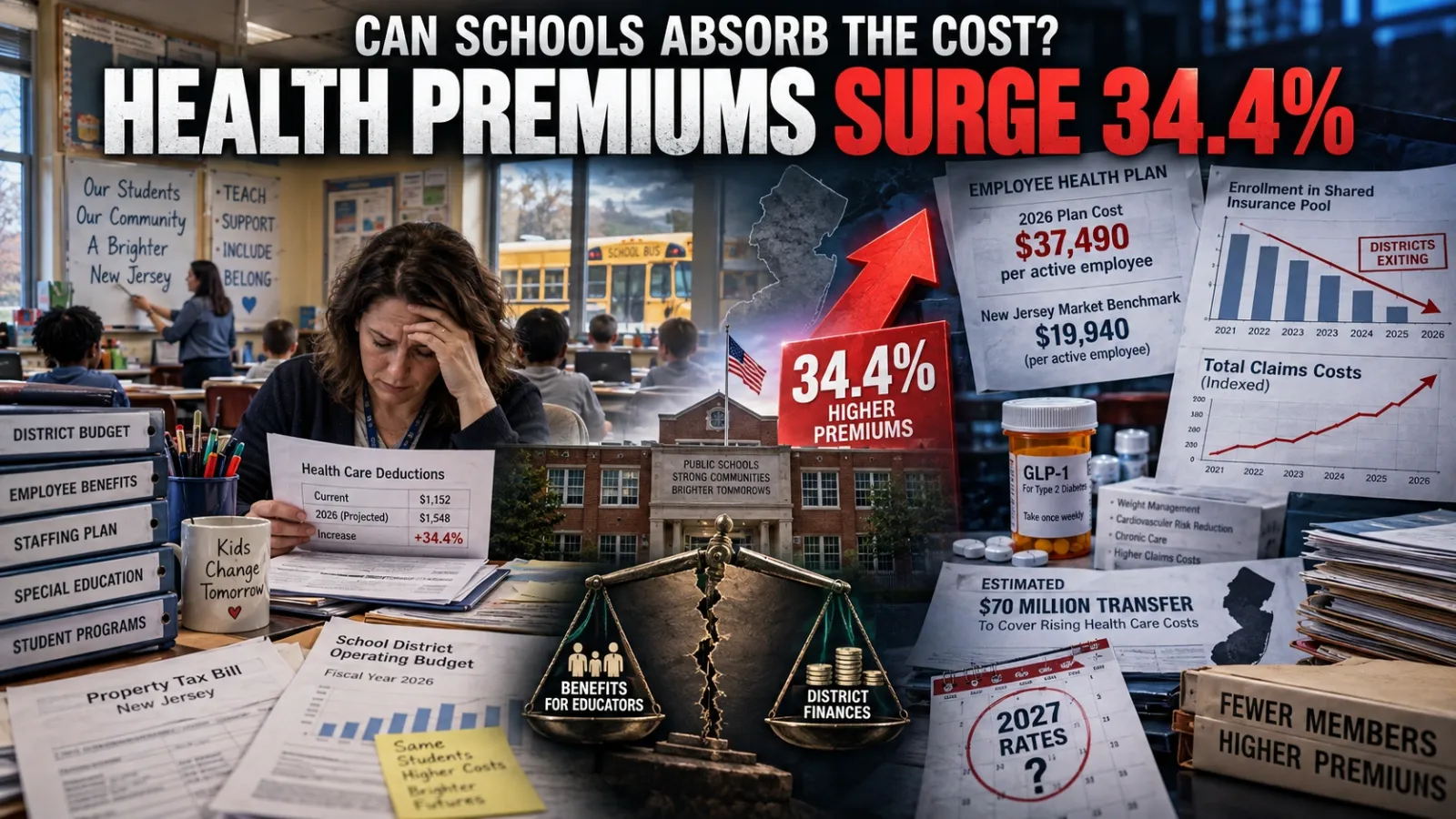
To keep the system temporarily afloat before the new rates take effect in 2027, the state has already been forced to rely on emergency cash infusions. Under a statutory mechanism known as Chapter 28, the Director of the Division of Pensions and Benefits is authorized to temporarily transfer available funds to cover unexpected, mid-year shortfalls. The Division estimated that a $70 million transfer would be required by the end of calendar year 2026 just to cover emerging claims for the struggling school plan. This emergency maneuvering underscores the depth of the fiscal hole the program has fallen into, setting the stage for a chaotic open enrollment period in October 2026.
The Anatomy of an Insurance Death Spiral
To understand how a public health plan reaches the catastrophic point of a 34.4 percent premium hike, one must examine the actuarial phenomenon known as a “death spiral.” The state’s actuarial consultant, Aon, reported that the SEHBP is suffering from severe adverse selection, a scenario that occurs when healthier, lower-risk demographic groups abandon a shared insurance pool to find cheaper rates in the private market. As these healthier groups exit, the remaining insured pool becomes disproportionately older, sicker, and vastly more expensive to cover on a per-capita basis.
This self-reinforcing downward cycle accelerates rapidly with each passing enrollment period. As higher medical claims drive up the baseline premium rates, the increased costs force even more financially strained school districts to seek private market alternatives. When these healthier districts leave, they take their vital premium contributions with them, which in turn drives the state plan’s premiums even higher the following year for those left behind. Aon’s historical and projected data paints a startling picture of this exodus, showing consecutive, accelerating drops in active enrollment over a four-year period.
| Coverage Year | Active Enrollment Decline | Actuarial Context |
|---|---|---|
| 2024 | 5.0% | Initial district departures to private insurance brokers. |
| 2025 | 8.0% | Expanding realization of lower private market benchmark rates. |
| 2026 | 18.0% | Accelerated exodus ahead of anticipated double-digit rate hikes. |
| 2027 (Projected) | 8.75% | Continued flight due to the finalized 34.4% premium increase. |
Following the September 2026 rate approval, union officials estimate that another 50 to 60 school districts will completely abandon the state program to seek private health coverage. However, the state has imposed strict legal guardrails that make leaving a complex and expensive endeavor. Under state law, any district opting out of the state system is legally required to offer private coverage that is strictly “equivalent” to the generous New Jersey Educators Health Plan. Policy analysts have compared this equivalency mandate to forcing districts to provide employees with a luxury vehicle, even when a standard sedan might provide adequate and much cheaper transportation.
The underlying cost disparity between the state plan and the broader market is staggering. Aon projected that the 2026 annual plan cost would hit $37,490 per active employee in local school districts. This figure is 88 percent higher than the New Jersey market benchmark of $19,940 for comparable commercial coverage. Without extraordinary legislative intervention to alter the plan’s underlying design, actuaries warn that this death spiral will inevitably lead to the total collapse of the insurance plan, as it simply runs out of solvent participants.
The GLP-1 Squeeze and the Pharmacy Cost Crisis
While structural flaws primed the state health plan for failure, the sudden and massive explosion in prescription drug costs served as the immediate catalyst for the 2026 crisis. Specifically, the surging popularity of GLP-1 weight-loss and diabetes medications, such as Wegovy, Zepbound, and Ozempic, has decimated employer health budgets nationwide. In the first nine months of 2024 alone, the use of GLP-1 medications by members of the New Jersey state health benefits program surged by an astonishing 99 percent compared to the prior year.
These specialty drugs represent a profound financial challenge due to both their expanding clinical applications and their astronomical branded list prices, which routinely run above $1,000 per month per patient. Because the SEHBP provides exceptionally generous coverage—boasting an average actuarial value of 98 percent, meaning the plan pays 98 percent of all total allowed medical expenses—the insurance pool absorbs almost the entirety of these exorbitant drug costs. The financial impact of this single drug class has been so severe that it entirely overwhelmed the plan’s existing premium structures and emergency reserve funds.
The scale of the GLP-1 phenomenon is difficult to overstate, with roughly one in eight U.S. adults now taking these medications for weight loss or diabetes management. A 2026 report by PwC noted that GLP-1 prescriptions filled in late 2025 were nearly double the number filled the previous year, driving a sharp 9.4 percent growth in prescription drug spending among large employers. This has forced the broader healthcare industry to scramble for cost-containment measures, with programs like Medicare’s temporary “Bridge” demonstration attempting to subsidize patient copays down to $50, even as the real net cost to the system remains near $245 a month.
For self-funded public entities like New Jersey’s school districts, no such federal subsidies exist to soften the blow. These pharmaceutical claims are landing on renewals in numbers that local governments simply never budgeted for, proving that a single pharmaceutical innovation can unravel years of disciplined plan management. Because the state plan is barred from aggressively restricting access to these medications without violating its own benefit mandates, the surge in pharmacy utilization directly translates into the 34.4 percent premium spike passed down to local taxpayers.
A Decade of Legislative Whiplash: Chapter 78 vs. Chapter 44
The current fiscal emergency cannot be fully understood without unpacking a decade of bitter political warfare over public worker compensation in New Jersey. In 2011, then-Governor Chris Christie pushed through landmark legislation known as Chapter 78. Modeled after federal government and private-sector health plans, Chapter 78 forced public employees to contribute a percentage of their actual health insurance premiums, ranging from 3 percent to 35 percent depending on their salary and chosen plan.
The policy was explicitly designed to give workers “skin in the game,” theorizing that if employees shared the financial burden of premium hikes, they would partner with the state to demand cheaper, more efficient healthcare plans. However, this shared incentive model backfired for the workers. Unrelenting medical inflation quickly caused insurance premiums to skyrocket, meaning the workers’ out-of-pocket percentage costs grew substantially faster than their modest base wage increases. This dynamic resulted in a net reduction in actual take-home pay for many teachers, setting the stage for massive union backlash.
Following years of protests, the state legislature, alongside Governor Phil Murphy, unanimously passed Chapter 44 in 2020, effectively capitulating to union demands and reversing the core tenets of Chapter 78. Chapter 44 eliminated the percentage-of-premium model for most school employees, replacing it with a system where contributions are strictly capped at a fixed percentage of their salary. For example, under the newly created New Jersey Educators Health Plan, a teacher at the top of the pay scale with family coverage pays no more than 7.2 percent of their salary toward healthcare, regardless of how high the actual premium climbs.
This legislative reversal created a catastrophic structural flaw when healthcare costs subsequently spiked. Because employee contributions are now tethered to their fixed salaries rather than the fluctuating cost of the insurance premium, school districts are legally forced to absorb almost the entirety of the massive 34.4 percent premium hike. Furthermore, Chapter 44 strictly prohibits the state from making meaningful structural modifications to these specific health plans until January 1, 2028, locking administrators into an inflating cost mechanism with no legal avenue to alter plan designs, deductibles, or copays.
Classroom Casualties and the Property Tax Trap
The human consequences of this legislative whiplash will be felt most acutely not in Trenton’s political chambers, but in local classrooms and community tax bills. In New Jersey, municipal tax levies are generally restricted by a strict 2 percent property tax cap, meaning school districts cannot simply raise taxes indefinitely to cover a 34.4 percent spike in health insurance costs. When a district’s largest fixed personnel expense balloons vastly beyond its legal ability to generate revenue, administrators must cannibalize other parts of the educational budget to make up the difference.
The impending budgetary cuts threaten the foundational pillars of community education. Union representatives have raised loud alarms, alleging that this financial burden translates directly into human losses. Daniel Holub warned the commission bluntly: “This is going to cost jobs. This is going to mean programs are going to get cut. It’s going to mean larger class sizes”. When benefits costs spiral out of control, it quickly morphs into an immediate staffing crisis, forcing school leaders into impossible choices between retaining veteran teachers and funding essential services like special education, art programs, and reliable school bus routes.
For the educators themselves, the crisis undermines the financial viability and appeal of the teaching profession. While Chapter 44 shields many newer teachers from the worst of the premium spike, veteran educators who are still trapped on legacy Chapter 78 plans—such as NJ Direct 10 or 15—face massive out-of-pocket jumps because they still pay a percentage of the total premium. A standard 2 percent annual salary raise is entirely obliterated when a worker is forced to absorb a 34 percent hike in an insurance premium that already costs thousands of dollars a year. This dynamic makes it increasingly difficult for districts to attract and retain talented educators, directly impacting the quality of public instruction.
State legislators are keenly aware of the trap they have built. State Senator Declan O’Scanlon recently proposed legislation to lift arbitrary state aid caps, noting that districts are currently being starved of funds while facing these exploding entitlement costs. If the state fails to provide more direct aid to offset the healthcare premium squeeze, local boards of education will have no choice but to issue sweeping reduction-in-force notices to perfectly capable teachers.
A National Contagion of Escalating Premiums
New Jersey’s public sector emergency is merely a highly concentrated manifestation of a much broader, systemic health insurance crisis plaguing the United States. Across the country, the cost of employer-sponsored health coverage is soaring at rates unseen in over a decade. According to the Kaiser Family Foundation’s (KFF) 2025 Employer Health Benefits Survey, the average premium for family coverage rose to nearly $27,000, while single coverage hit $9,325.
These national figures reflect a relentless upward trajectory that is severely dampening wage growth and household prosperity. In 2025, American workers contributed an average of $6,850 out of their own paychecks for family coverage. Over the last five years, family premiums rose by 24 percent, continuously outpacing standard inflation metrics and average wage growth. Projections for 2026 indicate an even steeper climb, with global consulting firm Aon projecting a 9.5 percent average trend rate increase for employer plans, pushing the average gross cost well above $17,000 per individual employee.
The burden is not just in the premiums, but in what workers must pay before the insurance even kicks in. The 2025 KFF survey revealed that the average annual deductible for single coverage has reached $1,886, reflecting a staggering 43 percent increase over the past decade. More than a third of covered workers now face a general annual deductible of $2,000 or more, fundamentally altering how working-class families interact with the medical system.
Other public school districts across the country are facing fiscal cliffs identical to New Jersey’s. In Norwalk, Connecticut, school officials projected a 33 percent increase in the renewal rate for their teachers’ private Cigna health plan. This massive jump threatened to add roughly $3,000 annually for family coverage, forcing the district and the local federation of teachers to scramble and consider returning to a state partnership plan just to survive the budgetary hit. From Wisconsin facing rising school workers’ compensation rates, to small businesses shedding coverage entirely, the fundamental business model of American healthcare risk arbitrage is buckling under the weight of escalating pharmaceutical costs and medical inflation.
What Happens Next
As the October 2026 open enrollment period begins, school districts and public employees are bracing for the immediate financial impact that will take effect on January 1, 2027. For the 50 to 60 districts expected to flee the state system, the next few months will involve an aggressive, high-stakes scramble to secure private health coverage that meets the state’s strict “equivalency” requirements. Actuaries caution that this mass exodus will likely ensure that the 2028 premium rates for the surviving state plan will be even more catastrophic, as the risk pool continues to degrade.
In response to the looming disaster, a massive lobbying effort is currently underway in the state legislature to bypass the statutory gridlock. The New Jersey Education Association is heavily backing a legislative package, S4438 and its companion bill A5285, formally known as the “Public School Employees’ Health Benefits Trust Act”. This legislation aims to radically overhaul the failing system by removing the health plan from the Department of the Treasury and placing it into a specialized, independent trust fund. Crucially, to stop the death spiral, the proposed legislation would strictly prohibit participating employers from withdrawing from the program once enrolled.
Whether lawmakers can muster the political will to pass this sweeping legislation before the fiscal damage becomes irreversible remains deeply uncertain. What is legally certain is that the structural protections and prohibitions implemented by Chapter 44 will automatically expire on December 31, 2027, reopening the entire system to collective bargaining. Until that legal sunset arrives, local school boards, local taxpayers, and dedicated teachers are trapped in a financial pressure cooker. They are forced to watch as the escalating, unchecked costs of modern healthcare systematically dismantle the municipal budgets meant to educate the next generation.
Sources (33)
- myknowledgebroker.com — Blog
- njspotlightnews.org — School workers health premium costs to jump by more than a third
- njspotlightnews.org — Op ed how special interests brought school health plan to brink
- facebook.com
- reddit.com — Health benefit premiums for nj school workers
- theedadvocate.org — Explosive health insurance hike threatens teacher jobs programs and bus routes 2
- reddit.com — Officials just deadlocked on a 34 insurance hike
- nancyonnorwalk.com — Norwalk teacher health insurance costs rise 33 adding millions to school budget
- nj.gov — Py2026 rate setting analysis education
- chasanlaw.com — As chapter 44 sunsets boards of education are left to ponder whats next
- njsba.org — Chapter 44 09 28 20
- njbia.org — Former state treasurer traces roots of school health plan crisis
- mercer.com — Employers are challenged to keep healthcare affordable as costs soar survey resu
- understoodcare.com — Glp 1 bridge program vs compounded semaglutide real costs
- pewresearch.org — 6 facts about obesity and weight loss drugs in the u s
- brightonhps.com — Resources
- pwc.com — Behind the numbers
- news.gallup.com — Glp usage reaches new high
- nj1015.com — New jersey school health benefits increase
- billtrack50.com
- nj.gov — Sehbp 2027 rate setting analysis
- nj.gov — 2026BBPOS
- njleg.state.nj.us — Bill text
- njea.org — Healthinsurance
- njea.org — Njea statement on adoption of 2027 sehbp rates
- dailyvoice.com — Nj school health plan saved but 34 hike could squeeze your district
- blog.nisbenefits.com — 2025 employer health benefits survey
- reddit.com — Oc average annual premium for employersponsored
- kff.org — 2025 employer health benefits survey
- kffhealthnews.org — Arm and a leg podcast employer sponsored health insurance costs businesses
- hotalinginsurance.com — Employee benefits cost per employee
- nj.gov — FY15BudgetBook
- declanoscanlon.com — Oscanlon statement health and environmental concerns in keyport


Leave a Reply