
The Cost of Classrooms: Why Back-to-School Shopping is Now a Choice of Survival
The late-summer ritual of back-to-school shopping has fundamentally transformed from a celebration of academic renewal into a grueling financial calculation for American households. In 2026, the aisles of mass merchants and discount stores serve as the front lines of a quiet economic crisis, where parents are increasingly forced to choose between outfitting their children for the classroom and securing basic household necessities. Driven by persistent inflation, sweeping tariffs on imported goods, and stagnant real wages, the cost of basic educational supplies has severely outpaced standard household budgets.
This affordability crisis matters now more than ever, as the financial mechanisms families use to survive are showing signs of systemic failure. A heavy reliance on credit cards and “Buy Now, Pay Later” installment platforms has temporarily masked the immediate pain, but underlying financial data reveals a consumer base stretched to the absolute breaking point. The burden of outfitting students is no longer absorbed by discretionary income; it is being quietly shifted onto high-interest credit lines and the personal savings of underpaid public school educators.
The consequences of this shift ripple outward, affecting millions of ordinary workers, families, and local communities across the United States. As the 2026 academic year commences, the intersecting pressures of macroeconomic policy, technological retail shifts, and the erosion of public funding are coming to a head. This is the new American reality, where acquiring a simple notebook or a pair of classroom shoes requires a dangerous sacrifice of long-term financial stability.
The Macroeconomic Squeeze on the Micro-Budget
The aggregate scale of the 2026 back-to-school economy paints a deceptive picture of robust consumer health and massive retail expenditure. According to the National Retail Federation (NRF), total spending for K-12 students is projected to reach an unprecedented $43.3 billion this season. This figure surpasses the previous high of $41.5 billion set in 2023, driven primarily by slight increases in planned spending on shoes, school supplies, and electronics. For families with children in elementary through high school, the NRF estimates an average planned spend of $863.86, a slight uptick from the previous year.
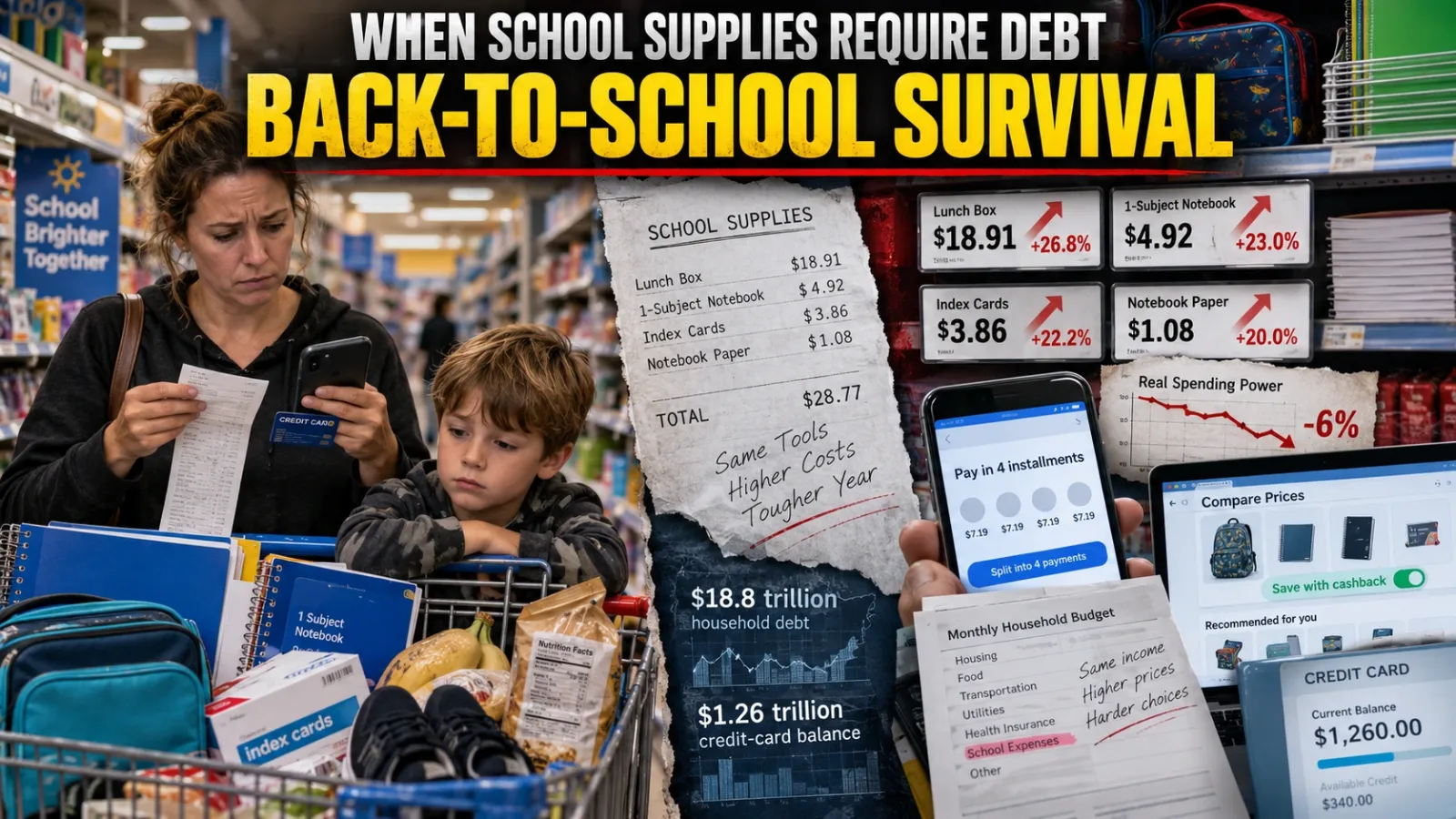
However, these aggregate spending records obscure a much darker, fragmented reality for individual household budgets on the ground. A concurrent 2026 survey by Deloitte reveals that back-to-school spending per child is actually expected to drop by $13 year-over-year to an average of $557. When adjusted for inflation, this nominal decline represents a significant 6 percent decrease in real spending power. This divergence between record overall market spending and shrinking per-child budgets highlights a distressed consumer base that is paying substantially more money simply to acquire less product.
This acute financial squeeze is not distributed equally across American income brackets, revealing a deep socioeconomic divide. Deloitte’s data highlights a striking dichotomy: lower-income and middle-income parents plan to spend 10 percent and 12 percent more, respectively, simply because they cannot avoid purchasing bare-bones essentials that have skyrocketed in price. Conversely, higher-income parents are planning to spend 20 percent less this year by leveraging their ability to delay discretionary purchases. These wealthier households are managing costs by declining to upgrade older laptops or passing on premium apparel, options unavailable to families starting from scratch.
To manage the immediate financial shock, working-class parents are fundamentally altering their shopping behaviors, brand loyalties, and timelines. By early July 2026, 62 percent of shoppers had already begun purchasing back-to-school items, desperately attempting to spread the financial damage over multiple summer paychecks. Consumers are aggressively prioritizing base value, with 71 percent of parents stating they will abandon and switch brands if their preferred label becomes too expensive. Furthermore, more than half of parents plan to abandon name brands entirely in favor of more affordable private-label store products.
Tariffs, Inflation, and the Twenty-Seven Percent Lunchbox
The microeconomic pain felt at the cash register is the direct, unavoidable result of macroeconomic trade policies and stubborn domestic inflation. In August 2026, the U.S. Bureau of Labor Statistics reported that the Consumer Price Index (CPI) for all urban consumers rose 3.4 percent year-over-year. While the overall food index rose by 2.7 percent, specific categories like apparel increased by 3.6 percent, and energy costs surged by a punishing 16.3 percent. These unavoidable baseline cost increases leave families with virtually no discretionary income left to absorb seasonal educational expenses.
Compounding standard domestic inflation are the sweeping tariffs implemented on imported consumer goods over the past several years. According to a joint analysis by The Century Foundation and the Groundwork Collaborative, tariffs introduced under the Trump administration have severely disrupted the supply chain for basic educational materials. Economists note that these import taxes have trickled down directly to the American consumer, raising the price of a standard list of school supplies by an average of 7.7 percent over the previous year. Some industry estimates project that as the full, cascading effect of these tariffs takes hold, retail supply prices could eventually increase by as much as 15 percent.
The specific price hikes on non-negotiable classroom essentials have been particularly brutal for working-class parents operating on fixed incomes. The Century Foundation report highlights that the cost of a standard one-subject notebook has jumped 23 percent to $4.92. Meanwhile, a simple pack of index cards now costs $3.86, representing a 22.2 percent increase, and notebook paper has risen by 20 percent. Even the essential tools required for bringing food to school have become luxury items for some struggling families.
| Essential School Item | 2026 Average Price | Percentage Increase from 2025 |
|---|---|---|
| Lunch Box | $18.91 | +26.8% |
| One-Subject Notebook | $4.92 | +23.0% |
| Index Cards | $3.86 | +22.2% |
| Notebook Paper | $1.08 | +20.0% |
The cost of filling that expensive lunchbox has also escalated dramatically, placing a crushing dual burden on parents. Pantry staples frequently used for school lunches have seen massive inflationary spikes, with sandwich bread up 21.8 percent and apple juice rising by 20 percent. Fresh produce has become increasingly inaccessible, as the price of blueberries skyrocketed by 48 percent to $4.89. With gasoline prices also remaining highly elevated, the daily financial cost of simply transporting a child to school and keeping them fed has become a primary stressor.
Artificial Intelligence and the New Retail Algorithm
As families desperately search for avenues to mitigate these rising costs, technology and artificial intelligence have become central to the shopping experience. Retailers are increasingly deploying algorithmic pricing and targeted digital promotions to capture the attention of highly price-sensitive consumers. Shoppers are actively responding to these digital ecosystems, with 25 percent of parents planning to utilize cashback websites and browser extensions to shave dollars off their final totals. This technological reliance indicates that the labor of back-to-school shopping has shifted from physical store aisles to complex digital price-tracking.
Interestingly, the integration of advanced technology into consumer habits has produced counterintuitive financial results for many households. According to Deloitte’s 2026 survey, parents who use Generative AI (GenAI) to research products and compare prices exhibit the highest average spend per child, coming in at $737. This figure is significantly higher than the $557 average for the general shopping population. Parents who deploy a broader range of digital tools in their shopping process consistently end up spending over $100 more on average than non-users.
This divergence suggests that while AI tools are marketed as money-saving assistants, their underlying algorithms often function as highly effective upselling mechanisms. GenAI platforms may streamline the discovery of premium products, identify trending “must-have” items, or inadvertently lock consumers into higher-priced brand ecosystems. When 45 percent of parents report that their child specifically requested a “must-have” item, the digital reinforcement of these trends often overrides initial parental budgets. In this environment, the algorithmic curation of school supplies can subtly transform a budget-conscious shopping trip into a premium retail experience.
Furthermore, the data reveals a stark divide in how different demographics interact with physical versus digital retail spaces. While online shopping remains a dominant force, in-store shoppers actually expect to spend less this year, averaging $521 per child. Conversely, parents who do the majority of their shopping online expect to spend significantly more, averaging $614. This implies that the frictionless nature of digital checkout, combined with algorithmic recommendations, effectively bypasses the psychological barriers that typically prevent overspending in a physical store.
Financing Pencils: The Buy Now, Pay Later Boom
Faced with double-digit price increases on non-negotiable items and the subtle upselling of digital retail, parents are increasingly turning to high-risk financing to bridge the gap. An Omnisend survey of U.S. consumers found that 45 percent of households plan to use “Buy Now, Pay Later” (BNPL) financing for their 2026 back-to-school purchases. This marks a significant and alarming increase from the 39 percent of households that relied on short-term installment loans for school supplies in 2025. The normalization of financing low-cost consumer goods highlights a severe liquidity crisis among ordinary families.
The depth of this reliance on point-of-sale debt is a glaring indicator of widespread financial distress among middle and lower-income households. Nearly one in three households expect BNPL services to cover more than 50 percent of their overall school spending this year. Using installment loans—which are historically reserved for large, durable goods like furniture or appliances—to finance consumable items like pencils, glue sticks, and children’s shoes represents a fundamental deterioration in consumer purchasing power. Furthermore, a Credit Karma survey indicates that nearly 45 percent of parents plan to take on traditional credit card debt just to cover the cost of back-to-school shopping.
This localized debt accumulation is occurring against the backdrop of a highly leveraged and fragile American consumer base. The Federal Reserve Bank of New York’s Q2 2026 Quarterly Report on Household Debt and Credit revealed that overall household debt stands at a staggering $18.8 trillion. While mortgage balances saw a slight decline, total credit card balances rose by $21 billion to reach $1.26 trillion, and auto loan balances increased by $28 billion. With new delinquencies for credit cards and auto loans remaining at elevated levels, parents are financing their children’s education on a foundation of precarious debt.
To keep these rising debt levels manageable, families are actively slashing their spending in other vital areas of daily life. The Omnisend survey notes that 30 percent of parents plan to reduce costs for family activities and entertainment to afford basic school expenses. Meanwhile, 21 percent are draining savings accounts originally meant for other purposes, and 18 percent are resorting to borrowing funds directly from friends or family members. The psychological anxiety surrounding these financial gymnastics is palpable, with 40 percent of parents expecting to experience more financial stress this season than they did in the previous year.
The Educators Subsidizing a Fractured System
While parents are leveraging their financial futures to supply their children, the American public education system is being quietly subsidized by the very people hired to teach in it. The RAND Corporation’s 2026 State of the American Teacher Survey revealed that an overwhelming 94 percent of educators pay for classroom necessities out of their own pockets. On average, these teachers report spending just over $600 annually on supplies that their respective school districts fail to provide. If these estimates hold true nationwide, educators are subsidizing the public school system to the tune of nearly $3 billion per year.
This heavy financial burden falls disproportionately on educators serving the nation’s most vulnerable and economically disadvantaged student populations. According to the RAND survey data, teachers working in high-poverty schools spend an average of $759 out of pocket, significantly more than the $560 averaged by teachers in low-poverty schools. These funds are rarely spent on luxury classroom decorations or superfluous items. Instead, they cover critical consumables like paper, pencils, tissues, and even daily snacks to ensure that hungry children can focus on their academic lessons.
The personal financial toll on these educators is severe, particularly when juxtaposed against stagnant real wages and soaring living costs. The RAND survey notes that teachers reported an average base salary of $75,599 in 2026, but only four in ten experienced an inflation-adjusted pay raise. Kathryn Vaughn, an elementary art teacher in Tennessee with two decades of experience, is given a yearly school budget of just $200 and two boxes of copy paper for her entire program. To ensure her students have access to basic art experiences, she spends over $1,000 of her own money each year, representing tens of thousands of dollars over her career.
In some extreme cases, the expectation to self-fund a functional classroom pushes educators to the absolute brink of financial ruin. Lyric Johnson, a second-grade teacher at a Title I school in Colorado, spent $1,500 on her classroom between June and September of 2026 alone. Because she received only 150 pencils from her district for the entire year, she continually buys basic supplies alongside culturally relevant books for her low-income students. Without a cost-of-living adjustment to offset these rising prices, the financial strain ultimately forced Johnson to box up her life and move to a cheaper apartment during her fall break.
Legislative Band-Aids: The Illusion of Tax Holidays
Recognizing the intense financial pressure facing their constituents, numerous state legislatures have attempted to provide relief through late-summer sales tax holidays. In 2026, over a dozen states, including Texas, Florida, and Ohio, suspended their state sales taxes on specific categories of school-related goods. These holidays typically last for a three-day weekend in August, allowing parents to purchase clothing, footwear, and limited school supplies without paying the standard state and local levies. For a family outfitting multiple children, these highly publicized holidays are marketed as a vital financial lifeline.
However, consumer advocates and economic analysts caution that these tax holidays offer merely a superficial bandage over a much deeper, structural affordability crisis. In states like Illinois, the 2026 holiday provided a 5 percent reduction in the state sales tax rate for qualifying clothing and school supplies priced under $125. While saving a few dollars at the register is undoubtedly welcome for cash-strapped parents, a 5 percent tax break mathematically fails to offset the 20 to 26 percent price hikes seen on items like notebooks and lunchboxes. The core issue plaguing families is not the localized tax rate, but the astronomically inflated base price of the goods themselves.
| State | 2026 Sales Tax Holiday Dates | Key Exemptions and Caps |
|---|---|---|
| Florida | July 20 – August 20 | Clothing ≤$100, Supplies ≤$50, Computers ≤$1,500 |
| Texas | August 7 – August 9 | Clothing, Footwear, Supplies, Backpacks ≤$100 |
| Illinois | August 7 – August 16 | Clothing/Footwear <$125 (State tax reduced by 5%) |
| Ohio | August 7 – August 9 | Clothing ≤$75, Supplies & Instructional Materials ≤$20 |
| Connecticut | August 16 – August 22 | Clothing, Footwear, Backpacks <$300 |
Furthermore, the strict and often confusing legislative caps placed on these tax holidays can severely frustrate consumers attempting to budget accurately. In Ohio, clothing items are only exempt if they are priced at $75 or less, while instructional materials are capped tightly at $20. In Texas, the exemption applies to standard backpacks, but strictly excludes specific luggage or computer bags, leading to confusion and unexpected costs at the checkout counter. These arbitrary bureaucratic thresholds mean that families relying on the holiday to purchase necessary technology or durable winter gear are often left paying full price.
Retail analysts also note that the rigid timing of these holidays forces families to condense their spending into a single, high-stress weekend. While 62 percent of shoppers reported starting their purchasing in early July to spread out their financial burden, the structure of tax holidays incentivizes waiting until August. This creates a massive bottleneck that strains retail inventories and forces lower-income parents to gamble on whether essential items will even be in stock by the time the tax exemption goes into effect. Ultimately, while politically popular, tax-free weekends shift the narrative away from the systemic underfunding of public education and the unchecked inflation of consumer goods.
The Invisible Hardship: Losing the Data to Fight Poverty
The inability to afford a binder or a pair of classroom shoes is rarely an isolated financial issue; it is almost always indicative of broader household distress. Data from the U.S. Census Bureau’s experimental Household Pulse Survey vividly illustrates the precarious nature of the American family budget in 2026. Recent findings indicate that 37.7 percent of all households report finding it “somewhat” or “very difficult” to pay for their usual household expenses over a mere seven-day period. When families are operating this close to the financial edge, the sudden requirement to spend $500 or more per child in August triggers an immediate crisis of prioritization.
This intense prioritization often results in a direct, tragic trade-off between acquiring school supplies and maintaining basic food security. The expiration of pandemic-era universal free school meal programs has actively compounded this financial hardship for millions of vulnerable households. Without guaranteed free meals, families living just above the poverty line must suddenly redirect their limited funds to cover the daily cost of school lunches, which themselves have been subject to severe food-price inflation. Consequently, parents are forced to rely even more heavily on BNPL programs for physical school supplies just to ensure they have enough liquid cash to feed their children throughout the month.
Tracking the precise, localized impact of these compounding hardships is becoming exceedingly difficult for researchers, economists, and policymakers. In early 2025, the Census Bureau restructured the Household Pulse Survey into the Household Trends and Outlook Pulse Survey (HTOPS), transitioning to a cross-sectional design by March 2026. Crucially, due to stringent budget constraints and limitations in data collection methods, the Census Bureau stopped publishing state-level hardship data entirely. The loss of SMS outreach and lower-than-average response rates prompted a shift to more expensive, traditional data collection, forcing a reduction in the survey’s geographic granularity.
This resulting “data deficit” actively harms grassroots efforts to direct relief to the specific communities being crushed by the back-to-school economic shock. Without state-level metrics to prove the extent of local suffering, child advocacy groups argue it is vastly more difficult to secure vital funding for targeted local interventions. Efforts to organize expanded school supply drives, emergency nutritional assistance, or local utility relief are severely hampered when the statistical evidence of regional poverty vanishes. As families silently sink into credit card debt and teachers quietly drain their savings, the lack of localized statistical data ensures that much of this economic suffering remains invisible to the wider public.
What Happens Next
The financial trauma of the 2026 back-to-school season points toward a permanent, structural shift in American consumer behavior and retail economics. Families have painfully learned that brand loyalty is a luxury they can no longer afford, with the majority now conditioned to seek out private-label goods and utilize digital tools to hunt for aggressive discounts. Retailers will be forced into an ongoing, brutal race to the bottom, continuously squeezing their global supply chains to offer deeply discounted essentials to a consumer base that has completely maxed out its credit lines. As the reliance on “Buy Now, Pay Later” normalizes for everyday consumable goods, economists warn of a looming wave of micro-defaults that could severely disrupt the broader fintech sector.
For the public education system, the fragile status quo of relying on the personal charity of educators is rapidly reaching an unsustainable breaking point. Teachers are already exiting the profession in high numbers due to a complex, demoralizing web of low pay, high financial stress, and continually expanding administrative workloads. When dedicated educators are literally priced out of their own homes because they spent their stagnant wages on pencils and snacks for their students, the cultural narrative of “teaching as a calling” loses its power to retain vital talent. Unless systemic legislative action is taken to adequately fund classroom supplies and stabilize the cost of living for working families, the back-to-school season will cease to be a celebration of academic renewal, solidifying instead as an annual crisis of basic survival.
Sources (61)
- presspublications.com — Nrf report back to school shopping,111379
- wsls.com — Back to school spending ticks up to just over 863 on average for families with s
- nrf.com — Value drives back to school shopping as classes begin
- nrf.com — Majority back class shoppers have already begun purchasing school items
- nrf.com — Majority of back to school shoppers get a head start on the season
- wrnjradio.com — Back to school spending expected to hit record levels as families start shopping
- nrf.com — 2026 back to school consumer trends webinar
- nrf.com — Back class data center
- nrf.com — Back to school
- retaildive.com
- investmentnews.com
- deloitte.com — Back to school survey
- retailtouchpoints.com
- deloitte.com — Deloitte back to school spending holds steady
- action.deloitte.com — Parents do the math on back to school spending
- deloitte.com — Deloitte 2025 back to school survey
- bls.gov — Cpi
- bls.gov — Cpi 03112026
- bls.gov — Cpi 04102026
- bls.gov — Cpi
- bls.gov — Cpi
- forbes.com — Fed funds rate history 1
- bls.gov — Cpi.t02
- britannica.com — Consumer Price Index goes thrifting
- lendingtree.com — Back to school stress
- support.google.com
- retaildive.com
- empower.com — Buy now pay later statistics
- chargeflow.io — Buy now pay later statistics
- grandviewresearch.com — Buy now pay later market report
- kpmg.com — Kpmg consumer pulse survey back to school final
- richmondfed.org — Eb 26 05
- ksvt.org — The price teachers pay
- nea.org — Out pocket spending school supplies adds strain educators
- ncae.org — New report reveals nc teachers spend over 1600 out pocket supply classrooms rank
- nea.org — Rising cost school supplies increases burden teachers
- nea.org — Classroom expenses push teachers high needs schools financial brink
- eagleeye.news — Opinion teachers should not have to pay for students supplies out of pocket
- edweek.org — Classroom funding
- rand.org — RAND RRA4404 2
- k12dive.com
- edweek.org
- cbsnews.com — Back to school supply lunch costs tariffs
- indexbox.io — Back to school costs surge families face nearly 8 higher supply prices in 2026
- edweek.org
- groundworkcollaborative.org — Back to school bummer classroom supplies lunchbox essentials up nearly 11 this y
- cbsnews.com — School supply cost inflation 2026
- tcf.org — Higher tariffs may worsen child care struggles
- tcf.org — As students head back to school families face 11 price hikes
- aninews.in — Us household debt drops by usd 13 bn to usd 188 tn in q2 2026 federal reserve ba
- seekingalpha.com — 4630835 household debt balances edge down in q2 new york fed
- newyorkfed.org — Hhdc
- tax.illinois.gov — Fy 2026 30
- taxadmin.org — 2026 sales tax holidays
- salestaxinstitute.com — Sales tax holidays
- avalara.com — Sales tax holidays.html
- fidelity.com — Tax free weekend
- stripe.com — Tax free weekend 2026
- census.gov — Household pulse survey
- communitysolutions.com — Census stops publication state level hardship data
- ageconsearch.umn.edu — Eb 37


Leave a Reply