
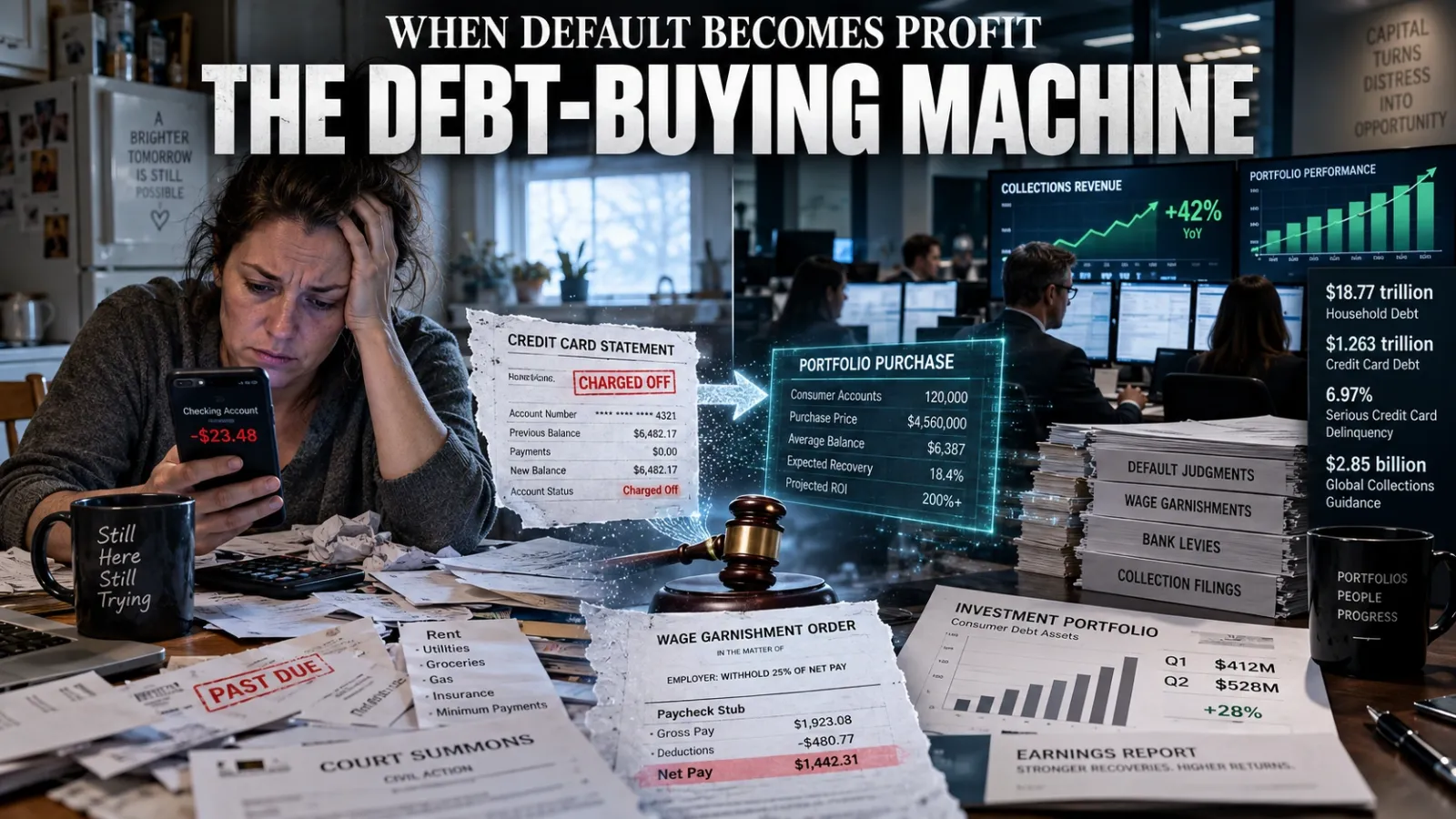
The Economics of Buying Despair
Encore Capital Group’s financial results for the first half of 2026 paint a picture of extraordinary corporate success amid widespread consumer distress. The company’s first-quarter net income skyrocketed by 84% to $86.2 million, delivering earnings per share of $3.86—a 100% increase compared to the previous year. By the second quarter, ending June 30, 2026, the company posted a revenue increase of 11.3% year-over-year, reaching $491.9 million.
These windfalls are entirely dependent on the failure of American consumers to keep up with their credit card bills. Encore’s business model involves purchasing portfolios of charged-off consumer debt from banks and credit card issuers at deep discounts. Historically, the company has paid between 33 and 48 cents for every dollar it actually expects to collect from borrowers.
In the first quarter of 2026 alone, Encore deployed $363 million to purchase global debt portfolios. The company allocated a massive $316 million of that capital specifically to the U.S. market through its domestic subsidiary, Midland Credit Management (MCM). This domestic focus was driven by highly attractive market conditions and higher available returns in the United States compared to Europe.
During the company’s first-quarter earnings call, CEO Ashish Masih openly celebrated the macroeconomic conditions fueling this growth. He noted that U.S. credit card charge-off rates had hit their highest levels in more than a decade, remaining elevated above 4%. This steady stream of defaulted accounts provides a “very robust environment” with favorable pricing and strong supply, allowing the company to raise its full-year 2026 guidance for global collections to an estimated $2.85 billion.
| Encore Capital Group Financials | Q1 2026 | Q2 2026 |
|---|---|---|
| Total Revenues | $475.4 Million | $491.9 Million |
| Global Collections | $718.4 Million | $736.9 Million |
| Net Income | $86.2 Million | $105.5 Million |
| U.S. Portfolio Purchases | $316.0 Million | $372.3 Million |
| Earnings Per Share (EPS) | $3.86 | $2.81 |
The financial markets have aggressively rewarded this performance, transforming consumer debt into a highly lucrative asset class. Encore’s stock price surged over 148% in the year leading up to late 2026, peaking near 52-week highs before experiencing a modest pullback driven by broader Treasury yield concerns. The company’s stock appreciation has been largely driven by a significant expansion in its price-to-earnings multiple, reflecting deep investor confidence in the sustainability of America’s debt crisis.
To optimize its capital structure, Encore executed a massive $1 billion debt refinancing in May 2026. While this move incurred $30.5 million in upfront refinancing costs during the second quarter, it is projected to save the company approximately $15 million in annual interest expenses going forward. This financial engineering ensures that an even greater percentage of the money extracted from consumers will flow directly to the company’s bottom line.
A Macroeconomic Engine of Default
To understand the sheer volume of debt flowing into Encore’s portfolios, one must look at the immense financial pressure crushing American households. The Federal Reserve Bank of New York’s Household Debt and Credit Report for the second quarter of 2026 reveals that total U.S. household debt stands at a near-record $18.77 trillion. While mortgage and student loan balances saw slight declines, auto loan and credit card balances continued their relentless upward march.
Credit card debt serves as the primary fuel for the debt-buying industry, and those balances grew by $21 billion in the second quarter to reach $1.263 trillion. This represents a significant increase from previous years, reflecting a populace that is increasingly relying on revolving credit to cover basic living expenses. The average annual percentage rate (APR) on credit cards nearly doubled over the past decade, jumping from 12.9% in 2013 to 22.8% by the end of 2023, making it incredibly difficult for borrowers to pay down their principal balances.
More alarming than the total balance is the rate at which consumers are failing to pay their minimum obligations. The flow into serious delinquency—defined as 90 days or more past due—hit 6.97% for credit cards in the second quarter of 2026. This spike in serious delinquency represents millions of individuals who have exhausted their financial safety nets and are spiraling toward default.
| U.S. Household Debt (Q2 2026) | Total Balance | Change from Q1 2026 | Serious Delinquency Rate |
|---|---|---|---|
| Total Household Debt | $18.77 Trillion | -$13 Billion | 2.57% |
| Credit Card Debt | $1.263 Trillion | +$21 Billion | 6.97% |
| Auto Loan Debt | $1.713 Trillion | +$28 Billion | 3.00% |
| Student Loan Debt | $1.651 Trillion | -$7 Billion | 7.83% |
According to Federal Reserve surveys, the total amount of credit card debt held by consumers facing financial difficulty has surged in recent years. Using merged credit bureau data, average balances increased by more than 35% among those who reported they were “finding it difficult to get by,” translating to an average balance increase of over $2,500 for the most vulnerable borrowers. These are the exact accounts that major banks eventually write off as losses and sell in bulk to debt buyers.
The transition from a struggling household to a lucrative debt portfolio is swift, highly systematic, and largely invisible to the consumer until the collection notices arrive. When a credit card account goes unpaid for approximately 180 days, the original creditor charges it off as a bad debt. The bank then bundles these charged-off accounts into massive data files containing thousands of similar profiles and auctions them off to companies like Encore Capital Group.
Upon winning these bids, Midland Credit Management essentially acquires the legal right to hound the consumer for the full original balance, plus potentially accrued post-judgment interest. This remains true despite the fact that MCM purchased the debt for a mere fraction of its face value. This stark asymmetry—buying despair at a discount and collecting it at full price—is the bedrock of the entire debt-buying industry.
The Assembly Line of Debt Litigation
Once Midland Credit Management acquires these defaulted accounts, the company deploys a vast, highly automated apparatus to extract payment. If digital servicing, physical letters, and persistent phone calls fail to produce a settlement, MCM frequently escalates the matter to the state civil court system. Debt buyers are now the dominant force in local courts across the United States, effectively transforming public judicial infrastructure into private collection agencies.
Research by The Pew Charitable Trusts reveals the staggering scale of this litigation assembly line over the past two decades. From 1993 to 2013, the number of debt collection lawsuits more than doubled from 1.7 million to 4 million nationwide. This surge caused debt claims to consume an increasingly massive share of civil dockets, rising from an estimated 1 in 9 civil cases to 1 in 4.
By 2023 and continuing into 2026, a tiny handful of companies accounted for the vast majority of these legal filings. Entities like Midland Credit Management, Portfolio Recovery Associates, and LVNV Funding routinely submit lawsuits in massive batches, dominating the court systems in major metropolitan areas. In Philadelphia County, for example, just 10 bulk filers were responsible for nearly 79% of all debt collection lawsuits between 2020 and 2022.
These lawsuits are rarely decided on their legal merits or through a rigorous examination of the facts. Instead, the debt buyer’s business model relies heavily on the statistical likelihood that the consumer will simply not show up to court to defend themselves. When a defendant fails to appear, the presiding judge automatically issues a default judgment in favor of the plaintiff, granting the debt buyer sweeping legal powers to forcibly collect the money.
The rates of these default judgments highlight a systemic failure in consumer legal protections. In jurisdictions like Detroit, default judgment rates for debt collection cases can reach nearly 70%. Philadelphia and Chicago see default rates of 59% and 53%, respectively, meaning the majority of defendants lose their cases automatically without ever speaking to a judge.
The reasons consumers fail to participate in their own defense are rooted in systemic disenfranchisement and confusing legal bureaucracy. Many defendants report never receiving formal notice of the lawsuit, either because the legal summons was sent to an old address or due to fraudulent service practices commonly known as “sewer service”. A Pew survey of defendants in Philadelphia found that 22% of those who did not attend their hearings simply did not know a lawsuit had been filed against them.
Furthermore, the procedural hurdles required to fight a lawsuit often present insurmountable barriers to low-income individuals. In many states, consumers must pay filing fees—sometimes exceeding $200—just to submit a formal written answer to the court. Faced with confusing paperwork, aggressive opposing counsel, and fees they cannot afford, most working-class defendants simply give up, allowing the default judgment machinery to run its course.
The Human Cost: Garnishments and Disparities
A default judgment in favor of a debt buyer like Midland Credit Management is not merely a negative mark on a credit report. It is a legal gateway to severe financial deprivation. Armed with a court order, debt buyers can legally seize a portion of a worker’s paycheck through a process known as wage garnishment.
Under federal law, collectors can seize up to 25% of a consumer’s disposable earnings. For families already living paycheck-to-paycheck, losing a quarter of their take-home pay instantly plunges them into deeper poverty. This aggressive extraction often creates a cascading financial crisis, leading to bounced checks, missed utility payments, and eventual eviction.
Beyond wage garnishment, debt buyers can execute bank account levies with a court’s permission. This process freezes a consumer’s funds and forcibly withdraws whatever cash they have managed to save, often without advanced warning. For the most vulnerable consumers, a single default judgment can mean the difference between housing security and catastrophic financial ruin.
The geographic and racial disparities inherent in these collection practices are stark and have been thoroughly documented by sociologists and consumer advocates. Pew’s analysis indicates that court judgments in debt cases disproportionately impact communities of color across the United States. In Philadelphia, Black defendants are significantly overrepresented, accounting for 49% of debt collection lawsuits despite making up only 41% of the city’s households.
Even after accounting for differences in income, the rate of default judgments in predominantly Black neighborhoods is often nearly double that of predominantly White neighborhoods. In Michigan, three out of four consumers with a judgment against them see their wages or bank accounts garnished, but those living in Black neighborhoods are 1.2 times more likely to experience garnishment than their White counterparts. This essentially weaponizes the civil justice system to extract wealth from historically marginalized communities.
Adding insult to injury, the amount consumers are ultimately forced to pay often far exceeds their original debt. Judgments regularly add court costs, plaintiff attorneys’ fees, and post-judgment interest to the principal balance. In some states, post-judgment interest rates can legally reach 12%, ensuring that the debtor remains trapped in a cycle of repayment long after the court case has concluded.
A History of Regulatory Run-Ins
Encore Capital Group’s aggressive collection methods and reliance on automated litigation have repeatedly drawn the ire of federal regulators. The company’s practices came under severe national scrutiny in 2015 when the Consumer Financial Protection Bureau (CFPB) initiated a major enforcement action against Encore and its various subsidiaries. The Bureau’s investigation revealed systemic abuses that struck at the core of the company’s high-volume business model.
The CFPB found that Encore was essentially operating a “robo-signing” scheme, churning out tens of thousands of lawsuits using affidavits signed by employees who had never actually reviewed the consumers’ underlying account records. Furthermore, the company was caught attempting to collect on “time-barred debt”—debts so old that the legal statute of limitations to file a lawsuit had already expired. To resolve these charges, Encore entered into a consent order that strictly prohibited them from suing consumers without verified, account-level documentation.
However, the lucrative nature of the debt-buying business apparently outweighed the deterrent effect of the initial regulatory action. In September 2020, the CFPB filed a new lawsuit against Encore, alleging widespread and systemic violations of the 2015 agreement. The Bureau claimed that the company had continued its illegal practices, prioritizing collection volume over legal compliance.
The 2020 CFPB complaint detailed how Midland Credit Management and its affiliates continued to sue consumers on expired debts, blatantly ignoring the restrictions placed upon them. The company also allegedly engaged law firms to collect money without providing mandatory legal disclosures to the consumers. When consumers actively disputed their debts and requested original documentation, Encore frequently failed to provide the required proof within the mandatory 30-day window.
Furthermore, Encore was cited for failing to disclose international transaction fees to consumers. Because the company utilizes foreign call centers in countries like India and Costa Rica, consumers making payments over the phone were sometimes hit with unexpected banking fees. The CFPB argued that this effectively denied consumers the opportunity to make informed choices about their preferred payment methods, directly violating the Consumer Financial Protection Act.
To resolve the 2020 lawsuit, Encore agreed to a stipulated final judgment, paying a $15 million civil money penalty and an additional $79,308 in direct consumer redress. The company was subjected to five more years of stringent regulatory monitoring to ensure compliance. Yet, when viewed alongside the company’s massive $491.9 million in quarterly revenue for Q2 2026, these multimillion-dollar fines appear to function less as a deterrent and more as a predictable operating expense.
The AI and Tech-Driven Collection Machine
To maximize profitability and manage millions of defaulted accounts, Encore Capital Group relies heavily on advanced data analytics and algorithmic profiling. The company does not simply call every debtor equally; it utilizes proprietary scorecards to analyze consumer behavior, employment status, and macroeconomic data. This high-tech approach allows the company to determine exactly which accounts are most likely to yield a return, separating consumers who literally cannot pay from those who can be pressured into compliance.
The integration of artificial intelligence and digital consumer portals is rapidly transforming the collection landscape. Midland Credit Management increasingly directs consumers to specialized payment websites, encouraging them to set up automatic recurring withdrawals to resolve their balances. While the company frames this as “empowering consumers” to regain financial independence, it also sharply reduces the company’s operational overhead and minimizes direct human interaction.
This relentless pursuit of automated efficiency has occasionally breached consumer privacy and telecommunications laws. Companies across the debt collection and financial services space, including MCM, have frequently run afoul of the Telephone Consumer Protection Act (TCPA). This federal law restricts the use of automated dialers and artificial or prerecorded voice messages to call mobile phones without the recipient’s prior express consent.
Class action lawsuits against major creditors and their collection partners for TCPA violations have resulted in massive financial settlements. Historic settlements in the industry have ranged from tens of millions to over $200 million, highlighting the pervasive and intrusive nature of automated harassment in debt collection. When collection agencies employ predictive dialers to churn through thousands of numbers an hour, consumers often face a barrage of unwanted calls intended to wear down their psychological resistance.
Despite these legal and ethical controversies, the data-driven model remains highly lucrative for Encore. The company boasts of achieving significant operating leverage by holding its total headcount relatively flat while driving massive increases in total collections. By treating human financial distress as a pure data optimization problem, the company ensures that its profit margins continue to expand regardless of the human suffering at the other end of the phone line.
Defending the Indefensible: The Consumer Fightback
The core mechanism enabling this immense transfer of wealth is a stark imbalance of power within state civil courts. When companies like Midland Credit Management file a lawsuit, they are virtually always represented by specialized local debt collection attorneys who process cases in massive batches. In contrast, consumer advocates and court data reveal that more than 90% of defendants in these cases are entirely unrepresented by legal counsel.
This lack of representation guarantees a deeply asymmetrical legal process. Because debt buyers purchase accounts as raw data files, they are often missing the original signed contracts, terms and conditions, or complete histories of fees and payments. They rely on the fact that an unrepresented consumer will not know how to challenge the admissibility of mass-produced affidavits or demand proper legal standing.
When a consumer does manage to hire an attorney, the dynamics of the lawsuit change dramatically. A defense lawyer will typically demand a complete “chain of title”—a documented series of assignments proving that the specific debt was legally transferred from the original creditor, to the debt buyer, and finally to the plaintiff. If a consumer challenges the chain of title or the statute of limitations, the debt buyer’s case frequently collapses due to insufficient evidence, leading to a dismissal.
Statistical analyses confirm that legal representation drastically alters the outcome of debt litigation. One comparative study by the Debt Collection Lab found that securing legal representation is associated with a 91.1% decrease in a defendant’s likelihood of receiving a default judgment. Unfortunately, the cost of hiring a lawyer often exceeds the total amount of the disputed debt, leaving low-income consumers with a mathematical dilemma that discourages them from mounting a defense.
Consumers also have rights under the Fair Debt Collection Practices Act (FDCPA) and the Fair Credit Reporting Act (FCRA) to counter-sue for illegal collection tactics. If Midland Credit Management reports inaccurate information to credit bureaus or uses abusive language, consumers can seek statutory damages up to $1,000 plus attorney’s fees. Consumer complaint databases maintained by the CFPB are filled with desperate narratives regarding MCM suing for debts resulting from identity theft or debts that were previously settled, showing that the fight for accurate reporting is a constant battle for borrowers.
When consumers push back or negotiate, they often find that the debt buyer is willing to accept significantly less than the face value of the debt. Because companies like Encore purchase debt at such steep discounts, they can still turn a healthy profit even if they agree to a massive reduction. Industry statistics show that when debts are settled out of court, they are resolved, on average, for 65.8% less than the original amount the collector sued for.
What Happens Next
As 2026 draws to a close, the macroeconomic forces sustaining the debt-buying industry show no signs of reversing. Credit card interest rates remain highly punitive, and the lingering effects of inflation continue to squeeze household budgets, ensuring a steady, long-term pipeline of defaulted accounts. Encore Capital Group expects to purchase up to $1.5 billion in debt portfolios throughout the year, projecting that U.S. credit conditions will remain highly favorable for its extraction model.
Federal regulatory shifts will also continue to shape the battlefield in the coming year. The CFPB’s aggressive attempts to cap credit card late fees at $8—which would have provided some relief to struggling borrowers and limited the inflation of overall balances—were vacated by a federal court order in 2025. The failure of this rule leaves consumers exposed to escalating penalty charges, which eventually compound and get sold to companies like Encore.
However, the CFPB continues to aggressively monitor debt collection practices under Regulation F, focusing specifically on how companies utilize newer technologies. As debt buyers pivot toward email, text messaging, and AI-driven chatbots to contact consumers, regulators are scrambling to ensure these digital communication methods do not become the next frontier of consumer harassment.
At the state level, a growing coalition of consumer advocates, legal aid organizations, and researchers are pushing to fundamentally reform civil court procedures. Proposed legislative models, such as the Uniform Consumer Debt Default Judgments Act, aim to mandate strict evidentiary standards before a judge can issue a default judgment or garnish a worker’s wages. Some states, like Massachusetts, are considering bills to drastically reduce post-judgment interest rates and require detailed proof of ownership from debt buyers at the outset of a lawsuit.
If these reforms are widely adopted, they could severely disrupt the automated lawsuit assembly lines currently dominating local courthouses. But legislative change is slow and heavily contested by industry lobbying groups. For now, the machinery of debt collection operates largely unhindered, seamlessly converting the financial despair of American families into corporate revenue. Until policymakers address both the root economic causes of consumer debt and the structural imbalances in the civil justice system, companies like Midland Credit Management will continue to thrive precisely because ordinary people cannot.
Source List
Sources (98)
- nasdaq.com — Encore capital group announces first quarter 2026 financial results 2026 05 06
- fool.com — Encore capital ecpg q1 2026 earnings transcript
- services.thebmc.co.uk — Encore Capital Group ECPG Q1 2026 Earnings Strong EPS Beat Driven by Operational
- trefis.com — ECPG
- perplexity.ai — ECPG
- encorecapital.com — Financial press releases
- encorecapital.com — Investors
- sec.gov — Ecpg 20260630
- tycoonstory.com — Midland credit management
- greatplacetowork.in — Midland credit management india private limited encore capital group
- leadiq.com — 5d1394c92000006d017b7ae5
- ijemh.com — Encore%20Capital%20Group%20Strategic%20Analysis%202025
- materials.proxyvote.com — INDEX
- appsruntheworld.com — Midland credit management an encore capital group usa
- encorecapital.gcs-web.com — 7dfb93c4 1d5c 42cf 82ee 4e537939fe06
- cardrates.com — Credit card delinquency rate statistics
- fred.stlouisfed.org — DRCCLACBS
- lendingtree.com — Credit card debt statistics
- en.wikipedia.org — Encore Capital Group
- attorneydebtfighters.com — Sued by midland credit management
- hollandlawfirm.com — Encore capital group sued over debt collection practices
- consumerfinance.gov — Encore capital group et al
- files.consumerfinance.gov — Cfpb encore order terminating the consent order 2020 10
- consumerfinance.gov — Consumer financial protection bureau settles lawsuit debt collectors and debt bu
- abi.org — Midland funding encore capital group asset acceptance sued for violating consent
- files.consumerfinance.gov — 201509 cfpb consent order encore capital group
- thekimlawfirmllc.com — Midland credit management
- sec.gov — Ecpg 20221231
- ginsburglawgroup.com — Midland credit management mcm is it legit and how to deal with them
- midlandcredit.com
- faithworksfinancial.org — How to settle with midland credit management
- guardianlit.com — Midland credit management lawsuit
- nycdebtlawyers.com — Midland credit management
- oag.dc.gov — Ag racine announces midland pay 6 million illegal
- consumerfinancemonitor.com — State ags enter into settlement with debt buyer to resolve robosigning allegatio
- reddit.com — Filed answer to debt suit from midland credit
- alabamaag.gov — Attorney general steve marshall announces 6 million national settlement with enc
- govinfo.gov — USCOURTS ohnd 3 10 cv 00091 3
- ycharts.com — Us credit card debt
- federalreserve.gov — 2026 economic well being of us households in 2025 credit
- tradingeconomics.com — Debt balance total
- kpmg.com — Q1 2026 hhdacr
- americanexpress.com — Average credit debt
- newyorkfed.org
- newyorkfed.org — Background
- newyorkfed.org — Hhdc
- federalreserve.gov — 2025 report economic well being us households 202605
- solosuit.com — Credit card debt statistics
- attorneydebtfighters.com — Florida debt collection companies list
- bbb.org — Complaints
- thedakotascout.com — Legals and public notices july 3
- encorecapital.gcs-web.com — 79e0084e ac56 40b5 897e ca83a97584c6
- solosuit.com — Debt collection litigation industry report
- kazlg.com — Settling debt with midland funding
- reddit.com — I won against midland credit management in court
- msbureau.com — Cfpb debt collection rules 2026
- sec.gov — Fis004 10xk 2025xhdxoptimi
- files.consumerfinance.gov — Cfpb 2025 cr annual report 2026 03
- tratta.io — Email debt collection communication regulation f
- troutman.com — Troutman CFS 2025YIRv3
- americanbar.org — Six things creditors should know
- pew.org — What courts can learn from package delivery companies
- pew.org — How debt collection works in philadelphias municipal court
- pew.org — How paperwork prevents consumers from participating in lawsuits
- pew.org — How debt collectors are transforming the business of state courts
- pew.org — The pew charitable trusts on h1168s663
- debtcollectionlab.org — Wherry Hill Default Judgments Comparative Study
- phlr.org — PEW%20Debt%20Collection%20Policy%20Brief Feb2024
- pew.org — How too many state policies fail americans sued for debt
- ncsl.org — Modernizing civil courts examining debt collection case innovations
- pew.org — Notifications can increase court participation
- nclc.org — State policy resources consumer debt collection
- fdic.gov — 07c14AC99
- nclc.org — Model family financial protection act 1
- ftc.gov — Dcwr
- financialservices.house.gov — Hhrg 113 ba15 wstate cwu 20140910
- nclc.org — Nclcs year in economic justice 2025
- neweconomyproject.org — DEBT DECEPTION FINAL WEB new logo
- philadelphiafed.org — Wp20 06
- bbb.org — Complaints
- leadshook.com — Biggest tcpa lawsuits
- afsaonline.org — Webinars
- thekimlawfirmllc.com — Did a debt collector put something inaccurate on your credit report a comprehens
- solosuit.com — Biggest debt collection agencies
- consumeraffairs.com — Debt settlement
- nber.org — W31692
- perplexity.ai — ECPG
- ad-hoc-news.de
- seekingalpha.com — 4931378 encore capital group inc ecpg q2 2026 earnings call transcript
- encorecapital.com — Quarterly results
- companiesmarketcap.com
- encorecapital.com — All sec filings
- encorecapital.com
- encorecapital.com — Annual reports
- consumerfinance.gov — Cfpb bans excessive credit card late fees lowers typical fee from 32 to 8
- consumerfinancemonitor.com — Cfpb signals it may revisit credit card late fee regulation
- moneyview.in — Rbi guidelines on credit card late payment charges
- consumerfinance.gov — Credit card penalty fees




Leave a Reply