
The Grocery Tax Mirage and Upside-Down Finances
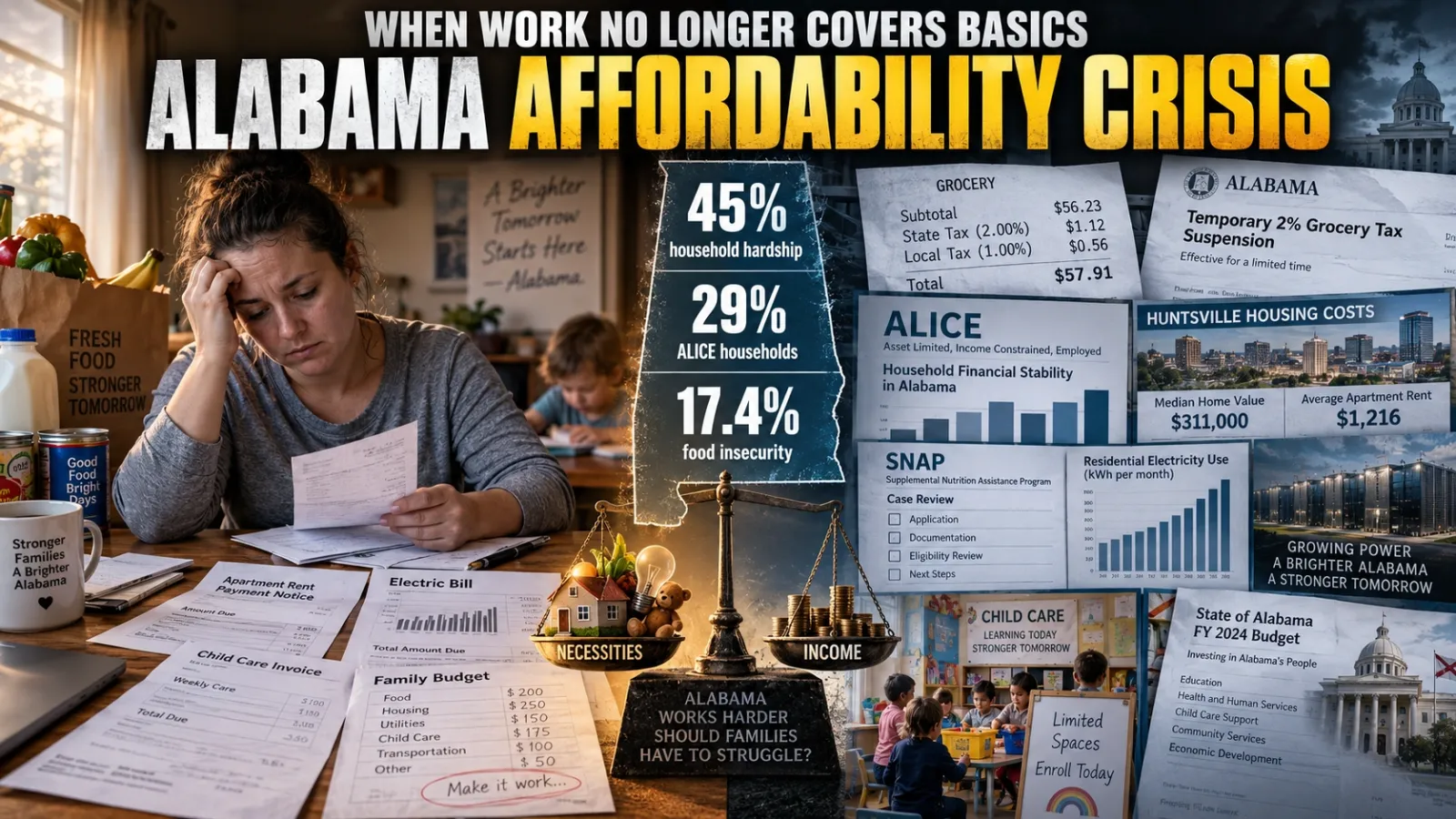
For two months during the summer of 2026, Alabama shoppers experienced a highly publicized, yet brief, reprieve at the checkout counter. Under Act 2026-604, signed by Governor Kay Ivey, the state implemented a 60-day full suspension of its 2 percent sales tax on groceries from May 1 through June 30. The temporary suspension saved families spending $800 a month on groceries roughly $16 per month. While certainly not life-changing, the measure provided targeted short-term relief amid stark predictions that food prices would continue their upward trajectory through the end of the year.
However, the temporary nature of this tax holiday highlighted a much deeper, structural regressivity in Alabama’s public finances. The state remains one of only a small handful in the nation that continues to impose a statewide sales tax on basic food staples. Advocacy groups like Alabama Arise have consistently argued that the grocery tax functions as a cruel penalty on survival that disproportionately pushes low-wage workers deeper into poverty. Even during the 2026 suspension, local county and municipal sales taxes remained fully active, forcing grocers to navigate a complex, split-rate environment at the register while consumers still paid local taxes on their food.
The broader tax system exacerbates this inequity, creating an environment where the poorest citizens subsidize the wealthiest. According to the 2026 edition of The Alabama Tax and Budget Handbook, Alabama features the 12th most regressive tax system in the United States. The state relies heavily on flat-rate sales and income taxes while maintaining a unique, highly controversial loophole that allows taxpayers to deduct 100 percent of their federal income tax liability when calculating their state taxes. Because the federal system is inherently progressive, this state deduction overwhelmingly benefits the highest earners while offering virtually no relief to low-income families who pay little federal income tax.
| Income Group | National Average State/Local Tax Rate | Alabama System Impact |
|---|---|---|
| Lowest 20% of Earners | 11.4% | Disproportionately high burden due to heavy reliance on sales taxes for essentials. |
| Middle 20% of Earners | 10.5% | Moderate effective tax rate, but highly vulnerable to utility and housing costs. |
| Top 1% of Earners | 7.2% | Lowest effective tax burden, heavily subsidized by full federal income tax deductions. |
By failing to generate adequate revenue from those most able to pay, the state routinely finds itself chronically underfunded for basic human needs. The Institute on Taxation and Economic Policy notes that upside-down tax codes artificially constrain revenue growth, leaving states with fewer resources to fund K-12 education, healthcare, and infrastructure. Consequently, working families are hit twice by the same system: once by a disproportionately high tax burden on basic daily essentials, and again by the systematic underfunding of the vital public services they desperately rely upon.
The ALICE Reality and the Housing Squeeze
The daily human toll of this economic structure is captured sharply in the latest data tracking household financial stability across the state. According to the 2026 United Way report, an alarming 45 percent of all Alabama households are currently experiencing acute financial hardship. This massive figure shatters the comfortable illusion presented by the official federal poverty rate, which sits at a much more modest 16 percent for the state.
This vast discrepancy is explained by the rapidly growing population of ALICE households, an acronym representing those who are Asset Limited, Income Constrained, Employed. These are working families who earn strictly above the federal poverty line but still do not make enough to afford the basic, non-negotiable necessities of housing, child care, food, transportation, and health care. In Alabama, 29 percent of households fall directly into the ALICE category, representing nearly twice as many households as those officially classified as living in poverty.
For a family of four in Alabama, the Household Survival Budget now averages a staggering $78,636 annually. This budget reflects the absolute bare minimum cost to live and work in the modern economy, incorporating taxes and a highly modest 10 percent miscellaneous safety net. When ordinary families cannot meet this foundational threshold, they are forced into impossible, dangerous trade-offs, such as skipping meals to pay for electricity or delaying critical medical care to cover child care expenses.
The housing market has only intensified this pressure, even in areas previously celebrated for their affordability. In Huntsville, one of the state’s major economic engines, the median home value has climbed to $290,244 as of late 2026, while average apartment rents hover around $1,330 per month. While these figures remain slightly below the national average, they represent a significant barrier for ALICE households whose wages have not kept pace with the region’s rapid technological and aerospace expansion. Without access to affordable credit or generational wealth, these households face a compounding disadvantage, driving them deeper into financial hardship whenever an unexpected housing or medical expense arises.
Empty Plates and the SNAP Bureaucracy
Nowhere is the state’s affordability crisis more visible or visceral than at the dinner table. Alabama currently suffers from an overall food insecurity rate of 17.4 percent, a startling figure that affects more than 884,000 residents statewide. This rate is significantly higher than the national average and reflects the devastating, lingering impact of elevated grocery prices combined with the expiration of pandemic-era safety net expansions.
The demographic breakdown of this food insecurity reveals deep, systemic inequities across the state. Households with children, single-parent families, and residents of isolated rural areas experience significantly higher rates of hunger than the general population. The long-term health consequences are incredibly severe, particularly for developing children, as food insecurity is directly linked to much higher risks of anemia, asthma, depression, and long-term cognitive behavioral issues.
Compounding this humanitarian crisis is the state’s precarious administration of the Supplemental Nutrition Assistance Program (SNAP). Alabama’s official SNAP error rate currently stands at 9.52 percent, a metric that has drawn intense scrutiny from federal regulators. Under strict new federal rules that heavily penalize states for administrative inaccuracies, this error rate could cost Alabama taxpayers an estimated $174 million in federal penalties by 2028 if not aggressively corrected.
The immense financial pressure to reduce these error rates places the state in a difficult, highly controversial position. Bureaucratic crackdowns designed to prevent overpayments often result in perfectly eligible families being wrongfully removed from the program due to minor paperwork issues. Anti-poverty advocates loudly argue that prioritizing paperwork over people will inevitably worsen the state’s hunger crisis, forcing state lawmakers to choose between funding essential food aid and covering massive state budget deficits.
The Power Paradox and AI Demand
Utility costs represent another massive, unavoidable strain on Alabama’s working families, characterized by a highly frustrating economic paradox. The state’s average residential electricity rate of 16.4 cents per kilowatt-hour is actually 11 percent below the national average, making the raw cost of power seemingly affordable. Yet, the average monthly electric bill for an Alabama household is roughly $160, which sits well above the national average for monthly utility costs.
This massive discrepancy is driven entirely by relentless residential consumption. Alabama ranks fifth in the nation for per-capita electricity usage, a reality dictated largely by the region’s intense subtropical climate, which requires air conditioning to run continuously for up to eight months of the year. Furthermore, a significant portion of the state’s housing stock, including a very high density of older manufactured homes, is poorly insulated, allowing cooled or heated air to easily escape and driving bills exponentially higher.
Alabama Power has attempted to mitigate severe consumer bill shocks by freezing its base retail rates through 2027, a move recently extended by the state legislature through January 2029 via House Bill 475. However, because residential bills fluctuate entirely based on volumetric usage, families still face crippling financial burdens during peak summer and winter months. Adding proper insulation or upgrading to efficient windows can drastically reduce these costs, but such capital improvements are virtually impossible for ALICE households living strictly paycheck to paycheck.
A new, rapidly accelerating threat to grid stability and consumer costs has also emerged in the form of artificial intelligence infrastructure. Tech companies are aggressively building large-load data centers across the state, with Southern Company recently reporting an unprecedented 55 percent year-over-year jump in data center electricity usage and a massive 17 gigawatt pipeline of new demand. To protect residential customers from bearing the infrastructure costs of this corporate expansion, Alabama Power has instituted strict full cost to serve requirements for these large-load data facilities. These specialized agreements force tech giants to pay for their own dedicated infrastructure upgrades, theoretically shielding ordinary ratepayers from the financial fallout if the AI bubble eventually bursts.
The Childcare Chasm
For families attempting to work their way out of financial hardship, the astronomical, rising cost of child care presents an almost insurmountable barrier. Across regional studies, such as those conducted in Lee County, the average cost of care for a single child under school age is approximately $153 per week, or nearly $8,000 annually. To successfully meet federal affordability standards, which dictate that child care should not exceed 7 percent of household income, an Alabama family with two young children would need to earn a staggering $227,000 a year.
This crisis is equally devastating for the professional workers providing the essential care. The child care funding gap results in abysmally low wages for early childhood educators, who average less than $11 an hour in Alabama—barely enough to cover their own basic living expenses. This compensation falls squarely in the bottom two percent of all occupations globally, leading to massive industry turnover and a severe, ongoing shortage of available child care slots.
The state government has recently taken some targeted legislative steps to address this critical economic bottleneck. In 2024, lawmakers passed the employer child care tax credit (HB358), which provides up to a 100 percent tax credit for specific employers who fund child care expenses for their workers. This initiative is explicitly scaled to invest $17.5 million in 2026 and eventually $20 million by 2027, with a specific 25 percent set-aside designed to protect rural and small businesses.
Additionally, Alabama actively expanded its nationally recognized First Class Pre-K program by adding 64 new classrooms for the 2026-2027 school year, serving an additional 1,152 children across the state. Despite these highly positive developments, economic experts warn that the underlying, fundamental economics of the private child care market remain severely broken. Until the massive gap between what parents can reasonably afford and what teachers need to survive is bridged by sustained public investment, working families will continue to lose ground.
Code Blue for Rural Healthcare
The affordability crisis is not limited strictly to consumer goods and services; it is actively dismantling the state’s physical healthcare infrastructure. Rural healthcare in Alabama is currently in a state of catastrophic, accelerated decline. As of late 2025, an astonishing 60 percent of Alabama’s rural hospitals were operating at a financial loss and were broadly at risk of permanent closure. Even more alarming for public health officials, 48 percent were officially classified as being at immediate risk of shutting their doors entirely.
The collapse of these vital facilities forces rural residents to travel vast, often dangerous distances for basic emergency care and specialized services. Over the last three years, hospitals in Monroe, Marengo, and Clarke counties have entirely shut down their labor and delivery units due to severe financial hemorrhaging. This systemic contraction has created sprawling maternal care deserts, directly contributing to Alabama’s abysmal infant mortality rate, which stands at 7.64 deaths per 1,000 live births—the third highest in the nation.
A temporary lifeline arrived recently in the form of targeted federal intervention. Alabama successfully secured $203.4 million in critical funding through the federal Rural Health Transformation Program for fiscal year 2026. While this much-needed capital injection will undoubtedly help stabilize failing infrastructure and modernize supply chains, health policy experts strictly warn that it cannot fix the fundamental, underlying revenue problem.
The core issue remains the state’s extraordinarily high rate of uninsured working residents, a statistic largely driven by Alabama’s continued, steadfast refusal to expand Medicaid under the Affordable Care Act. Without the consistent, reliable reimbursement streams that Medicaid provides, rural hospitals are forced to absorb massive, unsustainable amounts of uncompensated care. Critics fiercely argue that relying on temporary federal grants while simultaneously rejecting systemic Medicaid expansion ensures that the rural healthcare system will remain perpetually on the brink of total failure.
The 2026 Gubernatorial Clash
These deeply interconnected economic crises form the absolute center of the upcoming 2026 Alabama gubernatorial election. With Republican Governor Kay Ivey officially term-limited, the November 3rd contest features a highly anticipated rematch of the 2020 U.S. Senate race, pitting Republican nominee Tommy Tuberville against Democratic nominee Doug Jones. This election represents a stark, fundamental referendum on exactly how state government should respond to the affordability squeeze.
Tuberville, who easily secured the Republican nomination fortified by over $12 million in campaign funding, is running on a platform of strict fiscal conservatism and limited government. He consistently argues that the ultimate solution to the rising cost of living lies in deregulation, maintaining a highly tax-friendly environment for corporations, and limiting the role of federal mandates. His campaign forcefully suggests that robust private sector growth, unimpeded by heavy state taxation or bureaucratic red tape, is the only sustainable, long-term way to lift wages and improve the standard of living.
Jones, conversely, has built his entire campaign around direct, targeted government intervention to alleviate the affordability crisis. In a major policy address during the summer of 2026, Jones explicitly promised to expand Medicaid one way or another, directly linking the state’s poor health outcomes and hospital closures to its economic struggles. Furthermore, the Democratic nominee has loudly championed paid family leave, universal affordable child care, and aggressive structural reforms to combat the outsized influence of corporate money in state politics.
For the voters navigating this economic gauntlet, the choice is highly visceral and deeply personal. The electorate is intensely focused on their rising grocery bills, climbing power rates, and rapidly shrinking access to basic medical care. The outcome of this election will ultimately determine whether Alabama continues its historical path of minimal state intervention or pivots sharply toward utilizing state apparatuses to subsidize the basic costs of living for its working class.
What Happens Next
Regardless of who ultimately occupies the governor’s mansion in early 2027, the structural, unforgiving realities of Alabama’s economy will demand immediate legislative action. The 2027 fiscal year presents several massive, looming deadlines that will directly and immediately impact household budgets across the state. First, lawmakers will face immense public pressure to convert the temporary grocery tax suspensions into a permanent, total legislative repeal. Achieving this without severely decimating the Education Trust Fund—which relies heavily on those exact tax revenues—will require politicians to explore politically volatile alternatives, such as closing corporate loopholes or modifying the state’s highly regressive property tax structure.
Simultaneously, the state must carefully navigate a potential fiscal cliff as all remaining federal pandemic-era relief funds are fully exhausted. The state’s General Fund budget is expected to face a severe crunch, which could directly threaten funding for vital human resource departments and mental health services. Furthermore, the state will have to quickly and accurately rectify its SNAP administrative errors to avoid the devastating $174 million federal penalty slated for 2028, a massive fine that would decimate the state’s ability to provide future safety net services.
On the energy and infrastructure front, while base utility rates are legislatively frozen through January 2029, the physical expansion of AI data centers will violently test the limits of Alabama’s physical power grid. State regulators will be closely watched by consumer advocates to ensure that the strict full cost to serve policies genuinely hold up under immense corporate pressure, preventing tech conglomerates from socializing their infrastructure costs onto the backs of vulnerable residential ratepayers. Ultimately, the human consequences of these upcoming, highly complex policy decisions will definitively determine whether Alabama’s working families can regain their financial footing or if they will be squeezed entirely out of the middle class.
Sources (108)
- sales.tax — Alabama grocery tax suspension may june 2026
- revenue.alabama.gov — Notice temporary suspension of state sales and use tax on food
- salestaxinstitute.com — Alabama to temporarily eliminate state sales tax on groceries
- tuscaloosathread.com — Grocery tax holiday alabama
- youtube.com — Watch
- alabamapolicy.org — Grocery tax
- alabamaretail.org — Grocery sales tax holiday begins may 1
- revenue.alabama.gov — Notice state sales and use tax rate reduced on food beginning september 1 2025
- aldailynews.com — State sales tax on groceries drops to 2 today
- apnews.com — Medicaid work requirement self attestation 012ebf8a94ce672bd8ae5c863db566e5
- sltrib.com — Where do ice detainees go after
- alreporter.com — Gov ivey signs tax relief bill state grocery tax eliminated for two months
- theguardian.com — Michael kiwanuka life after devastating stroke
- hindustantimes.com — Is dylan stewart playing today latest injury update on south carolina star as li
- hindustantimes.com — Why is dylan stewart suspended and for how long shane beamer clarifies decision
- ft.com — A7aa2544 c328 40ef 87e2 488975a79f57
- education.ced.org — 201003 CED StateTaxMergedDoc%20AL
- trisharechildcare.com — Alabama
- bmss.com — Alabama childcare tax credits 2025 2027 opportunities for employers and childcar
- legislature.state.al.us — HB358 int
- sites.ua.edu — September spotlight disability advocacy leadership opportunities
- influencewatch.org — Alabama arise
- ecfunders.org — SRASiX TOOLKIT State Response 10 2 25
- sites.uab.edu — Policy watch the impact of eliminating grocery sales tax
- newsfromthestates.com — Food stamp changes will cost states billions raising fears about snaps future
- alreporter.com — Alabama arise calls for significant reforms to states tax system
- alreporter.com — Arise celebrates 60 day grocery tax holiday calls for permanent repeal
- jamaicaobserver.com — As grocery prices soar push grows to end sales tax on food
- unitedforalice.org — Alabama
- unitedwaylakemartin.org — Alice
- auw.org — Alice reports
- unitedforalice.org — National overview
- facebook.com
- unitedwaysci.org — Alice report released more households struggling
- unitedforalice.org — Alabama
- unitedwaysofalabama.org — Alice
- scribd.com — 2026 ALICE Report Findings
- browncountyunitedway.org — 2026 alice report data released
- alavoices.org
- alavoices.org — National kids count
- aldailynews.com — Alabama adds first class pre k classrooms but access remains an issue
- parcalabama.org — Public health
- earlysuccess.org — Alabama
- user-8msctv.cld.bz — 2025 Children s of Alabmama Community Health Needs Assessment
- alavoices.org — Child care
- facebook.com
- suscc.edu — Lee%20County%20Landscape%20Analysis%201 14 26%20(3)
- info.childcareaware.org — FY27 Appropriations Community Letter
- electricchoice.com — Alabama
- alabamapower.com — Are rates going up
- alabamapower.com — Why higher bills
- alabamapower.com — Alabama power commits to steady rates through 2027
- alabamapower.com — Time advantage rates
- alabamapower.com — Residential pricing and rate plans
- saveonenergy.com — Electricity bills by state
- eia.gov — Epm table grapher
- map.feedingamerica.org — Alabama
- beatauburnbeathunger.studentorg.ua.edu — Hunger statistics
- frac.org — Hunger poverty america
- ers.usda.gov — Food security and nutrition assistance
- ers.usda.gov
- ers.usda.gov — Interactive charts and highlights
- ers.usda.gov — Key statistics graphics
- americashealthrankings.org — AL
- ers.usda.gov — Eib 295
- apr.org — Family income rose and poverty fell in 2025 but safety net cuts could erase gain
- alabamapower.com — Data centers and bills
- facebook.com
- sites.uab.edu — Construction and consequences the human impacts of artificial intelligence data
- datacenterfrontier.com — Southerns 17 gw pipeline puts ai power demand into utility math
- insideclimatenews.org — Alabama power proposed data centers utility bills
- forbes.com — Will ai data centers raise your electric bill the rules that decide who pays
- utilitydive.com
- energy.gov — Powering americas ai future data center resource hub
- bls.gov — Iagauto
- facebook.com
- newsfromthestates.com — Doug jones calls affordability measures government reforms policy speech
- en.wikipedia.org — 2026 Alabama gubernatorial election
- ballotpedia.org — Alabama gubernatorial election, 2026
- aldemocrats.org — 2026 candidate qualifying
- algop.org — Qualified 2026 republican candidates
- aldailynews.com — House democrats stress affordability in 2026 legislative agenda
- multistate.us — Governors
- apnews.com — Alaska midterms senate lower 48 sullivan peltola 0ebdb3382c3b85da0f76f3c0ae6387b
- apnews.com — Polymarket new york lawsuit gambling b75b753e3c3cd069cdf8d6af175c9fbb
- washingtonpost.com — Democrats are making moves run president 2028 here what they doing
- chartis.com — 2026 rural health state state
- pubmed.ncbi.nlm.nih.gov
- mdpi.com
- facebook.com
- safetynetalliance.org — Rural areas account for net loss of u s hospitals
- kff.org — A closer look at the 50 billion rural health transformation program
- adeca.alabama.gov — ARHTP Project Narrative
- beckershospitalreview.com — 700 rural hospitals at risk of closing by state
- marketplace.org — The rural healthcare crisis
- timesofindia.indiatimes.com — 134430822.cms
- zillow.com — Huntsville al
- reddit.com — Huntsville area real estate economics report
- movingtohuntsville.org — Average rent in huntsville al
- redfin.com — Housing market
- huntsvillehomesforyou.com — Huntsville al rental market 2025 actual rent numbers roi
- realtor.com — Huntsville
- mattcurtisrealestate.com — 2026 huntsville housing predictions
- acre.culverhouse.ua.edu — Study august alabama rental trends show continued growth
- facebook.com
- youtube.com — Watch
- alreporter.com — Alabama possible releases 2025 barriers to prosperity data
- pmc.ncbi.nlm.nih.gov — PMC4721371


Leave a Reply