
America’s Collision Course: How a $40 Trillion Debt, AI Disruption, and a Fractured Safety Net are Reshaping the Working Family
On July 31, 2026, the Bipartisan Policy Center (BPC) and the National Governors Association (NGA) formally launched the American Opportunity Project (AOP) in Oklahoma City. This unprecedented federal-state partnership emerged to confront a rapidly accelerating national crisis born from the convergence of a soaring federal deficit, massive economic displacement driven by artificial intelligence, and a social safety net pushed to its breaking point. The initiative deliberately positions state governors as front-line problem solvers, tasking them with crafting scalable, bipartisan solutions before federal gridlock triggers severe economic consequences for local communities.
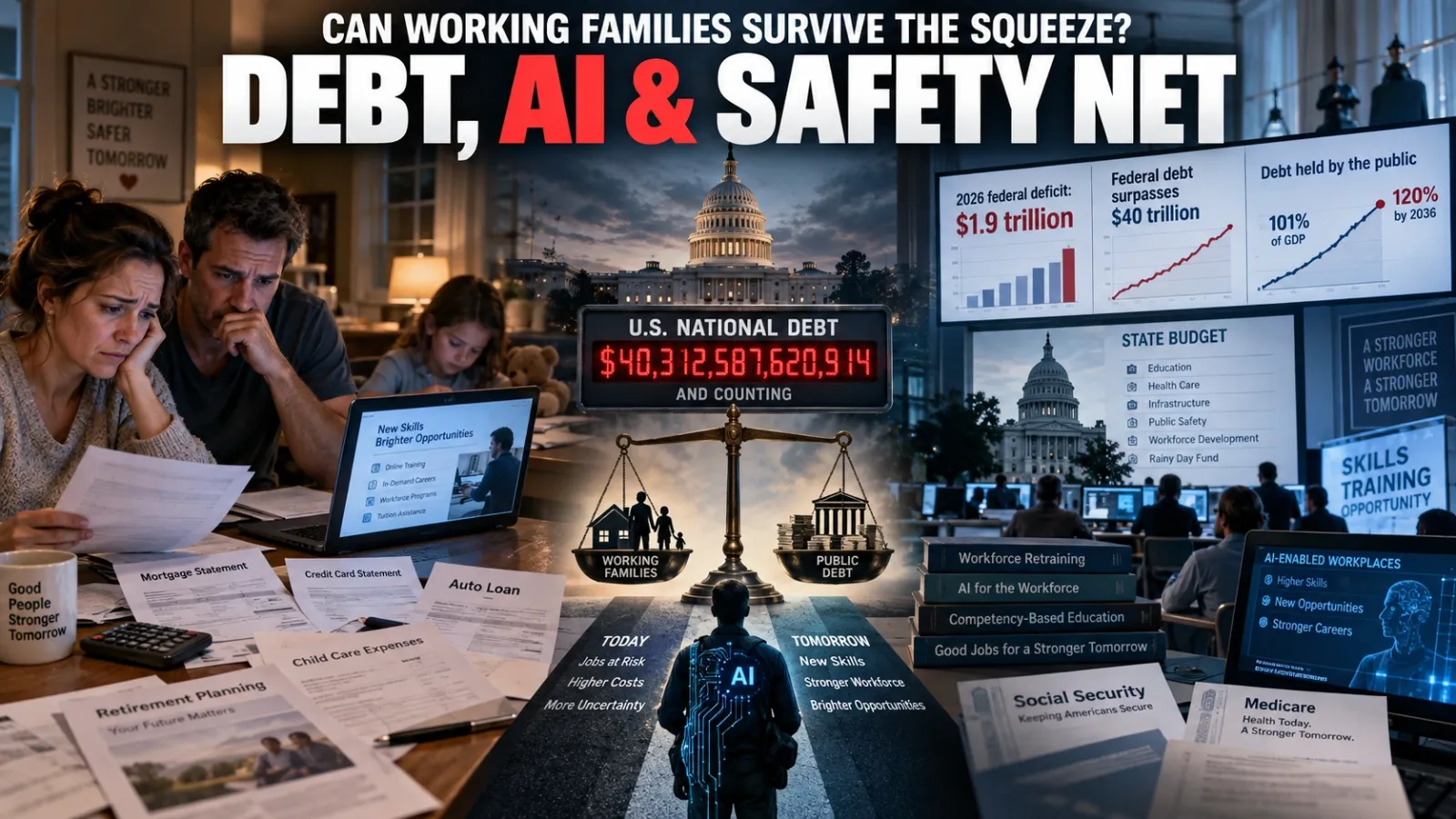
The urgency behind this sweeping initiative stems from a stark macroeconomic reality confronting the American public today. With the national debt eclipsing $40 trillion and the Congressional Budget Office (CBO) projecting a $1.9 trillion deficit for 2026, the financial foundations supporting Medicare, Social Security, and federal infrastructure are increasingly precarious. Simultaneously, the rapid integration of generative artificial intelligence is threatening to strand millions of workers in obsolete roles without adequate mechanisms for retraining or transition support. For ordinary workers and families, these macroeconomic trends translate directly into profound anxieties about retirement security, household budgets, and the ability to afford raising a family.
The American Opportunity Project seeks to bypass stalled federal debates, leveraging state-level innovations to build a cohesive talent pipeline and stabilize the American working family before the damage becomes irreversible. By breaking down the silos between national economic policy and local human services, the initiative attempts to view the American worker holistically. The stakes are remarkably high, as failure to reform these interconnected systems threatens to lock an entire generation out of the middle class while bankrupting the institutions designed to protect them.
The Macroeconomic Vise: A $40 Trillion Shadow Over the Kitchen Table
The fiscal trajectory of the United States has entered historically uncharted territory, casting a long and imposing shadow over domestic policy and family economics. According to the CBO’s Budget and Economic Outlook released in early 2026, the federal deficit for the fiscal year has swelled to $1.9 trillion, representing 5.8 percent of the nation’s gross domestic product. This massive shortfall is largely driven by soaring net interest costs, which are rapidly crowding out the government’s ability to fund discretionary programs, education, and vital infrastructure. If left unaddressed, the CBO projects that federal debt held by the public will rise from 101 percent of GDP this year to a staggering 120 percent by 2036, breaking the previous national record set in 1946 immediately following World War II.
This deteriorating fiscal health has been exacerbated by recent legislative and judicial developments that have blown unforeseen holes in the federal budget. The passage of the 2025 Reconciliation Act—commonly referred to as the One Big Beautiful Bill Act (OBBBA)—is projected to add $4.7 trillion to the cumulative deficit over the next decade through aggressive tax extensions and new spending provisions. While OBBBA introduced popular, temporary income tax deductions for tips and overtime to provide relief to service-industry workers, these measures function as deductions rather than total exemptions, narrowing the tax base at a critical moment. Furthermore, a recent Supreme Court decision striking down the administration’s tariffs applied under the International Emergency Economic Powers Act (IEEPA) has erased roughly $3 trillion in expected federal revenues, injecting massive uncertainty into the budget.
As a result, the federal government is forced to borrow at increasingly high volumes in a market where short-term interest rates are expected to settle at an elevated 3.1 percent. For the average American household, the consequences of this sovereign debt crisis are felt intimately through the tightening of consumer credit and the persistence of living costs. High federal borrowing creates upward pressure on overall interest rates, which directly translates into more expensive mortgages, higher auto loan rates, and punishing credit card interest for ordinary consumers. When the government consumes a larger share of available capital to service its own debt, the cost of borrowing for private citizens inevitably rises, stifling upward mobility.
As federal dollars are increasingly consumed by debt servicing, the government’s capacity to subsidize state-level social services, child care, and workforce development shrinks correspondingly. This effectively passes the financial burden down to the states, which must absorb the costs of maintaining the social safety net without the benefit of unlimited borrowing. The AOP recognizes that this federal insolvency directly threatens the kitchen-table economics of every American family, as cuts to federal grants ultimately manifest as reduced local services and higher state taxes.
| Fiscal Metric | 2026 Projection | 2036 Projection | Historical Context |
|---|---|---|---|
| Federal Deficit | $1.9 Trillion (5.8% of GDP) | $3.1 Trillion (6.7% of GDP) | 50-year average is 3.8% of GDP |
| Debt Held by Public | 101% of GDP | 120% of GDP | Previous high was 106% in 1946 |
| Federal Outlays | 23.3% of GDP | 24.4% of GDP | Driven by Social Security and interest |
| Federal Revenues | 17.5% of GDP | 17.8% of GDP | Slightly above 50-year average of 17.3% |
The State-Level Squeeze: Governors on the Front Lines
Frustrated by the glacial pace of federal legislative action and the hyper-partisan gridlock in Washington, policy leaders are increasingly turning to state capitals for functional governance. Unlike the federal government, states do not possess the ability to print money or run massive, indefinite operating deficits; they are constitutionally or statutorily required to balance their budgets annually. This strict fiscal constraint forces governors to operate as pragmatic, front-line problem solvers who must carefully weigh the immediate costs of social programs against long-term economic growth. The American Opportunity Project is explicitly built upon this premise, viewing states as active laboratories of innovation that can pilot scalable solutions.
State governments are already exhibiting signs of significant financial strain as they navigate this shifting fiscal landscape. Data from the National Association of State Budget Officers (NASBO) reveals that states are actively curbing their spending in fiscal year 2025 following the expiration of federal COVID-19 relief funds and a slowdown in consumer-driven tax revenues. While states collectively hold a record $155 billion in their rainy day funds, these reserves are increasingly viewed as necessary bulwarks against looming federal austerity rather than surplus capital for new social investments. In states like Arizona and California, multibillion-dollar budget shortfalls have already necessitated painful cuts to education and climate-related projects, demonstrating the fragility of local budgets.
The leadership driving the AOP reflects this urgent, bipartisan pragmatism in the face of austerity. Governor Kevin Stitt (R-OK), Chairman of the NGA, articulated this stark contrast during the project’s launch, noting that the federal government’s habit of spending $2 trillion over its revenue is a luxury states cannot afford. Similarly, Governor Wes Moore (D-MD), Vice Chair of the NGA, emphasized that while federal policymakers debate, governors are already executing record investments in “lighthouse industries” and building tangible pathways to wealth for working families. By convening these leaders, the AOP aims to surface successful state-level interventions and scale them into comprehensive national policy options.
This state-centric approach is particularly vital given the unpredictable nature of future federal funding and the ongoing impact of state-level tax cuts. Significant income tax reductions in states like Georgia and West Virginia are phasing in over several years, deliberately shrinking state revenues just as federal support begins to wane. Because state general funds are deeply sensitive to shifts in federal Medicaid matches and education block grants, governors have a vested interest in reforming the national safety net before federal insolvency forces draconian local cuts. The AOP’s structured working groups rely heavily on these state budget realities, applying rigorous modeling and scoring frameworks to ensure that proposed federal solutions are practically executable.
Artificial Intelligence and the Restructuring of the American Worker
As the federal government grapples with unprecedented debt, the American labor market is undergoing a seismic restructuring driven by the rapid deployment of generative artificial intelligence. The macroeconomic data paints a picture of a technology that is simultaneously acting as an economic savior and a ruthless disruptor of traditional livelihoods. The CBO recently adjusted its long-term economic outlook, maintaining a 1.8 percent growth rate largely by factoring in a 10-basis point (0.1 percent) annual productivity boost generated directly by the widespread adoption of AI. This technological dividend is effectively compensating for a shrinking labor force and declining immigration levels, allowing aggregate economic output to remain stable.
However, the localized human impact of this technological revolution is deeply unsettling for workers whose skills are being depreciated in real time. The Bipartisan Policy Center’s Commission on the American Workforce has warned that unprecedented technological changes are threatening to strand workers in obsolete roles, disrupting both entry-level positions and traditional knowledge work. The existing federal workforce apparatus, governed by legacy statutes like the Workforce Innovation and Opportunity Act (WIOA) and the Higher Education Act, was designed for a pre-digital economy. Consequently, millions of workers find themselves locked out of the economic gains generated by AI, lacking both the financial resources and the institutional support to reskill for emerging industries.
The structural failures of the American talent pipeline are becoming glaringly obvious as employers struggle to fill high-wage, AI-enabled roles while millions remain trapped in stagnant jobs. The Commission’s report, A Nation at Risk to A Nation at Work, concluded that the American education system remains entrenched in an antiquated, industrial-era model that prioritizes time spent in a classroom over the acquisition of verifiable skills. To survive the rapid economic restructuring brought on by artificial intelligence, the report argues that the entire continuum of learning must be radically reimagined. This includes abolishing mandatory seat-time requirements in high schools and replacing them with competency-based graduation goals.
Furthermore, educational institutions must urgently integrate AI literacy into their core curricula to prevent the next generation from being algorithmically disadvantaged. The BPC Action recommendations stress the need to expand AI literacy programs to ensure that students, educators, and transitioning workers understand how to utilize artificial intelligence safely and effectively. By treating AI literacy as a foundational skill alongside reading and mathematics, policymakers hope to empower workers to harness these tools rather than being replaced by them. Without this shared infrastructure and foundational knowledge, hiring will continue to default to the blunt instrument of traditional four-year degrees, leaving highly capable workers marginalized.
Legislative Remedies: The National Talent Strategy Act
In response to this systemic failure, lawmakers have introduced the National Talent Strategy Act of 2026, a sweeping legislative effort to untangle the federal government’s chaotic approach to human capital. Authored by Senators Lisa Blunt Rochester (D-DE) and Ted Budd (R-NC), the bill directly addresses the BPC’s finding that the United States currently operates more than 150 fragmented education and workforce programs. These disjointed programs spend over $250 billion annually without any unified strategy, creating a bureaucratic labyrinth that is virtually impossible for displaced workers to navigate. The lack of a cohesive national talent strategy severely hampers the country’s ability to respond to rapid economic shifts and technological advancements.
The legislation mandates the creation of an 18-member American Talent Working Group, tasked with developing the nation’s first comprehensive four-year Federal Strategic Talent Plan. This interagency body is designed to span the government’s full talent footprint, encompassing nine cabinet secretaries, four agency heads, and representatives from critical executive councils. By forcing the Departments of Labor, Education, Commerce, and Defense to sit at the same table, the bill aims to eliminate overlapping programs and ensure that federal investments are actually aligned with regional labor market demands. The Working Group is required to host regional meetings and engage directly with local industry leaders, labor unions, and tribal governments to capture on-the-ground realities.
The Federal Strategic Talent Plan must identify barriers to national workforce readiness across eight specific priority areas, ensuring that human capital investments support broader national objectives. These areas include domestic manufacturing capacity, transitioning service members, and industries most exposed to disruption from automation and artificial intelligence. Crucially, the legislation explicitly mandates that federal workforce programs remain aligned with the president’s List of Critical and Emerging Technologies (CET). This ensures that job development efforts are focused on the industries most vital to national security and global competitiveness, rather than generic, low-wage job placement.
To make this skills-first economy functional, the federal government and private sector must collaborate to build an interoperable data infrastructure. The Commission emphasizes the urgent need for Learning and Employment Records (LERs)—digital, portable transcripts that clearly communicate a worker’s validated skills to potential employers. The implementation of a national Talent Data System would allow both workers and policymakers to track outcomes in real time, ensuring that public investments in job training are actually leading to sustainable employment. For the ordinary worker, this means the end of navigating confusing government websites and the beginning of a streamlined, targeted pathway to a better career.
| Component of National Talent Strategy Act | Key Function | Human Impact |
|---|---|---|
| American Talent Working Group | 18-member interagency panel to coordinate $250B in spending. | Reduces bureaucratic friction for workers seeking federal training assistance. |
| Federal Strategic Talent Plan | Four-year strategic document evaluating all 150+ workforce programs. | Ensures training is relevant to local labor markets and emerging industries. |
| Critical Technologies Alignment | Aligns workforce programs with the president’s CET list. | Prepares workers for secure, high-wage jobs in national security and tech sectors. |
| Data and Outcome Evaluation | GAO evaluation of program effectiveness and overlapping inefficiencies. | Holds government accountable for actual job placement, not just enrollment. |
Empowering the Worker: The Promise of Skill Savings Accounts
Beyond interagency coordination, policymakers are increasingly pushing for direct-to-worker financial tools to facilitate continuous, lifelong learning. A prominent proposal gaining bipartisan traction is the creation of Skill Savings Accounts, which would allow tax-free contributions from employers, workers, and government agencies to fund ongoing education. Introduced in legislation by Representatives Glenn “GT” Thompson and Suzanne Bonamici, these accounts represent a fundamental shift in labor philosophy. By placing the financial resources directly into the hands of the worker, the government empowers individuals to proactively adapt to AI disruptions without waiting for slow-moving federal grants.
These accounts function similarly to health savings accounts or retirement funds, providing a flexible, tax-advantaged vehicle designed specifically for human capital investment. Workers could utilize these funds for a diverse array of workforce development opportunities, including registered apprenticeships, short-term credentialing programs, and specialized online courses. This flexibility is critical in an AI-driven economy, where the half-life of a learned skill is rapidly decreasing, and workers must constantly update their competencies to remain employable. For a mid-career logistics manager or accountant facing sudden algorithmic displacement, a Skill Savings Account provides a vital financial lifeline to pivot into a new sector.
The implementation of Skill Savings Accounts also serves to redefine the social contract between employers and their workforce. By allowing employers to make tax-free contributions to these accounts, the policy incentivizes corporations to invest in the long-term employability of their staff, rather than treating labor as a disposable commodity. This aligns perfectly with the BPC Commission’s recommendation to upgrade benefits and supports for employees, fostering a culture of continuous talent development. Furthermore, allowing community investment organizations and family members to contribute broadens the support network available to individuals striving for upward mobility.
However, the success of Skill Savings Accounts relies heavily on the transparency and quality of the training programs available to consumers. Without a robust Talent Data System and rigorous outcome-based evaluations, workers risk draining their accounts on predatory or ineffective training seminars that hold no real value in the labor market. Therefore, the push for Skill Savings Accounts must be firmly coupled with the interoperable skills frameworks and Learning and Employment Records advocated by the National Talent Strategy Act. Together, these tools can build an ecosystem where workers have both the funding and the actionable intelligence needed to navigate a turbulent economy.
The Child Care Chokehold: Breaking the Backbone of the Workforce
While technological displacement threatens the future of work, the immediate present is being suffocated by a catastrophic collapse in the child care market. Access to reliable, affordable child care is the foundational precondition for maternal workforce participation, yet the current system is actively driving parents out of the labor pool. Recent data highlights that 42 percent of women who exited the workforce cited the insurmountable costs of caregiving as their primary barrier to employment. For these families, the decision to leave a career is not a choice, but a stark mathematical reality where the cost of care completely eclipses their potential wages.
The federal government’s primary vehicle for addressing this crisis, the Child Care and Development Block Grant (CCDBG), has not been fully reauthorized since 2014. The program is so chronically underfunded that it currently serves only 15 percent of eligible children, leaving millions of working-class families stranded on indefinite waitlists. The economic realities of the child care industry represent a broken market where families cannot afford to pay the true cost of care, and providers cannot afford to accept anything less. To survive, child care centers are forced to suppress early educator wages, leading to a massive exodus of qualified teachers and the proliferation of child care deserts across rural and urban America.
To address this structural failure, a bipartisan coalition led by Senators Deb Fischer, Kirsten Gillibrand, Susan Collins, and John Hickenlooper introduced the Child Care Modernization Act of 2026 (CCMA). The legislation seeks to reauthorize the CCDBG through 2030 and fundamentally alter how states reimburse care providers. The CCMA proposes replacing outdated market-rate surveys with formal Cost Estimation Models (CEM), which would calculate reimbursement rates based on the actual expenses of running a quality facility. These models would mandate that states factor in competitive staff salaries, facility maintenance, and the varied costs of providing care during nontraditional hours, fundamentally anchoring provider compensation to economic reality.
Beyond reimbursement rates, the CCMA introduces vital flexibility designed to align the subsidy program with the complex realities of modern families. The legislation broadens the federal definition of eligible activities to include self-employment, education, and certain health treatments, recognizing that the modern path to economic stability is rarely linear. It also allows states to seek a waiver to serve families earning slightly above the current ceiling of 85 percent of state median income, helping to smooth the punishing “subsidy cliff” that often penalizes parents for accepting a minor raise at work. For a mother balancing night shifts and nursing school, these modernizations represent the difference between maintaining upward momentum and falling back into poverty.
The Ideological Collision: Debating the Child Care Modernization Act
Despite its bipartisan backing and the desperate need for reform, the CCMA has ignited fierce debate within the child care advocacy community. Organizations deeply invested in the current regulatory structure, such as the Center for Law and Social Policy (CLASP), the National Women’s Law Center, and Zero to Three, have sharply criticized the legislation. Their primary contention is that the bill completely fails to appropriate any new federal funding to the drastically underfunded CCDBG program. Critics argue that without new money, forcing states to pay providers higher reimbursement rates based on cost estimation models will inevitably result in hundreds of thousands of low-income families being abruptly cut from the subsidy roster entirely.
Furthermore, opponents warn that the bill strips away long-standing “equal access” federal mandates, a tenet that requires the program to be designed so participating families have equal access to child care as higher-income families. CLASP argues that by eliminating this provision, the CCMA threatens parents’ choices and weakens the oversight authority of the Department of Health and Human Services. They fear that states could complete the required cost analysis but still choose to keep reimbursement rates artificially low, essentially providing a loophole that harms families and providers alike. For these organizations, reopening the law without guaranteed new funding creates an unacceptable risk of undermining core protections for the most vulnerable children.
Conversely, proponents of the legislation, including the First Five Years Fund (FFYF), Bipartisan Policy Center Action, and the Niskanen Center, argue that the CCMA is a necessary, pragmatic step to prevent the total collapse of the child care supply side. They contend that the shift to Cost Estimation Models will finally provide sustainable revenue for home-based, rural, and faith-based providers who are routinely shortchanged by current market surveys. Because home-based providers often charge parents what they can afford rather than the true cost of their labor, market-rate surveys chronically suppress their reimbursements. By decoupling the reimbursement rate from the private-pay rate, the CCMA ensures that these vital, community-level providers can actually keep their doors open.
Proponents also emphasize that the bill is designed as an authorizing framework that establishes vital supply and facility grants, setting the structural foundation necessary before larger appropriations can be logically distributed. They argue that reauthorization and appropriations are complements, not substitutes, and that defending the broken status quo out of fear is not a viable strategy. The CCMA creates a new grant authority to help states address provider startup, expansion, and infrastructure costs—capital investments that current CCDBG funds generally cannot cover. For the ordinary working parent caught on a two-year waitlist, the debate underscores a bitter reality: until the physical supply of care is stabilized, the promise of a subsidy is entirely meaningless.
| Feature | Current CCDBG Framework | Proposed Child Care Modernization Act | Human Impact of Proposed Change |
|---|---|---|---|
| Reimbursement Method | Market-rate surveys (often artificially depressed). | Cost Estimation Models (CEM). | Pays providers true costs, enabling higher wages and staff retention. |
| Capital Investment | Funds generally cannot be used for construction or renovation. | Creates Supply and Facilities grants for expansion and repairs. | Directly builds new child care slots in extreme “care deserts.” |
| Eligibility Flexibility | Strict limits, abrupt “subsidy cliffs.” | Waivers for families slightly over the 85% median income ceiling. | Allows parents to accept raises without instantly losing child care access. |
| Federal Mandates | Relies on the vague “equal access” provision. | Requires a 10-year progress report and reporting on unserved families. | Forces states to transparently document exactly who is being left behind. |
Modernizing the Tax Code for the AI Era
Addressing the nation’s soaring deficit and funding a modern workforce strategy inevitably collides with the deeply contentious issue of federal tax reform. The “Modern Tax Code” pillar of the American Opportunity Project is tasked with navigating this political minefield, seeking ways to modernize taxation for growth and innovation without further detonating the national debt. The recent passage of the One Big Beautiful Bill Act (OBBBA) highlighted the profound complexity of this challenge. Lawmakers implemented temporary income tax deductions for tips and overtime to provide immediate relief for hourly service workers, but these popular measures contributed to a massive $4.7 trillion deficit expansion over the next decade. This illustrates the painful, real-world trade-offs between providing necessary worker relief and maintaining fiscal responsibility.
The tax code is also increasingly being utilized as a backdoor mechanism to subsidize the fragile social safety net and incentivize talent development. For example, the bipartisan Supporting Early-Childhood Educators’ Deductions (SEED) Act was designed to provide direct tax relief to child care workers, attempting to stabilize the bleeding workforce through federal tax incentives rather than direct state grants. Similarly, the proposed Skill Savings Accounts would rely on tax-free employer and employee contributions to bypass the bureaucratic friction of federal training programs. While these tax expenditures are highly effective at driving specific social behaviors, they further complicate the revenue side of the federal ledger, narrowing the tax base precisely when the government requires more capital to service its debt.
Looking forward, the integration of AI and the expansion of the gig economy present novel challenges for a tax system historically reliant on traditional payroll taxes. As automation displaces standard W-2 employment and more Americans transition into independent contracting or portfolio careers, the mechanisms for collecting Social Security and Medicare taxes must fundamentally evolve. The AOP’s working groups are evaluating how to balance the need for robust corporate investment in critical technologies against the necessity of ensuring that highly automated, AI-driven corporations contribute proportionately to the national tax base. Ultimately, any successful bipartisan tax reform will require bridging the gap between incentivizing domestic innovation and guaranteeing the solvency of the safety net programs that American families depend upon.
What Happens Next
The timeline for resolving these interconnected crises is rapidly compressing, prompting the Bipartisan Policy Center to aggressively accelerate its consensus-building efforts. On October 27, 2026, the BPC will host a major half-day summit titled “Racing Toward the Cliff: Debt, Demographics, and Divided Responsibilities,” bringing together CBO leadership, top economists like Heather Long and Carter Price, and state budget officers. This event is designed to publicly highlight the severity of the fiscal cliff and explore the cascading impacts of demographic shifts and AI on federal and state budgets. The summit serves as a critical public engagement milestone for the American Opportunity Project, translating complex econometric modeling into urgent political imperatives for the upcoming legislative sessions.
Following this public groundwork, the working groups of the American Opportunity Project will finalize their modeling and scoring frameworks over the next year. The stated goal is to publish a comprehensive, actionable menu of bipartisan policy options and brief current policymakers well prior to the 2028 election cycle. By establishing these frameworks before the intense polarization of the presidential campaign season fully takes hold, the AOP hopes to set a baseline of credible, state-tested solutions that both political parties can adopt. This proactive strategy aims to soften the political ground, making it safer for lawmakers to touch the traditionally radioactive issues of entitlement reform and tax overhauls.
The ultimate culmination of the AOP’s efforts will occur in early 2029, when the project formally briefs the newly inaugurated presidential administration and the incoming Congress. This will be immediately followed by an aggressive, heavily resourced advocacy strategy led by BPC Action and the National Governors Association to push the finalized policy options into binding legislation. For the ordinary American worker, the success or failure of this timeline dictates their economic future. If the AOP’s bipartisan consensus fails to materialize into legislative action, working families will be left to independently navigate the punishing realities of a $40 trillion debt burden, the rapid obsolescence of their professional skills, and the total collapse of the child care infrastructure that makes their employment possible.
Sources (38)
- bipartisanpolicy.org — New american opportunity project address debt ai economy expand opportunity
- bipartisanpolicy.org — American opportunity project
- learnworkecosystemlibrary.com — American opportunity project bipartisan policy center bpc national governors ass
- bipartisanpolicy.org — American opportunity project
- learnworkecosystemlibrary.com — Report a nation at risk to a nation at work the case for a national talent strat
- bipartisanpolicy.org — Whats in the national talent strategy act of 2026
- bipartisanpolicy.org — Spellings now is the time to build a 21st century national talent strategy
- ppc.land — Budd and blunt rochester bill seeks one plan for 250bn of us talent spending
- bpcaction.org — One pager learning and working in the age of ai
- bipartisanpolicy.org — The case for a national talent strategy
- cepr.harvard.edu — Bpc launches commission american workforce tackle human capital crisis 0
- cbo.gov
- cbo.gov
- crfb.org — Cbo 1 higher interest rates add trillions debt
- cbo.gov — 61882 Executive Summary
- bakerinstitute.org — Key economic shifts congressional budget office outlook
- brookings.edu — An update on the federal budget outlook
- conference-board.org — CBO releases negative fiscal outlook for 2026 2036
- afterschoolalliance.org — Bipartisan Child Care Modernization Act introduced in the 06 12 2026.cfm
- ffyf.org — First five things child care modernization act
- fischer.senate.gov — What they are saying support for fischer s child care modernization act
- ffyf.org — The child care modernization act a step forward for families
- bipartisanpolicy.org — What is the child care modernization act
- clasp.org — Child care modernization act not address child care crisis
- bpcaction.org — Its time to update federal child care policy pass the child care modernization a
- bipartisanpolicy.org — Modernizing child care to support a national talent strategy
- thompson.house.gov — Thompson bonamici introduce bill create skill savings accounts
- quiverquant.com — Press Release%3A Thompson and Bonamici Introduce Bipartisan Skill Savings Accoun
- niskanencenter.org — With the child care modernization act congress has an opportunity to expand pare
- tryplayground.com — Child care modernization act
- zerotothree.org — The child care modernization act fails to deliver real solutions to the child ca
- higherlogicdownload.s3.amazonaws.com — NASBO 2021 Budget Processes in the States S
- nasbo.org — Fiscal survey of states
- pew.org — State budgets are downsizing
- higherlogicdownload.s3.amazonaws.com — 2025 NASBO State Expenditure Report S
- community.nasbo.org — Impact of surplus budget in recent years
- nasbo.org — Capital budgeting in the states
- grsconsulting.com — Nasbo releases 2025 state expenditure report



Leave a Reply