
The Phantom Millions of Equity Compensation
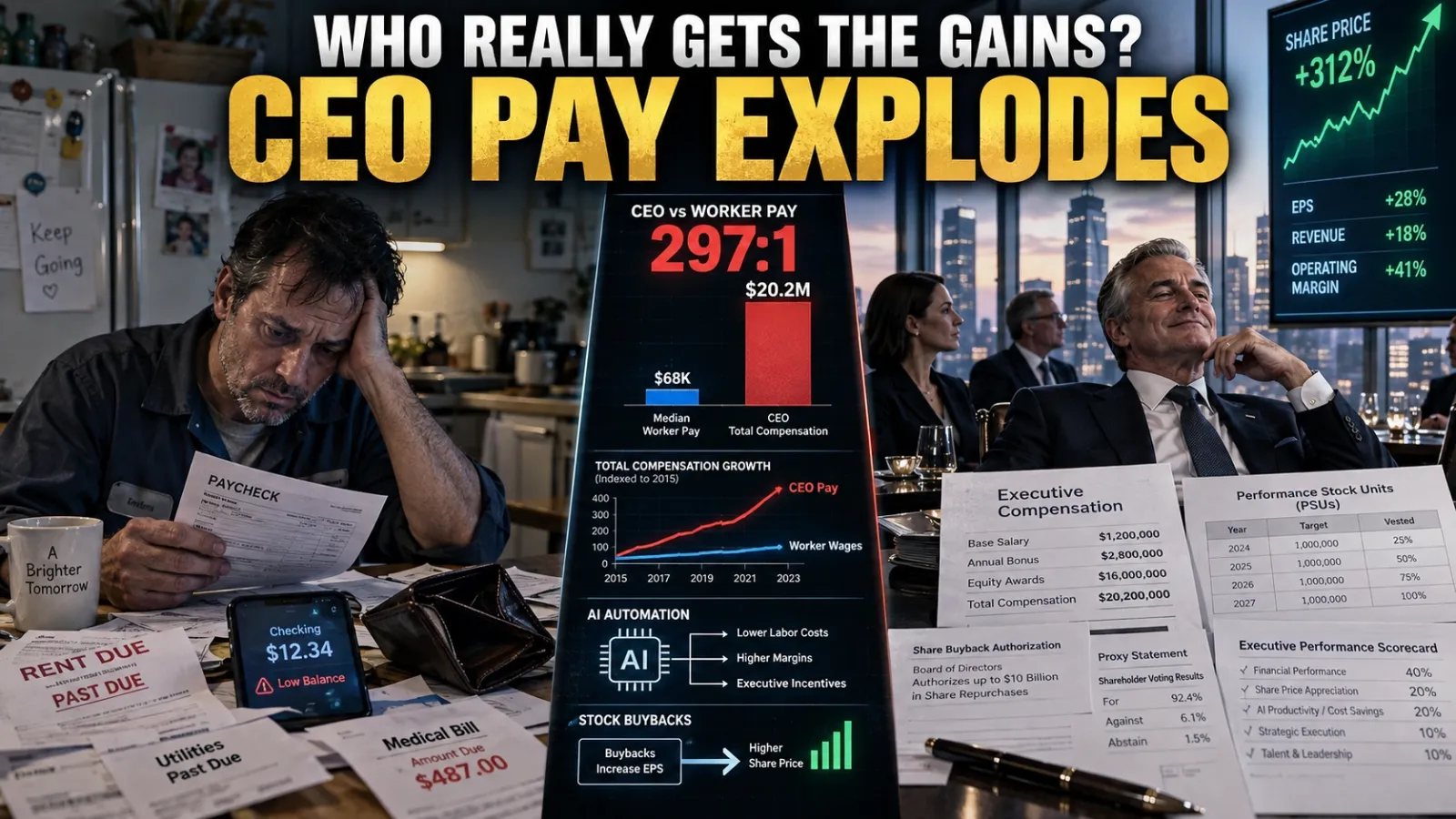
The staggering growth in chief executive pay since the turn of the decade has largely circumvented the traditional payroll department. According to extensive 2026 data compiled by The Conference Board, ESGAUGE, and FW Cook, median base salaries for S&P 500 executives increased by only about 16 percent since 2021. By stark contrast, median performance-award values skyrocketed by 46 percent in the S&P 500, and 51 percent across the broader Russell 3000 index. Equity, rather than cash in hand, is doing the heavy lifting in modern wealth accumulation.
The strategic logic behind this shift is straightforward for corporate compensation committees. Base salary increases permanently raise fixed costs, while equity grants give boards the unlimited runway to balloon an executive’s potential net worth. By relying on restricted stock units and performance stock units, companies can project a narrative of pay-for-performance while virtually guaranteeing massive payouts. As of 2026, performance stock units are utilized by 91 percent of S&P 500 companies, while traditional stock options have plummeted in popularity, dropping from 47 percent to just 33 percent.
This reliance on stock-based compensation fundamentally masks the true scale of executive wealth generation. Headline compensation figures reported in proxy statements increasingly reflect grant-date accounting estimates rather than the actual, eventually realized cash value. When a booming stock market multiplies the value of these equity grants over a three-to-five-year vesting schedule, the actual wealth transferred to the executive vastly exceeds the figures initially disclosed to the public.
Consequently, the size of a company has become the single strongest predictor of a chief executive’s paycheck, entirely eclipsing sector or industry performance. Among the smallest Russell 3000 companies, median reported CEO compensation sits at a relatively modest $3.4 million. However, at corporations with at least $50 billion in annual revenue, the median reaches a towering $23.6 million. At these mega-corporations, base salary accounts for a microscopic 8 percent of the total package, rendering the executive’s financial incentives entirely captive to equity market fluctuations.
Six Decades of Divergence
To understand the human consequence of the $17.5 million median pay package, one must look at the widening chasm between the boardroom and the breakroom. Data from the Economic Policy Institute reveals that in 2025, chief executives were paid 325 times as much as a typical worker. This represents a catastrophic departure from historical norms; in 1965, the CEO-to-worker pay ratio was a mere 21-to-1. Between 1978 and 2025, realized CEO compensation shot up by a staggering 1,316 percent, while the typical worker’s compensation crept up by just 28 percent.
The AFL-CIO’s 2026 Executive Paywatch report paints an even more granular picture of this extreme disparity. Across the S&P 500, the average pay ratio expanded to 312-to-1 in 2025, excluding extreme statistical outliers like Tesla. When factoring in those extraordinary outliers, the average ratio morphed into an unfathomable 5,387-to-1. To put this into perspective, a majority of S&P 500 chief executives now earn more in a single workday than the median American worker earns in an entire calendar year.
This extreme concentration of wealth at the executive level directly correlates with deepening economic precarity for the American workforce. Workers’ share of the U.S. national income has fallen to its lowest level since World War II. Consequently, 16 percent of American adults report being unable to pay all their bills in full, and 37 percent lack the cash to cover a standard $400 emergency expense. Furthermore, a devastating 49 percent of adults under the age of 30 are now forced to live with their parents due to skyrocketing housing costs.
The ripple effects of this disparity extend directly to the American taxpayer, who is increasingly forced to subsidize the workforce of highly profitable corporations. Employees at some of the nation’s largest companies are among the top recipients of public assistance programs, including Medicaid and SNAP food assistance. While equity awards enrich the C-suite, the social safety net is left to bear the human cost of unlivable wages at the bottom of the corporate hierarchy.
The Stock Buyback Engine and Downsize-and-Distribute
The reliance on equity-based executive compensation does not operate in a vacuum; it actively shapes the operational strategies of major corporations. Research by economists such as William Lazonick highlights a dangerous shift from a historical retain-and-reinvest corporate model to a modern downsize-and-distribute regime. Under the traditional model, corporations retained their earnings to reinvest in research, capital expenditures, and most importantly, the productive capabilities of their labor force.
Today, the imperative to maximize shareholder value has completely inverted that corporate logic. Corporations routinely lay off experienced, higher-paid workers while simultaneously using corporate cash to execute massive stock buybacks. Because executive compensation is heavily weighted in performance shares tied to stock prices or earnings-per-share metrics, buybacks serve as a highly effective tool for executives to artificially inflate the metrics that trigger their own payouts.
This dynamic creates a perverse incentive structure where corporate leaders are financially rewarded for hollowing out their own companies. By aggressively executing stock buybacks, companies divert critical capital away from worker training, infrastructure, and wage increases. The ultimate consequence is a landscape defined by middle-class employment instability, diminished national innovative capacity, and the relentless concentration of income among the richest households.
When an executive’s equity vests based on a targeted stock price, there is little financial motivation to prioritize long-term, sustainable growth over a quick, buyback-induced market pop. This short-termism, legally codified into executive contracts via equity milestones, reveals that the $17.5 million median is not merely a reflection of exceptional managerial talent. Rather, it is the byproduct of a system engineered to extract wealth from the labor force and distribute it directly to the executive class.
Outliers, Megagrants, and the Billion-Dollar Club
While the $17.5 million median is historically high, it is the spectacular outlier packages that truly illustrate the erosion of corporate restraint. The 2026 reporting season witnessed the highest concentration of nine-figure compensation awards in the history of executive pay studies. These megagrants, heavily weighted in performance stock, are reshaping the boundaries of corporate compensation and drawing unprecedented levels of institutional scrutiny.
The most prominent example remains Elon Musk’s 2025 compensation at Tesla, a restricted stock plan valued at an astonishing $158 billion. This single pay package was roughly 14 times higher than the total compensation of all other S&P 500 chief executives combined. However, the phenomenon of the megagrant extends far beyond the technology sector, fundamentally altering expectations across all major industries.
| Executive | Company | Reported Compensation | Context & Shareholder Response |
|---|---|---|---|
| Elon Musk | Tesla, Inc. | $158.3 Billion | Highest in history; ratio of 2,522,203-to-1. |
| Shankh Mitra | Welltower Inc. | $821.1 Million | Heavy shareholder dissent; only 19% support. |
| Peter M. Kern | Expedia Group | $296.3 Million | Outlier pandemic-era award; managed intense volatility. |
| David M. Zaslav | Warner Bros. Discovery | $165.0 Million | Met with intense backlash; just 15.6% support. |
| Patrick W. Smith | Axon Enterprise | $164.5 Million | Dominated by a single long-term stock award. |
These outlier packages have begun to severely test the patience of institutional shareholders. While overall say-on-pay votes continue to pass with roughly 73 to 76 percent of companies receiving overwhelming support, the dissent is becoming highly concentrated. Warner Bros. Discovery saw its compensation proposal crash to a dismal 15.6 percent approval rating after disclosing CEO David Zaslav’s $165 million package.
Similarly, real estate investment trust Welltower awarded CEO Shankh Mitra a massive $821 million package intended to cover his compensation for a decade. Shareholders unequivocally rejected the logic, with only 19 percent voting in favor of the proposal. These severe rebukes indicate that while investors tolerate routine inflation in executive pay, they are increasingly willing to revolt against exceptional equity awards that defy standard annual programming.
The Gender Divide in the Executive Stratosphere
Despite the astronomical figures circulating at the top of the corporate ladder, the demographic makeup of the recipients remains starkly homogeneous. By 2026, women accounted for only 9.3 percent of S&P 500 chief executives, an incremental rise from approximately 6 percent in 2021. While progress in the broader senior executive population has been steadier, women remain vastly underrepresented in the chief financial officer and chief operating officer roles that traditionally serve as pipelines to the top job.
Interestingly, unadjusted data suggests that women who do break through this barrier are compensated competitively relative to their male peers. Across the S&P 500, the median reported compensation in 2026 was $17.8 million for female executives compared to $17.5 million for men. In the broader Russell 3000, median pay reached $7.7 million for women versus $7 million for men.
However, compensation researchers warn that these figures do not control for company size, sector, or the specific timing of equity grants, making them an unreliable proxy for true gender parity. High-profile leaders like AMD’s Lisa Su and Citigroup’s Jane Fraser consistently rank among the highest-paid women in the market, pulling in tens of millions annually. Yet, the extreme outliers—the nine-figure and billion-dollar awards that warp the overall market—remain exclusively in the hands of male executives.
Artificial Intelligence as a Profit Multiplier
As corporate America races to integrate artificial intelligence, executive compensation committees have rapidly engineered new ways to reward the C-suite for technological disruption. By 2026, AI adoption and utilization metrics have explicitly entered executive incentive plans, carrying weightings that range from 5 percent in annual cash bonuses to 20 percent in long-term equity awards. On the surface, these metrics appear designed to ensure companies remain competitive in a rapidly evolving digital landscape.
However, the human reality of these AI incentives is significantly darker for the average employee. Industry observers note that AI deployment in the corporate sphere is rarely just about adopting new tools; it is fundamentally about workforce substitution. When executives are financially incentivized to achieve AI deployment milestones, they are implicitly rewarded for engineering the obsolescence of their own workforce.
In many cases, the most measurable way for a chief executive to prove successful AI integration is through documented cost savings and headcount reductions. If an executive champions an AI platform that allows the company to eliminate entire departments of middle-tier workers, their compensation committee scoring rubric registers this as a strategic triumph. This directly unlocks multi-million-dollar equity tranches for the executive while sending unemployment ripples through the broader economy.
This creates a terrifying dynamic for the modern worker, who is now forced to train the very systems designed to replace them. The very technology threatening their livelihood is actively enriching their corporate leadership. By embedding AI milestones into performance frameworks, corporate boards are legally and financially aligning executive success with the systematic devaluation of human labor.
The Fortress C-Suite and Corporate Duty
As the financial divide between executives and the public widens to unprecedented extremes, the resulting social friction has fundamentally altered the lifestyle of the American CEO. One of the most glaring human consequences detailed in the 2026 data is the rapid and staggering surge in personal and home security benefits provided to corporate leaders. Security is no longer viewed as an executive perk, but rather as a critical duty-of-care governance issue.
In 2026, 34 percent of S&P 500 chief executives received company-funded personal and home security benefits, nearly double the 18 percent reported just two years prior in 2024. At the largest Russell 3000 companies, a stunning 60 percent of CEOs now live behind corporate-funded security apparatuses. This militarization of the C-suite is widely attributed to escalating public resentment, catalyzed in part by the chilling December 2024 targeted killing of UnitedHealthcare CEO Brian Thompson in New York.
The expenditures required to maintain this physical distance between executives and the public are immense. The median disclosed security costs sit near $101,900 for the S&P 500, but the extremes are vast. The 20 largest security expenditures in the Russell 3000 averaged approximately $4.3 million per executive, with high-profile figures requiring millions in personal protection.
Furthermore, this security posture extends to the skies, ensuring that executives rarely interact with the traveling public. Personal use of corporate aircraft was reported for 48 percent of S&P 500 executives in 2026, up from 43 percent the previous year. Many boards now actively require or heavily encourage their executives to utilize private aviation strictly to mitigate physical risks. As their compensation models inevitably contribute to broader societal decay, corporate elites are using shareholder funds to physically insulate themselves from the communities their corporations inhabit.
Regulatory Pushback and Proxy Season Battles
The sheer velocity of executive wealth accumulation has predictably triggered waves of regulatory and legislative pushback. Under Section 953(a) of the Dodd-Frank Act, the Securities and Exchange Commission successfully implemented the Pay Versus Performance rule. This complex mandate forces companies to disclose the relationship between actual compensation paid and the financial performance of the issuer over a five-year period.
This rule represents a critical shift in corporate transparency. It demands that companies reconcile the idealized, grant-date fair value of equity awards with the turbulent reality of vested, mark-to-market valuations. By forcing boards to explicitly map executive payouts against metrics like Total Shareholder Return, regulators are attempting to expose situations where executives reap windfalls while shareholders and employees suffer.
Beyond the SEC, major proxy advisory firms have dramatically tightened their leashes on corporate boards. For the 2026 proxy season, both Institutional Shareholder Services and Glass Lewis extended their quantitative pay-for-performance assessment windows from three years to a stringent five-year lookback. By stretching the evaluation timeline, these powerful advisory firms are explicitly targeting the delayed vesting nature of equity awards, ensuring that long-term payouts truly align with long-term corporate health rather than brief stock spikes.
Simultaneously, the political arena has seized upon extreme compensation disparities, though success remains deeply contested. The Tax Excessive CEO Pay Act, championed by federal lawmakers, proposes a severe tax hike on large corporations that compensate their chief executives at a rate exceeding 50 times that of their median worker. However, local initiatives have proven equally contentious; in June 2026, San Francisco voters narrowly defeated Proposition D, an initiative that would have drastically increased the city’s existing Overpaid CEO Tax on companies with extreme pay gaps. The initiative failed only after massive corporate lobbying warned of imminent job losses and economic destabilization.
What Happens Next
The trajectory of executive compensation suggests that the tension between corporate boards, regulatory bodies, and organized labor is nearing a critical breaking point. As equity awards continue to push average S&P 500 payouts toward the $20 million threshold, the foundational logic of the American corporate social contract is being aggressively tested. Without systemic changes, the concentration of corporate wealth will continue to accelerate.
In the near term, corporate compensation committees will face an increasingly hostile environment during the annual proxy season. The expanded five-year lookback policies enacted by proxy advisors will likely trigger a surge in negative vote recommendations for companies whose equity grants fail to match sustained economic performance. Corporate boards will be forced to engage in heavy defensive public relations campaigns to prevent their compensation packages from suffering humiliating shareholder rejections.
For the American workforce, the outlook remains precarious and demands urgent collective action. The integration of AI metrics into executive bonus structures ensures that the automation and displacement of human labor will be aggressively pursued from the top down. In response, labor organizations are beginning to pivot their strategies, with major unions formally proposing policies that would enforce default collective bargaining rights at any firm where the pay ratio exceeds 100-to-1.
Ultimately, the $17.5 million median CEO is not a natural market anomaly; it is the mathematical result of an economic system that prioritizes equity distribution over human capital. Until federal tax codes, proxy regulations, or robust union interventions forcefully disrupt the mechanics of the performance stock unit, executive wealth will continue its stratospheric ascent. In this scenario, the median worker will be left to navigate an increasingly unaffordable, automated, and unstable reality.
Sources (103)
- wealthprofessional.ca
- equilar.com — 92 equilar associated press ceo pay study 2022
- equilar.com — 127 equilar associated press ceo pay study 2026
- ctvnews.ca — How ap and equilar calculated us ceo pay 2
- equilar.com — Executive factbook
- equilar.com — 118 equilar associated press ceo pay study 2025
- apnews.com — Compensation and benefits associated press industry regulation general news e48d
- equilar.com — 110 equilar associated press ceo pay study 2024
- equilar.com — 126 highest paid ceos 2026 equilar 100
- aflcio.org — 12 things you need know afl cios 2026 executive paywatch report
- rentseek.ing — Learn
- investmentnews.com
- conference-board.org — CEO pay 2026
- prnewswire.com — Report equity awards drive growth in sp 500 ceo compensation 302887937
- fwcook.com — Latest insights
- ropesgray.com — Ropes gray partners with the conference board
- fwcook.com — Articles
- conference-board.org — CEO and Executive Compensation Practices in the Russell 3000 and S and P 500 202
- fwcook.com — Fw cook partners with the conference board on 2026 ceo pay report highlighted in
- ir-impact.com — Executive pay metrics in sp 500 shift away from broad esg criteria
- kellogg.northwestern.edu — Suptone110906
- epi.org — Ceo pay
- epi.org — Ib331 ceo pay top 1 percent
- ecgi.global
- econstor.eu — Dp17243
- nber.org — W16585
- epi.org — Ceo pay in 2023
- cdi.mecon.gob.ar — Dp19008
- epi.org — Ceo pay in 2022
- researchgate.net — 227429276 Taxation and the value of employee stock options
- epi.org — Ceo pay surged in 2025 ceos are paid 325 times as much as the typical worker
- peoplematters.in — Average ceo pay climbs to dollar228 million amid rise of mega compensation award
- apnews.com — Ceo compensation stock awards workers pay ratio 67449e8a07011e5390d704c665533f94
- deloitte.com — Median ceo pay in india stands at inr 10 5 crore for fy 2025 26
- aflcio.org — Paywatch
- policymattersohio.org — Ceo pay report 2025
- m.economictimes.com — 134514804.cms
- digitalcommons.law.seattleu.edu
- ineteconomics.org — LAZONICK William Profits without Prosperity 20140406
- ineteconomics.org — The myth of maximizing shareholder value
- ir.lawnet.fordham.edu — Viewcontent.cgi
- brookings.edu — Stock buybacks from retain and reinvest to downsize and distribute
- commondreams.org — Sanders bill would hike taxes big corporations pay ceos over 50 times more media
- closeup.org — Ceo compensation an issue of fairness or evidence of a functioning free market
- closeup.org — Tax excessive ceo pay
- en.wikipedia.org — Elizabeth Warren
- sanders.senate.gov — News sanders and colleagues introduce legislation to combat corporate greed and
- axios.com
- whitehouse.senate.gov — Whitehouse introduces bill to curb excessive ceo pay
- facebook.com
- youtube.com — Watch
- youtube.com — Watch
- datablist.com — Download sample csv files
- en.wikipedia.org — 2026 San Francisco Measure D
- sfpublicpress.org — San franciscos overpaid ceo tax heads to voters
- spur.org — Sf prop d business tax increase
- youtube.com — UJk1CkWkJr8
- inequality.org — Corporate billionaire opponents to overpaid executive tax
- fenwick.com — Executive compensation alert sec proposes pay versus performance rules
- capartners.com — Sec issues final rules for pay versus performance disclosure
- media.mcguirewoods.com — Sec pay vs performance disclosure
- sec.gov — Uyeda statement final rule related pay versus performance 082522
- equitymethods.com — Pay versus performance is here part 1 overview and action items
- beqom.com — Complying with the new sec pay vs. performance disclosure rules
- gibsondunn.com — Sec releases final pay versus performance rules
- federalregister.gov — Pay versus performance
- sec.gov — Pay versus performance
- dart.deloitte.com — Sec issues pay vs performance
- jrgpartners.com — Executive compensation statistics 2026 base bonus equity data
- morganhr.com — Ai in executive compensation leadership behaviors
- mercer.com — Ai adoption in executive incentive plans
- cio.economictimes.indiatimes.com
- knowledge.wharton.upenn.edu — How can companies incentivize ai adoption
- performanceleader.com — Equity partner reward in the age of ai disruption what the survey data tells us
- pwc.com — Pwc 2026 ai performance study
- jpmorganworkplacesolutions.com — Artificial intelligence and equity compensation
- pearlmeyer.com — AI in incentive plans opportunity risk and the role of the compensation committe
- carta.com — AI shifts in compensation
- m.economictimes.com — 134452757.cms
- federalreserve.gov — Monetary20260729a1
- federalreserve.gov — Monetary20260916a
- federalreserve.gov — Fomcminutes20260729
- m.economictimes.com — 134566067.cms
- investor.factset.com — Ba920b54 c271 426a 84e9 fd1208cfee67
- jpmorgan.com — Mid year outlook 2026
- federalreserve.gov — Fomcminutes20260429
- home.treasury.gov — Sb0607
- federalreserve.gov — Scoos 202609
- oecd.org — Corporate debt market outlook in a transforming world cf86a220
- m.economictimes.com — 134547217.cms
- haynesboone.com — Key iss and glass lewis updates for 2026 proxy season
- execcomp.ai — Proxy advisor guidelines
- stblaw.com — Firmmemo 01 08 26
- uk.practicallaw.thomsonreuters.com — W 049 0345
- foley.com — Iss and glass lewis executive compensation benchmark policy updates for the 2026
- resources.glasslewis.com — Benchmark%20Policy%20Guidelines%202026%20 %20United%20States
- cooley.com — 2025 06 30 glass lewis previews changes to pay for performance model for 2026 pr
- glasslewis.com — Resource center
- legal500.com — Heads up for the proxy season iss and glass lewis policy updates for 2026 focus
- akingump.com — Iss and glass lewis publish 2026 benchmark proxy voting policies
- m.economictimes.com — 132007328.cms
- finance.biggo.com — Deb2c72a 9cf2 44ae 8ebc 2668c9a228f8
- indiatoday.in — Indian origin ceo shankh mitra second highest executive after tesla boss elon mu




Leave a Reply