
When Hard Work No Longer Builds Wealth: The Urgent Push to Rewire the American Economy
On September 3, 2026, the Urban Institute released a stark assessment of the modern American financial reality, concluding that the longstanding relationship between earning a paycheck and building household wealth is fundamentally broken. For decades, working-class families operated under the assumption that steady wages would inevitably translate into savings, homeownership, and generational stability. Today, volatile labor markets, extreme wealth concentration, and the looming specter of artificial intelligence have transformed that once-reliable pathway into an unforgiving obstacle course.
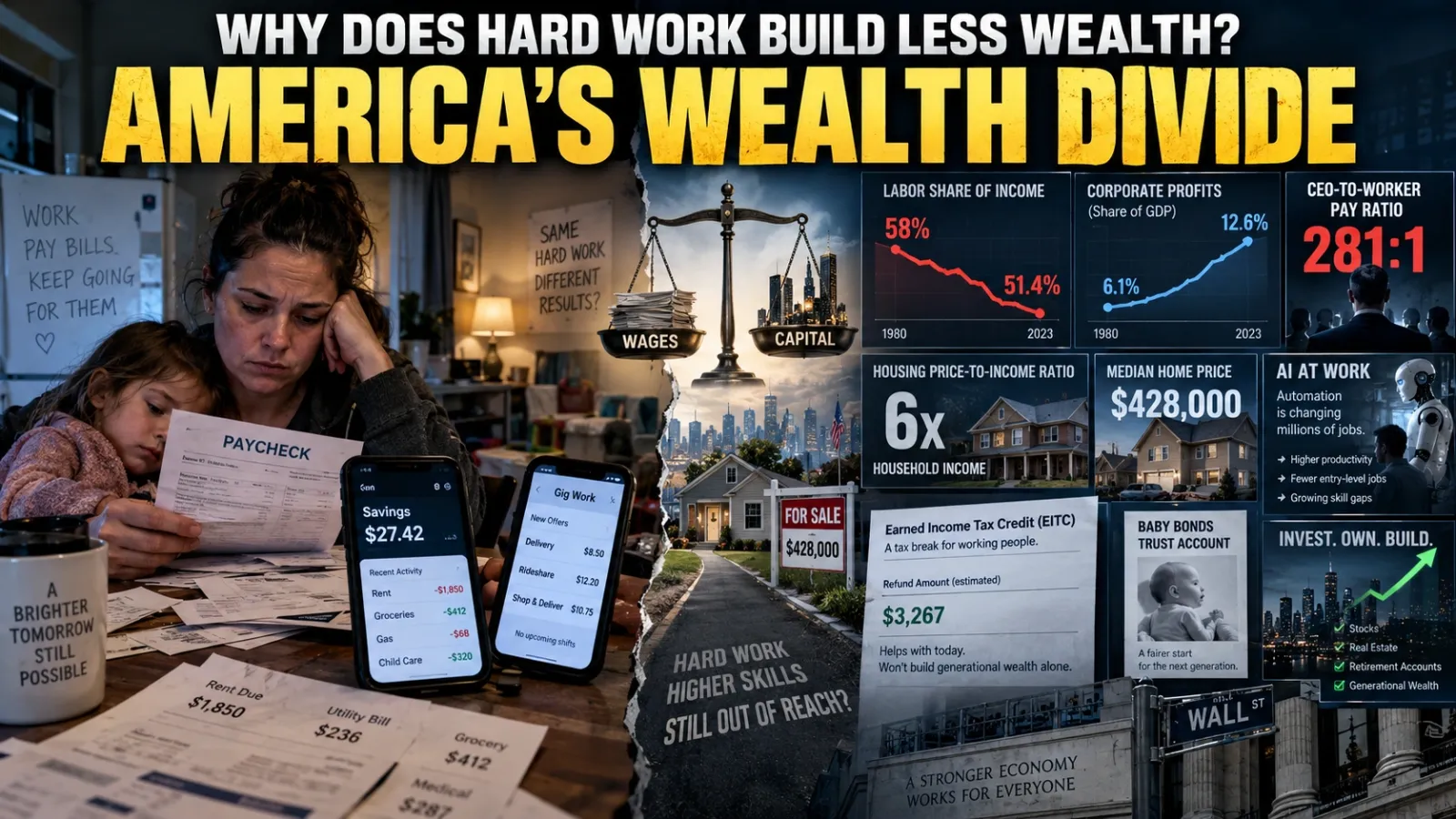
The urgency of this economic crisis is underscored by a historic shift in how money flows through the United States. Income earned directly from labor has plummeted to a record low share of the national income, while the financial returns on capital—such as stocks, business ownership, and real estate—continue to surge to unprecedented highs. This structural transformation disproportionately punishes ordinary wage earners, who are increasingly forced to drain their meager savings just to weather routine economic shocks.
For policymakers and advocates, the human consequences of this divide require immediate and coordinated intervention. Researchers Rekha Balu, William J. Congdon, and Elisabeth Jacobs argue that simply plugging holes in weekly paychecks is no longer sufficient to guarantee family stability. To help households achieve durable economic security, lawmakers must implement integrated solutions that simultaneously stabilize labor incomes and actively generate household wealth.
The Macroeconomic Shift: When Labor Lost to Capital
The deterioration of the American paycheck is not a recent phenomenon, but rather the result of decades of structural economic shifts favoring capital ownership. In 1980, the labor share of gross domestic income stood at an estimated 58 percent, a figure that steadily declined to 51.4 percent by late 2025. Conversely, corporate profits nearly doubled as a share of the national income over the same period, signaling a massive reallocation of resources away from the workforce. This macroeconomic trend quietly stripped trillions of dollars from the working class, leaving families with thinner margins for error.
As the labor share of income declined, the traditional middle class experienced a severe contraction in its overall financial footprint. In 1970, middle-class households captured roughly 62 percent of the aggregate national income, but by 2022, that share had plummeted to just 42 percent. Meanwhile, the concentration of extreme wealth accelerated, with the top 10 percent of the population capturing nearly 32 percent of economic wealth by the end of 2025. The CEO-to-worker pay ratio illustrates this divide perfectly, skyrocketing from 21-to-1 in 1965 to an astonishing 281-to-1 by 2024.
This systemic imbalance has bred a deep and persistent sense of economic pessimism among American households. Workers are increasingly trapped in a paradox where their overall productivity rises, yet their purchasing power remains heavily restricted. Without the ability to accumulate surplus capital, ordinary laborers are entirely shut out of the passive income streams that allow wealthier citizens to multiply their fortunes.
| Economic Indicator | Historical Baseline | Recent Measurement (2024–2026) |
|---|---|---|
| Labor Share of National Income | 58.0% (1980) | 51.4% (Q3 2025) |
| Middle-Class Aggregate Income | 62.0% (1970) | 42.0% (2022) |
| CEO-to-Worker Pay Ratio | 21:1 (1965) | 281:1 (2024) |
| Median Home Price-to-Income | 3.2x (1970) | 5.3x – 5.8x (2023-2026) |
Current tax policies heavily advantage wealth and its passive growth, treating capital gains far more favorably than hourly wages. This dynamic allows wealthier citizens to steadily accumulate riches while being lightly taxed, whereas lower-income workers face a steep uphill battle just to retain their earnings. Analysts argue that most current economic policies mistakenly focus only on plugging temporary income holes, entirely neglecting the need to help wage-earners convert their pay into durable assets.
The Rising Costs of Basic Survival
Compounding the problem of stagnant wage shares is the explosive growth in the cost of basic human survival. Housing, health care, and energy costs have vastly outpaced inflation, creating an affordability crisis that disproportionately impacts lower-income communities. For example, the median existing home price breached the $400,000 mark by 2025, pushing the national price-to-income ratio to nearly six times the median household wage. Consequently, homeownership—historically the primary vehicle for American wealth building—is increasingly walled off from the working class.
The rental market offers no refuge for struggling workers, particularly single parents navigating the modern economy. Data indicates that 70 percent of single mothers currently spend at least 30 percent of their pretax earnings on housing costs. Shockingly, half of these mothers spend 50 percent or more of their income just to keep a roof over their children’s heads. Such severe cost burdens make the accumulation of emergency savings a mathematical impossibility for millions of citizens.
When unforeseen crises strike, workers without a financial cushion are forced into precarious survival tactics. Unpredictable work schedules and the rise of gig employment have introduced severe volatility into household cash flows, stripping workers of basic benefits like paid leave or defined pensions. To survive temporary job losses or medical emergencies, families frequently draw down whatever minimal wealth they possess or accumulate high-interest debt. This reactive cycle effectively ensures that lower-income earners remain perpetually focused on immediate survival rather than long-term prosperity.
Rewiring the Safety Net: The Limits of the EITC
The Earned Income Tax Credit (EITC) illustrates the limitations of relying solely on income-based safety nets to generate wealth. As a refundable federal credit, the EITC provides vital cash support to low- and moderate-income workers, lifting millions out of poverty each year. Thirty-two states and the District of Columbia have also implemented their own localized versions of the EITC to further boost family cash flows. However, longitudinal studies reveal that while the EITC helps stabilize immediate household finances, it is largely ineffective at closing deep-rooted racial wealth disparities.
Research published by the Russell Sage Foundation indicates that exposure to the EITC during early childhood increases overall family wealth by about four percent. Yet, these financial gains are highly unequal across demographic lines. The wealth-building benefits of the EITC appear predominantly among white families, who see boosts in checking accounts and retirement savings, while the policy has an inconclusive or negligible impact on the net worth of Black families.
| EITC Tax Year | Max Credit (3+ Children) | Max AGI (Joint Filers) | Investment Income Limit |
|---|---|---|---|
| 2024 | $7,830 | $66,819 | $11,600 |
| 2025 | $8,046 | $68,675 | $11,950 |
| 2026 | $8,231 | $70,224 | $12,200 |
This racial discrepancy proves that income supplements alone cannot overcome systemic barriers to asset building, such as predatory lending or historic housing discrimination. Real reform requires policymakers to look beyond mere income replacement and design tax structures that explicitly subsidize working-class savings and investments. While the EITC is a necessary lifeline that reduces severe housing cost burdens, it was never designed to serve as a comprehensive engine for intergenerational wealth.
Conversely, some conservative policy analysts argue that focusing exclusively on economic transfers ignores the structural breakdown of the American family. Research from the Heritage Foundation posits that the decline of marriage and the normalization of unwed childbearing are primary drivers of childhood poverty and financial instability. From this perspective, the most effective wealth-building policy is the promotion of stable, dual-earner households rather than relying on expanding government tax credits or direct subsidies.
Artificial Intelligence: The New Frontier of Labor Anxiety
The rapid deployment of artificial intelligence represents a new and highly unpredictable variable in the labor market. A July 2026 Urban Institute blueprint highlights that AI could drastically transform how workers learn and earn, potentially displacing vast segments of the workforce. If left entirely to free-market forces, the economic benefits of these technological advancements are expected to flow predominantly to the shareholders who own the technology. This dynamic threatens to violently accelerate the existing trends that favor capital over human labor.
To prevent an algorithmic exacerbation of wealth inequality, researchers emphasize the need for an intentionally inclusive AI economy. Policymakers must proactively invest in workforce training programs that allow ordinary people to harness these new tools, rather than being replaced by them. Furthermore, ensuring that AI-driven productivity gains are widely shared will require updating outdated labor regulations that currently fail to protect workers from algorithmic management and automated hiring biases.
Integrating worker voices into the implementation of enterprise AI is considered critical for preserving job quality. Without deliberate policy actions, such as public investments in worker-centered technology, the default trajectory points toward broad automation and increased corporate profit margins. Should this default hold, the broader economy might register massive growth on paper, even as localized job opportunities diminish and working-class earnings evaporate.
Bridging the Gap at Birth: The Promise of Baby Bonds
To combat the inherent disadvantages of being born into a low-wealth household, some states are experimenting with direct capital transfers known as baby bonds. In 2023, Connecticut became the first state to launch and fully fund a statewide baby bond initiative, aimed at democratizing wealth for historically marginalized communities. The program automatically deposits up to $3,200 into a trust for every child born under HUSKY Health, the state’s Medicaid program. By July 2026, the initiative had successfully enrolled an estimated 48,000 eligible babies across the state.
The mechanical design of baby bonds specifically targets long-term, structural wealth accumulation rather than short-term consumption. The invested funds are projected to yield between $11,000 and $24,000 by the time the child reaches adulthood. Crucially, participants can only access these funds between the ages of 18 and 30 for distinct, wealth-generating activities. Permitted expenditures are strictly limited to higher education, buying a home in Connecticut, starting a local business, or saving for retirement.
By providing a guaranteed birthright to capital, baby bonds aim to directly shrink the racial wealth gap. In Connecticut, where Black households historically earn just 63 cents for every dollar earned by white households, these trust accounts offer a tangible mechanism for generational correction. Proponents argue that the psychological impact is equally profound, as giving low-income children a guaranteed future asset fundamentally alters their career aspirations and educational outlook from an early age.
However, the rollout of baby bonds has faced political and ideological hurdles at the national level. Federal baby bond proposals championed by progressive lawmakers have stalled, leading to the emergence of alternative conservative models, sometimes dubbed “Trump Accounts,” which operate on an opt-in basis rather than automatic enrollment. Experts warn that requiring low-income families to actively opt-in severely limits the reach of these programs, potentially excluding the exact populations that stand to benefit the most.
To simulate the real-world impact of these policies on older cohorts, philanthropic organizations in New Haven recently launched a “Wealth Accelerator” pilot. This program functions as a retroactive baby bond, distributing grants of $2,000 to $20,000 to young adults who were born into poverty before the state trust existed. By providing immediate capital to historically excluded communities, advocates hope to prove that direct wealth transfers are both viable and necessary for economic mobility.
Empowering Workers Through Sectoral Bargaining
Beyond government transfers, empowering workers to extract better terms directly from their employers remains a critical piece of the wealth puzzle. California recently demonstrated the potential of this approach by establishing a Fast Food Council, a sectoral wage board composed of workers, union representatives, and industry leaders. In 2024, the council successfully instituted a $20 minimum wage for large chain fast-food workers, with scheduled adjustments pushing the floor to $22 by 2026.
This model of sectoral bargaining sidesteps traditional, single-shop unionization, allowing labor standards to be elevated across an entire industry simultaneously. For decades, basic labor protections have failed to adequately cover sprawling sectors like food service, home health care, and gig work. Sectoral wage boards give workers a direct voice in shaping their working conditions, guaranteeing adequate rest between shifts and reducing the economic uncertainty that undermines saving.
[Editorial Caution: The regulatory authority of state-level sectoral wage boards, such as California’s Fast Food Council, remains the subject of ongoing legislative and legal disputes, with critics arguing such councils bypass traditional legislative processes.]
Despite the promise of these boards, their implementation is often fraught with political gridlock. Critics of the California model point out that the Fast Food Council faced significant administrative delays, with some analysts noting long periods where the council failed to convene at all. Nevertheless, labor advocates view the existence of these councils as a vital first step in modernizing labor market institutions to build actual worker power.
Democratizing Ownership: The Rise of ESOPs
Another powerful mechanism for bridging the gap between labor and capital is the expansion of Employee Stock Ownership Plans (ESOPs). By granting workers direct equity in the businesses they operate, ESOPs inherently link daily labor to long-term capital appreciation. Data from the National Bureau of Economic Research shows that lower-income workers in ESOPs boast a median wage that is 23 percent higher than their non-ESOP peers.
Furthermore, employees at these firms generally maintain more than double the retirement savings of workers at traditional companies. This structure actively narrows both gender and racial wealth gaps, as ordinary workers accumulate ownership shares alongside their standard hourly pay. For moderate-income earners, an ESOP account provides a distinct vehicle to capture a slice of the nation’s corporate profits, something generally reserved for elite investors.
The resilience of worker-owned models becomes especially apparent during periods of severe economic crisis. During the Covid-19 pandemic disruptions, ESOPs with majority employee ownership prioritized maintaining jobs and shifting staff to remote work, viewing their laborers as integral owners rather than disposable expenses. Traditional firms, driven entirely by the need to maximize outside shareholder income, were vastly more likely to enact immediate, deep workforce cuts. This stark contrast proves that democratizing corporate ownership fundamentally alters corporate behavior, shifting the focus from purely extracting wealth to actually sustaining the workforce.
What Happens Next
The American economy is currently operating on an outdated blueprint, one that assumes a steady paycheck naturally yields a stable life. As the Urban Institute’s 2026 findings make clear, policymakers can no longer treat income supports and wealth generation as separate, unrelated legislative categories. A failure to adapt to the realities of volatile gig work, soaring living costs, and AI disruptions will only deepen the financial pessimism gripping the nation.
In the immediate future, local and state governments are expected to shoulder the burden of economic experimentation. We will likely see an expansion of state-funded baby bond programs, as more states look to emulate Connecticut’s success in providing a birthright to capital. Simultaneously, worker advocates will continue pushing federal lawmakers to reform a tax code that overwhelmingly shields capital gains at the expense of wage laborers.
Ultimately, restoring the promise of the American working class requires acknowledging that economic dignity is built on assets, not just hourly wages. By connecting income stabilization tools—like a modernized EITC—with structural wealth-building mechanisms like ESOPs and trust accounts, a new economic reality is possible. Achieving it, however, demands the political courage to rewire a financial system that has spent the last fifty years heavily favoring capital over the people who create it.
Sources (14)
- urban.org — Support workers changing economy policymakers need link income and wealth soluti
- frontpagedocumentaries.com — Middle Class Documentary Sources
- irs.gov — Earned income and earned income tax credit eitc tables
- rsfjournal.org
- pmc.ncbi.nlm.nih.gov — PMC6669080
- urban.org — Policy priorities inclusive ai economy
- issuu.com — Baby bonds for racial equity
- codeforamerica.org — The wealth gap starts at birth heres one fix
- ctmirror.org — Ct baby bonds wealth inequality
- ctmirror.org — Wealth accelerator ct baby bonds new haven
- heritage.org — Saving america saving the family foundation the next 250 years
- clje.law.harvard.edu — Workers boards
- nber.org — W33310
- nceo.org — New data on employee ownership and economic well being




Leave a Reply