
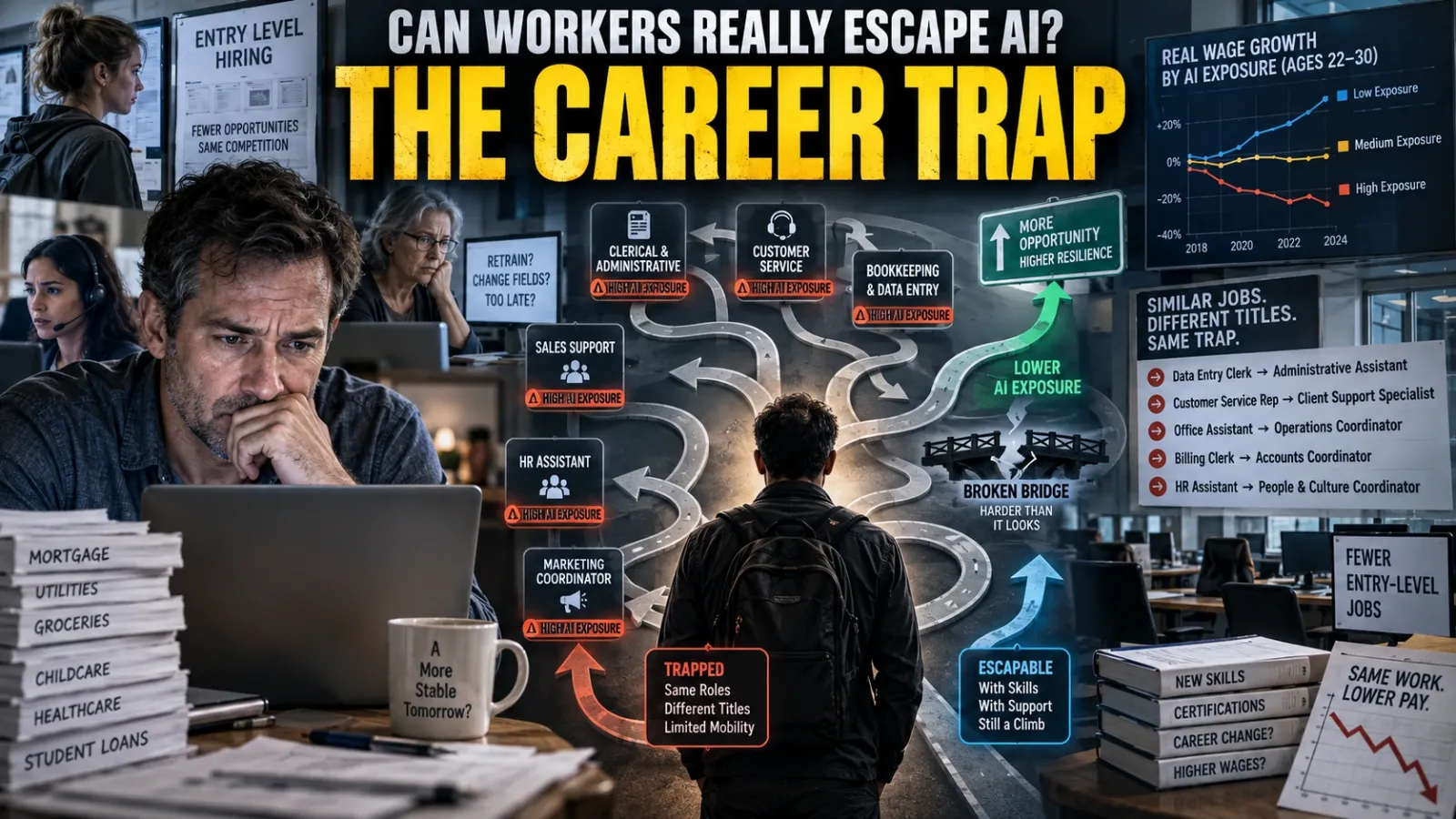
The Illusion of the Career Pivot
For years, research into AI’s impact on the workforce has relied heavily on abstract “exposure scores.” This methodology calculates the percentage of tasks within a specific job that a machine could theoretically perform or assist with, flagging jobs with high automation potential. Prominent academic frameworks, such as those pioneered by economists Daron Acemoglu and David Autor, have long illustrated how technology substitutes for routine tasks while complementing specialized human knowledge. Yet, this static view of the labor market frequently fails to account for human resilience and mobility. Workers rarely stand still when economic storms approach; they attempt to pivot.
The BPC’s 2026 analysis, Trapped Workers: A Network Analysis of Worker Mobility in the AI Economy, fundamentally altered this paradigm by mapping how Americans actually navigate their careers in real time. Utilizing microdata from the Current Population Survey (CPS) spanning 2019 to 2026, researchers did not just look at isolated job titles in a vacuum. Instead, they mapped the labor market’s natural mobility structure, applying the Louvain algorithm to cluster 472 distinct occupations into 16 interconnected communities. They found that career pivots are rarely random; transitions are tightly constrained by sector familiarity, transferable skills, geographic limitations, and existing professional networks.
When the researchers layered AI exposure data over this complex mobility network, a startling and grim reality emerged for the American workforce. They categorized occupations as either “escapable,” where workers can seamlessly move into roles with meaningfully lower AI exposure, or “trapped,” where common transition pathways lead right back into the crosshairs of automation. The BPC modeled this through two distinct lenses: a moderate scenario reflecting basic automation, and an aggressive scenario reflecting advanced enterprise adoption.
| Scenario | Total Analyzed Occupations | AI-Exposed (≥50% tasks automatable) | Trapped Occupations | Escapable Occupations |
|---|---|---|---|---|
| Moderate AI Capabilities | 525 | 31 | 10 (32.3%) | 21 (67.7%) |
| Aggressive AI Capabilities | 525 | 85 | 58 (68.2%) | 27 (31.8%) |
Table: Occupational vulnerability based on the BPC network mobility analysis. Data reflects the percentage of AI-exposed occupations that offer viable pathways to less-exposed roles.
Under the aggressive scenario—which many industry analysts in late 2026 argue is rapidly becoming the baseline reality in corporate America—nearly seven in ten AI-exposed occupations offer no safe exit. For the workers inhabiting these roles, the modern labor market functions less like a web of opportunity and more like a maze with no exit. The implication for American families is profound, as vulnerability effectively compounds with every job change. A worker may spend months retraining for a nearby role, only to find that their new desk is just as precarious as their old one.
The Collapse of the American Stepping Stone
To understand why the trapped worker crisis is so devastating to upward mobility, one must look at the invisible infrastructure of the labor market. For generations, certain jobs have acted as vital conduits between lower-wage hourly labor and the professional middle class. Economists refer to these critical roles as “bridge occupations,” which serve as high-volume transit points for the workforce. Jobs such as customer service representatives, operations managers, and administrative assistants have historically absorbed workers from disparate sectors, taught them enterprise skills, and served as launching pads into otherwise inaccessible corporate clusters.
These bridge occupations have long been the great equalizers of the American economy, particularly for workers who lack four-year college degrees. They allowed a retail worker to transition into a corporate office environment, learn proprietary software, and eventually move into marketing, human resources, or logistics. Today, however, these exact roles are squarely in the crosshairs of generative AI. Large language models and AI agents are uniquely adept at handling routine customer inquiries, drafting administrative communications, and processing structured operational data.
As businesses begin to automate these bridge occupations, they are not just eliminating individual jobs; they are actively burning the bridges that connect the working class to the middle class. The destruction of this labor market infrastructure threatens to permanently stratify the economy, leaving lower-wage workers with no clear path upward. Without these high-volume conduits, the leap from an hourly service job to a salaried professional role becomes impossibly wide. The historical mechanism for socioeconomic advancement is being systematically dismantled by algorithmic efficiency.
The early tremors of this collapse are already highly visible in payroll data across the country. Recent research from Stanford’s Digital Economy Lab, analyzing ADP payroll records through June 2026, highlights that employment for young adults (ages 22 to 25) in the most AI-exposed occupations has plummeted by 19% compared to their less-exposed peers since 2022. Employers facing economic uncertainty and armed with new productivity tools are quietly freezing entry-level hiring. They are increasingly leaning on senior staff whose deep, tacit experience is complemented by AI, rather than hiring unproven junior workers whose primary value once lay in executing the routine processes that software now handles.
A Crisis with a Female Face
When sweeping technological shifts disrupt an economy, the human toll is never evenly distributed among the population. The data emerging from the trapped worker framework reveals stark demographic disparities, fundamentally challenging the narrative that tech disruption is a gender-neutral phenomenon. According to the BPC’s demographic brief, Trapped Workers: Who AI Leaves Behind, women are bearing the overwhelming brunt of this structural economic shift. An astonishing 58.8% of all trapped jobs in the United States are currently held by women.
This gender disparity is deeply rooted in the historical segregation of the American workforce, which has long pushed women toward specific sectors. Women have historically been overrepresented in high-volume clerical, administrative, and business support roles. Today, these exact occupations represent the absolute vanguard of AI exposure. The statistical breakdown is sobering for anyone focused on gender equity in the economy, as women account for 91.9% of secretaries and administrative assistants, 82.7% of bookkeeping clerks, and 64.8% of customer service representatives.
Because these roles involve routine cognitive tasks that modern AI models excel at performing, the women holding them find their daily duties highly exposed to automation. The situation is further complicated by racial dynamics, which expose deep, preexisting economic inequities. Under the moderate AI scenario, Black workers face a trapped rate of 37.6%, which sits roughly eight percentage points higher than other racial groups. This elevated risk is largely driven by their heavy concentration in data-processing and clerical roles that fall just below the threshold of advanced AI, leaving them acutely vulnerable to even basic automation tools.
Age introduces another counterintuitive layer to the trapped worker crisis. For young Americans aged 16 to 24, direct exposure to AI is the highest of any demographic group at 17.4%. Yet, their statistical “trapped rate” is the lowest, sitting at just 46.9%. This statistical quirk occurs because millions of young workers are employed as cashiers or retail staff—jobs that are highly exposed to automation but are structurally designed to be “escapable” as young people graduate and move into different sectors. Conversely, older Americans face a terrifying landscape; for workers aged 65 and older who remain in the workforce, the trapped rate skyrockets to 73.7%, as they lack the time and resources to start over in a new industry.
The Tax Preparer and the Transcriptionist
The deep nuance of the trapped worker phenomenon is best understood through the diverging fates of two distinct professions. Consider the medical transcriptionist and the tax preparer, two roles that look virtually identical to an algorithm tracking automation risk. Both roles are overwhelmingly composed of routine cognitive tasks, whether that involves listening to audio and typing text, or ingesting financial data and filling out standardized forms. Both occupations sit well above the threshold where 50% of their daily duties are readily automatable by current AI systems.
If policymakers were to distribute workforce assistance based solely on raw “exposure scores,” the transcriptionist and the tax preparer would receive the exact same priority and funding. Yet, the BPC’s network analysis reveals that their real-world outcomes are wildly different. When medical transcriptionists are displaced, their most common career transitions lead them directly into hands-on patient care or specialized healthcare administration. These destination roles require human empathy, physical presence, and complex situational judgment—skills that completely insulate them from AI disruption.
The tax preparer, however, faces a much bleaker reality when navigating the modern job market. When automation compresses the demand for entry-level tax preparation, the historical transition paths for these workers lead directly into other administrative, bookkeeping, or general accounting roles. Because these destination jobs rely on the exact same underlying skillset—rule-based data processing and numerical categorization—they are equally, if not more, threatened by AI. The tax preparer is structurally trapped within a cluster of vulnerable professions, making traditional retraining efforts largely futile.
This comparative reality underscores a massive failure in how the United States currently conceptualizes workforce development and retraining. Treating all AI-exposed workers as a monolith ignores the geographic, educational, and network barriers that confine real people to specific economic sectors. According to recent working papers from the National Bureau of Economic Research (NBER), workers who are displaced and transition into other AI-exposed roles capture significantly lower returns on their training investments. Retraining a tax preparer to become a plumber sounds feasible in a macroeconomic textbook, but it ignores the human reality of mid-career professionals who cannot afford to abandon their established networks and start over at the bottom of a new industry’s wage ladder.
The Steep Price of Escape
For workers who recognize the looming threat of automation and actively seek to escape their exposed occupations, the labor market extracts a heavy and immediate toll. The pursuit of career stability in the AI era is rarely a lateral move for ordinary Americans; it is almost always a downward financial trajectory. In their late-summer 2026 issue brief, Trapped Workers: What’s the Cost of Leaving an AI-Exposed Job?, researchers tracked the financial outcomes of individuals who successfully navigated their way out of highly vulnerable roles.
The findings present a grim, unforgiving calculus for American families trying to plan their futures. The analysis revealed a direct, punishing correlation: the more a job move reduces a worker’s exposure to AI, the more it tends to cost them in lost wages. Finding transition destinations that preserve a worker’s existing income level is becoming exceedingly difficult in the modern economy. Less exposed destinations—such as manual services, personal care, or lower-tier healthcare support—are highly accessible, but they frequently mandate a lasting pay cut and a transition to weaker benefits.
Furthermore, the odds of a worker landing a pay raise while escaping an AI-exposed job have fallen dramatically since 2023. This dynamic places ordinary people in an agonizing psychological and financial bind. A 45-year-old single parent working as an auditing clerk understands their job is likely to be automated soon, but moving to a secure, low-exposure role as a food service manager would mean an immediate 20% reduction in their family’s income. They must choose between taking a pay cut today to guarantee employment, or clinging to an exposed job to extract a few more years of a middle-class salary before being laid off.
This is the hidden human consequence of AI disruption that rarely makes headlines. It is not just about spectacular, sudden mass layoffs; it is about the quiet, agonizing downward mobility of millions of workers. As AI dramatically lowers the cost of cognitive labor, it is also fueling a rise in precarious “solopreneurship.” Between 2024 and 2026, business filings from individuals not planning to hire any employees rose by roughly 27% in highly exposed sectors, while filings from those intending to hire dropped by 6%. As more Americans generate income through fragmented contracts rather than traditional W-2 payrolls, they lose access to vital employer-sponsored safety nets like healthcare and paid family leave.
The Capability Overhang and the Ticking Clock
Given the stark data regarding job exposure and the collapse of entry-level hiring, a critical question naturally arises for economic observers: why hasn’t the United States seen economy-wide, catastrophic job losses yet? The answer lies in a phenomenon that industry experts and economists have dubbed the “capability overhang”. This term describes the persistent, sometimes massive gap between what artificial intelligence systems are technically capable of doing in a laboratory setting, and how they are actually deployed by everyday businesses.
In 2026, the technology exists to automate vast swaths of administrative, legal, and financial work with remarkable precision. However, enterprise adoption is fiercely bottlenecked by factors that have nothing to do with computing power or algorithmic sophistication. Regulatory frameworks, liability concerns, and the sheer inertia of corporate workflows act as massive friction points that slow down deployment. Small businesses, in particular, operate on razor-thin margins and often lack the technical expertise, implementation support, and capital required to fully embed AI into their core operations.
Furthermore, professional liability creates a massive barrier to total automation. As seen in the medical field, malpractice insurers are often deeply reluctant to cover autonomous AI outputs, forcing human workers to remain in the loop even when the machine is perfectly capable of operating independently. This capability overhang provides a vital, albeit temporary, reprieve for trapped workers across the economy. It slows the pace of mass displacement, ensuring that jobs are eliminated through gradual attrition rather than overnight corporate purges.
However, relying on the capability overhang as a permanent defense is a dangerous gamble for the American workforce. The gap between technical capability and enterprise integration is actively closing every day. As AI safety guardrails improve and enterprise-grade applications become cheaper to integrate via cloud services, the friction slowing corporate adoption will inevitably evaporate. For trapped workers, the capability overhang is simply a ticking clock, providing a narrow window of time for both individuals to pivot and for the government to enact meaningful protective policies before the dam finally breaks.
A Broken Safety Net and the State-Level Scramble
As the reality of the trapped worker crisis sets in, the inadequacies of the American social safety net and workforce development systems have become glaringly obvious to policymakers. The United States government currently operates a staggering array of education, workforce, and child care initiatives to support its citizens. These initiatives comprise more than 150 separate programs spread across more than a dozen federal agencies, representing over $250 billion in annual spending.
Yet, this massive federal investment operates without a shared, coherent strategy connecting the needs of workers, students, and employers. Our existing policies are largely relics of the 20th-century industrial economy, designed around the premise of long-term employment with a single traditional employer. They are fundamentally ill-equipped to handle the rapid transitions required in the AI economy. For example, popular policy proposals like wage insurance or retention subsidies are designed to protect workers who already have jobs. While helpful for mid-career professionals, these tools do absolutely nothing for young adults seeking their first job in an economy where entry-level hiring has cratered.
The BPC researchers warn that policymakers must stop treating all AI exposure equally if they want to prevent widespread economic suffering. Targeting federal support based solely on raw exposure scores risks directing billions of taxpayer dollars toward workers who already possess viable, escapable career paths, while entirely missing the trapped workers who have nowhere else to go. Education and training systems must be reimagined to be adaptable and agile, shifting away from siloed funding streams and toward performance-based grants.
In the absence of a unified federal response, some states have begun scrambling to build their own lifeboats. Connecticut, for instance, has developed a statewide workforce plan that brings together cross-sector partners to create a unified talent strategy. This state-level initiative actively integrates economic development, K-12 education, postsecondary pathways, and worker supports into a single cohesive system. However, experts caution that localized, patchwork solutions will never be enough to address a macroeconomic disruption of this magnitude.
What Happens Next
The severity of the trapped worker data has catalyzed a rare moment of bipartisan urgency on Capitol Hill. Acknowledging that the American talent challenge is not a shortage of human ability, but a catastrophic failure of systemic coordination, lawmakers are attempting to rewrite the rules of workforce development. In response to the crisis, Senators Lisa Blunt Rochester (D-DE) and Ted Budd (R-NC) recently introduced the National Talent Strategy Act of 2026.
This landmark legislation directly operationalizes the primary recommendations set forth by the BPC’s Commission on the American Workforce. The bill mandates the creation of an American Talent Working Group, chaired by the Secretary of Labor, which will bring together nine cabinet departments and multiple federal agencies to untangle the $250 billion web of disconnected programs. More importantly, the act requires the government to develop the nation’s first comprehensive Federal Strategic Talent Plan within one year of enactment, creating a unified roadmap for the future of work.
This legislation has sharp teeth, requiring the government to systematically evaluate every workforce program against statutory goals and identify where systems overlap. The working group is mandated to keep workforce programs dynamically aligned with the President’s List of Critical and Emerging Technologies, ensuring that federal training dollars are flowing toward the skills of the future, not the dying jobs of the past. Additional companion bills, such as the MATCH Act of 2026 introduced by Rep. Burgess Owens (R-UT), aim to create interoperable ways to verify skills and connect displaced workers directly with emerging jobs.
For the millions of trapped workers staring down the barrel of generative AI, this legislative awakening represents a vital shift in philosophy. It signals a move away from attempting to protect obsolete jobs against the tide of technological progress, and toward a system designed to protect and elevate workers during periods of profound disruption. The true measure of the AI revolution will not be found in the speed of our microchips, but in whether we have the political courage to ensure that when hard-working Americans are forced to move on, they are not forced to move down.
Sources (38)
- bipartisanpolicy.org — Trapped workers who ai leaves behind
- learnworkecosystemlibrary.com — Trapped workers
- bipartisanpolicy.org — Additional resources
- seedops.co — Published a new report exploring four potential scenarios for how ai could resha
- bipartisanpolicy.org — Trapped workers a network analysis of worker mobility in the ai economy
- bsky.app — 3mufvzdyrrs2h
- facebook.com
- bipartisanpolicy.org — Research takeaways
- facebook.com
- learnworkecosystemlibrary.com — Report a nation at risk to a nation at work the case for a national talent strat
- workforceobserver.com — Ai
- bipartisanpolicy.org — Workforce
- bipartisanpolicy.org — Bipartisan policy center morning consult poll unemployment insurance and caregiv
- learnworkecosystemlibrary.com — Glossary
- bipartisanpolicy.org — Human capital
- bipartisanpolicy.org — Ai and the workforce an uncertain future and an unprepared present
- bipartisanpolicy.org — Postsecondary pathways
- bipartisanpolicy.org — Ai and the workforce impacts on jobs workers and employers
- bipartisanpolicy.org — Learning and working the age of ai
- bipartisanpolicy.org — Whats in the national talent strategy act of 2026
- bipartisanpolicy.org — Spellings now is the time to build a 21st century national talent strategy
- bipartisanpolicy.org — Designing for disruption reimagining our education and workforce systems
- bipartisanpolicy.org — A nation at risk to a nation at work the case for a national talent strategy
- bipartisanpolicy.org — Choice in affordable housing act
- ppc.land — Budd and blunt rochester bill seeks one plan for 250bn of us talent spending
- bipartisanpolicy.org — The case for a national talent strategy
- facebook.com
- bipartisanpolicy.org — Why bpc
- fractionalcsweet.com — Ai in the news weekly brief september 21 2026
- ilo.org — Research%20Brief Workers%20exposure%20to%20AI updated
- digitaleconomy.stanford.edu — Canaries August2026
- nber.org — W34174.rev2
- reports.weforum.org — WEF Future of Jobs Report 2025
- researchgate.net — 397579321 The Impact of Artificial Intelligence on the Future Economy Job Displa
- goldmansachs.com — Report
- brookings.edu — Workforce policy for the age of ai
- tandfonline.com — 13501763.2026.2710714
- jobsdata.ai — Overall us displacement




Leave a Reply