
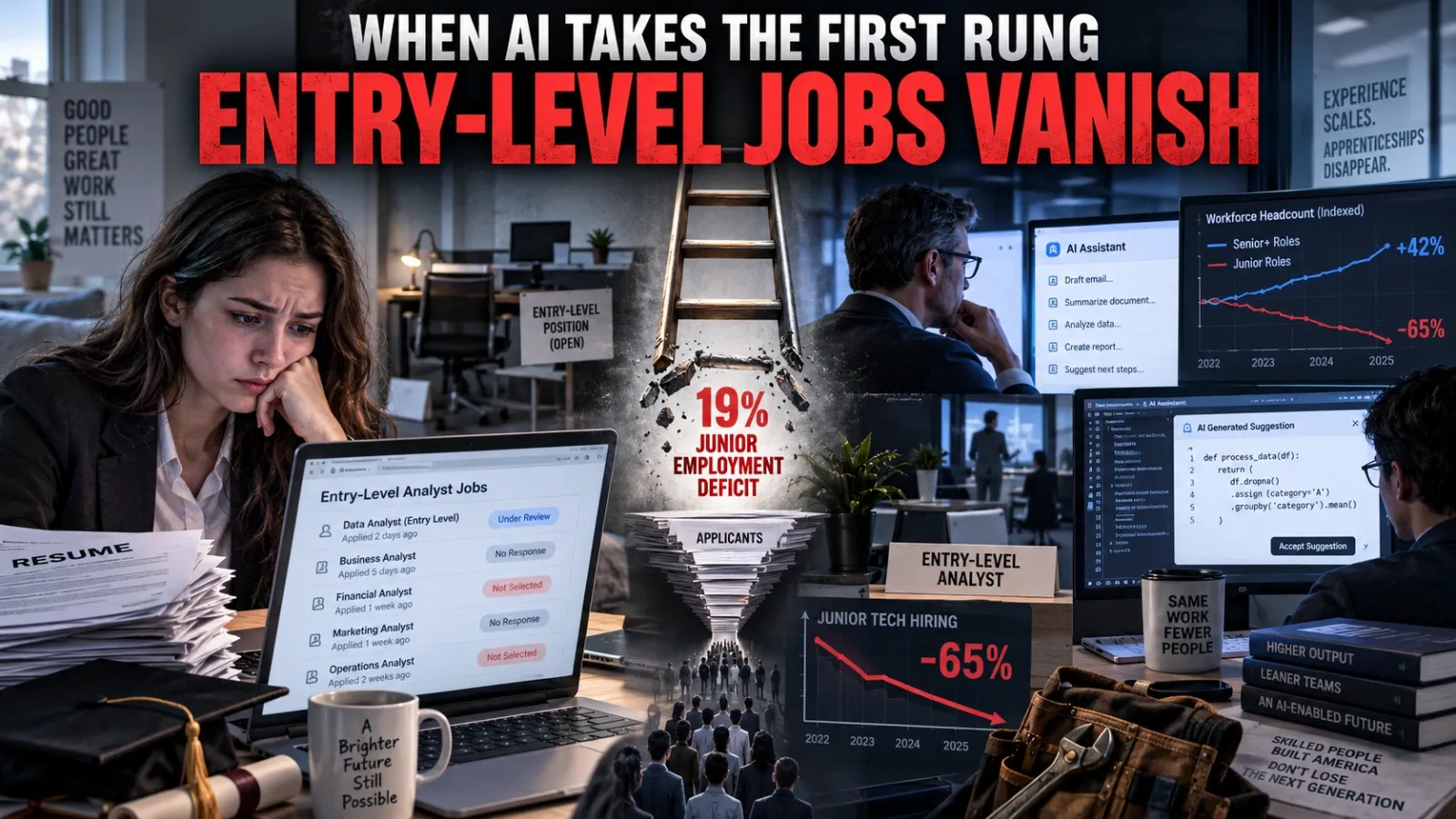
The Canaries in the Coal Mine: Payroll Data Reveals a Silent Squeeze
For the last three years, executives and economists have intensely debated whether artificial intelligence would act as a widespread job killer or a transformative job creator. A landmark August 2026 study by the Stanford Digital Economy Lab finally provided empirical clarity by analyzing the actual paychecks of American workers. Leveraging high-frequency administrative payroll data from ADP that covers millions of workers across 730 occupations, researchers documented a labor market fundamentally cleaved by age and experience.
The researchers identified a stark divergence in employment outcomes specifically tied to AI exposure. While overall employment in the United States remains robust, the employment of young workers aged 22 to 25 in highly AI-exposed jobs now stands 19 percent below where it would be if it had kept pace with less-exposed peers. This deficit is not the result of a macroeconomic downturn, as older workers in the exact same highly exposed industries saw their employment grow by as much as 11 percent between November 2022 and June 2026.
The researchers accurately dubbed these young workers the “canaries in the coal mine” of the new digital economy. They are the first demographic to suffer the suffocating effects of a technological paradigm shift that replaces the digitized, checkable knowledge taught in universities. Conversely, the technology acts as a powerful complement to the tacit, experience-based knowledge held by senior employees, making them far more productive and valuable to their employers.
This dynamic confirms that companies are not executing mass, headline-grabbing layoffs of their young staff, but rather engaging in a silent hiring freeze at the bottom of the ladder. Organizations are simply allowing junior roles to attrition out naturally, refusing to backfill the positions when young employees leave for other opportunities. The entry-level job is not disappearing overnight in a dramatic wave of terminations; it is slowly evaporating from the corporate budget, leaving new graduates with nowhere to submit their resumes.
A Global Restructuring: Expanding Headcounts, Shrinking Opportunities
The erosion of the entry-level career is not an isolated American phenomenon, but a global restructuring of corporate labor. A comprehensive study released in September 2026 by researchers from Stanford University and King’s College London analyzed 1.25 billion job postings and 154 million employment records across 41 countries. The findings definitively proved that AI adoption is changing who a company employs much more than how many people it employs.
The study demonstrated that firms adopting artificial intelligence actually expanded their overall employment by approximately 3.3 percent over a five-year period. However, the composition of that workforce shifted violently in favor of seasoned professionals. At AI-adopting companies, senior-level employment surged by 6.7 percent, while junior-level employment concurrently declined by 3 percent.
Overall, the share of junior workers within these digitized organizations dropped by 1.9 percentage points. The researchers noted that these junior employment losses run significantly deeper in wealthier, highly digitized economies such as the United States, the United Kingdom, and Saudi Arabia. In these markets, the cost of labor is high enough that the financial incentive to replace junior headcount with a software subscription is practically irresistible to corporate boards.
The mechanics behind this shift are deeply rooted in changing managerial incentives. When generative AI handles the drafting of client emails, the summarizing of legal documents, and the generation of boilerplate code, the operational need for a junior employee to execute these tasks vanishes. Instead of passing routine work down the chain of command to an entry-level analyst, managers are using AI to complete the work themselves in seconds.
The Tech Sector Collapse and the “Barbell” Labor Market
Nowhere is the destruction of the entry-level pipeline more visible than in the technology sector itself. Historically viewed as the most reliable engine for rapid upward economic mobility, the tech industry has severely contracted its intake of recent college graduates. According to labor market data from 2026, entry-level hiring at the largest tech majors has fallen by roughly 65 percent compared to 2019 levels.
The situation is even more dire at early-stage startups, where new-graduate hiring has plummeted by an astonishing 76 percent. Founders and engineering managers have realized that a junior developer equipped with an AI coding assistant is simply faster at generating code, but the code still requires human verification. Consequently, the scarce and valuable skill is no longer the ability to write code quickly, but the architectural judgment required to know if the AI-generated draft is secure, scalable, and correct.
This dynamic has created what labor economists describe as a “barbell” labor market. There is heavy, aggressive demand for experienced senior engineers at the top end of the market, a massive oversupply of desperate junior applicants at the bottom, and a fiercely contested, hollowed-out middle. Tech leaders are actively hiring, but their budgets are heavily concentrated on acquiring staff-level engineers who can strategically direct AI systems rather than be replaced by them.
| Tech Sector Hiring Metric | Entry-Level / Junior Roles | Senior / AI-Specialized Roles |
|---|---|---|
| Hiring Volume (vs. 2019 baseline) | Down ~65% at tech majors | Sustained aggressive growth |
| Median Total Compensation (2025) | $155,000 (+1.64% YoY) | $457,000 (+7.52% YoY) |
| Employer Hiring Difficulty | Low (Oversupply of applicants) | High (Tied for #1 hardest to fill) |
Data reflecting the structural inversion of tech sector hiring, where entry-level demand has collapsed while senior compensation and demand skyrocket.
[cite: 12]
The financial implications of this barbell market are staggering for employers and devastating for young job seekers. A senior engineering hire in the United States now routinely costs over $200,000 annually when fully loaded with benefits, and highly specialized AI engineers command starting base salaries approaching $193,000. Despite these exorbitant costs, companies are choosing to engage in fierce bidding wars for senior talent rather than taking a chance on training junior employees.
The Demographics of Disruption: Gender, Education, and the Wage Premium
The public narrative surrounding automation has historically centered on the threat to low-wage, blue-collar workers on factory floors. The generative AI revolution has completely inverted this historical precedent. According to 2026 labor data, the workers most exposed to AI disruption are highly educated, well-compensated knowledge workers operating in climate-controlled offices.
Data reveals that top-quartile AI-exposed workers actually earn roughly 47 percent more than their unexposed peers. The technology is landing squarely on high-value, cognitive work first, rather than low-wage physical labor. Conversely, approximately 30 percent of the American workforce has effectively zero AI task overlap, largely because their roles require physical presence, manual dexterity, or in-person human interaction that current models cannot replicate.
This exposure is not distributed equally across societal demographics, revealing a glaring and deeply concerning gender disparity. In the United States, 79 percent of employed women hold positions that are at a high risk of automation, compared to only 58 percent of employed men. Globally, the divide remains stark, with 4.7 percent of women’s jobs facing high AI disruption compared to just 2.4 percent for men.
This vulnerability stems from the historical concentration of female workers in administrative, clerical, human resources, and customer service roles. Because generative AI excels at processing language, managing schedules, and summarizing information, it easily mimics the core functions of these professions. As enterprises increasingly automate their back-office and support functions, the technology threatens to disproportionately erode the economic footholds that women have spent decades securing in the corporate economy.
The Death of Tacit Knowledge and the “Seniorisation” of Junior Roles
The immediate cost savings of automating junior work are glaringly obvious to corporate finance departments, but economists are warning of a devastating long-term consequence. By erasing the first rung of the career ladder, companies are inadvertently destroying the mechanism by which human expertise is actually generated. A groundbreaking June 2026 economic model by researcher Enrique Ide mapped exactly how AI disrupts the intergenerational transmission of knowledge.
Historically, entry-level tasks—such as a junior lawyer drafting a routine contract or a junior analyst cleaning a dataset—were never solely about producing corporate output. They functioned as a heavily subsidized curriculum for the employee. By working alongside seasoned experts on mundane tasks, young workers absorbed “tacit knowledge”—the practical, unwritten, hard-to-codify judgment that defines true professional mastery.
When these foundational, entry-level tasks are handed over to an artificial intelligence system, the output is generated instantly, but the transfer of tacit knowledge to the next generation is completely severed. Automation is a highly effective substitute for specific tasks, but it has never been a functional substitute for a human talent bench. Without a cohort of junior workers learning the ropes today, companies are virtually guaranteeing a catastrophic shortage of senior talent a decade from now.
Faced with a surplus of AI-generated output that requires human auditing, companies are shifting the burden of quality control onto whatever junior staff remain. This has led to a widely documented phenomenon known as the “Seniorisation” of entry-level jobs. According to PwC’s 2026 Global AI Jobs Barometer, the most AI-exposed entry-level jobs are now seven times more likely to require skills traditionally reserved for senior management, such as advanced emotional intelligence, strategic judgment, and leadership.
Employers are now demanding that 22-year-olds arrive on their first day possessing the mature judgment needed to audit an AI’s complex hallucinations. They expect recent graduates to skip the very apprenticeship phase where that professional judgment is normally forged through trial and error. This creates an impossible paradox for young workers: they cannot get a job without demonstrating advanced judgment, but they cannot develop advanced judgment without first having a job.
The Toolbelt Generation: Fleeing the Office for the Physical World
Young Americans are not ignoring the writing on the wall. Recognizing that a bachelor’s degree in communications, marketing, or even basic computer science no longer guarantees a secure desk job, Generation Z is executing a historic economic pivot. They are abandoning the automated dead end of the modern office and flocking to the skilled trades—roles anchored firmly in the physical world where artificial intelligence currently has zero functional capability.
The National Student Clearinghouse reported that enrollment in vocational-focused community colleges jumped by 11.7 percent in the spring of 2025 alone. This surge caps a nearly 20 percent increase in trade school enrollment since 2020, pushing the total number of vocational students past 871,000. Currently, 55 percent of Gen Z individuals are actively considering trade careers, earning this demographic the new moniker of the “toolbelt generation”.
From plumbing and electrical work to aviation maintenance and data center construction, young workers are chasing jobs that require physical dexterity, spatial reasoning, and on-site problem-solving. These traits remain completely out of reach for even the most advanced large language models. Furthermore, the trades are seeing unprecedented demographic shifts; 52 percent of Gen Z women are now exploring trade careers, nearly matching the 57 percent of young men doing the same.
The financial calculus driving this generation away from traditional universities is impossible to ignore. In 2026, the average full-time student pays roughly $11,950 annually for an in-state public university and up to $45,000 for a private college, often graduating with decades of unmanageable debt. Conversely, trade school programs typically cost a fraction of that amount, take between six and 24 months to complete, and place graduates directly into fields that are desperate for human labor.
| Educational Pathway | Average Time to Complete | Estimated Total Cost (2026) | AI Exposure Risk |
|---|---|---|---|
| Traditional 4-Year College | 48 months | $40,000 – $150,000+ | High (Cognitive/Knowledge tasks) |
| Vocational / Trade School | 6 to 24 months | $4,000 – $25,000 | Very Low (Physical/In-person tasks) |
Data comparing the modern educational pathways facing Generation Z, highlighting the financial and automation risks driving the surge in vocational enrollment.
[cite: 23, 26]
With AI-exposed white-collar wages facing long-term downward pressure, tradespeople are commanding premium rates to build the very physical infrastructure—such as server farms and data centers—that powers the AI revolution. For a generation uniquely obsessed with financial stability and debt aversion, the social prestige of physical labor is rapidly eclipsing the hollow, heavily automated promise of the corporate cubicle.
The Human Cost: Underemployment, Blocked Mobility, and Social Fracture
For those who remain trapped in the traditional white-collar pipeline, the economic reality on the ground is grim. The U.S. youth underemployment rate—which captures individuals working part-time who desperately desire full-time work, or college graduates forced into minimum-wage service roles—has surged to 17 percent. This represents the highest level of youth underemployment since the immediate aftermath of the pandemic shock in 2020.
Highly educated 23-year-olds are increasingly finding themselves pouring coffee, delivering groceries, or working in retail logistics. The entry-level analyst and junior copywriting roles they spent four years training for have simply been outsourced to a software subscription. This systemic bottleneck is devastating for upward economic mobility, particularly for the millions of American workers who rely on job experience rather than prestige degrees to climb the economic ladder.
A recent Brookings Institution report highlighted that almost half of the critical “gateway” jobs used to transition from low-wage work to higher-paying destination roles are now highly exposed to AI. There are currently over 15 million American workers without four-year degrees occupying these highly exposed roles. If these transitional positions evaporate, the traditional bridge to the middle class collapses with them, leaving workers permanently stranded in low-wage service sectors.
The psychological toll of this blocked mobility is rapidly translating into deep political and social disillusionment among the youth. When an entire generation does everything society asked of them—taking on massive student debt, earning degrees, and applying for corporate jobs—only to find the system has been automated against them, their faith in the economic order shatters. Polling data from 2026 shows that only 39 percent of young Americans currently support capitalism, a sharp and alarming decline from 45 percent just five years prior.
The inability to secure meaningful, upwardly mobile work is causing a profound ideological shift. Surveys indicate that 27 percent of young voters who backed conservative platforms in previous elections now express a desire for a democratic socialist president in the future. When young people stop believing that hard work and ownership can change their circumstances, radical political alternatives start to look less like a fringe ideology and more like a necessary survival mechanism.
Retooling the Safety Net: Wage Insurance and the Policy Response
As the labor market aggressively reorganizes itself around artificial intelligence, policymakers in Washington are scrambling to adapt a 20th-century social safety net to a 21st-century crisis. Traditional unemployment benefits are wholly insufficient for a structural shift where entire categories of entry-level and mid-level knowledge work permanently disappear. In response, labor economists and prominent think tanks are lobbying heavily for the implementation of federal wage insurance.
Unlike standard unemployment insurance, which pays workers only while they are entirely out of work, wage insurance operates proactively to keep people attached to the labor force. If a worker displaced by AI is forced to take a new job in a different sector at a significantly lower salary, the government temporarily subsidizes a portion of the income difference. While originally designed for older manufacturing workers displaced by overseas globalization, experts argue this mechanism is desperately needed today for white-collar workers whose specialized, codifiable skills have suddenly been commoditized.
Simultaneously, the American education system is being forced to radically restructure how it prepares youth for the modern workforce. Recent policy changes by Congress have expanded the use of Workforce Pell Grants, allowing low-income students to use federal financial aid for short-term, high-intensity vocational training programs. This legislative shift is designed to accelerate the entry of young workers into AI-resistant fields, bypassing the bloated four-year degree entirely.
Forward-thinking universities are also attempting to pivot before their enrollment collapses. Institutions like Purdue University and the University of Waterloo have abandoned the standard lecture-hall model in favor of massive, project-based co-op programs and embedded apprenticeships. By ensuring students alternate between academic terms and full-time, paid work placements, these universities guarantee that graduates leave with up to two years of real-world experience. This provides the crucial tacit knowledge and mature judgment that employers are currently demanding but refusing to teach.
What Happens Next
The pervasive assumption that artificial intelligence will universally wipe out all human labor is a science fiction narrative unsupported by the current economic data. Total aggregate employment remains robust, and AI is generating vast amounts of new wealth, output, and corporate productivity. However, the data unequivocally shows that the distribution of that economic opportunity has been violently distorted against the young.
By aggressively erasing the entry-level jobs that historically served as the on-ramp to the middle class, the corporate sector is quietly cannibalizing its own future. If businesses continue to automate junior roles solely as a short-term cost-cutting measure, they will inevitably face a catastrophic talent shortage within the next five to ten years. Companies must pivot from seeing entry-level workers as expensive, automatable liabilities to viewing them as critical long-term investments in their own institutional survival.
This requires corporate leaders to proactively redesign junior roles to focus on auditing, judgment-building, and AI orchestration from day one, rather than basic task execution. For the young workers currently navigating this brutal transition, the path forward requires a fundamental recalculation of personal risk. Until society reconstructs the corporate career ladder to account for artificial intelligence, the safest and most lucrative jobs will belong to those who build, repair, and maintain the physical world.
Sources (36)
- peoplematters.in — Ai adoption boosts senior hiring by 67percent while junior jobs fall 3percent st
- designrush.com — Ai job displacement statistics
- brookings.edu — How ai may reshape career pathways to better jobs
- hatchworks.com — Software engineer shortage
- fullscale.io — Developer hiring trends
- fmcgroup.com — Ai jobs replaced statistics
- thedispatch.com — American dream generation z socialism populism
- advanced.edu — Trade schools beating traditional college
- academicjobs.com — Vocational schools enrollment surge 2026 or academicjobs 8591
- utkarshdeoli.in — Gen z trades revolution
- nscresearchcenter.org — Current term enrollment estimates
- skinneratwork.com — Gen z trade recruiting
- challengergray.com — Job cuts report
- scribd.com — Challenger Report May 2026
- binance.com
- revenuestack.net — Ai adopting firms are cutting junior roles
- digitaleconomy.stanford.edu — HowDoesAIChangeLaborDemand
- arxiv.org — 2507.16078
- researchgate.net — 393923538 Automation AI and the Intergenerational Transmission of Knowledge
- pwc.com — 2026 global ai jobs barometer full report
- inc.com
- cryptoslate.com — According to adam livingston you have 5 years to stack bitcoin before ai takes y
- reddit.com — If unemployment is so low and the labor market is
- digitalapplied.com — Ai and jobs 2026 what the labor data shows analysis
- brookings.edu — Workforce policy for the age of ai
- orfonline.org — The ai jobs debate is asking the wrong question
- siai.org
- thirdway.org — Ai disruption plan preparing americans for the next great labor shock
- carnegieendowment.org — The ai labor debate three views on the future of work
- forbes.com — How ai can help higher ed fix the broken entry level career ladder
- digitaleconomy.stanford.edu — Canaries August2026
- ml6.eu — Ai is hitting entry level jobs harder than the rest
- hcamag.com
- indiatoday.in — Ai is taking away job opportunities of 22 25 year olds stanford study finds tchc
- edwardconard.com — In the 20 of occupations most exposed to ai employment of 22 to 25 year olds dec
- aecf.org — Workforce pell grants expand career training for young people




Leave a Reply