The Five-Day Ultimatum: A New Corporate Default
The transformation of the PIP from a developmental lifeline to a managed exit strategy is vividly illustrated by recent structural overhauls at Microsoft. In April 2025, Chief People Officer Amy Coleman issued an internal memo formalizing a stark new performance policy for employees identified as low performers. Under this globally consistent framework, the traditional, gradual process of constructive managerial feedback was abruptly replaced by a jarring, high-stakes ultimatum.
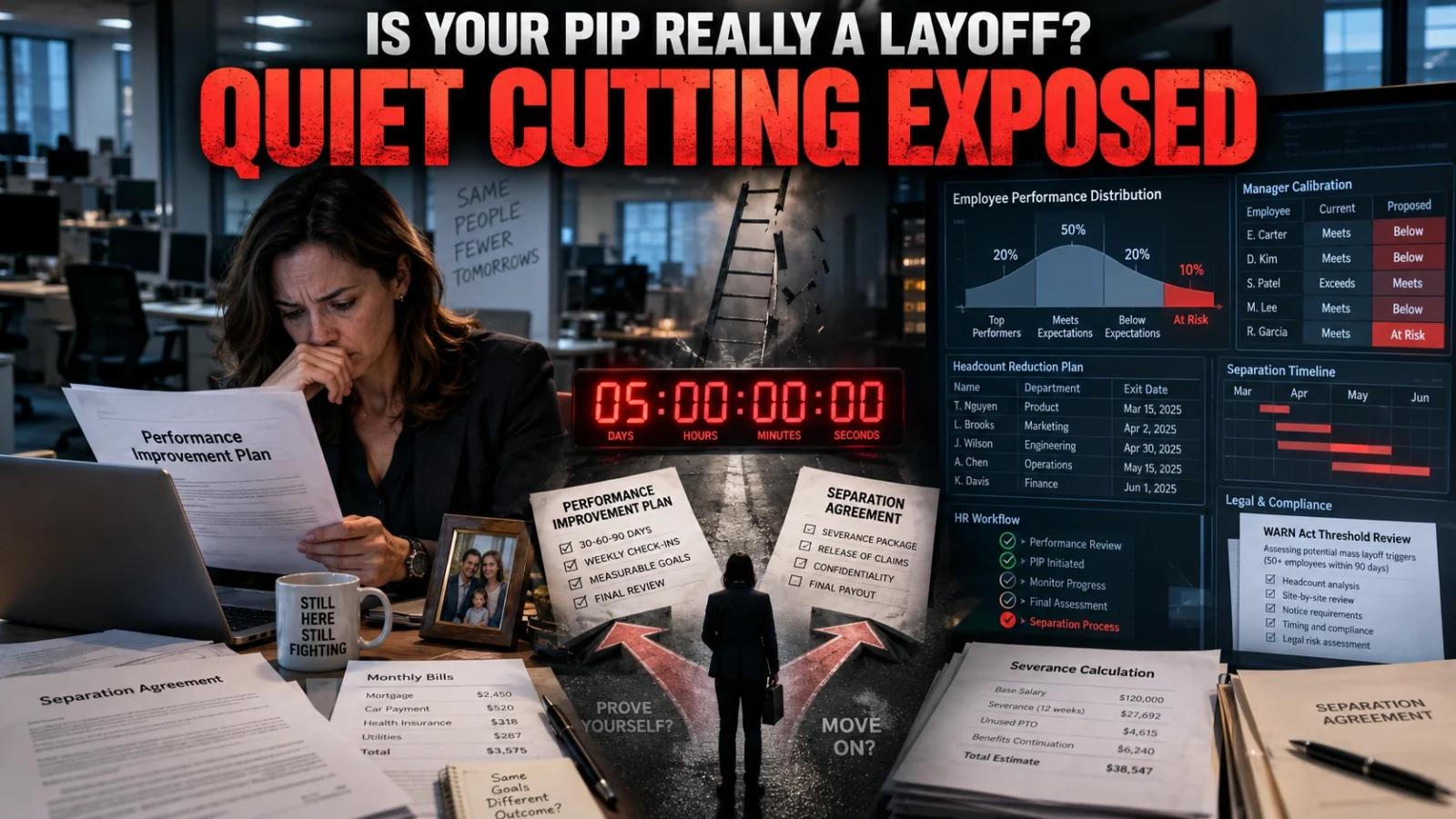
When a Microsoft employee is presented with a PIP under this system, a five-day countdown clock immediately begins. Before that clock expires, the worker must make a life-altering decision: sign a Global Voluntary Separation Agreement (GVSA) or formally attempt to survive the rigorous improvement plan. The GVSA typically offers approximately 16 weeks of base pay in exchange for the employee’s immediate resignation and a comprehensive waiver of legal claims against the company.
If the employee declines the GVSA and chooses to fight for their livelihood, the financial safety net evaporates entirely. They are given a compressed window, often up to 90 days, to meet stringent, highly monitored deliverables while working under maximum psychological stress. If the direct manager ultimately decides the employee failed to meet the bar, they are terminated with zero severance pay and subjected to a punitive two-year ban on being rehired.
This binary structure aggressively front-loads the financial exit, applying immense pressure on the worker to simply take the money and forfeit their career. Employment advocates argue that this architecture is deliberately designed to secure legally binding releases while classifying the departures internally as “good attrition” rather than formal layoffs. The process reportedly leaves virtually no room for objective appeal, as the manager who initiated the PIP maintains final, unilateral authority over the evaluation.
The Global Reach of the Quiet Cull
These algorithmic purges are not confined to domestic headquarters; they have rapidly become a standard export of American corporate management. In September 2026, industry analysts estimated that approximately 500 Microsoft employees in India were suddenly placed on PIPs. This localized action occurred just as the tech giant was aggressively shifting its capital expenditure toward artificial intelligence infrastructure and cloud computing.
While Microsoft officials cautioned that a performance plan does not automatically equate to a termination, industry observers noted the timing closely mirrored broader macroeconomic shifts in the region. Contemporaneously, Oracle initiated a massive restructuring effort that put roughly 3,000 Indian jobs at risk as customer demand for AI capacity outpaced legacy software functions. Market research experts pointed out that while traditional involuntary attrition accounts for 1% to 2% of a workforce, the current wave of performance labeling is fundamentally driven by automated headcount reductions.
The human cost of these global directives often carries severe local consequences, occasionally sparking unverified but alarming allegations of corporate overreach. In late 2026, a former product leader at the Microsoft Africa Development Centre in Nairobi, Kipkorir Arap Kirui, publicly alleged that local engineers were subjected to sudden PIPs despite previously meeting or exceeding expectations. According to these untested allegations, Kenyan staff were given a highly compressed six-week improvement window and were barred from showing their draft separation agreements to independent legal counsel.
While Microsoft did not publicly confirm the specific details of the Nairobi allegations, the broader mechanics align perfectly with the company’s documented 2025 global performance playbook. The disparity in treatment highlights a grim reality for international families reliant on tech incomes. While senior domestic staff are occasionally offered generous voluntary retirement packages with years of healthcare, ordinary global workers are increasingly managed out through rigid, unsympathetic performance ultimatums.
The Resurgence of the Vitality Curve
To understand why consistently strong employees are suddenly being labeled as deficient, one must look at the mathematical models driving modern HR software. Many major corporations have quietly reintroduced strict forced distribution models, heavily echoing the controversial “stack ranking” popularized by General Electric’s Jack Welch. These systems, sometimes called “rank and yank,” legally mandate that managers grade their teams on a predefined curve, ensuring a set percentage of workers are always labeled as underperformers.
At Meta, the highly publicized “Year of Efficiency” in 2023 evolved into a more normalized, systemic “Stealth Phase” throughout 2024 and 2025. During this period, middle managers reportedly faced immense executive pressure to place 15% to 20% of their staff into the “Meets Most” or lower performance categories. This forced calibration ensures a steady, permanent pipeline of employees who can be deprived of bonuses, blocked from internal mobility, and eventually transitioned out.
Amazon utilizes a similar strategic concept known internally as the “Unregretted Attrition” (URA) target, which establishes a baseline, mandatory churn rate for the bottom tier of the workforce. Under these rigid mathematical algorithms, if a manager oversees a team of ten exceptional, highly collaborative engineers, the model still demands that one or two of them be sacrificed to the bottom rank. These mathematically doomed individuals are subsequently pushed into Amazon’s “Focus” and “Pivot” programs, a two-stage managed exit system.
Academic research spanning decades has heavily criticized these forced distribution models, repeatedly concluding that they destroy workplace trust and collaboration. A prominent study highlighted by the Academy of Management Journal found that forced ranking systems incentivize counterproductive work behaviors, as sharing knowledge with a peer actively makes them a stronger threat to your own survival. Despite overwhelming evidence that these systems stifle long-term innovation, executives increasingly favor them because they provide a continuous, systemic mechanism for slashing payroll.
Anatomy of the ‘Sham PIP’
For an employee unexpectedly handed a formal performance document, distinguishing between a genuine developmental plan and a disguised layoff is a vital first step. Employment attorneys note that while a legitimate PIP is sincerely designed to salvage a struggling worker, a “sham PIP” is a highly engineered legal shield intended purely for termination. Recognizing the structural differences allows terrified workers to strategize, consult legal counsel, and protect their families’ financial interests.
A genuine improvement plan focuses strictly on objective, role-specific metrics that the employee has a realistic, mathematical chance of meeting within 60 to 90 days. Managers engaged in authentic coaching will provide active mentorship, specific training resources, and frequent feedback focused on the actual substance of the work. In contrast, a disguised PIP is characterized by impossible milestones, shifting goalposts, and highly subjective criteria such as “demonstrating better ownership”.
To help workers navigate this perilous landscape, legal advocates have identified several clear indicators that separate a legitimate managerial intervention from a predetermined corporate purge.
| Evaluative Metric | Genuine Performance Plan | Pretextual “Sham” PIP |
|---|---|---|
| Goal Clarity | Objective, SMART targets directly tied to the employee’s core job description. | Subjective, ambiguous behavioral goals easily manipulated by the manager. |
| Timeframe | Realistic operational window (60–90 days) allowing actual skill development. | Compressed window (30 days or less), often scheduled over holidays or crunches. |
| Managerial Support | Active mentoring, clear resources, and collaborative, substantive check-ins. | Check-ins act solely as documentation sessions to build a legal termination file. |
| Historical Context | Initiated after documented, progressive verbal feedback regarding specific flaws. | Abrupt implementation following years of positive reviews with no role change. |
| Outcome History | Historical HR data shows past employees successfully graduating the program. | Near 100% of employees placed on a PIP in that specific org ultimately exit. |
Legal experts caution that sham PIPs frequently demand the completion of massive, multi-month deliverables within a few short weeks, guaranteeing failure by design. Furthermore, if a performance plan is initiated shortly after an employee engages in protected activity—such as returning from Family and Medical Leave (FMLA) or reporting harassment—it strongly signals pretextual retaliation. In these instances, the document is not a roadmap to success, but a weaponized liability shield.
Evading the WARN Act
The financial and regulatory incentives for corporations to rebrand economic layoffs as individual performance issues are massive. Under standard corporate severance frameworks, employees terminated due to a generalized workforce reduction typically receive a full formula payout based on their years of service. However, by categorizing an exit as a “performance separation,” companies can routinely slash that severance by 50% to 75%, or offer a nominal flat rate regardless of tenure.
More significantly, spacing out terminations through rolling, individualized PIPs allows massive employers to entirely bypass the federal Worker Adjustment and Retraining Notification (WARN) Act. Enacted to protect local economies, the WARN Act requires employers with 100 or more employees to provide 60 days’ advance written notice before a mass layoff or plant closing. Failure to comply can result in severe federal penalties, including mandated back pay and benefits for every affected employee.
However, the WARN Act contains specific mathematical thresholds; the 60-day notice is generally only triggered when 50 or more employees at a single site are laid off within a rolling 30-day period. By stretching out a reduction in force over several months and coding the departures as individual performance terminations, corporations can shed hundreds of workers without ever triggering federal reporting requirements. This cynical maneuvering denies workers the legal transition period they are owed and keeps the company’s financial distress out of the public eye.
Corporate defense attorneys often advise clients that individual performance issues are legally distinct from economic layoffs, granting them wide latitude to manage their workforce. Yet, internal communications frequently reveal that the PIP is viewed primarily as a convenient lever for “quiet cutting”. By aggressively managing out the bottom tier of a forced curve, companies protect their stock prices, shed payroll liabilities, and sidestep the public relations nightmares inherently attached to mass WARN Act filings.
The Psychological Toll of ‘Quiet Cutting’
The human and cultural damage inflicted by these algorithmic purges extends far beyond the bank accounts of the terminated employees. The modern corporate environment is currently gripped by the phenomenon of “quiet firing” or “quiet cutting,” a strategy characterized by intentional isolation and passive-aggressive management designed to force voluntary resignations. The psychological toll on the American workforce is profound and measurable.
Extensive survey data collected in 2025 revealed just how deeply this hostile practice has permeated the labor market. A poll of over 1,100 U.S. business leaders found that 53% of companies were actively using or planning to use quiet firing tactics to reduce headcount. A complementary survey of the workforce showed that 35% of workers had directly experienced these tactics, reporting severe emotional exhaustion, burnout, and a devastating loss of professional identity.
For the employees who manage to survive the cuts, the resulting workplace environment is often deeply toxic. The knowledge that a company utilizes forced ranking and rolling performance plans breeds a culture of chronic anxiety and hyper-competition. Team members become acutely aware that assisting a struggling colleague could ultimately result in their own demotion to the bottom of the vitality curve, effectively destroying team cohesion.
Furthermore, the stigma of being placed on a PIP acts as a “scarlet letter” within the organization, isolating the worker from their peers. Employees flagged by the algorithm are frequently barred from internal transfers and excluded from critical meetings, ensuring they have no realistic path to redeem their standing. This deliberate, structural isolation turns the daily routine into a hostile endurance test, where the employee’s primary objective shifts from productive innovation to meticulously documenting their own survival.
The EEOC and the Fight Against Age Discrimination
As corporations refine their strategies for masking cost-cutting, federal regulators and aging workers are increasingly fighting back in the courts. The U.S. Equal Employment Opportunity Commission (EEOC) has witnessed a massive surge in complaints, processing over 88,500 new discrimination charges in fiscal year 2024 alone. This nearly 10% annual increase underscores the growing friction between automated corporate purges and federal civil rights protections.
Specifically, charges of age discrimination spiked to over 16,200 cases, highlighting a deeply troubling trend where highly paid, older workers are disproportionately targeted for pretextual performance plans. Many of these workers possess decades of institutional knowledge and commanded high salaries, making them prime targets for algorithms tasked with maximizing payroll efficiency. The EEOC has aggressively pursued these pretextual terminations, securing a record $528 million through mediation, conciliation, and litigation in 2025.
Federal courts are increasingly scrutinizing cases where a worker’s performance reviews were consistently positive until they reached a certain age or requested a medical accommodation. For instance, in Muldrow v. City of St. Louis, the Supreme Court recently broadened the class of detrimental employer actions that can sustain a disparate treatment claim, lowering the bar for workers to sue over discriminatory transfers and remote work denials. Shifting goalposts, sudden bad reviews, and impossible PIP metrics are now routinely successfully introduced as evidence of bad faith.
The EEOC’s recent litigation record demonstrates a willingness to punish corporations that use performance as a smokescreen for systemic bias. Recent massive jury verdicts, including an $11.5 million judgment against the Society for Human Resource Management (SHRM) and a $36.75 million verdict against Werner Enterprises, serve as stark warnings to employers. These cases prove that when companies fabricate performance issues to push out vulnerable workers, the financial penalties can far exceed the savings of a quiet layoff.
The NLRB Dismantles the Gag Order
Simultaneously, the National Labor Relations Board (NLRB) has aggressively moved to prevent companies from silencing workers during these coercive managed exits. For decades, the threat of losing severance pay kept workers quiet about sham PIPs, rigged performance evaluations, and discriminatory practices. That paradigm shifted dramatically with the landmark McLaren Macomb decision in 2023, and the subsequent Endurance Environmental Solutions ruling in late 2024.
In McLaren Macomb, the NLRB examined a hospital that offered furloughed employees standard severance agreements containing broad confidentiality and non-disparagement provisions. The Board ruled that offering agreements which prohibit employees from discussing the terms of their exit or disparaging the company fundamentally violates Section 7 of the National Labor Relations Act. These rulings affirm that employers cannot lawfully force everyday workers to waive their rights to collectively discuss their working conditions in exchange for a financial safety net.
These federal interventions have deeply unsettled corporate HR departments, which heavily relied on non-disclosure agreements to sweep retaliatory purges under the rug. Employment law firms are now scrambling to advise companies to narrowly tailor their separation agreements, warning that overly broad clauses will be struck down as unfair labor practices. This legal shift has empowered employees to speak openly about their experiences, consult freely with attorneys, and share compensation data with colleagues without fear of corporate retribution.
The dismantling of the corporate gag order has allowed the true scale of the PIP epidemic to come to light. Workers are increasingly utilizing social media and internal union channels to compare notes on sudden, coordinated performance warnings, quickly identifying when a company is conducting a stealth layoff. By removing the veil of secrecy, the NLRB has given workers a crucial tool to organize and fight back against the algorithmic weaponization of performance reviews.
What Happens Next
The landscape of corporate employment is poised for even greater turbulence as algorithmic management and artificial intelligence permanently reshape the economy. As massive technology firms continue to divert billions of dollars toward AI infrastructure and automated coding tools, the demand for legacy engineering and middle-management roles will inevitably shrink. Rather than announcing highly visible, stock-rattling layoffs, corporations will likely double down on the PIP playbook to continuously and silently churn their ranks.
In response, the nature of day-to-day employment survival will shift dramatically from technical competence to defensive bureaucratic readiness. Workers will increasingly need to operate as their own advocates, meticulously documenting their metrics, saving positive feedback, and quantifying their impact in writing. The era of trusting informal managerial feedback is over; employees are learning that a contemporaneous, written paper trail is their only viable defense against a sudden, algorithmically generated underperformer label.
Simultaneously, the surge in aggressive performance management is likely to catalyze a new, unprecedented wave of white-collar labor organizing. As the illusion of a benevolent corporate meritocracy fractures under the weight of forced curves and mandatory attrition quotas, tech workers are realizing they share the same fundamental vulnerabilities as factory workers. Until legislative reforms update the WARN Act to account for rolling algorithmic terminations, the performance improvement plan will remain corporate America’s most effective weapon for quiet downsizing—and ordinary families will continue to pay the price.
- BrightHR – Performance Improvement Plans Guide: https://www.brighthr.com/ca/articles/people-management/performance-management/performance-improvement-plans/
- CareerClimb – Microsoft PIP Process Analysis: https://www.careerclimb.app/blog/microsoft-pip
- Times of India – India’s Tech Workforce Gets Another Jolt: https://timesofindia.indiatimes.com/business/india-business/indias-tech-workforce-gets-another-jolt-oracle-is-cutting-around-3000-jobs-while-microsoft-puts-about-500-employees-on-pips-as-companies-shift-budgets-towards-newer-skills/articleshow/133678507.cms
- Economic Times – What a PIP Really Means: https://m.economictimes.com/news/international/us/got-a-pip-at-work-heres-what-it-really-means-and-exactly-what-you-should-do-about-it-now/articleshow/130835448.cms
- Forbes – PIP, PIP, Hooray! The Power Of Performance Improvement Plans: https://www.forbes.com/sites/forbesbooksauthors/2026/08/05/pip-pip-hooray-the-power-of-performance-improvement-plans/
- Millennium Post – Tech Layoffs Cross 175,000 in 2026 as AI Reshapes Jobs: https://www.millenniumpost.in/big-stories/tech-layoffs-cross-175000-in-2026-as-ai-reshapes-jobs-hiring-and-workforce-plans-674495
- ePeopleIndia – Performance Improvement Plan India 2026 Employee Rights Guide: https://epeopleindia.com/performance-improvement-plan-india-2026-employee-rights-guide/
- India Today – Nearly 500 Microsoft India Employees Placed Under PIP: https://www.indiatoday.in/jobs/story/nearly-500-microsoft-india-employees-could-be-placed-under-pip-may-lose-their-jobs-educ-2985161-2026-09-02
- Quartz – Oracle Cutting 3,000 India Jobs as Microsoft Places 500 on PIPs: https://qz.com/oracle-microsoft-india-layoffs-workforce-cuts-090126
- AIHR – Stack Ranking Performance Management: https://www.aihr.com/hr-glossary/stack-ranking/
- CareerClimb – How to Survive a Microsoft PIP: https://www.careerclimb.app/blog/how-to-survive-a-microsoft-pip
- The Hans India – New Microsoft Policy Lets Low Performers Exit With 16-Week Pay: https://www.thehansindia.com/news/national/new-microsoft-policy-lets-low-performers-exit-with-16-week-pay-965569
- Business Insider Africa – Microsoft Pivots Toward Amazon’s Way of Handling Low Performers: https://africa.businessinsider.com/news/microsoft-pivots-toward-amazons-way-of-handling-low-performers-by-paying-them-to/e78qhf3
- Kenya Insights – Ex-Director Reveals Microsoft Kenya Firings: https://kenyainsights.com/ex-director-reveals-the-ugly-treatment-at-microsoft-africa-development-centre-and-how-microsoft-kenya-quietly-fired-its-employees-in-forced-terms
- Business Insider Africa – Internal Microsoft Email Details New Policies Aimed at Culling Low Performers: https://africa.businessinsider.com/news/internal-microsoft-email-to-managers-details-new-policies-aimed-at-culling-low/d7475qq
- Compiler Today – Surviving Meta Layoffs Year of Efficiency Guide 2026: https://www.compiler.today/career/surviving-meta-layoffs-year-efficiency-guide-2026
- Employment Hero – Performance Improvement Plan Template: https://employmenthero.com/resources/performance-improvement-plan-template/
- Severance Ledger – Severance After PIP: https://severanceledger.com/posts/severance-after-pip/
- King & Siegel – Pretext in Wrongful Termination: https://www.kingsiegel.com/blog/pretext-in-wrongful-termination-california-retaliation-lawyers/
- Holland & Knight – NLRB Restricts Use of Severance Agreements: https://www.hklaw.com/en/insights/publications/2023/02/nlrb-restricts-use-of-severance-agreements-with-broad-confidentiality
- National Labor Relations Board – Board Returns to ‘Clear and Unmistakable Waiver’ Standard: https://www.nlrb.gov/news-outreach/news-story/board-returns-to-clear-and-unmistakable-waiver-standard
- HR Works – NLRB Upholds Restrictions on Severance Agreements: https://hrworks-inc.com/industry-update/nlrb-upholds-restrictions-on-severance-agreements/
- Baker Donelson – NLRB Challenges Overly Broad Confidentiality and Non-Disparagement Provisions: https://www.bakerdonelson.com/nlrb-challenges-overly-broad-confidentiality-and-non-disparagement-provisions-in-severance-agreements
- SHRM – Tracking SHRM’s 2026 Workplace Predictions: https://www.shrm.org/in/topics-tools/tracking-shrms-2026-workplace-predictions-midyear-review
- Setareh Law – California WARN Act Protection 2026: https://www.setarehlaw.com/california-warn-act-protection-2026/
- GovInfo – Congressional Report on WARN Act Overhaul: https://www.govinfo.gov/content/pkg/CRPT-110hrpt410/pdf/CRPT-110hrpt410.pdf
- SuperStaff – The Biggest Job Market Trends 2025: https://superstaff.com/blog/the-biggest-job-market-trends-2025/
- AbroadWorks – What is Quiet Firing: https://www.abroadworks.com/blog/what-is-quiet-firing
- Catholic University Law Review – FMLA Retaliation Claims: https://scholarship.law.edu/cgi/viewcontent.cgi?article=3806&context=lawreview
- Minnesota Law Review – Flexible Work, Rigid Discrimination: https://scholarship.law.umn.edu/cgi/viewcontent.cgi?article=1207&context=minnlrev
- Predict and Profit – Stack Ranking Destroyed the Best Team I Ever Worked On: https://predictandprofit.io/blog/stack-ranking-destroyed-the-best-team-i-ever-worked-on
- Scribed – Microsoft is Stack Ranking the Answer: https://www.scribd.com/document/596229149/5-to-8-Case-Microsoft-is-Stack-Ranking-the-Answer
- EEOC – Data and Statistics: https://www.eeoc.gov/data/data-and-statistics
- EEOC – EEOC Highlights Record-Breaking Results in Agency Reports: https://www.eeoc.gov/newsroom/eeoc-highlights-record-breaking-results-agency-reports
- Gen Re – EEOC Trends and Statistics 2025: https://www.genre.com/int/knowledge/publications/2026/june/eeoc-trends-and-statistics-2025-en
- Workwise Compliance – EEOC Releases FY 2024 Annual Performance Report: https://www.workwisecompliance.com/blog/eeoc-releases-its-fy-2024-annual-performance-report-and-litigation-stats.html
- Urbanic Law – 3 Surprising Statistics on Age Discrimination: https://urbaniclaw.com/3-surprising-statistics-age-discrimination-american-workplaces/
- SHRM – Performance Improvement Plan Alone Doesn’t Prove Discrimination: https://www.shrm.org/in/topics-tools/employment-law-compliance/performance-improvement-plan-alone-does-not-prove-discrimination
- Department of Labor – WARN Act: https://www.dol.gov/agencies/eta/layoffs/warn
- TrendHR – Employee Termination Guide: https://trendhr.com/articles/termination/
- Final Round AI – Signs of Layoff 2025: https://www.finalroundai.com/blog/signs-of-layoff-2025
- WizeHire – How to Lay Off Employees With Dignity: https://wizehire.com/blog/how-to-lay-off-employees-with-dignity
- Dinasti International Journal – The Influence of Forced Distribution Rating System: https://dinastipub.org/DIJEFA/article/download/3995/3101/24025
- Eckberg Lammers – Workplace Discrimination Claims Are Rising: https://eckberglammers.com/workplace-discrimination-claims-are-rising/
- Galloway Law Firm – EEOC’s Record Year: What it Means for Employers in 2026: https://gallowaylawfirm.com/eeocs-record-year-what-it-means-for-employers-in-2026/
- National Law Review – What Spike in EEOC Charges Tells Us: https://natlawreview.com/article/numbers-dont-lie-what-spike-eeoc-charges-tells-us




Leave a Reply