
The iPad Ransom: How Apple Uses Subscriptions to Kill the Concept of Ownership
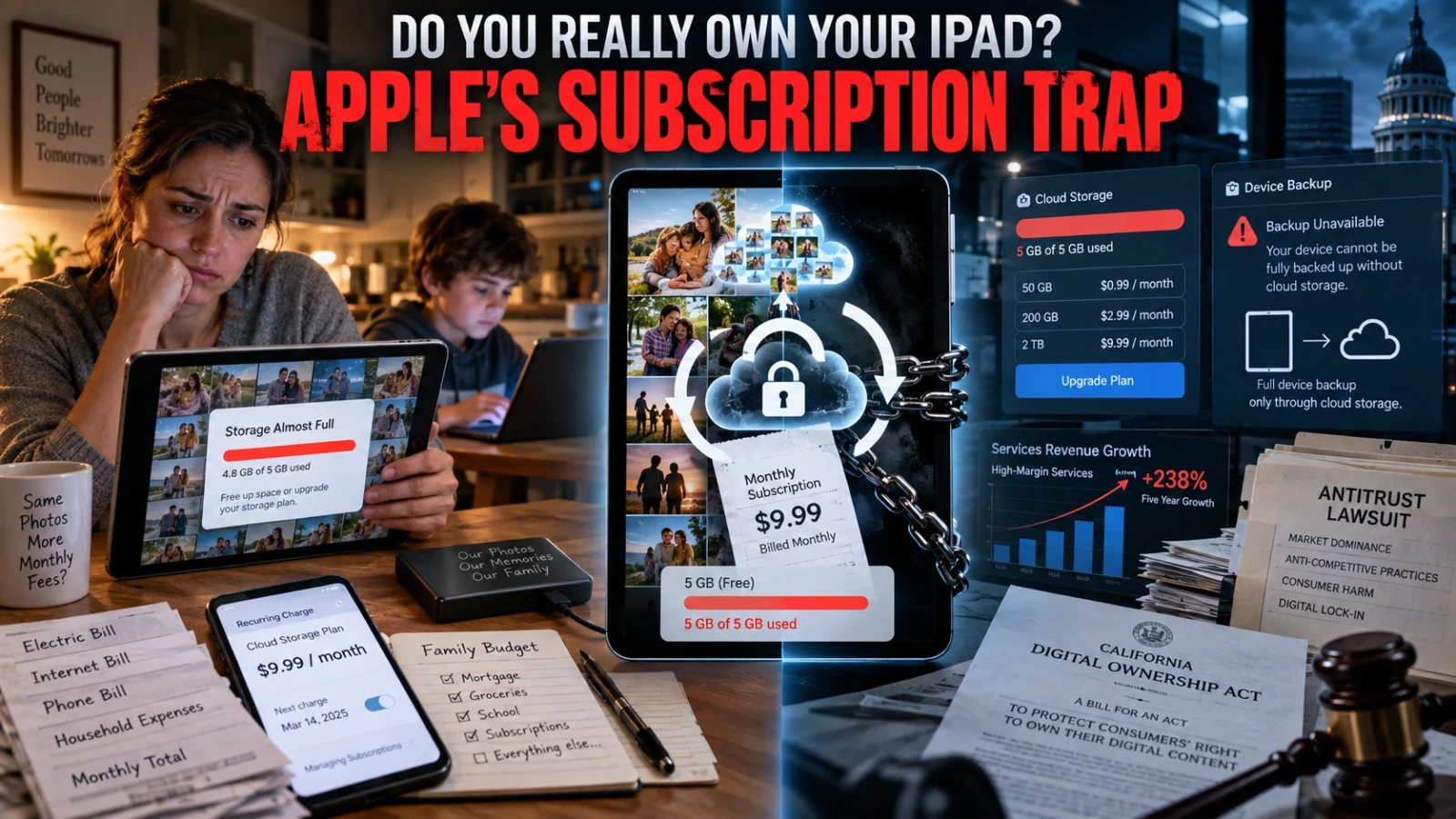
The modern tablet was originally marketed as an instrument of digital liberation, a pristine slab of glass that would democratize computing for the masses. For consumers in the fall of 2026, however, the purchase of an iPad is merely the expensive down payment on a perpetual digital tenancy. When ordinary families bring a new device home, the hardware quickly reaches a manufactured breaking point, triggering relentless system notifications that their iCloud storage is full. Without a paid monthly subscription, the device ceases to back up essential data, offload high-resolution family photos, or effectively synchronize with the broader digital ecosystem.
This forced transition from hardware ownership to software rental matters now more than ever, as global regulators and consumer advocacy groups mount aggressive legal challenges against the technology industry’s subscription-first business models. In the United States, a landmark Department of Justice antitrust lawsuit is moving through the federal courts, targeting the precise technical mechanisms Apple uses to lock users into its proprietary cloud services. Simultaneously, the United Kingdom’s Competition Appeal Tribunal has cleared a staggering £3 billion collective lawsuit for an October 2028 trial, alleging that 40 million users were unlawfully steered into inflated iCloud subscriptions.
The ultimate victims of this macroeconomic transition are ordinary workers, parents, and students who budget carefully for a premium device, only to find themselves ensnared in a web of recurring micro-transactions. Squeezed by household subscription fatigue and shifting legal definitions of what it actually means to “buy” a digital product, consumers are realizing that the physical aluminum they hold no longer guarantees autonomy. The era of true hardware ownership has effectively ended, replaced by an economic model that extracts a lifetime of rent just to keep a family’s digital memories secure.
The Illusion of the Five-Gigabyte Lifeline
When Apple first introduced iCloud to the public in 2011, the provision of five gigabytes of free digital storage seemed like a generous safety net for the average consumer. Fifteen years later, that identical 5GB limit remains entirely unchanged, despite exponential increases in device storage capacities, camera resolutions, and base operating system requirements. Because 5GB is now vastly insufficient for a modern user’s full device backup, the free tier acts less as a utility and more as a carefully calibrated psychological trap.
The friction is intentionally designed by software engineers to push consumers toward paid tiers, which range from $0.99 a month for 50GB to $59.99 a month for a massive 12TB family plan. Once the meager 5GB cap is breached, iPad and iPhone users are bombarded with persistent modal pop-ups warning that their device can no longer be safely backed up. These system-level warnings routinely interrupt basic device functions, creating a user experience so hostile that families frequently capitulate and agree to the monthly fee just to make the notifications stop.
This cloud storage squeeze has been heavily exacerbated by the late 2026 rollout of Apple Intelligence across the iPadOS ecosystem. The new generative artificial intelligence features demand approximately 7GB of internal device free space simply to function on supported A17 Pro chips. To clear enough local space for the operating system to utilize these heavily marketed AI tools, consumers are effectively forced to offload their existing media to the cloud. This architectural requirement guarantees that millions of holdouts will finally cross the threshold into paid iCloud territory just to use the features advertised on the box.
Architecting the Lock-In Through Restricted Files
The core legal and ethical issue is not simply that iCloud costs money, but that Apple has structurally prohibited competitors from offering alternative full-device backup solutions. Class action antitrust lawsuits, such as the Gamboa v. Apple case filed in California, allege that Apple arbitrarily categorizes user data to explicitly eliminate cloud storage competition. While third-party providers like Google Drive or Dropbox are permitted to store “accessible files” like photos and videos, they are systematically blocked from accessing the core files required to restore a device.
This bifurcation imposes an economic “requirements tie” on the consumer, forcing them to use iCloud if they want any insurance against losing their digital lives. A family might prefer to use a cheaper, alternative cloud provider for all their household storage needs, but the iOS architecture renders this impossible for complete device restorations. Managing multiple cloud accounts with different interfaces just to separate family photos from device settings introduces severe usability friction. Consequently, third-party alternatives become highly unattractive for the average user, cementing iCloud as the only viable option.
Apple has historically defended these operating system restrictions on the grounds of user privacy, arguing that its closed ecosystem prevents unauthorized access to sensitive device states. However, critics and legal complaints highlight the glaring contradiction that Apple itself relies heavily on third-party infrastructure, including Google and Amazon Web Services, to physically host portions of its encrypted iCloud data. If the data is ultimately resting on third-party servers regardless, plaintiffs argue the restriction is designed strictly to protect corporate profit margins rather than consumer privacy. It is important to note that these specific class-action claims remain heavily contested allegations, with a federal judge initially dismissing the Gamboa suit in late 2024, prompting an ongoing appeals process.
The Eighty Percent Profit Engine
Apple’s strategic pivot from a hardware manufacturer to a subscription landlord is starkly illuminated by its recent financial disclosures. During the third quarter of fiscal year 2026, Apple reported that its Services segment generated a staggering record of $30.7 billion in revenue, representing a 12 percent year-over-year growth. While the company’s physical product margins hovered around 40 percent, the Services division achieved gross margins of 75.6 percent.
Antitrust lawsuits explicitly allege that iCloud specifically operates with an 80 percent profit margin, an anomaly that plaintiffs argue is only possible because the service is insulated from free-market competition. This financial reality exposes the true function of the modern iPad in the corporate portfolio. The tablet is no longer just a product; it is a highly subsidized delivery mechanism designed to extract recurring, high-margin software revenues from captive families. With over 1.5 billion paid subscriptions active across its platforms, Apple has successfully insulated itself against the cyclical, volatile nature of hardware sales.
This economic shift is occurring at a time when hardware manufacturing costs are facing severe external macroeconomic pressures. During the July 2026 earnings call, Apple executives cited a “100-year flood” in rising memory component costs, which heavily squeezed hardware profitability across the supply chain. To appease shareholders and maintain massive overall corporate valuations, Apple must aggressively extract more recurring revenue from its existing user base. This dynamic cements the cloud lock-in strategy as an existential financial necessity for the company’s continued market dominance.
The Changing Math of Subscription Fatigue
For families attempting to manage household budgets in a precarious economy, the cumulative cost of digital rent has become an oppressive financial burden. In the summer of 2026, Apple quietly raised the prices of its Apple One subscription bundles across the United States. This pricing adjustment drove the Individual plan to $21.95, the Family plan to $27.95, and the Premier plan to $39.95 per month. These bundles package essential iCloud storage alongside media services like Apple TV+ and Apple Music, making it mathematically punishing to purchase cloud storage in isolation.
The financial reality of this “Hardware as a Service” model radically alters the true cost of consumer electronics over their functional lifespan. A simple total cost of ownership analysis reveals how deeply the subscription model eventually eclipses the initial hardware purchase price.
| Ownership Component | Base iPad Hardware (Est.) | Annual Subscription Cost | 3-Year Total Cost of Ownership |
|---|---|---|---|
| Hardware Only (No Backup) | $599.00 | $0.00 | $599.00 |
| Hardware + iCloud 2TB | $599.00 | $119.88 | $958.64 |
| Hardware + Apple One Family | $599.00 | $335.40 | $1,605.20 |
| Hardware + Apple One Premier | $599.00 | $479.40 | $2,037.20 |
Behavioral economists note that this model preys directly on subscription fatigue and the psychological vulnerability of the sunk cost fallacy. Once a family has integrated their photo libraries, digital identities, and daily communications into the Apple ecosystem, the administrative and emotional labor required to cancel the service becomes an insurmountable barrier. Consumers are mathematically bound to continue paying inflated monthly rates simply because the alternative is unthinkable. Losing a decade of family memories and crippling their expensive hardware is a consequence few parents are willing to risk.
Redefining Digital Property Through Legislation
The widespread frustration over perpetual digital tenancy has finally spilled out of the technology sector and into state legislatures. In California, lawmakers passed Assembly Bill 2426, a sweeping consumer protection law effective January 1, 2025, that directly attacks the illusion of digital ownership. The law strictly prohibits digital storefronts from using retail verbs like “buy” or “purchase” unless they receive an affirmative acknowledgment from the buyer. Consumers must explicitly agree that they are merely receiving a revocable license, not an unrestricted ownership interest in the digital good.
This legislative action was heavily catalyzed by high-profile corporate incidents that demonstrated the fragility of digital purchases. When the video game publisher Ubisoft unilaterally deleted the game The Crew from users’ libraries without warning or compensation, it sparked widespread public outrage. While the California law primarily targets digital media and games, it legally codifies the grim reality of the modern technology landscape across all sectors. Consumers do not own the software, the cloud storage, or the operating systems that give their physical hardware actual value.
The concept of digital exhaustion—the idea that a consumer should have the right to resell, repair, or unconditionally use a digital good they purchased—has been heavily eroded by restrictive End User License Agreements. Case law, dating back to the landmark Vernor v. Autodesk decision, established that software users are merely licensees if the copyright owner imposes significant transfer and use restrictions. Consequently, the modern iPad user is legally positioned as a tenant on their own device, subject to the whims and pricing structures of the corporate landlord.
The Regulatory Battle Over the Cancel Button
Simultaneously, federal regulators are attempting to empower consumers to escape digital lock-in through aggressive administrative rulemaking. The Federal Trade Commission aggressively pursued updates to its Negative Option Rule, colloquially known as the “Click-to-Cancel” mandate. This proposed framework sought to mandate that corporations make canceling a recurring subscription exactly as easy as initiating it in the first place. The FTC recognized that problematic negative option practices saddle shoppers with recurring payments for services they no longer want, a vital component of the cloud storage trap.
However, the technology and retail industries have fought bitterly to maintain the friction that keeps subscription revenues flowing. In July 2025, the Eighth Circuit Court of Appeals dealt a severe blow to consumer advocates by vacating the FTC’s Negative Option Rule on procedural grounds. This judicial pushback highlights the immense difficulty of regulating business models that rely heavily on consumer inertia and complex digital architectures.
Even if the FTC ultimately succeeds in reinstating click-to-cancel mandates, regulatory experts warn it may not be enough to solve the iPad storage dilemma. The FTC can mandate easier cancellation buttons, but it lacks the statutory authority to mandate that Apple redesign its operating system to allow seamless third-party device backups. Therefore, while canceling a subscription might become mechanically easier, the functional consequences of doing so—losing device backup capabilities—remain a devastating deterrent for the average family.
The Antitrust Sword and the Privacy Shield
When challenged by regulators regarding these restrictive practices, Apple uniformly deploys privacy and security as its ultimate legal shield. The company argues that strict control over iCloud, hardware encryption keys, and the device’s Secure Enclave is what allows them to protect users from data breaches and cyber-attacks. They maintain that opening the operating system to allow unrestricted third-party cloud backups would fundamentally compromise the end-to-end security architecture of the iPad and iPhone.
Antitrust regulators view this security defense as a convenient pretext for monopolistic behavior and illegal market maintenance. In the landmark case United States v. Apple, the DOJ explicitly outlines how Apple leverages privacy justifications to suppress competitive alternatives that could offer consumers better, cheaper, or more innovative services. By citing security to justify the exclusion of rivals across digital wallets, smartwatches, and cloud storage, Apple manages to keep users trapped in an ecosystem that artificially inflates the company’s bottom line.
The federal judiciary has shown an increasing willingness to entertain the government’s arguments regarding technological lock-in. In a critical June 2025 ruling, the US District Court for the District of New Jersey denied Apple’s motion to dismiss the DOJ’s lawsuit. The court confirmed that the construction of technological barriers designed to stifle competitors can qualify as anticompetitive conduct under Section 2 of the Sherman Act. This ruling signals a massive shift in judicial patience toward Big Tech’s habit of disguising market manipulation as consumer protection.
The UK Revolt: A Multi-Billion Pound Reckoning
The backlash against cloud subscription steering is not confined to the United States; it has metastasized into a global legal reckoning. In the United Kingdom, the prominent consumer advocacy group ‘Which?’ launched a massive legal claim alleging that Apple breached competition law by effectively forcing users into its iCloud ecosystem. The opt-out collective claim asserts that Apple abused its dominant market position by denying iPhone and iPad users a genuine choice of alternative cloud storage providers.
The scale of the UK litigation illustrates the vast human impact of Apple’s subscription strategy. The lawsuit seeks approximately £3 billion in damages on behalf of nearly 40 million affected Apple customers in the UK who have used iCloud services since 2015. If successful, the legal action could result in a payout of roughly £70 to £77 for every eligible consumer.
In a major procedural victory for consumer rights advocates, the UK Competition Appeal Tribunal officially authorized the collective lawsuit to proceed. The tribunal granted a ‘Collective Proceedings Order’, clearing the path for a highly anticipated trial currently scheduled for October 2028. While Apple vehemently denies the allegations and certification does not equal a finding of wrongdoing, the sheer volume of users involved highlights how ubiquitous the 5GB storage trap has become for ordinary families.
What Happens Next
The collision between hardware lock-in and antitrust enforcement is now scheduled to play out in courtrooms globally over the next several years. In the US, the DOJ’s antitrust case has formally entered the grueling discovery phase, where internal Apple communications regarding the deliberate suppression of competitors will undoubtedly be scrutinized. Legal analysts expect the litigation to drag on for years, potentially culminating in a trial that could reshape the entire digital economy.
If these international lawsuits ultimately succeed, the courts could theoretically compel Apple to unbundle its operating system from iCloud. Such a remedy would force Apple to allow seamless third-party device backups, instantly commoditizing the cloud storage market. Apple would be forced to compete on price and features rather than relying on the hostage dynamics of device restoration, representing a historic victory for digital consumer rights.
Until the legal system forces a structural change, the reality for the consumer remains incredibly expensive. Anyone purchasing an iPad today must factor a lifetime of monthly fees into the true cost of the device, knowing that failing to pay the toll will severely degrade the hardware’s utility. The technology industry has successfully executed one of the most profitable business pivots in modern history, and for now, the concept of independent hardware ownership remains firmly in the grave.
Sources (193)
- apple.com — Icloud
- news.ycombinator.com — Item
- facebook.com
- appleinsider.com — Lawsuit complaining about apples free 5gb icloud plan is dismissed
- 9to5mac.com — Icloud 5gb limit class action lawsuit
- techhq.com — Apples icloud storage battle court sides with tech giant
- entrepreneur.com
- retail.economictimes.indiatimes.com
- reddit.com — Apple accused of misleading users over icloud
- hbsslaw.com — Apple icloud antitrust
- scholars.unh.edu — Viewcontent.cgi
- scribd.com — Words Onscreen
- feeds.fireside.fm — Rss
- newenglrev.com — NewEnglandLawReviewVol.55 1Full
- studylib.net — Managers and the legal environment strategies for busin…
- reddit.com — Microsoft blames eu rules for allowing worlds
- dubitai.com — Feed
- news.alphastreet.com — Apple aapl services revenue is the hidden growth engine investors keep underesti
- techlila.com — Apple services revenue statistics
- tikr.com — Why apple stock looks compelling after its q2 gross margin and services record i
- apple.com — Apple reports third quarter results
- apple.com — Apple reports second quarter results
- sec.gov — Aapl 20251227
- bullfincher.io — Revenue by segment
- apple.com — Apple reports fourth quarter results
- apple.com — Apple reports first quarter results
- investor.apple.com — Default
- edrawsoft.com — Ipad history timeline
- currys.co.uk — Ipad generations
- setapp.com — All ipad generations in order
- croma.com — Evolution of the ipad every single ipad launched since 2010
- apple.fandom.com — List of iPad models
- discussions.apple.com — DOC 250001726
- en.wikipedia.org — IPad
- in.ign.com — Every ipad generation a full history of release dates
- blog.internxt.com — Apple icloud pricing
- macobserver.com — Icloud plus pricing five tiers 099 to 5999 beyond storage
- icloud.com — Icloud plus tv arcade
- apple.com — Icloud
- support.apple.com
- support.apple.com — Icloud
- support.apple.com
- macrumors.com — Apple adds 6tb and 12tb icloud tiers
- mashable.com — Apple icloud plus storage 6tb 12tb plans
- discussions.apple.com
- pcmag.com — What is apple one subscription
- howtogeek.com — What is apple one
- cnet.com — Apple one subscription bundle plans comparison individual vs family vs premier i
- apple.com — Apple one
- apple.com — Apple one
- support.apple.com
- discussions.apple.com
- one.apple.com — Us
- recreatecoalition.org — A decade of impact recreate marks 10 years championing copyright policies that e
- webiano.digital — Software stopped being sold once and started being renewed
- sherafy.com — Do you own digital games microsoft xbox lawsuit
- cambridge.org — 46046CFC82FF89094DAD2055097E7ACC
- academic.oup.com
- direct.mit.edu — Book 9780262335959
- natlawreview.com — Federal trade commission and artificial intelligence
- digitalownershipact.org
- reddit.com — Were experts on the economy law and tech from
- researchgate.net — 414527802 Digital Ownership Connected Storage and Intelligent Data Management in
- cloudslinker.com — Transfer files from google drive to icloud drive
- lemon8-app.com — Best%20note%20apps%20for%20computers
- drfone.wondershare.com — Manage device data
- drfone.wondershare.com — App to transfer from iphone to android
- drfone.wondershare.com — How to restore data from whatsapp
- studylib.net — Fundamentals of information systems ralph stair george …
- primary.vc — Insights
- pdfcoffee.com — Principles of programming amp coding pdf free
- fliphtml5.com — AMSJ VOL.24 NO.4 2020 FULLTEXT
- cyberpsy.ru — Carr the big switch
- scribd.com — Cloud Computing Black Book Kailash Jayaswal Jagannath Kallakurchi Etc Z lib org
- questventures.com — Publications
- parksassociates.com — Previous events
- archives.ndtv.com
- sec.gov — Ea0285766 f1 horizon
- apple.gadgethacks.com — Is apple one worth it 2026 how the july price increase changes the math
- macrumors.com — Apple one
- macrumors.com — Apple one price increase
- techrepublic.com — News apple music apple one price increase 2026
- discussions.apple.com
- cnet.com — Apple price increases music one bundle subscriptions
- en.wikipedia.org — Apple One
- content.next.westlaw.com — Key Findings District Court Denies Apple s Motion to Dismiss in DOJ Antitrust Ca
- businesslawreviewgeorgetown.org — Simply stated
- cablj.org — Doj v the blue bubble
- en.wikipedia.org — United States v.Apple(2024)
- federalregister.gov — United states et al v live nation entertainment inc proposed final judgment and
- scholarlycommons.law.emory.edu — Viewcontent.cgi
- cdn.saverave.com — Federal Antitrust Lawsuit United States %28D N J%29
- njd.uscourts.gov — Case information
- scribd.com — 220EEF3D 3E60 43F5 AAC6 CA009BBAC484
- digitallawcenter.ch — Unige 96170 attachment01
- academic.oup.com
- docs.manupatra.in — 220EEF3D 3E60 43F5 AAC6 CA009BBAC484
- jolt.law.harvard.edu — Zhang The Paradox of Data Portability and Lock In Effects
- one.oecd.org — Pdf
- aethaconsulting.com — Zero rating practices in broadband markets July 2017
- europarl.europa.eu — ECTI STU(2025)778576 EN
- columbialawreview.org — The separation of platforms and commerce
- btlj.org — 06 Menell Web
- readless.app — Subscription fatigue statistics 2026
- scribd.com — THE IMPACT OF SUBSCRIPTION BASED MODELS ON CONSUMER BEHAVIOR A COMPARATIVE STUDY
- internationalfinance.com — Subscription fatigue the next trend
- screensnap.pro — Snagit pricing
- peony.ink — Top 10 google drive alternatives
- plug.tech — Ipad performance aging differences
- panbloom.com — Cloud storage price performance audit icloud google one microsoft 365
- getvoibe.com — Apple dictation pricing
- lpude.in — DECAP470 CLOUD COMPUTING
- rivo.io — Apple retention strategy
- news.ycombinator.com — Item
- reddit.com — Ama with wassym bensaid rivian chief software
- theprivacyreport.net — What is the apple secure enclave
- support.apple.com
- support.apple.com — Web
- help.apple.com — Apple platform security guide
- apple.com — Features
- help.apple.com — Personal safety user guide
- cashify.in — Apple iphone privacy security explained
- sophos.com — Apple allegedly made nice with fbi by dropping icloud encryption plan
- medium.com — Essential ios hardening steps 2d608d3fdc2e
- facebook.com
- texasattorneygeneral.gov — Google%20Search%20Engine%20Monopoly%20Ruling
- federalregister.gov — United states et al v live nation entertainment inc proposed final judgment and
- govinfo.gov
- supremecourt.gov — 20250227152404466 2027 02 27%20American%20Airlines%20Petition%20For%20Certiorari
- appliedantitrust.com — 16 foreclosure
- ourcuriousamalgam.libsyn.com — Rss
- caselaw.findlaw.com
- americanbar.org — Recent developments antitrust litigation
- techmeme.com — P22
- mjlr.org — Why do corporations merge
- consumer.georgia.gov — Negative option plans
- federalregister.gov — Negative option rule
- regulations.gov — FTC 2024 0047 0001
- blog.promise.legal — Ftc click to cancel rule compliance
- retailconsumerproductslaw.com
- news.ycombinator.com — Item
- blog.promise.legal — Ftc fake reviews endorsement compliance dtc
- reddit.com — New ftc rule around contract cancellations
- nyc.gov — PublicComments Proposed Rules Cancellation of Subscriptions
- pymnts.com — Apple officially responds to dojs antitrust lawsuit defends iphone ecosystem des
- btlj.org — The dojs antitrust complaint could change apple the way we know it
- lawreview.syr.edu — Is the writing on the wall for the apple ecosystem
- timesofindia.indiatimes.com — 108687210.cms
- justice.gov — Attorney general merrick b garland delivers remarks lawsuit against apple monopo
- kotaku.com — California ab 2426 digital games the crew new law psn 1851659641
- connectontech.bakermckenzie.com — Do you sell digital goods to consumers you may want to stop using the words buy
- yelzkizi.org — Lawsuit 5 alarming playstation store license facts
- gadgetreview.com — Sony says you already knew your playstation games werent yours lawsuit disagrees
- etcentric.org — Steam preemptively adds license only terms to online store
- facebook.com
- steamcommunity.com
- truthinadvertising.org — Deitrich v Audible complaint
- publicknowledge.org — FTC letter Digital Ownership
- scholarship.law.unc.edu — Viewcontent.cgi
- en.iphonea2.com — Almacenamiento y funcionamiento de apple intelligence
- reddit.com — Apple intelligence now requires almost double the
- support.apple.com — Web
- support.apple.com — Ipados
- arxiv.org — 2606.06181v1
- arxiv.org — 2105.06942v3
- arxiv.org — 2411.05051v1
- arxiv.org — 2604.17413
- arxiv.org — 2412.06726
- policyreview.info — Metaverse interoperability eu india
- arxiv.org — 2209.05458
- apeiron.iulm.it — Francesco%20De%20Matteo%20THESIS%20REVIEWED
- arxiv.org — 2405.08542v2
- researchonline.gcu.ac.uk
- pymnts.com — Uk tribunal clears path for 3 billion competition lawsuit against apple over icl
- appstoreclaims.co.uk — Apple
- cloudclaim.co.uk — Documents
- techrepublic.com — News emea uk apple icloud lawsuit 2028 trial
- reddit.com — Apple faces uk icloud monopoly compensation claim
- which.co.uk — Which to represent up to 39.7 million icloud users in multibillion pound legal c
- facebook.com
- cloudclaim.co.uk
- forums.macrumors.com — Uk icloud users could claim 77 each as apple case heads to trial.2484418
- betafinch.com — Apple q3 2026 earnings revenue eps july
- gurufocus.com — Apple inc aapl q3 2026 earnings call highlights record revenue amid supply const
- macrumors.com — Apple 3q 2026 earnings
- apnews.com — Apple earnings revenue iphone ai 94102918cb3592ebc1d2a38c4d7d819a
- gadgets360.com — Apple q3 fy26 earnings call iphone ipad mac revenue share growth 11847271
- spglobal.com — Apple earnings preview q3 2026
- apple.com — FY26 Q3 Consolidated Financial Statements
- youtube.com — Watch
- ft.com — 88e87863 4cf6 4c4e 8858 f0099db350d4
- timesofindia.indiatimes.com — 134546296.cms
- en.wikipedia.org — United States v.Apple(2012)


Leave a Reply