
The High Cost of Being Poor
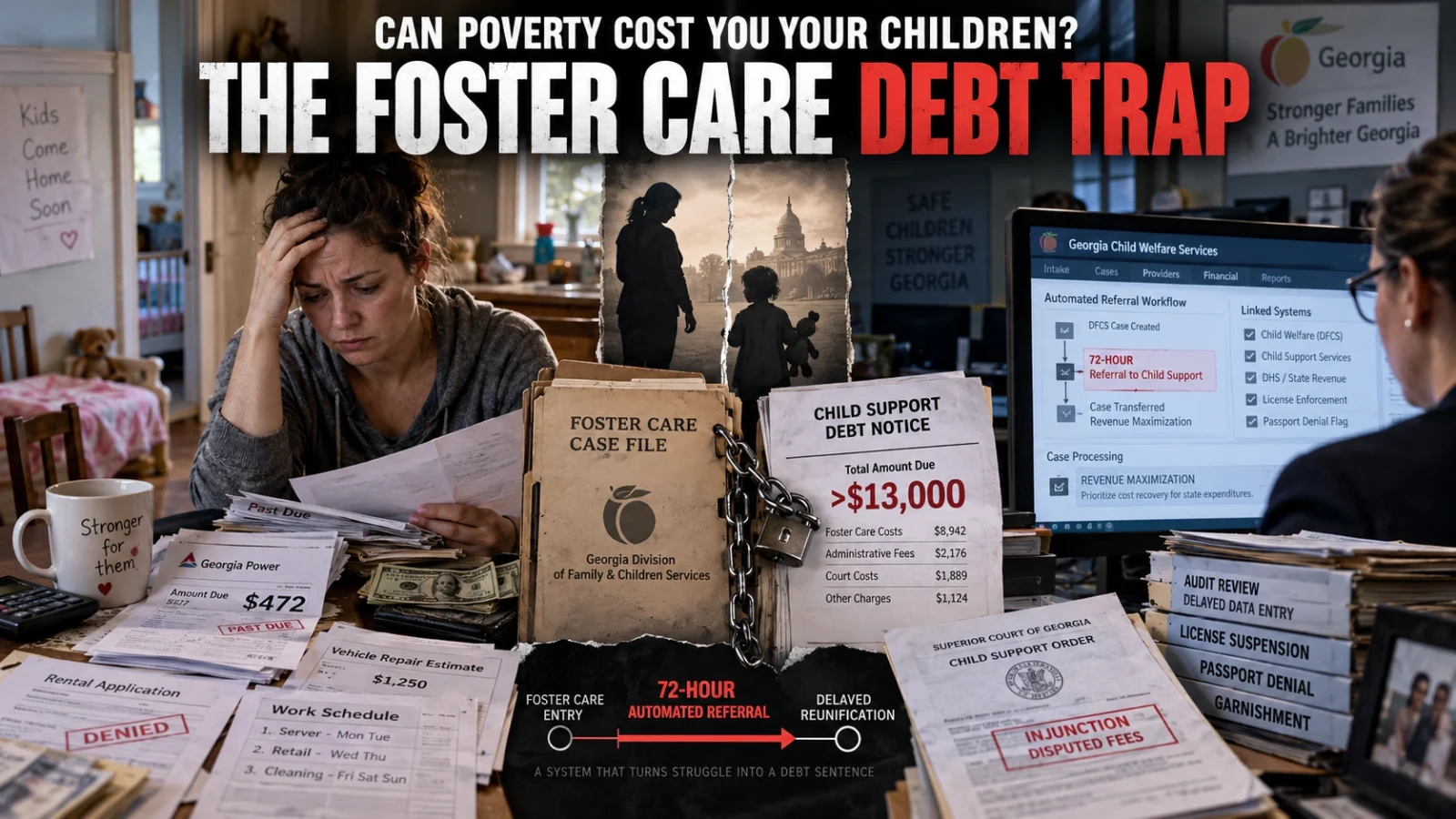
The human consequences of state-mandated foster care fees are most clearly illustrated by the experiences of parents like Annalinda Martinez. A forty-year-old mother from Kennesaw, Georgia, Martinez lost custody of her six eldest children in 2018 after fleeing an abusive relationship. Despite working three separate jobs, she was unable to secure affordable housing, prompting the state to intervene and place her children into the foster system. Instead of providing emergency housing vouchers or financial assistance to keep the family intact, the state removed her children and began charging her for their care.
Georgia’s child welfare agency billed Martinez $472 per month while she was actively trying to rebuild her life, secure stable housing, and regain custody. This billing continued unabated even after two of her children turned eighteen and aged out of the system, and another child was formally adopted. Martinez lived in constant fear of being jailed for missing payments, eventually accumulating over $13,000 in state-mandated child support debt. Her story highlights a punitive feedback loop where the state extracts wealth from those who have none, punishing them for the very poverty that triggered state intervention in the first place.
Represented by the civil rights nonprofit Equal Justice Under Law, Martinez became the lead plaintiff in a class-action lawsuit challenging the constitutionality of this practice. Phil Telfeyan, the organization’s executive director, noted that the current model functions purely to punish parents for struggling financially. The lawsuit argues that imposing these fees without assessing a parent’s actual ability to pay violates fundamental equal protection rights. For families teetering on the edge of financial ruin, these state-sanctioned debts turn temporary crises into permanent legal and economic traps.
Inside the Algorithm of Family Separation
Behind the emotional trauma of family separation lies a highly automated, deeply entrenched bureaucratic machine designed to maximize state cost recovery. In Georgia, DFCS operates through a statewide database known as Georgia SHINES, a web-based Statewide Automated Child Welfare Information System (SACWIS) built by Accenture. When a child is removed from a home, case managers are required to input the family’s data into this system within strict timeframes. The software is explicitly programmed to automate Title IV-D child support referrals to the state’s enforcement division within 72 hours of a child entering care.
State policy dictates that if a caseworker selects “Failure to Return” on the system’s custody page, the software automatically begins the process of attaching a parent’s limited income. The system triggers a financial management unit known as Rev Max to initiate a new referral to the Division of Child Support Services (DCSS), which then moves to establish a new support order in Superior Court. The state’s Department of Human Services has historically relied on these collected funds to backfill projected budget gaps, effectively balancing agency ledgers on the backs of the poor. Case workers are instructed to secure these court orders for child support regardless of whether the parents are concurrently attempting to meet state-mandated financial requirements for safe housing.
The technological detachment of this digital bureaucracy often leads to severe real-world consequences for marginalized families. Data from state audits reveals that Georgia SHINES frequently suffers from delayed data entry, with 31 percent of intake reports entered late and 45 percent of foster care visits recorded outside the mandated timeframes. These delays mean that children may leave foster care or age out of the system while the software continues generating automated bills for months or years afterward. When an algorithm blindly dictates debt collection based on flawed data, the nuanced realities of poverty, domestic violence, and trauma are entirely erased from the state’s calculations.
The Economics of Delayed Reunification
From an academic and economic standpoint, the practice of charging parents for foster care is entirely counterproductive to the stated goals of the child welfare system. Groundbreaking research by economists Maria Cancian and Lawrence M. Berger has heavily scrutinized the mechanisms linking child support cost-recovery orders to prolonged foster care stays. Their studies suggest that aggressively pursuing child support from biological parents actually reduces the likelihood that a family will be successfully reunited. Extracting financial resources from fragile households effectively sabotages the very parents the state is claiming to rehabilitate.
The raw data surrounding these collections paints a stark picture of policy failure. A comprehensive study conducted in Washington State revealed that the state’s aggressive collection tactics actively harmed family preservation efforts. The economics are devastatingly simple: parents are mandated by the courts to secure stable housing and reliable transportation as a condition of regaining custody of their children. When the state garnishes their meager wages to pay for foster care, parents cannot afford rent or car repairs, ensuring their children remain in state custody indefinitely.
Furthermore, the administrative cost of chasing down these funds often exceeds the actual revenue generated by the state. The federal government acknowledges that tracking, billing, and legally pursuing destitute parents requires massive administrative overhead, driving up overall Title IV-E foster care expenditures. Child welfare systems end up spending thousands of taxpayer dollars to squeeze minimal payments from individuals who are already relying on public assistance. This cyclical waste of public resources ultimately enriches debt collection mechanisms while actively harming the children it purports to protect.
| Metric | Impact of Foster Care Child Support Collections |
|---|---|
| Reunification Delay | 6.6-month delay in family reunification for every $100 collected (Washington State data). |
| Financial Burden | Parents billed hundreds of dollars monthly, routinely amassing over $10,000 in state debt. |
| Systemic Cost | Administrative overhead of collections drives up overall Title IV-E expenditures while yielding minimal net revenue. |
A Lack of Candor in the Courtroom
The judicial intervention in September 2026 signaled a profound shift in how federal courts view the aggressive collection tactics of state child welfare agencies. U.S. District Judge Tiffany Johnson issued a preliminary injunction forcing Georgia to immediately halt the collection of unwarranted foster care fees. The judge specifically mandated that the state establish a simple, accessible mechanism for eligible parents to report erroneous charges and dispute unlawful debts. Furthermore, the court ordered state officials to actively correct past billing errors while the broader class-action litigation continues.
The courtroom proceedings leading up to the ruling were marked by intense judicial scrutiny of the state’s legal defense. Judge Johnson openly chastised state defendants for a distinct “lack of candor” during oral arguments held earlier in the year. State attorneys had vigorously defended their debt enforcement measures, only to later reveal that they had quietly enacted middle-of-the-night fee modifications to obscure their ongoing practices. The judge formally warned that any further incidents of deception or violations of court rules would result in severe judicial sanctions against the state.
This ruling serves as a vital protective shield for hundreds of low-income parents currently trapped in Georgia’s child support system. The order to cease secondary enforcement measures, such as the revocation of driver’s licenses and passports, removes immediate barriers to employment for parents trying to earn a living. By freezing these collections, the court implicitly recognized that financial stability is a prerequisite for successful parenting, not a privilege to be suspended by the state. The state’s Department of Human Services has confirmed it will comply with the injunction, though appellate options remain under review by the state Attorney General.
Poverty vs. Neglect: The Policy Blur
The debate over foster care fees inevitably exposes a deeper, more systemic flaw within the American child protection apparatus: the routine conflation of poverty with neglect. According to comprehensive data from Human Rights Watch, over 3 million children are subjected to child welfare investigations annually in the United States, yet 80 percent of these cases are ultimately unfounded. When children are removed, a staggering number of cases are driven entirely by poverty-related conditions such as homelessness, food insecurity, or lack of access to affordable childcare. The system frequently treats structural economic disadvantages as personal moral failings, penalizing parents for circumstances beyond their control.
Legal scholars have increasingly drawn parallels between the child welfare system and traditional law enforcement, noting that both systems disproportionately surveil and control race-class subjugated groups. Caseworkers often justify home interventions and family separations based on vaguely defined standards of “adequate shelter” or “appropriate nurturance,” which effectively criminalize a family’s inability to secure a living wage. This dynamic allows the state to deploy social workers in a quasi-policing role, managing the symptoms of severe poverty through family separation rather than economic support. The resulting trauma inflicted on Black, brown, and Indigenous families maintains historical power structures rooted in systemic inequality and institutionalized racism.
Meaningful reform requires dismantling the financial incentives that reward the removal of children over the preservation of the family unit. Experts and human rights advocates recommend adopting universal rights to pre-petition legal counsel for parents, ensuring they have advocates before the state can sever their family ties. Furthermore, states must be compelled to engage in active efforts to mitigate poverty-related barriers to reunification, such as providing direct financial support for transportation, housing, and mandated services. Until the legal definition of neglect is formally decoupled from the realities of poverty, the child welfare system will continue to function as a punitive extension of the state’s economic hierarchy.
A National Shift Against the Foster Care Tax
While Georgia’s legal battle is currently in the spotlight, it is part of a much broader national reckoning regarding the ethics of the so-called foster care tax. In 2022, the federal Administration for Children and Families (ACF) issued new joint IV-E/IV-D guidance urging state child-welfare agencies to drastically limit how often they seek child support from impoverished parents. This federal pivot recognized that leveraging the child support system against families in crisis was fundamentally at odds with the modern goal of family preservation. As a result, states have begun rapidly unwinding decades of punitive financial legislation.
To date, exactly thirty states have taken legislative or executive action to eliminate these fees, often referring to the reform as ending the “orphan tax”. The momentum has accelerated significantly, with multiple states passing sweeping reforms in just the past few years to protect the financial assets of vulnerable youth. This wave of policy correction highlights a rare bipartisan consensus that state governments should not be in the business of bankrupting vulnerable families to fund their own administrative oversight.
| State | Action Taken Regarding Foster Care Financial Policies | Implementation |
|---|---|---|
| Washington | Halted practice of pursuing parents for foster care costs, directly citing the 6.6-month reunification delay caused by collections. | Sept. 2022 |
| Alabama | Enacted rule prohibiting the use of federal survivor benefits to reimburse state foster care maintenance costs. | April 2026 |
| Alaska | Announced state policy to end the “orphan tax,” preventing the state from seizing foster children’s supplemental security and survivor benefits. | Sept. 2026 |
| Georgia | Forced by federal court injunction to halt erroneous fee collections and restore suspended driver’s licenses for impoverished parents. | Sept. 2026 |
The momentum achieved by these states provides a clear legislative roadmap for jurisdictions still clinging to aggressive collection tactics. Advocates argue that shifting resources from debt collection toward direct housing and child care assistance would preserve families at a fraction of the current public cost. As more states successfully transition away from cost-recovery models without suffering administrative collapse, the justification for maintaining the foster care tax continues to evaporate on a national scale.
What Happens Next
The immediate focus now turns to the looming procedural deadlines in the federal court in Atlanta. The state defendants, including the leadership of the Georgia Department of Human Services, must formally submit their answers to the remaining claims in the class-action lawsuit by October 7, 2026. How the state chooses to navigate this deadline—whether by fighting to preserve elements of their automated collection apparatus or by conceding to broader systemic reforms—will dictate the pace of justice for thousands of affected parents. Equal Justice Under Law continues to push for a total eradication of foster care debt for all low-income parents in the state, rather than just a halt to future erroneous collections.
Beyond the courtroom, the federal injunction is expected to catalyze legislative action during the upcoming Georgia General Assembly session. Lawmakers are facing mounting pressure from civil rights organizations, child welfare advocates, and federal agencies to codify Judge Johnson’s temporary mandates into permanent state law. A permanent legislative fix would prevent future administrations from quietly reinstating these predatory fees during times of budget shortfalls. It would also align Georgia with the growing majority of states that have successfully abandoned the foster care tax in favor of family preservation.
Ultimately, the resolution of this crisis demands a profound paradigm shift in how government agencies interact with families in distress. Rather than deploying automated software to garnish the wages of homeless mothers, states must redirect their administrative budgets toward proactive social safety nets. The survival of the family unit cannot remain contingent on a parent’s ability to pay a state-imposed ransom for their own children. As the legal framework supporting the foster care tax crumbles, the imperative to build a child welfare system rooted in authentic support and economic dignity has never been clearer.
Sources (70)
- grishamandpoole.com — New georgia child support laws
- fostergeorgia.com — Foster parent bill of rights
- dhs.georgia.gov — Foster parent manual
- ajc.com — Georgia must stop charging parents erroneous fees judge rules
- pamms.dhs.ga.gov
- pamms.dhs.ga.gov
- apnews.com — Greenland denmark us un colonialism security a7ba8a250e217cbe9eb0eab757cb7af1
- facebook.com
- equaljusticeunderlaw.org — Ending foster care debt 1
- timesofindia.indiatimes.com — 134502308.cms
- gov.georgia.gov — Download
- mynorthwest.com
- apnews.com — Italy school foreign students classrooms veil migrants education 3d7cf97f62c8e9a
- dfcs.georgia.gov — Foster
- gbpi.org — Overview 2027 fiscal year budget for the georgia department of human services
- hoodline.com — Kennesaw mom s lawsuit forces georgia to halt erroneous foster care fees
- equaljusticeunderlaw.org
- ajc.com — They took her kids because she was poor then they sent her the bill
- houstonlawreview.org — 162441 uncomfortably reminiscent odonnell v harris county in history and memory
- equaljusticeunderlaw.org — Thejusticereport
- researchgate.net — 362699712 ACCESS TO JUSTICE
- calbar.ca.gov — Discussion and Potential Action Regarding the Community Justice Workers Proposal
- americanbar.org — New
- sabanorthamerica.com — Advocacy
- ocfs.ny.gov — Foster care
- wearefamiliesrising.org — All states at a glance
- sandiego.edu — State
- tn.gov — Update on child care funding
- ncsea.org — QF CS Program Funding 2025 FINAL1
- cafo.org — Foster care statistics
- beresfordlaw.com — What is changing for child support in january of 2026
- acf.gov — 30 states have ended orphan tax preserving survivor benefits foster youth
- legis1.com — Child welfare funding 1 states over half of
- thesouthafrican.com — Why the next few weeks could be crucial for orlando pirates
- amarafamily.org — Washington will no longer pursue parents of kids in foster care for child suppor
- datacenter.aecf.org — 5104 foster care timely reunifications during reporting period
- gapundit.com — Georgia politics campaigns and elections for september 29 2026
- lawdaryl.com — Blog
- nsuworks.nova.edu — 2026.2
- dccouncil.gov — Dchdatt
- chinafile.com — Z
- advocate.com — States with transgender bathroom bans
- ob.aom.org — Announcements
- members.capcsd.org — Leadershipacademyalumni
- ballotpedia.org — Julie Rikelman
- nfapa.org — 5f55a782 e1b2 4e53 b382 bcfd9b11c00e
- deloitte.com — Child support integration imperative
- irp.wisc.edu — Child support and child welfare system interactions examining the potential econ
- bu.edu — MEHCHU
- hrw.org — Family separation crisis us child welfare
- pubknow.com — Examining new iv e iv d guidance
- nber.org — W29906
- pmc.ncbi.nlm.nih.gov — PMC6545981
- healthaffairs.org — Hlthaff.2024.01250
- pmc.ncbi.nlm.nih.gov — PMC6396831
- semanticscholar.org — 48a16dedccecb24e465068761e37c60f668aa546
- dfcs.georgia.gov — Data
- fosteringcourtimprovement.org — Summary1.shtml
- cwla.org — Georgia Fact Sheet 2022
- dlg.usg.edu — Dlg ggpd s ga ba800 b ps1p4 bs5 b2012 belec p btext
- pamms.dhs.ga.gov
- scribd.com — 10 10 Comprehensive Child and Family Assessment CCFA
- pamms.dhs.ga.gov
- pamms.dhs.ga.gov
- dfcs.georgia.gov — Download
- pamms.dhs.ga.gov
- dfcs.georgia.gov — Download
- cfsrportal.acf.hhs.gov — VqnNne
- e1.nmcdn.io — Period 13 Final Monitoring Report
- aspe.hhs.gov — Admin costs drive foster care claims fy19 23 trends




Leave a Reply