
The Hidden Ledger of the Shadow Carceral State
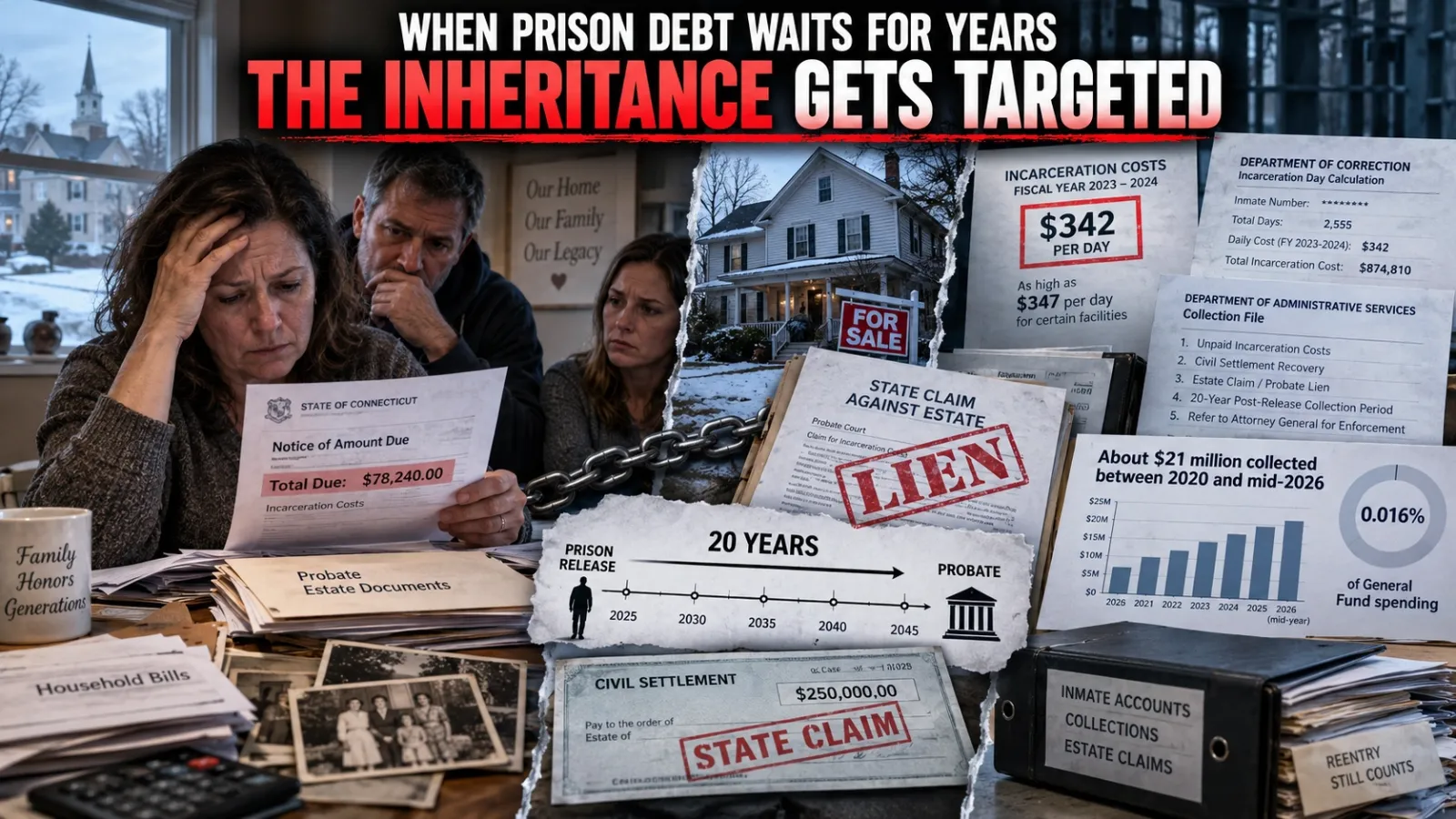
When an individual is sentenced to prison, the presiding judge hands down a span of months or years, but rarely mentions the daily financial meter that begins running immediately. In Connecticut, the state has charged former inmates as much as $347 for every single day spent behind bars, making it one of the most expensive jurisdictions in the country. For the 2023–2024 fiscal year, the official rate stood at $342 per day, meaning a single year in a state facility translates to a civil debt of nearly $127,000. These costs accrue indiscriminately, wrapping room, board, and administrative overhead into a massive financial liability that most individuals can never realistically repay.
What makes Connecticut’s statute particularly aggressive is its long memory and predatory timing. Under Connecticut General Statutes Sections 18-85a and 18-85b, the state retains the authority to pursue these debts for up to twenty years after an individual is released from custody. However, the state rarely tries to collect from newly released individuals, recognizing that formerly incarcerated people face an estimated 27 percent unemployment rate and generally lack liquid assets. Instead, the state waits patiently for a major financial event, such as a probate proceeding, a family inheritance, or a civil lawsuit settlement.
This delayed enforcement turns the state into a dormant financial predator, lying in wait while individuals spend decades successfully reentering society. Former inmates enter the workforce, pay their taxes, and occasionally inherit a modest family home when an elderly parent dies. It is precisely at this vulnerable moment of intergenerational transfer that the state’s Department of Administrative Services (DAS) files a lien in probate court. Without warning, the state steps to the front of the line as a priority creditor, legally authorized to intercept the wealth that was intended to secure a family’s future.
The mechanics of this debt collection rely on a bifurcated bureaucratic system that distances policymakers from the actual human harm. The Department of Correction (DOC) is responsible for calculating the daily per capita cost of incarceration and tracking the exact number of days an individual served. Meanwhile, DAS functions entirely as the state’s collection arm, relying exclusively on the data provided by the DOC to execute liens against estates. By separating the accounting from the enforcement, state officials can easily deflect responsibility, claiming they are merely implementing statutory mandates rather than driving policy.
The Probate Trap and the Erosion of Testamentary Freedom
For many working-class and middle-class families, residential real estate is the sole vehicle for generational wealth. Pay-to-stay laws directly intercept these assets, effectively punishing innocent family members for crimes committed decades earlier. Mark Mullen, a resident of Vernon, Connecticut, worked at a gas station earning $28,000 a year while simultaneously serving as the primary caretaker for his ailing mother. He had maintained his sobriety for nearly a decade after serving a one-year sentence in 2009 for multiple drunken driving convictions.
When Mullen’s mother passed away in November 2025, she left behind the family home where Mullen had planned to live and establish permanent financial stability. Instead of inheriting shelter, the state sent him a letter indicating he owed more than $50,000 for his single year in prison. Because Mullen did not have the liquid cash to satisfy the state’s sudden demand, he and his brothers were forced to sell their deceased mother’s house. The inheritance that was supposed to provide him with a safety net was abruptly liquidated to reimburse the state government.
Teresa Beatty’s ordeal echoes this same pattern of delayed financial devastation and bureaucratic overreach. Between 2000 and 2002, Beatty was incarcerated for a minor drug offense, but she spent the subsequent twenty years working as a certified nursing assistant in Stamford. When her mother died in 2020, Beatty inherited a portion of the family home, which she desperately needed to house herself and her disabled older brother. Shortly after the probate case opened, the state demanded $83,762.26, laying claim to roughly 35 percent of her entire inheritance.
By targeting the family home, pay-to-stay statutes ensure that the consequences of a conviction ripple outward, economically destabilizing spouses, children, and siblings who bear absolutely no culpability for the original offense. This practice completely bypasses traditional intestate succession laws, which were historically designed to keep property within families and prevent wealth from escheating to the government. If parents knew the state would confiscate their estate to pay for decades-old prison debts, they would likely structure their wills entirely differently to protect their assets. In this way, pay-to-stay laws covertly override a citizen’s fundamental legal right to testamentary freedom.
Monetizing Tragedy and Wrongful Death Settlements
The reach of pay-to-stay statutes extends far beyond inheritances, frequently crossing into morally precarious territory by targeting civil lawsuit settlements. When individuals or their family members suffer catastrophic injuries or wrongful deaths, they often sue for damages to cover insurmountable medical bills and lost wages. Under Connecticut’s laws, the state is legally permitted to seize these compensatory settlements to satisfy old prison debts. The state bureaucracy views these human tragedies merely as a sudden influx of liquid assets, rendering them instantly ripe for collection.
Lisa Janssen, a resident of Brookfield, Connecticut, lived on just $2,000 a month while exhaustively caring for her husband, who suffered from severe kidney disease. Both her husband and her son had previously served time for larceny and drug offenses years prior. When her husband ultimately passed away, a medical malpractice settlement from Danbury Hospital offered a brief glimmer of financial relief for her mounting bills. Despite statutory hardship provisions designed to theoretically protect surviving spouses, the state seized approximately $35,000 from the estate, eventually forcing Janssen to apply for SNAP benefits just to buy groceries.
The state’s collection efforts have been equally ruthless when the government itself is the entity responsible for a citizen’s death. In one highly publicized case, Connecticut paid $2 million in compensation to a family after a one-year-old child tragically died while in state foster care. Simultaneously, the state demanded that the grieving father pay back over $84,000 from his share of the settlement to cover his prior prison stays. In another instance, the state seized $40,000 from the family of an East Hartford man who died after being violently slammed to the floor by two police officers.
Natasha Tosado faced a similarly cruel nightmare after her fifteen-year-old son was shot and killed by a police officer. When Tosado received a settlement for her son’s death, the Department of Administrative Services filed a lawsuit attempting to claim 50 percent of the proceeds to pay for her incarceration between 2016 and 2018. It was only after she was granted a full gubernatorial pardon that the state legally dropped its claim to her son’s settlement. Critics and civil rights attorneys argue it is fundamentally perverse for the state to profit from its own fatal misconduct by clawing back wrongful death settlements under the guise of prison debt.
The Budgetary Illusion and the Rise of Stategraft
The modern architecture of these pay-to-stay laws was largely constructed during the 1990s, an era defined by aggressive rhetoric and exploding prison populations. In 1995, during the debates over Connecticut’s statute, lawmakers vocally argued that prisoners should share the financial burden of mass incarceration. State Senator John Kissel stated that it was a matter of “fundamental fairness” to have inmates pay “for their own freight,” framing the policy as a lesson in fiscal responsibility. Then-Attorney General Richard Blumenthal publicly supported the concept, comparing the policy to the federal government charging mobster John Gotti for his confinement.
However, the financial reality of these programs reveals that they are largely a budgetary illusion that fails to generate meaningful revenue for taxpayers. Between 2020 and mid-2026, Connecticut targeted approximately 500 people per year and collected about $21 million through prison liens. While this sounds substantial in a vacuum, it represents just 0.016 percent of the state’s $125.3 billion in total General Fund spending during that same period. The revenue generated covers less than half a percent of the Department of Correction’s annual operating budget, proving it does virtually nothing to offset operational costs.
| Pay-to-Stay by the Numbers: Connecticut | Key Metric |
|---|---|
| Maximum Daily Incarceration Fee | Up to $347 per day |
| Cost of a 1-Year Sentence | ~$127,000 |
| Statute of Limitations on Debt | 20 years post-release |
| Average Annual Revenue Collected | $3.3 million |
| Percentage of State General Fund Spending | 0.016% |
Legal scholars and sociologists describe this exact phenomenon as “stategraft,” a systemic process where state agencies extract resources from marginalized populations through fines, fees, and property seizures. A 2025 report by Campaign Zero emphasized that pay-to-stay fees are entirely ineffective as fiscal policy, often costing governments more in administrative and legal overhead than they yield in actual revenue. In states like Illinois, which eventually repealed its pay-to-stay law, lawmakers realized that litigating these debts was frequently a net financial loss for taxpayers over the long term.
Despite these negligible fiscal benefits, state collection agencies proceed with unyielding bureaucratic efficiency, viewing themselves purely as administrators rather than moral arbiters. Eleanor Michael, Deputy Commissioner of the Department of Administrative Services, explicitly distanced her agency from the ethical debate. “We’re not involved in the policy discussion here. We’re just the ones that are implementing the law,” she stated in response to media inquiries. This administrative detachment allows the state to routinely dispossess families of their homes while pointing to rigid statutory mandates as their only justification.
The Nationwide Web of Legal Financial Obligations
Connecticut is not an anomaly in its pursuit of carceral debt; it is merely one of the most aggressive enforcers of a deeply entrenched national policy. Currently, forty-five states have some form of pay-to-stay statute on the books, authorizing the government to seek reimbursement for incarceration. While some states strictly limit collections to garnishing wages earned through prison work-release programs, others enact broad statutes that allow for the seizure of bank accounts, civil settlements, and family inheritances. According to the National Consumer Law Center’s 2025 report, “Handcuffing Heirs,” at least three states explicitly authorize the seizure of inheritances, while twenty-five remain dangerously ambiguous in their legal language.
The Fines and Fees Justice Center has tracked the explosive growth of these policies, noting that they effectively criminalize poverty and create a two-tiered justice system. For a wealthy individual, a pay-to-stay fee is a manageable surcharge on their sentence that can be paid off immediately. For a working-class individual, it is a life-altering financial anchor that guarantees they will exit the prison system with a massive negative net worth. A recent review of legal financial obligations found that courts and carceral facilities assess billions in debt annually, with an estimated $27.6 billion in outstanding court debt burdening families nationwide.
This financial extraction is not limited to room and board, but extends into an expansive web of predatory legal financial obligations. In Missouri, a woman named Brooke Bergen was billed $15,900 in pay-to-stay fees after spending a year in jail for stealing an $8 tube of mascara. In other jurisdictions, exorbitant fees are levied for basic telecommunications, forcing families to pay highly inflated per-minute rates just to speak with their incarcerated loved ones. While Connecticut successfully passed Public Act No. 21-54 to make prison communication free, many states continue to rely on commission-based telecom contracts that extract wealth directly from impoverished families.
Furthermore, the involvement of private prisons introduces a profound ethical conflict into the collection of carceral debt. When private entities administer incarceration, pay-to-stay statutes allow for-profit corporations to extract financial yields from seized inheritances and property. It is widely considered unconscionable to allow a for-profit entity to directly profit from the liquidation of a deceased grandparent’s estate just because their grandchild once served time. As state budgets face periodic shortfalls, municipalities increasingly lean on these extractive fees, transforming the criminal justice system from a vehicle of public safety into a predatory collection agency.
Constitutional Battles and Legislative Half-Measures
As public awareness of these harsh debt collection practices has grown, civil rights groups have launched major legal challenges to disrupt the system. In 2022, the ACLU of Connecticut filed a federal class-action lawsuit, Beatty v. Lamont, on behalf of Teresa Beatty, Douglas Johnson, and Natasha Tosado. The plaintiffs aggressively argued that seizing inheritances to pay for decades-old prison stays explicitly violated the Excessive Fines Clause of the U.S. Constitution. By bringing the issue to federal court, advocates hoped to secure a sweeping legal precedent that would dismantle the practice across the entire state.
The legal foundation for this challenge stems directly from the Eighth Amendment, which was recently fortified by the Supreme Court’s ruling in Timbs v. Indiana. In that landmark case, the Court ruled that the Excessive Fines Clause applies to state actions, severely limiting the government’s ability to seize property that is grossly disproportionate to the underlying offense. Legal advocates argued that billing a former inmate $83,000 for a minor drug offense, or seizing a $232,000 family home, represented the exact type of disproportionate financial punishment the Constitution was designed to prevent. These legal arguments remain fiercely debated, as the state consistently maintains it is simply recovering operational costs rather than imposing punitive fines.
Faced with mounting political pressure and negative press, the Connecticut state legislature enacted a series of compromises in 2022 and 2024 to soften the law’s most egregious impacts. Lawmakers revised the statutes to exempt the first $50,000 of an inheritance from state seizure, provided the individual was not convicted of a highly serious crime like murder. They also prohibited the state from recovering costs for crimes that are eventually erased from a person’s record, or for individuals fully pardoned by the state board. Because these specific legislative changes cleared the debts owed by the named plaintiffs, the federal court dismissed the Beatty lawsuit as moot in October 2024.
While state officials heralded the legislative reforms as a major victory that would reportedly exempt 98 percent of inmates from future debt, legal advocates argue the changes are insufficient half-measures. Civil rights attorney Alex Taubes points out that the state still targets families relentlessly, collecting nearly $20 million over the last five years despite the newly enacted exemptions. The failure of the federal courts to rule on the merits of the Excessive Fines Clause means that the underlying legal mechanism allowing these seizures remains perfectly intact. The Department of Administrative Services retains the statutory authority to act as a priority creditor, continually monitoring probate dockets for potential windfalls.
The Criminogenic Cycle and the Racial Wealth Gap
The ultimate irony of pay-to-stay fees is that they actively undermine the fundamental rehabilitative goals of the criminal justice system. Studies consistently show that financial stability, housing security, and steady employment are the strongest proven deterrents to recidivism. By saddling individuals with six-figure debts upon release, states create intensely criminogenic conditions that heavily increase the likelihood of future criminality. People who are stripped of their inheritances and locked out of their family homes are far more likely to experience homelessness or return to the underground economy just to survive.
This cycle of state-mandated poverty does not fall equally across the population; it acts as an aggressive accelerant for racial inequality. Because of historical systemic racism and wildly disproportionate incarceration rates, pay-to-stay inheritance seizures severely exacerbate the existing racial wealth gap. Black and Latino families have historically been excluded from traditional avenues of intergenerational wealth transfer through redlined housing markets and discriminatory lending practices. When these families finally manage to secure a piece of real estate, prison debt laws step in to confiscate it, resetting their generational financial progress back to zero.
Furthermore, prioritizing the state as a creditor actively harms the innocent dependents of formerly incarcerated individuals, punishing children for the sins of their parents. As Fred Hodges, a former inmate who paid thousands in daily fees, explained, the money the state seized from him could have gone to feed and support his seven grandchildren. It creates an unavoidable ripple effect of deprivation that starves marginalized communities of much-needed capital. Families report sacrificing basic necessities like food, rent, and healthcare just to manage the looming threat of state debt collection.
By viewing incarceration as a “user-funded” system, state legislatures also absolve themselves of the political pressure to reduce the bloated prison population. If the state believes it can simply bill families to recover the exorbitant costs of maintaining overcrowded facilities, the financial urgency to pursue meaningful decarceration completely evaporates. Because a significant portion of prison operational expenditures remain constant regardless of the total number of prisoners, reducing the overall inmate population does not proportionally decrease costs. As a result, the per capita cost assessed to each remaining incarcerated person actually increases, deepening the financial burden on the poorest families.
What Happens Next
The momentum for nationwide reform is accelerating as more states recognize the inherent cruelty and fiscal inefficiency of pay-to-stay laws. Following the lead of states like Illinois and California—which fully repealed their pay-to-stay statutes after acknowledging the devastating economic harms—advocates are pushing for outright abolition across all remaining jurisdictions. Organizations like the Fines and Fees Justice Center and the National Consumer Law Center have outlined extensive model legislation for 2026, explicitly urging lawmakers to ban the seizure of inheritances, civil settlements, and critical wages. In states like Massachusetts, bills are actively moving through committees to strip away medical and health service fees entirely.
However, the path to reform is threatened by looming macroeconomic factors that could stall legislative progress. As tax revenue growth slows and inflation drives up the cost of municipal operations, states are facing renewed budget crunches that traditionally trigger a heavy reliance on legal financial obligations. Policymakers warn that without sustained public pressure, cash-strapped local governments may quietly increase their collection efforts to balance deficits. Advocates must successfully prove that the administrative cost of chasing this debt significantly outweighs the meager revenue it ultimately produces.
In Connecticut, civil rights groups are actively preparing for the next round of legal and legislative battles, knowing that the $50,000 inheritance exemption still leaves countless middle-class homes highly vulnerable to probate court liens. Legal groups anticipate that new plaintiffs will soon emerge to bring the Excessive Fines Clause challenge back to federal court, demanding a definitive ruling on the constitutionality of carceral debt. Until a total repeal is achieved, the shadow carceral state will continue to haunt families for decades, ensuring that long after a prison sentence is served, the true punishment is passed down to the next generation.
Sources:
- Colorado Law Review, “Estate to State: Pay-to-Stay Statutes and the Problematic Seizure of Inherited Property,” https://lawreview.colorado.edu/print/volume-95/estate-to-state-pay-to-stay-statutes-and-the-problematic-seizure-of-inherited-property-brittany-l-deitch/
- CT Mirror, “They served their time in prison. Then the bills arrived,” https://ctmirror.org/2026/09/27/they-served-their-time-in-prison-then-the-bills-arrived/
- AP News, “At $249 per day, prison stays leave ex-inmates deep in debt,” https://apnews.com/article/crime-prisons-lawsuits-connecticut-074a8f643766e155df58d2c8fbc7214c
- Inside Investigator, “Prison debt lawsuit dismissed by Federal court,” https://insideinvestigator.org/prison-debt-lawsuit-dismissed-by-federal-court/
- National Consumer Law Center, “Handcuffing Heirs: How Seizing Inheritances to Collect Pay-to-Stay Prison Fees Hinders Recovery,” https://www.nclc.org/resources/handcuffing-heirs-how-seizing-inheritances-to-collect-pay-to-stay-prison-fees-hinders-recovery-and-financial-stability/
- Campaign Zero, “Paying for One’s Own Incarceration: National Landscape of Pay-to-Stay Fees,” https://static.prisonpolicy.org/scans/pay-to-stay-report-20250622.pdf
- Fines and Fees Justice Center, “2025 Legislative Roundup Part 2: End Justice Fees,” https://finesandfeesjusticecenter.org/news/2025/12/15/2025-legislative-roundup-part-2-end-justice-fees/
- USC Dornsife, “How one state’s repeal of a prison ‘pay-to-stay’ law could guide national reform,” https://dornsife.usc.edu/news/stories/pay-to-stay-prison-reform-research-could-guide-change/
- Wisconsin Law Review, “Pay-to-Stay as Stategraft,” https://wlr.law.wisc.edu/pay-to-stay-as-stategraft/
- The Marshall Project, “Court Fees May Rise as Government Budgets Shrink,” https://www.themarshallproject.org/2026/08/08/money-court-fee-pennsylvania-fine
- CT General Statutes, Section 18-85a, https://law.justia.com/codes/connecticut/title-18/chapter-325/section-18-85a/
- Pew Charitable Trusts, “Fiscal Pressures Threaten Reforms to Court Fines and Fees,” https://www.pew.org/en/research-and-analysis/articles/2026/07/23/fiscal-pressures-threaten-reforms-to-court-fines-and-fees




Leave a Reply