
The Haus Coffee Implosion
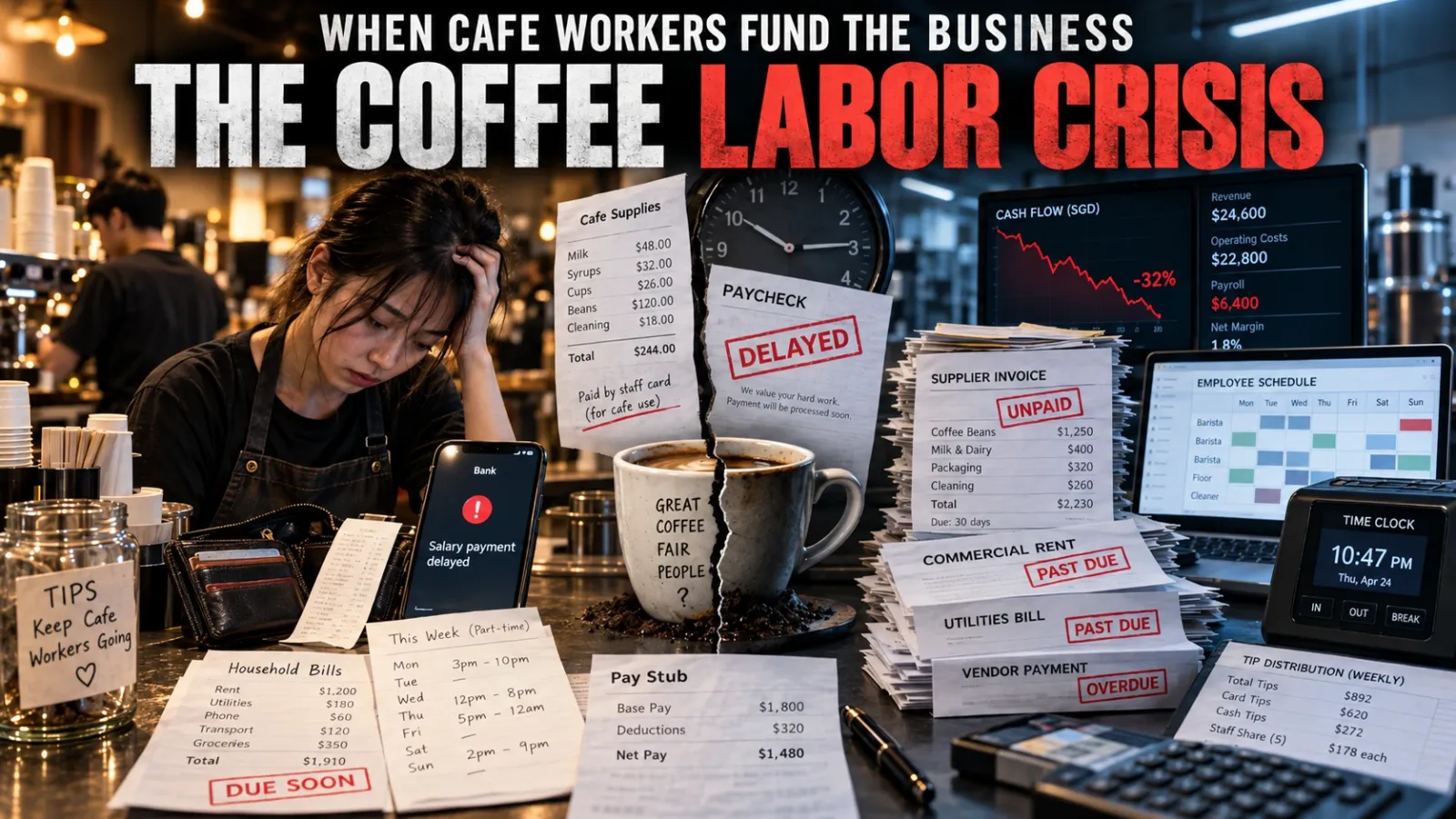
The catalyst for this industry-wide reckoning began at Haus Coffee, a highly popular coffee and streetwear shop located in Singapore’s Golden Mile Tower. Known for its specialty matcha lattes, banana pudding, and frequent pop-up events across the country, the cafe abruptly announced a temporary closure on September 17, 2026. The brand cited a vague need to “sort out internal matters,” which immediately sparked rumors across social media platforms. Young workers and suppliers began alleging a severe pattern of unpaid labor and neglected invoices, contrasting sharply with the cafe’s curated public image.
On September 26, the narrative shifted from online murmurs to established fact when owner Tan Junyu published a detailed apology on Instagram and formally stepped down from the business. In a stunning admission of mismanagement, Tan confessed that employee salaries had been paid late “more often than not,” despite staff sending him multiple reminders. Most alarmingly, he acknowledged that his employees were repeatedly forced to pay for the cafe’s stock and supplies out of their own personal pockets because he had failed to make adequate operational arrangements. Tan also admitted to delaying payments to vendors who had consigned their goods at Rookies, a clothing store co-located within the cafe.
Tan attributed his business failures to his own “reckless lifestyle and habits,” which he admitted caused great inconvenience and disappointment to his staff, customers, and consignors. While Tan took full responsibility for the delayed paychecks and unpaid supplier debts, the situation is also clouded by more severe, unverified allegations circulating online. A former business partner and ex-girlfriend published claims on social media accusing Tan of misappropriating business funds, selling replica designer goods as authentic, and engaging in infidelity.
From an editorial and legal standpoint, these specific claims regarding fraud and personal misconduct remain strictly unverified and require caution, as they stem from a private account. However, the established, self-admitted facts of the case—chronic late payments and staff subsidizing business inventory—serve as a glaring localized example of a much larger global labor crisis. The brand is now reportedly under an undisclosed new management team tasked with overhauling hiring, training, and finances to salvage the operation.
The Glamour Trap in Specialty Coffee
The collapse of Haus Coffee resonates deeply in the United States, where the specialty coffee industry heavily recruits young, passionate demographics under the guise of artisanal craft. Currently, there are over 474,600 individuals employed as baristas across the country, representing a massive and essential segment of the service economy. This workforce is overwhelmingly female, comprising 74% of the barista population, and is largely restricted to part-time hours, with only 35% of workers securing full-time schedules. Many of these workers are drawn to the aesthetic appeal and community atmosphere of independent cafes, often overlooking the inherent financial precarity of the role.
Despite the premium prices customers pay for specialty drinks, the financial reality for the workers pouring them is stark and uncompromising. The average barista in the United States earns a base wage of around $15.55 per hour, which translates to a modest annual income that frequently falls below living wage thresholds in major urban centers. While tips can add an estimated $2 to $5 per hour to their earnings, this reliance on customer generosity makes income highly unpredictable and subject to seasonal fluctuations.
This disconnect between the glamorous public image of specialty coffee and the grueling reality of the labor has led to a severe crisis of morale across the industry. Recent workforce data reveals that most baristas rate their overall job satisfaction at a dismal 2.9 out of 5, placing them in the bottom quartile of all professions. Satisfaction with their actual salaries sits even lower at 2.6 out of 5, indicating a widespread recognition that passion for coffee cannot compensate for an inability to pay the rent.
Employers are now facing a workforce that is far less willing to accept structural exploitation in exchange for proximity to a trendy brand. As Generation Z becomes the dominant demographic behind the espresso machine, they are loudly demanding work-life balance, reliable scheduling, and transparent pay structures. The days when a cafe owner could rely on an endless supply of starry-eyed youth willing to endure late paychecks for the sake of “the craft” are rapidly coming to an end, fundamentally altering the hiring landscape.
The Mechanics of Cafe Wage Theft
When trendy cafes experience cash flow problems, the burden is frequently, and illegally, passed down to the workers through various forms of wage theft. Wage theft in the service sector typically manifests in subtle ways: forcing employees to work off-the-clock during opening and closing procedures, failing to pay time-and-a-half for overtime, or quietly shaving hours off digital timecards. In the United States, research indicates that up to 17% of low-wage workers have experienced minimum wage violations, draining billions of dollars from working-class households annually.
One of the most pervasive forms of theft in the cafe industry revolves around the illegal confiscation of tips and the mishandling of the tip credit system. Federal law under the Fair Labor Standards Act (FLSA) clearly dictates that while tip pooling among service staff is legal, managers, supervisors, and owners are strictly prohibited from taking any portion of those tips. Furthermore, an employer utilizing a “tip credit” to pay a sub-minimum base wage must legally make up the difference if a worker’s tips do not bring their total earnings up to the standard minimum wage.
Another common violation, directly mirroring the abuses admitted at Haus Coffee, involves illegal paycheck deductions for operational expenses. Under US labor law, including strict regulations in states like California, employers cannot deduct money from a worker’s paycheck to cover cash register shortages, accidental breakages, or uniform costs if doing so drops their pay below minimum wage. Forcing an hourly worker to pay out-of-pocket for store inventory—such as milk, syrups, or cups—is a severe violation of their fundamental labor rights.
The financial impact of these practices is devastating for the individuals targeted, plunging many into cycles of debt. Studies reveal that the lowest-paid workers in the United States lose roughly 21% of their income, or an estimated $1.67 per hour, directly to employer wage theft. For a barista surviving on a precarious part-time schedule, these stolen wages represent the difference between buying groceries, accessing healthcare, or falling into absolute poverty.
Technology and the Modern Time Clock
While traditional wage theft relies on manual manipulation, the integration of advanced technology into cafe operations has created new vectors for both worker surveillance and algorithmic exploitation. The hospitality industry is increasingly adopting artificial intelligence to manage schedules, a trend that has brought about a “chronic crisis over the clock” for hundreds of thousands of baristas. Systems that use real-time inputs to control staffing levels often result in unpredictable “just-in-time” scheduling, leaving workers unable to plan their lives or secure a second job.
AI-powered surveillance cameras and algorithmic decision-making wearables are now being deployed to monitor worker productivity down to the second. While these tools are marketed as efficiency upgrades, they frequently lead to sophisticated forms of wage theft, where automated time clocks automatically round down hours or dock pay for minor infractions. In response to these invasive practices, the US Department of Labor recently clarified that employers deploying AI to monitor employees must continue to comply with the FLSA to ensure workers are compensated for all hours worked.
Conversely, technology also provides baristas with new mechanisms to protect themselves against unscrupulous employers. Without daily records of what they earned, proving tip theft or shaved hours is almost impossible for a vulnerable worker facing a well-resourced business owner. Digital tip-tracking applications and personal time-logging software now allow employees to create an immutable evidence trail, empowering them to cross-reference their personal data against their official pay stubs.
This digital arms race between employers and employees highlights a fundamental lack of trust within the modern hospitality sector. When an employer leverages technology strictly to minimize labor costs rather than to enhance the worker experience, they inevitably foster a hostile environment. Smart operators are realizing that using data to align shifts with hourly sales is only sustainable if the technology also respects the worker’s need for a stable, predictable income.
The Margin Squeeze on Independent Cafes
Understanding why so many cafe owners resort to wage theft requires examining the brutal macroeconomic realities of running an independent hospitality business in 2026. While the broader US coffee market generates a staggering $80 billion in annual revenue, the profit margins for individual independent shops are notoriously razor-thin. Most mature, well-run independent cafes manage a net profit margin of 10% to 25%, but new or struggling shops often scrape by with net margins of just 2.5% to 7%.
This precarious financial position leaves small business owners highly vulnerable to market volatility and inflation. In recent years, cafe owners have been battered by soaring commercial rents, utility spikes, and a highly unpredictable supply chain where the cost of green coffee beans fluctuates wildly. When an independent cafe faces a sudden cash shortage, payroll is often the only flexible expenditure left, leading desperate or negligent owners to delay salaries just to keep the lights on.
The physical format of the cafe also heavily dictates its financial survival and its subsequent ability to pay workers fairly. Drive-thru and kiosk models currently post the highest net margins—often exceeding 15%—because they require a significantly smaller real estate footprint and lower labor costs per transaction. Conversely, large, aesthetic-driven cafes that encourage customers to sit for hours with a single laptop and a basic drip coffee face immense pressure to cover their overhead, making them far more susceptible to financial ruin.
| Cafe Business Model | Estimated Net Profit Margin (2026) | Operational and Labor Impact |
|---|---|---|
| Drive-Thru / Kiosk | 15% – 20%+ | Lowest labor and real estate cost per transaction; higher financial stability. |
| Mature Independent Cafe | 10% – 25% | Requires high volume and strict cost control; relies on experienced staff retention. |
| New Independent Cafe | 2.5% – 7% | Extreme sensitivity to cash flow issues; highest risk of payroll delays and wage theft. |
| US Specialty Coffee Market | $52.1 Billion Total Value | Massive industry wealth that disproportionately bypasses the frontline workers. |
Rather than adopting smarter, data-driven scheduling or adjusting their pricing models, failing owners often attempt to balance their books on the backs of their staff. This financial mismanagement creates a toxic cycle: low pay and delayed wages lead to staff burnout, which triggers high turnover. Ultimately, this approach costs the business more in the long run, as the hidden cost of replacing a single trained barista ranges from $5,000 to $8,000.
The Human Toll on the Anchor of Hospitality
When trendy brands stop paying their baristas, the consequences transcend a simple breach of contract; they strike at the core of human dignity and family stability. Service industry workers structure their entire lives around the fragile expectation that their time will be compensated accurately and on schedule. A single missed paycheck can initiate a devastating domino effect, leading to overdraft fees, eviction notices, and an inability to afford basic transportation to get back to the very job that owes them money.
The psychological burden of wage theft is equally severe, eroding the foundational trust between an employer and their team. When an owner lives a self-described “reckless lifestyle” while simultaneously telling their staff that payroll will be a week late, it generates deep resentment and a profound sense of devaluation. Forcing employees to utilize their own meager personal funds to purchase essential cafe supplies, as seen in the Haus Coffee incident, crosses a boundary that completely shatters workplace confidence and morale.
This exploitation disproportionately impacts vulnerable demographics, particularly women, students, and immigrants who may feel they lack the legal standing or financial runway to fight back. Furthermore, because 65% of US baristas are restricted to part-time hours, they rarely qualify for employer-sponsored health insurance or paid sick leave. Consequently, when their wages are stolen or delayed, they have absolutely no safety net to fall back on, forcing many to rely on publicly funded welfare programs to survive.
The ultimate irony is that these underpaid baristas are the primary drivers of the “hospitality” that defines the specialty coffee experience. Customers return to their local cafes for the genuine human connection and the skill of the barista crafting their beverage, not just the aesthetic design of the room. When owners exploit these workers, they are effectively starving the very asset that makes their business viable in a fiercely competitive market.
Retooling the Cafe Economy
Fortunately, the narrative of the struggling, exploited barista is not a permanent, unchangeable feature of the hospitality industry. By 2026, the most successful and resilient specialty cafes have recognized that chronic underpayment and high turnover are fundamentally bad for long-term business survival. Forward-thinking operators now treat retention as a core financial strategy, realizing that paying a premium wage costs significantly less annually than absorbing constant replacement cycles.
To eliminate this massive financial bleed, smart cafes are abandoning the minimum-wage model and purposefully paying well above the local market rate. In mid-cost US markets, this translates to $17 to $19 an hour for skilled baristas, and up to $24 an hour for shift supervisors, alongside transparent tipping structures. By providing a structured, clear path for wage growth, these businesses give their staff a tangible reason to stay, effectively neutralizing the urge to leave for a minor pay bump at a competitor.
Beyond compensation, the most radical and effective shift in the 2026 cafe economy is the widespread adoption of the 32-hour work week model. Recognizing the intense physical and emotional toll of front-line hospitality work, progressive owners are scheduling staff for fewer hours without reducing their overall take-home pay. This model drastically reduces burnout, ensures workers arrive at their shifts rested, and subsequently elevates the quality of customer service to a level that justifies premium menu pricing.
Finally, the role of automation is being reframed not as a tool to replace human workers, but as a mechanism to eliminate grueling, low-skill repetition. By automating basic batch brewing, simple drip orders, and routine point-of-sale logistics, skilled baristas are freed to focus entirely on crafting complex espresso beverages and building authentic customer relationships. When employers invest in their staff as irreplaceable assets rather than disposable line items, the entire business model stabilizes and thrives.
What happens next
In the immediate wake of the Haus Coffee scandal, the cafe’s operational future rests entirely in the hands of its newly appointed, yet publicly unnamed, management team. This new leadership is currently tasked with an uphill battle to restore public trust, oversee new staff recruitment, and untangle a web of severe financial mismanagement left behind by the previous owner. Meanwhile, independent consignors and suppliers remain in a frustrating state of limbo, waiting for clear communication regarding when—or if—they will finally receive payment for their goods.
On a broader scale, localized incidents like this are accelerating a massive labor reckoning across the entire United States coffee sector. Major unionization efforts are actively challenging the status quo, with organized baristas at massive chains currently scaling their bargaining demands to secure a $17 per hour base pay floor, safer staffing levels, and guaranteed annual increases. As organized labor demonstrates its power, independent cafe owners will face intense pressure to match these improving standards or risk losing their talent pool entirely.
Simultaneously, state-level regulatory bodies and attorneys general are becoming increasingly aggressive in stepping up where federal enforcement has historically fallen short. With new state laws taking effect in 2025 and 2026, such as New York City’s strict barista wage mandates and California’s SB 648 targeting tip theft, owners who illegally pool tips or delay payroll will face steeper fines and swifter legal consequences. The era of the “aesthetic” cafe operating above the law and exploiting young workers is rapidly closing.
Ultimately, the survival of the neighborhood coffee shop will depend heavily on a fundamental shift in consumer consciousness and operator ethics. As the public becomes more aware of the “Latte Lie”—the stark contrast between ethical branding and exploitative labor practices—diners are increasingly voting with their wallets. Cafes that refuse to transparently value and pay their struggling baristas will soon find that no amount of viral marketing or minimalist design can save a business built on stolen wages.
Sources (64)
- sea.peoplemattersglobal.com — Haus coffee owner steps down amid late salary payments and workplace culture con
- news.theonlinecitizen.com — Haus coffee owner apologises over unpaid salaries and supplier debts steps down
- mothership.sg — Haus coffee owner apologise steps down
- theindependent.sg — Singapore coffee shop owner steps down due to reckless lifestyle after rumours o
- facebook.com
- mustsharenews.com — Haus coffee owner
- reddit.com — Owner of haus coffee apologises steps down over
- asiaone.com — Haus coffee owner steps down late salary payments
- facebook.com
- mustsharenews.com — Amp
- theroasthauscoffeeco.com — Cappuccino
- 7shifts.com — Average barista salary
- oysterlink.com — Barista statistics
- pureearthcoffee.com — Coffee shop staffing crisis solutions 2026
- perfectdailygrind.com — What baristas love hate working coffee shops
- intelligence.coffee — Coffee industry maturing hiring staff
- zippia.com — Trends
- reveliolabs.com — Employees
- labornotes.org — Starbucks bargaining backwards baristas say
- park-lawyers.com — Improper deductions tip splitting commissions piece rate
- dir.ca.gov — FAQ tipsandgratuities
- reddit.com — My boss the owner is taking most of our tips and
- amundsendavislaw.com — Margaret miles
- researchgate.net — 346304289 Accounting's role in resisting wage theft a labour process theory anal
- reddit.com — Fast food restaurant lies about my hired wage
- epi.org — State ag labor rights activities 2018 to 2020
- muckrock.com — Boston wage theft data
- news.ycombinator.com — Item
- perfectdailygrind.com — Coffee shop trends in 2026
- beanandbrewtech.com — Coffee shop challenges 2026 what owners need to know to succeed
- oydisplay.com — Unique coffee shop design ideas to stand out
- matteoborea.it — Coffee profit margins
- novatab.com — Coffee shop profit margins
- perfectdailygrind.com — Opening coffee shop 2026
- businessresearchinsights.com — Specialty coffee market 117443
- coffeegreenbeans.com — Biggest challenges for the specialty coffee industry in 2026
- coherentmarketinsights.com — Specialty coffee market
- grandviewresearch.com — Coffee market
- riseaccounting.co.uk — Coffeeshop break even analysis
- cambridge.org — F2246E9AF2628AB202A915F751852762
- smlr.rutgers.edu — Denver Minimum Wage Report Sept2024
- publicintegrity.org — Ripping off workers with no consequences
- pmc.ncbi.nlm.nih.gov — PMC4062017
- equitablegrowth.org — Jobs report u s employment growth slowed in december with the leisure and hospit
- researchgate.net — 341626328 Wage theft in the United States Towards new research agendas
- pbs.org — Wage theft hits immigrants hard
- policymattersohio.org — Honest days pay
- nelp.org — JustPayRelease
- dol.gov — Low wage high violation industries
- rooseveltinstitute.org — Federal employment standards revisiting minimum wage
- forthepeople.com — Wage theft what every worker should know about their rights
- epi.org — Employers steal billions from workers paychecks each year
- oysterlink.com — Hiring barista new york city wage laws checklist
- server44.app — Tip theft your rights and what to do if your employer steals tips
- sec.gov — Brcb 20251231
- repository.uclawsf.edu — Viewcontent.cgi
- deputy.com — Time clock rules for hourly employees
- irs.gov — 2025 42 IRB
- amundsendavislaw.com — Steven Jados
- researchgate.net — 334622502 Does the hospitality industry need or deserve talent
- govinfo.gov — CRPT 118hrpt970
- usaemploymentlawyers.com — Wage theft in the service industry
- davidgallolaw.com — Wage theft in restaurants how emoyers deceuve
- laborlawcenter.com — Top labor law challenges in the food service industry



Leave a Reply