
Gambling the Golden Years: How the AI Tech Bubble is Swallowing 401(k) Savings
By the close of 2025, United States retirement assets reached a staggering $49.1 trillion, buoyed by a historic stock market rally that pushed aggregate household wealth to unprecedented heights. Millions of American workers have watched their 401(k) balances surge, largely unaware that this aggressive growth is heavily dependent on a single, highly speculative economic engine: artificial intelligence. As the technology industry pours hundreds of billions into data centers and advanced chips, the foundational savings of the American middle class have been quietly conscripted to fund this digital buildout.
This convergence of passive retirement investing and Silicon Valley exuberance has created a fragile financial ecosystem that masks profound underlying vulnerabilities. While daily headlines celebrate record-breaking valuations for elite artificial intelligence firms, a vast disconnect is growing between the trillions of dollars committed to digital infrastructure and the actual commercial revenues generated by the technology. If the artificial intelligence market experiences a sharp correction, the resulting financial shock will not be contained to the balance sheets of venture capitalists and elite hedge funds.
The most severe consequences will fall on ordinary workers, teachers, and nurses who rely on target-date funds and passive index trackers for their future survival. Those nearing retirement face the greatest peril, as the traditional safeguards designed to protect their portfolios are increasingly compromised by the sheer gravitational pull of the concentrated tech sector. The quiet transformation of the 401(k) from a diversified safety net into a concentrated bet on artificial intelligence represents a systemic gamble with the golden years of an entire generation.
The Automation of Retirement Savings
Most American workers no longer actively select their retirement investments, handing that responsibility over to automated financial systems. Currently, 61 percent of defined contribution plans automatically enroll workers, generally defaulting them into target-date funds that mechanically adjust risk over time. At Vanguard, which commands a massive footprint in the retirement sector, 96 percent of administered plans offer these lifecycle funds. Consequently, nearly 69 percent of all retirement plan participants are now parked in professionally managed allocations that function entirely on autopilot.
The core promise of a target-date fund is elegantly straightforward for the everyday saver. It offers a broadly diversified portfolio that automatically reduces volatility as a worker ages, requiring zero active maintenance from the investor. For a young worker early in their career, the fund typically holds 90 percent of its value in global equities to maximize long-term compounding growth. By the time that individual reaches their retirement target date at age 65, the equity allocation glides down to roughly 50 percent, shifting toward fixed-income investments for stability.
Because these default funds are overwhelmingly built on passive, market-capitalization-weighted indices, they simply purchase the largest public companies in exact proportion to their market size. Historically, this mechanical nature has actually benefited retail investors by preventing emotional trading during brief market panics. During the market volatility between 2022 and 2025, Vanguard data revealed that target-date fund investors essentially bought and sold themselves an extra $23 billion in value simply by maintaining steady, automated payroll contributions. The average dollar invested in these strategies gained 8.0 percent annually, outperforming the funds’ time-weighted returns because participants consistently bought the dip during market drawdowns.
However, this exact behavioral advantage morphs into a fatal vulnerability when the broader market structure becomes wildly unbalanced. Index funds must continuously purchase shares of companies in exact proportion to their escalating size, triggering mandatory, relentless buying from 401(k) providers whenever a tech giant’s valuation surges. This algorithmic dynamic effectively strips the market of traditional human price discovery, creating a self-sustaining feedback loop that artificially inflates the top tier of the index. When a sector begins to severely decouple from its underlying economic reality, workers are blindly funneling their paychecks into a growing bubble.
Extreme Concentration and the New Market Mechanics
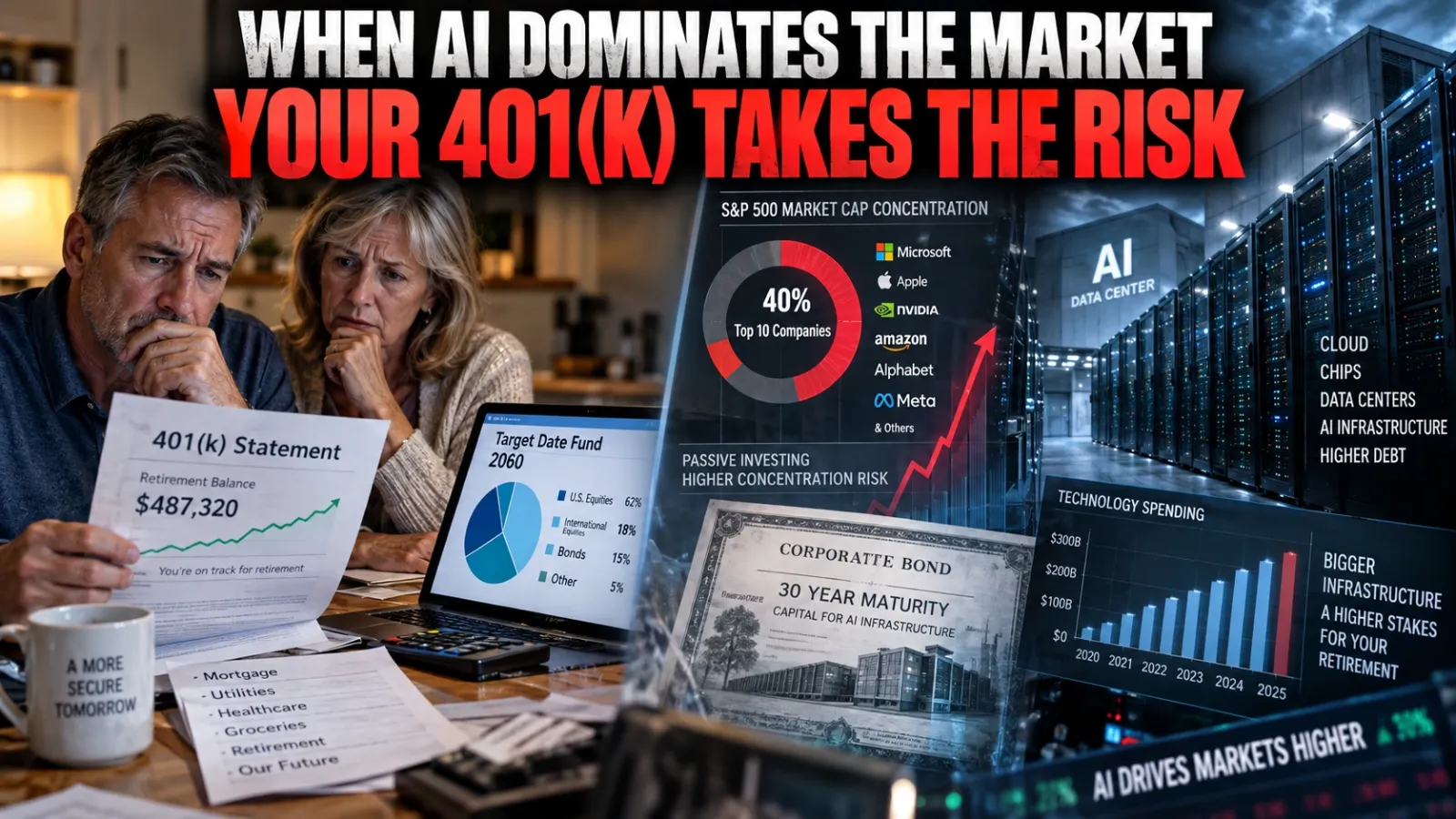
Today, buying the broader equity market means buying a massive, highly concentrated stake in technology and artificial intelligence. The ten largest companies in the S&P 500 now account for roughly 40 percent of the index’s total market capitalization. This represents a severe escalation of concentration risk, significantly dwarfing the 25 percent concentration peak observed during the height of the 1999 dot-com bubble. For an ordinary worker holding a supposedly diversified index fund, nearly half of their stock portfolio is now tethered directly to the fortunes of the “Magnificent Seven” and their capital-intensive ambitions.
Comparisons between the current artificial intelligence boom and the dot-com bubble of the late 1990s are increasingly common among economists. Apollo Global Management’s chief economist, Torsten Slok, argues that the current equity bubble has already surpassed the technology mania of the previous generation in its market dominance. In 1999, only five of the ten largest companies in the S&P 500 were technology firms, sharing the top tier with diversified titans like General Electric, Walmart, and Exxon. Today, the combined market capitalization of the top ten tech-adjacent firms is almost $22 trillion, reflecting an unprecedented centralization of economic power.
Some market optimists argue that current valuations are entirely justified by genuine technological breakthroughs and dominant market shares. They note that the Nasdaq 100 is trading at a trailing price-to-earnings ratio of about 34, which is not nearly as extreme as the absurd triple-digit multiples seen in early 2000. Furthermore, the initial public offering market has not seen the same reckless, speculative frenzy of unprofitable dot-com startups going public simply to cash in on retail hype. However, this optimistic defense ignores the sheer volume of nominal capital at risk and the rigid, unforgiving mechanics of modern passive investing.
At the end of 2025, 52 percent of all long-term mutual fund and ETF assets were permanently parked in passive index funds, a structural reality that did not exist twenty years ago. Unlike the dot-com era, where individual day traders actively gambled on speculative internet stocks, the current bubble is structurally underwritten by automatic, bi-weekly payroll deductions. Under a quantitative risk framework, this high concentration means that any localized shock to the technology sector will immediately dictate the performance of the entire S&P 500. For the 76 million United States households that own mutual funds or ETFs, genuine diversification has quietly eroded from their retirement portfolios.
The $600 Billion Revenue Void
The fundamental threat to this passive retirement strategy is the rapidly widening gap between the capital being spent on infrastructure and the actual money the technology makes. Sequoia Capital analyst David Cahn recently updated his industry analysis to highlight what he describes as the “$600 billion question” facing the global economy. The firm’s research reveals an alarming $500 billion annual shortfall between the massive investments poured into data centers and the tangible revenues generated by software applications. While the post-pandemic supply shortage of crucial computing chips has ended, technology companies continue to aggressively stockpile hardware without a clear, immediate path to commercial profitability.
The financial mechanics of the industry’s leading private firms illustrate the sheer, unsustainable scale of this exuberance. OpenAI, the creator of ChatGPT, closed a colossal $122 billion funding round in March 2026, achieving a staggering $852 billion post-money valuation. Despite carrying a price tag nearing a trillion dollars, the company operates at a profound deficit, losing an estimated $1.22 for every single dollar it earns. In 2025 alone, OpenAI generated roughly $13.07 billion in revenue but burned through $34 billion in expenses to sustain its rapid infrastructure expansion.
Independent financial analysts have begun drawing stark comparisons between this operating model and previous corporate disasters. OpenAI’s current operating loss-to-revenue ratio sits at an estimated 160 percent, a figure that is remarkably worse than the 105 percent ratio WeWork carried before its spectacular collapse. Despite these glaring profitability issues, the startup has committed an estimated $1.15 trillion to infrastructure spending through 2035. These astronomical commitments require flawless execution and sustained pricing power, assumptions that are severely challenged as large language models increasingly commoditize into low-margin digital utilities.
This web of immense financial commitments functions as a circular money machine that artificially inflates the public stock market. Venture capital and corporate investments injected into startups are immediately recycled back into the tech ecosystem to purchase proprietary cloud computing services and silicon chips from their own investors. For instance, when OpenAI pays Microsoft for cloud services using Microsoft’s own investment money, Microsoft books it as cloud revenue growth. Main Street retirement accounts then passively purchase these inflated Microsoft index shares at peak valuations, unwittingly providing the exit liquidity for this elaborate corporate shell game.
The Corruption of the Fixed-Income Buffer
For generations, financial planners have relied on a foundational portfolio principle: when volatile stocks crash, high-quality bonds provide a protective, uncorrelated buffer. Target-date funds structurally depend on this exact dynamic, seamlessly shifting older workers’ money from equities into fixed-income assets to preserve their capital as retirement approaches. However, the unprecedented capital requirements of the digital buildout are fundamentally altering the composition of the corporate bond market. Concentration risk, traditionally an equity market phenomenon, has rapidly and quietly migrated into the very asset class that conservative investors hold specifically for diversification.
Technology companies have historically accounted for a relatively modest, stable slice of the investment-grade corporate bond index. That dynamic shattered entirely as hyperscalers—such as Alphabet, Amazon, Meta, Microsoft, and Oracle—radically increased their borrowing to fund the construction of massive domestic data centers. Between 2020 and 2024, these corporate giants issued an average of $35 billion in debt annually, but by 2025, that figure skyrocketed to $93 billion. Leading industry forecasts suggest that total related debt issuance across the broader hardware and utility ecosystem will swell to between $300 billion and $570 billion for the full year of 2026.
This deluge of technology-sector borrowing is subtly poisoning the defensive characteristics of broad bond index funds held in retirement accounts. The new debt issued by hyperscalers is heavily long-dated, often featuring 30-year maturity terms that extend the overall duration of the corporate bond index. By extending this duration, these massive corporate issuances subtly increase the interest rate sensitivity of the passive portfolios that track them, introducing new, unwanted volatility. Furthermore, a substantial share of secondary data-center financing is being arranged through opaque private credit channels, meaning public balance sheets no longer capture the true, leveraged risk of the buildout.
The most alarming consequence of this shift is the dual-threat it poses to the traditional retirement portfolio structure. The new corporate bonds being added to these conservative indices represent a financial claim on the exact same investment cycle that is driving equity returns. If the underlying economics of the infrastructure buildout disappoint investors, wider credit spreads on tech-linked bonds could occur simultaneously alongside plunging stock prices. This synchronized collapse would entirely neutralize the diversification expected by older retirees, devastating both the aggressive and conservative sleeves of their savings at the worst possible moment.
The Human Toll and Main Street Realities
While Wall Street celebrates historic index highs fueled by tech enthusiasm, the financial reality for the individual American worker remains deeply precarious. Vanguard’s extensive 2026 data notes that the average 401(k) balance sits at a seemingly healthy $167,970, but this figure is severely skewed by a small percentage of ultra-wealthy, long-tenured savers. The median balance—a much more accurate reflection of the typical household’s reality—is just $44,115 across the national participant base. A sudden, systemic contraction in the technology sector would utterly devastate these already modest safety nets, pushing millions into financial jeopardy.
To understand the true vulnerability of the modern workforce, one must examine the savings of those who are rapidly approaching retirement age. Older workers simply do not possess the decades of future earning potential required to wait out and recover from a massive, structural market drawdown.
| Age Bracket | Average 401(k) Balance | Median 401(k) Balance |
|---|---|---|
| Under 25 | $7,259 | $2,234 |
| 25–34 | $50,261 | $18,732 |
| 35–44 | $120,742 | $46,919 |
| 45–54 | $214,991 | $78,730 |
| 55–64 | $305,006 | $107,269 |
| 65+ | $330,186 | $103,202 |
(Data reflects year-end 2025 balances across the Vanguard recordkeeping universe.)
For a worker aged 55 to 64, a median balance of $107,269 is meant to help sustain them through potentially two decades of retirement living. Under traditional target-date fund mechanics, roughly half of that critical capital remains fully exposed to the stock market. Because the broader equities market is functionally propped up by a handful of tech giants, a market collapse could instantly vaporize a quarter of this near-retiree’s total liquid wealth. Consequently, millions of older Americans are unknowingly carrying extreme speculative risk into the most fragile financial chapter of their lives.
Severe signs of acute economic distress are already appearing among the workforce, forcing many to cannibalize their futures just to survive the present. In 2025, a record 6 percent of Vanguard participants took hardship withdrawals from their retirement accounts, marking the fourth consecutive year of rising emergency cash-outs. Of those forced to withdraw funds, 36 percent did so to avoid eviction or home foreclosure, while 31 percent desperately needed the money to cover unexpected medical expenses. These financially strained workers are forced to liquidate their holdings, while those who can afford to leave their money untouched continue passively feeding the tech bubble through automated contributions.
Systemic Fragility and Asymmetric Understanding
Beyond the simple mechanics of valuation and index concentration, artificial intelligence is introducing entirely novel vectors of systemic risk to global financial stability. The National Bureau of Economic Research (NBER) dedicated its spring 2026 conference to exploring the profound frictions and fragilities emerging in modernized financial markets. A central theme among researchers is that algorithmic trading has the potential to disrupt institutional trust in a fundamental and qualitatively new way. As asset managers increasingly delegate trading and risk assessment to complex neural networks, the foundational understanding of market behavior is shifting away from human operators.
Economist Markus Brunnermeier has termed this phenomenon “asymmetric understanding,” a dangerous evolution of the classic asymmetric information problem. In traditional markets, one party might possess hidden information, but both parties share a fundamental human understanding of causal economic links. However, when financial institutions rely on autonomous agents that utilize non-explainable logic, these systems hold a radically different, alien representation of the world. Humans cannot properly verify the objectives of these algorithms, meaning that catastrophic misalignments in trading strategies become undetectable until a crisis is already underway.
This opacity is particularly terrifying when paired with the massive, unthinking momentum of passive index funds. Researchers warn of “hidden risk,” where investors and regulators cannot observe or comprehend the true exposures taken by their asset managers. If an unexpected market shock occurs, highly capable algorithmic agents could execute rapid, correlated sell-offs across the financial system based on variables humans cannot decipher. In a market where 40 percent of the S&P 500 is concentrated in a few tech firms, an algorithmic panic could overwhelm traditional circuit breakers, transforming a sector correction into a full-scale systemic meltdown.
The Fiduciary Minefield and ERISA Lawsuits
The escalating concentration of risk in standard retirement accounts is beginning to draw intense legal and regulatory scrutiny from across the industry. Under the Employee Retirement Income Security Act (ERISA), plan sponsors and employers carry a strict fiduciary duty of prudence to protect their participants’ assets. This legal standard dictates that all investment menu decisions must reflect the care, skill, and diligence of a prudent expert acting solely in the interest of the workers. With the market currently heavily distorted by speculation, defaulting employees into index funds deeply exposed to a single economic theme could invite massive liability if the bubble inevitably bursts.
The legal landscape is already turning highly adversarial for employers attempting to manage defined contribution plans in this environment. In 2025 alone, 155 ERISA fiduciary class action lawsuits were filed in federal courts, nearing a historical record for the industry. Excessive-fee allegations leaped 64 percent in a single year, while complex claims regarding imprudent investment selection continued their steady, relentless climb. As the gap between the behavior of the real economy and the tech-heavy stock market widens, plaintiffs’ attorneys are closely monitoring how 401(k) fiduciaries handle this unprecedented concentration risk.
Further complicating this legal minefield, federal regulators are simultaneously attempting to expand the menu of high-risk investments available to ordinary workers. In March 2026, the Department of Labor proposed a landmark rule offering process-based safe harbors for fiduciaries evaluating alternative investments, including private equity and crypto assets. This proposal was pitched as a populist effort to democratize access to the lucrative alternative assets historically reserved for institutional wealth. However, the inclusion of these assets introduces profound liquidity and valuation complexities that clash directly with the mechanical requirements of standard 401(k) plans.
Private equity funds, for example, typically lock up investor capital for seven to twelve years, fundamentally conflicting with the ERISA safe harbor provision requiring quarterly liquidity for plan participants. To circumvent this, the industry plans to embed these illiquid assets inside the broader strategic allocation of target-date funds, masking the liquidity mismatch. Rather than responsibly diversifying away from the public tech bubble, the introduction of private credit and equity may only expose older workers to newer, highly opaque vectors of financial risk. Ultimately, plan fiduciaries find themselves trapped between the liability of maintaining highly concentrated public equity menus and the operational nightmares of integrating volatile private alternatives.
What Happens Next
The technology industry is rapidly approaching a painful reckoning where its astronomical capital expenditures must be justified by equivalent, real-world profits. Historically, technological revolutions often result in what macroeconomists categorize as a “productive bubble”. During the late 1990s, telecommunications companies laid millions of miles of fiber-optic cable in a speculative frenzy, ultimately going bankrupt while simultaneously gifting society the cheap infrastructure required for the modern internet. The current market may follow the exact same historical trajectory, meaning society will eventually benefit from an oversupply of cheap computing power, but the financial vehicles that funded it will be thoroughly decimated.
For the millions of workers holding these passive portfolios, this impending transition phase represents a period of extreme financial peril. If technology revenues stall and the $500 billion annual infrastructure gap is not swiftly bridged, corporate credit spreads will widen dramatically. This event would trigger a simultaneous, catastrophic sell-off in both the stock and bond allocations of the retirement funds millions rely upon. At that exact moment, the structural flaws of modern 401(k) design will be fully and tragically exposed to the American public.
In the political and economic aftermath, regulators and plan sponsors will face immense pressure to fundamentally redesign the American retirement apparatus. Fiduciaries may be forced to abandon blind market-capitalization weighting entirely in favor of strict concentration limits, ensuring that a single industrial theme can never again capture half of a worker’s portfolio. The Department of Labor and the Securities and Exchange Commission will likely implement aggressive stress-testing requirements for target-date funds to prevent a repeat of this synchronized asset failure. Until those systemic guardrails are eventually erected, ordinary workers remain captive passengers on Silicon Valley’s most expensive ride, risking their golden years on a technological promise that has yet to pay its own bills.
Source List
Sources (101)
- mordorintelligence.com — Asset management market
- whitehouse.gov — 2026 Economic Report of the President
- deloitte.com — Investment management industry outlook 2025
- corporate.vanguard.com — Ai buildout comes to bond market
- ici.org — Sec rules committee complete meeting materials 0926
- invesco.com — Why investing matters and what makes it work
- icimutual.com — FINAL Claims Trends 2026
- rationalreminder.ca
- dechert.com — Investment Lawyer Will Trump Admin Reorder 401k Plan Alternatives
- goldmansachs.com — The sp 500 expected to rally 12 this year
- spglobal.com — In the shadows of giants
- venquestgroup.com — Sp500 concentration risk two speed market
- blackrock.com — Fine tuning megacaps build etfs
- capitalgroup.com — Four charts that expose market concentration risk
- spglobal.com — Sp 500 information technology sector top 10 equal capped index
- kiplinger.com — The ai bubble may burst ways retirees can protect their portfolios
- walletgrower.com — Best target date funds
- carry.com — Most popular investment types in 401k and retirement accounts
- investor.vanguard.com — Target retirement funds
- retirementplans.vanguard.com
- fidelity.com — Freedom funds
- fundresearch.fidelity.com — 92202E409
- fundresearch.fidelity.com — 92202E839
- fundresearch.fidelity.com — 92202E888
- corporate.vanguard.com — How america saves report 2025
- morningstar.com — Target date funds continue their rapid rise
- researchgate.net — 411189772 The AI Investment Cycle Investment Ahead of Revenue The AI Buildout as
- apolloacademy.com — Extreme concentration in the sp 500 3
- apollo.com — Daily spark
- tradu.com — Ais stock market boom bullish breakthrough or bubble in the making
- businesstimes.com.sg — Todays ai boom bigger dotcom bubble
- newindianexpress.com — Gold rush ai bubble roaches and scent of fear
- edwardconard.com — Torsten slok apolloglobal notes the 10 largest stocks in the sp 500 make up 35 o
- medium.com — The 1 3 trillion house of cards 4d5ad539c120
- marketwise.com — Five reasons the ai boom isnt in dot com bubble territory yet
- prototypr.io — Ai 600b question
- devnotesdaily.com — Eclipse foundations new theia ide
- tomtunguz.com — Nvidia nortel vendor financing comparison
- sequoiacap.com — Ais 600b question
- horse.energy — Openai wework analysis
- forum.valuepickr.com
- semiwiki.com — Ai%E2%80%99s 600b question.21960
- scribd.com — Ai %E6%B3%A1%E6%B2%AB%E7%A0%94%E6%8A%A5
- modwm.com — How much should i have in my 401k
- randallwealthgroup.com — Average 401k balance by age
- mployeradvisor.com — Erisa litigation is rising every benefits decision maker should understand why
- legal500.com — 2026 erisa litigation developments
- angelinvestorsnetwork.com — Erisa alternative investments 401k dols 2026 rule explained
- lebelharriman.com — A primer on effective 401k investment menu design
- quinnemanuel.com — Client alert private credit under stress emerging litigation risks
- rockco.com — Private investments in defined contribution plans
- 401ktv.com — Target date funds are the default choice but they cant be a default decision
- milliman.com — 401k plans crypto private equity alternative assets
- sec.gov — Uyeda remarks diversification deficit opening 401ks private markets 112025
- valueaddvc.com — Openai at 852b how the worlds most valuable ai company is being priced
- techstackipo.com — Openai
- valueaddvc.com — Openai valuation 2026 852 billion after the 122b raise
- techmarketbriefs.com — Openai
- useluminix.com — Openai financial fact sheet june 2026
- sacra.com — Openai
- rovenin.com — Openai ipo research the 300 billion argument
- taskade.com — Openai chatgpt history
- longtermwiki.com — Openai
- retirementplans.vanguard.com — PubFundChart
- markets.businessinsider.com — Vanguard target retirement 2030 fund us92202e8883
- investor.vanguard.com — Vthrx
- workplace.vanguard.com — FS695
- morningstar.com — Portfolio
- my.voya.com
- advisors.vanguard.com — Vanguard target retirement 2030 fund
- vanguard.com — Tcsfunds
- nber.org — Financial frictions and systemic risk
- nber.org — Financial market frictions and systemic risks spring 2026
- blog.ssrn.com — Home
- morningstar.com — Vanguard target date retirement series
- morningstar.com — Morningstars guide target date investing
- morningstar.com — Vanguard target date fund investors bought sold themselves an extra 23 billion
- workplace.vanguard.com — Investors winning as a behavior gap shrinks
- dataporium.tech — Target date funds explained what is inside fees and how they shift with age in 2
- accelerateretirement.com — Retirement times september 2026
- novawealthmanagement.com — Millennial retirement savings
- boldin.com — Average 401k balance by age
- workplace.vanguard.com — Previewing how america saves 2026
- workplace.vanguard.com — HowAmericaSaves2026
- workplace.vanguard.com — How america saves 2026
- thewealthadvisor.com — Vanguards latest retirement savings data
- workplace.vanguard.com — How target date funds support retirement income
- researchgate.net — 404397264 The Concentration Conundrum What the SP 500 Transformation Means for P
- bde.es — Dt2615e
- morganstanley.com — Article whoisontheotherside
- mdpi.com
- thierry-roncalli.com
- ecgi.global — Asset manager capture
- ecgi.global — Law 898 2026 private equity for all the paradoxical push to democratize p 0 0
- everycrsreport.com — R48512
- kansascityfed.org — Brunnermeier
- academic.oup.com
- yourerisawatch.com — Your erisa watch week of september 9 2026
- millerjohnson.com — 12 ELS 2026 PPT Benefits
- statestreet.com — 2025 annual report
- cardozolawreview.com — Executive order 14330 a solution in search of a problem




Leave a Reply