
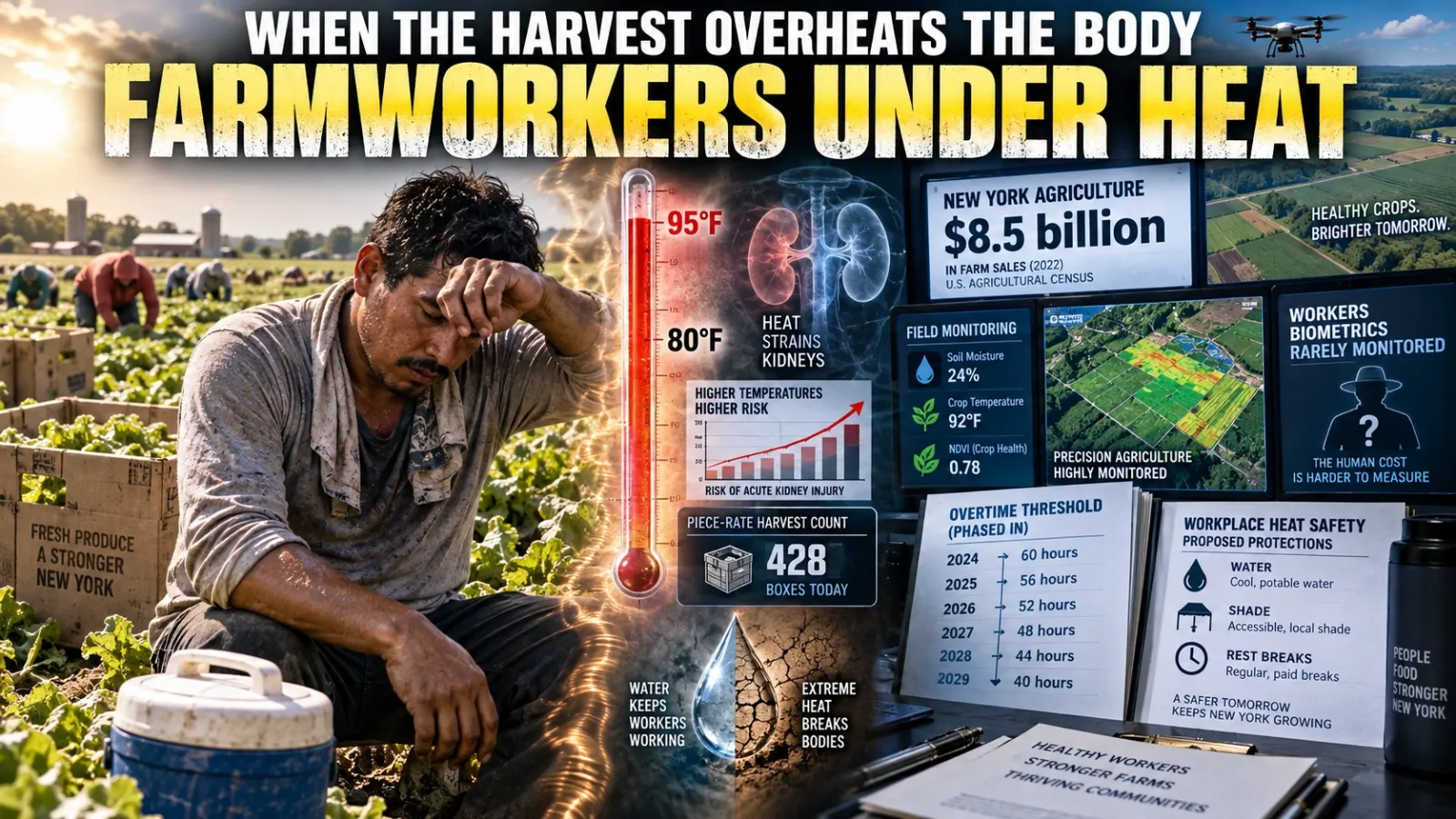
The Biological Toll of the Harvest
The human body is equipped with a highly efficient natural cooling system, but extreme occupational heat fundamentally short-circuits these physiological defenses. When physical exertion is combined with high ambient temperatures, the body attempts to dissipate heat by increasing blood flow to the skin and producing sweat. However, when external temperatures and humidity climb too high, sweat no longer evaporates efficiently, causing the internal core temperature to rise to dangerous levels. This cascading failure leads to heat exhaustion—characterized by dizziness, nausea, and heavy sweating—and can quickly escalate to heat stroke, a life-threatening condition marked by central nervous system dysfunction, confusion, and unconsciousness.
For farmworkers, the acute danger of a sudden collapse is only a fraction of the physiological threat. Emerging occupational health research has established a direct, terrifying link between prolonged agricultural heat exposure and severe renal destruction. When laborers sweat profusely without adequate hydration or rest, their blood becomes concentrated, forcing the kidneys to filter viscous fluids. Simultaneously, the organs are deprived of oxygen-rich blood, which the body has desperately diverted to the skin for cooling.
Clinical studies tracking agricultural workers in high-heat environments have revealed alarming rates of organ damage. Researchers have found that up to 43 percent of certain agricultural workers exhibit clinical signs of Acute Kidney Injury (AKI) after just a single shift in the fields. In one clinical cohort in Florida, researchers discovered that each five-degree Fahrenheit increase in the heat index was associated with a 47 percent higher risk of a worker developing AKI. Another study found that 14.9 percent of monitored farmworkers demonstrated evidence of AKI after one day of agricultural work, with the odds nearly doubling for those engaged in heavy workloads.
This repeated, daily trauma to the kidneys does not simply heal overnight. Medical researchers warn that recurrent episodes of AKI represent a direct pathway to Chronic Kidney Disease of unknown etiology (CKDu), a fatal, irreversible epidemic sweeping through agricultural communities globally. The damage is silent, cumulative, and deeply tied to the specific mechanics of farm labor. Despite this overwhelming clinical evidence, routine biological monitoring for heat strain or kidney function remains virtually nonexistent on American farms.
The occupational hazards of the field extend well beyond physical organ failure, quietly eroding the psychological well-being of the workforce. A July 2024 pilot study of farmworkers in Florida revealed that 21 percent suffered from moderate-to-severe anxiety, while 25 percent exhibited moderate-to-severe depression. Furthermore, 34 percent of the surveyed workers reported experiencing significant climate change psychological distress, figures that vastly exceed national benchmarks for U.S. adults. The workforce is being systematically driven to the point of physical and mental exhaustion to maintain the continuous output required by modern agricultural supply chains.
The Piece-Rate Trap and the Economics of Exhaustion
The physical destruction of the agricultural workforce is not merely an unfortunate byproduct of the weather; it is an active outcome of the industry’s economic incentive structures. Central to this dynamic is the piece-rate compensation system, which pays laborers based on the sheer volume of crops they harvest rather than the number of hours they work. While proponents argue this allows highly skilled workers to maximize their earnings, occupational health experts recognize piece-rate pay as a fundamental driver of heat-related mortality. By explicitly linking financial survival to uninterrupted physical exertion, the piece-rate system weaponizes a worker’s own economic desperation against their biological need for rest.
Studies have shown that workers compensated by volume are heavily incentivized to skip critical water breaks, ignore the early warning signs of heat exhaustion, and push their bodies beyond safe metabolic limits. The clinical data supporting this behavioral shift is stark. Research indicates that piece-rate workers face three to four times the odds of developing acute kidney injury compared to their hourly-paid counterparts. When a worker’s ability to feed their family requires ignoring their own physical collapse, taking a ten-minute break in the shade becomes an unaffordable luxury.
This localized exploitation feeds into a massively profitable agricultural macroeconomy. According to the United States Department of Agriculture’s 2022 Census of Agriculture, New York farms alone generated $8.5 billion in gross sales. Yet, while the industry consolidates, corporate farms are aggressively squeezing their labor overhead as overall production expenses rise.
| Metric | 2017 USDA Census | 2022 USDA Census | Percentage Change |
|---|---|---|---|
| Total Farms in New York | 33,438 | 30,650 | -8.3% |
| Total Acres in Production | 6,866,171 | 6,502,286 | -5.3% |
| Average Farm Size (Acres) | 205 | 212 | +3.4% |
| Total Farm Sales (NY) | $5.3 Billion (approx) | $8.5 Billion | +60.3% |
As illustrated by the data, farm sizes and overall sales are increasing even as the total number of farms shrinks, pointing toward rapid industry consolidation. Concurrently, the New York Farm Bureau noted that labor costs represented the biggest increase in production expenses, jumping 41 percent over the five-year census period. To combat these rising costs, farm management increasingly relies on the hyper-efficiency demanded by the piece-rate system.
In New York State, these economic pressures have been intensified by recent legislative changes to agricultural overtime pay. Under the Farm Laborers Fair Labor Practices Act (FLFLPA), New York farmworkers became entitled to overtime pay, with the threshold gradually reducing from 60 hours in 2020 down toward a standard 40-hour workweek.
| Effective Date | Overtime Threshold (Hours per Week) |
|---|---|
| January 1, 2020 | 60 hours |
| January 1, 2024 | 56 hours |
| January 1, 2028 | 48 hours |
| January 1, 2032 | 40 hours |
While intended to protect workers, the shrinking overtime threshold has paradoxically incentivized some employers to demand higher output during regular hours to offset premium pay. The result is a hyper-accelerated work environment where human endurance is stretched to the breaking point to preserve corporate margins. Rather than absorbing the costs or adjusting harvest timelines, the industry largely passes the physical deficit onto the laborers in the fields.
AgTech’s Blind Spot: Monitored Crops, Unmonitored Humans
The agricultural industry’s refusal to protect its workforce from extreme heat stands in stark, unsettling contrast to its massive investments in precision technology. Modern corporate farms are increasingly managed by “precision agriculture,” an ecosystem of smart sensors, drones, and artificial intelligence designed to optimize every facet of crop production. Connected Internet of Things (IoT) devices continuously monitor soil moisture, leaf temperature, and nutrient levels, sending automated alerts to farm managers the second a plant experiences mild water stress.
Through algorithms and real-time data, agribusinesses can deploy targeted irrigation and climate interventions to ensure their fruit and vegetables never suffer the degrading effects of the heat. Advanced systems utilize satellite imagery to calculate the Normalized Difference Vegetation Index (NDVI), predicting crop performance in relation to climatic variables. Yet, the human beings hand-harvesting these meticulously monitored crops are afforded no such technological oversight. There are no wearable sensors alerting a supervisor when a worker’s core body temperature crosses a lethal threshold, nor are there automated algorithms prompting mandatory hydration breaks.
When technology is applied to the workforce, it is almost exclusively utilized to extract greater productivity rather than ensure safety. Farm management software and digital labor tracking tools are routinely deployed to monitor piece-rate production, time, and labor efficiency down to the minute. These systems provide real-time insights into exactly how fast an employee is picking apples or cutting ferns, but deliberately ignore the biological cost of that speed. The crops are treated as invaluable assets requiring micro-management, while the laborers are treated as disposable, easily replaceable machinery.
This technological dissonance highlights a fundamental moral failure within modern agribusiness. The industry possesses the capital, the infrastructure, and the technological capability to predict heat waves, monitor microclimates, and avert biological stress. It simply chooses to apply these life-saving innovations exclusively to its flora, determining that an oxidized apple is a financial loss worth preventing, but a farmworker with acute kidney injury is an acceptable externality. If the sector applied a fraction of its AgTech investments toward worker safety—such as deploying predictive analytics for heat stress or wearable core-temperature monitors—the epidemic of agricultural heat fatalities could be virtually eradicated.
Regulatory Standstill: The TEMP Act and OSHA’s Retreat
Despite the mounting death toll and clinical evidence of organ damage, efforts to mandate basic heat protections for farmworkers have been systematically paralyzed by corporate lobbying and political gridlock. In New York, progressive lawmakers have spent years attempting to pass the Temperature Extreme Mitigation Program (TEMP) Act (S03412/A03527). This legislation would legally require employers to provide potable water, access to shade, and paid preventative rest breaks when temperatures reach 80 degrees Fahrenheit, alongside imposing strict financial penalties for non-compliance.
The TEMP Act would mandate a minimum ten-minute preventative cool-down rest period every two hours when outdoor temperatures reach or exceed 95 degrees Fahrenheit. However, the bill has been fiercely opposed by the agricultural lobby, most notably the New York Farm Bureau, which has consistently characterized the proposed safety mandates as “unrealistic” and “burdensome”. In one highly controversial instance, a leaked farm industry memo opposing the TEMP Act allegedly relied on racist tropes, claiming that Caribbean and Latino immigrants would “feel very comfortable working in New York in the summertime”. Worker advocates argue this essentially weaponized workers’ ethnicities to justify denying them basic occupational health standards.
The regulatory void at the state level is compounded by a total abdication of responsibility at the federal level. For decades, there have been no federal Occupational Safety and Health Administration (OSHA) standards specifically governing heat exposure for outdoor workers. In July 2024, OSHA finally published a proposed rule in the Federal Register titled “Heat Injury and Illness Prevention in Outdoor and Indoor Work Settings”. The proposed framework sought to establish definitive, enforceable thresholds for employer interventions.
| Regulatory Standard | Initial Heat Trigger | High Heat Trigger | Key Mandated Protections | Current Status |
|---|---|---|---|---|
| OSHA Proposed Rule (Federal) | 80°F Heat Index | 90°F Heat Index | Paid 15-min breaks every 2 hours at 90°F; water and shade access. | Stalled under current administration |
| TEMP Act (New York S03412) | 80°F Temperature | 95°F Temperature | Potable water; 10-min cool-down breaks every 2 hours at 95°F. | Pending state legislative approval |
| OSHA General Duty Clause | None specified | None specified | Vague requirement to keep workplaces free from recognized hazards. | Active, but reactive and difficult to enforce |
However, under the shifting political winds of the 2026 administration, the federal rule has been indefinitely stalled. Without a specific standard, OSHA is forced to rely on its generic “General Duty Clause” to issue citations, a cumbersome legal tool that usually only comes into play after a worker has already been severely injured or killed. While OSHA increased its maximum penalty for willful or repeated violations to $165,514 in 2026, the absence of a specific heat standard makes it incredibly difficult to prove an employer willfully violated the law.
OSHA’s enforcement capabilities have been further diluted by recent administrative rollbacks. The agency’s National Emphasis Program (NEP) for heat hazards recently underwent a revision that narrowed the list of targeted industries and eliminated its prior numeric inspection goals. While OSHA retains the authority to conduct unprogrammed inspections during National Weather Service heat advisories, the rollback signals a retreat from proactive enforcement. As Worker Justice Center of New York advocate Eline Martinez noted, worker safety currently depends “on the practices of individual employers rather than clear public protections,” forcing laborers to choose between a paycheck and their physical survival.
Visa Vulnerabilities and the Fear of Retaliation
The exploitation of agricultural workers in extreme heat is deeply compounded by the structural inequities of the United States immigration system. A massive and growing portion of the agricultural workforce operates under the H-2A visa program, which permits employers to import temporary foreign laborers, predominantly from Mexico and Jamaica, for seasonal work. While the program ostensibly fills domestic labor shortages, it intrinsically binds a worker’s legal immigration status directly to a single corporate employer.
This legal tether creates an environment of profound silence and fear. If an H-2A worker complains about the lack of shade, demands a water break, or refuses to work through a dizzy spell, the employer holds the ultimate trump card: the power of deportation and the refusal to renew the worker’s contract for the following season. “You just don’t know if you’re coming back until they call you,” explained Christopher, a Jamaican H-2A worker in New York. “You could be in Jamaica, you don’t have a primary job that you can depend on, you’re depending on this job that you have now”.
The financial stakes for these workers are incredibly high. For 2026, the Department of Labor established the Adverse Effect Wage Rate (AEWR) for New York H-2A workers at $18.83 per hour, a wage that vastly exceeds typical earnings in the workers’ home countries. The desperate need to secure this income ensures that workers endure lethal heat indices without complaint, fully aware that self-advocacy equates to economic ruin. Employers leverage this desperation, knowing that a steady stream of replacement laborers is always available if a current worker physically falters.
Advocates argue that the H-2A program functions less as a mutually beneficial labor exchange and more as a captive workforce system. When laborers are imported specifically to perform grueling physical tasks under a ticking seasonal clock, their humanity is inherently subordinated to their output. The threat of non-renewal acts as an invisible whip, pushing workers to ignore the pounding in their temples and the cramping in their muscles as the afternoon sun reaches its zenith.
The Union Battleground: Wafler, Cahoon, and the UFW
In an effort to break this cycle of vulnerability, agricultural workers have begun mounting historic, grassroots unionization campaigns. Leveraging New York’s 2019 Farm Laborers Fair Labor Practices Act (FLFLPA)—which finally granted farmworkers the legal right to collectively bargain—the United Farm Workers (UFW) successfully organized laborers at major Upstate orchards. By 2023, the UFW had secured union certifications at farms utilizing predominantly Jamaican H-2A workforces, including Wafler Farms and Cahoon Farms in Wayne County.
These hard-won union drives aimed to secure vital provisions, including seniority rights, pension plans, and guaranteed hourly wage increases designed to mitigate the deadly pressures of the piece-rate system. At Cahoon Farms, management agreed to follow the union’s first contract in New York, yielding immediate improvements in workplace respect and compensation. However, the corporate resistance at other orchards has been ruthless and protracted, revealing the limits of state labor laws when employers simply refuse to comply.
The situation at Wafler Farms has become a flashpoint for the state’s agricultural labor movement. In early 2025, a state-appointed impasse arbitrator from the Public Employment Relations Board (PERB) issued a binding award (Case IA2024-003) granting the UFW’s proposals for the Wafler workforce. The award mandated a base hourly rate of $21.46 for general labor, significant increases to fresh-market apple piece rates, ten paid holidays, and employer contributions to a pension plan. Despite this legally binding order, union advocates allege that Wafler Farms has actively refused to implement the contract or pay the mandated wages.
“Without the contract, workers at Porpiglia [a related entity] will make only 16.35anhour,”statedUFWSecretary−TreasurerArmandoElenes.”That′smorethanUS5 an hour difference”. In response, the UFW filed an unfair labor practice charge with PERB, accusing the farm of failing to follow the arbitrated contract. Workers at these orchards report ongoing retaliation, intimidation, and an environment of silence where sick leave still means a day without pay. The sheer exhaustion of fighting the heat is now matched by the exhaustion of fighting for the basic legal recognition of their humanity.
A Changing Climate in Upstate New York
The agricultural narrative often portrays extreme heat as a localized problem confined to the Sun Belt or the arid fields of California. However, the climate crisis is rapidly rewriting the meteorological realities of the Northeast, transforming Upstate New York’s orchards and dairies into high-risk thermal environments. Climatologists project that New York will experience a 10 to 20 percent increase in extreme heat events and heavy rainfall in the coming decades, fundamentally shifting the region’s agricultural hardiness zones from zone 3 to zone 5.
This shift is not merely about higher peak temperatures; it is about the lethal combination of heat and suffocating humidity. Meteorologists note that even if absolute summer temperatures stabilize, surging dew points in the Northeast make the air feel exponentially hotter, preventing sweat from evaporating and plunging outdoor workers into immediate danger. Furthermore, volatile weather patterns create “gap seasons” where record-breaking heat waves strike unseasonably early in the spring or linger deep into the autumn harvest, catching workers un-acclimatized and physically unprepared.
The impacts of these climatic shifts are highly localized, creating dangerous microclimates within rural agricultural corridors. While urban heat islands receive the bulk of public health attention, vast, unshaded monoculture fields and densely packed commercial orchards trap radiant heat, creating localized temperature spikes. Heavy precipitation and flash floods frequently damage crops and delay planting, forcing farmers to compress harvesting schedules into brutally short, high-heat windows to salvage their yields.
The human cost of this shifting climate is already visible on the ground, often exposing stark inequalities in how agricultural capital is protected. Fernandez, a dairy worker and organizer in Western New York, pointed out the stark hypocrisy of farms installing industrial fans, misters, and advanced ventilation systems for their cattle to preserve milk yields, while leaving the human workers to swelter in the exact same barns. “If both the cows and the workers are important to the business,” Fernandez asked, “why not give priority to both?”.
What Happens Next
As the 2027 harvest season approaches, the standoff between agricultural laborers, corporate agribusiness, and state regulators is reaching a critical inflection point. In Albany, labor advocates and progressive lawmakers are mounting a renewed offensive to force the TEMP Act through legislative gridlock, hoping that the escalating frequency of heat-related hospitalizations will finally break the Farm Bureau’s lobbying blockade. Without state intervention, the regulatory vacuum will persist, leaving millions of outdoor workers exposed to the lethal whims of the weather.
In the fields of Upstate New York, the United Farm Workers are preparing for protracted legal warfare to force employers to honor their collective bargaining agreements and arbitrated PERB awards. The enforcement of these contracts—and the higher base wages they guarantee—will be a pivotal test case for whether organized labor can successfully dismantle the piece-rate systems that drive workers to renal failure. The outcome of these legal battles will signal to H-2A workers nationwide whether unionization offers a genuine shield against exploitation, or merely a hollow promise.
At the federal level, the fate of OSHA’s proposed heat standard remains deeply uncertain. Occupational health advocates are petitioning the agency to reinstate aggressive numeric inspection targets and bypass the political hurdles holding up the final rule. Meanwhile, the integration of precision AgTech will undoubtedly accelerate, raising moral questions about whether Silicon Valley developers will finally design affordable biometric wearables to monitor human heat strain, or if they will continue to exclusively serve the needs of the crops.
Ultimately, the trajectory of agricultural labor in the United States remains tethered to a rapidly warming planet. Unless fundamental structural changes are implemented—whether through aggressive OSHA enforcement, mandatory climatic monitoring for human workers, or comprehensive immigration reform that severs the H-2A tether—the fields will continue to function as open-air sweatshops. For workers like Adriana, who return to the orchards every dawn despite the trauma of watching their peers fall, the coming summer offers no illusions. They know that when the heat index rises, the corporate imperative for profit will always eclipse the human desperate need for shade.
Source List
Sources (51)
- nysfocus.com — New york farmworkers extreme heat protections
- frontiersin.org — Full
- pmc.ncbi.nlm.nih.gov — PMC12352266
- pmc.ncbi.nlm.nih.gov — PMC12386589
- pmc.ncbi.nlm.nih.gov — PMC10637212
- pmc.ncbi.nlm.nih.gov — PMC10841276
- stacks.cdc.gov — Cdc 84943 DS1
- pasca.unhas.ac.id
- pmc.ncbi.nlm.nih.gov — PMC8861180
- osc.ny.gov — Profile of agriculture in nys
- nyfb.org — New york farm bureau statement 2022 usda agriculture census
- nass.usda.gov — New York
- esmis.nal.usda.gov — Fnlo0225
- agriculture.ny.gov — Farm employer overtime credit advance
- xecutethevision.com — New york overtime laws
- employerpass.com — New york overtime law
- choicesmagazine.org — Potential impacts of overtime laws for us crop workers
- plantvoice.farm — App precision agriculture
- hexagon.com — Agriculture
- smartertechnologies.com — Precision agriculture iot
- climate-adapt.eea.europa.eu — Precision agriculture
- touchmemory.com — Search
- nationalgeographic.com — Excessive heat wearable technology
- billtrack50.com
- nysenate.gov — A
- documentedny.com — Temp act immigrant labor
- perryweather.com — Osha heat safety rules
- federalregister.gov — Heat injury and illness prevention in outdoor and indoor work settings
- osha.gov — Standards
- progressivesafetyservices.com — Staying safe in the heat understanding heat exhaustion and oshas evolving regula
- environmentalsafetyupdate.com — New york city executive order signals forthcoming heat illness requirements for
- osha.gov — Penalties
- osha.gov — 2025 annual adjustments osha civil penalties
- bdlaw.com — Osha refines heat enforcement strategy while federal heat rule remains pending
- freshfruitportal.com — Osha heat
- nysfocus.com — H2a visa farm worker new york wafler farms
- theguardian.com — New york farm workers ufw unions
- rochesterbeacon.com — Ufw pushes for farms to honor union contracts
- nysfocus.com — New york farmworker union rights
- flag.dol.gov — Adverse effect wage rates
- perb.ny.gov — Ia2024 003 award 6 26 25
- rochesterbeacon.com — United farm workers secures first contract in new york
- jamaica-gleaner.com — Higher wages lower pay
- thechiefleader.com — Workers at upstate apple farm frustrated by owner s refusal to abide by contract
- reddit.com — 2050 climate projections for inland new york
- nysclimateimpacts.org — Agriculture summary
- tughilltomorrowlandtrust.org — Impact
- surface.syr.edu — Viewcontent.cgi
- climatesmartfarming.org — Changing climate
- pmc.ncbi.nlm.nih.gov — PMC11668509
- labornotes.org — Heat and smoke workers fight negligent bosses


Leave a Reply