
The Vanguard on Willamette Street
When the partners at the South Eugene Starbucks on Willamette Street voted unanimously to join Workers United in April 2022, they became a beacon for the labor movement in the Pacific Northwest. They acted as the vanguard, inspiring a wave of unionization that eventually encompassed seven of the eight Starbucks locations in the Eugene-Springfield market. The baristas believed that a collective voice would finally force corporate leadership to address chronic understaffing, safety concerns, and stagnant wages that had eroded their working conditions. Within months, their organizing efforts sparked a chain reaction of labor militancy across the state.
However, the euphoria of the historic 2022 vote quickly dissolved into a grueling, multi-year war of attrition against corporate legal teams. Formalizing a contract proved entirely elusive, as Starbucks continually delayed bargaining sessions and allegedly engaged in bad-faith negotiation tactics. In August 2022, workers at the Willamette location launched a strike in protest after two local organizers were abruptly fired by regional management. Tensions continued to escalate, prompting the Willamette Street workers to launch a prolonged strike in November 2025 over the company’s persistent failure to finalize a labor agreement.
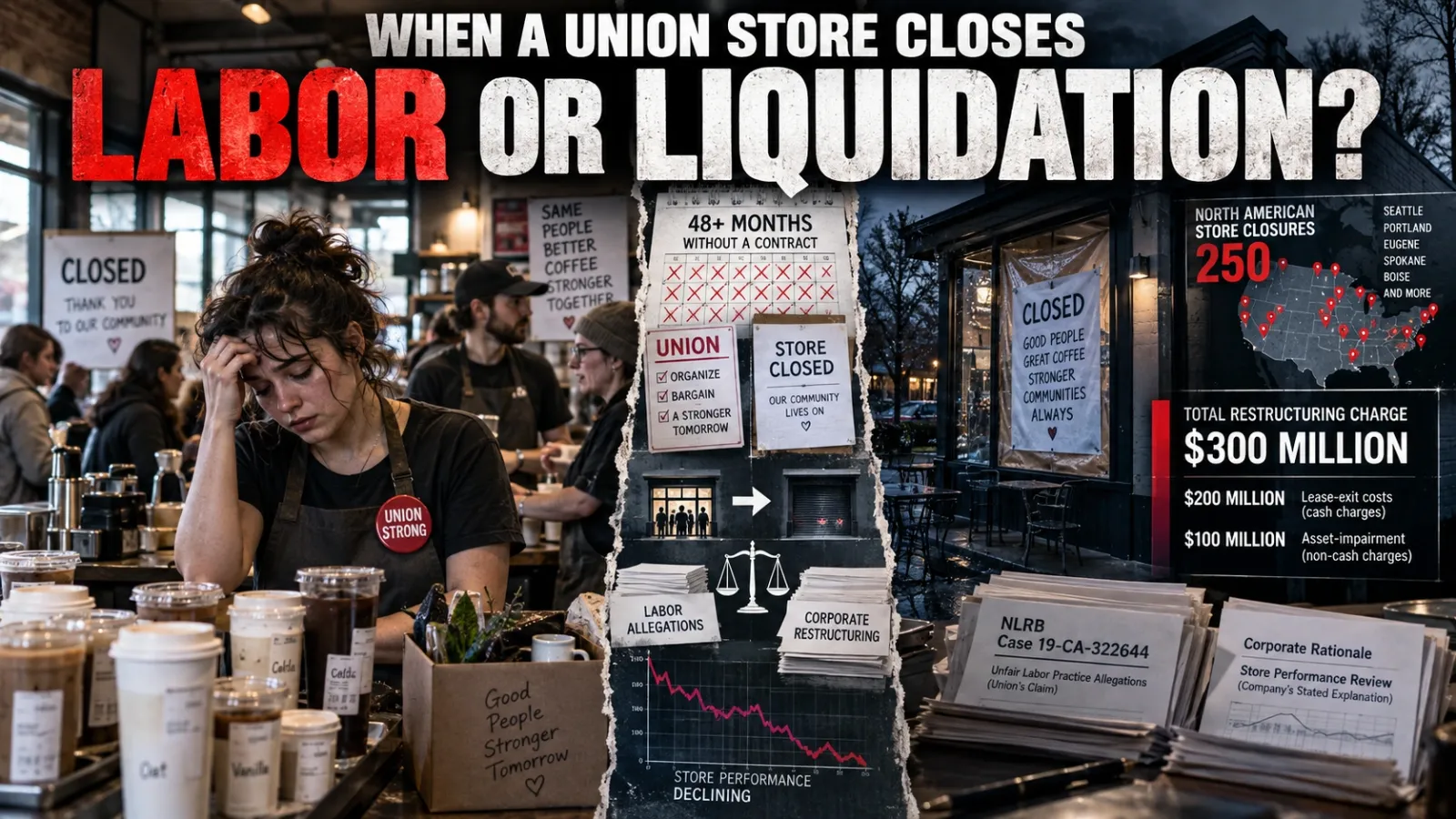
The workers remained without a contract for over 48 months, a period marked by intense legal battles. The National Labor Relations Board (NLRB) Seattle Region has been actively litigating Case 19-CA-322644 against Starbucks Corporation regarding the Willamette Street store. Union legal representative Marina Multhaup and Starbucks corporate counsel Ryan Hammond have repeatedly clashed over allegations of bad faith bargaining and unlawful changes to employment conditions. With the store now physically closed, the legal remedies available through federal labor channels may prove entirely hollow for the displaced workers.
The Logic of Liquidation
The final blow arrived this week when a Starbucks representative confirmed the Willamette Street location would permanently shutter. Corporate spokespeople maintained that the closure was not retaliatory, but rather the result of an objective evaluation of the store’s financial performance and customer experience metrics. This explanation aligns with the company’s broader “Back to Starbucks” strategy, an aggressive turnaround plan focused on optimizing the real estate portfolio. The initiative aims to upgrade 1,500 locations to better handle massive mobile-order volumes while cutting underperforming assets.
In a memo distributed to employees, Starbucks Chief Operating Officer Mike Grams articulated the corporate justification for the sweeping closures. Grams stated that the company’s progress over the past year has provided a clearer view of individual coffeehouse performance. He noted that certain locations “continue to underperform despite the hard work and commitment of all of you,” asserting that they lack a path to acceptable financial results. Management has officially framed the liquidations as an unfortunate but necessary evolution of their retail footprint.
To labor advocates, however, the willingness to burn hundreds of millions of dollars to exit leases suggests an ulterior motive driven by anti-union animus. Michelle Eisen, a representative for Starbucks Workers United and a former barista, publicly questioned the company’s financial justifications. She attributed the liquidations to “corporate greed and disorganization” while refusing to rule out targeted retaliation against recognized union hubs. Union representatives allege that closing organized stores is a calculated strategy disguised as routine corporate housekeeping.
The Restructuring Machine
The current wave of 250 North American closures is the second major retail reduction executed under the tenure of Starbucks CEO Brian Niccol, who joined the company in 2024. In September 2025, the company shuttered an astonishing 627 stores across North America and Europe, simultaneously eliminating 900 corporate and non-retail positions. That massive restructuring severely impacted the Pacific Northwest, wiping out 13 locations in Oregon alone, including stores in the Medford metropolitan area. The sheer scale of these closures highlights a fundamental shift away from the company’s historically aggressive expansion model.
To execute this week’s 250 closures, Starbucks is willingly absorbing a staggering $300 million restructuring charge. This financial hit includes $200 million in cash charges to exit real estate leases and pay employee separation benefits. It also involves $100 million in non-cash asset impairments related to the disposal of coffeehouse equipment and fixtures. Corporate leadership appears entirely comfortable taking this massive short-term financial penalty to aggressively reshape their long-term operational costs.
| Closure Wave | Implementation Date | Stores Shuttered | Estimated Restructuring Cost |
|---|---|---|---|
| First Wave | September 2025 | 627 (North America & Europe) | Over $1 Billion (Corporate-wide) |
| Second Wave | September 2026 | 250 (North America) | $300 Million |
The geographic footprint of the 2026 closure wave indicates a systematic withdrawal from specific regional markets. In addition to the Willamette Street store, Starbucks is liquidating several prominent locations across the Pacific Northwest, including stores on SE Powell Boulevard in Portland and SE McLoughlin Boulevard in Milwaukie. Other regional casualties include locations in West Linn, The Dalles, Spokane, and Redmond. Management has largely kept the comprehensive master list of closures guarded, but regional reports confirm deep cuts across both urban centers and suburban districts.
The 6,666-to-1 Disconnect
The tension between Starbucks’ corporate suite and its shop floor is fundamentally underscored by staggering economic disparities. In 2024, CEO Brian Niccol received $95.8 million in total compensation, a figure that dwarfed the earnings of the company’s frontline workforce and drew sharp political criticism. According to a report released by the AFL-CIO, Niccol made 6,666 times more than the average Starbucks barista, who took home roughly $14,674 that same year. This staggering gap represented the largest CEO-to-worker pay ratio among all companies listed in the S&P 500 index.
Although Niccol’s total compensation dropped significantly to $31.0 million in fiscal year 2025—largely due to a 68 percent decrease in stock awards—the underlying inequality remains a core driver of worker dissatisfaction. Displaced workers frequently point out that the financial resources expended on executive compensation could easily fund the wage increases demanded by the union. Starbucks Workers United has consistently claimed that the total expense of meeting the workers’ unresolved contractual demands would cost less than what the global company earns in a single typical day. This extreme wealth consolidation highlights the human cost of treating frontline labor as a highly expendable asset.
Meanwhile, Wall Street has largely insulated the corporation from the immediate fallout of its labor disputes. Despite the announcement of 250 store closures and a reduction in fiscal 2026 net new store opening guidance to roughly 440 locations, Starbucks shares dipped less than one percent. Institutional investors continue to pour capital into the company, with firms like State Street disclosing a massive $5.03 billion stake. With U.S. comparable sales growing by 7.9 percent in the third quarter of 2026, the financial markets are essentially rewarding Starbucks for its aggressive real estate and labor contraction.
The Algorithmic Sprint and Worker Burnout
Behind the espresso machines, the daily reality for these baristas has devolved into a grueling algorithmic sprint dictated by proprietary software. Organizers report that mobile applications and digital ordering systems have fundamentally industrialized the modern cafe workplace. Skeleton crews are routinely forced to process upwards of 80 to 90 transactions—amounting to 200 individual customized items—in a single 30-minute window. This relentless, tech-driven pace has entirely erased the “warmth and human connection” that Starbucks historically marketed as its core brand identity.
The psychological and physical toll of this digitized environment on the human workforce is exceptionally severe. A comprehensive 2024 academic study measuring workforce exhaustion among major corporate restaurant chains found that Starbucks workers suffered the second-highest burnout rating in the entire industry. Scoring an 81.97, the coffee giant trailed only Chipotle, which posted a staggering 97.72 burnout rating among its frontline staff. For the workers at the Willamette Street location, unionizing was not merely a political or ideological statement, but an act of basic survival against an entirely unsustainable operational model.
The pandemic acted as a major catalyst for this labor awakening, exposing the deep vulnerabilities of essential service workers. Baristas were forced to navigate face-to-face interactions during major health crises, often without adequate safety protections or hazard pay. As one Florida-based organizer noted, the pandemic revealed that workers did not have to accept the inherent exploitation of the service economy. The drive to unionize was born from a collective realization that the individuals generating the company’s record profits deserved a fundamental restructuring of their workplace rights.
The Precedent of Punishment
When Starbucks corporate leadership claims that its closures are strictly financial, labor organizers immediately point to the company’s documented legal history of retaliation. The National Labor Relations Board has previously found the coffee giant guilty of unlawfully closing unionized stores in a deliberate effort to chill labor organizing. In a landmark September 2024 ruling, NLRB Administrative Law Judge Geoffrey Carter ordered Starbucks to reopen two specific locations in Ithaca, New York. The company had permanently closed these stores in May 2023, just months after their respective workforces voted to unionize.
Judge Carter’s meticulous decision detailed how Starbucks regional leadership began secretly contemplating the permanent closure of the Ithaca Commons and Meadow Street cafes mere weeks after a successful union vote. The ruling mandated the immediate physical reopening of the stores and the reinstatement of the affected workers with back pay. Legal experts noted that the decision highlighted a clear corporate strategy of utilizing store closures as the ultimate weapon against organized labor. However, the glacial pace of federal labor litigation means that justice often arrives years after a store has been gutted and its local community permanently scattered.
The legal mechanisms available to protect workers are currently under severe threat from higher courts. Following recent Supreme Court rulings that strictly limited the NLRB’s authority to easily secure federal injunctions against employers, the labor board’s ability to halt retaliatory closures has been severely handicapped. Legal experts suggest that elevating the standard for federal injunctions gives massive leverage back to corporate legal teams. Without the credible threat of immediate court intervention, multinational corporations can freely liquidate union hubs and simply absorb the eventual legal fines as a standard cost of doing business.
Dilution and the Transfer Tactic
When a Starbucks location is liquidated, the human capital inside it is forcefully dispersed into the broader retail ecosystem. The company has publicly stated that it will attempt to transfer employees from the 250 closing stores to other nearby locations whenever possible, offering severance packages only to those who cannot be placed. However, in the context of a unionized workforce, this transfer mechanism serves a dual, potentially devastating purpose for the broader labor movement. Organizers view these transfers as a calculated method to deliberately dilute union density across regional markets.
When vocal union leaders and dedicated organizers are transferred to unorganized stores, their original, legally recognized bargaining unit is permanently dissolved. If they are placed in a non-union store, they immediately lose their collective bargaining protections and are subjected to the company’s standard at-will employment terms. Conversely, if an exhausted worker accepts a severance package, they are entirely removed from the Starbucks ecosystem, legally barred from organizing the company from the inside. This dynamic essentially forces union workers to choose between their legal rights and their immediate financial survival.
Workers United is actively combatting this dilution tactic through administrative channels. Following the September 2026 closure announcement, the union issued a formal request for information to Starbucks, demanding transparency to ensure displaced workers are placed in locations according to their personal preferences. But the organizational arithmetic is grim. In the September 2025 closure wave, the union lost 59 organized stores—roughly 10 percent of its entire national base at the time. Current estimates from union representatives indicate that at least 20 unionized locations are confirmed to be shuttered in this newest wave, representing another significant erosion of their institutional power.
The Economic Science of Stifling Labor
The aggressive containment strategy employed by Starbucks aligns perfectly with established economic theories regarding the “threat effect” of unionization. Empirical economic models demonstrate that when a highly visible employer in a local market successfully unionizes, surrounding non-union firms are frequently forced to emulate union wages. This defensive mechanism is deployed by competitors to prevent their own workers from organizing or quitting for better conditions. By successfully maintaining a union-free environment, a massive employer can effectively suppress baseline wages across the entire regional service sector.
Academic studies of the Starbucks union drive specifically highlight the danger that localized victories pose to corporate earnings management. A statistical analysis of National Labor Relations Board elections between 2017 and 2024 showed that Starbucks alone practically doubled the nation’s total unionization efforts at its peak in early 2022. The data clearly indicates that Starbucks’ corporate leadership has a massive financial incentive to break the union before a standardized first contract is ever finalized. A strong national contract would permanently alter the baseline labor costs of their entire 18,300-store North American portfolio, fundamentally threatening their profit margins.
To mitigate this existential threat, companies will often endure significant short-term financial penalties to secure long-term wage suppression. The $300 million restructuring charge taken by Starbucks this week is dwarfed by the potential cost of raising wages and benefits across their entire network. The closure of 2830 Willamette Street removes a highly visible symbol of worker power from the Eugene market. It serves as a stark warning to the remaining seven unionized stores in the city, implicitly communicating that aggressively demanding a fair contract could ultimately result in total job liquidation.
A Community Fabric Torn
The permanent closure of these cafes extends far beyond the localized loss of hourly employment; it represents the systematic dismantling of vital community spaces. For decades, Starbucks intentionally marketed itself as the quintessential “third place”—a communal environment nestled comfortably between home and work where neighborhoods could gather, study, and connect. Yet, as the company pivots aggressively toward digital fulfillment, drive-thrus, and sterile mobile-only pickup locations, it is actively destroying the communal architecture it spent billions to build.
For the workers at Willamette Street, the coffeehouse was a genuine community nexus rather than just a transaction point. They intimately knew their regular customers, memorized complicated custom orders, and relied heavily on the surrounding neighborhood for emotional and financial solidarity during their strikes. When the company casually suggested that affected customers simply visit the nearest non-union Starbucks located inside a local Albertsons grocery store, it underscored a profound corporate detachment. The suggestion fundamentally ignored the human relationships that made the Willamette location a cornerstone of the South Eugene neighborhood.
The psychological toll on the organizers and frontline workers is exceptionally profound. Baristas who risked their financial stability to stand on freezing picket lines, wearing red union shirts and weathering intimidation from regional managers, have now seen their workplace boarded up. The liquidation of their store is interpreted by many as a highly punitive measure, designed to exhaust their spirit and demonstrate the absolute, unilateral power of capital over labor. For many young workers, the closure shatters the illusion that corporate loyalty offers any protection against the demands of the shareholder class.
What happens next
The shuttering of 2830 Willamette Street and 249 other North American locations marks a critical escalation in the ongoing, multi-year labor war. In the immediate aftermath, Starbucks Workers United has launched a coordinated pressure campaign, urging sympathetic consumers to boycott the coffee giant entirely. Organizers are explicitly asking the public to shift their daily spending to local, independent coffeehouses that treat their workers fairly. The union hopes that directly hitting the company’s foot traffic and comparable sales metrics will eventually force corporate leadership back to the bargaining table to negotiate in good faith.
Simultaneously, the union’s legal apparatus is preparing a barrage of new Unfair Labor Practice charges against the corporation. Legal teams will heavily rely on the precedent set by the Ithaca closures, arguing before the NLRB that the current wave disproportionately targets organized stores and constitutes illegal retaliation under federal law. However, the federal labor apparatus moves exceptionally slowly. Any potential administrative order to reopen the Willamette Street store could take years to materialize, long after the displaced baristas have been forced to find new employment to pay their rent.
For Starbucks executives, the $300 million closure campaign is a highly calculated financial gamble. The company hopes that aggressively trimming 250 physical locations will optimize overall profitability, dilute regional union density, and appease institutional investors demanding fatter operating margins. Yet, as the American public’s approval of labor unions hovers at historic highs not seen since the 1950s, the optics of liquidating profitable stores and displacing thousands of workers to maintain a 6,666-to-1 pay ratio carries immense brand risk. The ultimate consequence of this liquidation strategy may leave a bitter cultural taste that no amount of corporate restructuring can effectively sweeten.
Sources (39)
- klcc.org — Starbucks
- facebook.com
- facebook.com
- medfordalert.com — Starbucks to close 250 locations nationwide no medford metro stores expected to
- kgw.com — 283 2e6e474d 79ba 47d8 a2b0 5e1de9b6a068
- facebook.com
- opb.org — Starbucks eugene closing union
- nlrb.gov — 19 CA 322644
- weareiowa.com — 507 cdb95ac8 c4fc 47c6 aa5f a30b6af4f3cb
- kiiitv.com — 507 cdb95ac8 c4fc 47c6 aa5f a30b6af4f3cb
- newscentermaine.com — 507 cdb95ac8 c4fc 47c6 aa5f a30b6af4f3cb
- opb.org — Business
- klcc.org — First starbucks in oregon to unionize is being shuttered
- aeaweb.org — E9bFrEZD
- emerginginvestigators.org — Pdf
- restaurantdive.com
- americanprogress.org — The fight to unionize starbucks by the numbers
- therealnews.com — Starbucks is the largest labor violator in modern history starbucks workers prep
- theguardian.com — Starbucks union strike
- truthout.org — In first starbucks workers united and its 12000 members call for boycott
- facebook.com
- cornellsun.com — Breaking nlrb orders starbucks to reopen two closed ithaca locations
- wnylabortoday.com — Index
- facebook.com
- facebook.com
- ithacavoice.s3.amazonaws.com — JDD.03 CA 317496.ALJCarter.docx
- apnews.com — Starbucks close stores coffeehouses 6be14000fc4f760d2de78af0294b7695
- newsday.com — Starbucks close stores coffeehouses a22070
- perplexity.ai — SBUX
- facebook.com
- apnews.com — Starbucks close stores layoffs 3aa70c7d3828520855998a490ebe865b
- fastcompany.com — Starbucks closing stores 2026 list shuttered locations us states
- qz.com — Starbucks closing 250 stores north america second wave 092626
- pmc.ncbi.nlm.nih.gov — PMC10878506
- rfberlin.com
- triple-c.at
- restaurantdive.com
- hrgrapevine.com — 2025 12 01 bernie sanders takes aim at starbucks ceo as barista strike widens
- rentseek.ing — SBUX


Leave a Reply