
The Hollow Promise of Full Employment
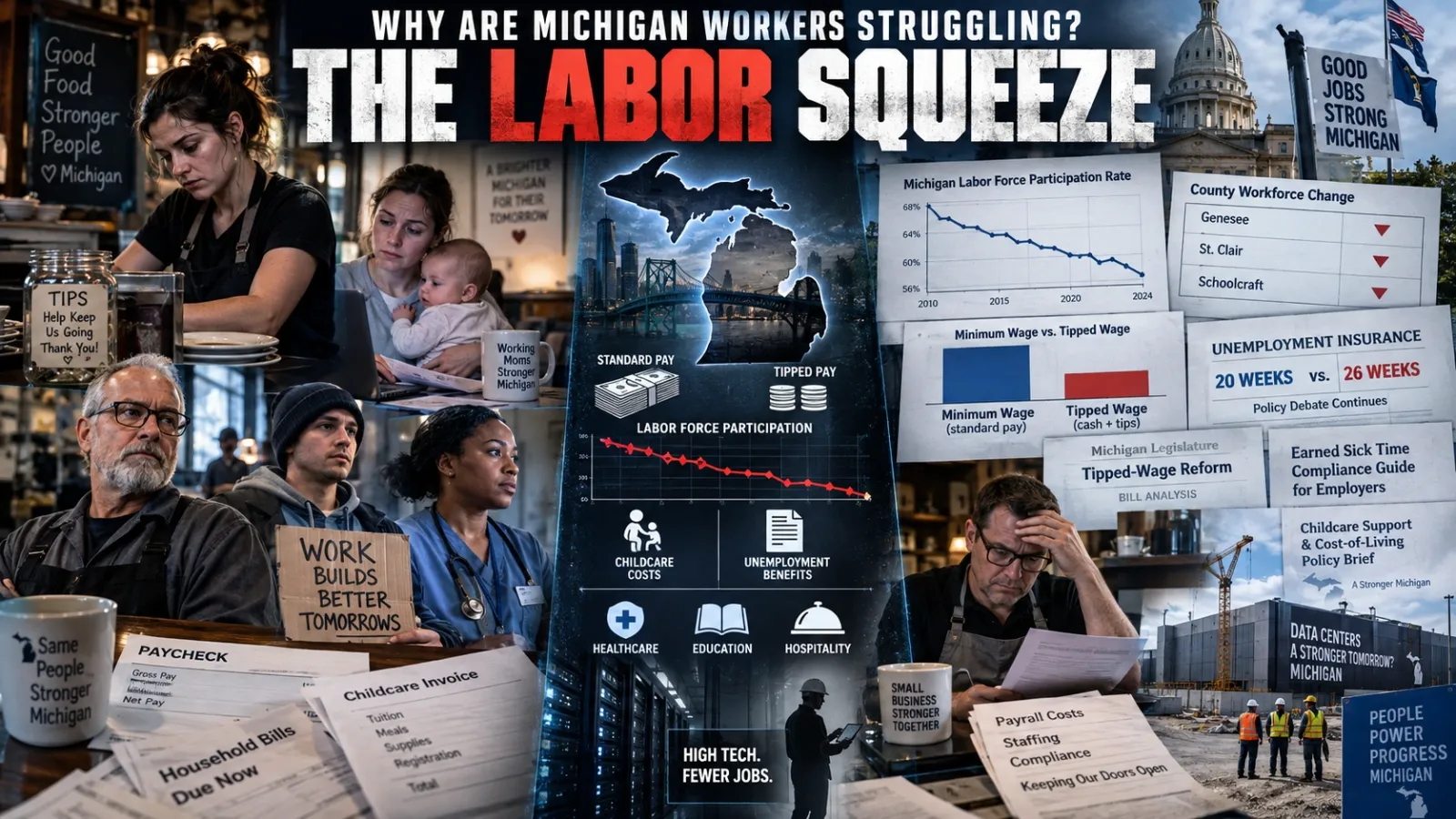
While Michigan’s top-line unemployment rate has stabilized at a seemingly healthy 5 percent, policy analysts caution that this figure masks deeper structural distress. The state’s labor force participation has dropped by 1.7 percent since the pandemic began, reflecting a workforce that is shrinking as residents age or simply give up the search for viable employment. Economists note that the state has lost more than 326,000 workers since the year 2000, fundamentally altering the region’s economic capacity and placing immense strain on local tax bases. Today, about 37 percent of state residents aged 55 and older are either employed or looking for work, an indicator of an aging labor pool increasingly forced to delay retirement.
The demographic shifts in labor market participation are particularly severe among the state’s youngest workers. In 2011, only half of Michiganders ages 16 to 24 were active in the workforce, and while that number has recently grown to 63 percent, it remains lower than any year prior to 2006. Regional disparities further complicate the picture, with several historically industrial counties experiencing massive localized labor force abandonment over the past two decades. Consequently, workforce policy analysts argue that getting more people safely and sustainably back into the labor force is the single most vital task for the state’s economic future.
| Michigan County | 2000 Labor Force | 2016 Labor Force | Net Gain / Loss | Percentage Loss |
|---|---|---|---|---|
| Genesee | 215,846 | 183,107 | -32,739 | -15% |
| St. Clair | 87,339 | 74,350 | -12,989 | -15% |
| Schoolcraft | 3,943 | 3,318 | -625 | -16% |
The High Cost of Working: Childcare and Basic Needs
For many working-age adults, the barriers to entry in the modern labor market are overwhelmingly financial and logistical. Full-time, center-based infant childcare in Michigan now costs an average of $14,064 per year, a staggering burden that pushes many parents—disproportionately mothers—out of the labor pool entirely. When the cost of going to work exceeds the potential take-home pay, families are forced into impossible decisions that ultimately stall their long-term career growth. Policy experts stress that without significant state investments in early childhood infrastructure, this talent drain will continue to constrain regional businesses.
To counter this affordability crisis, the MLPP is actively advocating for expanding the state’s Earned Income Tax Credit (EITC) into a more comprehensive “Cost-of-Living Refund”. The proposed policy would provide a $1,200 basic credit to essential economic contributors who are currently excluded from the EITC, including caregivers, full-time students, and young workers under the age of 25 without children. Advocates argue this modernization would provide a vital income boost to nearly 3.6 million Michiganders, effectively rewarding work while helping low-income families afford basic necessities like car repairs and childcare.
Furthermore, Michigan’s social safety net remains uniquely punitive compared to neighboring Midwestern states, leaving workers highly vulnerable during periods of joblessness. In 2011, Michigan became the first state in the nation to reduce the maximum number of weeks for state-funded Unemployment Insurance (UI) from 26 weeks to just 20 weeks. As the state navigates slowing job growth in 2026, labor advocates are pushing the legislature to permanently restore the 26-week maximum and extend basic unemployment protections to the growing sector of independent contractors.
Tech and AI: False Hopes for the Heartland?
As traditional manufacturing faces global headwinds, political leaders frequently point to artificial intelligence and the broader technology sector as the ultimate solution for Michigan’s economic revitalization. However, labor policy experts warn that these emerging industries are highly unlikely to provide the sheer volume of middle-class jobs required to replace the state’s legacy industrial base. “It is clear we are looking for a new industry… However, the truth is that AI, data centers and the tech industry do not seem to be the answer,” noted the MLPP in its recent labor analysis.
The primary concern is that data center construction and AI infrastructure require massive upfront capital and energy resources, but yield remarkably low long-term employment density. Once construction is complete, these sprawling high-tech facilities often require only a skeleton crew of highly specialized technicians to operate, leaving the broader blue-collar workforce behind. Consequently, experts argue that state subsidies directed at tech conglomerates might artificially inflate regional GDP numbers while doing virtually nothing to lower the localized labor underutilization rate.
Instead of chasing elusive tech miracles, labor advocates urge the state to focus on improving the quality, pay, and stability of existing essential jobs in healthcare, education, and hospitality. Forecasts from the University of Michigan’s Research Seminar in Quantitative Economics (RSQE) indicate that these service-oriented sectors will account for the vast majority of job growth through 2028. Ensuring that these foundational roles offer dignified wages and adequate benefits is viewed as a far more reliable path to economic stability than attempting to pivot the state into a Silicon Valley clone.
The Tip Credit Battle: A Decade of Legislative Whiplash
For the hospitality sector, the fight for fair compensation has been a chaotic legal and legislative rollercoaster spanning nearly a decade. In 2018, Michigan voters gathered enough signatures to place the Improved Workforce Opportunity Wage Act on the ballot, which aimed to raise the minimum wage and eliminate the subminimum wage for tipped workers. To prevent a public vote, the state legislature deployed a controversial “adopt-and-amend” strategy, passing the initiative into law only to gut its core provisions during the same legislative session. This maneuver slashed the planned wage hikes and preserved the tipped wage system, sparking intense legal battles.
In July 2024, the Michigan Supreme Court delivered a landmark ruling in Mothering Justice v. Nessel, declaring the legislature’s 2018 adopt-and-amend tactic unconstitutional. The court’s decision theoretically restored the original ballot measure, promising to gradually phase out the tip credit completely by the year 2030. For a brief moment, labor organizers celebrated what appeared to be a monumental, generation-defining victory for the state’s 163,000 tipped workers, of whom 74 percent are women.
However, the victory was severely compromised when lawmakers moved swiftly to alter the mandate before its February 2025 implementation date. Governor Gretchen Whitmer signed Senate Bill 8 into law, establishing an accelerated bump in the base minimum wage while permanently capping the tipped wage at just 50 percent of the standard minimum by 2031. For 2026, this legislative compromise leaves the tipped wage at a meager $5.49 an hour against a $13.73 standard minimum wage, equating to just 40 percent of parity.
| Effective Date | Standard Minimum Wage | Tipped Minimum Wage | Tipped Wage as % of Standard |
|---|---|---|---|
| February 21, 2025 | $12.48 | $4.74 | 38% |
| January 1, 2026 | $13.73 | $5.49 | 40% |
| January 1, 2027 | $15.00 | $6.30 | 42% |
| January 1, 2028 | $15.00 + Inflation | $6.60 + Inflation | 44% |
| January 1, 2031 | Indexed to Inflation | Indexed to Inflation | Capped at 50% |
Waitstaff and bartenders feel deeply shortchanged by a government they believed had finally heard their pleas at the ballot box. “We’re making $5.98 less per hour than the regular minimum wage, but are still required to meet regular minimum wage requirements,” noted Sarah, a bartender and mother from White Lake, Michigan. “The government told us they would take care of us. But you forgot about us”.
Disposable Labor and the Racial Wealth Divide
The economic pressures in Michigan are not distributed equally, with systemic wage disparities hitting marginalized communities the hardest. After accounting for inflation, the median hourly wage for Black Michigan residents fell by 43 cents last year, pushing the state’s racial wage gap to a severe 23.4 percent. The hospitality industry’s reliance on subminimum wages heavily exacerbates this inequality, as 21 percent of the state’s tipped workforce are people of color. Advocacy groups point out that tipped workers face poverty rates double those of the rest of the workforce, alongside the highest rates of sexual harassment in the U.S. economy.
Beyond the restaurant industry, millions of Americans find themselves trapped in precarious, non-traditional employment arrangements that lack basic financial security. A recent survey by MIT labor economist Paul Osterman concluded that U.S. employers treat nearly 57 million workers as entirely “disposable,” relying heavily on marginal workers, independent contractors, and organizational freelancers. In Michigan, these part-time jobs pay nearly 20 percent less per hour than full-time roles, and the absence of employer-sponsored health and retirement benefits widens the total compensation gap by an additional 5 percent.
In an effort to protect organizing efforts and give these vulnerable workers a stronger voice, policy experts are urging state lawmakers to ban captive audience meetings. These mandatory anti-union gatherings are frequently deployed by employers to intimidate workers during unionization drives, suppressing labor’s collective bargaining abilities under the threat of termination. Following Michigan’s historic repeal of its anti-union Right to Work laws, advocates view the banning of captive audience meetings as the essential next step in restoring workplace democracy and closing the racial wealth divide.
The View from Main Street: Small Business Survival
Business groups and conservative policy centers offer a starkly different diagnosis of the state’s labor environment, cautioning that aggressive mandates will ultimately harm the workers they intend to help. The Mackinac Center for Public Policy notes that forcing restaurants to pay a full minimum wage before tips could trigger a wave of catastrophic closures and layoffs across the hospitality sector. Industry advocates frequently point to Washington, D.C., where the elimination of the tipped wage reportedly preceded the loss of 1,600 service jobs and the closure of 73 restaurants in a single year. For many small business owners operating on razor-thin margins, additional payroll liabilities could mean raising menu prices to levels that local consumers simply cannot absorb.
Opponents of the minimum wage hikes argue that the free market is already driving up compensation without the need for heavy-handed government intervention. Average wages for the lowest quintile of earners in America increased 16 percent above inflation from 2019 to 2023, largely due to fierce competition for labor rather than state mandates. Analysts warn that artificial wage floors benefit a select group of workers in the short term but lead to destructive long-term consequences, including reduced overall compensation as employers inevitably cut shift hours to balance their books. Furthermore, the Michigan Restaurant and Lodging Association claims that tipping percentages often decrease when consumers are faced with mandatory service charges or inflated item prices.
The regulatory burden extends far beyond hourly wages, with recent changes to the state’s Earned Sick Time Act presenting massive logistical hurdles for small enterprises. Beginning in October 2025, businesses with 10 or fewer employees will be required to comply with expansive new paid sick leave mandates, joining larger employers who were forced into compliance earlier in the year. Business owners express deep frustration with the administrative complexities of tracking these accrual mandates, warning that the rigid requirements strip them of the flexibility needed to run efficient daily operations. Ultimately, industry leaders fear that Michigan is cultivating a hostile regulatory environment that will drive future economic development projects to neighboring, business-friendly states.
Budget Deadlines and the Loss of Federal Safety Nets
Complicating the push for stronger worker protections is a state government gridlocked by massive budgetary constraints and intense partisan divisions. Over the summer of 2026, the Michigan legislature notably blew past its July 1 statutory deadline to pass a budget, leaving funding for the whole of government, K-12 schools, and community colleges entirely in limbo. Lawmakers described the session as one of the least productive in Michigan history, with critical policy bills and budget items stalled behind closed-door negotiations. State Senator Darrin Camilleri noted the severe frustration this delay causes residents, as municipal districts are left guessing about how many teachers they can hire and which programs they can afford to run.
The root of this fiscal paralysis lies in the evaporation of pandemic-era federal relief funds, which had artificially inflated state budgets over the previous three years. House Speaker Joe Tate acknowledged that the current budgetary process requires a harsh correction, forcing the state to absorb the loss of federal funding while attempting to maintain basic services. This tight fiscal outlook directly limits the state’s ability to implement sweeping social programs, such as the proposed Cost-of-Living Refund or expanded childcare subsidies. Consequently, the burden of improving worker livelihoods is being shifted almost entirely onto the shoulders of private employers through regulatory mandates.
Despite the gridlock, state analysts project that Michigan will finish the 2026 fiscal year on relatively stable footing, expecting overall revenues to reach $34.37 billion. However, conservative lawmakers are demanding that these modest surpluses be utilized for permanent tax relief and infrastructure repairs rather than expanding the social safety net. This fundamental ideological clash over how to deploy state resources ensures that any legislative attempt to strengthen workers’ rights will face fierce, highly politicized opposition in the chambers.
What Happens Next
The battle over Michigan’s labor laws remains highly volatile, with progressive advocacy groups taking their fight directly to the voters ahead of the 2026 and 2028 elections. The organization One Fair Wage is currently building a formidable political coalition with the United Auto Workers to launch a ballot measure aimed at securing a $25 minimum wage for all workers by 2028. This campaign explicitly seeks to reverse the February 2025 legislative compromise, aiming to finally eradicate the subminimum wage for tipped workers entirely. Early polling indicates strong enthusiasm for the initiative, with 56 percent of likely Michigan voters—including 78 percent of Black mothers—supporting a minimum wage increase combined with a tipped wage phase-in.
Meanwhile, the state’s broader macroeconomic outlook suggests a period of stabilization, provided global trade tensions do not escalate further. The University of Michigan’s RSQE projects that statewide inflation will cool to 3.2 percent in 2026 before easing to 2.2 percent by 2028, offering some relief to cash-strapped households. Real disposable income per person is forecast to increase by a slight 0.5 percent in 2026, indicating that spending power is growing, albeit at an agonizingly slow pace. However, economists warn that new tariffs on steel and aluminum imports could eliminate roughly 600 jobs in Michigan’s critical transportation equipment manufacturing sector by the end of the year, threatening the livelihoods of blue-collar workers.
As the national debate over what constitutes a living wage continues to rage, Michigan stands as a pivotal testing ground for the future of American labor policy. The outcome of the upcoming ballot initiatives and ongoing legislative negotiations will unequivocally shape the financial realities of millions of households. Whether the state can successfully balance its desire to remain a competitive environment for businesses with its moral and economic obligation to protect its most vulnerable workers is a question that will define the region’s trajectory for the next decade.
Sources (41)
- ground.news — Policy experts ask michigan to strengthen workers rights as state grapples with
- ecdpress.com — Virginias job losses are accelerating economic report says data center construct
- civl.com — Us payrolls surge 162 000 manufacturing adds 16 000 in august ede5c4c6
- newsfromthestates.com — Michigan legislature again fails meet july 1 budget deadline final deal still ou
- facebook.com
- newsfromthestates.com — Right work repeal will make michigan leading state workers rights again unions s
- lsa.umich.edu — RSQE Michigan Forecast Feb25
- mlpp.org — The looming danger of tax cut triggers in michigan
- michiganvotes.org — Bill 4001
- mackinac.org — Minimum wage fantasy sports donor privacy 5g and more
- mackinac.org — Minimum wage does maximum damage
- michigancapitolconfidential.com — Lost wages and shuttered restaurants could happen under new ballot proposal
- utahgrit.com — The 136 hour week
- mackinac.org — Is employment exploitation
- legislature.mi.gov — 2025 SFA 0008 N
- fineos.com — Michigan supreme court reinstates 2018 paid sick leave minimum wage provisions
- natlawreview.com — History case mothering justice v nessel
- elinfonet.com — Michigan
- mlpp.org — The cost of living refund a bold proposal to help make michigans economy work fo
- mlpp.org — From safety net to springboard using the family independence program to help mor
- mlpp.org — Beyond coronavirus crisis improve michigans unemployment insurance to better hel
- mlpp.org — 2026 labor day snapshot
- newsfromthestates.com — Policy experts ask michigan strengthen workers rights state grapples economic ch
- thesuntimesnews.com — U m forecast michigan economy to rebound after job losses
- michiganpublic.org — U m economic group forecasts job growth in 2025 26
- lsa.umich.edu — RSQE Oakland Forecast May2025
- wkar.org — Tariffs and slower job growth to affect michigan economy
- bis.org — 20260420 economic outlook and labor market
- detroitmi.gov — City detroit reports updated revenue estimates fiscal years 2027 2031
- newsfromthestates.com — Analysts project modest 2025 economic growth michigan while state and school rev
- onefairwage.org — Michigan
- livingwageforall.org — Michigan
- server44.app — States eliminating tip credit one fair wage
- rippling.com — Minimum wage for tipped employees
- onefairwage.org — Subminimum wage
- onefairwage.org — State campaigns
- sbam.org — Small business owner guide to new minimum wage and paid sick leave requirements
- paychex.com — Michigan earned sick time act
- honigman.com — Alert 3097
- canr.msu.edu — Earned sick time act fact sheet
- millercanfield.com — Resources Changes Revised Earned Sick Time Act Michigan Employers



Leave a Reply