
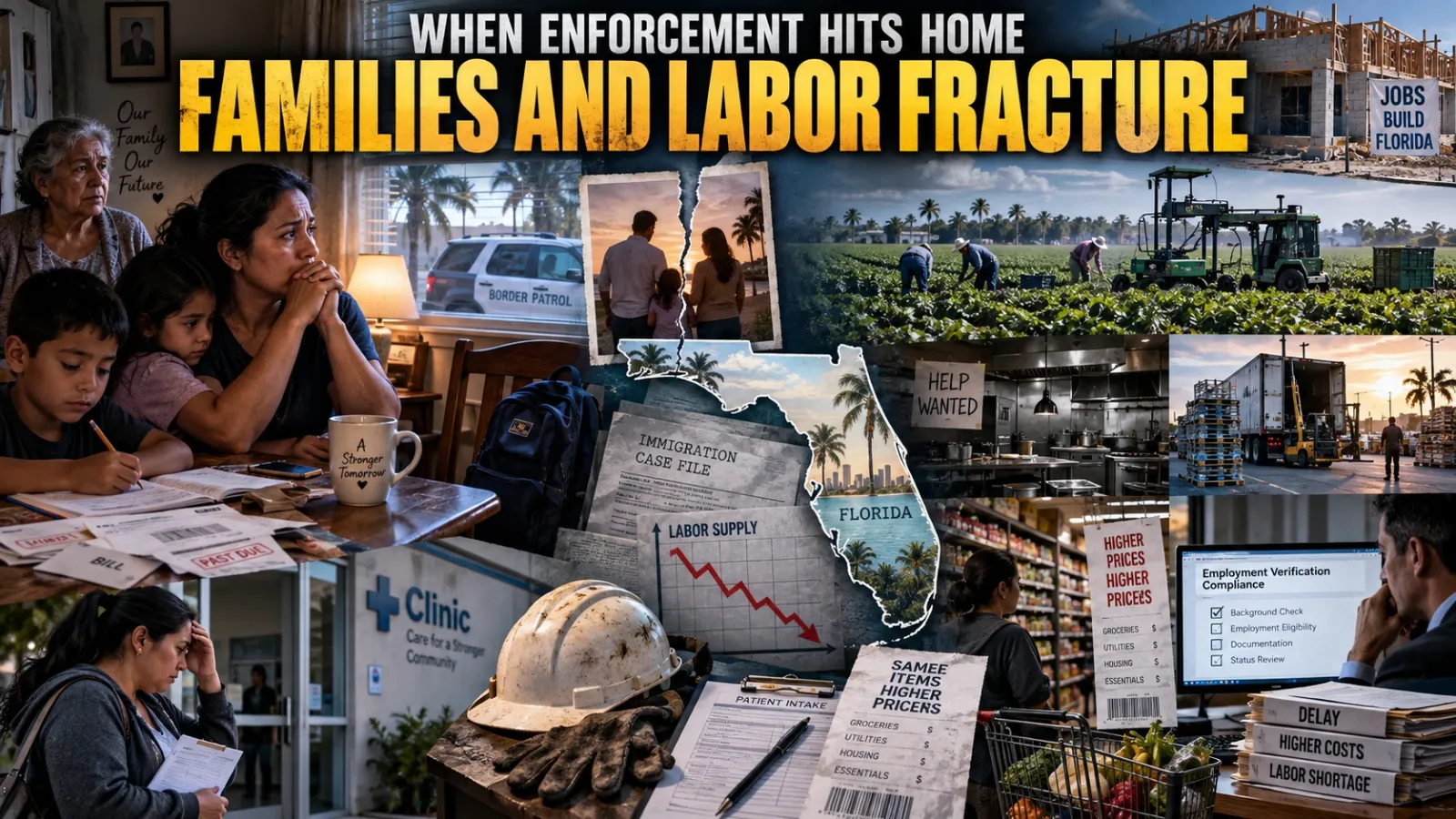
The Invisible Crisis: How Hardline Immigration Policies are Fracturing Families, Economies, and the Future of Labor
In late September, a comprehensive study featured in the Tampa Bay Times laid bare the compounding human and economic casualties of strict state and federal immigration enforcement. Conducted by the Im/migrant Well-Being Research Center (IWRC) at the University of South Florida, the research revealed a deeply fractured landscape where aggressive policies are paralyzing working families and draining local economies. As the administration accelerates deportation efforts into 2026, the ripple effects are being felt far beyond undocumented communities, reshaping the fabric of American society.
This intersection of policy and human survival matters now more than ever because the financial and social stakes have reached unprecedented levels. Independent estimates indicate that Florida’s stringent immigration law, SB 1718, could cost the state’s gross domestic product up to $12.6 billion in a single year. Meanwhile, businesses across the agricultural, construction, and hospitality sectors are facing existential labor shortages that threaten the broader supply chain and have accelerated a desperate pivot toward artificial intelligence and agricultural robotics.
The cascading consequences are ultimately affecting ordinary citizens, mixed-status families, and local consumers who face rising prices at the grocery store. From U.S.-born children experiencing severe psychological trauma to vital agricultural operations scrambling to replace human hands with automated systems, the human impact is profound. As enforcement mechanisms tighten, a climate of pervasive fear is fundamentally altering the demographic, technological, and economic future of the nation.
The Architecture of Fear and Resettlement Ambivalence
The foundation of the current crisis stems from a deliberate legislative effort to create an environment hostile to undocumented immigrants. Florida’s SB 1718, which took effect in recent years, mandated that businesses utilize the E-Verify system, invalidated out-of-state driver’s licenses for undocumented residents, and severely penalized the transportation of migrants into the state. Anyone driving an undocumented family member or coworker into Florida could face a third-degree felony charge. These sweeping mandates were designed to discourage undocumented migration, but they immediately cast a chilling effect over entire communities.
Researchers at the University of South Florida refer to the resulting psychological trauma as “resettlement ambivalence.” Drawing on 53 in-depth interviews, Dr. Elizabeth Aranda and her team documented how intensified enforcement forces immigrants to constantly question their fundamental right to stay in their established communities. Instead of integrating into the local economy and society, long-term residents are forced into a permanent state of precarious survival. This generational trauma fundamentally alters how U.S.-born young adults view their country and their intrinsic place within it.
The fear extends well beyond those who lack legal status, paralyzing naturalized U.S. citizens and permanent residents in mixed-status families. A recent survey of 466 participants revealed that perceived everyday discrimination, independent of actual immigration status or income, serves as a significant barrier to daily life. The pervasive fear of systemic discrimination and racial profiling overrides the legal rights of these residents, forcing them into the shadows. Consequently, social isolation has become the default survival mechanism for millions of families nationwide.
This isolation has devastating effects on educational attainment and early childhood development. Teachers and advocates report that Latino children facing the threat of parental deportation exhibit lower engagement rates and severe learning disruptions in the classroom. Early childhood education programs, which normally help shrink systemic learning gaps, are seeing reduced participation as fearful parents keep their children hidden at home. This educational marginalization ensures that the social disadvantages of restrictive immigration policies will persist for generations.
Economic Hemorrhaging and the Supply Chain Crisis
The macroeconomic consequences of this legislated fear have been immediate, severe, and far-reaching. Following the passage of SB 1718, a palpable culture of fear rapidly took hold across major Florida industries, prompting workers to flee to neighboring states. Local construction firms and roofing contractors began struggling to maintain basic operations, with developers facing the threat of $10,000 daily fines per undocumented worker alongside the potential revocation of business licenses. This exodus has severely disrupted both high-end commercial builds and routine residential repairs, rendering development projects significantly slower and more expensive.
The resulting labor drain translates directly into massive financial losses for local and state economies. The Florida Policy Institute estimated that these strict immigration mandates could cost the state up to $12.6 billion in gross domestic product in a single year. Furthermore, undocumented immigrants nationally contribute approximately $96.7 billion in federal, state, and local taxes every year, while generating over $375 billion in total household income. Stripping this critical demographic from the labor pool fundamentally weakens the nation’s capacity to maintain basic economic growth.
Opponents of immigration frequently cite differing economic models to justify hardline enforcement policies. Organizations like the Federation for American Immigration Reform have argued that illegal immigration costs Florida taxpayers over $8 billion annually in education, healthcare, and associated services. At the federal level, similar advocacy groups claim that taxpayers subsidize the undocumented population to the tune of $182 billion per year. However, independent policy analysts argue these estimates routinely fail to account for the massive economic output, uncollected tax revenues, and consumer spending generated by the undocumented workforce.
When local businesses lose their primary workforce, the resulting supply chain bottlenecks inevitably drive up the cost of everyday goods and services. Consumers are ultimately left absorbing these elevated costs at the grocery store, in restaurants, and in the local housing market. During the height of the recent pandemic, foreign-born workers comprised more than one in four essential frontline workers in healthcare, child care, and social services in Florida. The systematic removal of these essential workers introduces dangerous vulnerabilities into the broader infrastructure of American daily life.
Healthcare Hesitancy as a Public Health Threat
Beyond the immediate economic fallout, strict immigration policies are triggering a quiet but expansive public health crisis. A highly controversial provision of Florida’s SB 1718 mandated that hospitals receiving Medicaid funding must explicitly ask prospective patients about their immigration status during the intake process. Consequently, immigrants and their families are increasingly avoiding medical facilities out of fear that their private information will trigger deportation proceedings. This hesitation spans across the entire healthcare spectrum, delaying critical treatments and leaving infectious diseases dangerously undiagnosed.
The chilling effect directly impacts naturalized citizens who share households with undocumented relatives. Research published in the journal MDPI demonstrates that individuals with insecure legal status, those experiencing financial hardship, and women are particularly reluctant to engage with healthcare systems. The overarching anti-immigrant discourse creates a hostile environment where even legally present individuals forgo preventative care to protect their loved ones. When vulnerable populations delay basic medical interventions, they ultimately require expensive emergency treatments that drive up systemic healthcare costs.
Mental health outcomes are simultaneously plummeting as families navigate constant surveillance and intense operational uncertainty. The daily stress of potential separation exacerbates depression, severe anxiety, and post-traumatic stress disorder among both adults and children in immigrant communities. Despite this escalating need for psychological support, marginalized individuals remain disconnected from therapeutic resources due to the very policies causing their distress. The resulting untreated trauma drastically reduces the emotional resources parents can deploy to raise healthy, well-adjusted children.
Furthermore, the long-term consequences of delayed healthcare access will disproportionately affect municipal emergency medical systems. As routine preventative care becomes increasingly inaccessible, minor health issues inevitably escalate into severe, life-threatening conditions. Because emergency rooms are legally obligated under federal law to treat critical patients regardless of status, the financial burden of these complex cases ultimately falls on local hospitals and taxpayers. This reactive approach to public health completely undermines ongoing, systemic efforts to advance health equity across the United States.
Fractured Families and the Heavy Cost of Remittances
The most profound casualties of intensified enforcement are the millions of children caught in the crossfire of mass deportations. Approximately 5.1 million U.S. citizen children currently live with an undocumented family member, placing them at direct risk of sudden and traumatic family separation. When parents are arrested or deported, the resulting disruption destabilizes the child’s emotional security, leading to feelings of abandonment and reduced self-esteem. State-initiated family separations actively weaken communities by removing primary breadwinners and plunging surviving family members into severe financial poverty.
The separation of transnational families also exacts a heavy toll on international economies and global migration patterns. Many working-age adults come to the United States without documentation out of sheer necessity, sending essential remittances back to spouses and children in developing nations. These remittances are direct evidence of the vast wealth created by immigrant workers, accounting for over $2.7 trillion in U.S. GDP contributions in a single year. However, this financial lifeline comes at the heavy cost of decades-long family division due to restrictive borders.
The lingering grief and separation anxiety experienced by children left behind in foreign countries has direct implications for U.S. border security. Children grow up with enhanced financial resources but suffer from the ambiguous loss of essentially absent parents. Once their primary caregivers—often elderly grandparents—pass away, these children frequently embark on dangerous journeys toward the U.S. border. The trauma of separation thus serves as a powerful catalyst for future waves of unaccompanied minors attempting perilous international crossings.
Conversely, the physical act of mass deportation poses an insurmountable logistical and financial hurdle for the federal government. The American Immigration Council estimates that a one-time operation to deport the nation’s undocumented population would cost taxpayers at least $315 billion. This astronomical figure includes $89.3 billion for mass arrests, $167.8 billion for detention camps, and tens of billions for legal processing and physical removals. The sudden extraction of this demographic would also collapse local tax bases, as an estimated 1.6 million homeowners would be forcibly uprooted from their communities.
| Economic and Fiscal Metrics | Estimated Financial Impact | Source Context |
|---|---|---|
| One-time Mass Deportation Cost | $315 Billion | Total federal cost for arrest, detention, and removal operations. |
| Annual Cost of 1M Deportations | $88 Billion | Sustained yearly operational expenses for staggered deportation efforts. |
| Florida SB 1718 GDP Loss | $12.6 Billion | Projected one-year economic loss in Florida due to strict enforcement. |
| Annual Tax Contributions | $96.7 Billion | Combined federal, state, and local taxes paid by undocumented workers. |
| Annual Income Generated | $375 Billion | Total income generated annually by the undocumented labor force. |
Inside the Detention Surge and Institutional Abuse
The legislative push to deport undocumented residents has funneled tens of thousands of individuals into a rapidly expanding, highly controversial detention apparatus. By mid-2025, the national immigration detention population reached an unprecedented daily average of over 56,000 people, marking the highest level in United States history. This surge was heavily fueled by a massive increase in 287(g) agreements, which empower local police departments and sheriff’s offices to partner directly with Immigration and Customs Enforcement. These local partnerships grew by a staggering 225 percent in just a few months, effectively turning routine traffic stops into direct deportation pipelines.
Conditions inside these overcrowded detention centers have drawn severe condemnation from human rights organizations and medical professionals. A July 2025 investigation by Human Rights Watch revealed flagrant violations of international standards at multiple Florida facilities, including the Krome North Service Processing Center and the Broward Transitional Center. Detainees reported being held in freezing holding cells, denied access to basic hygiene, and subjected to severely substandard medical treatment. The systemic neglect extends deeply into mental health protocols, where individuals seeking psychological care were allegedly punished with isolation in solitary confinement.
The sudden influx of detainees has pushed facility capacities far beyond their architectural and operational breaking points. At times, the Krome facility held more than three times its maximum operational capacity, forcing individuals to sleep on cold concrete floors under constant fluorescent lighting. Crucially, nearly 72 percent of the individuals swept up in these massive detention surges possessed no prior criminal history whatsoever. The aggressive criminalization of administrative immigration violations has transformed the detention system into a sprawling enterprise that operates with minimal independent oversight.
The privatization of these detention facilities further complicates efforts to reform the system and ensure basic human dignity. Private contractors operate many of these overcrowded centers, creating a powerful financial incentive to maintain maximum occupancy levels regardless of infrastructural strain. Independent oversight is notoriously difficult to enforce, leaving vulnerable detainees with virtually no legal recourse to protest dangerous living conditions or medical neglect. As federal budgets for immigration enforcement continue to balloon, critics argue that taxpayer dollars are effectively subsidizing corporate profit at the direct expense of human rights.
The Desperate Pivot to AI and Agricultural Robotics
Faced with a vanishing labor pool and the exorbitant costs of temporary H-2A visas, the agricultural sector is desperately pivoting toward technological intervention. Farmers across the country are heavily investing in autonomous tractors, artificial intelligence inventory systems, and robotic harvesters to compensate for the lack of human hands. In Florida, the nursery and greenhouse industry recently received a $1 million federal grant to develop automated systems for potting, fertilizing, and managing plant inventory. These innovations aim to ease tedious, manual tasks and keep local growers financially viable amid permanent labor shortages.
However, the transition to mechanized farming is fraught with unique logistical limitations and massive financial obstacles. While automated systems work reasonably well for uniform row crops like corn and soybeans, specialty crops require a level of physical dexterity that machines currently lack. Fresh fruits and ornamental plants are highly delicate, ripen at inconsistent rates, and typically demand precise human articulation to harvest without causing massive product loss. Furthermore, unpredictable environmental variables, such as field moisture levels, can easily hamstring heavy autonomous equipment, requiring constant human oversight.
For the farmworkers who remain, the rapid rise of automation introduces a new layer of existential anxiety to an already grueling profession. Labor organizers report that migrant workers are deeply concerned about being entirely replaced by autonomous machines, viewing robots as tools that “don’t ask for anything”. Workers frequently hesitate to demand better wages, safer working conditions, or hazard pay because they fear their employers will simply purchase a machine to replace them. In this highly unbalanced power dynamic, agricultural automation serves as an implicit threat that suppresses labor rights and keeps wages artificially stagnant.
The physical realities of agricultural labor have also become increasingly perilous due to shifting climate dynamics and extreme weather events. Migrant laborers are routinely subjected to dangerous heat, prolonged droughts, and intense rainfall, often working 20-hour shifts just to salvage seasonal harvests. While mechanization could theoretically protect humans from these brutal conditions by taking over the most dangerous tasks, the technology is primarily being deployed to maximize corporate profit rather than improve worker welfare. Without strong regulatory frameworks, the integration of AI and robotics may simply further marginalize the human beings who currently anchor the food supply chain.
Market Pressures, Consolidation, and Food Security
The steep financial barrier to entry ensures that artificial intelligence and automation will not be a universal savior for the agricultural economy. Only heavily capitalized corporate farming operations can easily absorb the massive upfront costs associated with advanced agricultural robotics and drone technology. Consequently, smaller family farms that operate on razor-thin margins are left entirely unable to compete, afford the technology, or hire expensive legal labor. As agricultural automation progresses, it threatens to dramatically accelerate the consolidation of the farming sector into the hands of a few mega-corporations.
Federal trade policies are simultaneously complicating the adoption of these vital new technologies. New tariffs on imported drones, intended to target foreign manufacturing, have inadvertently raised the costs for farmers attempting to inspect, map, and spray crops using precision agriculture. While larger farms can absorb these technological tariffs, the financial strain pushes smaller operations closer to bankruptcy. The intersection of strict immigration enforcement and aggressive trade policies is effectively squeezing mid-sized farmers out of existence.
Academic institutions are racing against time to help farmers bridge this technological gap. Researchers at the University of Florida’s Institute of Food and Agricultural Sciences are actively conducting field trials to determine how automated inventory and robotic harvesting can maximize crop yields. Social scientists are simultaneously studying farmer hesitation to understand the cultural and economic barriers preventing widespread technological adoption. Ultimately, a successful transition to automated agriculture will require massive federal subsidies to prevent the complete collapse of mid-sized farming operations.
The geopolitical implications of this labor displacement are profoundly significant, as diminished domestic output forces the United States to rely heavily on imported goods. If local farmers cannot secure sufficient human labor or afford robotic alternatives, they are forced to leave viable crops rotting in the fields. This inevitable drop in domestic food production increases reliance on foreign agricultural markets, introducing dangerous vulnerabilities into the national supply chain. Restrictive immigration policies do not just hurt migrant workers; they actively compromise the broader food security and economic independence of the American public.
What happens next
As the federal government aggressively expands its deportation apparatus, state economies will likely experience compounding structural fractures throughout the remainder of the decade. Industries heavily reliant on immigrant labor will face intense pressure to rapidly innovate, consolidate, or outsource their operations entirely. American consumers can expect a significant and sustained increase in the cost of consumer goods, fresh produce, and residential construction as businesses pass their escalated labor and technological expenses onto the general public. Furthermore, the sudden loss of billions in state GDP and associated tax revenues will force local municipalities to eventually cut essential public services to balance their budgets.
In the long term, the most enduring legacy of these hardline policies will be the generational trauma inflicted upon millions of mixed-status families. The psychological toll of widespread detentions, family separations, and societal isolation will heavily burden the social safety net, requiring extensive mental health interventions for decades to come. U.S. citizen children who witnessed the fracture of their families will enter the workforce carrying the deep psychological scars of systemic marginalization and educational disruption. Unless policymakers recalibrate their approach to balance economic realities with urgent humanitarian concerns, the foundational fabric of American communities will remain in a state of perpetual crisis.
In response to the growing economic vacuum, industry leaders and agricultural coalitions will likely intensify their lobbying efforts for comprehensive immigration reform and federal technology subsidies. Without access to legal guest worker programs, a reliable pathway to citizenship, or affordable robotic automation, key sectors of the American economy simply cannot sustain their current production models. Lawmakers will eventually be forced to reconcile the deep contradictions between aggressive border security rhetoric and the practical necessities of a functioning, modern labor market. Until this legislative gridlock is resolved, local businesses, ordinary consumers, and working families will continue to bear the heavy financial and emotional burden of a deeply fractured system.
Source List
Sources (63)
- tampabay.com — Article1012148.ece
- tampabay.com — Juan carlos chavez
- tampabay.com — Article1190773.ece
- facebook.com
- aulablog.net — Immigration policies harm families economic wellbeing and mental health
- bushcenter.org — Monthly immigration update september 2026
- timesofindia.indiatimes.com — 75342961.cms
- cfpublic.org — Florida policy researcher explains how immigrants impact the economy
- unidosus.org — The economic costs of pursuing hardline state immigration policies how expanded
- usf.edu — Listing
- facebook.com
- usf.edu — Listing
- lizaaranda.com
- usf.edu
- facebook.com
- floridapolitics.com — 796026 sunburn the morning read of whats hot in florida politics 5 14 26
- facebook.com
- usf.edu — Index
- usf.edu — Iwrc
- hrw.org — Abusive practices at three florida immigration
- law.georgetown.edu — Immigration enforcements far reaching effects on health outcomes
- usforacle.com — Ice can visit usf experts say students should know their rights
- wusf.org — Tampa bay organizations help grow immigrant population
- usf.edu — Publications
- cdn.prod.website-files.com — 64d543cbfd5c9c8dd00387c0 fy2023 24%20budget%20summary
- floridapolicy.org — Florida hb 1617 sb 1718 potential economic and fiscal impact
- reddit.com — How floridas immigration law could backfire the
- prnewswire.com — Fair illegal immigration costs florida taxpayers more than 8 billion a year 3017
- whitehouse.gov — Fact sheet president donald j trump ends taxpayer subsidization of open borders
- govinfo.gov — CHRG 118hhrg55834
- epicforamerica.org — Billions of government benefits for illegal aliens
- budget.house.gov — The cost of the border crisis 1507 billion and counting
- facebook.com
- hrw.org — Practicas abusivas en tres centros de detencion de
- floridapolicy.org — Fy 2025 26 budget summary corrections and youth justice
- tcf.org — Improving affordability and advancing health equity for immigrants
- americanimmigrationcouncil.org — Mass deportation report 2024
- mdpi.com
- scholar.dominican.edu — Viewcontent.cgi
- unidosus.org — Unidosus theeconomiccostsofpursuinghardlinestateimmigrationpolicies
- greenbuildermedia.com — Floridas immigration policy sends shockwaves through building sector
- facebook.com
- govinfo.gov — CHRG 118hhrg54615
- encyclopedia.com — Cost immigration
- ballotpedia.org — Immigration in Florida, 1952 2017
- cis.org — Costs Immigration
- cis.org — States Must Pay Health and Education Benefits Illegal Immigrant Families
- mpra.ub.uni-muenchen.de — MPRA paper 109519
- cis.org — Does Immigration Harm Poor
- pmc.ncbi.nlm.nih.gov — PMC8612123
- cbo.gov
- youtube.com — Watch
- jeelani-law.com — Impact of floridas new immigration law on labor shortage
- wusf.org — Can automation help florida plant nurseries withstand labor shortages
- cbsnews.com — Farming automation ford migrant workers
- investigatemidwest.org — More farms are turning to automation amid labor shortages
- pdfs.semanticscholar.org — 67d914bfec94dffd840e00bfe574b1413551
- fruitgrowersnews.com — 2026 fgn labor survey h2a automation
- kansascityfed.org — Some segments of the agricultural economy are particularly sensitive to changes
- floridaagricultureauthority.com — Florida agricultural labor and farmworkers
- researchgate.net — 391447452 Labor shortages and farmer adaptation strategies
- freshproduce.com — Farm labor shortages
- journals.ashs.org — Article p240.xml


Leave a Reply