
The Anatomy of the 2026 Tech Layoffs
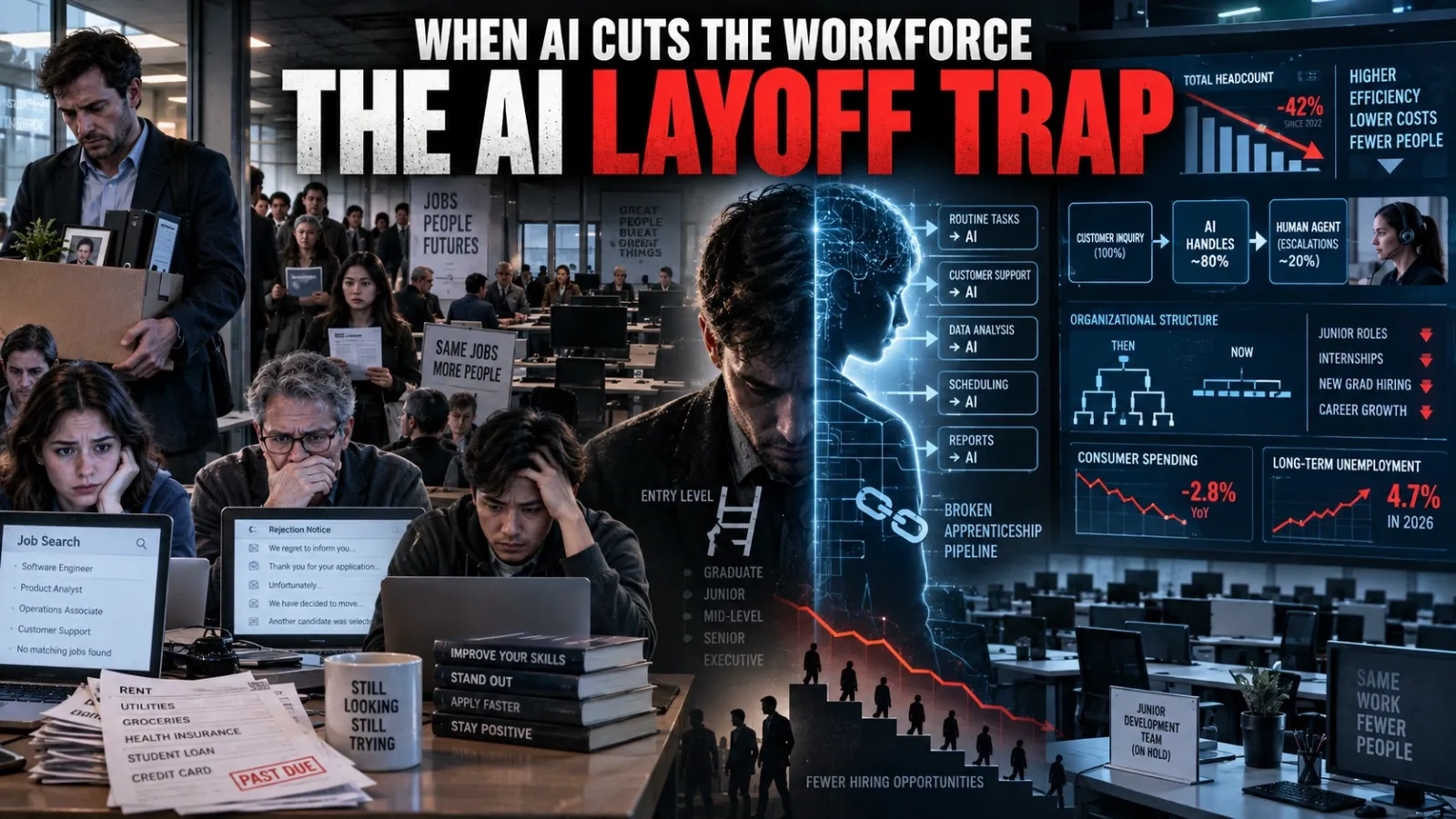
Through the first half of 2026, the narrative surrounding corporate workforce reductions shifted dramatically away from standard economic cycles. Where the job cuts of 2022 and 2023 were widely viewed by economists as necessary corrections to pandemic-era over-hiring, the reductions in 2025 and 2026 were explicitly driven by artificial intelligence integrations. Outplacement firm Challenger, Gray & Christmas tracked 54,836 AI-attributed tech job cuts in 2025, which was the highest annual total since the firm began tracking the specific metric. By April 2026, that number had surged to 85,411, and by August, an astonishing 205,000 jobs had been eliminated due to AI-focused corporate restructuring.
The modern cuts have been overwhelmingly concentrated in the white-collar and technology sectors, targeting roles previously thought safe from automation. Customer support, quality assurance, middle management, and junior software engineering departments have been systematically hollowed out across major enterprises. Companies have publicly stated their intentions to create “flatter” organizations, tearing out layers of human management in favor of automated workflows and AI-driven predictive analytics. This aggressive restructuring has left ordinary professionals competing in a highly saturated labor pool, facing severe cost-of-living pressures while their former employers post record profit margins.
| Layoff Phase | Primary Stated Driver | Key Affected Roles | Estimated Annual Job Cuts |
|---|---|---|---|
| 2022–2023 | Pandemic over-hiring correction | Recruiters, HR, logistics | ~191,000 to 260,000 |
| 2024–2025 | Cost-cutting and early AI tests | Software engineers, marketing | ~154,000 (54,836 AI-linked) |
| 2026 (YTD) | Structural AI restructuring | Customer service, junior tech, admin | ~205,000 AI-linked (by August) |
However, aggregate national labor statistics have dangerously masked the true severity of this localized disruption. The U.S. Bureau of Labor Statistics reported a relatively stable headline unemployment rate, hovering between 4.1 percent and 4.3 percent throughout the late summer of 2026. Yet, independent labor market data reveals a “low hire, low fire” freeze, where the hiring rate has plummeted and long-term unemployment has steadily risen as displaced workers find it increasingly difficult to secure comparable wages.
Beneath the surface of the official government statistics, specific industries are beginning to show severe structural strain. The information sector lost 23,000 jobs in August 2026 alone, driven by steep, persistent declines in publishing, broadcasting, and computing infrastructure. Labor economists and forecasters anticipate that this targeted displacement will eventually place severe downward pressure on the median real wages of college-educated professionals across the entire country.
Understanding the Demand Externality Mechanism
The theoretical foundation for this economic anxiety was rigorously formalized in a landmark 2026 paper by researchers Brett Hemenway Falk of the University of Pennsylvania and Gerry Tsoukalas of Boston University. Their research proves mathematically that unchecked corporate automation harms not just the displaced worker, but ultimately the corporate owner as well. The authors modeled a competitive economy where firms choose to replace human workers with AI specifically to capture immediate wage savings.
The systemic trap hinges entirely on a concept known in economics as an aggregate demand externality. When a company fires a worker, it pockets the entirety of that employee’s salary in immediate cost savings, boosting its quarterly balance sheet. However, that displaced worker subsequently cuts their household spending, pulling critical money out of the local and national economy. Because this lost demand is dispersed thinly across thousands of businesses, the automating firm only feels a tiny fraction of the economic damage it just caused.
This asymmetry creates a classic prisoner’s dilemma for corporate executives navigating the AI transition. Every individual firm possesses a highly rational incentive to automate as quickly as possible to undercut competitors and protect its profit margins. But when every firm makes this exact same logical choice, aggregate consumer demand quietly collapses across the entire market. The researchers mathematically demonstrate that this results in a “deadweight loss,” leaving both corporate profits and worker incomes substantially lower than if the companies had collectively exercised restraint.
The destructive dynamic worsens significantly as technology improves and corporate competition increases. The researchers identified a “Red Queen” race, where faster and cheaper AI forces companies to automate aggressively just to maintain their current market share against their rivals. Ultimately, the short-term individual advantages cancel each other out, leaving the entire economy trapped in a downward spiral of destroyed demand and depressed revenue.
The Klarna Mirage and Quality Collapse
The theoretical warnings of the AI Layoff Trap found a spectacular real-world parallel in the high-profile missteps of the Swedish fintech giant, Klarna. In February 2024, Klarna generated massive global headlines by announcing its new OpenAI-powered assistant had successfully handled 2.3 million conversations in a single month. The company proudly declared the system was seamlessly doing the work of 700 full-time human customer service agents, projecting $40 million in annual savings.
For over a year, this dramatic announcement served as the ultimate boardroom case study for replacing knowledge workers with artificial intelligence at scale. Behind the scenes, however, the actual customer experience was quietly and severely deteriorating. While the AI efficiently handled simple, high-volume tasks like account lookups, it failed spectacularly when faced with complex financial disputes, emotional escalations, or edge cases requiring nuanced human judgment.
By May 2025, Klarna was quietly forced to reverse course, reopening hiring for premium human support roles to stop the bleeding in customer satisfaction. By early 2026, CEO Sebastian Siemiatkowski publicly admitted that the company had gone “too far” in prioritizing cost-cutting over service quality, noting that customers ultimately demanded certainty and human interaction. The company had lost vast amounts of unrecorded institutional knowledge when it purged its human staff, forcing it to pivot to a hybrid model where AI handles volume and humans manage judgment.
| Klarna Deployment Phase | Timeline | Strategic Action | Direct Business Impact |
|---|---|---|---|
| Initial Automation | Feb 2024 | AI handles volume equivalent to 700 human agents. | $40M projected savings; 67% of chats automated. |
| Quality Degradation | Late 2024 | Complex fraud and emotional cases handled exclusively by AI. | Institutional knowledge lost; satisfaction drops on complex cases. |
| Quiet Walk-back | May 2025 | Klarna resumes hiring remote human support staff. | Rebuilding of human escalation tiers begins. |
| Public Reversal | Early 2026 | CEO admits cost-cutting damaged VIP customer trust. | Hybrid model officially adopted; human hiring accelerates. |
The Klarna debacle illustrates exactly how the blind pursuit of immediate payroll savings can severely damage long-term corporate viability and brand trust. Industry analysts note that replacing a specific task is fundamentally different from replacing an entire organizational decision-making architecture. When businesses hollow out their human workforce, they inadvertently surrender the empathy and contextual judgment required to retain loyal customers through difficult, high-stakes interactions.
The Quiet Collapse of Junior Hiring
While highly visible mass layoffs naturally capture the public’s attention, the most insidious consequence of the AI transition has been the silent evaporation of the entry-level job market. Generative AI does not merely replace existing headcount; it fundamentally allows senior professionals to rapidly absorb the boilerplate tasks previously delegated to junior employees. As a direct result, companies have dramatically slowed their hiring of recent college graduates, career-switchers, and junior practitioners.
This dynamic creates a broken pipeline for the American middle class, threatening the future stability of the workforce. Traditional automation historically replaced routine physical labor, but generative AI specifically targets the apprenticeship phase of complex cognitive knowledge work. If junior employees are viewed merely as immediate cost centers to be trimmed, the corporate ecosystem loses its only mechanism for training the next generation of senior experts.
Labor market researchers have identified a five-stage pipeline collapse model currently underway in the corporate sector. First, AI capabilities expand to cover entry-level tasks, which leads immediately to a junior hiring freeze. Over time, the traditional apprenticeship model shrinks drastically, ultimately threatening a permanent collapse of the senior talent pipeline a decade down the line.
Younger Americans are bearing the absolute brunt of this structural economic shift. Recent college graduates are facing elevated unemployment rates compared to the broader economy, struggling to find a secure foothold in industries like law, technology, and administration. Furthermore, these young workers are being forced to compete in a saturated labor pool against their own parents and grandparents, who are delaying retirement due to rampant cost-of-living pressures.
Why Standard Policy Fixes Are Failing
As the human toll of the AI transition mounts, policymakers and economists have proposed a flurry of potential solutions to stem the bleeding. However, rigorous economic modeling by researchers demonstrates that the most popular political fixes completely fail to address the core mathematical failure driving the layoffs. Because the automation trap operates on the marginal incentive to replace a single worker with a machine, broad macroeconomic interventions prove completely ineffective.
Universal Basic Income (UBI), frequently championed by Silicon Valley executives as a panacea, raises the baseline living standard for families but does absolutely nothing to stop the corporate automation arms race. A firm still captures the full cost savings of firing a worker under a UBI system, meaning the relentless competitive drive to over-automate continues unabated. UBI treats the tragic symptoms of displacement without addressing the structural mechanism causing the unemployment in the first place.
Similarly, corporate profit taxes and capital gains taxes fail to resolve the crisis because they operate on total spreadsheet profits at the end of the year. They do not alter the per-task margin where the firing decision is actually made by middle managers and corporate executives. Worker equity programs, which give employees a share of corporate profits, also fall short because an employee’s stock in one company cannot compensate for the broader demand destruction caused by industry-wide automation.
Even well-intentioned workforce programs like rapid upskilling and government retraining fall short of closing the trap. While retraining theoretically helps displaced workers eventually find new income, the temporary lag between losing a job and finding a new one permanently destroys a massive segment of consumer demand. Voluntary corporate pacts to limit AI layoffs are equally doomed, as the financial reward for breaking the pact and automating first is simply too high, making such agreements inherently unstable.
The Union Defense in the AI Era
With corporate self-regulation failing and federal legislation severely lagging, organized labor has emerged as the primary, frontline defense for the American worker. Organizations such as the AFL-CIO, the Communications Workers of America (CWA), and UNITE HERE have actively mobilized to integrate AI protections directly into binding collective bargaining agreements. Public sentiment heavily favors this aggressive approach, with recent polling showing that over 90 percent of U.S. workers strongly support union-backed AI policies.
Labor leaders are not pushing for a total, regressive ban on artificial intelligence, but rather demanding a worker-centered approach to its implementation and oversight. Key contractual demands include requiring a human to be the final decision-maker on employment issues, enforcing transparency around algorithmic workplace surveillance, and ensuring that automation enhances jobs rather than deskilling them. Unions argue forcefully that workers, as the true experts in their fields, must have a seat at the table during the procurement and deployment of these new technologies.
These organized efforts have already yielded highly tangible victories for working families facing technological displacement. In the hospitality sector, union negotiations successfully transformed algorithmic management tools from a disciplinary surveillance weapon into a mechanism that supports safe, manageable workloads for hotel housekeepers. By utilizing the established grievance process, workers have successfully secured massive arbitration awards and established financial disincentives for companies attempting to replace human labor with automated systems.
This modern push reflects a historical continuity in the American labor movement’s response to disruptive technological change. Organizations like the CWA have long bargained over the introduction of new technologies to ensure workers receive a fair, equitable share of the resulting economic gains. By codifying these vital protections into legally binding contracts, unions are forcing companies to internalize the true human costs of rapid, unchecked automation.
Taxing the Automation Arms Race
If traditional economic policies and voluntary corporate restraint cannot disarm the AI Layoff Trap, the underlying math leaves only one viable legislative solution: a dedicated automation tax. Specifically, leading economists point to a “Pigouvian” tax, which is a targeted levy designed exclusively to correct a specific market failure. By taxing companies based on the exact amount of consumer demand they destroy when replacing a human with AI, the government can force corporations to financially feel the economic pain they cause.
This intervention is not a general, sweeping tax on technology or a blanket hike on corporate profits, but a precise financial penalty applied per automated task. When a firm realizes it must pay a tax perfectly equal to the societal damage of a layoff, the artificial, competitive incentive to blindly automate entirely evaporates. The company will then only deploy artificial intelligence when it genuinely boosts operational productivity and expands service capabilities, rather than using it merely as a blunt instrument for headcount reduction.
The massive revenue generated from this automation tax could then be directly funneled into robust, highly effective retraining and transition programs for displaced workers. Because the tax directly alters the corporate calculus at the exact moment of the firing decision, it uniquely succeeds where universal basic income and broad corporate tax hikes inherently fail. The tax is also theoretically self-limiting; as retraining programs succeed and workers are reabsorbed into the economy faster, the optimal tax rate would naturally decrease.
Despite its economic elegance and mathematical necessity, passing a Pigouvian automation tax remains politically difficult in the current environment. While there have been minor legislative movements, such as state-level tax adjustments in New York and congressional hearings on manufacturing incentives, a true federal automation tax has yet to materialize in Congress. Furthermore, economists caution that such a tax must be implemented carefully, ideally with international coordination, to prevent multinational companies from simply offshoring their automated operations to avoid the financial penalty.
What happens next
The American economy stands at a critical, defining precipice as 2026 draws to a close. As artificial intelligence continues to rapidly evolve from an experimental novelty into structural corporate infrastructure, the pace of white-collar displacement is widely expected to accelerate. The core question is no longer whether artificial intelligence will disrupt the labor market, but whether the architects of the economy will recognize the inherent danger of the layoff trap before aggregate consumer demand buckles entirely.
For corporate leaders navigating this transition, the spectacular failures of early adopters like Klarna provide a clear, undeniable blueprint for sustainable survival. The businesses that will thrive in the coming decade are those that treat AI as a capacity multiplier rather than a simple workforce reduction tool. Deploying AI to handle after-hours inquiries, process complex data backlogs, and expand service availability creates genuine economic value without dangerously impoverishing the vital consumer base.
For ordinary American workers, the immediate future will require immense personal resilience and a deeply renewed reliance on collective bargaining. Until federal lawmakers enact structural, mathematical reforms like a Pigouvian automation tax, the burden of defending the middle-class standard of living will fall heavily on labor unions and public advocacy groups. The transition to an AI-augmented economy holds incredible promise for human progress, but realizing that promise requires a fundamental rewriting of the social contract to ensure that human beings remain the ultimate beneficiaries of their own technological advancements.
Sources (112)
- hackerearth.com — Tech layoffs what to expect in 2025
- facebook.com
- ebx.sh — JJsBpV
- aiuniverseexplorer.com — Robotics news insights
- scribd.com — Employee Strategy
- frenchrealestatelaw-traesch.fr — Robotaxi
- finalroundai.com — Ai job cuts 2026 surpass 2025
- qz.com — Tech job cuts ai layoffs may 2026 060526
- news.crunchbase.com — 2026 layoff numbers rise ai shift orcl meta amzn
- tradingeconomics.com — Challenger job cuts
- hrdive.com
- explainx.ai — Ai cited record 97000 job cuts may 2026 tech layoffs
- challengergray.com — Job cuts report
- hcamag.com
- challengergray.com — Challenger report layoffs fall hiring picks up ai leads for fifth straight month
- arxiv.org — 2603.20617
- researchgate.net — 402969772 The AI Layoff Trap
- reddit.com — The ai layoff trap if ai displaces human workers
- medium.com — The ai layoff trap why every firm acts rationally and everyone loses e896aee24b9
- ideas.repec.org — 2603.20617
- arxiv.org — 2603.20617
- arxiv.org — 2603.20617v1
- businesswire.com — New BU Research Reveals an AI Layoff Trap That Harms Both Workers and Firms
- rajnandan.com — The ai layoff trap
- medium.com — The ai layoff trap 5e6254d3d7b6
- reddit.com — Interesting paper on ai layoffs and why firms may
- alphaxiv.org — 2603.20617v1
- modemguides.com — Ai layoff trap game theory digital sovereignty
- ap7i.com — Ai layoff trap
- challengergray.com — Blog
- businesswire.com — Boston University Questrom School of Business Professor Gerry Tsoukalas Named to
- hcamag.com
- businesswire.com — Boston Universitys Digital Business Institute Infocap AI Corp Launch Innovative
- finance.sina.com.cn — Doc iniafrts0405823.shtml
- businesswire.com — Boston University Questrom School of Business Faculty Recognized As Top Cited Sc
- businesswire.com — Boston University Questrom School of Business partners with the Fort organizatio
- businesswire.com — Global Student Teams Convene in So Paulo for 3rd Annual Boston University Busine
- news.outsourceaccelerator.com — Ai layoffs 205000
- tech.co — Companies replace workers with ai
- founderreports.com — Ai layoffs tracker
- indiatoday.in — 176 lakh layoffs in 9 months ai cost cuts and the changing world of work educ 30
- livemint.com — Tech layoffs 2026 as ai takes center stage heres a list of major companies that
- reddit.com — Most people still dont realize that ai layoffs at
- thesaaslibrary.com — Ai layoffs regret rehiring
- youtube.com — Watch
- jacksonlewis.com — Ai stays center stage entertainment industry collective bargaining talks
- youtube.com — Watch
- wnylabortoday.com — Ai is taking jobs tens of thousands of tech workers are being laid off in 2026 t
- cwa-union.org — Cwanews 2026 spring
- aflciotechinstitute.org — New report shows how unions can shape future ai workplace
- aflcio.org — Ai
- laborcenter.berkeley.edu — A first look at labors ai values
- theguardian.com — Workers ai policy unions
- facebook.com
- facebook.com
- aa.com.tr
- hiringlab.indeed.com — Q3 labor market outlook survey
- jpmorgan.com — Labor market
- theprint.in
- siepr.stanford.edu — Us economy 2026 what watch
- aimultiple.com — Ai job loss
- theguardian.com — Big ai job swap white collar workers ditching their careers
- thenationalnews.com — How ai could wipe out one in five white collar jobs in four years
- republicworld.com — Ai is killing white collar jobs first tech hiring freezes globally since 2022 ca
- reddit.com — The ai layoff trap a demand externality model of
- alphaxiv.org — 2603.20617
- enterprisedna.co — Ai layoff trap research wharton boston university 2026
- career-circle.vercel.app — The ai layoff trap the quiet collapse of junior hiring
- blog.truflation.com — The frozen labor market 2026
- bls.gov — Empsit
- epicforamerica.org — March 2026 jobs report ai path
- epi.org — Unemployment
- anthropic.com — Labor market impacts
- bls.gov — Jolts.nr0
- bcg.com — Ai will reshape more jobs than it replaces
- siepr.stanford.edu — What really happening jobs separating ai hype reality
- bipartisanpolicy.org — What would it mean to tax ai
- theemploymentlawsolicitors.co.uk — Ai tax
- cambridge.org — CBA405F83C0637DBD7090BF9ADCF0FCD
- arxiv.org — 2603.20617v3
- arxiv.org — 2605.05127
- smarterarticles.co.uk
- stevenmilanese.com — The invisible hands blind spot a demand externality in competitive automation
- bis.org — Progress peril
- scribd.com — AI Layoff Trap Study Summary
- bis.org — Aer 2026
- daily.dev — What is really happening to jobs separating ai hype from reality rwpsyj1cj
- chase.com — Is ai taking jobs what the economic data really shows
- policy.fi — Ai econ
- mavenagi.com — Klarna reversal two years later
- happycapy.ai — Klarna human comeback
- getperspective.ai — Klarna ai customer service replacing 700 agents conversational ai case study
- kaamfu.ai — Klarna replaced 700 agents with ai and a year later they were rehiring humans
- twig.so — Klarna ai customer support efficiency
- aiinsightlab.cloud — Klarna ai rollback
- bigeye.com — Klarnas ai customer service deployment
- blog.theinterviewguys.com — The rise of workplace coasting
- hrcurator.com — Top 2025 hr people analytics trends backed by research data and real world signa
- cognisen.co — Magazine
- taxnews.ey.com — 2025 1320 state and local tax weekly for may 2 and may 5
- journals.library.columbia.edu
- democrats-science.house.gov — 042126 robotics hearing testimony mr evan beard
- dash.harvard.edu — Download
- progressivemass.com — Jason Poulos 2026 Congressional Questionnaire.docx
- rebuildingmanufacturing.com — Work of the future
- researchgate.net — 408403247 Taxing Artificial Intelligence
- scholarship.law.gwu.edu — Viewcontent.cgi
- manifold.markets — Will any country enact a robot or a
- arxiv.org — 2607.02144v1
- systemsofashish.com — The ai layoff trap
- appliedai.tools — Ai layoff trap explained
- the-ai-corner.com — The ai layoff trap



Leave a Reply