
The Arithmetic of a “Streamlined” Livelihood
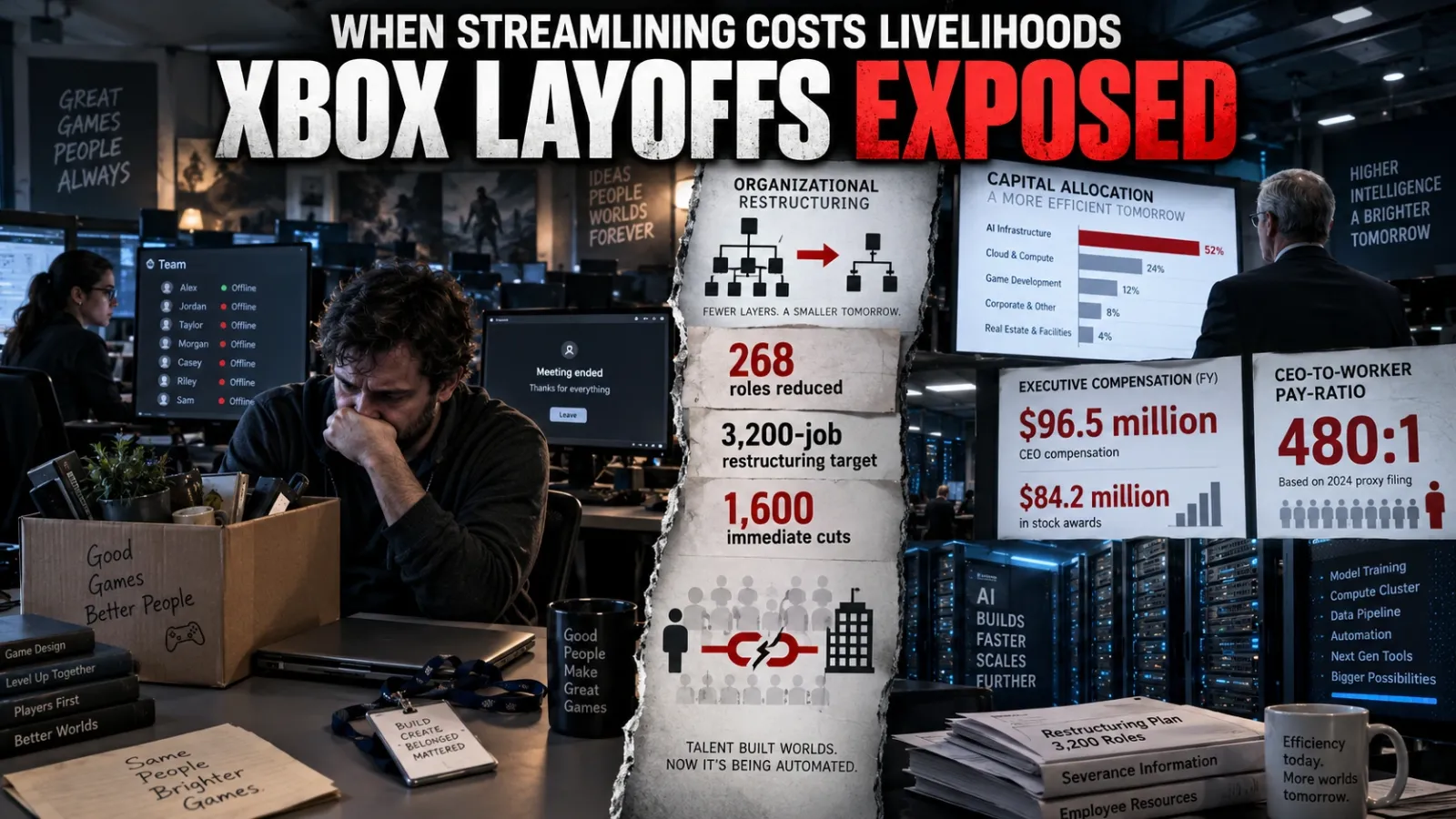
In modern corporate parlance, people do not lose their jobs; their roles are “streamlined,” their departments undergo “optimization,” and their employment ends via an “involuntary career event”. Behind this polished vocabulary lies a trail of upended lives and shuttered creative hubs across the United States and abroad. The recent elimination of 268 roles at Xbox is merely the latest tremor in a prolonged structural earthquake designed to flatten the organization and reduce headcount.
This most recent wave of redundancies directly impacted personnel across Halo Studios, various first-party development teams, and the central management layer of Xbox Game Studios. The scale of Microsoft’s ongoing gaming contraction is staggering when viewed over a multi-year timeline. Since finalizing the purchase of Activision Blizzard in late 2023, the company has ruthlessly consolidated its creative assets and shed thousands of dedicated professionals.
In 2024 alone, Microsoft jettisoned 2,550 workers across two separate rounds and abruptly shuttered respected internal studios such as Arkane Austin, Tango Gameworks, and Alpha Dog Games. By July 2026, Xbox’s new CEO, Asha Sharma, announced a sweeping plan to shed approximately 3,200 workers, representing a massive shift in corporate strategy. Roughly 1,600 of those affected personnel were terminated immediately, sending shockwaves through the industry as entire development teams were dismantled.
These cuts are not just numbers on a balance sheet; they represent the dissolution of deeply collaborative, highly specialized teams. Microsoft has actively divested itself of acclaimed studios like Double Fine, Compulsion Games, and Undead Labs. Meanwhile, Ninja Theory reportedly faces the imminent threat of closure after previous divestiture agreements fell through.
| Event Date | Restructuring Action | Reported Impact |
|---|---|---|
| Jan & Sept 2024 | Two rounds of Microsoft gaming layoffs | 2,550 jobs eliminated |
| May 2024 | Closure of Arkane Austin, Tango Gameworks, Alpha Dog | Widespread job losses and studio closures |
| July 2026 | Announcement of massive fiscal year restructuring | Target of 3,200 jobs to be cut; 1,600 immediate |
| Sept 4, 2026 | Washington WARN notice filed by Microsoft | 605 jobs cut, including 493 in Redmond |
| Late Sept 2026 | Latest wave of Xbox structural consolidation | 268 jobs eliminated across Halo Studios and management |
The architectural framework of Xbox is being radically altered to fit a leaner corporate vision. Obsidian Entertainment is being folded entirely into Bethesda, Playground Games is merging with Turn 10, and the stewardship of the flagship Halo franchise is being transferred directly to Activision. For the people on the ground, these transitions are sudden, jarring, and devoid of the empathy often preached in corporate manifestos.
The Vocabulary of Moral Disengagement
When a chief executive describes the elimination of thousands of jobs as “great to see,” it reveals a profound psychological distancing mechanism endemic to the modern C-suite. Harvard Business School professor Sandra Sucher identifies this phenomenon as “moral disengagement,” a cognitive coping strategy utilized by corporate leaders. This psychological mechanism allows harm-doers to rationalize and detach from the tangible suffering their decisions inflict upon ordinary families.
By framing mass layoffs as necessary “streamlining” or “resetting,” executives construct a linguistic shield that sanitizes human suffering. It transforms the loss of a family’s livelihood into a mere strategic imperative required for future corporate growth. This interpretative crisis fundamentally breaks the “psychological contract” between employer and employee.
A psychological contract is the unwritten set of expectations, obligations, and mutual trust that governs how workers perceive their value within an organization. When a highly profitable company suddenly terminates thousands of workers despite previous assurances of stability, employees interpret the act as a deep moral failure. The rhetoric of being a “corporate family” is instantly exposed as an illusion, replaced by a cold reality where human capital is entirely disposable.
The damage extends far beyond those who are handed pink slips, manifesting in the broader organizational culture and impacting every remaining project. As trust in leadership evaporates, survivors often adopt a self-protective, detached mindset, choosing silence over proactive collaboration. This toxic shift in workplace dynamics ultimately stifles the creativity and innovation that technology companies rely upon to build successful products.
Survivor Syndrome and the Psychological Toll
The employees who remain after a mass culling frequently suffer from an intense, pervasive condition known as “survivor syndrome”. These surviving workers grapple with intense guilt, heightened anxiety, and a state of “learned helplessness”. They quickly realize that their personal performance, dedication, and expertise offer no actual protection against future algorithmic cuts mandated by the executive board.
This realization severely diminishes their intrinsic motivation, leading to widespread burnout and emotional exhaustion across the remaining teams. Workers describe being summoned into two-minute remote meetings only to be told that their decades-long careers have been abruptly terminated without warning. As Slack channels go silent and institutional memory evaporates, the remaining employees are left to shoulder impossible workloads while grieving their former colleagues.
Morgan Goin, a worker at ZeniMax Online Studios, described the chilling aftermath of these sudden terminations in a primarily remote studio environment. “All through the morning, everyone was sending their goodbyes… Then silence,” Goin recounted, highlighting the abrupt severance of professional and personal ties. The feeling of loss is profound, with many developers stating that they feel as though they are actively grieving a death in the family.
Another Bethesda employee, known only as Barrett in union statements, expressed complete disbelief at the sudden termination of highly anticipated creative projects. “We thought that the work we were doing was going to keep us safe,” she explained, noting that decades of dedicated careers were ended in mere minutes. Colleagues were described as being in “really dark places,” struggling to comprehend how their passion and artistic skill could be so easily discarded by management.
Ultimately, this cynical environment corrodes the very foundation of creative enterprise within the video game industry. Research consistently demonstrates that when companies repeatedly utilize downsizing as a standard operational strategy, they create an inherently toxic workplace culture. Instead of fostering agility, these continuous restructurings yield a paralyzed, fearful workforce incapable of taking the creative risks necessary to build innovative video games.
The Ninety-Six-Million-Dollar Question
The human toll of Xbox’s structural reset becomes even more discordant when juxtaposed with the staggering financial rewards reaped by those executing the cuts. For Microsoft’s fiscal year 2025, CEO Satya Nadella received a total compensation package of $96.5 million. This figure represents a 22 percent increase from his fiscal 2024 earnings of $79.1 million, and nearly double what he was paid just two years prior.
While ordinary developers face the terrifying prospect of unemployment in a tightening economy, Microsoft’s leadership is achieving unprecedented personal wealth. To understand the mechanics of this disparity, one must look closely at how executive compensation is structured in modern proxy statements. Nadella’s base salary has remained frozen at a relatively modest $2.5 million since 2019, making up only a tiny fraction of his overall earnings.
The overwhelming majority of his compensation—approximately 87 percent—was delivered in the form of stock awards valued at $84.2 million, alongside a non-equity cash bonus of $9.6 million. Wall Street aggressively rewards cost-cutting and corporate “streamlining,” meaning the act of shedding labor costs directly inflates the company’s stock price. This inevitably enriches the very executives who mandate the layoffs, creating a perverse incentive structure that directly links executive wealth to worker displacement.
| Executive Compensation Metric | Fiscal Year 2024 | Fiscal Year 2025 | Year-Over-Year Change |
|---|---|---|---|
| CEO Base Salary | $2.5 Million | $2.5 Million | 0% |
| CEO Stock Awards | N/A (Total $79.1M) | $84.2 Million | N/A |
| CEO Total Compensation | $79.1 Million | $96.5 Million | +22% |
| Median Employee Pay | N/A | $200,972 | N/A |
| CEO-to-Worker Pay Ratio | N/A | 480:1 | N/A |
Other top executives at the company have seen similar financial windfalls during this period of intense corporate restructuring. Bradford Smith, Microsoft’s vice chair and president, earned approximately $28.2 million in fiscal year 2025, up from $23.4 million the previous year. This financial architecture highlights a brutal systemic reality: the current corporate model is heavily incentivized to view human workers strictly as disposable liabilities rather than valuable assets.
In fiscal year 2025, Microsoft reported a staggering CEO-to-median-employee pay ratio of 480:1. While the median Microsoft worker earns roughly $200,972—a high figure compared to national averages—the sheer magnitude of the gap illustrates how the fruits of increased productivity are funneled almost exclusively upward. For the quality assurance testers and artists losing their jobs, the concept of a “sustainable business model” appears to apply only to wealthy shareholders.
Reallocating Capital: Algorithms Over Artists
The mass displacement of Xbox developers cannot be viewed in isolation; it is intrinsically linked to Microsoft’s broader, aggressive pivot toward Artificial Intelligence. The technology industry is currently engaged in an estimated $10.3 trillion global AI build-out. This requires incomprehensible amounts of capital for new datacenters, specialized silicon, and massive energy infrastructure to power generative models.
To fund this monumental paradigm shift, legacy divisions like gaming are being aggressively tapped for cash by corporate finance departments. Human workforces are trimmed to redirect funds toward server farms, large language models, and automated systems. Workers on the ground see this transition clearly and view it as an existential threat to the collaborative art of game development itself.
Union leaders have loudly criticized Microsoft’s decision to deem human workers “too costly to keep” while simultaneously pouring billions of dollars into experimental AI initiatives. There is a profound ideological friction between the executives who view technology as a path to “unmetered intelligence” and the creatives who argue that human labor is irreplaceable. For the developers, prioritizing algorithms over artists is a fundamental betrayal of the interactive entertainment medium.
This dynamic is particularly painful for those who have spent their lives mastering complex, highly specialized artistic disciplines. Everything that makes players fall in love with a video game—the creature designs, the nuanced storytelling, the meticulously crafted environments—comes directly from the labor of thousands of dedicated game workers. Discarding these skilled artisans to fund technologies that many consumers actively reject as “slop” is viewed by the workforce as a catastrophic misallocation of resources.
Furthermore, the integration of AI into corporate workflows is actively weaponized to justify further headcount reductions across the sector. As executives seek to flatten organizational structures, they increasingly rely on AI tools to replace entry-level coding, quality assurance, and middle-management functions. This creates a hostile feedback loop where the financial savings generated by mass terminations are used to further accelerate the industry’s automation.
The Collapse of Institutional Memory
When a company lays off 5,750 workers in a span of three years, it does not merely reduce its payroll; it actively destroys its own institutional memory. AAA video game development is an incredibly delicate, iterative process that relies heavily on deep, unspoken collaboration among veteran teams. Impacted developers have likened the recent mass layoffs to taking a wide piece of woven cloth and arbitrarily pulling out half of the threads. The corporate structure may still nominally hold together, but its structural integrity is fundamentally compromised by the loss of foundational talent.
This loss of veteran talent is impossible to easily replicate with cheaper, less experienced labor hired in the future. Stephanie Zachariadis, a former Bethesda quest designer who was laid off in July, lamented that the legends who filled the company’s trophy cases are now mostly gone, laid off, or driven away by toxic conditions. You cannot terminate an artist with two decades of proprietary engine experience and expect a new hire to seamlessly replicate their output on day one.
The intricate knowledge required to make these massive digital worlds function smoothly leaves the building the moment network access is revoked by human resources. The inevitable consequence of this severe brain drain is a homogenization of the end product presented to consumers. Without the financial safety net required to invest in true creativity, massive studios are forced to rely on safe, repetitive formulas to guarantee a return on investment.
The radical reorganization of Xbox’s portfolio signals a massive corporate retreat from artistic risk and bold storytelling. It suggests a future where video games are manufactured by committee rather than crafted by passionate artisans, driven entirely by engagement metrics rather than artistic passion. The justification frequently offered by leadership points to thin revenue margins in the gaming sector and the absolute necessity of realigning resources.
However, labor advocates actively dispute this narrative of unavoidable financial scarcity pushing the company to the brink. As union representatives point out, Microsoft recently increased the price of Xbox consoles by as much as $150, marking the third such price hike since 2025. The capital unequivocally exists within the corporate ecosystem; leadership is simply making a calculated choice regarding who absorbs the financial friction.
“We Will Not Be Traded As Disposable”
Faced with a corporate structure that views them as expendable line items, the workforce is increasingly turning to organized labor for protection. The Communications Workers of America (CWA) has emerged as a powerful counterweight to Microsoft’s unilateral decision-making over the past several years. The union is currently mobilizing thousands of game developers across the United States and Canada to fight for fair contracts and basic workplace dignity.
Following the recent rounds of layoffs, hundreds of unionized video game workers amassed outside Xbox studios, actively protesting the mass terminations. The rhetoric from the picket lines is sharp, highlighting the stark inequalities embedded in the tech industry’s modern business model. “We’re here to say this plainly: those workers will not be traded as disposable,” stated CWA District 9 vice president Frank Arce during a recent press briefing.
The union has actively pushed back against the narrative of economic necessity perpetuated by the Microsoft executive team. They point to the company’s soaring profits, massive stock buybacks, and continuous console price hikes as proof that the corporation can easily afford to retain its workforce. For the CWA and its members, these layoffs are not a reflection of a struggling business, but rather a brazen exercise in unchecked corporate greed.
The labor fight extends far beyond mere severance packages; it is a battle for the fundamental future of the tech worker in an AI-driven economy. Union representatives like Morgan Goin and Wayne Uduwana have publicly condemned the way Microsoft leadership has refused to negotiate in good faith during recent bargaining sessions. They argue that hard work and the creation of excellent games no longer offer any protection against termination, destroying the core incentive for employees to perform.
This mobilization represents a historic, hard-fought turning point for the notoriously non-unionized video game sector. Workers are realizing that without collective bargaining, they possess zero leverage against trillion-dollar monopolies that can alter their lives with a two-minute calendar invite. It should be noted that allegations of unfair labor practices remain subject to ongoing review by regulatory bodies. The CWA has already filed complaints in multiple countries, arguing that Microsoft is actively ignoring federal labor laws by failing to consult the union before executing these mass dismissals.
What Happens Next
The immediate future for Xbox employees remains highly perilous and fraught with existential uncertainty. According to recent statements from Xbox Chief Creator Officer Matt Booty, the company is only roughly three-quarters of the way through its previously announced restructuring. This confirms that the looming specter of the 3,200-job cut quota has not yet been fully realized across the gaming division.
Hundreds of remaining workers are expected to face termination before the end of the current fiscal year as the company continues to aggressively consolidate its assets. Industry reports heavily indicate that further studio consolidations are imminent, leaving development teams in a state of suspended animation. They are forced to wait for the next wave of corporate “streamlining” while attempting to hit stressful production deadlines on major titles.
On a macroeconomic scale, the severe bleeding in the broader games industry shows absolutely no signs of clotting. After a devastating 2024 that saw over 15,600 jobs eliminated across the sector, analysts project that 2026 will end with roughly 14,666 total industry-wide layoffs. This cements a new, grim status quo for digital media professionals who once viewed the tech sector as a bastion of job security and innovation. The era of hyper-growth fueled by cheap capital has definitively ended, replaced by an era of ruthless austerity and AI-driven consolidation.
However, the aggressive pushback from organized labor guarantees that Microsoft’s transition will not be entirely frictionless. The CWA has vowed to demand immediate bargaining over fair severance, recall rights, and internal displacement protections for all affected union members. Following breakthrough contracts recently secured by workers at Blizzard Entertainment, the labor movement possesses a viable blueprint for forcing tech giants to the negotiating table.
Ultimately, Satya Nadella and Asha Sharma must navigate the long-term consequences of gutting the very talent that built the Xbox brand. While Wall Street may applaud the immediate financial efficiencies of ripping out the organization’s creative foundations, a video game publisher cannot permanently sustain itself on cost-cutting and AI data centers alone. Eventually, the company must actually produce art that consumers want to buy, and only human workers can deliver that essential value.
Sources (40)
- techpowerup.com — Microsoft ceo says xboxs streamlining is great to see following recent layoffs
- pcgamer.com — Microsoft ceo says xboxs streamlining process is great to see following its most
- wccftech.com — Nadella xbox streamlining layoffs 268 cuts
- ign.com — Microsoft ceo says streamlining at xbox is great to see as layoffs affect thousa
- gamesindustry.biz — Microsoft boss nadella says xbox has to invent sustainable business model
- in.ign.com — Microsoft ceo says streamlining at xbox is great to see as layoffs affect thousa
- reddit.com — Axed another 268 jobs slashed at xbox as
- timesofindia.indiatimes.com — 134544091.cms
- eurogamer.net — Satya nadella xbox streamlining great to see layoffs
- kotaku.com — Microsoft ceo on recent xbox layoffs theres some amount of streamlining asha is
- worldwellbeingmovement.org — Work Wellbeing Playbook 2.0 Full Deck
- columbia.edu — 2026 Wang Mai Slepian JOB
- emerald.com — The survivor syndrome aftermath of downsizing
- researchgate.net — 235279297 The survivor syndrome aftermath of downsizing
- researchgate.net — 392753988 The Interpretative Crisis of Corporate Ethics From 'Family' Values to
- gamedeveloper.com — Microsoft ceo says xbox is streamlining after laying off 5 750 workers in three
- rentseek.ing — MSFT
- salarybatao.com — Satya nadella salary
- ctclens.com — Satya nadella salary
- foxbusiness.com — Microsoft ceo satya nadellas annual pay climbs 96 5m
- salary.com — Satya nadella executive member of microsoft corp
- microsoft.com — Index
- shattered.io — Xbox new layoffs studio consolidation 2026
- siliconrepublic.com — Xbox cutting 268 jobs amid unit consolidation gaming restructuring
- cwad2-13.org — Statement microsoft layoffs updated
- theguardian.com — Xbox layoffs microsoft
- geekwire.com — Microsoft cuts hundreds more jobs shifts next halo game to activision in xbox ov
- gamesbeat.com — Cwa represented workers at xbox criticize microsoft management and pending layof
- reddit.com — Cwa statement on layoffs at microsoft
- cwa-union.org — Cwa statement response further layoffs xbox
- gamedeveloper.com — Hundreds of union workers rally across north america to protest xbox layoffs
- peoplematters.in — Microsofts 3200 xbox layoffs trigger labour complaints in two countries 50899
- labornotes.org — Video game workers win first contract microsoft owned blizzard
- namely.com — Soft separations empathy and understanding in the layoff process
- researchgate.net — 388468370 The Impact of Layoffs on Organizational Culture and Employee Morale in
- knowledge.insead.edu — Layoffs focus human element
- bendbulletin.com — How companies say layoffs without saying layoffs
- atlantis-press.com
- exsys.iocspublisher.org
- pmc.ncbi.nlm.nih.gov — PMC9741364



Leave a Reply