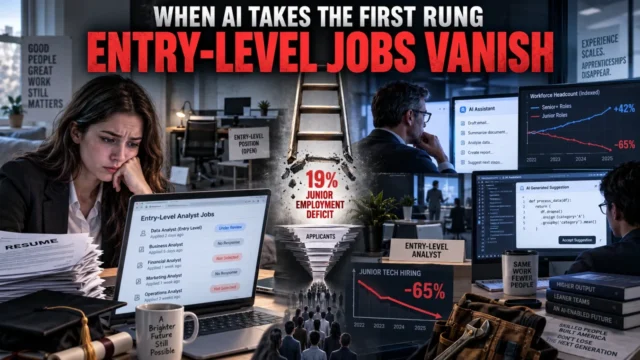
Young graduate facing shrinking entry-level job opportunities as AI reshapes corporate hiring and increases demand for experienced workers

When AI Takes the First Rung: Entry-Level Jobs Vanish

Payroll and global employment data show AI adoption is reshaping the career ladder, with junior opportunities contracting while demand for experienced workers rises. Young workers are increasingly confronting a labor market that expects senior-level judgment before they have had the chance to build it.

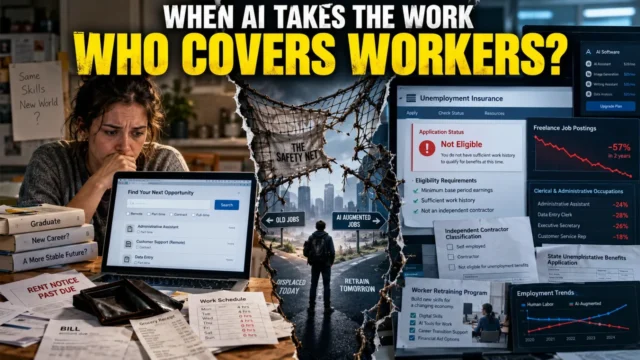
Displaced American worker facing financial pressure beside unemployment insurance documents and AI-related labor market data

When AI Takes the Work: Who Covers Workers?

AI-driven labor-market disruption is exposing long-standing gaps in US unemployment insurance, particularly for gig workers, part-time workers and new entrants. The coverage gap can leave displaced workers with little financial runway to retrain or search for suitable employment.

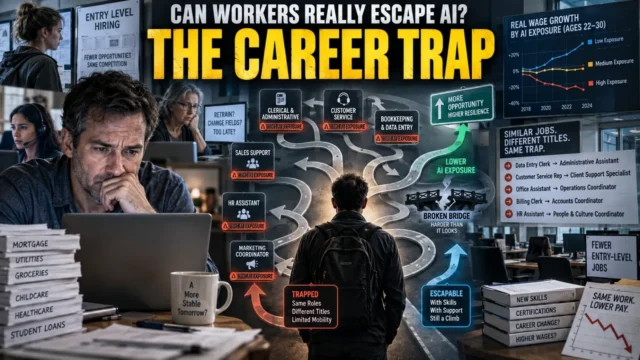
American workers navigating career transitions while AI automation threatens administrative and bridge occupations

Can Workers Really Escape AI? The Career Trap

New worker-mobility research suggests AI exposure alone does not reveal who can realistically escape automation risk. Career networks, bridge occupations, demographics and wage losses may determine who becomes trapped.

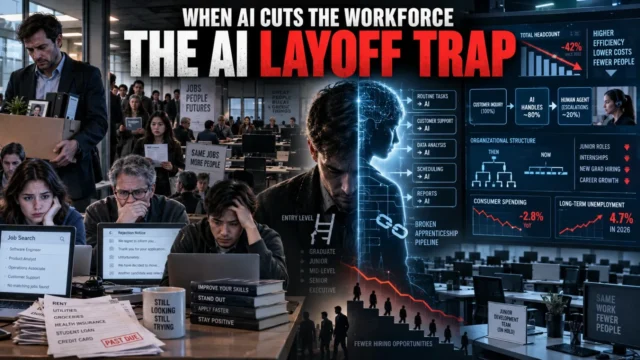
Displaced technology worker facing AI-driven restructuring, shrinking hiring opportunities and corporate automation pressures in 2026

When AI Cuts the Workforce: The AI Layoff Trap

The 2026 wave of AI-driven restructuring is cutting white-collar jobs, weakening junior hiring and intensifying competition for comparable work. Economic research and Klarna’s automation reversal reveal how aggressive cost-cutting can also damage demand, service quality and long-term talent pipelines.

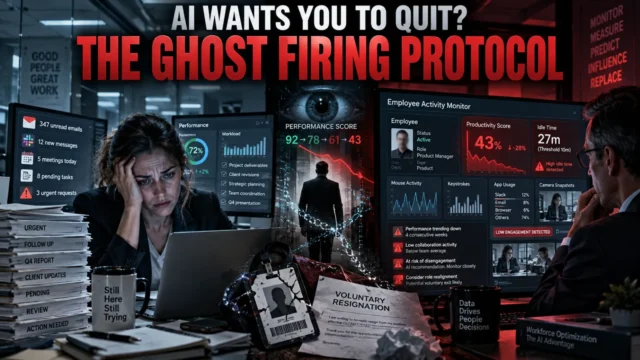
AI ghost firing and workplace surveillance pushing an exhausted American employee toward resignation

The “Ghost Firing” Protocol: How AI-Driven Management Can Push Employees to Quit

Your boss may never call you into a room and fire you. The algorithm may do something quieter. Impossible targets appear. Every idle minute becomes a metric. Meaningful projects disappear. Surveillance intensifies, performance scores deteriorate, and eventually quitting feels easier than staying. This investigation examines the emerging idea of “ghost firing”—the use of AI-driven management, workplace monitoring and psychological pressure to create conditions that can push employees out without a conventional layoff.

White-collar professional worker at computer looking stressed about AI job displacement, office setting showing career uncertainty and pay cuts

How AI Is Quietly Destroying White-Collar Careers: The Hidden Pay Cuts and Job Degradation Workers Face

AI isn’t replacing white-collar jobs instantly—it’s degrading them through brutal pay cuts and deskilling. Professional writer Jacqueline Bowman saw her salary slashed 50% after being demoted to “AI editor,” spending twice the time cleaning up algorithmic errors. Journalist Mateusz Demski was fired and replaced by synthetic AI avatars. This is “AI workslop”—a purgatory where knowledge workers become digital janitors. Companies grow revenue 15% while freezing headcount, eliminating entry-level positions that built the middle class. The real crisis isn’t mass unemployment tomorrow—it’s the structural erosion of professional careers happening right now, creating a “silicon ceiling” that traps workers in precarious, low-paid AI supervision roles while executives enrich shareholders.