
The Human Cost of the Coverage Gap
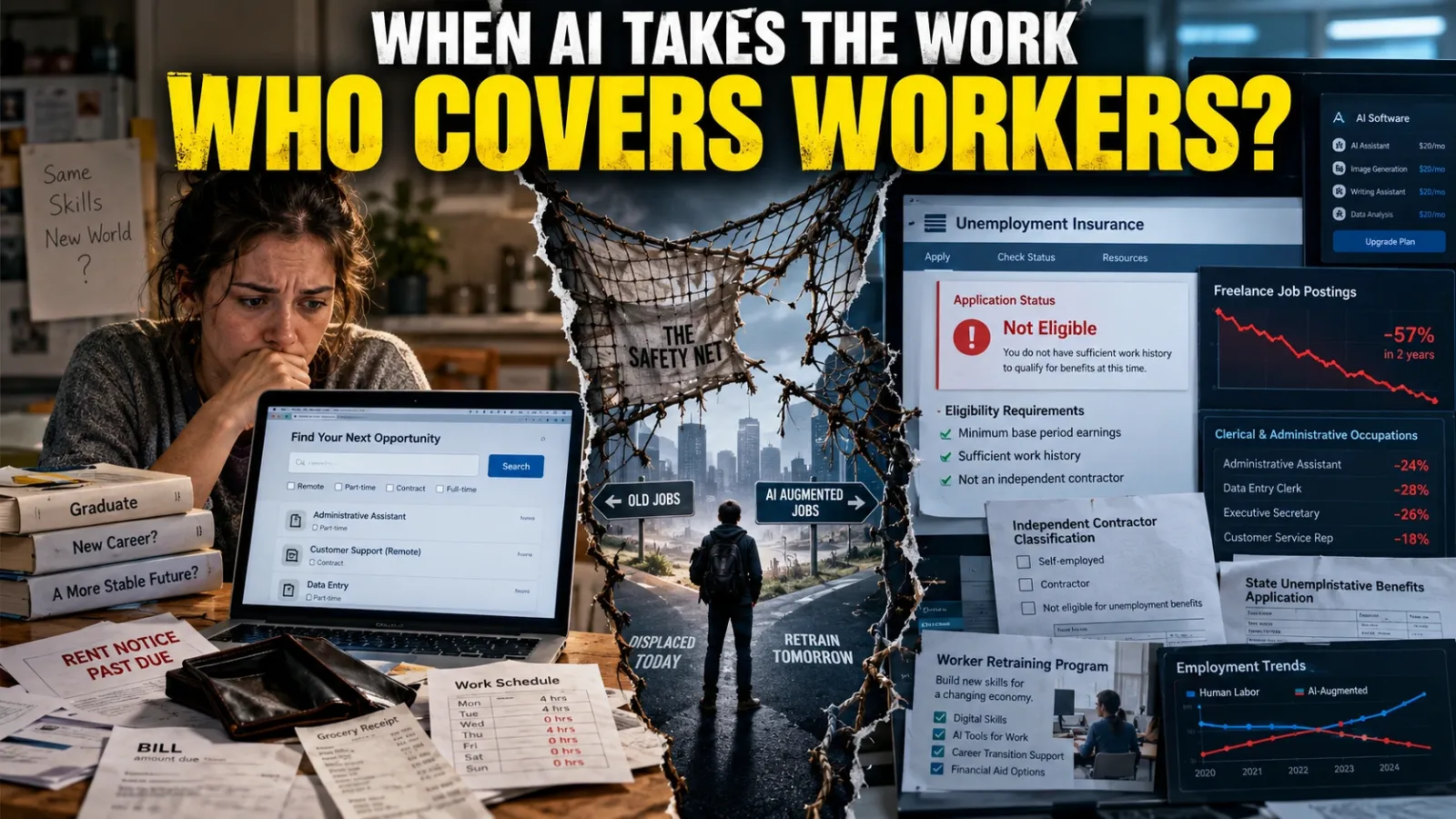
When workers lose their jobs without the backing of unemployment insurance, the economic shockwave hits their households immediately. Traditional UI provides temporary, partial wage replacement so that laid-off individuals can meet basic needs and sustain household consumption while searching for suitable new employment. Without these benefits, workers operating without a financial cushion face severe hardship, as they simply cannot afford to wait for a job that matches their skill level.
The financial fragility of the American workforce makes this lack of coverage particularly dangerous. According to the Federal Reserve Board’s 2025 Survey of Household Economics and Decisionmaking, 37 percent of respondents reported they could not finance a $400 emergency expense with cash or its equivalent. For these families, a sudden loss of income translates directly into missed rent payments, food insecurity, and deferred medical care.
This immediate poverty trap has been further exacerbated by recent legislative reductions to broader federal support systems. The 2025 congressional budget reconciliation bill, known as the One Big Beautiful Bill Act, enacted deep funding cuts to key social safety net programs including the Supplemental Nutrition Assistance Program (SNAP) and Medicaid. These cuts significantly reduced the alternative relief options available to unemployed or underemployed workers when their earned income is abruptly interrupted.
New entrants to the labor market face identical barriers, suffering long-term consequences before their careers even begin. Every year, millions of recent graduates attempt to enter the workforce, such as the 1.2 million high school graduates and 1.2 million bachelor’s degree recipients in 2024. Because they lack a sufficient work history to meet state earnings thresholds, they are disqualified from receiving UI, resulting in reduced lifetime earnings and slower career progression relative to older peers.
How AI is Rewriting the Labor Market
The scale of AI-driven job displacement is rapidly coming into focus, revealing a labor market undergoing an unprecedented restructuring. Analysis indicates that artificial intelligence has recently reduced monthly payroll growth by roughly 16,000 jobs in the United States, raising the unemployment rate by 0.1 percent. Globally, the International Monetary Fund estimates that nearly 40 percent of jobs could be affected by AI, with routine occupations facing the highest threat levels.
Certain demographics and sectors are bearing the brunt of this technological transition. Research from the International Labour Organization suggests that 2.3 percent of global employment, or roughly 75 million jobs, is at risk of automation due to high exposure to generative AI technology. Because the highest exposure lies in clerical support roles—such as customer service workers and administrative secretaries—women are estimated to be 2.5 times more exposed to automation risks than men.
While automation creates efficiencies, it also generates intense anxiety regarding the ultimate ceiling of human job losses. The World Economic Forum predicts that while AI will create 133 million new jobs, it will concurrently displace 75 million workers, widening existing skills gaps. Note: Claims regarding potential unemployment rates reaching as high as 20 percent, such as those attributed to Anthropic CEO Dario Amodei, remain speculative estimates that require editorial caution, as they are not currently supported by mainstream labor market consensus.
Despite the uncertainty of exact projections, the structural nature of this shift draws historical comparisons to some of the nation’s deepest economic crises. Some analysts draw parallels to the Great Depression, noting that while AI-driven unemployment may not reach the 25 percent peaks seen in 1933, the impact will be permanent rather than tied to a cyclical economic recovery. This permanence means that displaced workers cannot simply wait for their old roles to return; they must adapt or face lasting exclusion from the modern economy.
The Freelance Split and the Gig Worker Trap
The theoretical risks of AI displacement became a concrete reality for independent contractors over the past two years, serving as an early warning for the broader economy. An estimated 16.5 million self-employed individuals and gig workers operated in the U.S. in 2025, representing a massive labor pool that is legally excluded from the UI system. Because gig platforms classify these workers as independent contractors, companies avoid paying into unemployment insurance pools, leaving the workers entirely exposed when demand evaporates.
Within months of major generative AI deployments, routine freelance tasks were heavily absorbed by automated systems. Studies tracking millions of freelance job postings across 61 countries captured a massive shockwave, with deep declines in demand for commodity digital labor. Clients quickly realized that they could utilize generative AI directly for basic tasks, collapsing the floor of the freelance marketplace.
| Freelance Sector | Estimated Decline in Job Postings | Market Context |
|---|---|---|
| Copywriting & Content | -30.37% | Businesses internalized routine text generation using AI models. |
| Software & App Dev | -20.62% | AI coding assistants reduced demand for entry-level programming. |
| Graphic Design | -17.01% | Automated image generation replaced templated and stock design work. |
Table 1: Reductions in global freelance job postings for automation-prone categories.
Simultaneously, corporate spending behavior shifted dramatically away from human freelancers toward software subscriptions. Corporate financial data indicates that companies with the highest exposure to AI substituted roughly one dollar of reduced freelance spend for every three cents spent on AI tools. This means that AI is not replacing freelance spend dollar-for-dollar; rather, companies are realizing steep discounts and reinvesting the savings, permanently erasing that income from the independent labor pool.
However, the freelance market did not disappear entirely; it split into two extremes. While gig workers doing commodity work felt a brutal squeeze, specialists who adapted early to supervise or build upon AI tools saw their earnings rise by 40 to 60 percent. Unfortunately, displaced gig workers lacking UI benefits rarely possess the financial runway required to retrain and transition into these higher-paying, tech-augmented roles, trapping them at the bottom of a collapsing market.
A 1930s Safety Net in a 2026 Reality
The architectural flaws of the current safety net become glaringly apparent when contrasted with the realities of AI-driven workforce displacement. Established in the 1930s, the UI system was explicitly built to serve as an automatic macroeconomic stabilizer during temporary, cyclical economic downturns. It operates on the assumption that a laid-off worker will eventually return to their previous industry or a highly similar role once broader consumer demand recovers.
Because the system was never designed to manage sweeping structural transformations of the labor market, its qualification metrics are rigid and outdated. UI requires workers to meet minimum W-2 earnings thresholds over a continuous 12- to 24-month base period, a metric that effectively ignores the fragmented income streams of the modern gig economy. Part-time workers are also frequently excluded, with 4.8 million involuntary part-time workers in 2025 routinely denied benefits due to insufficient earnings histories or state mandates requiring full-time job searches.
This rigid design leads to massive underutilization of the safety net, even among those who might theoretically qualify. Data from the U.S. Bureau of Labor Statistics revealed that nearly 75 percent of potentially eligible unemployed workers in 2022 did not apply for or receive benefits. Disparate state-by-state rules, complicated application platforms, and confusion surrounding eligibility criteria actively deter individuals from seeking the help they desperately need.
The consequences of state-level administrative flexibility are vast geographic inequalities in worker protection. During the pandemic-era benefit expansions, some regions like California achieved UI recipiency rates as high as 90 percent, effectively shielding their local populations from ruin. In contrast, states like Florida saw recipiency rates hover at just 25 percent, as short benefit durations and restrictive portals caused claimants to exhaust their limited lifelines prematurely.
Consumption Smoothing vs. The Moral Hazard Debate
Understanding the human impact of these exclusions requires looking at the core economic mechanisms that unemployment insurance is meant to support. Economists emphasize the concept of “consumption smoothing,” which is the ability of a household to maintain a baseline standard of living despite a sudden loss of primary income. Historical data demonstrates that a 10 percentage point increase in the UI replacement rate shrinks the initial drop in a family’s consumption by 2.7 percent upon losing a job.
Without UI, the financial drop-off is exceptionally steep for the average worker. Over measured historical periods, the average fall in household consumption for the unemployed was 7 percent. Economic models suggest that in the complete absence of unemployment insurance, this sudden drop in consumption would be over three times as large, creating catastrophic ripple effects for local businesses that rely on consumer spending.
Critics of expanding the safety net often point to the risk of “moral hazard,” arguing that providing generous unemployment benefits disincentivizes job searching and artificially prolongs unemployment spells. However, recent economic literature evaluating safety nets in transitional economies suggests that these fears are frequently overstated. Studies demonstrate that the perceived moral hazard is often minimal compared to the profound liquidity constraints that actually keep workers from securing adequate employment.
Furthermore, rushing uninsured workers back into the labor market destroys economic value. When displaced workers are terrified of insolvency, they are forced to accept the first available low-wage position, creating severe human capital mismatches. Moderate levels of unemployment insurance actually increase overall labor productivity by granting workers the time to find roles that genuinely match their skills, rather than accepting substandard work out of desperation.
Retraining, Wage Insurance, and the Path Forward
For workers permanently displaced by algorithms, simply securing a new job is rarely a complete solution to their financial woes. Research indicates that job displacement causes severe and persistent long-term earnings losses, with full-time workers previously earning $15 an hour or less experiencing a 13 percent reduction in earnings even six years after losing their jobs. A substantial portion of this financial damage occurs because workers lose highly valuable, non-transferable, employer-specific skills when their industry undergoes automation.
Traditional workforce retraining programs have historically struggled to bridge this earnings gap for displaced adults. Generic technological literacy programs often fail to yield strong employment outcomes because they do not align with the granular ways businesses actually deploy AI. Experts stress that to be effective, retraining initiatives must be domain-specific, hands-on, and developed in direct partnership with employers to ensure workers learn the specific judgment calls required to oversee AI outputs.
To combat the steep financial penalty of structural displacement, policy experts have proposed establishing a permanent federal wage insurance program. Modeled after the Reemployment Trade Adjustment Assistance (RTAA) framework, this policy would temporarily subsidize the earnings of displaced workers who take new jobs that pay less than their previous roles. By cushioning the financial blow, wage insurance makes reemployment more attractive and prevents the negative psychological and economic effects associated with long-term non-employment.
The empirical evidence supporting wage insurance interventions is exceptionally strong. Evaluations of the RTAA program showed that wage insurance eligibility increased short-run employment probabilities by 8 to 17 percentage points and reduced initial non-employment durations by approximately one calendar quarter. Furthermore, the program increased workers’ cumulative earnings by over $18,000 across four years, demonstrating that targeted financial support can successfully guide workers through structural labor market transitions.
The Jobseeker’s Allowance and Legislative Push
As the limitations of the traditional safety net become undeniable, a consensus is building among policymakers around the need for urgent legislative reform. Think tanks and labor advocates are increasingly pointing to the Unemployment Insurance Modernization and Recession Readiness Act of 2025 as a critical step forward. This Senate proposal is aimed at fundamentally updating the federal-state Extended Benefits program to ensure it meets the realities of the modern workforce.
A central mechanism of this modernization effort is reforming the economic “triggers” that initiate extended support. Under the proposed legislation, additional weeks of unemployment benefits would automatically become available when a state’s total unemployment rate hits 5.5 percent, or when it rises 0.5 percentage points above its lowest recent average. Furthermore, the legislation would increase the federal financing of these extended benefits to 100 percent, removing the financial burden from individual states during crises.
Beyond fixing traditional UI, a foundational pillar of these reform discussions is the creation of a permanent “Jobseeker’s Allowance” (JSA). The JSA is designed as a modest weekly benefit specifically targeting unemployed individuals who are actively searching for work but fail to qualify for standard UI due to non-standard work histories. This federal program would finally provide a safety net for the millions of self-employed workers, independent contractors, and recent graduates who currently fall through the cracks.
Proponents argue that the Jobseeker’s Allowance would serve multiple vital macroeconomic functions in an AI-disrupted economy. Beyond providing a baseline level of consumption smoothing for vulnerable families, it would actively increase overall labor force participation by keeping displaced gig workers formally attached to the job market. When paired with modernized job counseling, such an allowance could provide the necessary financial stability for workers to undergo retraining and transition into emerging, high-productivity sectors.
What Happens Next
The trajectory of the U.S. labor market over the next decade hinges entirely on how swiftly social infrastructure can adapt to technological realities. If the Unemployment Insurance system remains rigidly tied to 20th-century models of W-2 employment, the workforce will continue to rapidly fracture. AI-driven productivity gains will concentrate wealth among corporate entities and highly skilled adapters, while millions of uninsured, displaced workers slip into prolonged financial distress.
Conversely, proactive and aggressive policy interventions could transform this AI disruption into an opportunity for broad-based economic growth. Implementing modernization tools like the Jobseeker’s Allowance, targeted wage insurance, and employer-partnered retraining would provide the connective tissue required to safely guide workers through occupational shifts.
The timeline for these structural adjustments is shrinking rapidly. As generative models continue to improve at a staggering rate, establishing a resilient, inclusive social safety net is no longer simply an issue of economic justice. It has become an absolute baseline requirement for maintaining the stability and purchasing power of the American economy.
Sources (45)
- equitablegrowth.org — What happens to u s workers without access to unemployment insurance amid econom
- goldmansachs.com — The jobs ai is likely to boost and those it may disrupt
- equitablegrowth.org — Why unemployment insurance alone is not enough in the ai era
- scribd.com — Impact of Artificial Intelligence on Unemployment 1 4
- ilo.org — Minimizing negative effects ai induced technological unemployment
- gatesnotes.com — A turbulent ai era and critical choices to make
- brookings.edu — Workforce policy for the age of ai
- pmfias.com — Employment in the ai era need strengths challenges
- privatebank.jpmorgan.com — Jobs in the ai revolution disruption today growth tomorrow
- yipinstitute.org — The benefits gap a 20th century safety net in a 21st century workforce
- equitablegrowth.org — The coronavirus recession exposes how u s labor laws fail gig workers and indepe
- cambridge.org — 6551EE8797327E2FA88BEF27BDB94FEE
- yipinstitute.org — The gig economy safety net gap gen z and worker protections
- usa.gov — Unemployment benefits
- dol.gov — Unemployment insurance
- en.wikipedia.org — Unemployment benefits
- nelp.org — National partners offer new comprehensive proposal to strengthen unemployment pr
- finance.senate.gov — Ui section by section summary
- research.upjohn.org — Viewcontent.cgi
- hamiltonproject.org — A plan to reform the unemployment insurance system
- manhattan.institute — Targeted unemployment insurance
- americanprogress.org — Strengthening unemployment protections in america
- nelp.org — Executive Summary Strengthening Unemployment Protections in America
- theguardian.com — Tories target universal credit claimants plan condemned fast track to poverty
- econspeakers.org — Alexander hertel fernandez
- epi.org — Alexander hertel fernandez
- equitablegrowth.org — An unemployment insurance modernization bill now before the u s senate is a much
- reddit.com — Is there any model of unemployment insurance
- economics.mit.edu — Productivity%20Gains%20from%20Unemployment%20Insurance
- nber.org — W33450
- nber.org — W13967
- ideas.repec.org
- tandfonline.com — 00220388.2022.2096444
- economics.yale.edu — Gerard naritomi jobdisplcons ada ns
- actuary.org — Ai and the moral hazard problem in health insurance
- commission.europa.eu — S2 2 p marimon et al
- winvesta.in — Ai cut freelance rates 30 how top earners fight back
- mediabistro.com — Freelance writing jobs in the age of ai what the data says and how to position y
- upwork.com — Will ai replace writers
- fueler.io — Case studies of freelancers using ai to earn more
- aibmag.com — Ai replacing customer service 2026 case studies
- jobbers.io — Ai vs human freelancers the 2025 displacement report
- asapp.com — Ai customer service use cases top 5 examples
- blackthorn-vision.com — Ai use cases
- cdp.com — Ai use cases for marketers


Leave a Reply