
The Four-Figure Commute: How Predatory Financing and Bloated Vehicles Turned Car Ownership Into a Mortgage
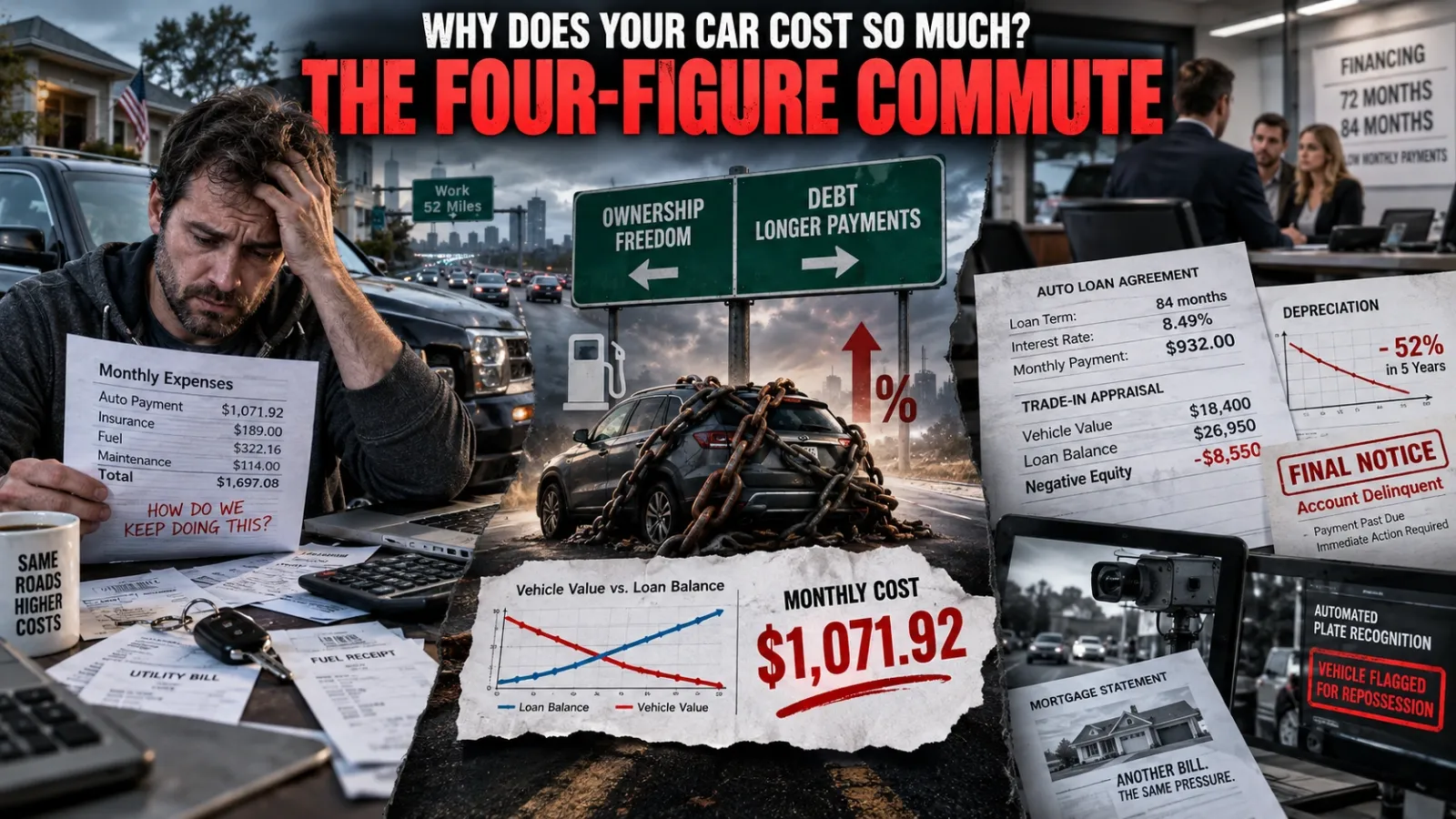
The American dream of the open road has collided with a harsh macroeconomic reality, transforming the personal vehicle from a symbol of freedom into a crippling financial anchor. On September 15, 2026, the American Automobile Association (AAA) released its annual Your Driving Costs analysis, revealing that the average cost to own and operate a new vehicle has surged to an unprecedented $12,863 per year. For the average American driver, this translates to $1,071.92 every month, effectively turning car ownership into a secondary mortgage for millions of working households.
This milestone arrives at a precarious moment for the American working class, whose budgets are already stretched to the breaking point by persistent inflation and elevated interest rates. Data from the Bureau of Labor Statistics indicates that housing and transportation now consume more than 50 percent of all household spending. For families commuting from distant suburbs to urban employment centers, the automobile is an absolute necessity, yet it now demands 17 percent of their annual household expenditures.
The consequences of this financial burden extend far beyond mere inconvenience, fundamentally altering the economic mobility of ordinary workers. Delinquencies on auto loans are hitting record highs, negative equity is trapping buyers in perpetual debt cycles, and an emerging gig economy of artificial intelligence and surveillance technology is accelerating vehicle repossessions. As federal consumer protections face aggressive rollbacks under a changing administrative regime, the modern automotive market has engineered a perfect storm that extracts wealth from those least able to afford it.
The Mathematics of the Four-Figure Commute
The staggering $1,072 monthly cost of vehicle ownership is not solely the result of higher sticker prices, though the sales-weighted average manufacturer’s suggested retail price (MSRP) for a new vehicle now sits at a formidable $39,376. The true financial damage stems from a confluence of hidden and recurring costs that remain largely invisible to consumers until long after they have signed their financing agreements. Depreciation remains the single largest expense, erasing a weighted average of $4,422 in vehicle value each year from the moment it leaves the dealership. This invisible tax on ownership heavily outweighs routine, visible expenses like maintenance, insurance, or fuel.
The push for electric vehicles (EVs), long championed as a cost-saving alternative to gasoline dependency, presents a particularly brutal financial paradox for working-class buyers. AAA’s 2026 data shows that EV charging costs—averaging 18 cents per kilowatt hour—are 66 to 70 percent lower than fuel costs for traditional gas vehicles. However, massive depreciation and higher financing fees completely nullify these operational savings at the point of resale or trade-in. For example, electric medium sedans depreciate twice as fast as their gas-powered counterparts, pushing their total ownership costs 29 percent higher annually than comparable internal combustion models.
Consequently, lower-income buyers who stretch their budgets to participate in the green transition often find their net wealth severely diminished by the time they need to upgrade or replace their vehicle. Hybrids currently represent one of the few reliable refuges from this mathematical trap. They successfully combine meaningful fuel savings with a slower rate of depreciation, making them cheaper to own annually than both pure electric and traditional gas models across multiple vehicle categories, including sedans, compact SUVs, and pickup trucks. However, the initial purchase price of hybrids still requires consumers to take on larger principal loan amounts, exposing them to elevated finance charges derived from aggressive interest rates.
Bloated Vehicles and the Policy Loophole
A significant driver of escalating vehicle costs is the physical size of the vehicles themselves, a trend deeply intertwined with federal policy. For years, automakers have exploited the “footprint loophole” within the Corporate Average Fuel Economy (CAFE) standards. By engineering larger trucks and SUVs with a wider wheelbase and track, manufacturers are subject to more lenient minimum fuel economy requirements. This regulatory quirk has incentivized the systematic elimination of smaller, affordable sedans from the American market, replacing them with massive, highly profitable SUVs and pickup trucks that drain household budgets.
Consumers are consequently pushed into larger, more expensive vehicles they do not necessarily need, absorbing the higher initial purchase price and the subsequent operational costs. The AAA analysis notes that a half-ton pickup truck costs substantially more per mile to operate than a small sedan, yet consumer choices are increasingly restricted by what automakers choose to produce and market. The financial weight of these bloated vehicles becomes acutely apparent when examining long-distance transit. A 2026 analysis of auto shipping versus driving costs revealed that driving a modern vehicle across the country burns significantly more capital than simply paying a logistics company to move it.
| Distance Traveled | Typical Shipping Price | Estimated Driving Cost (Gas, Hotels, Wear) |
|---|---|---|
| 450 miles | $950 | $250 |
| 1,100 miles | $1,400 | $1,000 |
| 1,700 miles | $1,650 | $1,450 |
| 2,750 miles | $1,950 | $2,350 |
When accounting for gas, hotel stays, tire wear, and the steep depreciation added by long highway miles, the break-even point between shipping and driving a car sits at approximately 2,000 miles. This dynamic underscores how expensive operating a personal vehicle has become in 2026. The simple act of driving a bloated, heavy SUV on a cross-country trip now incurs thousands of dollars in rapid depreciation and fuel costs, rendering the classic American road trip an expensive luxury.
Drowning in the Negative Equity Trap
The most devastating consequence of inflated vehicle prices and higher borrowing costs is the explosion of negative equity. This phenomenon occurs when a consumer owes more on their auto loan than the vehicle is currently worth on the open market. In the second quarter of 2026, data from Edmunds revealed that 29.6 percent of all new-vehicle purchases involving a trade-in carried negative equity. This represents a massive financial hazard for families who are forced to replace a vehicle due to sudden lifestyle changes, mechanical failures, or growing household sizes.
To cope with unaffordable monthly payments, consumers are increasingly stretching their auto loans to perilous lengths. Dealerships routinely arrange 72-month or 84-month financing terms to lower the immediate monthly payment, mathematically guaranteeing that the vehicle will depreciate faster than the principal is paid down. When these buyers inevitably return to the dealership three or four years later, they are met with catastrophic rollover debt. In the first quarter of 2026, the average negative equity rolled into a new loan hit an astonishing $7,183.
| Year | Share of Trade-ins with Negative Equity | Average Amount of Negative Equity |
|---|---|---|
| 2020 | 37.2% | -$5,845 |
| 2021 | 23.1% | -$4,246 |
| 2024 | 23.9% | -$6,255 |
| 2025 | 26.6% | -$6,754 |
| 2026 (Q2) | 29.6% | -$6,884 |
The compounding effect of this rollover debt creates a financial black hole for working families. Buyers who roll negative equity into a new purchase face an average monthly payment of $932, which is $159 above the broader market average. Over the life of these extended loans, underwater buyers will pay an estimated $15,663 in total interest alone, compared to just $9,592 for the average buyer. The debt burden has become so severe that in late 2025, a record 27 percent of underwater trade-ins carried five-figure negative equity, meaning the buyer owed $10,000 or more above the car’s actual value. Edmunds analysts note that this is largely a hangover from the pandemic era, where inventory shortages forced consumers to pay above MSRP for vehicles that have since suffered steep, normalized depreciation. Even vehicles traditionally known for holding their value, such as the Chevrolet Silverado 1500 and Jeep Grand Cherokee, are seeing average negative equity balances well above $7,000 when traded in.
A comprehensive June 2024 report by the Consumer Financial Protection Bureau (CFPB) laid bare the systemic risks of this practice. The agency found that consumers who finance negative equity from a prior loan into a new loan were more than twice as likely to have their account assigned to repossession within two years compared to those with a positive trade-in. Furthermore, these consumers displayed significantly larger loan-to-value (LTV) and payment-to-income (PTI) ratios, highlighting how the industry heavily leverages borrowers with lower average credit scores and lower household incomes. For vehicles priced at $20,000 or less, negative equity financed made up 23 to 25 percent of the total vehicle price, demonstrating how the burden disproportionately crushes lower-income buyers.
The Subprime Debt Engine Revs Up
As households struggle to absorb these escalating costs, the foundational cracks in the auto lending market have become impossible to ignore. According to the Federal Reserve Bank of New York, outstanding auto loan debt reached a record $1.713 trillion in the second quarter of 2026. Auto loans now represent the second-largest category of consumer debt in the United States, accounting for 9.1 percent of all household debt and trailing only residential mortgages.
This massive debt load is rapidly souring, particularly among younger and economically vulnerable populations. In the second quarter of 2026, 5.49 percent of all auto loan balances transitioned into serious delinquency, defined as being 90 days or more past due. The crisis is distinctly generational and deeply uneven. Approximately 4.83 percent of auto balances held by borrowers aged 18 to 29 transitioned into serious delinquency, a rate nearly three times higher than that of borrowers in their sixties.
The reliance on subprime lending continues to act as a dangerous propellant for this crisis. Borrowers with credit scores below 620 accounted for 16.1 percent of all new auto loan volume in the second quarter of 2026. For these consumers, nonprime interest rates guarantee exorbitant monthly payments, pushing the average new-vehicle payment for subprime and nonprime borrowers above $800. With real wages struggling to keep pace with these fixed transportation costs, a single financial emergency—such as a medical bill or a sudden reduction in work hours—is often enough to trigger a default.
The pressure on the working class is vividly illustrated by data from the Bureau of Labor Statistics’ Consumer Expenditure Survey. In 2024, the average household spent $78,535 annually, with housing and transportation accounting for over 50 percent of that total. Transportation expenditures alone averaged $13,318 per year, eclipsing the $10,169 spent on food. For lower-income households, the burden is exponentially worse. Internal banking data suggests that lower-income families spend a significantly higher share of their monthly income just on gasoline compared to affluent drivers, placing them at the mercy of volatile energy markets on top of their fixed loan costs.
AI, Surveillance, and the Gig Economy of Repossession
When defaults inevitably occur, borrowers face a hyper-efficient, technologically advanced repossession infrastructure that has fundamentally altered the grace period of automotive debt. Private companies have successfully turned vehicle surveillance into a lucrative gig economy, crowd-sourcing the tracking of delinquent borrowers. Using Automatic License Plate Recognition (ALPR) cameras mounted to personal vehicles, private individuals can now earn direct commissions by scanning plates and locating cars flagged for repossession.
This decentralized network captures millions of data points daily, effectively creating a real-time, unregulated geographic map of American drivers. Companies operating these ALPR networks boast that highly active “scanners” can generate over $8,000 a month in passive income simply by driving through apartment complexes, retail parking lots, and residential neighborhoods. Agents can earn up to $55 per vehicle recovered, alongside tiered bonuses based on the sheer volume of license plates captured and uploaded to central databases.
Further accelerating this process are artificial intelligence platforms that track vehicles without the need for traditional GPS hardware. Systems like LoanBridge.ai aggregate data from impound lots, law enforcement records, and private tow logs to close the loop between lenders and recovery agents. By integrating directly into repossession assignment systems, these AI platforms can drop vehicle recovery times from a sluggish seven days to just a few hours. While these technologies dramatically improve the balance sheets of subprime auto lenders by reducing storage and impound fees, they subject ordinary citizens to continuous commercial surveillance.
Privacy advocates note that this data is frequently retained and shared without consumer consent, transforming the private hardship of loan default into a profitable data commodity. Legislative pushback has been slow and largely ineffective. For example, Illinois introduced HB 5151 in early 2026 to regulate how ALPR data is collected, stored, and shared by private operators and law enforcement. However, the bill remains stalled in committee, highlighting the regulatory inertia surrounding surveillance technology in the automotive finance sector. State laws currently present a disjointed patchwork; as of late 2025, only 23 states had statutes or rules regulating the use of ALPRs, leaving millions of drivers exposed to unregulated tracking.
The Great Regulatory Retreat
As the financial and surveillance pressures on consumers mount, the federal regulatory safety net designed to protect them is systematically unraveling. In early 2025, the Fifth Circuit Court of Appeals vacated the Federal Trade Commission’s (FTC) Combating Auto Retail Scams (CARS) Rule on procedural grounds, citing a failure to issue an Advance Notice of Proposed Rulemaking. The CARS Rule was specifically designed to mandate total price transparency and eliminate deceptive “junk fees” that dealerships routinely pack into the final moments of a financing negotiation.
With the primary federal rule invalidated, regulatory agencies have been forced to retreat to a piecemeal, case-by-case enforcement strategy. In March and April of 2026, the FTC sent warning letters to 97 auto groups regarding deceptive pricing practices. These practices included advertising prices that excluded mandatory fees, required massive undisclosed down payments, or conditioned the vehicle’s price on using the dealer’s specific financing. While the FTC and state attorneys general have secured occasional victories—such as a $4 million settlement with a Connecticut Nissan dealership for falsely low prices and unwanted add-ons—industry analysts note that warning letters lack the systemic deterrence of a codified federal mandate. Consumers are left highly vulnerable to bait-and-switch tactics on the showroom floor.
Simultaneously, the Consumer Financial Protection Bureau (CFPB) is undergoing a massive structural shift under new acting leadership that openly favors aggressive deregulation. Reports indicate the agency has reduced its workforce by 88 percent—equating to 1,500 employees—and slashed its auditing operations in half. Examiners who remain are reportedly required to adhere to a “Humility Pledge,” signaling a stark departure from the agency’s previously robust consumer advocacy stance. This dismantling of federal oversight effectively gives the auto finance industry free rein to dictate terms to vulnerable populations.
For families attempting to navigate the complex arithmetic of trade-in valuations, interest rate markups, and extended warranties, this regulatory retreat means they are entirely on their own against sophisticated, profit-driven financial institutions. Consumer advocates warn that without rigorous CFPB supervision, predatory lending practices—such as pushing subprime borrowers into loans they fundamentally cannot afford—will rapidly proliferate unchecked across the nation.
What Happens Next
The transition of the automobile from an accessible tool of economic mobility to an exclusive, mortgage-like financial burden will have profound cascading effects on the American economy. As average monthly payments permanently normalize above $1,000, working-class families will be forced to drastically alter their broader financial behaviors just to stay afloat. Discretionary spending, retirement contributions, and saving for homeownership will inevitably be sacrificed to keep the family car in the driveway and avoid the immediate devastation of an ALPR-assisted repossession.
Vehicle ownership cycles will extend far beyond historical norms, with consumers clinging to aging vehicles well past 100,000 miles simply to avoid the punitive financing costs of the modern auto market. This delayed replacement cycle will severely impact the secondary market, creating a persistent shortage of affordable, reliable used cars for the lowest-income demographics. As older cars become more expensive to maintain, lower-income workers will face a perilous choice between insurmountable repair bills or predatory financing for a newer model.
In the absence of federal intervention, state attorneys general will likely attempt to fill the regulatory void using localized consumer protection laws, often referred to as “Little FTC Acts,” to target egregious dealership markups and deceptive financing. However, a patchwork of state laws will do little to alter the macroeconomic reality of a $1.713 trillion auto debt bubble. Until systemic changes are made to how vehicles are sized, priced, financed, and regulated, the four-figure commute will remain a grim, mandatory toll on the American working class.
Sources (33)
- badcredit.org — Why new cars cost 1072 a month to own according to aaa
- newsroom.aaa.com — Aaa new vehicle ownership costs hit 12863 annually
- mwg.aaa.com — September 15 2026
- magazine.northeast.aaa.com — Aaa new vehicle ownership costs hit 12863 annually
- shipacarinc.com — Is it cheaper to ship a car or drive
- edmunds.com — Q2 new vehicle purchases with negative equity trade ins hit record monthly payme
- edmunds.com — Edmunds insights q1 2026 report
- edmunds.com — Edmunds q4 2025 insights report
- b2b.kbb.com — Negative equity trade in challenges dealers
- hallmarksubarubirmingham.com — 5 ways a up front payment changes your auto loan
- consumerfinancemonitor.com — Cfpb issues report on negative equity in auto financing
- newyorkfed.org — Hhdc
- lendingtree.com — Debt statistics
- kaplancollectionagency.com — Are auto loans becoming the next subprime crisis
- foxbusiness.com — New york fed finds credit card auto loan delinquencies remain elevated
- newsblaze.in — The true annual cost of owning a car 5724
- bls.gov — Housing and transportation accounted for 50 percent of household spending in 202
- bls.gov — Cex
- institute.bankofamerica.com — Consumer gas affordability
- autoblog.com — This company is turning surveillance and auto repos into a gig economy
- motorolasolutions.com — License plate recognition camera systems
- automotiveventures.com — Why we invested loanbridge ai
- legislativeanalysis.org — Automatic License Plate Recognition Systems Summary of State Laws
- ailawtracker.org — Government
- consumerfinancemonitor.com — Ftc sends warning letters about pricing to 97 auto groups
- dealerre.com — F i compliance checklist
- consumerfinancialserviceslawmonitor.com — Auto finance
- providers-administrators.com — What to expect in 2026 new rules and regulations on the horizon
- nclc.org — Auto finance
- kahnandassociates.com — Auto consumer protection laws
- consumerfed.org — What everyone can learn from california s fight against predatory auto lending
- reddit.com — Every year cars keep growing in size what needs
- commercebank.com — The real cost of owning a car


Leave a Reply