
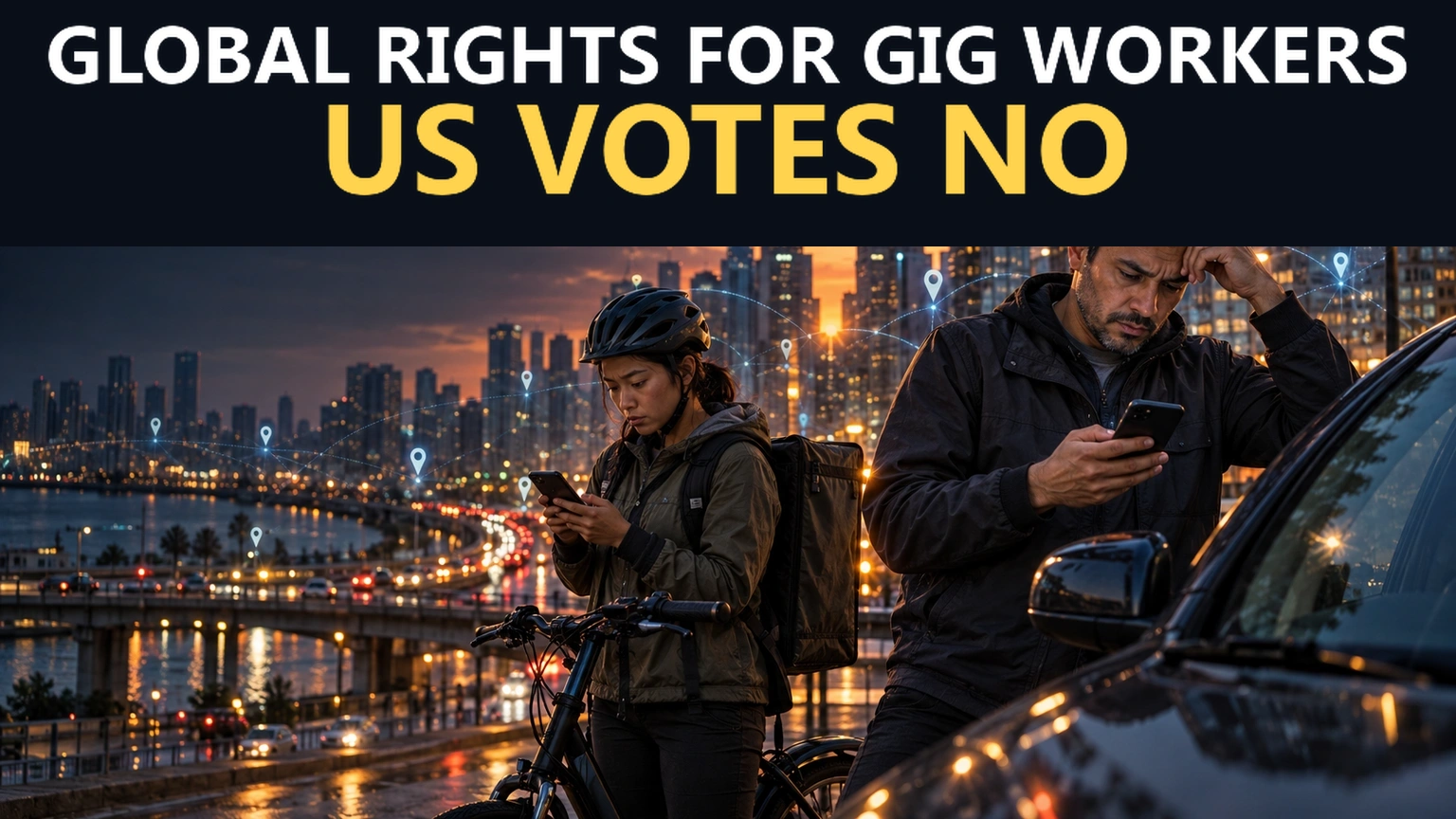
Fired by an Algorithm, Protected by a Treaty: Inside the Historic Global Mandate for Gig Worker Rights
On June 12, 2026, the international community fundamentally altered the legal architecture of the digital economy. Gathering in Geneva, the International Labour Conference adopted the Decent Work in the Platform Economy Convention, No. 193. It is the first binding international treaty dedicated exclusively to establishing a minimum floor of labor rights for the rapidly expanding, highly unregulated global gig workforce. The landmark instrument was adopted by an overwhelming majority, securing 406 votes in favor to 8 against, with 36 abstentions, signaling a definitive global consensus that technological innovation can no longer serve as an automatic exemption from basic human rights at work.
For the estimated 150 million to 435 million individuals worldwide who earn their living through ride-hailing, food delivery, online freelancing, and digital care work, the treaty represents a monumental shift. For the better part of a decade, the digital platform economy has thrived on a model of worker misclassification—labeling essential laborers as “independent contractors” to circumvent statutory minimum wages, occupational safety standards, unemployment insurance, and the right to collective bargaining. Convention 193 confronts this paradigm directly, imposing unprecedented transparency mandates on the artificial intelligence systems that manage workers and guaranteeing fundamental rights regardless of how a worker’s employment status is classified in a corporate terms-of-service agreement.
Yet, the adoption of Convention 193 also exposes a deep fracture in global labor policy. The United States—home to the world’s largest and most influential technology platforms—was one of the few governments to vote against the treaty. As the global community moves to rein in the untethered power of algorithmic management, American gig workers find themselves caught in a localized deregulatory undertow. With federal rules swinging backward and state legislatures preempting local labor standards, the divergence between international human rights standards and domestic economic policy in the United States has never been starker.
The Human Architecture of the Platform Economy
To understand the necessity of Convention 193, one must examine the profound human consequences of the economic model it seeks to regulate. The digital platform economy did not merely optimize the matching of supply and demand; it fundamentally severed the legal and ethical relationships between capital and labor. By categorizing workers as independent micro-entrepreneurs, digital platforms successfully shed the traditional, hard-won obligations of an employer. The consequences for ordinary people and families—particularly those from marginalized or immigrant backgrounds—have been severe and compounding.
According to 2021 data from the Pew Research Center, roughly 16 percent of adults in the United States have engaged in gig work through an online platform, with 31 percent of current or recent gig workers relying on it as their absolute primary source of income. This reality sharply contradicts the early corporate narrative that platform work was merely a supplementary “side hustle” meant to help people monetize a spare bedroom or a few hours of free time on the weekend. Today, it is a structural pillar of the broader economy. Yet, without the safety net of minimum wage laws or collective bargaining, these workers are highly vulnerable to poverty-level compensation.
Independent nonprobability surveys, including case-level data collected and synthesized by human rights researchers, have indicated that the true financial picture of gig work is often bleak. After deducting critical work-related expenses that are entirely offloaded onto the worker—such as vehicle depreciation, maintenance, fuel, and insurance—the median wage for some platform workers can plummet to as low as $5.12 per hour. This shifts the fundamental financial risks of doing business away from multi-billion-dollar corporations and places it squarely on the shoulders of individuals who possess virtually zero bargaining power.
Beyond financial distress, the human toll is measured in acute physical and psychological harm. Ride-hailing drivers and delivery couriers face intense, algorithmic pressure to meet speed and acceptance-rate metrics. This digital gamification of labor increases the risk of traffic accidents, physical injury, and chronic stress. Because these workers are classified as independent contractors, they are routinely denied access to workers’ compensation, paid medical leave, or employer-sponsored health insurance. When a courier is injured in an intersection while delivering food, the financial devastation falls entirely on their family and the public social safety net, while the platform assumes zero liability.
This dynamic extends far beyond transportation and logistics. The platform model has rapidly expanded into the domestic and care sectors. Home-based carers, disability support workers, and nurses—roles predominantly filled by women and migrant workers—are increasingly booked, tracked, and paid through digital apps. This platformization fragments continuity of care into discrete, poorly compensated, billable tasks. It injects the precarity and surveillance of gig work into essential human services, stripping marginalized workers of protections while subtly degrading the quality of care provided to vulnerable populations.
The Strategy of Evading the Employment Relationship
Legal scholars and labor analysts have increasingly argued that this evasion of labor standards was not an accidental byproduct of new technology, but the core design of the business model. In a comprehensive analysis of ILO Convention 193 published by Wolters Kluwer, legal expert Jeffrey Vogt unpacks the historical context of platform corporate strategy. He notes that the digital platform economy built its global footprint on a bedrock of strategic illegality.
Editorial caution: The characterization of platform business models as systematically evasive relies heavily on leaked internal documents, whistleblower testimony, and subsequent critical legal analysis. Corporate entities within the platform economy frequently dispute these allegations in ongoing litigation and public relations campaigns, maintaining that their operations offer lawful, flexible earning opportunities that workers actively prefer over traditional employment.
Nevertheless, historical leaks from major platform companies, including internal documents from Uber executives dating back to the company’s aggressive global expansion phase, demonstrated an overt strategy of overriding local regulations. As noted in the Wolters Kluwer analysis, former senior executives openly described the company’s operations as intentionally illegal at the time, operating under a deliberate philosophy to break the law, demonstrate the service, and subsequently lobby to change the law to legalize their disruption.
To sustain this model, platforms utilized aggressive legal mechanisms. They forced workers to sign terms of service laced with indemnity clauses, mandatory individual arbitration agreements, and choice-of-law provisions that routed legal disputes to distant, corporate-friendly jurisdictions. The strategy was to make it financially and logistically impossible for a wronged worker to seek justice in an open court. By maintaining the legal fiction that platform workers were just independent contractors utilizing a piece of software, companies exempted themselves from paying the minimum wage, contributing to social security, providing protection from discrimination, and recognizing the rights of workers to organize. Convention 193 was engineered explicitly to dismantle the legal loopholes that permitted this exact brand of regulatory arbitrage.
Decent Work in the Platform Economy: The Status-Agnostic Revolution
The foundational breakthrough of ILO Convention 193 is its structural design. Recognizing that previous national regulatory efforts were constantly defeated by corporate legal maneuvering over complex employment definitions, the ILO drafted a treaty that is radically “status-agnostic”.
Article 1 of the Convention broadly defines a “digital platform worker” as any individual engaged in platform-mediated work for remuneration, explicitly stating that this applies “regardless of their classification of status in employment”. This seemingly simple phrasing is a seismic shift in international labor law. It means that the core protections of the treaty attach to the individual simply because they are a human being performing platform work. Whether a local court, a state legislature, or a corporate terms-of-service agreement labels the individual an “employee,” a “partner,” or an “independent contractor” becomes entirely irrelevant to the threshold question of whether their fundamental human rights apply.
At the heart of the instrument is Article 9, which enshrines the “primacy of facts” principle. For years, platform companies relied on the sanctity of the standard-form contract; if the contract said the worker was an independent business owner, courts were expected to take that at face value. Article 9 shatters this defense. It requires Member States to ensure the correct classification of platform workers guided mainly by the empirical facts of how the work is actually performed and controlled, rather than by the boilerplate labels inserted into a contract.
As the Wolters Kluwer analysis points out, this mirrors the reasoning of landmark judicial decisions like the UK Supreme Court’s ruling in the Aslam case. In that instance, the court looked past the contractual label of “partner” to examine the reality of control—who dictated the fares, who determined the routes, who managed the ratings, and who controlled the acceptance of trips. Under Article 9, if a platform exercises this level of control, the reality of that subjugation supersedes any contractual language.
During the arduous negotiations in Geneva, global employer groups fiercely resisted this provision, successfully blocking the inclusion of a mandatory legal presumption of employment within the treaty. However, the resulting text—mandating that states must “ensure” correct classification based on facts—still provides powerful legal scaffolding. It strongly encourages national legislatures to adopt burden-shifting laws, where the platform must prove the worker is genuinely independent, rather than placing the impossible burden of proof on the marginalized worker.
Piercing the Black Box: Algorithmic Management and Human Review
Perhaps the most visceral consequence of the platform economy is the total subjection of the human worker to artificial intelligence. In traditional employment, a worker can reason with a manager, explain a delay, or appeal a disciplinary action. In the platform economy, workers are managed by opaque algorithms that harvest granular data—location, speed, braking severity, acceptance rates, and customer reviews—to optimize corporate efficiency.
Workers are routinely penalized or outright fired through automated “deactivation” without ever interacting with a human being. A delayed delivery due to extreme weather, or a fraudulent complaint from a customer seeking a refund, can trigger an algorithm to instantly sever a worker’s ability to earn a living.
Convention 193 takes dead aim at this digital dystopia through Articles 13 through 17, which establish unprecedented global standards for algorithmic management. First, the treaty mandates algorithmic transparency. Platforms must proactively disclose the existence and operation of automated systems to workers and their representatives. This disclosure requirement is revolutionary because it opens the operation of the algorithm—a previously fiercely guarded corporate trade secret—to collective bargaining and regulatory scrutiny.
Furthermore, platforms are required to use these systems “responsibly,” a term the Convention expressly ties to fundamental rights. An algorithm cannot be utilized to detect and punish union organizing, to implement discriminatory pricing or work allocation based on a worker’s background, or to enforce work intensities that are incompatible with a safe and healthy workplace.
Crucially, Article 15 establishes the worker’s right to an explanation and a genuine human review of significant adverse decisions. When an algorithm freezes a worker’s pay, suspends their account, or permanently deactivates them, the worker is legally entitled to have that decision reviewed by a human. As noted in European case law—such as recent rulings by the Amsterdam Court of Appeal—this human review cannot be a mere symbolic act or a rubber-stamp by a low-level customer service representative. It must involve meaningful human involvement by personnel authorized to override the algorithm and reverse the decision. By forcing humanity back into the management loop, the Convention seeks to dismantle the digital cages that have isolated and terrorized platform workers for years.
The Right to Organize and the Defeat of the Competition Law Trap
The isolation of the gig worker is not merely a technological feature; it has been enforced by a perverse application of traditional law. Historically, one of the greatest obstacles to platform workers organizing to demand better wages has been competition and antitrust law. Because platform workers are nominally classified as independent contractors—essentially, individual business entities—any attempt by them to collectively bargain for higher rates has been treated by authorities as an unlawful price-fixing cartel.
This legal trap left vulnerable delivery drivers subjected to the same anti-collusion laws designed to prevent multinational corporations from price gouging. Under Article 3 of Convention 193, this paradox is resolved. The treaty obliges each Member State to respect, promote, and realize fundamental principles and rights at work for all platform workers, with freedom of association and the effective recognition of the right to collective bargaining explicitly placed first.
On the face of the text, even the genuinely self-employed platform worker is owed the right to freedom of association. This provides a clear, international legal mandate for nations to carve out solo self-employed platform workers from competition rules, allowing them to form unions and negotiate collectively without the threat of antitrust prosecution.
The inclusion of these rights was hard-fought. The International Organisation of Employers (IOE) and aligned corporate groups have historically resisted broad interpretations of ILO conventions, most notably engaging in a decades-long dispute over whether the fundamental right to strike is inherently protected under ILO Convention No. 87 on Freedom of Association. That dispute was only recently settled by a landmark advisory opinion from the International Court of Justice, which affirmed that the right to strike is indeed a fundamental corollary to freedom of association. Against this backdrop of intense corporate resistance to collective labor rights, the explicit guarantees in Convention 193 represent a vital victory for worker solidarity in the digital age.
The Wage Compromise and Occupational Safety
While Convention 193 makes sweeping guarantees regarding algorithmic transparency and collective bargaining, the issue of strict remuneration required a difficult diplomatic compromise. During negotiations, the line between traditional employment and genuine independent contracting became a fierce battleground regarding minimum wage floors.
Under Article 10, the Convention guarantees every platform worker—regardless of their employment status—that whatever remuneration is due to them must be paid in full and subject only to lawful deductions, effectively importing the protections of the historic Protection of Wages Convention. Article 11 supplies the vital counterpart of pay transparency, requiring platforms to give workers timely, accurate, and easily understandable information on their pay and deductions, which is critical to fighting the unilateral clawbacks that plague gig work.
However, the guarantee of a statutory minimum wage and mandatory compensation for work-related expenses (like vehicle fuel and maintenance) applies strictly only to those platform workers who are classified as employees in an employment relationship. For the millions of workers remaining outside of that formal relationship, governments are merely directed to “give consideration” to extending minimum-wage measures to them. While this represents a real obligation for states to evaluate wage floors in good faith, it stops short of mandating universal minimum pay for all gig workers, leaving a significant loophole for platforms to exploit in jurisdictions that lack aggressive enforcement.
Despite this compromise on wages, the Convention holds a hard line on occupational safety and health (OSH). Recognizing that platform business models inherently push workers to take physical risks to earn a living, the Convention establishes that the primary OSH duty sits with the party controlling the organization of work—the platform. This duty reaches both physical hazards, such as road traffic risks and musculoskeletal strain, and psychological risks stemming from algorithmic strain and online harassment. It extends the protections of the ILO Violence and Harassment Convention to cover abuse from third-party customers, and guarantees the absolute right of workers to withdraw themselves from work posing an imminent and serious danger without facing algorithmic retaliation or deactivation.
| Global Gig Economy: Comparative Market and Regulatory Data (2026) | |
|---|---|
| Global Platform Workforce Estimate |
150 million to 435 million individuals |
| U.S. Gig Economy Participation (Adults) |
~42 million (approx. 16% of U.S. adults) |
| India Gig Workforce Projection (by 2030) |
23.5 million (approx. 6.7% of non-agricultural workforce) |
| ILO Convention 193 Adoption Vote |
406 In Favor; 8 Against; 36 Abstentions |
| U.S. Government Official Vote |
Against |
| India Government Official Vote |
Abstained |
Washington’s Dissent: The U.S. Regulatory Undertow
The global consensus achieved in Geneva casts a harsh, critical light on the United States. The American government delegates were among the isolated minority to vote against the adoption of Convention 193. This rejection did not occur in a vacuum; it occurred against the backdrop of a highly volatile, fiercely contested domestic labor landscape where corporate interests exercise immense influence over public policy.
The United States currently lacks a unified, coherent federal approach to the platform economy, leaving the fates of millions of workers swinging wildly depending on which political party occupies the executive branch and the ideological leanings of state legislatures. At the federal level, the regulatory environment is actively regressing. In February 2026, the U.S. Department of Labor issued a Notice of Proposed Rulemaking regarding independent contractor classification under the Fair Labor Standards Act. The proposed rule effectively rescinds the more worker-friendly guidelines established by the Biden administration in 2024, replacing them with a framework heavily modeled on restrictive, Trump-era policies.
This 2026 proposed rule reorganizes the “economic reality” analysis to focus almost entirely on two core factors: the nature and degree of control, and the worker’s opportunity for profit or loss. By narrowing what legally counts as “control”—treating algorithmic scheduling and app-based task allocation much more leniently than direct human supervision—the federal government is actively constructing a massive tailwind for platform employers. It provides federal cover for gig companies to continue classifying their workforce as independent contractors, directly contradicting the spirit of ILO Convention 193’s “primacy of facts” directive.
With the federal government retreating from aggressive labor enforcement, the battle for gig worker rights has devolved to the states, resulting in a chaotic and often deeply inequitable patchwork of laws. Progressive municipalities have attempted to pass local ordinances raising the minimum wage for platform workers and guaranteeing basic health standards. However, these grassroots efforts are frequently crushed by conservative state legislatures utilizing the blunt legal instrument of preemption.
Throughout the American South in particular, state lawmakers have passed sweeping preemption laws that strip local city councils of the authority to enact labor standards that exceed the state minimum. This state-level interference carries profound demographic and racial implications. In the United States, platform work is heavily concentrated among immigrants, people of color, and low-income individuals. Preemption laws are predominantly passed by majority-white state legislatures to intentionally block the policy initiatives of diverse, urban municipalities whose residents desperately need these economic protections. It is a systemic legislative strategy that deliberately limits the political and economic power of vulnerable populations, ensuring they remain locked in precarious, low-wage labor conditions.
Even in deeply progressive states like California, legislative victories for workers have been repeatedly undermined by unprecedented corporate spending. In 2020, major platform companies spent well over $200 million to successfully pass Proposition 22, a ballot initiative that explicitly exempted them from a state law requiring them to classify their drivers as employees. Furthermore, technology companies continue to aggressively litigate against emerging state protections; for instance, in early 2026, Elon Musk’s artificial intelligence company xAI filed a federal lawsuit seeking to block a new Colorado law designed to prevent algorithmic bias in employment decisions. The U.S. vote against ILO Convention 193 must be viewed through this specific domestic lens: it reflects a political environment where corporate lobbying heavily suppresses labor policy, and where the fundamental concept of universal worker protection has been subordinated to the demands of algorithmic capitalism.
Global Ripples and Transnational Accountability
While the United States remains highly resistant to the tenets of Convention 193, the treaty’s reach extends far beyond the borders of the nations that actively support it. The platform economy is inherently transnational. A digital labor platform may be headquartered in Silicon Valley, host its servers in Ireland, employ software engineers in Eastern Europe, and deploy a black-box algorithmic management system that dictates the wages of ride-hailing drivers in Nairobi, delivery couriers in Mexico City, and data annotators in Manila.
Historically, platform companies have exploited this borderless reality through complex jurisdictional evasion. Buried deep within the terms of service that workers must blindly accept to access an app are “choice-of-law” clauses. These clauses often stipulate that any legal dispute between the worker and the company must be resolved under the laws of the company’s home jurisdiction. For an underpaid courier in a developing nation, suing a multi-billion dollar tech giant under California law is a logistical and financial impossibility.
Convention 193 addresses this geographic asymmetry directly. Article 19 explicitly dictates that the terms and conditions of platform work should “preferably” be governed by the laws of the country where the work is actually performed. By attempting to anchor legal accountability to the physical location where the labor occurs and the worker resides, the Convention seeks to prevent platforms from seamlessly relocating their legal risk to distant, corporate-friendly tax havens. Furthermore, it mandates that where intermediary sub-contractors or fleet owners are used, member states must enact clear laws allocating responsibilities and legal liability between the parent platform and the intermediary, preventing corporations from hiding behind layers of subcontractors.
The global consensus around these rules is reshaping domestic policy in rapidly developing economies. Mexico, for example, recently cited its own domestic platform labor reforms—which brought hundreds of thousands of gig workers into the formal social security system—as a driving force behind the successful ILO negotiations, providing a blueprint for how national law and international standards can mutually reinforce one another. Conversely, in India—which boasts a rapidly expanding gig workforce projected to hit 23.5 million by 2030—the government chose to abstain from the Convention vote. Despite passing the Code on Social Security in 2020 to recognize gig workers, India cited a doctrine of domestic regulatory caution, highlighting the immense tension developing nations face between protecting their vulnerable workers and fearing that strict algorithmic transparency and labor costs might stifle vital digital innovation and foreign investment.
Importantly, Article 23 of the Convention establishes an uncompromising floor of equal treatment. It demands that platform workers be treated “no less favourably” than comparable workers with the same employment status in the traditional economy. This non-discrimination mandate ensures that the platform economy cannot legally function as a sub-protected, second-class labor market, forever segregated from the rights enjoyed by the rest of society.
What Happens Next
The adoption of ILO Convention 193 is a historic, paradigm-shifting achievement for the global labor movement, yet it represents only the beginning of a much longer, granular battle for enforcement and accountability. In the realm of international law, an ILO Convention becomes a legally binding treaty only on the specific member states that formally ratify it through their national legislatures. Convention 193 will officially enter into force 12 months after the first two national ratifications are formally registered with the ILO in Geneva, subsequently taking effect for each ratifying country 12 months after their respective ratification date.
Over the next several years, the true impact of the Convention will be tested in national parliaments across Europe, Latin America, and Asia. In regions where domestic legislation regarding platform work is already advancing, ratification will serve to lock in these gains, harmonize standards across borders, and provide a bulwark against future corporate lobbying efforts seeking to roll back protections.
In the United States, formal ratification of Convention 193 by the Senate is virtually impossible in the near term. The U.S. government’s overt “no” vote in Geneva reflects deep, structural opposition to international labor mandates, meaning the 42 million Americans navigating the gig economy cannot rely on a swift, treaty-based federal rescue.
However, the absence of U.S. ratification does not render the Convention powerless within American borders. The text of Convention 193 now exists as the definitive, globally recognized legal framework for what constitutes fair treatment and human dignity in the digital age. It provides a highly detailed, internationally vetted blueprint for local worker organizations, labor unions, and progressive state legislatures.
Grassroots organizing networks, such as Rideshare Drivers United and Gig Workers Rising, have already spent years fighting algorithmic exploitation block by block, city by city, often relying on strikes and public pressure to win incremental gains. Armed with the moral and legal weight of Convention 193, these advocacy groups can point to an established international standard to push state lawmakers to adopt the specific tenets of the treaty—such as the right to genuine human review of deactivations, total algorithmic transparency, and the primacy of facts over contract labels—into state-level legislation. The Convention also provides a powerful, persuasive framework for civil rights lawyers challenging discriminatory algorithmic practices in federal courts, arguing that these global norms reflect an evolving standard of basic human rights that technology companies can no longer simply ignore.
Ultimately, the survival of the platform economy’s exploitative model has relied heavily on the enforced invisibility and isolation of its workforce. The proprietary algorithms were explicitly designed to isolate workers, preventing them from communicating with one another, sharing vital wage data, or collectively challenging their digital bosses. ILO Convention 193 tears down that veil of invisibility. It asserts, with the full backing of the international community, that an app is not an excuse for human exploitation, an algorithm is not above the law, and the human being behind the steering wheel—or the screen—retains their fundamental rights, no matter what a tech company’s terms of service claim. The treaty has established the baseline; it now falls to lawmakers, judges, and the workers themselves to force the platforms to comply.
Source List
-
socialprotection.org/publications/convention-concerning-decent-work-in-the-platform-econom
-
tascplatform.org/whats-new/ilo-convention-no-193-a-global-framework-for-decent-work-in-the…
-
legalblogs.wolterskluwer.com/global-workplace-law-and-policy/ilo-convention-193-on-decent-…
-
facebook.com/ILO.ORG/posts/the-new-ilo-convention-no-193-on-decent-work-in-the-platform-ec…
-
podcast.ilo.org/episode/decent-work-in-the-platform-economy-how-a-new-global-labour-standa…
-
ilo.org/resource/article/new-ilo-convention-platform-work-offers-important-safeguards-work…
-
privacyinternational.org/advocacy/5693/ilo-convention-decent-work-platform-economy
-
drishtiias.com/daily-updates/daily-news-analysis/ilo-convention-no-193-on-decent-work-in-t…
-
drishtiias.com/daily-updates/daily-news-analysis/ilo-convention-no-193-on-decent-work-in-t…
-
facebook.com/ILO.ORG/posts/the-new-ilo-convention-no-193-on-decent-work-in-the-platform-ec…
-
itforchange.net/joint-statement-on-ilo-convention-on-decent-work-platform-economy/
-
socialprotection.org/publications/convention-concerning-decent-work-in-the-platform-econom
-
itforchange.net/joint-statement-on-ilo-convention-on-decent-work-platform-economy/
-
legalblogs.wolterskluwer.com/global-workplace-law-and-policy/ilo-convention-193-on-decent-…
-
botpopuli.net/can-can-the-new-ilo-convention-on-decent-work-in-the-platform-economy-advanc…
-
legacyias.com/editorials-opinions-analysis-for-upsc-30-july-2026/
-
nextias.com/ca/current-affairs/31-07-2026/ilo-convention-193
-
mexicobusiness.news/talent/news/mexico-cites-platform-labor-reform-push-ilo-standard
-
onlabor.org/a-win-for-platform-workers-ilo-convention-no-193/
-
legalblogs.wolterskluwer.com/global-workplace-law-and-policy/ilo-convention-193-on-decent-…
-
onlabor.org/a-win-for-platform-workers-ilo-convention-no-193/
-
botpopuli.net/can-can-the-new-ilo-convention-on-decent-work-in-the-platform-economy-advanc…
-
legalblogs.wolterskluwer.com/global-workplace-law-and-policy/ilo-convention-193-on-decent-…
-
mexicobusiness.news/talent/news/mexico-cites-platform-labor-reform-push-ilo-standard
-
legacyias.com/editorials-opinions-analysis-for-upsc-30-july-2026/
-
digitalapplied.com/blog/gig-economy-freelance-statistics-2026-data-points
-
gigeconomydata.org/basics/how-many-gig-workers-are-there.html
-
jobbers.io/gig-economy-statistics-2026-the-definitive-data-report/
-
precisionbusinessinsights.com/market-reports/gig-economy-market
-
legalblogs.wolterskluwer.com/global-workplace-law-and-policy/ilo-convention-193-on-decent-…
-
onlabor.org/every-worker-should-know-about-washington-aluminum/
-
legalblogs.wolterskluwer.com/global-workplace-law-and-policy/evaluating-the-international-…
-
legalblogs.wolterskluwer.com/global-workplace-law-and-policy/evaluating-the-international-…
-
onlabor.org/the-icj-upholds-a-right-to-strike-under-convention-no-87-in-a-landmark-opinion
-
onlabor.org/the-icj-upholds-a-right-to-strike-under-convention-no-87-in-a-landmark-opinion
-
legalblogs.wolterskluwer.com/global-workplace-law-and-policy/the-right-to-strike-under-ilo…
-
ilo.org/sites/default/files/2026-06/ILC114-Provisional-List-Delegations.pdf
-
techpolicy.press/why-gig-platform-wage-theft-is-a-governance-crisis/
-
legal500.com/intelligence/united-states/employment-and-hr/a-look-ahead-employment-law-tren…
-
ilo.org/sites/default/files/2026-06/ILC114-Provisional-List-Delegations.pdf
-
littler.com/news-analysis/littler-report/wpi-labor-day-report-ten-issues-shaping-workplace…
-
littler.com/news-analysis/littler-report/wpi-labor-day-report-ten-issues-shaping-workplace…
-
littler.com/news-analysis/asap/labor-employment-world-cup-2026-us-mens-national-team-and-c…
-
researchgate.net/publication/356657774_Digitalised_management_control_and_resistance_in_pl…
-
legal500.com/intelligence/mexico/employment-and-hr/mexico-increases-the-minimum-wage-for-2…
-
legal500.com/intelligence/mexico/employment-and-hr/minimum-wage-increase-for-2026
-
littler.com/news-analysis/asap/labor-employment-world-cup-2026-us-mens-national-team-and-c…
-
frontiersin.org/journals/sociology/articles/10.3389/fsoc.2024.1456617/full
-
researchgate.net/publication/356657774_Digitalised_management_control_and_resistance_in_pl…
-
legal500.com/intelligence/mexico/employment-and-hr/mexico-increases-the-minimum-wage-for-2…
-
littler.com/news-analysis/littler-report/wpi-labor-day-report-ten-issues-shaping-workplace…
-
ilo.org/sites/default/files/2026-06/ILC114-Provisional-List-Delegations.pdf
-
legal500.com/intelligence/mexico/employment-and-hr/minimum-wage-increase-for-2026
-
ilo.org/sites/default/files/2026-06/ILC114-Provisional-List-Delegations.pdf
-
botpopuli.net/can-can-the-new-ilo-convention-on-decent-work-in-the-platform-economy-advanc…
-
onlabor.org/making-gig-work-pay-ilo-convention-193-and-remuneration/
-
oas.org/ext/es/principal/calendario/evento/moduleid/14104/id/903/lang/1/controller/item/ac…
-
oas.org/ext/es/principal/calendario/evento/moduleid/14104/id/903/lang/1/controller/item/ac…
-
rialnet.org/sites/default/files/documents/OutcomesDoc_Workshop_IAandPlatforms_Final.pdf
-
rialnet.org/sites/default/files/documents/OutcomesDoc_Workshop_IAandPlatforms_Final.pdf
-
finance.senate.gov/download/defending-and-investing-in-us-competitiveness-subcommittee-on-…
-
legalblogs.wolterskluwer.com/global-workplace-law-and-policy/evaluating-the-international-…
-
legalblogs.wolterskluwer.com/global-workplace-law-and-policy/right-to-strike-at-the-intern…
-
facebook.com/internationalorganisationofemployers/videos/gender-equality-an-important-ilc2…
-
legalblogs.wolterskluwer.com/global-workplace-law-and-policy/right-to-strike-at-the-intern…
-
legalblogs.wolterskluwer.com/global-workplace-law-and-policy/evaluating-the-international-…
-
facebook.com/internationalorganisationofemployers/videos/ittakesacommunity-alvise-giustini…
-
facebook.com/ctsp.sindika.5/posts/the-ctsp-youth-team-took-the-challenge-we-asked-the-mini…
-
facebook.com/internationalorganisationofemployers/videos/-the-356th-session-of-the-ilo-gov…
-
legalblogs.wolterskluwer.com/global-workplace-law-and-policy/the-right-to-strike-under-ilo…
-
facebook.com/internationalorganisationofemployers/videos/gender-equality-an-important-ilc2…
-
facebook.com/internationalorganisationofemployers/videos/-the-356th-session-of-the-ilo-gov…
-
facebook.com/ctsp.sindika.5/posts/the-ctsp-youth-team-took-the-challenge-we-asked-the-mini…
-
dokumen.pub/the-external-dimension-of-the-eus-policy-against-trafficking-in-human-beings-9…
-
legalblogs.wolterskluwer.com/global-workplace-law-and-policy/the-right-to-strike-under-ilo…
-
dokumen.pub/the-external-dimension-of-the-eus-policy-against-trafficking-in-human-beings-9…
-
shifttrackerapp.com/blog/gig-economy-definition-what-it-means-for-us-gig-workers
-
scribd.com/document/1040676682/03-ECON412-Gig-Economy-Labor-Market-Research
-
legalblogs.wolterskluwer.com/global-workplace-law-and-policy/ilo-convention-193-on-decent-…
-
hrw.org/report/2025/05/12/the-gig-trap/algorithmic-wage-and-labor-exploitation-in-platform…
-
hrw.org/report/2025/05/12/the-gig-trap/algorithmic-wage-and-labor-exploitation-in-platform…
-
dokumen.pub/the-gig-economy-workers-and-media-in-the-age-of-convergence-9780367690212-9780…
-
dokumen.pub/the-gig-economy-workers-and-media-in-the-age-of-convergence-9780367690212-9780…
-
edwardbetts.com/monograph/Capital_in_the_Twenty-First_Century_by_Thomas_Piketty
-
edwardbetts.com/monograph/Capital_in_the_Twenty-First_Century_by_Thomas_Piketty
-
jtnylaw.com/2026/05/independent-contractor-2026-dol-rule-new-york-misclassification/
-
researchgate.net/publication/340823562_What_Do_Platforms_Do_Understanding_the_Gig_Economy…
-
earn.us/building-a-just-and-inclusive-recovery-for-all-workers/
-
hrw.org/report/2025/05/12/the-gig-trap/algorithmic-wage-and-labor-exploitation-in-platform…
-
nelp.org/insights-research/state-agenda-americas-workers-18-ways-promote-good-jobs-states/…
-
earn.us/building-a-just-and-inclusive-recovery-for-all-workers/
-
researchgate.net/publication/340823562_What_Do_Platforms_Do_Understanding_the_Gig_Economy…
-
hrw.org/report/2025/05/12/the-gig-trap/algorithmic-wage-and-labor-exploitation-in-platform…
-
jtnylaw.com/2026/05/independent-contractor-2026-dol-rule-new-york-misclassification/
-
legalblogs.wolterskluwer.com/global-workplace-law-and-policy/the-intersection-of-forced-la…
-
legalblogs.wolterskluwer.com/global-workplace-law-and-policy/the-intersection-of-forced-la…




Leave a Reply