
The Economic Weight of Modern Premiums
The rising cost of health insurance has become a defining economic pressure for the American working class. Workers contributed an average of $6,850 out of their own paychecks toward the cost of a family premium in 2025, alongside $1,440 for single coverage. These paycheck deductions represent only the initial financial hurdle for insured families. Before their coverage even begins to pay for most services, nearly three-quarters of workers face substantial deductibles, with one in five navigating an out-of-pocket maximum exceeding $6,000.
Over the past five years, the cumulative cost of a family health plan has ballooned by 26 percent. Industry analysts note that this consistent year-over-year growth has transformed healthcare premiums into a financial obligation comparable to purchasing a brand-new compact car annually. The financial strain is not isolated to employees, as employers also absorb massive cost increases that ultimately suppress wage growth and limit hiring.
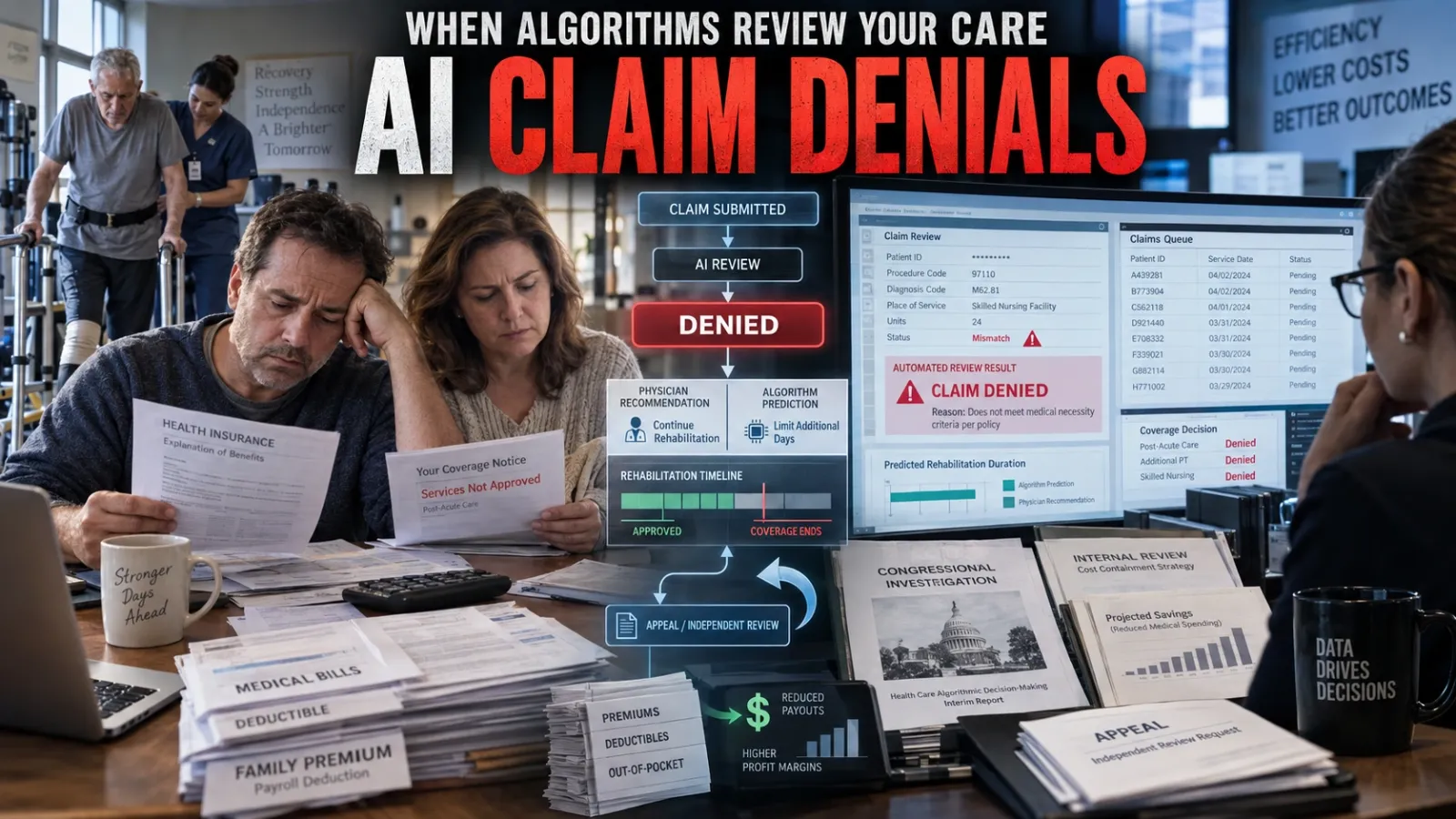
The primary justification offered for these high premiums is the escalating cost of medical services, hospital care, and prescription drugs. However, the reality of the managed care model dictates that insurers profit most when they collect maximum premiums while disbursing minimal payouts for actual medical care. To protect their margins, insurers employ prior authorization and concurrent review processes to verify the medical necessity of prescribed treatments. While originally designed to prevent fraudulent or low-value care, these cost-containment tools have increasingly morphed into automated barriers that simply refuse to pay.
| Health Insurance Metric | 2025 Average Cost | 5-Year Cumulative Increase |
|---|---|---|
| Total Family Premium | $26,993 | 26% |
| Worker Contribution (Family) | $6,850 | 23% |
| General US Inflation | N/A | 23.5% |
| Overall Wage Growth | N/A | 28.6% |
Source: Kaiser Family Foundation Employer Health Benefits Survey |
The disparity between the premiums collected and the care authorized has drawn intense scrutiny from consumer advocates. Critics argue that the modern health insurance industry operates on a model of premium extraction, where the focus has shifted from managing health risk to managing financial liability. By integrating artificial intelligence into their claims processing architecture, insurers have found a legally ambiguous method to scale their denials infinitely while keeping overhead costs virtually non-existent.
The Architecture of Algorithmic Rejection
The mechanics of mass claim denial were brought to public light through the scrutiny of Cigna’s proprietary review software, known as PxDx. The acronym stands for procedure-to-diagnosis, representing a system designed to automatically flag claims where a patient’s diagnosis code does not align with corporate-approved test criteria. Rather than triggering a manual clinical review, the software instantly cues these mismatched claims for bulk rejection. Over a two-month period in 2022, Cigna used this exact system to reject more than 300,000 requests for medical payments.
The speed at which these denials were processed defies any standard of legitimate medical review. According to internal documents and former employees, Cigna’s medical directors spent an average of just 1.2 seconds evaluating each denied claim. The system allowed corporate physicians to sign off on batches of fifty denials in roughly ten seconds, operating with a single electronic signature. Former company doctors admitted that they literally clicked and submitted these batches without ever opening a patient’s medical file or reviewing their clinical history.
The volume of work assigned to individual medical directors highlights the absurdity of the process. In the first two months of 2022 alone, one Cigna medical director rejected 121,000 claims, while two others handled more than 80,000 and 63,000 instant denials respectively. The architect behind the PxDx system, a former pediatrician turned insurance executive, defended the bulk-denial mechanism by claiming that requiring manual reviews for each rejection would add unnecessary administrative expense to medicine. He asserted that the automated formula has undoubtedly saved the corporate bottom line billions of dollars.
These algorithmic rejections frequently target routine, low-dollar claims that patients desperately need but are unlikely to fight over. Nick van Terheyden, a physician who was personally denied coverage for a medically necessary vitamin test, expressed profound frustration at having his clinical needs second-guessed by a computer algorithm. Cigna internal presentations explicitly acknowledged that adding certain routine tests to the PxDx denial list would create a negative customer experience. However, the company proceeded with the implementation because it was projected to save roughly $2.4 million annually in medical costs.
Cigna currently faces multiple class-action lawsuits in states like California, with plaintiffs alleging the insurer’s automated process violates laws requiring thorough and fair medical investigations. Regulators have warned that if medical directors are truly rubber-stamping the output of matching software without additional review, they are failing to meet basic compliance standards. Cigna has vigorously defended its technology, characterizing the reporting on PxDx as biased and asserting that the tool merely accelerates the review of incorrect coding without denying actual care.
Predicting the End of Care
While automated screening tools disrupt routine claims, predictive artificial intelligence has taken aim at the most vulnerable population in the healthcare system. Seniors enrolled in Medicare Advantage plans are increasingly subject to algorithmic models that dictate the exact duration of their recovery. UnitedHealth Group and its subsidiary, NaviHealth, are currently facing a sprawling class-action lawsuit over their deployment of a predictive algorithm known as nH Predict. This software is allegedly used to systematically deny post-acute care for elderly patients recovering from major medical events like strokes and bone fractures.
The nH Predict algorithm was reportedly trained on a database of six million historical patient records. It compares a newly admitted patient’s diagnosis, age, living situation, and physical function to this historical data to estimate the exact number of days of rehabilitation they should require. According to the lawsuit, once a patient reaches the algorithm’s predetermined expiration date, UnitedHealthcare automatically generates a coverage denial, abruptly cutting off funding for their skilled nursing facility. This algorithmic discharge is allegedly enforced regardless of the clinical reality on the ground or the explicit recommendations of the patient’s actual treating physicians.
The real-world consequences of these algorithmic limits are devastating for families. Gene Lokken, a 91-year-old Medicare Advantage beneficiary, fractured his leg and ankle and was admitted to a skilled nursing facility for rehabilitation. Despite his doctors’ advice that he required ongoing therapy, the insurer terminated his coverage after just two-and-a-half weeks based on algorithmic guidelines. His family was forced to liquidate their savings, paying up to $14,000 per month out-of-pocket to keep him safely housed in the facility until he eventually passed away.
The most damning allegation against the nH Predict tool is its astonishingly high error rate. Investigations and court documents suggest that more than 90 percent of the claim denials generated by the algorithm are ultimately overturned when patients appeal the decision to an independent judge. Insurers remain deeply insulated from this failure rate because the appeals process is notoriously complex, exhausting, and difficult for sick seniors to navigate. A recent government analysis found that Medicare Advantage members appeal only 0.2 percent of all denied claims, meaning the algorithm successfully extracts savings in the vast majority of cases simply through attrition.
The legal battle over this predictive software recently achieved a significant breakthrough in a Minnesota federal court. Judge John R. Tunheim allowed the plaintiffs’ motion to proceed with discovery, ruling that the allegations of irreparable injury justified bypassing standard administrative exhaustion requirements. The court permitted breach of contract claims to move forward, focusing on the fact that UnitedHealth’s member documents promised reviews by clinical staff and physicians, with absolutely no mention of artificial intelligence. Legal experts note that this ruling establishes a critical precedent: if an insurance adjuster cannot definitively prove they independently reviewed the AI’s output, the algorithmic decision is discoverable and legally actionable.
Congressional Scrutiny and Profit Motives
The systematic denial of post-acute care eventually caught the attention of federal lawmakers, leading to a sprawling congressional investigation. In October 2024, the Senate Permanent Subcommittee on Investigations released a scathing majority staff report detailing how the nation’s largest Medicare Advantage insurers intentionally weaponized predictive technology against seniors. The investigation, led by Senator Richard Blumenthal, analyzed hundreds of thousands of internal corporate documents from UnitedHealthcare, Humana, and CVS Health. The subcommittee concluded that these companies deliberately restricted access to costly care settings specifically to inflate their corporate profits.
The Senate report revealed a massive, unprecedented spike in denial rates that perfectly coincided with the deployment of new algorithmic tools. Between 2019 and 2022, UnitedHealthcare’s overall denial rate for post-acute services escalated from 8.7 percent to an astounding 22.7 percent. Even more drastically, the insurer’s denials for patients needing care in skilled nursing homes increased ninefold during this short three-year window. Humana exhibited similar patterns, with its denial rate for long-term acute care hospitals—the most expensive type of post-acute care—growing by 54 percent between 2020 and 2022.
These denial spikes were not accidental anomalies, but the result of carefully calculated corporate strategies. According to internal documents uncovered by the Senate, CVS launched a specific “Post-Acute Analytics” initiative in 2021 designed to utilize AI to reduce overall spending on skilled nursing facilities. While CVS initially projected this algorithmic initiative would save the company between $10 million and $15 million, the models were so ruthlessly efficient that revised projections estimated $77.3 million in savings over three years. The subcommittee also uncovered internal Humana presentations that explicitly trained staff on how to verbally justify these algorithmic coverage denials to angry healthcare providers.
The insurers fiercely pushed back against the Senate’s findings, arguing that the report fundamentally mischaracterized their clinical practices. Spokespeople for CVS Health and Humana claimed that many of the documents cited were either outdated drafts or internal deliberations that did not reflect actual patient care policies. UnitedHealthcare asserted that the investigation ignored federal criteria that actively demand greater scrutiny of expensive post-acute care spending. Despite these denials, Senator Blumenthal firmly rejected their defenses, noting that the investigation relied exclusively on the insurers’ own internal data and proprietary documents.
The core issue highlighted by the Senate is the structural financial incentive baked into the Medicare Advantage program. Because private insurers are paid a fixed capitated rate per patient by the federal government, every dollar they avoid spending on patient care directly pads their bottom line. The subcommittee’s report recommended that the Centers for Medicare & Medicaid Services (CMS) conduct targeted audits of insurers’ prior authorization data and enact stricter regulations to ensure that human workers are never bound by predictive algorithms. As Senator Blumenthal warned the industry during hearings, “If you deny lifesaving coverage to seniors, we’re watching, we will expose you.”
The Algorithmic Burden on the American Hospital
The avalanche of AI-generated prior authorization denials has pushed the American hospital system to the brink of operational collapse. Clinical staff are spending thousands of cumulative hours arguing with automated systems, desperately trying to secure approval for standard, medically necessary procedures. A comprehensive survey conducted by the American Medical Association (AMA) found that 61 percent of physicians explicitly fear that the integration of artificial intelligence into payer workflows is systematically increasing denial rates. This bureaucratic friction is not merely an administrative annoyance; 28 percent of responding doctors reported that prior authorization delays directly led to a serious adverse clinical event for their patients.
Faced with mounting administrative costs and unpaid claims, major healthcare systems are taking unprecedented steps to sever ties with Medicare Advantage networks entirely. San Diego-based Scripps Health sent shockwaves through the industry when it terminated its Medicare Advantage contracts, abruptly forcing roughly 32,000 seniors to scramble for new healthcare options. Scripps executives were unapologetic about their rationale, citing excessive prior authorization denial rates, severely delayed reimbursements, and an overwhelming administrative burden. The system’s CEO bluntly described the insurer strategy as a game of “delay, deny and not pay.”
The decision to walk away from Medicare Advantage has proven to be financially stabilizing for hospitals brave enough to take the leap. Since exiting the private Medicare contracts, Scripps Health reported that its inpatient volumes largely held steady and it ceased posting quarterly operating losses. Ratings agencies that had previously downgraded the health system quickly signaled potential upgrades based on the improved financial outlook. Other major networks have paid close attention to this success, with prominent organizations like HealthPartners in Minnesota choosing to drop UnitedHealthcare’s Medicare Advantage plans entirely by 2025.
The exodus from Medicare Advantage is rapidly gaining momentum across various geographic markets. Health systems such as St. Charles Health System in Oregon, Brookings Health System in South Dakota, and Cameron Regional Medical Center in Missouri have all terminated or severely restricted their participation in these plans. Hospital administrators universally cite the same underlying pathology: insurers are utilizing algorithms to issue blanket denials, fully expecting that hospitals will lack the staffing bandwidth to appeal every single case. This dynamic has transformed the concept of “in-network” status from a collaborative healthcare partnership into an adversarial battle of attrition.
The Safety-Net Disparity and Administrative Waste
The algorithmic denial crisis does not impact all medical providers equally, revealing deep systemic inequities within the healthcare system. A massive 2019 multipayer claims study published in Health Affairs Scholar analyzed the adjudication lifecycle of millions of medical claims, exposing severe disparities based on provider type. The data showed that Medicare Advantage plans aggressively generated the highest initial denial rates across the entire industry, hitting 20 percent for inpatient services and 16.5 percent for outpatient claims.
However, the burden of these automated denials falls disproportionately on safety-net hospitals that serve the nation’s poorest and most vulnerable populations. According to the study, safety-net providers faced uniformly higher initial denial rates across all categories, suffering a 13.6 percent denial rate for professional claims compared to just 9.2 percent for well-funded, non-safety-net facilities. Because these underfunded hospitals lack dedicated administrative armies to fight algorithmic rejections, they also suffer from significantly lower successful appeal overturn rates.
| Provider and Payer Type | Initial Denial Rate | Final Denial Rate (Post-Appeals) |
|---|---|---|
| Medicare Advantage (Inpatient) | 20.0% | 4.1% |
| Commercial Insurance (Inpatient) | 14.9% | 4.2% |
| Safety-Net Providers (Professional) | 13.6% | 7.3% |
| Non-Safety-Net (Professional) | 9.2% | 4.5% |
Source: Health Affairs Scholar Multipayer Claims Dataset Study |
The massive gap between initial denial rates and final denial rates exposes the true purpose of the algorithmic gatekeeping. Despite Medicare Advantage issuing initial inpatient denials at a staggering 20 percent rate, a massive 60.8 percent of those denials were ultimately overturned upon appeal, leaving a final denial rate of just 4.1 percent. This statistical reality proves that the algorithms are not accurately identifying fraudulent or unnecessary care. Instead, they function as a synthetic barrier designed to delay payments and extract value from providers who simply give up on the appeals process.
The financial cost of managing this artificial bureaucracy is actively draining resources away from direct patient care. Hospitals are forced to divert massive amounts of capital to hire specialized billing experts, purchase their own AI appeal software, and maintain massive revenue cycle management departments. The current system operates as a zero-sum game where billions of premium dollars are incinerated in a perpetual digital war between payer algorithms denying claims and provider algorithms appealing them.
The Legislative Backlash in the States
Recognizing the severe threat that unregulated artificial intelligence poses to patient safety, state legislatures across the country have initiated aggressive regulatory crackdowns. California has emerged as a national leader in this effort with the passage of Senate Bill 1120, officially known as the Physicians Make Decisions Act. Signed into law by Governor Gavin Newsom in September 2024 and effective January 2025, the legislation fundamentally restructures how health insurance companies are legally permitted to operate their utilization review programs.
The core mandate of California’s SB 1120 is the strict prohibition of automated medical denials based exclusively on statistical group datasets. Under the new law, any AI systems utilized by health plans must generate recommendations based on the individual enrollee’s specific clinical history and medical records. Furthermore, while AI can be used to triage and organize data, the final determination regarding the medical necessity of a requested treatment must be explicitly approved by a licensed physician or competent healthcare professional.
This legislative momentum has rapidly cascaded across other key state jurisdictions. In Texas, Governor Greg Abbott signed SB 815, which prohibits utilization review agents from issuing adverse determinations using AI without direct human oversight. Illinois enacted the Healthcare Protection Act (HB 5395), which establishes stringent guardrails targeting unchecked AI prior authorizations. Maryland similarly passed legislation banning artificial intelligence as the sole basis for medical necessity denials, requiring insurers to submit quarterly performance reports to the state insurance commissioner.
These state-level interventions have created massive operational headaches for national insurance conglomerates. Insurers are now legally required to maintain transparent audit trails proving that a human physician genuinely applied independent clinical judgment to every denied claim. SB 1120 also holds California health plans strictly liable for the actions of their third-party software vendors, dramatically raising the stakes for utilizing unregulated algorithms. Willful violations of these state standards carry the threat of severe administrative penalties, signaling an end to the era of risk-free automated rejections.
Federal Guardrails and the Transparency Mandate
As state legislatures scrambled to build local consumer protections, the federal government simultaneously overhauled the national regulatory framework for Medicare Advantage and health data interoperability. The Centers for Medicare & Medicaid Services (CMS) finalized a landmark rule (CMS-4201-F) that became fully applicable in January 2024. This regulation explicitly bans Medicare Advantage organizations from relying solely on population-level algorithms or artificial intelligence to predict patient recovery timelines or issue care denials.
CMS directly addressed the industry’s reliance on predictive tools like nH Predict, declaring that an algorithm alone cannot be used to terminate post-acute care or downgrade an inpatient admission. The federal agency mandated that insurers base all coverage determinations on individual patient circumstances, heavily factoring in the specific clinical notes and recommendations provided by treating physicians. CMS also warned insurers about algorithmic “drift,” strictly prohibiting plans from allowing machine learning tools to silently alter or restrict publicly available coverage criteria over time.
To permanently dismantle the bureaucratic delays that define the prior authorization process, CMS finalized a second, equally disruptive regulation known as the Interoperability and Prior Authorization Final Rule (CMS-0057-F). Taking operational effect on January 1, 2026, this rule imposes strict, federally mandated shot clocks on insurance decision-making. Payers are now legally required to process all standard prior authorization requests within a maximum of seven calendar days, a timeline cut entirely in half from previous industry norms.
| CMS-0057-F Workflow Element | Pre-2026 Insurance Standards | New Federal Mandate (Jan 1, 2026) |
|---|---|---|
| Standard Request Decision | Up to 14 calendar days | Maximum of 7 calendar days |
| Expedited (Urgent) Request | Varied widely by plan/payer | Maximum of 72 hours |
| Denial Justification | Often vague (“Not medically necessary”) | Must provide a specific, actionable clinical reason |
| Accountability & Metrics | Protected internal corporate data | Mandatory annual public reporting on payer websites |
Source: CMS Interoperability and Prior Authorization Metrics Guidance |
The most transformative aspect of the 2026 federal rule is the unprecedented demand for total public transparency. Insurers can no longer hide behind vague rejection letters; they are legally mandated to provide a specific, actionable clinical reason for every single prior authorization denial. Furthermore, starting in March 2026, all impacted payers must publicly publish their annual prior authorization metrics on their websites. For the first time, patients and employers will be able to directly compare the approval rates, denial rates, and average response times of competing health plans.
The Insurance Industry Defense
Faced with a barrage of legislative restrictions, class-action lawsuits, and furious medical providers, the health insurance industry has fiercely defended its use of artificial intelligence and prior authorization. America’s Health Insurance Plans (AHIP), the powerful national trade association representing the industry, insists that these utilization management tools are the only mechanisms keeping the entire healthcare system financially solvent. AHIP maintains that prior authorization is absolutely essential to promote safe, evidence-based, and affordable medical care for consumers.
The industry argues that without algorithmic oversight, unchecked provider billing would cause healthcare premiums to explode even faster. Insurers consistently point to research indicating that prior authorization successfully prevents unnecessary surgeries, restricts the use of addictive medications, and curbs wasteful spending. A study published in JAMA Health Forum supports this economic narrative, finding that Medicare Advantage beneficiaries received 9.2 percent fewer low-value medical services compared to those enrolled in traditional Medicare, largely due to the managed care strategies employed by private plans.
Addressing the outrage over automated technology, AHIP insists that artificial intelligence is being fundamentally misunderstood by the public and misrepresented by regulators. The association claims that AI is deployed primarily to read complex medical charts and instantly approve clear-cut claims, drastically accelerating the authorization process. Industry leaders vehemently deny that their algorithms are programmed to automatically reject care, maintaining that all adverse clinical decisions are still reviewed by licensed human medical professionals.
To stave off heavier federal regulation, AHIP and its member companies have launched a series of high-profile voluntary commitments aimed at self-correcting the system. By 2026, participating health plans have pledged to significantly reduce the sheer volume of medical codes subjected to prior authorization requirements and honor existing care approvals for a 90-day transition period when patients switch insurers. The industry’s ultimate technological promise is slated for 2027, when health plans intend to deploy standardized Fast Healthcare Interoperability Resources (FHIR) APIs. AHIP claims this digital infrastructure will eventually allow 80 percent of all electronic prior authorization requests to be approved in real-time, effectively eliminating the delays that currently plague the system.
What Happens Next
The American healthcare system is currently locked in a precarious transition phase between unchecked algorithmic gatekeeping and strict regulatory accountability. The activation of the CMS transparency metrics in early 2026 represents a watershed moment for consumer power. As massive insurance conglomerates are forced to publicly disclose their specific denial rates and turnaround times, large employers and union groups will finally possess the hard data necessary to negotiate better contracts or abandon highly restrictive plans entirely. This transparency threatens to expose which insurers are genuinely managing care and which are simply practicing premium extraction.
However, the technological arms race is far from over. Healthcare providers, exhausted by the administrative burden of appealing millions of algorithmic rejections, are now heavily investing in their own artificial intelligence tools. Hospitals are deploying advanced software designed to pre-screen medical claims, auto-generate clinical justifications, and rapidly submit thousands of appeals the moment a denial is registered. This dynamic virtually guarantees that the immediate future of medical billing will be dominated by provider algorithms battling payer algorithms at lightning speed, with the actual human patient caught in the digital crossfire.
Ultimately, the underlying conflict driving skyrocketing premiums remains deeply embedded in the financial architecture of privatized healthcare. Insurers have a fiduciary duty to maximize shareholder value, and deploying sophisticated technology to restrict expensive payouts will always be the most efficient strategy to achieve that goal. Until the financial incentives that reward the mass denial of medical care are fundamentally restructured, ordinary families will continue to pay exorbitant premiums into a system that relies on a computer to say no.
Sources (134)
- healthcaredive.com
- fiercehealthcare.com — Cigna hit august another lawsuit over claims denials through pxdx
- reddit.com — Cigna sued over algorithm allegedly used to deny
- nfp.com — Court allows lawsuit over ai use in benefit denials to proceed
- cbsnews.com — Cigna algorithm patient claims lawsuit
- medium.com — The algorithm said no how ai became the gatekeeper of american healthcare e2111b
- propublica.org — Cigna pxdx medical health insurance rejection claims
- medicaleconomics.com — Cigna faces second class action suit over automated claims denials
- propublica.org — Cigna health insurance denials pxdx congress investigation
- kantorlaw.net — Cigna doctors rejecting health claims without reading them
- denyback.com — Navihealth nh predict unitedhealth lawsuit medicare advantage appeal
- en.wikipedia.org — NH Predict
- youtube.com — Watch
- sacfirm.com — What hospitals can learn from the unitedhealth ai lawsuit a legal and compliance
- business-humanrights.org — Usa judge orders unitedhealth to disclose details of its use of an algorithmic t
- ijoc.org
- aiweekly.co — Unitedhealth sued over nh predict ai in medicare denials
- dlapiper.com — Lawsuit over ai usage by medicare advantage plans allowed to proceed
- hsgac.senate.gov — The senate permanent subcommittee on investigations to hold hearing on delays de
- axios.com — Senate report hits medicare advantage plans
- healthcaredive.com
- blumenthal.senate.gov — Senate permanent subcommittee on investigations releases majority staff report e
- ctmirror.org — Medicare advantage insurers blumenthal
- meritalk.com — Blumenthal seeks answers from medicare advantage insurers on ai use
- thelundreport.org — Medicare advantage insurers deny care too often blumenthal says
- leadingage.org — Analysis senate report on ma plans reveals troubling data
- wsha.org — Senate democrats release scathing report on medicare advantage denials
- insideinvestigator.org — Blumenthal releases scathing medicare advantage report
- blumenthal.senate.gov — Blumenthal and hawley press medicare advantage insurers about refusal of care fo
- kff.org — 2025 employer health benefits survey
- kff.org — What your employer based health coverage really costs
- parrottbenefitgroup.com — Summary of the kff 2025 employer health benefits annual survey
- kff.org — Employer health benefits survey
- kff.org — Annual family premiums for employer coverage rise 6 in 2025 nearing 27000 with w
- njbia.org — Kff family premiums for employer health insurance hit 27k in 2025
- kff.org
- kff.org
- cms.gov — 2024 medicare advantage and part d final rule cms 4201 f
- everyailaw.com — Cms medicare advantage
- mhk.com — Preparing for the future of prior authorization changes in the 2024 cms final ru
- reedsmith.com — Cms confirms medicare advantage organizations may use ai in making coverage
- federalregister.gov — Medicare program contract year 2024 policy and technical changes to the medicare
- ankura.com — Cms confirms new prior authorization requirements for medicare advantage in 2024
- apprisemd.com — Rac paper
- researchgate.net — Medicare advantage becoming a disadvantage with use of artificial intelligence i
- pmc.ncbi.nlm.nih.gov — PMC12979811
- legal500.com — Cms weighs in on the use of algorithms and artificial intelligence in coverage d
- aao.org — Ai use for prior authorization
- healthcaredive.com
- infinx.com — Ama poor prior authorization outcomes are negatively affecting us health
- ajmc.com — Ama survey highlights growing burden of prior authorization on physicians patien
- allzonems.com — Ai prior authorization denials physician survey
- ama-assn.org — How ai leading more prior authorization denials
- kessenick.com — Implications of californias sb 1120 for healthcare utilization
- sites.wustl.edu — Ai regulation wrapped
- healthesystems.com — State of the nation summer 2024
- horizonsearch.org
- physicianspractice.com — California law to protect ethical ai use in health care
- aapc.com — 93960 taking a stand against ai denials
- csha.info
- facs.org — Surgeons help acs drive state advocacy efforts on scope of practice other issues
- dlapiper.com — Lawsuit over ai usage by medicare advantage plans allowed to proceed
- healthcaredive.com
- havenhealthmgmt.org — Unitedhealth lawsuit can ai deny healthcare services
- pmc.ncbi.nlm.nih.gov — PMC9463603
- pmc.ncbi.nlm.nih.gov — PMC13531318
- pmc.ncbi.nlm.nih.gov — PMC13505359
- pmc.ncbi.nlm.nih.gov — PMC13492083
- healthaffairs.org — Hlthaff.2025.01373
- pmc.ncbi.nlm.nih.gov — PMC11886789
- pmc.ncbi.nlm.nih.gov — PMC11924284
- pmc.ncbi.nlm.nih.gov — PMC12723545
- govinfo.gov — GOVPUB Y4 G74 9 PURL gpo234149
- ahcancal.org — AHCA%20Statement%20for%20the%20Record
- care-directions.com — Qr
- healthaffairs.org — Hlthaff.2024.01485
- oncpracticemanagement.com — Artificial intelligence algorithms and abuse
- columbialawreview.org — Ai generated denials medical necessity in medicare advantage today
- academic.oup.com
- ajmc.com — Insurers ai denials of postacute care face senate scrutiny
- natlawreview.com — Court allows discovery insurers use ai deny claims
- webberwentzel.com — When ai rejects insurance claims
- govinfo.gov — USCOURTS mnd 0 23 cv 03514
- swept.ai — Lokken ruling ai claim denial discovery bad faith
- litigationtracker.law.georgetown.edu — Estate of gene b lokken the et al v unitedhealth group inc et al
- law.justia.com
- law.justia.com
- legalhie.com — Judge decides class action lawsuit can proceed against unitedhealth for use of a
- courthousenews.com — Memo to support UHG dismiss motion
- ahip.org — Prior authorization
- familiesusa.org — Acknowledging ahip report on prior authorization health consumer groups call for
- content.naic.org — AHIP%20Comments%208.29.25
- beckerspayer.com — How payers are embracing ais benefits and whats next ahip
- forbes.com — Marshall goldsmith on why leaders never find time to develop themselves
- ahip.org — Ahip statement for the record 7 15 26 wm markup
- timesofindia.indiatimes.com — 134433525.cms
- ahip.org — Health plans are on track to streamline prior authorization
- ahip.org — Health plans take action to simplify prior authorization
- kff.org — Regulation of ai in prior authorization and claims review a look at federal and
- ajmc.com — Through ahip payers vow to rein in prior authorization but doctors have doubts
- ahip.org — Update on health plans efforts to standardize electronic prior authorization sub
- thecoastnews.com — Two major scripps groups drop medicare advantage
- beckershospitalreview.com — 15 health systems dropping medicare advantage plans 2024
- beckerspayer.com — Medicare advantages sunk cost problem
- pnhp.org — Ppo becomes pp no providers refuse medicare advantage
- medpagetoday.com
- royjonesonwheels.com — Major hospitals are quietly dropping medicare advantage here s why
- oncologynewscentral.com — Medicare negotiation tactics put cancer care at risk
- myrgh.org — Hospitals are dropping medicare advantage plans
- pnhp.org — Hospitals are dropping medicare advantage left and right
- kffhealthnews.org — Medicare advantage payment rates friction
- facebook.com
- gphealth.org — Medicare advantage
- facebook.com
- justcareusa.org — Hospitals increasingly opt out of medicare advantage networks
- counterforcehealth.org — United healthcare medicare advantage network changes 2025
- kffhealthnews.org — Medicare advantage breakups contracts hospitals doctors patients choice
- pa.gov
- accessonepay.com — Navigating healthcare costs in a recession strategies for patients and providers
- reddit.com — Is debt from medical bills really an issue in the
- sycamoretn.org — Medical debt 101
- kff.org — 8537 medical debt among people with health insurance
- academic.oup.com
- hbs.edu — 22 045 16db6f8b 1540 440c bd62 588714a7e5b0
- ncbi.nlm.nih.gov — NBK616494
- publications.aaahq.org — Health Information Technology Investments Patient
- commercehealthcare.com — Healthcare finance trends for 2025 accelerating change
- cms.gov — Prior authorization metrics reporting overview template
- prombs.com — Prior auth 2026 provider compliance guide
- medicotechllc.com — Prior authorization medical billing 2026 cms rules
- cbhphilly.org — CBH Prior Auth Metrics CY2025 2026 03
- humanmedicalbilling.com — Cms prior authorization rules 2026 payer expectations
- centrocdx.com — Cms 0057 f prior authorization 2026
- blog.nalashaahealth.com — Cms interoperability and prior authorization final rule for payers



Leave a Reply