
Oct 5, 2026 · @Som Bentur
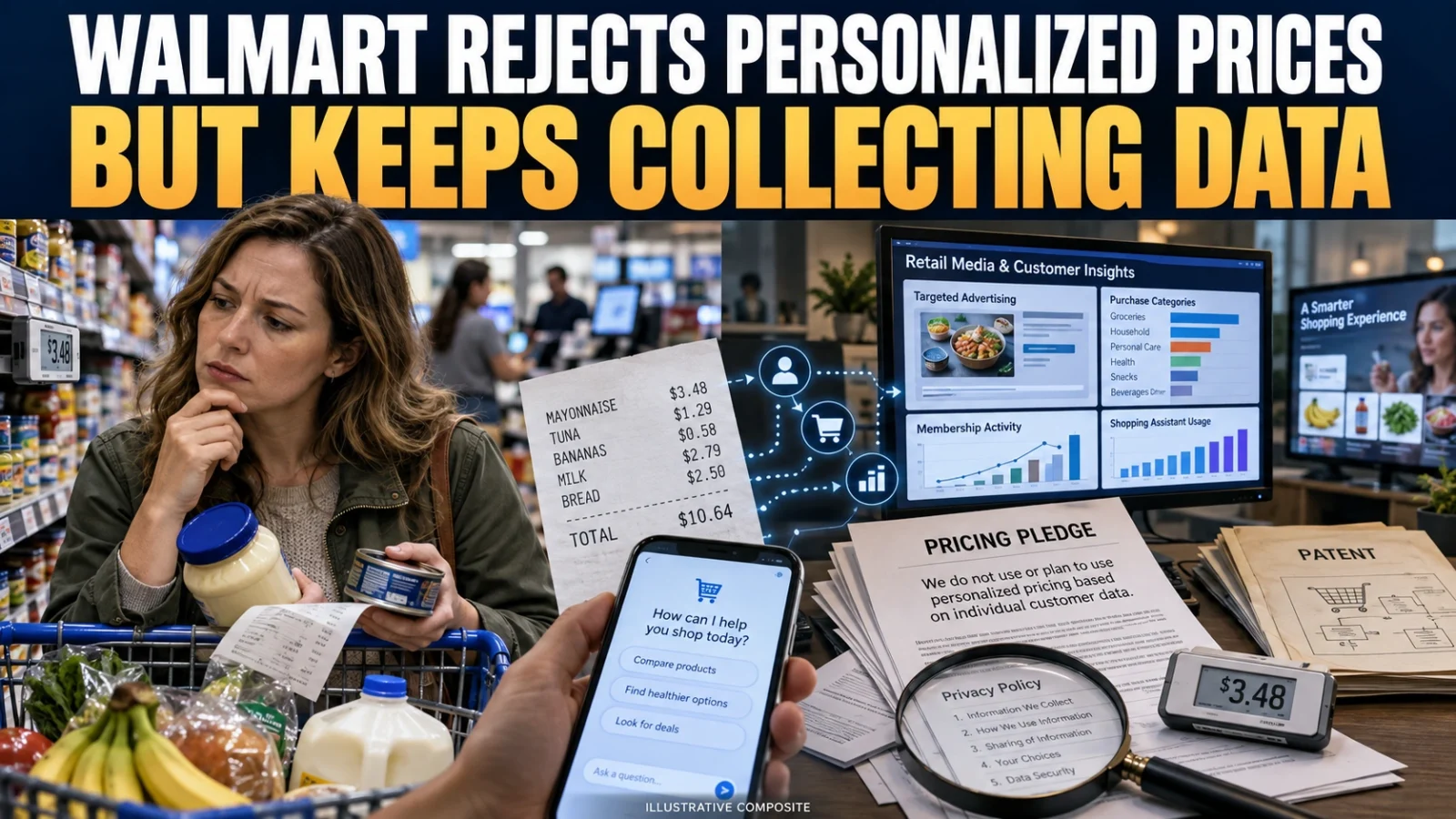
On September 25, 2026, Walmart CEO John Furner published promising that the nation’s largest retailer will not use a shopper’s income, purchase history or “moment of need” to charge them more, in stores or through Sparky, its AI shopping assistant. “We price the product, not the person,” he wrote. The letter landed the same day the Federal Trade Commission closed public comments on a proposal to police so-called surveillance pricing, according to .
The timing is the story. Walmart is rolling digital shelf labels into thousands of stores, pushing Sparky to more customers, and holds patents for systems that change prices based on forecast demand. Regulators, state lawmakers and at least one city have moved against individualized pricing in the past year. A pledge from the company that is both the country’s largest retailer and its largest private employer sets a floor for the whole industry.
Who is affected: anyone who buys groceries, and anyone whose shopping data Walmart already holds. The letter rules out one use of that data. It does not say Walmart will collect less of it, and the company’s fastest-growing businesses, advertising and membership, run on exactly the information the pledge describes.
What the letter says, and what it does not
Furner’s letter makes three commitments. Walmart will not set different prices based on who a customer is or the time of day; its shopping tools, including Sparky, will not use what customers share to raise prices or hide cheaper options; and customers decide what extra information they give the assistant. He added that employees will keep overseeing pricing and the company will “monitor and test our technology against these commitments.”
The letter is careful about scope. Prices can still change, Furner wrote, when an item costs more to buy or transport, and those changes apply to everyone. That is the distinction between dynamic pricing, which moves a price for all shoppers, and personalized pricing, which moves it for one. The letter forbids the second and leaves the first intact.
Two things are absent. There is no commitment to collect less data, and no outside audit. Furner’s third promise is to use information “responsibly” and to be clear about how it is used, which is a description of Walmart’s existing privacy policy, not a new limit. The commitments are also voluntary; nothing in the letter binds Walmart if it changes course, though a public pledge of this kind can be enforceable under the FTC’s deception authority if the company later acts against it.
How a quiet practice became a political problem
In July 2024 the FTC ordered eight pricing-technology firms, including Mastercard, Accenture, PROS, Bloomreach, Revionics and McKinsey, to explain how they help retailers set prices. The agency’s said these intermediaries worked with at least 250 clients, from grocers to apparel chains, and could draw on precise location, browsing history, items left in a cart and even mouse movements on a page. The FTC called the findings preliminary; the report used hypothetical examples to protect trade secrets and did not name which retailers used which tactics.
Under Chairman Andrew Ferguson, the commission shifted from study to enforcement. On August 19, 2026, it voted 2-0 to propose an saying that where shoppers reasonably expect one price for everyone, a business that personalizes prices without clearly disclosing the fact, the basis and the data used is likely violating Section 5 of the FTC Act. Ferguson said the agency cannot ban the practice outright. Comments closed September 25, the day Furner’s letter went up.
Cities moved faster. On September 22, Seattle’s council voted 7-2 to bar large grocers and delivery services from setting individualized prices based on personal data, the first such city law in the country, after a push by the grocery workers’ union UFCW Local 3000, according to the . Consumer Reports, which backed the measure, cited a test in which the same Safeway basket in Seattle ranged from $114.34 to $123.93 depending on the account, a difference of $9.59 for the same food. The ordinance takes effect September 1, 2027.
The data Walmart keeps collecting
The pledge rules out one use of shopper data. The same data powers the parts of Walmart that are growing fastest. In its , reported August 20, global advertising revenue rose 38 percent, with Walmart Connect, the retail-media arm that sells targeted ads based on what customers buy, up 43 percent. Membership fee revenue grew 17 percent, and Walmart+ posted record second-quarter sign-ups. Chief Financial Officer John David Rainey has said close to half of profit growth now comes from areas like membership, advertising and marketplace.
Sparky is a data engine in its own right. On the same earnings call, Furner said the number of customers using the assistant was up 70 percent from a year earlier, and that Sparky users spend 40 percent more per order than those who don’t. The 2024 purchase of TV maker Vizio adds another channel: Walmart U.S. CEO David Guggina told a Goldman Sachs conference this month that Sparky could one day “come to life on your TV,” helping people shop and navigate apps, Retail Dive reported.
Then there are the patents. Walmart was granted one in 2023 for remotely controlling electronic shelf labels that, by its own text, could change prices “in a dynamic manner,” with an example of offering a different mayonnaise price to a customer who already has tuna in their cart, according to the advocacy group Groundwork Collaborative. Two more patents this year cover automated online markdowns and machine-learning demand forecasting. Walmart has said the markdown patent is unrelated to dynamic pricing, that patents protect ideas rather than describe plans, and that shelf labels collect no customer information. Walmart did not answer Retail Dive’s question about why it would patent cart-based pricing it says it will not use. Groundwork’s Lindsay Owens called on the company to withdraw the filings; that is an advocacy position, and a patent is not evidence of deployment.
Key dates
| Date | Event |
|---|---|
| July 2024 | FTC orders eight pricing-technology firms to disclose surveillance pricing practices |
| January 17, 2025 | FTC interim findings: intermediaries serve 250+ clients using location, browsing and cart data |
| July 8, 2025 | New York’s Algorithmic Pricing Disclosure Act takes effect, first state law of its kind |
| January–March 2026 | Walmart granted patents for automated online markdowns and ML demand forecasting |
| August 19, 2026 | FTC proposes enforcement policy on personalized pricing; comment deadline later set at Sept. 25 |
| August 20, 2026 | Walmart Q2 results: ad revenue up 38%, Sparky users up 70% |
| September 22, 2026 | Seattle council passes first city ban on grocery surveillance pricing (effective Sept. 1, 2027) |
| September 25, 2026 | Furner letter published; FTC comment period closes |
| October 1, 2026 | Maryland’s Protection From Predatory Pricing Act takes effect |
| End of 2026 | Walmart’s target for digital shelf labels in all 4,600-plus U.S. stores |
What this means for shoppers and workers
For the family doing a weekly grocery run, the practical effect of the letter is that the sticker price and the checkout price should be the same for everyone in the store, and the price Sparky shows should not depend on what Sparky knows about you. That is a meaningful line. The Seattle test cited by Consumer Reports shows the alternative is not hypothetical: nearly $10 of variation on one basket at a competitor’s store.
What the letter does not change is the trade behind the counter. Every Walmart+ membership, Sparky conversation and Vizio screen feeds a profile that Walmart sells access to through advertising. Shoppers are not being charged more for the mayonnaise; they are being sold to the mayonnaise maker. The pledge is a promise about the price tag, not about the dossier.
For store workers, digital shelf labels cut hours of tag-changing and reduce checkout disputes, which Furner cited as the reason for the rollout. Unions see the same screens differently. UFCW has backed bans on surveillance pricing and, in some states, on electronic shelf labels themselves, arguing that workers end up explaining algorithmic prices they did not set to customers who cannot see why they changed. Both can be true: the labels are a labor-saver today and a pricing instrument in waiting.
A patchwork of rules, and a pledge that fills the gap
There is no federal ban on personalized pricing. The FTC’s proposed policy requires disclosure, not abstention, and Ferguson has said Congress has not given the agency power to prohibit the practice. Two federal bills that would ban it, the One Fair Price Act and the Stop AI Price Gouging and Wage Fixing Act, have not advanced, according to a Paul, Weiss summary.
States have moved in different directions. New York requires a notice reading “THIS PRICE WAS SET BY AN ALGORITHM USING YOUR PERSONAL DATA” and has a broader ban awaiting the governor’s signature. Maryland, Connecticut and New Jersey enacted bans covering groceries and other sectors in 2026, with Maryland’s taking effect October 1, according to a . California’s attorney general opened an investigative sweep in January under the state’s privacy law. More than 40 bills were pending in two dozen states as of summer, Holland & Knight counted.
In that environment, a voluntary corporate pledge does real work for the company making it. It sets the terms of the debate on Walmart’s ground, distinguishing “personalized” from “dynamic” pricing, before legislatures do. IBM’s Elaine Parr argued in a commentary cited by BigGo Finance that the letter conflates the two and that the real safeguards lie in the data, the model and the rules governing them, not the shelf label. That is an analyst’s view, not a finding; it is also the question regulators will ask next.
What happens next
The FTC will review the comments it received through September 25 before finalizing its enforcement policy; it has not set a date. The House Oversight Committee, which opened its own inquiry in March, asked the agency for a briefing on enforcement plans. New York’s governor must decide whether to sign the One Fair Price Act, which would turn the state’s disclosure rule into a ban.
Walmart’s digital shelf labels are due in every U.S. store by year-end, and the company says Sparky will keep expanding, including onto Vizio TVs. Furner’s letter commits Walmart to “monitor and test” its systems against the pledge; it does not say who outside the company will see the results. For now, the test of the promise is whether the shelf price, the app price and the checkout price match for every shopper in every store.
Editorial note: The claim that Walmart’s pledge serves a data strategy is this publication’s analysis of public financial disclosures and the letter’s text, not an allegation of wrongdoing. Walmart has denied using or planning to use personalized pricing, says its patents are not evidence of intent, and says its shelf labels collect no customer data. The Safeway and Kroger findings cited by Consumer Reports concern other retailers, not Walmart.
Sources
Walmart, “A Letter From Our CEO,” September 25, 2026 — https://corporate.walmart.com/about/everyday-affordability/letter-from-our-ceo
Walmart Inc., Q2 FY2027 earnings release (SEC Form 8-K), August 20, 2026 — https://www.sec.gov/Archives/edgar/data/104169/000010416926000145/earningsreleasefy27q2.htm
Retail Dive via Yahoo Finance, “Walmart CEO addresses dynamic pricing concerns” — https://finance.yahoo.com/technology/articles/walmart-ceo-addresses-dynamic-pricing-161200476.html
TheStreet via Yahoo Finance, “Walmart CEO debunks major rumor that had customers worried” — https://finance.yahoo.com/markets/stocks/articles/walmart-ceo-debunks-major-rumor-191300377.html
Fortune via Yahoo Finance, “Walmart’s new pricing patents spark fears of surveillance” — https://finance.yahoo.com/media-advertising/articles/walmart-pricing-patents-spark-fears-161239305.html
TechSpot, “Walmart secures two AI pricing patents, raising dynamic pricing concerns” — https://www.techspot.com/news/111752-walmart-secures-two-ai-pricing-patents-raising-dynamic.html
Inc., “Walmart Embraces New Digital Shelf Labels, Not Dynamic Pricing” — https://www.inc.com/kevin-haynes/walmart-embraces-new-digital-shelf-labels-not-dynamic-pricing-we-wont-do-it-ceo-vows/91410956
FTC, “FTC Seeks Comment on Enforcement Policy Statement Regarding Personalized Pricing,” August 19, 2026 — https://www.ftc.gov/news-events/news/press-releases/2026/08/ftc-seeks-comment-enforcement-policy-statement-regarding-personalized-pricing
FTC, comment period extension, September 3, 2026 — https://www.ftc.gov/news-events/news/press-releases/2026/09/ftc-extends-public-comment-proposed-policy-statement-regarding-personalized-pricing
FTC, “Surveillance Pricing Study Indicates Wide Range of Personal Data Used,” January 17, 2025 — https://www.ftc.gov/news-events/news/press-releases/2025/01/ftc-surveillance-pricing-study-indicates-wide-range-personal-data-used-set-individualized-consumer
House Oversight Committee letter to FTC Chairman Ferguson, September 9, 2026 — https://oversight.house.gov/wp-content/uploads/2026/09/Letter-to-FTC-Ferguson_9.9.2026.pdf
NW Labor Press, “Seattle to ban ‘surveillance pricing’ of groceries” — https://nwlaborpress.org/2026/10/seattle-to-ban-surveillance-pricing-of-groceries
TheBlaze, Seattle vote and Consumer Reports Safeway test — https://theblaze.com/tech/seattle-votes-to-ban-grocery-surveillance-pricing-your-data-shouldn-t-set-your-food-bill
Holland & Knight, “Surveillance Pricing and Dynamic Pricing: What General Counsels Need to Know” — https://www.hklaw.com/en/insights/publications/2026/08/surveillance-pricing-and-dynamic-pricing-what-general-counsels
Paul, Weiss, “Surveillance Pricing and Algorithmic Pricing — U.S. Regulatory Developments” — https://www.paulweiss.com/insights/client-memos/surveillance-pricing-and-algorithmic-pricing-us-regulatory-developments-and-enforcement-actions
AI Laws by State, surveillance pricing tracker — https://www.ailawsbystate.com/tools/surveillance-pricing-tracker
Skadden, “New York Algorithmic Pricing Law Enacted” — https://www.skadden.com/insights/publications/2026/01/new-york-algorithmic-pricing-law
BigGo Finance, “Walmart CEO Vows Never to Use Personal Data to Set Individual Prices” (IBM commentary) — https://finance.biggo.com/news/d865a69a-d727-4d19-beae-cf75ba07879e
Fox Business, “Walmart vows not to use customer data for personalized pricing” — https://www.foxbusiness.com/retail/walmart-vows-not-use-customer-data-personalized-pricing-we-wont-do-it


Leave a Reply